

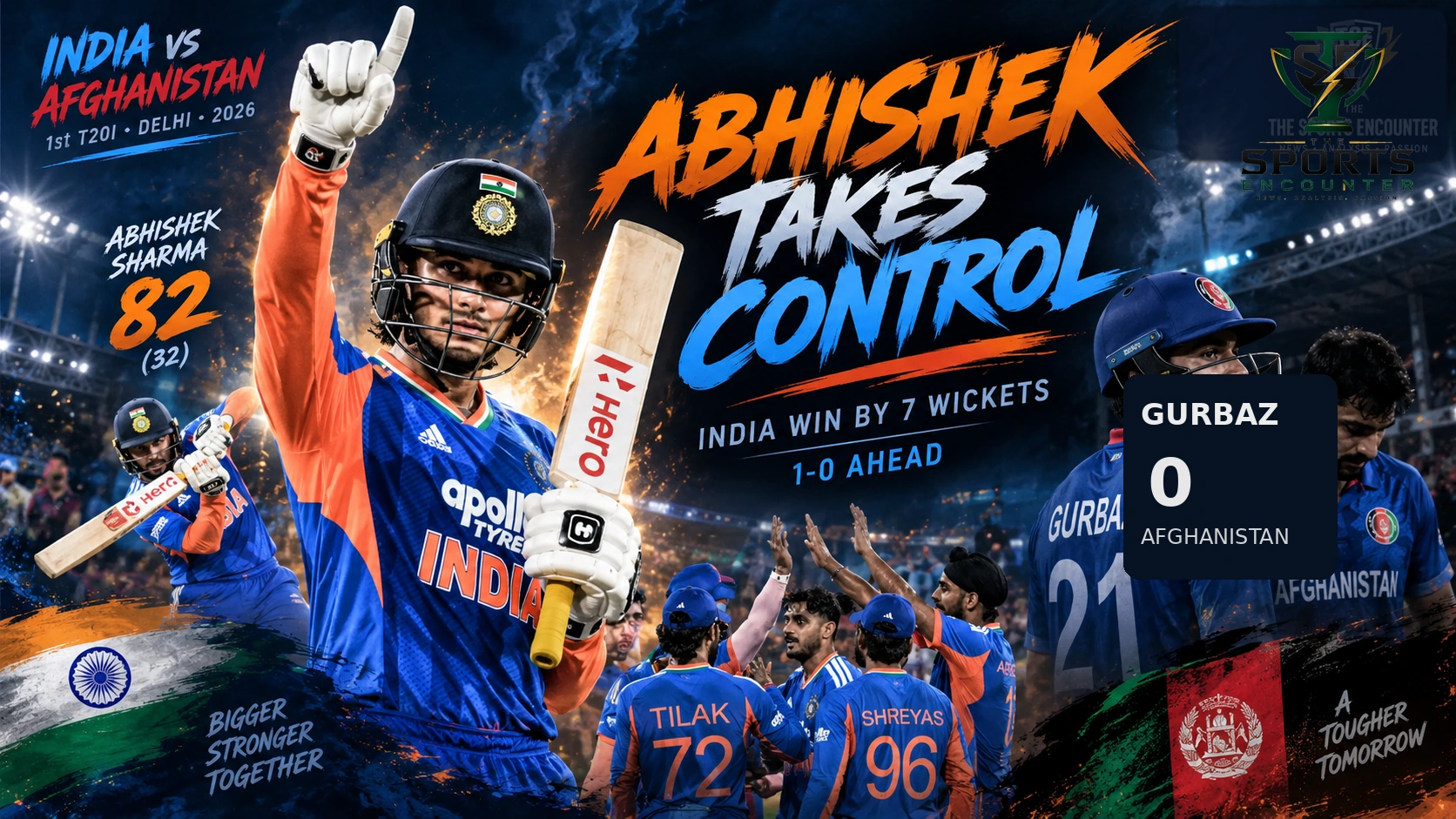
NEW DELHI, India, September 14, 2026: Afghanistan spent nearly 13 overs repairing the damage India caused in seven.
Abhishek Sharma needed barely half that time to destroy the repair work.
India opened the three-match T20I series with a seven-wicket victory at the Arun Jaitley Stadium after chasing 157 in only 13.4 overs, with Abhishek smashing 82 from 32 balls in an innings that removed any realistic possibility of a competitive finish.
Afghanistan had recovered impressively from 43 for five to reach 156 for eight, largely through Azmatullah Omarzai’s unbeaten 64 and Mohammad Nabi’s 33. That recovery gave the scorecard some respectability.
Story at a glance
Bumrah Broke Afghanistan Before the Match Had a Shape
Jasprit Bumrah needed two deliveries to remind Afghanistan what facing India’s best fast bowler can feel like.
Ishan Kishan’s Run-Out Was the First Major Turning Point
Ibrahim called Kishan’s run-out the turning point afterward, and the score supports his assessment.
Arshdeep and Varun Made Sure Bumrah’s Start Was Not Wasted
Bumrah created the first disruption.
Azmatullah Omarzai Saved Afghanistan From a Much Smaller Total
Afghanistan were 43 for five when Azmatullah Omarzai found himself carrying almost the entire middle-order recovery.
India’s Fifth and Sixth Bowling Options Were the One Clear Weakness
Nitish Kumar Reddy bowled two overs for 30 runs.
It did not give their bowlers enough protection.
India reached 82 for one inside the powerplay, crossed 100 in 8.2 overs and completed the chase with 38 deliveries unused. Abhishek struck seven fours and seven sixes at a strike rate of 256.25, while Ishan Kishan supplied the stabilizing support with 42 from 33 balls.
The result gives India a 1-0 lead in a three-match series that the BCCI confirms will remain entirely in Delhi, with the second and third T20Is scheduled for September 15 and 17.
India vs Afghanistan 1st T20I Match Summary
| Detail | Information |
|---|---|
| Match | India vs Afghanistan, 1st T20I |
| Venue | Arun Jaitley Stadium, Delhi |
| Date | September 13, 2026 |
| Afghanistan | 156/8 in 20 overs |
| India | 157/3 in 13.4 overs |
| Result | India won by seven wickets with 38 balls remaining |
| Player of the Match | Abhishek Sharma, 82 off 32 balls |
| Series Position | India lead 1-0 |
Bumrah Broke Afghanistan Before the Match Had a Shape
Jasprit Bumrah needed two deliveries to remind Afghanistan what facing India’s best fast bowler can feel like.
Rahmanullah Gurbaz fell for a duck, caught by Abhishek Sharma, and Afghanistan were immediately forced away from the aggressive opening plan they would have preferred.
The early wicket mattered because Gurbaz is one of the few Afghanistan batters capable of forcing the tempo against elite pace before the spinners enter.
Without him, Ibrahim Zadran and Sediqullah Atal had to rebuild.
They briefly did.
The partnership moved Afghanistan to 38 before Ishan Kishan’s fielding intervention changed the innings again.
Ishan Kishan’s Run-Out Was the First Major Turning Point
Ibrahim called Kishan’s run-out the turning point afterward, and the score supports his assessment.
Afghanistan were 38 for one when the captain was run out for 11.
Seven runs later, they were 43 for five.
Arshdeep Singh removed Atal for 13. Axar Patel dismissed Gulbadin Naib for two. Varun Chakravarthy bowled Darwish Rasooli for two.
Afghanistan had lost four wickets for five runs.
The collapse also highlighted one of India’s biggest improvements from the instability seen earlier in the year.
During the England series, India’s T20 structure repeatedly broke down under pressure. The 125-run defeat at Trent Bridge exposed poor decision-making and a fragile top order, while the next match brought another heavy loss as England sealed the series with a nine-wicket victory.
Delhi showed a team operating with far greater clarity.
Arshdeep and Varun Made Sure Bumrah’s Start Was Not Wasted
Bumrah created the first disruption.
Arshdeep Singh produced the best bowling figures.
The left-arm seamer finished with three for 19 from four overs, conceding only 4.75 runs per over. He removed Atal before returning later to dismiss Nabi and Rashid Khan.
Varun was even more economical.
His four overs cost only 16 runs, and he bowled Rasooli during Afghanistan’s worst phase.
Axar Patel conceded 27 from his four overs and removed Gulbadin.
Between Bumrah, Arshdeep, Axar and Varun, India received 16 overs for 88 runs and six wickets.
That control made Afghanistan’s eventual 156 look considerably better than the innings had appeared after seven overs.
Azmatullah Omarzai Saved Afghanistan From a Much Smaller Total
Afghanistan were 43 for five when Azmatullah Omarzai found himself carrying almost the entire middle-order recovery.
He responded with the best innings of the visitors’ night.
Omarzai finished unbeaten on 64 from 44 balls, hitting four fours and four sixes. His strike rate of 145.45 was particularly impressive given the state of the innings when he began rebuilding it.
The key partnership came with Mohammad Nabi.
Together they added 83 runs for the sixth wicket, taking Afghanistan from 43 for five to 126 before Arshdeep bowled Nabi for 33.
The partnership had two functions.
First, it prevented the innings from collapsing completely.
Second, it gave Afghanistan enough of a platform to attack the final overs.
That second phase exposed one of the few areas India will want to examine before the next match.
India’s Fifth and Sixth Bowling Options Were the One Clear Weakness
Nitish Kumar Reddy bowled two overs for 30 runs.
Shivam Dube’s only over cost 21.
Abhishek conceded eight from his single over.
Those four overs therefore cost 59 runs.
The contrast with India’s main attack was significant.
Shreyas Iyer later explained that using Dube at the end was not ideal because the all-rounder had not had an opportunity to read the surface earlier in the innings.
The captain’s explanation is reasonable.
The larger selection question remains relevant.
If India want Nitish and Dube to provide genuine overs rather than emergency coverage, those roles need to become more clearly defined.
India’s recent T20I history contains several examples of balance becoming a problem when specialist plans break down. The England series offered one such warning when Jacob Bethell dismantled India’s death-over control at Old Trafford.
Against Afghanistan, the margin of victory meant the weakness never became dangerous.
Against stronger batting units, it could.
Afghanistan Reached 156 but the Powerplay Had Already Cost Them Too Much
Afghanistan finished with a run rate of 7.80.
That number hides how dramatically the innings changed.
They scored 41 for four in the powerplay and were 56 for five after 10 overs.
Omarzai and Nabi then rebuilt sufficiently to push the total beyond 150.
Mujeeb Ur Rahman added nine from three balls at the finish, while 21 extras also helped Afghanistan’s total.
The visitors therefore recovered from a position where 120 looked possible to a score that might have been competitive with a strong powerplay from their bowlers.
India never gave them one.
Sanju Samson Fell Early and Afghanistan Still Gained Nothing
Azmatullah removed Sanju Samson for 10 in the third over.
Under normal circumstances, an early wicket in a chase of 157 creates a chance to compress the scoring rate and bring Rashid Khan and Mohammad Nabi into the game.
Abhishek treated the dismissal as background noise.
The left-hander immediately continued attacking.
India’s fifty arrived from only 26 deliveries.
The hundred came from 50.
By the end of the powerplay, India were 82 for one.
Afghanistan’s total had effectively stopped being a target and become a countdown.
Abhishek Sharma Produced the Innings India Have Been Waiting For
Abhishek’s 82 contained almost no settling period.
He reached fifty from 22 balls with six fours and three sixes.
By the time he was dismissed at the end of the 11th over, he had added four more sixes and another four.
His final strike rate was 256.25.
The importance of the innings extends beyond one comfortable chase.
India have been trying to establish an aggressive top-order identity for much of 2026. The approach has occasionally produced spectacular starts, but it has also produced collapses when aggression became disconnected from shot selection.
That problem was obvious during the England tour. Abhishek made only 10 during India’s Trent Bridge collapse and 16 in Bristol as England completed a ruthless series victory.
Delhi was different.
His aggression had shape.
He punished width, attacked anything in his hitting zones and never allowed Afghanistan’s spinners to settle into defensive fields.
That is the version of Abhishek India need.
Ishan Kishan Played the Perfect Supporting Role
Kishan’s 42 from 33 balls will disappear behind Abhishek’s 82, but it was exactly the innings the chase required.
He hit five fours and one six while allowing Abhishek to take the larger risks.
The pair added 121 for the second wicket.
Their partnership reached 50 from only 17 balls and 100 from 43.
Kishan’s willingness to play second fiddle gave the innings balance.
That role also continues an encouraging run for him after a difficult period earlier in the summer.
He contributed 49 against England at Old Trafford in India’s second T20I defeat and later made 35 during India’s seven-wicket win over Zimbabwe.
Against Afghanistan, he looked calm enough to let the match come to him.
Rashid Khan Could Not Stop the Chase
Rashid Khan’s presence normally gives Afghanistan a route back into almost any T20 contest.
India never allowed that route to open.
Rashid bowled 3.4 overs for 34 runs without taking a wicket.
Noor Ahmad conceded 25 from two.
Fazalhaq Farooqi’s two overs disappeared for 38.
Mujeeb was the only Afghanistan bowler to concede fewer than nine an over, finishing with 0 for 16 from two overs.
Mohammad Nabi took the wickets of both Abhishek and Kishan, but by then India were already 139 for two.
The damage was complete.
Afghanistan’s Stronger Recent Results Could Not Protect Them From India’s Powerplay
Afghanistan arrived in this series with genuine confidence in their broader international progress.
Only weeks earlier, Rashid Khan had helped secure direct qualification for the 2027 ODI World Cup, a campaign examined in The Sports Encounter’s report on Afghanistan’s decisive win over Ireland.
The Afghanistan Cricket Board also entered this series with Ibrahim confirmed as full-time T20I captain and a squad containing several established match-winners, including Gurbaz, Nabi, Rashid, Noor, Mujeeb and Fazalhaq Farooqi.
The official ACB squad announcement framed the tour as an important first assignment for Ibrahim’s permanent captaincy.
Delhi showed how quickly that quality can become irrelevant when India dominate the first six overs of both innings.
India’s Improvement Looks More Important Because of Where They Came From
This victory should not be treated as proof that India’s T20I problems have disappeared.
The context is still encouraging.
India’s summer began with major setbacks.
Ireland recorded a historic first T20I victory over India in Belfast, covered in TSE’s report on that 34-run upset.
England then exposed India repeatedly, including the 125-run defeat at Trent Bridge and the nine-wicket loss at Bristol.
The response began during the Zimbabwe series when younger players helped India rediscover momentum. Vaibhav Sooryavanshi’s 19-ball fifty in Harare offered one glimpse of the aggressive model India wanted.
Abhishek’s Delhi innings was a much stronger version of the same idea.
Complete Afghanistan Scorecard
| Batter | Dismissal | R | B | 4s | 6s | SR |
|---|---|---|---|---|---|---|
| Rahmanullah Gurbaz | c Abhishek Sharma b Bumrah | 0 | 2 | 0 | 0 | 0.00 |
| Ibrahim Zadran | run out (Ishan Kishan/Axar Patel) | 11 | 10 | 2 | 0 | 110.00 |
| Sediqullah Atal | c Bumrah b Arshdeep Singh | 13 | 13 | 1 | 1 | 100.00 |
| Gulbadin Naib | c Nitish Kumar Reddy b Axar Patel | 2 | 6 | 0 | 0 | 33.33 |
| Darwish Rasooli | b Varun Chakravarthy | 2 | 6 | 0 | 0 | 33.33 |
| Azmatullah Omarzai | not out | 64 | 44 | 4 | 4 | 145.45 |
| Mohammad Nabi | b Arshdeep Singh | 33 | 27 | 2 | 2 | 122.22 |
| Rashid Khan | c Axar Patel b Arshdeep Singh | 1 | 10 | 0 | 0 | 10.00 |
| Noor Ahmad | run out (Shreyas Iyer) | 0 | 1 | 0 | 0 | 0.00 |
| Mujeeb Ur Rahman | not out | 9 | 3 | 2 | 0 | 300.00 |
| Extras | 21 | |||||
| Total | 156/8 in 20 overs | |||||
India Bowling
| Bowler | Overs | Runs | Wickets | Economy |
|---|---|---|---|---|
| Jasprit Bumrah | 4 | 26 | 1 | 6.50 |
| Arshdeep Singh | 4 | 19 | 3 | 4.75 |
| Axar Patel | 4 | 27 | 1 | 6.75 |
| Varun Chakravarthy | 4 | 16 | 1 | 4.00 |
| Nitish Kumar Reddy | 2 | 30 | 0 | 15.00 |
| Abhishek Sharma | 1 | 8 | 0 | 8.00 |
| Shivam Dube | 1 | 21 | 0 | 21.00 |
Fall of wickets: 5/1, 38/2, 39/3, 41/4, 43/5, 126/6, 131/7, 131/8.
Complete India Scorecard
| Batter | Dismissal | R | B | 4s | 6s | SR |
|---|---|---|---|---|---|---|
| Sanju Samson | c Darwish Rasooli b Azmatullah Omarzai | 10 | 8 | 2 | 0 | 125.00 |
| Abhishek Sharma | c Rashid Khan b Mohammad Nabi | 82 | 32 | 7 | 7 | 256.25 |
| Ishan Kishan | c Rashid Khan b Mohammad Nabi | 42 | 33 | 5 | 1 | 127.27 |
| Shreyas Iyer | not out | 8 | 5 | 1 | 0 | 160.00 |
| Tilak Varma | not out | 3 | 4 | 0 | 0 | 75.00 |
| Extras | 12 | |||||
| Total | 157/3 in 13.4 overs | |||||
Afghanistan Bowling
| Bowler | Overs | Runs | Wickets | Economy |
|---|---|---|---|---|
| Fazalhaq Farooqi | 2 | 38 | 0 | 19.00 |
| Mujeeb Ur Rahman | 2 | 16 | 0 | 8.00 |
| Azmatullah Omarzai | 1 | 14 | 1 | 14.00 |
| Mohammad Nabi | 3 | 28 | 2 | 9.33 |
| Rashid Khan | 3.4 | 34 | 0 | 9.27 |
| Noor Ahmad | 2 | 25 | 0 | 12.50 |
Fall of wickets: 18/1, 139/2, 152/3.
What Afghanistan Need to Change Before the Second T20I
The problem is not difficult to identify.
Afghanistan cannot afford another powerplay in which the top order disappears before Rashid, Noor and Mujeeb have a meaningful total to defend.
Omarzai and Nabi showed there are runs available once a partnership survives the early movement and India’s fielding pressure.
The next challenge is making sure they are rebuilding from 80 for three rather than 43 for five.
Gurbaz’s role becomes particularly important.
Ibrahim expects him to respond, and Afghanistan need that response quickly because Bumrah, Arshdeep and Varun will again attack wickets rather than simply contain.
What India Should Still Fix
A seven-wicket win in 13.4 overs leaves little room for complaint.
There is still useful work to do.
India conceded 59 runs from the four overs delivered by Nitish, Dube and Abhishek.
The frontline bowlers cannot be expected to provide every difficult over across an entire series.
There is also value in remembering how quickly confidence disappeared during previous T20I campaigns. India looked similarly capable with the bat at times against England before individual bad phases became full collapses.
The ODI side later rediscovered greater control, including Axar Patel’s all-round performance in India’s first ODI victory over England, but even that series eventually exposed middle-order weaknesses in the Cardiff defeat and the Lord’s decider.
Delhi should therefore be treated as evidence of progress, not proof that every issue has disappeared.
TSE Verdict
India’s first victory of the series was built on two bursts that Afghanistan could not absorb.
The first reduced the visitors to 43 for five.
The second carried India to 82 for one after six overs.
Everything between those moments belonged to Afghanistan’s recovery.
Omarzai and Nabi turned a collapse into 156. Arshdeep and Varun prevented that recovery from becoming something larger. Then Abhishek made the total irrelevant.
His innings was the clearest difference between aggressive batting and reckless batting.
India have produced plenty of the latter in 2026.
Delhi delivered the former.
One match cannot define a short three-game series, but Afghanistan now know exactly what has to change before September 15.
They need to survive India’s first attack with the ball.
Then they need to find a way to survive Abhishek’s first attack with the bat.
Continue the Cricket Story



Frequently Asked Questions
Who won the first India vs Afghanistan T20I in 2026?
India won by seven wickets after chasing Afghanistan’s 156 for eight in 13.4 overs.
Who was Player of the Match?
Abhishek Sharma was named Player of the Match after scoring 82 from 32 balls.
How many sixes did Abhishek Sharma hit?
Abhishek hit seven sixes and seven fours during his 32-ball innings.
Who scored the most runs for Afghanistan?
Azmatullah Omarzai top-scored with an unbeaten 64 from 44 balls.
Who took the most wickets for India?
Arshdeep Singh took three wickets for 19 runs from four overs.
When is the second India vs Afghanistan T20I?
The second T20I is scheduled for September 15, 2026, at the Arun Jaitley Stadium in Delhi.
Who captains India in the series?
Shreyas Iyer is captaining India in the three-match T20I series. The official BCCI squad announcement confirmed Iyer as captain.
Who captains Afghanistan?
Ibrahim Zadran is Afghanistan’s captain and is beginning his tenure as the country’s full-time T20I leader.
The Sports Encounter’s cricket coverage follows international series through match reports, tactical analysis, player performances, selection debates and the moments that change games beyond the final score.