Curtis Breaks World Record as Popovici, Sjöström, Walshe, and Liebmann Strike Gold on Day 3 of Paris 2026
Sara Curtis shattered the women’s 50m backstroke world record as Popovici survived a 100m thriller, Sjöström returned with gold and Walshe led a memorable Irish night in Paris.
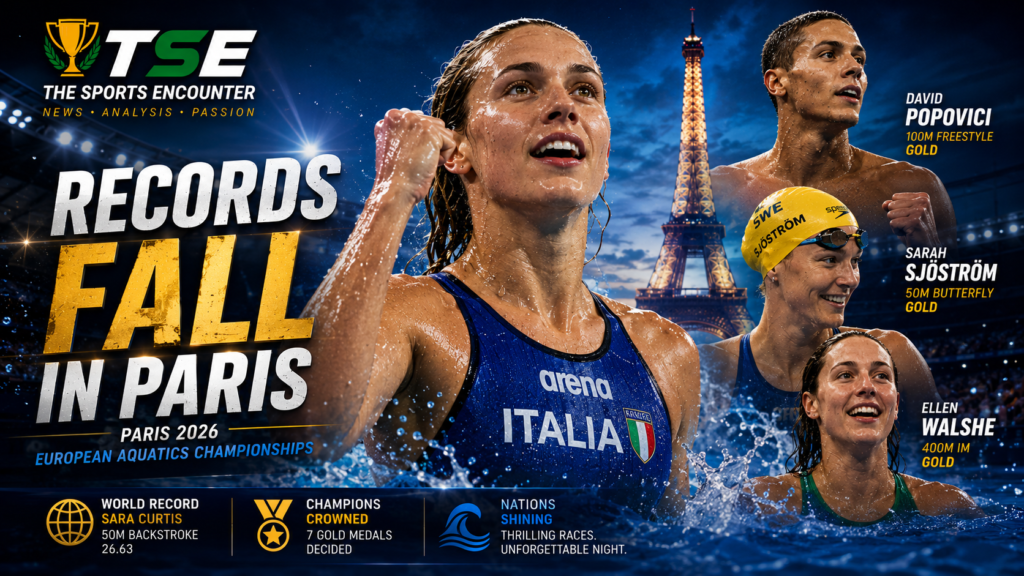
Paris produced the kind of swimming session that refuses to settle around one headline. Sara Curtis broke the women’s 50m backstroke world record before even reaching the final, David Popovici survived a spectacular 100m freestyle challenge, Sarah Sjöström returned to the top of a European podium after becoming a mother, Johannes Liebmann lowered his own European record, and Ellen Walshe delivered Ireland a dramatic 400m individual medley gold.
Day 3 of swimming at the 2026 European Aquatics Championships turned the Olympic Aquatic Centre into a record-breaking stage on Wednesday, August 12.
Seven titles were decided.
Some champions controlled their races. Others had to find something in the final meters.
The most extraordinary performance did not even come in a final.
Italy’s 19-year-old Sara Curtis blasted 26.63 seconds in the women’s 50m backstroke semifinals, breaking the world record before returning later in the evening to help Italy win silver in the women’s 4x100m freestyle relay.
Romania’s Popovici needed almost every centimeter of the pool to secure his third consecutive European 100m freestyle crown. Sweden’s Sjöström added another chapter to one of European swimming’s greatest careers. Germany’s Liebmann moved the continental 800m freestyle standard forward again.
Hungary’s Hubert Kós added European gold to his global backstroke credentials, Britain’s Angharad Evans produced another championship record in the women’s 100m breaststroke, and Walshe gave Ireland one of its biggest moments of Paris 2026.
The Netherlands then closed the evening with a championship record in the women’s 4x100m freestyle relay.
Paris 2026 Swimming Day 3 Gold Medalists
| Event | Champion | Nation | Winning Time | Significance |
|---|---|---|---|---|
| Men’s 200m Backstroke | Hubert Kós | Hungary | 1:53.08 | First European title in the event |
| Women’s 50m Butterfly | Sarah Sjöström | Sweden | 25.05 | 18th European gold |
| Men’s 100m Freestyle | David Popovici | Romania | 46.56 CR | Third consecutive European title |
| Women’s 100m Breaststroke | Angharad Evans | Great Britain | 1:04.87 CR | Third championship record across the rounds |
| Women’s 400m Individual Medley | Ellen Walshe | Ireland | 4:34.32 | Late surge earns European gold |
| Men’s 800m Freestyle | Johannes Liebmann | Germany | 7:37.59 ER | European record |
| Women’s 4x100m Freestyle | Netherlands | Netherlands | 3:31.89 CR | Championship record |
Official schedules and complete results are available through European Aquatics.
Sara Curtis Produces the Performance of the Night Before the Finals Are Over
Sara Curtis arrived in Paris as one of Italy’s most exciting young swimmers.
By Wednesday night, she was a world-record holder.
Curtis entered the women’s 50m backstroke semifinals having already established a European record of 27.07 earlier this summer.
She took the event somewhere entirely different in Paris.
The Italian touched in 26.63 seconds.
That erased the previous world record of 26.68 set by Australia’s Kaylee McKeown.
The performance becomes even more striking when placed in context.
Curtis is only 19.
She broke the world record in a semifinal.
The European title itself is still to be decided.
That leaves Thursday’s final with a rare dynamic: Curtis enters as the fastest woman in history rather than simply the fastest qualifier at these championships.
Her night was still not finished.
Curtis later produced a 52.29 relay leg as Italy challenged for the women’s 4x100m freestyle title.
The Netherlands ultimately denied them gold, but Curtis had already transformed the evening.
Popovici Finds the Final Strokes He Needs
David Popovici’s third consecutive European 100m freestyle title looked anything but inevitable with only a few meters remaining.
Egor Kornev attacked the first length aggressively and turned in 22.06, giving him a 0.30-second advantage over the Romanian.
Popovici had work to do.
He gradually reduced the gap through the second 50 meters, but Kornev remained in front deep into the finish.
Then came the decisive strokes.
Popovici touched first in 46.56 seconds.
Kornev finished only 0.18 behind in 46.74.
Hungary’s Kristóf Milák took bronze in 46.87.
| Position | Swimmer | Nation | Time |
|---|---|---|---|
| 1 | David Popovici | Romania | 46.56 CR |
| 2 | Egor Kornev | NAB | 46.74 |
| 3 | Kristóf Milák | Hungary | 46.87 |
Popovici also lowered the championship record he had established in the semifinals by another 0.16 seconds.
The result gives him three straight European titles in the event.
What made this one memorable was the pressure.
Popovici could see the race disappearing.
His response came when the margin for correction had almost vanished.
Sjöström Returns and Immediately Starts Winning Again
Sarah Sjöström’s 50m butterfly victory carried a different kind of significance.
The Swedish great had been absent from championship racing for 20 months.
She became a mother during that period before returning to competition in April.
Paris was therefore testing more than speed.
It was testing whether one of the defining swimmers of her generation could return to a major championship and immediately compete for titles again.
The answer arrived in 25.05 seconds.
Sjöström had already qualified fastest through the heats and semifinals. She improved again in the final, holding off Belgium’s Roos Vanotterdijk.
| Position | Swimmer | Nation | Time |
|---|---|---|---|
| 1 | Sarah Sjöström | Sweden | 25.05 |
| 2 | Roos Vanotterdijk | Belgium | 25.12 |
| 3 | Sara Junevik | Sweden | 25.51 |
The victory brought Sjöström’s collection to 18 European gold medals.
Her comeback therefore moved almost immediately from a story about returning to competition into another story about winning.
Liebmann Breaks His Own European Record
Johannes Liebmann is also 19.
His breakthrough came across 800 meters rather than 50.
The German produced 7:37.59 to win a high-quality men’s 800m freestyle final and lower his own European record.
Germany made the result even stronger when Sven Schwarz took silver in 7:41.16.
Hungary’s Zalan Sarkany completed the podium in 7:41.75.
| Position | Swimmer | Nation | Time |
|---|---|---|---|
| 1 | Johannes Liebmann | Germany | 7:37.59 ER |
| 2 | Sven Schwarz | Germany | 7:41.16 |
| 3 | Zalan Sarkany | Hungary | 7:41.75 |
| 4 | Daniel Wiffen | Ireland | 7:43.30 |
Daniel Wiffen finished fourth in 7:43.30.
For Ireland, that was one of the evening’s few frustrations, especially given Wiffen’s Olympic pedigree.
For Germany, it was an emphatic demonstration of distance depth.
Liebmann had already broken Schwarz’s European record earlier in 2026.
Paris showed he was capable of moving his own standard again under championship pressure.
Ellen Walshe Refuses to Let Amalie Smith Get Away
Ireland’s biggest celebration came in the women’s 400m individual medley.
For much of the decisive closing phase, Great Britain’s 16-year-old Amalie Smith appeared capable of completing a remarkable senior European breakthrough.
Ellen Walshe kept coming.
The Irish swimmer attacked the final freestyle leg and finally moved past Smith inside the last 25 meters.
Walshe touched in 4:34.32.
Smith followed for silver, while Poland’s Justina Kozan claimed bronze in 4:36.47.
The result completed an excellent evening for Ireland after Mona McSharry had already won silver in the women’s 100m breaststroke.
Walshe’s race also demonstrated why the individual medley can produce some of swimming’s best finishes.
A lead built through butterfly, backstroke or breaststroke can disappear quickly when two athletes reach freestyle with very different amounts of energy remaining.
Walshe judged that final transition better.
She still needed the finish of her life to turn it into gold.
Angharad Evans Keeps Getting Faster
Angharad Evans did something unusual during the women’s 100m breaststroke competition.
She kept rewriting the championship record.
Her final performance of 1:04.87 represented the third consecutive championship record of her Paris campaign.
Italy’s Benedetta Pilato reached the turn 0.30 seconds ahead.
Evans remained patient.
Her final 25 meters changed the race completely.
The British swimmer surged clear and secured European gold after winning two Commonwealth titles for Scotland earlier this summer.
Mona McSharry gave Ireland another medal by finishing second in 1:05.41.
Pilato held on for bronze in 1:05.89.
| Position | Swimmer | Nation | Time |
|---|---|---|---|
| 1 | Angharad Evans | Great Britain | 1:04.87 CR |
| 2 | Mona McSharry | Ireland | 1:05.41 |
| 3 | Benedetta Pilato | Italy | 1:05.89 |
Defending champion Eneli Jefimova finished fourth in 1:05.94.
Evans’ progression through the rounds made the result particularly convincing.
She did not simply arrive at one exceptional swim.
She became faster as the championship demanded more.
Hubert Kós Turns Semifinal Speed Into 200m Backstroke Gold
Hubert Kós had already delivered a warning before the men’s 200m backstroke final.
The Hungarian qualified in 1:52.30, setting European and championship records in the semifinal.
That performance put Aaron Peirsol’s long-standing 1:51.92 world record within the wider conversation entering the final.
Kós did not reproduce his semifinal time when the medals were decided.
He did not need to.
The world and Olympic champion controlled the final sufficiently to win in 1:53.08.
Defending European champion Apostolos Siskos took silver in 1:53.81, with Italy’s Thomas Ceccon third in 1:53.96.
| Position | Swimmer | Nation | Time |
|---|---|---|---|
| 1 | Hubert Kós | Hungary | 1:53.08 |
| 2 | Apostolos Siskos | Greece | 1:53.81 |
| 3 | Thomas Ceccon | Italy | 1:53.96 |
It was Kós’ first European title in the 200m backstroke.
The larger point is what happened across the two rounds.
He demonstrated world-record-level ambition in the semifinal and enough control to finish the job in the final.
Netherlands Ends the Night With Another Championship Record
The final title of Day 3 went to the Netherlands.
Italy made the women’s 4x100m freestyle relay competitive, with Curtis contributing her 52.29 split after the emotional high of her world record.
Marrit Steenbergen settled the race.
The Dutch world champion produced a 51.34 anchor leg to carry the Netherlands home in 3:31.89.
That established another championship record.
Italy finished second in 3:33.19, while NAB took bronze in 3:33.69.
| Position | Nation | Time |
|---|---|---|
| 1 | Netherlands | 3:31.89 CR |
| 2 | Italy | 3:33.19 |
| 3 | NAB | 3:33.69 |
Steenbergen’s anchor was another reminder that relay races are often decided by which team can keep its strongest swimmer within striking distance for the final exchange.
The Netherlands did exactly that.
Ireland Leaves Day 3 With Gold, Silver and a Painful Fourth
Few nations experienced as many different emotions Wednesday as Ireland.
Walshe won the 400m individual medley.
McSharry collected silver in the 100m breaststroke.
Wiffen finished fourth in the 800m freestyle.
Those results represent three very different championship experiences.
Walshe produced the late attack required to become European champion.
McSharry added another major international medal to her résumé.
Wiffen found himself on the wrong side of one of swimming’s most unforgiving positions, close enough to the podium to see exactly what was missing.
Collectively, however, Ireland showed significant depth across medley, breaststroke and distance freestyle.
Day 3 Belonged to Different Generations
Perhaps the most interesting feature of Wednesday was the age range of the athletes shaping it.
Curtis is 19.
Liebmann is 19.
Amalie Smith is 16 and came within the closing meters of a European title.
At the other end of the spectrum, Sjöström is 32 and returned from becoming a mother to win another major championship gold.
That creates a compelling picture of European swimming in 2026.
The next generation is already breaking world and continental records.
Some of the defining champions of the previous generation remain fast enough to beat them.
Three Different Records Fell in One Evening
The times also explain why Day 3 deserves more than a standard results recap.
Curtis produced a world record.
Liebmann produced a European record.
Popovici and the Netherlands lowered championship records in their finals.
Evans completed a remarkable sequence of championship records across the women’s 100m breaststroke rounds.
Kós had already broken the European 200m backstroke record in qualifying for his final.
Paris is therefore producing fast swimming across very different disciplines.
There is sprint speed.
There is distance speed.
There is backstroke speed.
The depth of those records matters more than one isolated spectacular swim.
Noe Ponti Responds After His 50m Butterfly Frustration
Wednesday also created important stories for Thursday.
Switzerland’s Noe Ponti had endured a frustrating men’s 50m butterfly final when his goggles became dislodged.
His response in the 100m butterfly semifinals was emphatic.
Ponti qualified fastest in 50.21.
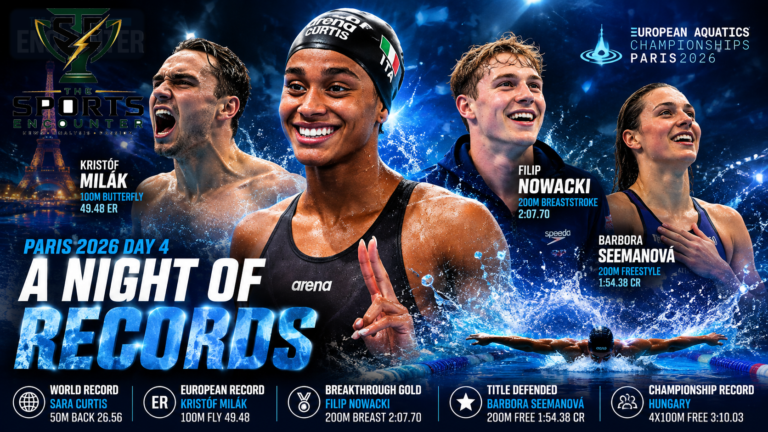
Kristóf Milák followed at 50.50, with France’s Maxime Grousset at 50.78.
That gives Thursday a high-quality final involving three swimmers capable of changing the race in very different ways.
Ponti now has an immediate opportunity to turn one championship disappointment into a title challenge.
Filip Nowacki Leads the 200m Breaststroke Finalists
Great Britain’s Filip Nowacki provided another glimpse of Europe’s younger generation.
The 18-year-old world junior champion qualified fastest for the men’s 200m breaststroke final in 2:08.60.
Austria’s Luka Mladenovic followed in 2:08.85.
The final therefore gives Nowacki an opportunity to translate junior success onto the senior European stage.
After Evans’ victory in the women’s 100m breaststroke, British breaststroke enters Thursday with considerable momentum.
What to Watch on Paris 2026 Swimming Day 4
Thursday’s schedule continues immediately with another strong medal program.
The men’s 100m butterfly final brings Ponti, Milák and Grousset together.
Curtis returns for the women’s 50m backstroke final as the new world-record holder.
The men’s 200m breaststroke final gives Nowacki his first major senior title opportunity.
The women’s 200m freestyle final will add another major test of European middle-distance depth.
The men’s 4x100m freestyle relay closes the evening.
Morning competition also begins new paths toward medals in the men’s 200m freestyle, women’s 100m butterfly, men’s 50m backstroke, women’s 200m breaststroke and women’s 1500m freestyle.
That makes Curtis particularly fascinating.
Breaking the world record created history Wednesday.
Thursday asks her to reset emotionally and win the actual European title.
TSE Verdict: Paris Produced Its First Truly Extraordinary Swimming Night
The opening days established the championship.
Wednesday accelerated it.
A 19-year-old broke a world record.
Another 19-year-old broke a European record.
Popovici needed a furious finish to preserve his European 100m freestyle reign.
Sjöström returned from motherhood and a 20-month championship absence with another gold medal.
Walshe chased down a 16-year-old rising star in the final 25 meters.
Evans kept rewriting the championship record every time the pressure increased.
Kós backed up a European-record semifinal with gold.
Steenbergen closed the evening with a relay anchor worthy of a championship record.
That variety made Day 3 special.
Paris did not give the evening to one swimmer, one nation or one generation.
Established champions survived.
Young swimmers arrived.
Records disappeared.
Several Thursday finals became considerably more interesting because of what happened Wednesday.
And Sara Curtis still has to swim the final of the event in which she has already become the fastest woman in history.
That may be the best measure of how quickly Paris 2026 has come alive.
Frequently Asked Questions
Who broke the world record at Paris 2026 on August 12?
Italy’s Sara Curtis broke the women’s 50m backstroke world record with 26.63 seconds in the semifinals.
Who won the men’s 100m freestyle?
David Popovici won in a championship-record 46.56, narrowly beating Egor Kornev’s 46.74.
How many consecutive European 100m freestyle titles has Popovici won?
Popovici has now won three consecutive European titles in the men’s 100m freestyle.
Who won the women’s 50m butterfly?
Sarah Sjöström won in 25.05 seconds, earning her 18th European gold medal.
Who won the women’s 400m individual medley?
Ireland’s Ellen Walshe won in 4:34.32 after passing Great Britain’s Amalie Smith during the closing stages.
Who won the women’s 100m breaststroke?
Great Britain’s Angharad Evans won in a championship-record 1:04.87, with Ireland’s Mona McSharry taking silver.
Who broke the men’s 800m freestyle European record?
Germany’s Johannes Liebmann lowered his own European record to 7:37.59 while winning gold.
Where did Daniel Wiffen finish?
The Irish Olympic champion finished fourth in the men’s 800m freestyle in 7:43.30.
Who won the men’s 200m backstroke?
Hungary’s Hubert Kós won in 1:53.08 after setting a European record of 1:52.30 in the semifinals.
Who won the women’s 4x100m freestyle relay?
The Netherlands won in a championship-record 3:31.89, ahead of Italy and NAB.
When does swimming at Paris 2026 finish?
The pool swimming program continues through Sunday, August 16.

Breaking News
Lionel Messi Back on Inter Miami Duty Four Days After Father’s Death
Lionel Messi returned to Inter Miami’s matchday squad against Club León only four days after the death of his father, Jorge Messi, while still processing a loss that has made him question his football future.
Lionel Messi has returned to an Inter Miami matchday squad just four days after the death of his father, Jorge Messi, with the Argentine captain named among the substitutes for Wednesday night’s Leagues Cup game against Club León at Nu Stadium.
The 39-year-old had returned to Argentina after his father died in Rosario following a long illness and missed Inter Miami’s 2-1 defeat to Monterrey over the weekend.
His return to the bench against León does not signal a normal football comeback.
It comes during one of the most difficult periods of his life, only hours after Messi publicly described the depth of his grief and admitted that his father’s death had left him questioning how much longer he wants to continue playing.
Inter Miami therefore named Messi among the substitutes rather than asking him to start, while Rodrigo De Paul and Casemiro were included in the midfield for a crucial Leagues Cup Phase One game.
The Sports Encounter has already examined the importance of Jorge Messi’s role in his son’s life and career in our tribute to Lionel Messi’s father and longtime adviser.
Lionel Messi Returns to the Inter Miami Bench
| Match Detail | Information |
|---|---|
| Competition | 2026 Leagues Cup |
| Match | Inter Miami vs Club León |
| Date | August 12, 2026 |
| Venue | Nu Stadium, Miami |
| Messi status | Named among the substitutes |
| Previous match missed | Inter Miami 1-2 Monterrey |
| Reason for absence | Death of his father, Jorge Messi |
| Inter Miami midfield | Rodrigo De Paul, Casemiro, Telasco Segovia, Yannick Bright |
Official squad information, fixtures and club updates are available through Inter Miami CF.
Four Days That Changed the Context Around Messi
Jorge Messi died at the age of 68 in Rosario after a prolonged illness.
For Lionel Messi, the loss was deeply personal and also inseparable from his football life.
Jorge had been present from the earliest stages of his son’s career, supporting the move from Rosario to Barcelona and later acting as an adviser and representative during many of the major decisions that shaped Messi’s professional journey.
Messi has spoken repeatedly over the years about how much his father’s opinion mattered to him.
That relationship gives Wednesday’s return a very different emotional meaning.
He is back with his club.
That does not mean the grief has passed.
Messi Missed the Monterrey Match While Inter Miami Paid Tribute
Inter Miami played Monterrey without Messi on Saturday.
The club honored Jorge Messi with a moment of silence, while players wore black armbands.
Rodrigo De Paul then produced one of the most emotional moments of the night.
After scoring from distance in the first half, De Paul revealed a Messi shirt beneath his own and pointed toward the No. 10 as a tribute to his teammate and friend.
Monterrey eventually came back to win 2-1, leaving Inter Miami under pressure in the Leagues Cup standings.
The gesture mattered more than the result in the moment.
De Paul has shared some of the biggest stages of Messi’s recent career with Argentina, including the 2022 World Cup triumph and the 2026 final.
His tribute showed how strongly the loss was felt inside the dressing room.
Messi’s Own Words Changed the Story Again
Before returning to the matchday squad, Messi published an emotional tribute to his father that extended beyond mourning.
He admitted that Jorge’s death had left him with serious doubts about continuing his football career for much longer.
That statement matters because retirement discussions around Messi had previously been based largely on age, contracts and tournament cycles.
The Sports Encounter recently examined those questions in our analysis of when Lionel Messi might retire.
The context is different now.
Messi’s uncertainty comes from grief rather than a tactical or physical calculation.
He also revealed that his father’s wish had been one of the reasons he pushed himself to play at the 2026 World Cup despite the emotional strain surrounding Jorge’s declining health.
The 2026 World Cup Had Already Carried a Hidden Emotional Weight
Argentina reached another World Cup final this summer before losing 1-0 to Spain after extra time.
Messi scored eight goals and recorded four assists during the tournament, producing another extraordinary campaign at the age of 39.
The Sports Encounter covered the scale of that run in our Argentina vs Spain World Cup final coverage and later included Messi among the defining players of the tournament in the 2026 fan-voted World Cup Dream Team.
What the public did not fully understand during much of the competition was how heavily Messi was carrying his father’s illness.
He later explained that he had been waiting for messages from Jorge after matches and that the World Cup was the first major tournament his father could not attend.
That makes his performances in North America look different in retrospect.
Why a Bench Role Makes Sense
From a football perspective, naming Messi among the substitutes is logical.
He had spent time away from the team and traveled to Argentina under extraordinary emotional circumstances.
Starting him immediately would have asked for much more than simply match fitness.
A bench role gives Inter Miami flexibility.
Messi can remain part of the squad without the expectation of carrying the team from kickoff.
Coach Guillermo Hoyos can decide later whether the match situation and Messi’s own readiness justify using him.
That distinction is important.
Availability and readiness are not always the same thing.
Inter Miami Start De Paul and Casemiro Without Messi
Inter Miami began the game with Rocco Ríos Novo in goal and a midfield featuring Telasco Segovia, Casemiro, Rodrigo De Paul and Yannick Bright.
Lovend’s Delinois and Daniel Pinter started in attack.
That setup gives Miami more defensive structure through Casemiro and greater progression through De Paul while Messi waits on the bench.
The broader Inter Miami squad has changed significantly during 2026, with the arrival of both De Paul and Casemiro giving the club more experience around its older attacking core.
Messi remains the central creative figure when available.
His absence forces others to carry more of the possession and final-third responsibility.
Glad to have you back, Leo. ❤️
— Major League Soccer (@MLS) August 12, 2026
Messi has returned to @InterMiamiCF and is on the bench tonight against Leon in @LeaguesCup. pic.twitter.com/QApKUU2Rmc
The Leagues Cup Stakes Still Matter
Inter Miami entered the Club León game under pressure.
They had opened the tournament with a 4-2 victory over Atlético San Luis, a match in which Messi scored twice and added an assist after returning from the World Cup.
The defeat to Monterrey changed the qualification picture.
Only the leading teams advance to the knockout phase, leaving Miami needing a strong result against a León side that had won its first two matches.
León therefore arrived with greater control over its own qualification path.
Miami entered needing both performance and composure.
That is the football backdrop to Messi’s return.
It should remain the secondary story.
Messi’s Presence Changes the Atmosphere Even From the Bench
There is no need to exaggerate what Messi’s presence means to his teammates.
His importance is already obvious.
He remains the captain, the most accomplished player in the squad and the figure around whom Inter Miami have built much of their identity since his arrival in MLS.
The Sports Encounter explored that wider influence in our feature asking whether Lionel Messi belongs among the greatest athletes in sports history.
Seeing him back with the squad so soon after his father’s death inevitably changes the emotional atmosphere around the group.
That does not mean teammates should expect him to solve the match.
It means he has chosen, for now, to be present.
There Is No Need to Rush the Retirement Question
Messi’s comments about his future will naturally fuel another wave of retirement speculation.
That conversation deserves patience.
He remains contracted to Inter Miami and has not announced his retirement from club or international football.
Earlier this month, Argentine Football Association president Claudio Tapia made clear that the timing of any retirement decision belongs to Messi.
That position feels even more appropriate now.
Messi is processing the death of the person who accompanied virtually every stage of his football life.
Any decision about what comes next should be understood in that context.
A Career Built With His Father Beside Him
Jorge Messi’s influence stretched far beyond contract negotiations.
He was part of the decision to move the family’s football future toward Barcelona when Lionel was still a child.
He remained involved as his son became the defining player of the club’s greatest era.
Later came Paris Saint-Germain, Inter Miami and the final stages of Messi’s Argentina career.
That is why Lionel’s recent statement carried such weight.
Football had always been something he experienced with his father nearby.
Returning to an Inter Miami bench without that connection is a new reality.
The Human Side of Returning to Elite Sport
Athletes are often expected to move quickly between personal grief and professional responsibility.
Sport schedules do not stop.
Fixtures remain on calendars.
Teams still travel.
Qualification scenarios still exist.
The individual experiencing the loss has to decide when returning feels possible.
There is no standard timeline.
For Messi, that timeline has been only a few days.
The fact that he is on the bench should be understood as his decision to rejoin the group, rather than evidence that the emotional process is complete.
TSE Verdict: The Important Part Is That Messi Chose to Be There
Lionel Messi’s return against Club León should be treated carefully.
There will be questions about whether he comes on.
There will be questions about how many minutes he plays.
There will be questions about whether he can help Inter Miami qualify.
Those questions belong to the match.
The larger story belongs somewhere else.
Four days after losing his father, Messi has returned to the Inter Miami squad.
He has done so after publicly admitting that the loss has made him question the future of the career Jorge helped build from the beginning.
That makes Wednesday night unusually significant, regardless of whether Messi ever leaves the bench.
The football world has spent more than two decades watching him score, create, win trophies and rewrite records.
This moment asks for something different from the audience.
Restraint.
Messi has returned to the stadium.
For now, that is enough.
Follow The Sports Encounter’s soccer coverage for Inter Miami, Leagues Cup, international football and Lionel Messi developments.
Frequently Asked Questions
Is Lionel Messi playing against Club León?
Messi was named among Inter Miami’s substitutes for the Leagues Cup match against Club León. He did not start.
Why did Messi miss Inter Miami’s previous match?
Messi returned to Argentina following the death of his father, Jorge Messi, and missed the 2-1 defeat to Monterrey.
How old was Jorge Messi?
Jorge Messi was 68 when he died in Rosario after a long illness.
Did Inter Miami honor Messi’s father?
Yes. The club observed a moment of silence and players wore black armbands during the Monterrey match.
How did Rodrigo De Paul pay tribute?
After scoring against Monterrey, De Paul revealed a Lionel Messi shirt underneath his Inter Miami jersey and pointed toward the No. 10.
Has Lionel Messi announced his retirement?
No. Messi has not announced his retirement, although he has said his father’s death has left him with doubts about how much longer he wants to continue playing.
Who started in Inter Miami’s midfield against Club León?
Rodrigo De Paul, Casemiro, Telasco Segovia and Yannick Bright were included in the starting midfield.
Where was Inter Miami vs Club León played?
The Leagues Cup match was played at Nu Stadium in Miami.
Birmingham 2026
Hudson-Smith Makes History as Records Fall on Day 3 of Birmingham 2026
Matthew Hudson-Smith made European 400m history on home soil as Silja Kosonen, Emma Zapletalová and Jason Joseph won gold and Birmingham 2026 set up a loaded Day 4.
Matthew Hudson-Smith turned Alexander Stadium into his own stage, Silja Kosonen finally converted years of promise into senior European gold, Emma Zapletalová delivered Slovakia a historic title, Jason Joseph closed the night with a Swiss sprint-hurdles triumph, and the women’s 200m field sharpened into one of Birmingham 2026’s most anticipated finals.
Day 3 of the 2026 European Athletics Championships did more than award four gold medals.
It changed the tone of the championship.
The opening two days had already produced British sprint success, major title defenses and standout field performances. Wednesday added something different: deeper historical significance, national breakthroughs and semifinal performances that may ultimately prove as important as some of the finals.
Hudson-Smith became the first man to win three individual European 400m titles. Kosonen claimed the first major senior gold of her career. Zapletalová became the first Slovakian woman to win European Athletics Championship gold. Joseph upgraded his previous continental bronze to victory.
Meanwhile, Mark English ran 1:43.49 to break a championship record that had survived since 1978, Rhasidat Adeleke won her women’s 200m semifinal in 22.43, Amy Hunt qualified fastest in 22.37, and Leo Neugebauer ended the opening day of the decathlon in front despite a difficult final 400m.
For readers catching up from the beginning, The Sports Encounter’s Birmingham 2026 Day 1 wrap-up covered Amy Hunt’s 100m gold, Jakob Ingebrigtsen’s winning return and Norway’s mixed relay triumph, while our Day 2 report followed Romell Glave, Nadia Battocletti, Nadine Visser, Miltiadis Tentoglou and Bence Halász.
Birmingham 2026 Day 3 at a Glance
| Event | Gold Medalist | Winning Mark | Main Story |
|---|---|---|---|
| Women’s Hammer | Silja Kosonen, Finland | 76.28m | First major senior title |
| Men’s 400m | Matthew Hudson-Smith, Great Britain | 44.17 | First man to win three European 400m titles |
| Women’s 400m Hurdles | Emma Zapletalová, Slovakia | 52.91 | First Slovakian woman to win European gold |
| Men’s 110m Hurdles | Jason Joseph, Switzerland | 13.12 | Season-best finish secures first European outdoor title |
Official schedules, results and championship information are available through the European Athletics Birmingham 2026 results center.
Hudson-Smith Turns Lane Nine Into a Homecoming
Matthew Hudson-Smith’s victory was always likely to dominate the evening.
The circumstances made it even bigger.
He started from lane nine, outside the visual reference of almost every rival, on the same Alexander Stadium track where he trained during the early years of his career.
Hudson-Smith attacked the race aggressively, reached 200 meters in 20.86 and 300 meters in 31.80, and then fought through the final straight as Muhammad Abdallah Kounta and Jonas Phijffers closed behind him.
He reached the line in 44.17.
Kounta took silver for France in 44.40, while Phijffers broke the Dutch national record with 44.41 for bronze.
| Position | Athlete | Country | Time |
|---|---|---|---|
| 1 | Matthew Hudson-Smith | Great Britain | 44.17 |
| 2 | Muhammad Abdallah Kounta | France | 44.40 |
| 3 | Jonas Phijffers | Netherlands | 44.41 NR |
The victory gave Hudson-Smith his third individual European 400m title after previous wins in 2018 and 2022.
No man had done that before.
It also took his European Championship medal collection to eight, matching Christophe Lemaitre’s men’s championship record.
The emotional layer came from the venue itself.
A temporary stand at Alexander Stadium bears Hudson-Smith’s name, and the Wolverhampton athlete has spent years racing and training on the track.
The Sports Encounter examined the full significance of that homecoming in our Birmingham 2026 coverage.
Hudson-Smith’s performance also extended Great Britain’s remarkable sprint run after Hunt’s women’s 100m title and Glave’s men’s 100m victory. Our feature on Amy Hunt’s breakthrough gold showed how quickly the home sprint hierarchy began changing on the opening night.
Zapletalová Converts World-Leading Form Into Gold
Emma Zapletalová arrived in Birmingham carrying the kind of season that creates expectations.
She left with the title.
The Slovakian won the women’s 400m hurdles in 52.91, confirming the form that had already made her one of the fastest athletes in the world this year.
Great Britain’s Emily Newnham produced the race of her life behind her.
Newnham finished second in 53.33, a personal best that moved her to second on the British all-time list behind Sally Gunnell.
Portugal’s Fatoumata Binta Diallo completed the podium in a national-record 53.55.
| Position | Athlete | Country | Time |
|---|---|---|---|
| 1 | Emma Zapletalová | Slovakia | 52.91 |
| 2 | Emily Newnham | Great Britain | 53.33 PB |
| 3 | Fatoumata Binta Diallo | Portugal | 53.55 NR |
Zapletalová’s victory carries national significance.
She became the first Slovakian woman to win gold at the European Athletics Championships.
That alone would make the result important.
The manner of the victory added another layer.
She moved decisively into control around the eighth hurdle and maintained enough rhythm through the closing section to prevent Newnham’s strong finish from becoming a genuine challenge for gold.
Newnham’s silver was still one of the most encouraging British performances of the evening.
She had been sixth with two hurdles remaining and used her closing strength to move through the field.
That is the kind of race that can change an athlete’s confidence quickly.
Kosonen Finally Wins the Senior Title Her Career Had Been Building Toward
Silja Kosonen has spent several years collecting evidence that she belonged among Europe’s best hammer throwers.
Wednesday finally produced the senior gold medal.
The 23-year-old Finn threw 76.28m in the second round and never surrendered the lead.
Defending champion Sara Fantini opened with 74.35m and held silver, while Norway’s Beatrice Nedberge Llano produced 72.88m for bronze.
| Position | Athlete | Country | Mark |
|---|---|---|---|
| 1 | Silja Kosonen | Finland | 76.28m |
| 2 | Sara Fantini | Italy | 74.35m |
| 3 | Beatrice Nedberge Llano | Norway | 72.88m |
Kosonen had already won European U20, European U23 and world U20 titles, but senior championship podiums had repeatedly remained just out of reach.
That changed in Birmingham.
The biggest surprise came from the other Finnish favorite.
Krista Tervo entered the championship with a world-leading 77.35m and looked capable of giving Finland two medals.
She struggled badly in the final, recorded only one legal throw at 67.74m and finished 11th.
Anita Włodarczyk, one of the greatest hammer throwers in history, finished fourth with 72.37m.
Ireland’s Nicola Tuthill produced another strong championship result, finishing fifth with 70.33m.
At 22, she was the youngest athlete in the final and improved from ninth at the previous European Championships.
Her performance fits a wider Irish athletics pattern in Birmingham: athletes are increasingly reaching finals and forcing themselves into serious continental conversations.
Jason Joseph Saves His Best Finish for the Final
The men’s 110m hurdles ended the stadium program with one of the night’s cleanest races.
Jason Joseph won in a season-best 13.12, using his trademark closing speed to move clear after the final barrier.
France’s Just Kwaou-Mathey took silver in 13.16, while Poland’s Jakub Szymański claimed bronze in 13.26.
| Position | Athlete | Country | Time |
|---|---|---|---|
| 1 | Jason Joseph | Switzerland | 13.12 SB |
| 2 | Just Kwaou-Mathey | France | 13.16 |
| 3 | Jakub Szymański | Poland | 13.26 |
Joseph had won bronze at the previous European Championships.
Birmingham gave him the upgrade.
His race was built around control.
He avoided the barrier trouble that disrupted several rivals in the semifinals, stayed technically clean and then accelerated through the final meters.
Great Britain’s Sam Bennett had produced a personal-best 13.26 in the semifinal and looked capable of challenging for a medal.
The final did not unfold as smoothly.
Bennett finished seventh in 13.62.
Even so, the semifinal performance moved him to equal eighth on the British all-time list and established him as another developing sprint-hurdles option for the host nation.
Mark English Breaks a Championship Record Older Than Most of the Field
Some of Day 3’s biggest performances did not produce medals.
Mark English delivered the clearest example.
The Irish middle-distance runner won his men’s 800m semifinal in 1:43.49.
That broke the European Championships record of 1:43.84 set by East Germany’s Olaf Beyer in Prague in 1978.
The old mark had survived for 48 years.
English removed it in a semifinal.
That says something about the quality of the current European 800m field.
Ben Pattison finished behind him in 1:43.72, while France’s Corentin le Clézio ran a personal-best 1:43.80.
Max Burgin also progressed from the other semifinal, giving Britain multiple serious options in Thursday’s final.
English now enters that final carrying more than sentimental momentum.
He has a legitimate championship-winning performance already on the board.
His race will also attract Irish attention after a summer in which national athletes have repeatedly produced championship-level breakthroughs.
The Sports Encounter saw similar middle-distance intensity at Glasgow 2026, where Georgia Hunter Bell won the Commonwealth women’s 800m title during one of the strongest athletics nights of those Games.
Adeleke, Hunt and Asher-Smith Set Up Thursday’s 200m Final
The women’s 200m semifinals created the next major sprint storyline.
Amy Hunt qualified fastest in 22.37.
Rhasidat Adeleke won her semifinal in 22.43.
Dina Asher-Smith won hers in 22.49.
Three performances, three different narratives.
Hunt is chasing a sprint double after winning the 100m.
Adeleke is rebuilding an injury-disrupted season and now looks increasingly comfortable at championship speed.
Asher-Smith carries the experience of a former world champion and remains capable of transforming completely between semifinal and final.
Britain also placed Success Eduan into the final through a qualifying time.
That gives the host nation three athletes in the medal race.
Adeleke’s progression deserves particular attention.
She had suffered two hamstring injuries earlier in the season and needed a late 22.80 performance at the Irish Championships simply to secure her Birmingham place.
Now she has won a European semifinal.
The change in trajectory has been rapid.
Hunt, meanwhile, continues to look increasingly comfortable carrying the expectations created by her 100m gold.
Neugebauer Leads the Decathlon Despite a Difficult Finish
World champion Leo Neugebauer ended the first day of the men’s decathlon in front with 4,483 points.
Jeff Tesselaar of the Netherlands sits second on 4,412, with Sander Skotheim third on 4,382.
| Position After Day 1 | Athlete | Country | Points |
|---|---|---|---|
| 1 | Leo Neugebauer | Germany | 4,483 |
| 2 | Jeff Tesselaar | Netherlands | 4,412 |
| 3 | Sander Skotheim | Norway | 4,382 |
Neugebauer’s position is notable because the final event of the day looked uncomfortable.
He struggled badly over the closing stages of the decathlon 400m and finished last in his heat.
His earlier work was strong enough to keep him ahead overall.
The second day now becomes much more interesting.
Tesselaar is only 71 points behind, while Skotheim remains close enough to apply pressure across the remaining five disciplines.
The decathlon concludes Thursday with the 110m hurdles, discus, pole vault, javelin and 1500m.
At Glasgow 2026, The Sports Encounter followed another multi-event championship battle when Kate O’Connor won the Commonwealth heptathlon, showing how dramatically standings can change during the second half of a combined event.
Warholm Stays on Course for a Fourth European 400m Hurdles Title
Karsten Warholm remains firmly in the men’s 400m hurdles title picture.
The Norwegian world-record holder won his semifinal in 48.01 and progressed comfortably.
Sweden’s Carl Bengtström Edlund produced one of the strongest performances of the round with a national-record 47.81.
That gives Friday’s final a more interesting shape than a routine Warholm coronation.
Warholm still possesses the championship pedigree.
The semifinal round showed that he will not enter the final without serious opposition.
Birmingham has already demonstrated several times that reputation alone does not guarantee control.
Great Britain Moves to the Top of the Medal Table
Hudson-Smith’s gold and Newnham’s silver pushed Great Britain to the top of the championship standings after three days.
| Rank | Country | Gold | Silver | Bronze | Total |
|---|---|---|---|---|---|
| 1 | Great Britain | 3 | 3 | 0 | 6 |
| 2 | Italy | 2 | 2 | 1 | 5 |
| 3 | Netherlands | 2 | 1 | 2 | 5 |
| 4 | Norway | 2 | 0 | 1 | 3 |
| 5 | Switzerland | 1 | 1 | 0 | 2 |
Britain’s advantage comes from a pattern rather than one isolated breakthrough.
Hunt won the women’s 100m.
Glave won the men’s 100m.
Hudson-Smith added the 400m.
Azu, the mixed 4x400m relay team and Newnham supplied silver medals.
That gives the host nation a broad sprint-centered foundation entering the second half of the championships.
At Glasgow 2026, The Sports Encounter watched medal-table momentum shift repeatedly across disciplines. Our Day 5 Commonwealth Games wrap-up, Day 7 report and Day 8 analysis showed how quickly one strong athletics session can reshape a national campaign.
Birmingham is beginning to show the same pattern.
What Day 3 Revealed About Birmingham 2026
The strongest insight from Wednesday is that this championship has stopped relying on individual headline names.
It now has depth.
Hudson-Smith’s gold was the obvious home story.
Zapletalová’s victory gave Slovakia a landmark moment.
Kosonen’s breakthrough rewarded years of junior and age-group dominance.
Joseph changed Switzerland’s medal count.
English rewrote a championship record without even reaching the final yet.
Adeleke changed the conversation around her season.
Newnham moved into rare British company.
Tuthill confirmed that Ireland’s throwing program continues to produce finalists.
These stories matter because they widen the championship beyond the most famous athletes.
That is usually the point when a major event begins to feel established.
What to Watch on Birmingham 2026 Day 4
Thursday now carries several finals with genuine momentum from Wednesday.
The women’s 200m may be the most anticipated.
Hunt has the fastest semifinal time and the confidence of a European 100m title.
Adeleke looks increasingly dangerous after an injury-disrupted build-up.
Asher-Smith has championship experience few athletes in the field can match.
The men’s 800m final also looks exceptional after English’s championship record.
Neugebauer will try to protect his decathlon lead through five demanding events.
The women’s pole vault, women’s triple jump, women’s 3000m steeplechase and men’s discus will also award medals.
Day 4 therefore has something Day 3 created very effectively.
Expectation.
TSE Verdict: Day 3 Made the Championship Feel Bigger
Birmingham 2026 needed no help producing famous names.
It already had Olympic champions, world champions and European record holders.
Day 3 showed why championships become memorable for reasons beyond the entry list.
Hudson-Smith turned local history into European history.
Zapletalová gave Slovakia a first.
Kosonen finally reached the senior podium’s top step.
Joseph found the clean race he needed.
English broke a record that had survived since 1978.
Adeleke transformed an injury-hit season into a medal opportunity.
Newnham ran faster than every British woman in history except Sally Gunnell.
Neugebauer survived a difficult ending and still leads the decathlon.
That is the real measure of Day 3.
The night did not simply produce four champions.
It created several stories that will still matter when Birmingham 2026 reaches its final weekend.
Follow The Sports Encounter’s Birmingham 2026 hub for daily results, medal-table movement, records, tactical analysis and athlete stories throughout the European Athletics Championships.
Frequently Asked Questions
Who won the men’s 400m at Birmingham 2026?
Matthew Hudson-Smith won the European men’s 400m title in 44.17 seconds, becoming the first man to win three individual European titles in the event.
Who won the women’s hammer?
Finland’s Silja Kosonen won with 76.28 meters, earning the first major senior title of her career.
Who won the women’s 400m hurdles?
Emma Zapletalová of Slovakia won in 52.91 seconds. Great Britain’s Emily Newnham took silver in a personal-best 53.33, while Portugal’s Fatoumata Binta Diallo won bronze in a national-record 53.55.
Who won the men’s 110m hurdles?
Switzerland’s Jason Joseph won in a season-best 13.12 seconds ahead of Just Kwaou-Mathey and Jakub Szymański.
What record did Mark English break?
English ran 1:43.49 in the men’s 800m semifinal, breaking the European Championships record of 1:43.84 set by Olaf Beyer in 1978.
Did Rhasidat Adeleke reach the women’s 200m final?
Yes. Adeleke won her semifinal in 22.43 seconds and advanced to Thursday’s final.
Who qualified fastest for the women’s 200m final?
Amy Hunt qualified fastest in 22.37 seconds.
Who leads the decathlon after Day 1?
Germany’s Leo Neugebauer leads with 4,483 points, ahead of Jeff Tesselaar on 4,412 and Sander Skotheim on 4,382.
Who leads the Birmingham 2026 medal table after Day 3?
Great Britain leads with three gold and three silver medals for six overall.
When is the women’s 200m final?
The women’s 200m final is scheduled for Thursday, August 13 at Alexander Stadium.
Where can fans follow the full Birmingham 2026 results?
Official schedules, live results and medal standings are available through European Athletics, while The Sports Encounter continues daily analysis and wrap-up coverage throughout the championships.
Breaking News
Dallas Cowboys Reach $15.5B as NFL Team Values Surge 31% in One Year
The Dallas Cowboys are worth a record $15.5 billion, but the bigger story is the NFL’s financial surge: the average team is now valued at $9.34 billion, up roughly 31% in one year.
The Dallas Cowboys are still the NFL’s financial king, but the bigger story in Sportico’s 2026 franchise valuations is how quickly the entire league is becoming more valuable.
Dallas is now valued at $15.5 billion, up 21% from last year and comfortably ahead of the Los Angeles Rams at $12.7 billion and the New York Giants at $12 billion.
That headline is familiar.
The scale of the league around it is not.
The average NFL franchise is now worth $9.34 billion, up from $7.13 billion in 2025. That represents an increase of roughly 31% in a single year.
Nine teams are worth at least $10 billion. The Atlanta Falcons are already at $9.78 billion. The Washington Commanders are at $9.64 billion. The Super Bowl champion Seattle Seahawks have climbed to $9.61 billion after a 46% year-over-year increase.
Even the Cincinnati Bengals, ranked 32nd, are valued at $7.4 billion.
That changes the way these rankings should be understood.
This is no longer simply a story about which NFL owner has the most valuable team.
It is a story about the NFL becoming one of the most expensive collections of sports assets in the world.
Readers can follow contracts, team-building decisions, ownership developments and league business through The Sports Encounter’s NFL coverage.
2026 NFL Franchise Valuations: The Top 12
| Rank | Team | 2026 Valuation | 2025 Change |
|---|---|---|---|
| 1 | Dallas Cowboys | $15.50 billion | +21% |
| 2 | Los Angeles Rams | $12.70 billion | +22% |
| 3 | New York Giants | $12.00 billion | +17% |
| 4 | New England Patriots | $10.40 billion | +19% |
| 5 | New York Jets | $10.35 billion | +28% |
| 6 | Philadelphia Eagles | $10.31 billion | +22% |
| 7 | Miami Dolphins | $10.25 billion | +24% |
| 8 | San Francisco 49ers | $10.21 billion | +19% |
| 9 | Las Vegas Raiders | $10.10 billion | +28% |
| 10 | Atlanta Falcons | $9.78 billion | +39% |
| 11 | Washington Commanders | $9.64 billion | +30% |
| 12 | Seattle Seahawks | $9.61 billion | +46% |
The valuations were compiled by Sportico and reported by Reuters.
The Cowboys Are Worth $2.8 Billion More Than the Rams
Dallas is not barely holding first place.
The gap between the Cowboys and the second-ranked Rams is approximately $2.8 billion.
That difference alone is larger than the total value of many major sports clubs around the world only a few years ago.
Dallas is also valued roughly 66% above the current NFL average.
Against the Bengals, the comparison becomes even more dramatic.
The Cowboys are worth a little more than twice Cincinnati’s $7.4 billion valuation.
That financial gap exists inside a league specifically designed to create competitive balance through shared national revenue, salary-cap rules, the draft and schedule structure.
That is what makes NFL franchise economics unusual.
The teams compete under relatively equal football rules.
Their commercial ecosystems are anything but equal.
Dallas Keeps Winning the Business Championship
The most striking aspect of the Cowboys’ valuation is how disconnected it has become from recent championship success.
Dallas has not won a Super Bowl since the 1995 season, with its last title coming on January 28, 1996.
Three decades without another Lombardi Trophy have done little to damage the franchise’s commercial position.
That tells us something important about sports branding.
Winning matters enormously for fandom, history and short-term commercial momentum.
It is not the only way to build asset value.
Dallas operates as a national brand rather than simply a Texas football team.
The Cowboys have decades of television exposure, enormous merchandise reach, high-value sponsorship relationships and one of the NFL’s most recognizable identities.
AT&T Stadium also functions as more than an NFL venue, generating business through major sporting events, concerts and corporate activity.
Those assets help explain why the franchise can remain No. 1 even while its postseason record frustrates supporters.
Jerry Jones Bought the Cowboys for $140 Million
The long-term value creation is difficult to overstate.
Jerry Jones purchased the Cowboys in 1989 for approximately $140 million.
Sportico’s current $15.5 billion estimate puts the franchise at more than 110 times that purchase price in nominal terms.
That does not represent a simple investment return calculation because Jones has invested heavily in the team, stadium infrastructure and surrounding businesses over the decades.
It still illustrates how dramatically elite sports assets have appreciated.
The Cowboys were already a famous franchise when Jones bought them.
What followed was a transformation of how aggressively NFL clubs could commercialize their brands.
Dallas became a model for turning team identity into year-round business.
The Cowboys Have Gone From $10.32B to $15.5B in Two Years
The recent acceleration may be even more revealing than the long-term growth.
| Year | Sportico Valuation |
|---|---|
| 2024 | $10.32 billion |
| 2025 | $12.80 billion |
| 2026 | $15.50 billion |
Dallas became the first sports franchise to cross the $10 billion mark in Sportico’s 2024 ranking.
Two years later, another $5 billion has effectively been added to the estimate.
This is not normal inflation.
It reflects increasing confidence in the future cash-generating power of elite sports rights and scarcity.
Why NFL Teams Are Becoming So Expensive
There is no single reason.
The NFL benefits from several structural advantages working together.
National media rights provide long-term visibility
The league has long-term distribution agreements with Amazon, CBS, ESPN/ABC, Fox and NBC extending through the 2033 season.
Those contracts give teams unusual visibility into future national revenue.
Sports rights have also become more valuable because live games remain among the few forms of entertainment audiences still regularly consume in real time.
For official information on the NFL’s national media agreements, readers can visit NFL.com.
Revenue sharing protects every franchise
The NFL’s national model distributes major shared revenue streams across all 32 teams.
That helps explain why Cincinnati can rank last and still be worth $7.4 billion.
Buying a smaller-market NFL team does not mean buying an isolated local sports business.
It provides participation in a national entertainment machine.
There are only 32 teams
Scarcity matters.
There is no open market where a billionaire can simply create another NFL franchise whenever demand increases.
Expansion is controlled by the league.
Existing teams therefore become extraordinarily scarce assets.
There are far more billionaires who might want an NFL team than there are teams potentially available.
Stadiums have become entertainment businesses
Modern stadium economics extend well beyond eight or nine regular-season home dates.
Owners can generate revenue from concerts, college football, international soccer, sponsorships, naming rights, premium hospitality, retail, surrounding real estate and other events.
That helps teams in major metropolitan markets produce value even when the football itself underperforms.
Nine $10 Billion Teams Changes the Meaning of Elite
In 2024, crossing $10 billion was historic.
In 2026, more than a quarter of the NFL has reached that threshold.
Nine of 32 teams, or just over 28%, are now valued at $10 billion or more.
The Patriots, Jets, Eagles, Dolphins, 49ers and Raiders all join Dallas, the Rams and Giants above the line.
Several more are close enough that another strong valuation cycle could push them through.
Atlanta is already at $9.78 billion.
Washington sits at $9.64 billion.
Seattle is at $9.61 billion.
Houston and Chicago are also above $9 billion in the broader Sportico ranking.
What looked like a rare valuation milestone is quickly becoming the upper-middle class of NFL ownership.
Seattle’s 46% Surge Is One of the Most Interesting Numbers
The Seahawks provide the most dramatic recent example among the league’s leading franchises.
Seattle’s valuation jumped 46% from approximately $6.59 billion in 2025 to $9.61 billion.
The Seahawks also enter 2026 as defending Super Bowl champions after defeating New England 29-13 in Super Bowl LX.
Championship success does not automatically produce a 46% valuation increase, and franchise estimates incorporate much more than the previous season’s record.
The timing still matters.
Seattle’s national profile is at a high point, its football product is elite, and the organization sits inside one of the NFL’s strongest technology-driven regional economies.
The Sports Encounter recently examined another part of Seattle’s championship-era planning in its coverage of the Seahawks’ roster and contract decisions.
The challenge for championship teams is maintaining the football core while the commercial value around that success expands.
The Rams Show Why Market and Infrastructure Matter
The Los Angeles Rams sit second at $12.7 billion despite being almost $3 billion behind Dallas.
Their position illustrates the importance of market access and venue economics.
Los Angeles provides one of the largest media and commercial markets in the United States.
The Rams also benefit from their connection to SoFi Stadium and the wider Hollywood Park development.
The combination creates value beyond ticket sales.
That type of infrastructure-driven model has become increasingly important as owners attempt to transform franchises into broader entertainment platforms.
The Giants Remain a $12 Billion Team Without Recent Dominance
The New York Giants rank third at $12 billion.
Like Dallas, their commercial strength is not dependent on current title contention.
The Giants benefit from history, the New York market, league visibility and decades of brand recognition.
That reinforces the central lesson of the ranking.
Football success can accelerate value.
Established market position can protect it.
The Jets at $10.35B Show How Market Value Can Outrun Results
The New York Jets are another revealing case.
They rank among the $10 billion franchises despite a long period without sustained postseason success.
Market size, brand visibility, media attention and scarcity continue to support the asset.
The Jets’ position also shows why NFL team valuations should never be treated as simple reflections of standings.
Football performance is one input.
The commercial platform is much larger.
The Eagles Are Now Worth More Than $10 Billion
Philadelphia’s $10.31 billion valuation reinforces how strongly recent championship credibility can combine with an established fan base.
The Eagles have become one of the league’s most prominent modern franchises, with sustained relevance, a highly engaged regional following and regular national exposure.
The Sports Encounter recently explored the financial side of elite roster construction through Peter Skoronski’s record-setting guard contract, which moved him ahead of Dallas star Tyler Smith at the position.
Those player contracts exist within the same business ecosystem driving franchise values higher.
Player Salaries Are Rising, but Franchise Values Are Rising Faster
The NFL salary cap has also expanded dramatically.
The league projected the 2026 cap above $300 million per team after the 2025 figure reached $279.2 million.
That provides players with access to a growing share of football revenue.
Yet the franchise valuation numbers reveal something even larger.
Owners are benefiting from the expected long-term value of media rights, venues, sponsorships, scarcity and future commercial opportunities.
A player contract might reset a positional market by a few million dollars per year.
A franchise can add billions in estimated value during one valuation cycle.
That contrast is worth remembering whenever NFL economics become a debate about whether a star player is asking for too much money.
Private Equity Has Changed the Ownership Conversation
The NFL historically maintained some of the strictest ownership rules in major American sports.
That began changing in 2024 when owners approved limited private-equity investment.
Approved funds can own passive minority stakes of up to 10% in franchises under the framework announced by the league.
The change matters more as valuations rise.
A 10% stake in a $15.5 billion franchise would theoretically correspond to $1.55 billion before any minority-interest discount, transaction structure or other adjustment.
That illustrates how difficult liquidity can become even for extremely wealthy owners.
Minority sales allow ownership groups to unlock capital without surrendering control.
The NFL’s official explanation of its private-equity framework is available through NFL.com.
Green Bay Shows the Other Side of the NFL’s Financial Model
The Packers remain the league’s unique ownership case because they are publicly owned rather than controlled by a billionaire or family group.
That limits access to some capital tools available to other franchises.
Green Bay officials have acknowledged that privately held teams can sell minority equity stakes to raise substantial amounts of money while maintaining control.
The Packers cannot operate that way.
They therefore rely more heavily on operating revenue, reserves and other commercial initiatives.
The contrast becomes more important as the price of remaining competitive rises.
The Sports Encounter has been tracking those pressures across Green Bay and the wider NFL preseason.
The Bengals Being Last at $7.4B Tells You Everything
The Cincinnati Bengals rank 32nd.
Normally, last place implies weakness.
Here, last place means $7.4 billion.
That is perhaps the clearest illustration of the NFL’s financial power.
The league’s least valuable team is still an extraordinarily scarce multibillion-dollar asset.
Cincinnati also reportedly increased roughly 35% from last year’s valuation.
Being last in this ranking does not mean the franchise is losing value.
It means everyone else is rising too.
The NFL Average Jumped About 31% in One Year
The league-wide number may be the most important statistic in the entire report.
Average franchise value:
| Year | Average NFL Franchise Value |
|---|---|
| 2025 | $7.13 billion |
| 2026 | $9.34 billion |
| Increase | Approximately 31% |
That is an enormous single-year move for mature sports businesses.
It suggests investors are not simply paying more for the Cowboys or the largest markets.
The entire league is being repriced upward.
Why Valuation Is Not the Same as Sale Price
This distinction matters.
A valuation is an estimate of what a business is worth based on revenue, assets, market comparisons, transaction history and other financial assumptions.
It is not a guaranteed sale price.
If Jerry Jones decided to sell the Cowboys tomorrow, the final figure could be higher or lower than $15.5 billion depending on bidding, deal structure, included assets and league approval.
The same applies to every team on the list.
Actual franchise sales remain the strongest real-world test of these estimates.
The Washington Commanders’ $6.05 billion sale in 2023 became a major benchmark at the time.
Current valuations suggest the market has already moved far beyond it.
Sports Teams Are Becoming Scarcity Assets
The broader investment logic is increasingly straightforward.
There are thousands of publicly traded companies.
There are only 32 NFL franchises.
More teams cannot be manufactured simply because wealthy buyers want them.
That scarcity combines with long-term media contracts, powerful brands and highly predictable fan demand.
The result resembles the economics of rare real estate or unique infrastructure assets more than a conventional entertainment company.
Buyers are paying for present cash flow.
They are also paying for the possibility that there may never be another comparable asset available.
Dallas Proves Winning and Valuation Can Separate
There is an uncomfortable truth here for Cowboys fans.
From a business perspective, Dallas has been extraordinarily successful.
From a championship perspective, the franchise has spent 30 years trying to get back to the Super Bowl.
Those realities can coexist.
Jerry Jones has built a business strong enough that postseason disappointment has not undermined the Cowboys’ commercial position.
That does not make losing irrelevant.
It makes the brand unusually resilient.
The Sports Encounter’s recent NFL coverage involving former Cowboys quarterback Tony Romo is another reminder of how deeply Dallas personalities remain part of the league’s broader media conversation years after their playing careers end.
What Rising Franchise Values Mean for Owners
For existing owners, higher valuations create enormous paper wealth.
They can increase borrowing capacity, make minority equity stakes more valuable and strengthen the economics of generational ownership.
They also create succession challenges.
A franchise worth several billion dollars can become complicated to transfer through families because of taxes, estate planning and ownership requirements.
That is another reason minority stakes and institutional capital have become more relevant.
What Rising Values Mean for Fans
Fans do not receive a dividend because their favorite team became worth another billion dollars.
They can still feel the effects indirectly.
Higher commercial revenue can support better facilities, more expensive coaching structures, international marketing and increasingly sophisticated football operations.
It can also drive higher ticket prices, premium seating costs and sponsorship commercialization.
The business grows because demand is strong.
Fans often help pay for that growth.
What Rising Values Mean for Players
Players have their own economic stake through collectively bargained revenue sharing and the salary cap.
As league revenues increase, the player compensation pool generally grows with them under the collective bargaining agreement.
That is visible in the rapidly expanding cap and record contracts across positions.
The Sports Encounter has covered that escalation through Skoronski’s $100 million extension and other major contract stories.
The scale remains different.
Player earnings are compensation for performance during finite careers.
Ownership captures long-term appreciation of the underlying asset.
The Seahawks Show How Quickly the Hierarchy Can Move
Seattle’s 46% rise offers another useful lesson.
The top of these rankings is not frozen.
Market developments, stadium economics, ownership expectations and team success can change relative positions quickly.
Seattle now sits within $400 million of the $10 billion threshold.
A year ago, it was valued below $7 billion.
That is a dramatic reclassification.
The Sports Encounter has also been following Seattle’s efforts to preserve its championship core, including the unresolved long-term situation around Devon Witherspoon and other Seahawks developments entering the 2026 season.
Why the $10B Club Will Probably Keep Growing
Atlanta, Washington and Seattle are all close.
Houston and Chicago are not far behind.
If media economics remain strong and no major external shock disrupts sports valuations, it would not be surprising to see the number of $10 billion NFL teams increase again.
The league does not need every team to become Dallas.
It only needs the underlying economics to continue compounding.
TSE Verdict: The Cowboys Are No. 1, but the NFL Is the Real Winner
The easiest headline is that the Dallas Cowboys are worth $15.5 billion.
The more important conclusion sits underneath it.
The Cowboys are not separating from a weak league.
They are leading a league whose financial floor keeps rising.
The average team is now worth $9.34 billion.
Nine franchises have crossed $10 billion.
The lowest-ranked club is worth $7.4 billion.
Seattle increased 46% in a year.
Dallas itself has moved from $10.32 billion in 2024 to $15.5 billion two years later.
These numbers describe more than football popularity.
They describe scarcity, stable national revenue, premium live media rights, stadium economics and investor confidence in the NFL’s ability to keep monetizing attention.
The Cowboys remain the league’s most valuable team despite not winning a Super Bowl since January 1996.
That contrast would look embarrassing if this were only a sporting ranking.
It is not.
Dallas has spent three decades falling short of another championship while simultaneously building one of the strongest commercial brands in global sport.
Jerry Jones would unquestionably rather have both.
Financially, however, there is no debate over who sits first.
The Cowboys are worth $15.5 billion.
The remarkable part is how quickly the rest of the NFL is beginning to catch the same financial wave.
For more league business, roster strategy, contracts and preseason developments, follow The Sports Encounter’s NFL hub, our latest NFL training-camp analysis, the Lane Johnson and Bears camp roundup, and our 2026 Pro Football Hall of Fame feature.
Frequently Asked Questions
What are the Dallas Cowboys worth in 2026?
Sportico values the Dallas Cowboys at $15.5 billion in its 2026 NFL franchise rankings.
Are the Dallas Cowboys the most valuable NFL team?
Yes. Dallas ranks first ahead of the Los Angeles Rams at $12.7 billion and the New York Giants at $12 billion.
How much did the Cowboys’ value increase in 2026?
The Cowboys’ estimated value increased 21% from approximately $12.8 billion in 2025 to $15.5 billion in 2026.
What is the average NFL team worth in 2026?
The average NFL franchise is valued at $9.34 billion, up from $7.13 billion in 2025.
How many NFL teams are worth at least $10 billion?
Nine NFL franchises are valued at $10 billion or more in Sportico’s 2026 ranking.
Which is the second-most valuable NFL franchise?
The Los Angeles Rams rank second at $12.7 billion.
Which NFL team had the biggest highlighted increase near the top of the ranking?
The Seattle Seahawks rose 46% from their 2025 valuation to $9.61 billion in 2026.
What is the least valuable NFL team?
The Cincinnati Bengals rank 32nd at $7.4 billion.
When did the Cowboys last win the Super Bowl?
Dallas last won the Super Bowl following the 1995 season, defeating Pittsburgh in Super Bowl XXX on January 28, 1996.
How much did Jerry Jones pay for the Cowboys?
Jerry Jones purchased the Cowboys in 1989 for approximately $140 million.
Are NFL franchise valuations the same as sale prices?
No. Valuations are estimates based on financial and market factors. The actual price in a sale can differ depending on demand, included assets, transaction terms and league approval.
Can private equity invest in NFL teams?
Yes. The NFL approved limited passive private-equity investment in 2024, allowing approved funds to acquire minority stakes under specific league rules.