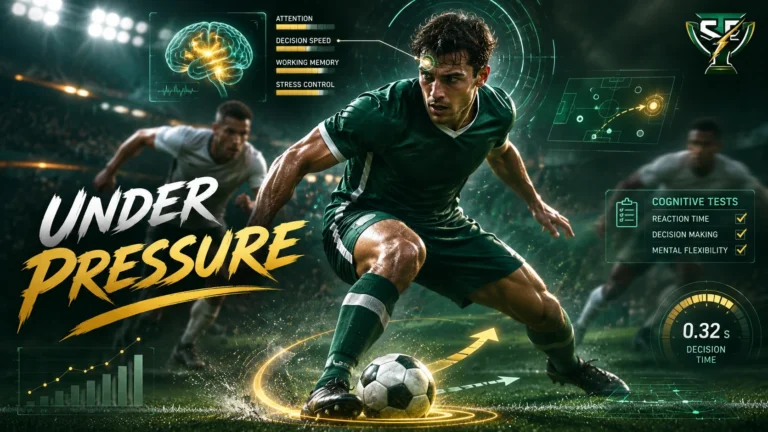
Football clubs know how fast a player can run and how accurately they can pass. But how much do they know about how quickly that player can think when time, space and options are limited?
Pressure is relative to the individual. A situation that overwhelms one player may feel entirely manageable to another. Experience, preparation and cognitive ability all influence how a player responds.
Key Takeaways
- A 2026 study of 63 UK academy football coaches found that, despite agreement on the importance of perceptual-cognitive skills, coaches differed in how they understood, prioritized and assessed them.
- AIQ, or Athletic Intelligence Quotient, was developed specifically for sport.
- Adam Billing is Director of Technology & International Strategy at AIQ and has a professional and commercial interest in the assessment discussed.
For coaches, the challenge is understanding why players respond differently, how to better prepare them and which assessment tools can provide meaningful insights. That question sits at the heart of the debate over football intelligence and whether it can be measured.
From Observation to Understanding Football Intelligence
A 2026 study of 63 UK academy football coaches found that, despite agreement on the importance of perceptual-cognitive skills, coaches differed in how they understood, prioritized and assessed them.
Imagine two midfielders who repeatedly lose possession under pressure. One may struggle to process rapidly changing information, while the other may struggle to identify the most relevant passing options.
The outcome is the same, but the underlying reasons may be different.
By understanding these differences, coaches can individualize training, help players build on their strengths, address weaknesses and develop greater confidence in demanding situations.
The importance of interpreting player behavior is also evident in The Sports Encounter’s analysis of Manchester United’s tactical difficulties, where the timing and coordination of pressing actions were central to understanding the team’s problems.
But how can coaches reliably identify the underlying cognitive abilities that influence such decisions?
Choosing the Right Cognitive Assessment
Cognitive assessments have long been used in the corporate world. Tools such as SHL’s Verify assessments and the Criteria Cognitive Aptitude Test (CCAT) help organizations evaluate reasoning, problem-solving and learning ability.
However, the cognitive demands of professional sport are different. Athletes must constantly interpret changing information, recognize opportunities and make decisions under significant time constraints.
For sporting organizations, the question is whether an assessment measures abilities relevant to athletic performance and whether those measures are supported by research at the elite sporting level.
That distinction is particularly relevant to recruitment. As TSE’s investigation into Manchester United’s recruitment and tactical weaknesses explored, identifying individual ability is only one part of building an effective football team.
Football intelligence involves understanding how a player’s abilities translate into decisions within the demands of a particular position, tactical system and competitive environment.
Understanding Athletic Intelligence
AIQ, or Athletic Intelligence Quotient, was developed specifically for sport. It measures cognitive abilities including processing speed, scanning, reaction time, learning, adaptability and instincts.
Its database contains more than 16,000 athlete profiles, according to company-reported figures.
Published research across the NBA, NFL and professional baseball has identified relationships between cognitive abilities and sporting performance.
A 2023 study of 182 NBA players found that stronger decision-making abilities were associated with better shooting efficiency and assist-to-turnover ratios, while stronger visual-spatial processing was associated with fewer turnovers.
These findings do not directly establish how footballers perform under pressure. They do, however, demonstrate that certain cognitive abilities can have measurable associations with sporting outcomes.
Football-specific research also offers evidence of a relationship between cognitive skills and playing performance.
In a 2012 study published in PLOS ONE, Torbjörn Vestberg and colleagues examined executive functions among soccer players and found associations with playing level and subsequent performance.
Nevertheless, standardized cognitive assessments cannot reproduce every element of a competitive football match. A player’s decisions are also influenced by experience, tactical knowledge, teammates, opponents and the immediate match situation.
Preparing Players for the Demands of Elite Football
AIQ works with professional football organizations, including Benfica, to incorporate cognitive assessment into player development and talent identification.
For coaches, understanding a player’s cognitive profile provides a starting point for individualizing training and preparing players for increasingly demanding situations.
For recruitment teams and academy directors, it offers another dimension when considering whether a player is equipped to transition into a faster, more complex competitive environment.
Player development increasingly involves combining different forms of expertise. Michele Kang’s Kynisca football project, for example, illustrates the growing organizational emphasis on sports science, scouting and shared development resources.
But collecting more information is not the same as proving that every assessment improves recruitment decisions.
For a cognitive measurement to be useful, coaches need to understand what it measures, how reliable it is, and whether the result provides information beyond existing scouting methods.
These considerations become especially important when a new manager introduces different playing demands. TSE’s analysis of Mauricio Pochettino’s Manchester United challenge examined how defensive organization, pressing and player adaptation can become immediate coaching priorities.
Continue the Soccer Story


Cognitive assessment should complement coaching judgment, match analysis and technical evaluation rather than replace them.
Can Football Intelligence Predict Performance Under Pressure?
The central limitation is the difference between identifying a cognitive ability and demonstrating that it predicts decisions in a competitive match.
A footballer may perform well in a standardized assessment but struggle with an unfamiliar tactical assignment. Another may compensate for slower information processing through anticipation, positioning and experience.
Testing also needs to be interpreted in the context of a player’s role. The information a central midfielder must process differs from the decisions facing a goalkeeper or center forward.
Collective organization adds another layer. TSE’s examination of Manchester United’s defensive and tactical rebuilding priorities highlighted how coordinated pressing depends on player positioning and collective responses, not merely individual attributes.
Research on cognitive performance therefore needs to establish not only whether a test produces consistent results, but whether those results meaningfully explain football performance under match conditions.
The value of AIQ is not simply in identifying who might perform well under pressure. It is in helping coaches understand the individual, so they can better prepare them to perform when it matters most.
Ultimately, football intelligence should be interpreted alongside the evidence already available to coaches. As TSE’s examination of player selection and tactical understanding illustrates, match performance can rarely be explained through one measurement alone.
Author Disclosure
Adam Billing is Director of Technology & International Strategy at AIQ and has a professional and commercial interest in the assessment discussed. The NBA research referenced in this article disclosed an author affiliation with AIQ.
Further independent research is needed to establish whether AIQ assessments reliably predict football performance under match pressure.
Research References
The article draws on the following published research and supporting materials:
- Triggs, A. O., et al. (2026). Perceptual-cognitive skills in talent development environments: A survey of academy football coaches in the United Kingdom. Frontiers in Psychology, 17, 1751602.
- SHL. Verify Range of Cognitive Ability Assessments. Product documentation.
- Criteria Corp. Criteria Cognitive Aptitude Test (CCAT). Assessment documentation.
- AIQ. AIQ+ Athlete Intelligence Profile Database. Company-reported information.
- Hogan, S. R., Taylor, D., Boone, R. T., and Bowman, J. K. (2023). The Athletic Intelligence Quotient and performance in the National Basketball Association. Frontiers in Psychology, 14, 1197190.
- The Athletic Intelligence Quotient and Performance in the National Football League. (2020). Sports and Exercise Medicine – Open Journal, 6(2), 39–50.
- The Athletic Intelligence Quotient and Performance Outcomes in Professional Baseball. (2021). Frontiers in Psychology, 12, 629827.
- Sports Business Journal. (2024). Coverage of AIQ’s partnership with S.L. Benfica.
- Vestberg, T., et al. (2012). Executive functions predict the success of top-soccer players. PLOS ONE, 7(4), e34731.
- Reinhard, M. L., et al. (2025). The role of generic cognitive skills: An empirical investigation into the association between generic and sport-specific cognitive skills and playing level in youth football. Journal of Science and Medicine in Sport.