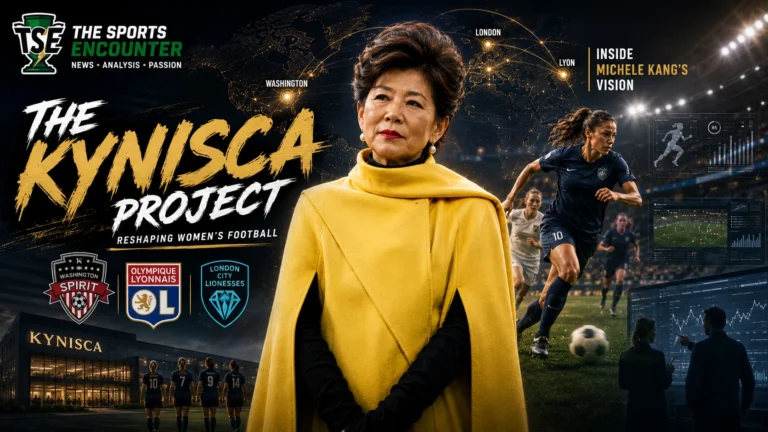
Inside Michele Kang’s Kynisca Project and Her Plan to Reshape Women’s Football
Michele Kang is building far more than a portfolio of women’s football clubs. Through Kynisca, she is connecting ownership, female-focused sports science, scouting, technology and player development across countries. Her ambitious model could raise standards across the women’s game, but its growth also brings important questions about club independence, transfers and governance.
Owning major football clubs in three countries would already place Michele Kang in a small group of global sports investors. Building that portfolio specifically around women’s football makes her project far more unusual.
The South Korean-American businesswoman owns the Washington Spirit in the United States, OL Lyonnes in France and London City Lionesses in England. In June 2025, she was also appointed chairwoman and president of Olympique Lyonnais, extending her influence into the men’s side of one of France’s best-known football institutions.
Yet Kang’s most important idea may have little to do with the number of clubs she controls.
Through Kynisca Sports International, she is attempting to build an interconnected women’s football system in which clubs can share expertise in performance science, data, scouting, coaching, recruitment and player development. At the same time, she is investing heavily in research designed specifically around female athletes.
The ambition is significant. So are the questions surrounding it.
If Kynisca works, it could offer a blueprint for how women’s clubs accelerate professionalization without rebuilding the same infrastructure separately in every market. As the network grows, however, decisions involving coaches, players and resources will increasingly test whether clubs under common ownership can maintain genuine sporting independence.
That tension makes Kang’s project one of the more important experiments taking place in the modern football landscape.
What Is Michele Kang Building Through Kynisca?
Kang formally launched Kynisca Sports International in 2024 as a global organization dedicated to women’s football.
The structure connected Washington Spirit, OL Lyonnes and London City Lionesses under a broader organizational umbrella while allowing each club to retain its own identity.
According to Kynisca’s launch announcement, centrally developed capabilities include performance science and technology, data analytics, global scouting and sporting staff development.
The logic behind the system is relatively straightforward.
A football club traditionally builds its own recruitment network, medical department, performance systems, analytics processes and coaching infrastructure. Another club hundreds or thousands of miles away may be spending money solving many of the same problems.
Kynisca’s model creates the possibility of developing expertise once and applying that knowledge across several organizations.
If a better injury-prevention protocol is developed in Washington, knowledge from that work could eventually benefit players in London or Lyon. Scouting intelligence collected in Europe could potentially help the Spirit. Coaching methods, recruitment processes and performance data could circulate across the network rather than remaining locked inside individual clubs.
For a women’s game still developing professional structures across many countries, those efficiencies could be valuable.
Why the Name Kynisca Matters
The organization’s name comes from Cynisca, or Kyniska, the Spartan princess traditionally recognized as the first woman to win at the ancient Olympic Games.
Women could not compete directly in Olympic chariot racing, but owners of winning horses were officially recognized as victors. Cynisca entered horses and became associated with Olympic victories despite the restrictions placed on women at the time.
The symbolism fits Kang’s wider message. Women’s sport has historically developed inside structures that frequently gave female athletes fewer resources, less research and fewer professional opportunities.
Her investment strategy is aimed at changing some of those underlying systems rather than concentrating entirely on results and transfers.
The 6% Problem Behind Kang’s Sports Science Investment
The most distinctive part of the Kynisca project may be its focus on female-specific sports science.
When the Kynisca Innovation Hub was introduced in 2024, the organization said only around 6% of sports science research focused exclusively on females.
Kang committed $50 million in combined seed and matching funding toward an initiative designed to develop research, training methods and performance systems around female physiology.
Her message was memorable because it addressed a long-standing problem directly: elite women should be trained using evidence gathered from women.
Kang argued that the industry needed to stop training women as though they were simply smaller versions of male athletes.
The consequences of that research could extend well beyond a training session.
Injury Prevention, Recovery and Performance Could All Change
Elite football increasingly depends on marginal gains.
Clubs track workloads, acceleration, recovery, nutrition, sleep, muscular stress, tactical movement and dozens of other performance indicators. Yet systems built largely from research involving male athletes cannot automatically answer every question surrounding female performance.
A deeper female-specific evidence base could improve decisions around injury prevention, recovery, training loads, nutrition and long-term player health.
That becomes especially important as women’s football calendars become more demanding.
Domestic competitions, international tournaments, continental club competitions and expanded commercial schedules are increasing the physical load placed on leading players. Better research could help clubs understand when athletes should train harder, when they need additional recovery and how individual physiological factors influence performance.
The implications also reach youth development. If evidence-based methods become part of academies and development programs, female players could benefit much earlier in their careers.
This matters particularly as the women’s game expands into new markets. The recent rise of nations such as Malawi, who qualified for their first Women’s World Cup, and Algeria, who also secured a historic World Cup debut, shows how quickly competitive opportunities are broadening.
Kang Has Already Expanded the Research Project Beyond Kynisca
Kang’s sports science ambitions are no longer confined to her own clubs.
In April 2025, Kynisca announced that the Innovation Hub’s operations would be integrated into U.S. Soccer’s Soccer Forward Foundation. Kang committed another $25 million to support research, innovation and standards across women’s soccer.
U.S. Soccer described the collaboration as an effort to advance research, improve health outcomes and establish better performance and development standards.
That followed Kang’s other investments in women’s sport, including financial support for the United States women’s rugby sevens program.
Her professional background helps explain the emphasis on data and research. Kang built much of her business career in healthcare technology through Cognosante, an industry where evidence, systems, technology and measurable outcomes influence major decisions.
Kynisca appears to be applying a similar institutional mindset to women’s football.
The Multi-Club Model Creates Its Own Governance Test
The same structure that gives Kynisca its potential also creates its biggest challenge.
Shared knowledge is relatively easy to defend. Shared ownership becomes more complicated when coaches or players move between clubs inside the network.
The issue became visible in 2025 when Jonatan Giráldez left Washington Spirit to become head coach of OL Lyonnes.
Giráldez had arrived in Washington after a hugely successful spell with Barcelona, where he won two UEFA Women’s Champions League titles. Under his leadership, the Spirit reached the 2024 NWSL Championship game and later won the 2025 NWSL Challenge Cup.
Washington promoted assistant coach Adrián González as Giráldez prepared to move to Lyon.
From Kynisca’s perspective, the transition demonstrates one of the network’s advantages. Expertise developed or strengthened within one organization can remain within the broader group.
From the perspective of individual supporters, however, the question looks different.
If two clubs controlled by the same ownership group both want an elite coach, who decides which club needs him more?
And whose interests come first?
The Kadidiatou Diani Transfer Made the Question Harder to Ignore
The issue became even more visible during the summer of 2026.
London City Lionesses signed France international Kadidiatou Diani from OL Lyonnes on a three-year contract.
The clubs did not publicly disclose the transfer fee. French newspaper L’Équipe reported a fee of €800,000 and described it as the biggest player sale in OL Lyonnes’ history.
The significance goes beyond the amount.
Both clubs belong to Kang’s football network.
There is no evidence that the Diani deal was improperly structured or that the reported fee was manipulated. The transaction nevertheless illustrates a governance question that Kynisca will face repeatedly if more players and staff move between its clubs.
When the same ownership network stands behind the buyer and seller, supporters and competitors need confidence that decisions reflect the legitimate sporting and financial interests of each club.
Football is already wrestling with broader questions over ownership, commercial power and institutional accountability. Recent disputes covered by The Sports Encounter, including UEFA’s confrontation with FIFA over private investment and CONCACAF’s rejection of FIFA’s proposed World Cup stake structure, show how sensitive governance becomes when commercial interests intersect with sporting independence.
Can Shared Ownership Strengthen Clubs Without Weakening Independence?
This is the central challenge inside Kynisca.
Sharing sports science, scouting, technology and staff development can make every club more efficient. Moving influential players and coaches between those clubs introduces another layer of responsibility.
A strong multi-club system therefore needs transparent decision-making.
Each organization needs credible sporting leadership, clearly defined responsibilities and safeguards that allow supporters, players and competitors to understand how major decisions are made.
Those questions will become more important if Kynisca continues expanding.
Kang’s argument is that women’s football still lacks resources and infrastructure that men’s clubs have spent decades developing. Completely isolating every organization may therefore force women’s clubs to duplicate expensive research and systems unnecessarily.
There is merit in that argument.
The challenge is proving that collaboration can coexist with genuine sporting autonomy.
Kynisca Could Raise Standards Across Women’s Football
If Kang’s model succeeds, its influence could extend well beyond the three clubs she currently owns.
Competition has a habit of forcing investment.
If Kynisca clubs begin gaining measurable advantages through better performance science, stronger scouting, improved medical support and deeper analytics, rival owners will have an incentive to respond.
That could push other clubs to invest more heavily in training facilities, medical teams, analytics departments, academy structures and specialist coaching.
Women’s football would benefit if competition among owners gradually raises the minimum professional standard across the sport.
Transfer Spending Could Accelerate the Women’s Game
London City Lionesses have already shown how aggressive investment can change expectations around recruitment.
Higher transfer fees create economic value for selling clubs. Greater competition for established players can improve bargaining power for footballers. Better-funded squads can also attract more attention from broadcasters, sponsors and supporters.
There is another side to that development.
Clubs with smaller budgets may struggle to compete if a handful of wealthy ownership groups begin dominating the market for elite talent.
Women’s football therefore faces a familiar challenge: attracting more capital while preserving meaningful competitive balance.
The sport’s rapid growth makes that conversation increasingly important. Wider disputes over commercial control in football, including the recent collapse of FIFA’s proposed World Cup investment structure, have already demonstrated how quickly financial expansion can become a governance issue.
A Global Scouting Network Could Open New Pathways
Kynisca’s geographic spread gives it another potentially important advantage.
The United States, England and France have different football cultures, academy systems, player markets and competitive structures. Connecting those environments can create a wider scouting and development network.
Young players discovered in one market could eventually gain access to expertise or opportunities elsewhere in the organization.
This possibility becomes particularly significant outside football’s traditional elite nations.
The growth of women’s football across Africa offers a useful example. Nations reaching new levels of international competition are producing players who may previously have received limited global exposure. Recent qualification breakthroughs by Malawi and Algeria underline how quickly the player pool is widening.
A genuinely international scouting structure could identify talent earlier and create stronger routes into professional football.
The question is whether those pathways ultimately strengthen local football ecosystems as well as the clubs doing the recruiting.
Could Multi-Club Ownership Concentrate Too Much Power?
The larger the network becomes, the more significant another concern becomes.
If a small number of investors own leading women’s clubs across several countries, they can potentially gain considerable influence over the movement of players, coaches, intellectual property and sporting expertise.
Women’s football needs investment. It also needs competitive diversity.
Kynisca therefore has an opportunity to demonstrate whether multi-club ownership can help professionalize the women’s game while addressing the governance concerns that have followed similar structures elsewhere in football.
The question belongs to a much wider debate about who controls the sport. The Sports Encounter has tracked similar concerns at the international level, including the broader power struggle surrounding FIFA’s leadership and commercial direction.
Kang Wants the Network to Reach Beyond Three Clubs
Washington, London and Lyon may only be the beginning.
In a 2024 interview with The Guardian, Kang said she wanted to have a club in each continent.
She did not attach a firm timetable to that ambition, but the statement makes the scale of the project clear.
Kynisca has also spoken about investing in structures across Africa, the Americas, Asia and Europe.
A broader network could create opportunities for girls who currently live far from established professional pathways. Coaching expertise, scouting systems, research and performance support could reach markets where those resources remain limited.
Expansion would also increase the management challenge.
Football regulations differ across countries. So do league structures, financial conditions, transfer rules, cultural expectations and player-development systems.
A model that works in Washington cannot simply be copied into London, Lyon or another continent without adaptation.
What Would Success Actually Look Like?
The number of clubs Kang eventually owns will attract headlines, but it should not become the primary measure of whether Kynisca succeeds.
A more meaningful evaluation would look at outcomes.
- Are players healthier and missing fewer matches through preventable injuries?
- Are female-specific research and performance methods producing measurable benefits?
- Are academies developing more players?
- Are clubs becoming commercially stronger?
- Are salaries, facilities and professional standards improving?
- Are new international talent pathways opening?
- Can clubs inside the network retain credible sporting independence?
Those questions matter more than portfolio size.
Kang is effectively testing whether women’s football can build some of its future infrastructure differently from the men’s game rather than simply replicating systems that developed over the previous century.
The Bigger Question Facing Michele Kang and Kynisca
Women’s football is entering a period of rapid expansion.
New countries are reaching World Cups. Transfer fees are rising. Major clubs are investing more aggressively. Commercial interest is growing, while debates around governance and competitive balance are becoming more serious.
Kang has placed herself near the center of all those developments.
Her project combines club ownership, female-specific sports science, technology, scouting, player development and international expansion in a way few investors have attempted before.
The model now has to prove that scale can improve the game without compromising the independence of the clubs operating inside it.
If Kynisca can produce healthier athletes, stronger development pathways, better professional environments and commercially sustainable clubs while maintaining transparent sporting governance, Kang’s influence will extend far beyond Washington Spirit, OL Lyonnes and London City Lionesses.
That would represent a meaningful change in how women’s football is built.
If the network expands without equally strong safeguards around transfers, staff movement and club autonomy, the same structure designed to accelerate progress could create new concerns about concentrated power.
That is why Michele Kang’s project deserves attention.
The real story is bigger than how many clubs she owns. It is whether Kynisca can prove that an interconnected global football organization can improve the environment around female athletes while preserving the competition and independence that make the sport worth watching.
Breaking News
Manchester United Sign Carlos Baleba From Brighton as Carrick’s Midfield Rebuild Accelerates
Manchester United have completed the signing of Carlos Baleba from Brighton, adding the 22-year-old Cameroon midfielder to Michael Carrick’s rebuilt midfield.
Manchester United have completed the signing of Carlos Baleba from Brighton & Hove Albion, adding one of the Premier League’s most dynamic young midfielders to Michael Carrick’s increasingly ambitious 2026-27 squad.
United confirmed the transfer on August 25, with Baleba signing a contract until June 2031 and the club holding an option to extend the deal for another year.
The 22-year-old Cameroon international arrives after establishing himself as one of Brighton’s most important midfielders and one of the league’s strongest young ball-winners. Manchester United have not officially disclosed the fee, so any transfer figure should still be treated as reported rather than confirmed.
The official Manchester United announcement confirmed the completion of the transfer, while the club’s Baleba player profile lists his contract through June 2031 with an additional one-year option.
For United, this signing matters because Baleba does not simply add another midfield body. He changes the physical and tactical ceiling of a department Carrick has already reshaped with Youri Tielemans and Andrey Santos.
Carlos Baleba to Manchester United: Key Facts
| Detail | Information |
|---|---|
| Player | Carlos Baleba |
| Age | 22 |
| Nationality | Cameroon |
| Position | Central midfielder |
| Previous club | Brighton & Hove Albion |
| New club | Manchester United |
| Contract | Until June 2031 |
| Extension option | One additional year |
| Date signed | August 25, 2026 |
| Official fee disclosed? | No |
Why Baleba Fits Michael Carrick’s Manchester United
United’s midfield rebuild has already been one of the defining features of Carrick’s first full summer in charge.
Youri Tielemans brought control, passing range and Premier League experience. Andrey Santos added athleticism, forward movement and another younger profile.
Baleba gives Carrick something different again.
He can recover possession, carry the ball through pressure and cover large spaces without forcing United to sacrifice technical security.
That balance is particularly valuable for a team attempting to become more aggressive without becoming structurally loose.
The Sports Encounter examined that broader project in our analysis of Michael Carrick’s Manchester United rebuild, where midfield control was identified as one of the biggest differences between the current side and several weaker United teams of recent years.
Baleba now deepens that evolution.
His Brighton Numbers Explain the Attraction
Manchester United’s official player profile highlights why Baleba had become one of the Premier League’s more valuable young midfielders.
During the 2024-25 season, his combined tackles and interceptions ranked sixth among Premier League midfielders, while he also ranked fourth for progressive ball carries per 90 minutes.
In 2025-26, he played 31 Premier League matches and ranked in the top eight percent of players for combined tackles and interceptions.
He also ranked in the top one percent for second balls won.
Those numbers are useful because they describe the type of midfielder United are buying.
Baleba is not primarily a tempo controller like Tielemans.
He is not a pure attacking midfielder either.
His value comes from affecting the spaces between both boxes.
United Have Built a Midfield With More Than One Solution
For years, Manchester United’s midfield often depended too heavily on one player solving too many problems.
Bruno Fernandes carried enormous creative responsibility.
Kobbie Mainoo was frequently asked to provide control and progression despite still developing.
Defensive coverage could become stretched when United lost possession.
The current recruitment strategy looks more deliberate.
Tielemans can dictate rhythm.
Santos can carry and press.
Baleba can win duels, drive forward and cover ground.
Mainoo can operate with greater freedom because the entire structure no longer depends on him performing every midfield task at once.
That is one reason United entered the season as genuine contenders in The Sports Encounter’s Premier League 2026-27 title contender rankings.
The squad still had questions, but midfield depth was already becoming a strength.
Baleba makes it stronger again.
This Is Carrick’s First Full-Summer Squad Taking Shape
The timing matters because Carrick inherited the team midway through last season rather than building it himself.
He still guided United from seventh to third and back into the Champions League.
The Sports Encounter’s Premier League 2026-27 season preview identified United as one of the most intriguing teams entering the new campaign because Carrick now has a full preseason and a squad shaped more closely around his football.
Baleba is an important part of that transition.
This is no longer a manager attempting to stabilize someone else’s team.
Carrick is beginning to assemble his own.
Baleba Could Help United Become Less Dependent on Transitions
One of the biggest tests facing United this season is whether they can consistently dominate opponents who defend deeply.
Last season, Carrick improved the side’s transition structure and defensive organization quickly.
The next step is controlling matches for longer periods.
Baleba’s ability to carry the ball through midfield can help with that problem.
When opponents block central passing lanes, ball carriers become especially valuable because they can move the defensive structure without relying on a risky vertical pass.
That ability should also help Fernandes receive the ball in more advanced positions.
The goal is not to turn Baleba into another creator.
It is to give United a midfielder capable of transporting possession far enough that the creative players do not have to retreat constantly to build attacks.
United’s Preseason Already Suggested a More Controlled Identity
The tactical direction was visible before the competitive season began.
United’s 5-0 preseason win over Rosenborg showed Carrick experimenting with greater patience in possession and more defined midfield spacing.
The subsequent 1-1 draw with Leeds United before a 5-4 penalty shootout win offered a different test, with United having to remain composed in a tighter contest.
Those matches were useful because they showed the broader direction of travel.
Baleba now gives Carrick another player suited to that style.
The Marcus Rashford Return Adds Another Layer to United’s Rebuild
The midfield is not the only part of the squad changing.
Marcus Rashford has returned after spells away from Old Trafford and is attempting to rebuild his own United career under Carrick.
The Sports Encounter explored that situation in our report on Rashford’s Manchester United return.
That context matters because United now have more attacking options than they carried through much of the previous campaign.
A stronger midfield should help those forwards receive possession earlier and in better areas.
The relationship between recruitment lines is important.
Baleba is not being signed in isolation.
He is part of a wider attempt to make the entire team function more efficiently.
What Baleba Could Mean for Kobbie Mainoo
One of the most interesting consequences may involve Mainoo.
The academy midfielder has already demonstrated that he can handle high-pressure Premier League matches, but United have often asked him to perform several different functions at once.
Baleba could reduce that burden.
With another athletic ball-winner available, Mainoo may receive more opportunities to operate as a possession midfielder rather than being forced constantly into recovery situations.
Carrick could also rotate more aggressively across domestic and European competition without dramatically changing the character of the midfield.
That will matter because United return to the Champions League this season.
The Sports Encounter’s analysis of Carrick’s rebuild identified Europe as one of the biggest tests facing a squad that had enjoyed a simpler competitive rhythm during the second half of last season.
Baleba Arrives With Premier League Experience, Not Adaptation Guesswork
Another advantage is familiarity.
Baleba is not arriving from a league where United need to guess how quickly he will adjust to English football.
He has already spent several seasons at Brighton and has faced the pace, physicality and tactical demands of the Premier League.
That reduces one of the biggest risks associated with expensive midfield recruitment.
There will still be a transition.
Playing for Manchester United brings different expectations, more possession, more scrutiny and less patience.
But the basic environment is already familiar.
That should make it easier for Carrick to integrate him once he is fully fit.
Brighton Lose Another Midfielder Developed Into Elite Value
From Brighton’s perspective, Baleba’s departure fits a familiar pattern.
The club have repeatedly identified young players, developed them inside a clear tactical environment and eventually sold them at significantly higher value.
Baleba arrived from Lille as a teenager and became a Premier League regular before attracting interest from one of England’s biggest clubs.
His development also contributed to Brighton qualifying for European football last season.
The Premier League’s official platform continues to list Brighton and Manchester United among the clubs beginning the new 2026-27 campaign with European ambitions.
For Brighton, replacing Baleba’s ball-winning and carrying ability may now become one of the most important remaining tasks of the transfer window.
The Reported Fee Should Be Handled Carefully
Manchester United have not publicly confirmed the financial details of the transfer.
That distinction matters.
Current reporting has placed the initial fee around £60 million, with additional payments potentially increasing the total value of the deal.
Until either club discloses the numbers, those figures should remain described as reported.
The sporting logic of the move is easier to assess than the final accounting.
At 22, Baleba offers several prime years and potential resale value.
United are paying for current Premier League performance and future development rather than a short-term veteran solution.
Baleba’s Fitness Is the Immediate Question
The transfer does not necessarily mean Baleba is ready to walk directly into Carrick’s starting XI.
He sustained an ankle ligament problem during preseason, making his recovery one of the immediate issues United must manage.
That should prevent the club from rushing him simply because the transfer has been completed.
United already possess enough midfield depth to allow a sensible return.
The bigger priority is ensuring Baleba becomes available for the sustained run of Premier League and Champions League fixtures rather than forcing an early debut and creating a longer absence.
Why This Signing Changes United’s Title Conversation
United finished third last season with 71 points.
That was enough to return to the Champions League but still left them 14 points behind champions Arsenal.
The Sports Encounter’s title contender analysis argued that United’s next step depends on eliminating the inconsistent weekends that separate a Champions League team from a champion.
Baleba helps because those dropped points often occur in midfield.
Teams lose control after turnovers.
Second balls go uncontested.
Transitions become too open.
Opponents turn one clearance into a counterattack.
Baleba’s statistical profile directly addresses those moments.
That does not make United title favorites.
It does make the squad more capable of surviving the type of match that championship contenders must win even when their attacking football is imperfect.
TSE Analysis: Baleba Makes United More Complete, Not More Glamorous
This is not the type of signing built primarily around shirt sales or global name recognition.
Baleba’s appeal is functional.
He gives Manchester United another way to win midfield duels, escape pressure and protect attacking players from doing too much defensive work.
That may prove more important than adding another headline forward.
United already have creators.
They already have finishers.
They already have players capable of producing spectacular moments.
The challenge under Carrick is turning those individual qualities into a side that controls enough of every match to compete across 38 league games and a Champions League campaign.
Baleba fits that problem.
What Happens Next?
The next focus will be Baleba’s recovery from his ankle injury and how quickly Carrick integrates him into training.
His eventual role could depend on the opponent.
Against aggressive pressing teams, his carrying ability may become especially valuable.
Against transition-heavy opponents, his defensive coverage could matter more.
Against deeper blocks, he may be used alongside Tielemans to combine physical security with distribution.
The important point is that Carrick now has options.
Manchester United began the summer rebuilding their midfield.
With Baleba added to Tielemans and Santos, that rebuild now looks much closer to complete.
Final Analysis
Carlos Baleba is one of the clearest indications yet that Manchester United’s summer is being built around structure rather than reputation.
At 22, he already has Premier League experience, elite ball-winning numbers and the ability to carry possession through midfield.
For Brighton, his departure removes one of the most valuable players from a team that reached European competition.
For United, the significance is broader.
Carrick now has a midfield capable of changing personality without changing the entire team.
That flexibility should help in the Premier League.
It may become even more important in Europe.
Baleba still has to recover, settle and prove he can handle the pressure attached to Old Trafford.
But the logic behind the signing is difficult to miss.
Manchester United are no longer trying to build a midfield around one answer.
They are building one with several.
Frequently Asked Questions
Has Carlos Baleba signed for Manchester United?
Yes. Manchester United officially confirmed Baleba’s signing from Brighton & Hove Albion on August 25, 2026.
How long is Carlos Baleba’s Manchester United contract?
Baleba has signed until June 2031, with Manchester United holding an option to extend the contract for another year.
How old is Carlos Baleba?
Baleba is 22 years old.
Which country does Carlos Baleba represent?
Baleba is a Cameroon international.
What position does Carlos Baleba play?
He primarily plays as a central midfielder and is particularly strong in ball recovery, second-ball situations and progressive carrying.
How much did Manchester United pay for Carlos Baleba?
Manchester United have not officially disclosed the transfer fee. Current reporting has placed the initial amount around £60 million with possible add-ons, so that figure remains reported rather than confirmed.
What were Carlos Baleba’s Premier League strengths at Brighton?
Manchester United’s official profile notes that Baleba ranked in the top eight percent of Premier League players for combined tackles and interceptions in 2025-26 and in the top one percent for second balls won.
Is Carlos Baleba fit to make his Manchester United debut?
Baleba has been recovering from an ankle ligament injury suffered during preseason, so his immediate availability will depend on his rehabilitation and United’s medical assessment.
Who else has Manchester United signed in midfield?
United have also added Youri Tielemans and Andrey Santos, giving Michael Carrick several different midfield profiles for the 2026-27 season.
Editor's Choice
Serena Williams Returns to US Open With Carlos Alcaraz in Blockbuster Mixed Doubles Partnership
Serena Williams returns to the US Open for the first time since 2022, partnering Carlos Alcaraz against Erin Routliffe and Lloyd Glasspool in the 2026 mixed doubles championship.
Serena Williams returns to the US Open on Tuesday for her first appearance at Flushing Meadows since 2022, partnering Carlos Alcaraz against doubles specialists Erin Routliffe and Lloyd Glasspool in one of the headline matches of the 2026 US Open Mixed Doubles Championship.
Four years after Williams walked away from Arthur Ashe Stadium with what many believed would be her final US Open appearance, the 23-time Grand Slam singles champion is back in New York with a partner from an entirely different tennis generation.
Williams, 44, and Alcaraz received a wild card into the 16-team mixed doubles main draw and will begin against Routliffe and Glasspool, who survived two demanding qualifying matches on Monday to earn their place.
The partnership immediately creates one of the most unusual storylines of US Open Fan Week: one of the greatest players in tennis history returning to the tournament where she won nine titles across singles, women’s doubles and mixed doubles, alongside a player who has become one of the defining figures of the current men’s game.
The official US Open announcement confirmed Williams and Alcaraz as wild-card entrants and placed them in a field filled with major champions, world No. 1s and established doubles specialists.
For The Sports Encounter, the real question is not whether the partnership attracts attention. That part was guaranteed the moment the draw was announced. The more interesting question is whether two extraordinary singles players can adapt quickly enough to a compressed doubles format against opponents whose careers have been built around the discipline.
Serena Williams and Carlos Alcaraz at US Open 2026: Key Facts
| Detail | Information |
|---|---|
| Competition | 2026 US Open Mixed Doubles Championship |
| Round | First Round |
| Team | Serena Williams / Carlos Alcaraz |
| Opponents | Erin Routliffe / Lloyd Glasspool |
| Entry | Williams / Alcaraz received a wild card |
| Opponent entry | Routliffe / Glasspool qualified on August 24 |
| Venue | USTA Billie Jean King National Tennis Center, New York |
| First round and quarterfinals | August 25 |
| Semifinals and final | August 26 |
| Championship prize | $1 million |
| Serena’s last US Open appearance | 2022 |
| Serena’s previous US Open mixed doubles title | 1998 with Max Mirnyi |
Serena Williams Is Returning to a Tournament That Once Looked Like Her Farewell
The setting gives this comeback considerably more meaning than an ordinary wild-card appearance.
Williams last competed at the US Open in 2022, when her run ended in the third round and the tournament became the stage for an emotional departure from professional tennis.
For several years, that appeared to be the final chapter.
Her 2026 comeback changed the picture.
Williams returned to competition in June and has gradually rebuilt her schedule rather than attempting an immediate full-time return. She has played doubles, returned to Grand Slam competition at Wimbledon and recently reunited with Venus Williams in Cincinnati.
The Sports Encounter followed that latest step when Serena and Venus Williams played doubles together in Cincinnati for the first time since the 2022 US Open.
They lost 2-6, 6-1, 10-8 to Marta Kostyuk and Peyton Stearns, but the match mattered because it showed Serena continuing to expose herself to competitive tennis rather than treating her comeback as a sequence of ceremonial appearances.
New York is the next test.
This Is Serena’s First US Open Appearance in Four Years
The significance of the occasion can be measured by Williams’ history at Flushing Meadows.
She has won six US Open women’s singles championships, two women’s doubles titles and the 1998 mixed doubles crown with Max Mirnyi.
That gives her nine US Open titles across three disciplines.
A championship with Alcaraz would therefore become her 10th US Open trophy and her second in mixed doubles, arriving 28 years after the first.
The return also comes during a remarkable period for the Williams family. Venus Williams has received another opportunity in New York at age 46, a story The Sports Encounter explored in our report on Venus Williams receiving a 2026 US Open wild card.
Their situations are different, but together they have turned the Williams name into an active competitive storyline again rather than purely part of US Open history.
Alcaraz Gives Serena a Partner With Elite Singles Firepower
Carlos Alcaraz brings an entirely different type of pressure to the partnership.
His game is built around explosive movement, improvisation, heavy groundstrokes and the ability to turn defensive positions into attacks within one shot.
Those qualities can be extremely useful in doubles, where reaction time is reduced and points often turn on the first aggressive move.
There is still an important distinction between being an exceptional singles player and an exceptional doubles player.
Alcaraz has considerably less mixed doubles experience than Williams. His previous Grand Slam mixed doubles appearance came at the 2025 US Open, when he partnered Emma Raducanu and lost in the opening round to Jessica Pegula and Jack Draper.
That history makes Tuesday’s match more tactically interesting.
Williams and Alcaraz possess enormous individual ability. Their opponents possess the more established doubles credentials.
Routliffe and Glasspool Are Much More Dangerous Than the Celebrity Narrative Suggests
It would be easy to frame this entirely around Serena and Alcaraz.
That would miss the competitive problem standing across the net.
Erin Routliffe and Lloyd Glasspool came through the new mixed doubles qualifying competition on Monday, and neither qualification match was routine.
They defeated Luisa Stefani and Neal Skupski 4-1, 3-5, 10-7 before surviving Kristina Mladenovic and Marcelo Arevalo 5-4(4), 2-4, 11-9.
The official US Open qualifying report confirmed that Routliffe and Glasspool needed deciding match tiebreaks in both rounds.
That experience could matter immediately.
They have already played two competitive matches under the tournament’s unusual scoring system. Williams and Alcaraz enter without that same match repetition as a team.
Celebrity makes Williams and Alcaraz the headline pairing.
Doubles familiarity may make Routliffe and Glasspool the more comfortable pairing when the first few points begin moving quickly.
TSE Analysis: The First Four Games Could Decide Much More Than Usual
The tournament format changes the strategic value of every early mistake.
From qualifying through the semifinals, sets are played to four games instead of six, with no-ad scoring and a tiebreak at 4-4. If teams split the opening two sets, a 10-point match tiebreak decides the winner.
The final returns to six-game sets while retaining no-ad scoring and a deciding 10-point tiebreak instead of a conventional third set.
The official US Open mixed doubles championship guide confirms the format and the compressed August 24-26 schedule.
For Williams and Alcaraz, the shortened sets remove one of the luxuries great singles players normally possess: time to understand an opponent.
Lose serve early and a set can disappear almost immediately.
Miss two return opportunities and there may not be enough games remaining to create another opening.
That increases the value of doubles instincts, first volleys, return positioning and communication.
Williams has decades of experience reading those situations.
Alcaraz has to adapt quickly.
Serena’s Serve May Still Be the Partnership’s Most Important Weapon
Much of the attention will naturally fall on Alcaraz’s speed and power, but Williams’ serve could determine whether the partnership settles into the match.
Even late in her career, Serena’s service motion remains one of the great technical foundations in women’s tennis.
Mixed doubles can expose a weaker serve brutally because the opposing male player can attack returns from inside the baseline.
Williams historically avoided that problem through accuracy, disguise and placement rather than relying solely on speed.
If she can consistently start points on favorable terms, Alcaraz becomes considerably more dangerous at the net.
The opposite is also true.
If Routliffe and Glasspool force Williams into repeated second serves, the physical and reaction demands will rise immediately.
Alcaraz’s Net Positioning Could Become the Hidden Variable
Alcaraz has enough athletic ability to cover huge amounts of court, but mixed doubles will test his positional discipline differently from singles.
At the net, raw speed does not compensate for every poor decision.
Knowing when to cross, when to hold position, when to leave a ball for a partner and how aggressively to close toward the center can determine points before athleticism becomes relevant.
Williams has spent much more of her career working within those patterns.
The partnership therefore creates an unusual leadership dynamic.
Alcaraz may be one of the dominant players of the current men’s era, but Williams carries the deeper doubles vocabulary.
That may make communication between points as important as anything they produce with the racket.
The US Open Has Turned Mixed Doubles Into a Showcase Event
The partnership also reflects the US Open’s attempt to dramatically increase the visibility of mixed doubles.
The reimagined championship now takes place during Fan Week before the singles main draw begins, concentrating a field of recognizable stars into a short competition staged largely inside Arthur Ashe Stadium and Louis Armstrong Stadium.
The 16-team main draw includes combinations featuring Novak Djokovic, Aryna Sabalenka, Jessica Pegula, Taylor Fritz, Iga Swiatek, Casper Ruud, Alexander Zverev and several accomplished doubles players.
The Sports Encounter’s complete US Open 2026 preview identified mixed doubles as one of the tournament’s important Fan Week storylines long before Williams and Alcaraz were added to the field.
Their wild card has increased the attention considerably.
A $1 Million Prize Changes the Competitive Tone
The champions will receive $1 million, while the runners-up earn $500,000.
That prize structure reinforces the US Open’s attempt to turn mixed doubles into a premium event rather than a side competition operating quietly around singles schedules.
More importantly, the compressed format gives players very little recovery time.
The first round and quarterfinals are scheduled for Tuesday.
The semifinals and final follow Wednesday night.
A team can therefore move from an opening-round experiment to playing for a Grand Slam championship in little more than 24 hours.
That is why Williams and Alcaraz cannot treat Routliffe and Glasspool as a warm-up.
There is no warm-up round in this format.
The Draw Could Produce Serena and Alcaraz vs Sabalenka and Djokovic
The tournament bracket adds another layer.
Williams and Alcaraz are in the top half of the draw, where a semifinal meeting with Aryna Sabalenka and Novak Djokovic was possible when the bracket was released.
That potential matchup helped explain the attention surrounding the competition before a ball was played.
Djokovic enters New York with his own questions after a difficult Cincinnati return. The Sports Encounter examined those concerns after Djokovic’s Cincinnati defeat raised fresh US Open fitness questions.
His situation is part of a much broader men’s tournament picture that remains unusually fluid before singles play begins.
US Open Preparation Has Been Far From Straightforward for the Leading Men
New York is arriving after a North American hard-court swing filled with injuries, upsets and rapidly changing form.
Jannik Sinner’s preparation was interrupted when a knee problem forced him to withdraw from Cincinnati, a development covered in The Sports Encounter’s report on Sinner’s Cincinnati withdrawal and US Open uncertainty.
Taylor Fritz strengthened his own case earlier in the swing by winning Washington. Our report on Fritz’s Mubadala DC Open title examined why his hard-court form matters heading toward New York.
Canada then added another set of questions, which The Sports Encounter tracked through our National Bank Open 2026 guide.
Mixed doubles sits outside the men’s singles championship, but it gives Alcaraz competitive exposure to Arthur Ashe Stadium conditions before the main event begins.
Serena’s 2026 Comeback Has Already Crossed Several Different Tests
There is a tendency to evaluate every Serena appearance against the impossible standard of the player who dominated women’s tennis for more than two decades.
That is no longer the most useful measurement.
At 44, the meaningful questions concern movement, recovery, timing, competitive instincts and whether she can still find enough high-level tennis inside shorter windows.
Her comeback has already taken her through grass-court tennis, Grand Slam competition and doubles alongside Venus.
The Sports Encounter’s Wimbledon 2026 curtain-raiser framed the extraordinary generational landscape Serena returned to this summer, where players from different eras suddenly occupied the same tournament again.
That generational contrast is even more visible beside Alcaraz.
Mixed Doubles Gives Serena a Different Path Than Singles
Doubles reduces some of the court coverage demanded by singles but increases the importance of reactions, positioning and coordination.
That tradeoff may suit Williams at this stage of her comeback.
She does not have to defend the entire baseline for two or three hours.
She does have to process points extremely quickly at the net and protect her service games inside a shortened scoring format.
Her Wimbledon experience also showed how complicated comeback management can become. The Sports Encounter noted Serena’s withdrawal from doubles during Wimbledon 2026 as part of a chaotic tournament day.
That makes workload management another factor worth watching in New York.
Grand Slam Mixed Doubles Has Produced Major Stories Already in 2026
The discipline has enjoyed several meaningful moments this season.
At Wimbledon, Jelena Ostapenko and Marcelo Arevalo came from behind to win the mixed doubles championship, a result The Sports Encounter covered in our report on Ostapenko and Arevalo’s Wimbledon mixed doubles triumph.
The US Open has chosen a dramatically different presentation model, but the sporting problem remains the same.
Two players with different instincts and tactical responsibilities must become a functioning team almost immediately.
That is what makes Williams and Alcaraz fascinating beyond the names.
What Happens If Serena and Alcaraz Win?
The format moves quickly.
A first-round victory would send Williams and Alcaraz directly into Tuesday’s quarterfinals.
From there, one more win would put them into Wednesday night’s semifinals at Arthur Ashe Stadium.
Two victories on Wednesday would complete one of the most extraordinary possible endings to this comeback chapter: Serena Williams becoming a US Open champion again 28 years after her first mixed doubles title.
That outcome remains several difficult matches away.
Routliffe and Glasspool are the first reason not to look too far ahead.
TSE Verdict: The Names Make the Match Huge, the Format Makes It Dangerous
Serena Williams returning to the US Open beside Carlos Alcaraz is enough to make this one of Tuesday’s most watched tennis matches.
The sporting challenge is what makes it worth following closely.
Williams and Alcaraz bring overwhelming singles pedigree, elite shot-making and the ability to change points from seemingly defensive positions.
Routliffe and Glasspool bring recent matches under the exact format, deeper doubles familiarity and considerably more experience making rapid positional decisions as a partnership.
The short sets reduce the margin for experimentation.
There may not be enough time for Williams and Alcaraz to spend several games discovering what works.
They have to arrive with answers.
That tension gives Serena’s return something better than nostalgia.
It gives it competitive uncertainty.
Frequently Asked Questions
Who is Serena Williams playing with at the 2026 US Open?
Serena Williams is partnering Carlos Alcaraz in the 2026 US Open Mixed Doubles Championship.
Who will Serena Williams and Carlos Alcaraz play first?
They face Erin Routliffe and Lloyd Glasspool, who qualified for the main draw by winning two matches on August 24.
Is Serena Williams playing singles at the 2026 US Open?
Her confirmed US Open appearance discussed here is in the mixed doubles championship alongside Alcaraz.
When did Serena Williams last play at the US Open?
Williams last competed at Flushing Meadows in 2022 before returning for the 2026 mixed doubles event.
Has Serena Williams won the US Open mixed doubles title before?
Yes. Williams won the 1998 US Open mixed doubles championship with Max Mirnyi.
How many US Open titles has Serena Williams won?
Williams has won nine US Open championships across disciplines: six women’s singles titles, two women’s doubles titles and one mixed doubles title.
What is the US Open mixed doubles prize money?
The 2026 champions will receive $1 million, while the runners-up earn $500,000.
What is the 2026 US Open mixed doubles format?
From qualifying through the semifinals, sets are played to four games with no-ad scoring and a 10-point match tiebreak replacing a third set. The final uses conventional six-game sets with no-ad scoring and a 10-point deciding tiebreak.
When is the US Open mixed doubles final?
The semifinals and championship match are scheduled for Wednesday, August 26 at Arthur Ashe Stadium.
Breaking News
Lions FC Destroy North Sunshine Eagles 4-0 as Australia Cup Fairytale Ends
Lions FC powered into the Hahn Australia Cup 2026 semifinals with a 4-0 win over North Sunshine Eagles, ending the tournament’s standout underdog run.
Lions FC are through to the Hahn Australia Cup 2026 semifinals after overwhelming North Sunshine Eagles 4-0 at Luxury Paints Stadium, ending one of the competition’s great underdog runs and moving the Queensland club within one victory of the final.
North Sunshine Eagles had spent the past month proving that knockout football could bend around them. They won away from home on their national-stage debut, survived 120 scoreless minutes against the previous season’s finalists and watched goalkeeper Rory Brian repeatedly rescue their campaign when elimination appeared close.
Lions FC never allowed this quarterfinal to develop into that kind of contest.
The NPL Queensland side attacked the match aggressively, converted their superiority into a commanding advantage and completed a 4-0 victory that sends them into the Australia Cup semifinals for the first time.
Football Australia’s official Australia Cup match report confirmed the comprehensive victory and Lions’ progression to the final four.
For readers who followed this matchup from the beginning, The Sports Encounter’s Lions FC vs North Sunshine Eagles quarterfinal preview identified the central danger before kickoff: if North Sunshine could survive the early pressure, the psychology of the match might begin shifting toward the underdogs.
Lions made sure that never happened.
Lions FC 4-0 North Sunshine Eagles: Match at a Glance
| Detail | Information |
|---|---|
| Competition | Hahn Australia Cup 2026 |
| Round | Quarterfinal |
| Result | Lions FC 4-0 North Sunshine Eagles |
| Venue | Luxury Paints Stadium, Queensland |
| Lions FC level | NPL Queensland |
| North Sunshine Eagles level | VPL1 |
| Outcome | Lions FC advance to Australia Cup semifinals |
| Semifinal opponent | Winner of Preston Lions vs South Melbourne |
The Cup Match North Sunshine Needed Never Developed
The most revealing part of the result is not simply that Lions scored four goals.
It is how completely they removed the conditions that had allowed North Sunshine to become one of the stories of the tournament.
The Eagles’ Round of 16 victory against Heidelberg United had been built around survival, patience and the gradual accumulation of belief.
They remained scoreless for 120 minutes against the 2025 finalists, survived an 80th-minute penalty and eventually won 4-3 in the shootout after Rory Brian produced an extraordinary goalkeeping performance.
The official Australia Cup account of the Heidelberg upset recorded Brian saving the regulation-time penalty and another two during the shootout.
That victory gave North Sunshine a psychological blueprint for the quarterfinal.
Stay alive. Absorb pressure. Let the favorite become frustrated. Give Brian opportunities to make saves. Wait for the game to become emotionally uncomfortable.
Lions destroyed that blueprint by making their superiority count early enough that North Sunshine never reached the stage where belief could begin influencing the contest.
TSE Analysis: Lions Learned the Most Important Lesson From Heidelberg
The warning signs were available before kickoff.
Heidelberg had discovered what happens when a stronger side allows North Sunshine to remain alive.
Even after the Eagles failed to create sustained attacking pressure, the longer the score remained level, the more dangerous the tie became for the favorite. By the time penalties arrived, North Sunshine were competing in precisely the environment they wanted.
Lions approached the problem differently.
They did not treat possession as control by itself. They used territorial pressure to force North Sunshine deeper and then turned that pressure into goals rather than allowing the visitors to settle into another defensive marathon.
That distinction explains why this quarterfinal became so different from the Heidelberg match.
The Eagles could survive without much of the ball.
They could not survive while conceding repeatedly.
Lions FC Are No Longer a Cute Australia Cup Story
There is another reason this 4-0 result deserves attention.
Lions FC have now eliminated Perth Glory, Melbourne City and North Sunshine Eagles during their national-round campaign.
The first victory required penalties.
The second was a 2-0 win against Melbourne City.
The third has produced four unanswered goals in an Australia Cup quarterfinal.
That progression matters.
Lions initially demonstrated that they could survive against professional opposition. They then showed they could beat an A-League side in regulation. Now they have handled the pressure of entering a national quarterfinal as favorites.
Those are three very different knockout tests.
The Sports Encounter highlighted that development in our quarterfinal analysis before the match, noting that the 2-0 victory over Melbourne City had changed the meaning of Lions’ campaign.
This result changes it again.
Being Favorites Created a Different Kind of Pressure
Against Perth Glory and Melbourne City, Lions could embrace the role normally occupied by Member Federation clubs in the Australia Cup.
The professional team carried the expectation.
Lions could attack the opportunity.
North Sunshine reversed that dynamic.
Suddenly Lions were the established NPL leaders playing at home against a club from Victoria’s second state tier. Their previous Cupsets meant very little once they became the team expected to progress.
That can be an uncomfortable transition for an underdog.
Some teams thrive when they have nothing to lose but become hesitant once they are asked to control a knockout match.
Lions showed no such hesitation.
The 4-0 scoreline is therefore evidence of more than attacking quality. It shows a team capable of changing psychological roles without losing its football identity.
North Sunshine’s Fairytale Deserves More Than the Final Score
A four-goal defeat is a brutal ending, but it should not become the defining image of North Sunshine’s tournament.
The Eagles were making their first appearance on the national stage.
They opened by traveling to South Australia and defeating FK Beograd 3-2 in a match where all five goals arrived after halftime.
Football Australia’s official Round of 32 review documented that breakthrough victory, which immediately gave North Sunshine a place in the national tournament’s wider story.
Then came Heidelberg.
The Eagles faced the 2025 finalists, survived extra time and became only the second second-tier Member Federation club in Australia Cup history to reach the final eight.
That achievement cannot be erased by what happened in Queensland.
North Sunshine arrived at the quarterfinal because they repeatedly earned the right to be there.
Rory Brian Finally Met a Problem Goalkeeping Could Not Solve
Brian entered the quarterfinal as arguably the most important individual player in North Sunshine’s run.
Against Heidelberg, he had saved a penalty during regulation and another two in the shootout.
That performance created a fascinating question before the Lions match.
Could he keep North Sunshine alive long enough for doubt to creep into the home side?
The answer was no, but that should not be interpreted as a failure of the goalkeeper.
A keeper can rescue a team from individual chances. It becomes considerably harder when the opponent establishes sustained attacking control and repeatedly reaches dangerous areas.
North Sunshine needed the entire defensive structure to survive.
Lions broke it.
The 4-0 Result Stands Apart From the Other Quarterfinals
The first three Australia Cup quarterfinals have produced three very different routes into the semifinals.
Sydney FC became the first team through after Takahiro Sekine’s goal secured a tense 1-0 victory over SD Raiders. The Sports Encounter covered how the NPL NSW side made the A-League club work for almost every minute in our Sydney FC vs SD Raiders quarterfinal report.
Melbourne Victory required even more patience.
APIA Leichhardt kept them scoreless through 90 minutes before substitute Harry Sawyer finally found the breakthrough in extra time. Our Melbourne Victory vs APIA Leichhardt report examined how Victory survived a genuine knockout test before securing their semifinal place.
Lions have taken the opposite route.
They have produced the most emphatic quarterfinal result of the tournament so far.
Australia Cup 2026 Semifinal Picture
| Quarterfinal | Result/Status | Semifinal Outcome |
|---|---|---|
| SD Raiders vs Sydney FC | Sydney FC won 1-0 | Sydney FC advanced |
| APIA Leichhardt vs Melbourne Victory | Melbourne Victory won 1-0 after extra time | Melbourne Victory advanced |
| Lions FC vs North Sunshine Eagles | Lions FC won 4-0 | Lions FC advanced |
| Preston Lions vs South Melbourne | August 26 | Winner faces Lions FC |
The semifinal bracket has therefore begun taking shape.
Sydney FC and Melbourne Victory will meet in one semifinal, creating a heavyweight A-League contest after both professional clubs survived difficult quarterfinals.
Lions FC will face the winner of Preston Lions vs South Melbourne in the other semifinal.
Lions Are Guaranteed a Member Federation Semifinal
The structure of the remaining bracket makes Lions’ achievement even more interesting.
Preston Lions and South Melbourne are both Member Federation clubs.
Whoever emerges from that final quarterfinal will meet Lions rather than an A-League opponent.
That guarantees a Member Federation club a place in the 2026 Australia Cup final.
For Lions, the opportunity is enormous.
They have already beaten two professional opponents, but their route to the final will now run through another club outside the A-League.
That does not make the semifinal easy.
It makes it historic.
Preston Lions vs South Melbourne Now Carries Another Layer
The final quarterfinal on August 26 will determine who travels into the other side of the semifinal bracket.
Preston have already produced one of the tournament’s major Cupsets by eliminating 2025 Australia Cup winners Newcastle Jets before later defeating Brunswick Juventus 4-1.
South Melbourne have their own giant-killing credentials after eliminating Adelaide United.
Either opponent will arrive against Lions with evidence that they can survive national knockout football.
That means Lions cannot interpret the 4-0 quarterfinal as proof that the semifinal will follow the same pattern.
The challenge changes again.
The Sydney FC-Melbourne Victory Semifinal Creates a Fascinating Contrast
One half of the bracket will contain two of Australia’s biggest professional clubs.
The other will guarantee a Member Federation finalist.
That is close to an ideal Australia Cup semifinal structure.
Sydney and Victory bring A-League history, professional squads and one of Australian football’s most recognizable rivalries.
The Sports Encounter’s APIA vs Melbourne Victory quarterfinal preview had already identified the possibility of a Sydney-Victory semifinal before Victory survived at Leichhardt Oval.
Now it is confirmed.
On the opposite side, Lions and either Preston or South Melbourne will carry the Member Federation game to within 90 minutes of the trophy match.
Why Lions’ Route Matters to the Australia Cup
The Australia Cup works best when the national hierarchy becomes temporarily negotiable.
That does not mean every A-League club needs to lose.
It means clubs from different levels need a credible route to competing with one another.
Lions have provided one of the clearest examples in 2026.
Perth Glory could not eliminate them.
Melbourne City could not eliminate them.
North Sunshine could not turn the quarterfinal into another underdog survival story.
Now Lions are one match away from the final.
The tournament’s official fixtures and results center will confirm the final semifinal matchup once Preston Lions and South Melbourne complete the quarterfinal stage.
The Continental Prize Is Getting Closer
The stakes also extend beyond the Australia Cup trophy.
The competition provides a pathway into Asian football, which gives the later rounds unusual significance for Member Federation clubs.
For an A-League team, continental competition is part of the professional ecosystem.
For a club such as Lions FC, the possibility of reaching that environment would carry an entirely different scale of sporting significance.
The Sports Encounter has followed Asian soccer beyond Australia throughout the season, including the growing influence of the AFC within global football’s changing power structure.
Lions are still several steps away from turning their Cup run into continental football.
After Tuesday night, however, those steps no longer feel theoretical.
TSE Verdict: Lions Solved the Problem Before It Became Dangerous
The most impressive part of Lions’ quarterfinal was their refusal to allow North Sunshine’s previous achievements to dictate the emotional shape of the match.
The Eagles had already demonstrated that they could survive pressure.
They had shown they could win away from home.
They had beaten the previous year’s finalists.
They had a goalkeeper who had already changed one knockout tie almost single-handedly.
All of that became dangerous only if Lions allowed the game to remain close.
They did not.
That is the difference between simply being the stronger team and performing like one when elimination is possible.
Lions have now survived penalties against Perth Glory, beaten Melbourne City in regulation and demolished North Sunshine while carrying the expectation of favoritism.
Three knockout rounds have asked three different questions.
So far, Lions have answered every one.
What Happens Next?
Lions FC can now watch Wednesday’s final quarterfinal knowing exactly what awaits.
Preston Lions or South Melbourne will stand between them and the Australia Cup final.
Sydney FC and Melbourne Victory occupy the other side of the semifinal bracket.
For North Sunshine Eagles, the national run ends after two victories, one unforgettable penalty shootout and a first appearance that took them further than almost anyone could reasonably have expected.
The Sports Encounter will continue following the tournament through the final quarterfinal and both semifinals as the 2026 Australia Cup moves toward its decisive stage.
Frequently Asked Questions
Who won Lions FC vs North Sunshine Eagles?
Lions FC defeated North Sunshine Eagles 4-0 in the Hahn Australia Cup 2026 quarterfinal at Luxury Paints Stadium.
Did Lions FC reach the Australia Cup semifinals?
Yes. The victory sends Lions FC into the Australia Cup semifinals for the first time.
Who will Lions FC play in the semifinal?
Lions FC will face the winner of the Preston Lions vs South Melbourne quarterfinal.
Who are the other Australia Cup semifinalists?
Sydney FC and Melbourne Victory have already qualified and will face each other in one semifinal.
How did North Sunshine Eagles reach the quarterfinal?
North Sunshine defeated FK Beograd 3-2 in the Round of 32 before eliminating 2025 finalists Heidelberg United 4-3 on penalties following a 0-0 draw after extra time.
Was this North Sunshine Eagles’ first Australia Cup national-stage campaign?
Yes. The Eagles won two matches during their first appearance on the national stage before their run ended against Lions FC.
Which A-League clubs have Lions FC beaten in the 2026 Australia Cup?
Lions eliminated Perth Glory on penalties in the Round of 32 and then defeated Melbourne City 2-0 in the Round of 16.
What was the biggest Australia Cup quarterfinal win so far in 2026?
Lions FC’s 4-0 victory over North Sunshine Eagles is the largest winning margin through the first three quarterfinals.
When is Preston Lions vs South Melbourne?
The final Australia Cup 2026 quarterfinal is scheduled for August 26, with the winner advancing to face Lions FC.
-
Cricket4 weeks agoIs The Hundred Losing Its Oomph Among English Cricket Fans?
-
Editor's Choice3 weeks agoPremier League 2026–27 Curtain Raiser: Fixtures, Teams, Title Contenders, Transfers and Season Predictions
-
Editor's Choice4 weeks agoUS Open 2026 Curtain-Raiser: Players, Schedule, Title Contenders, New York Storylines and Everything Fans Need to Know