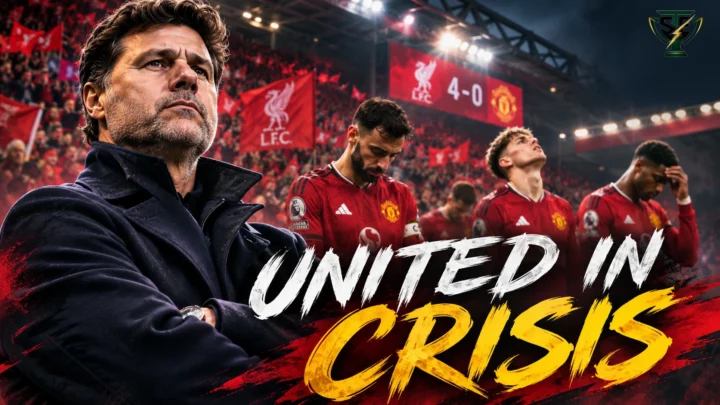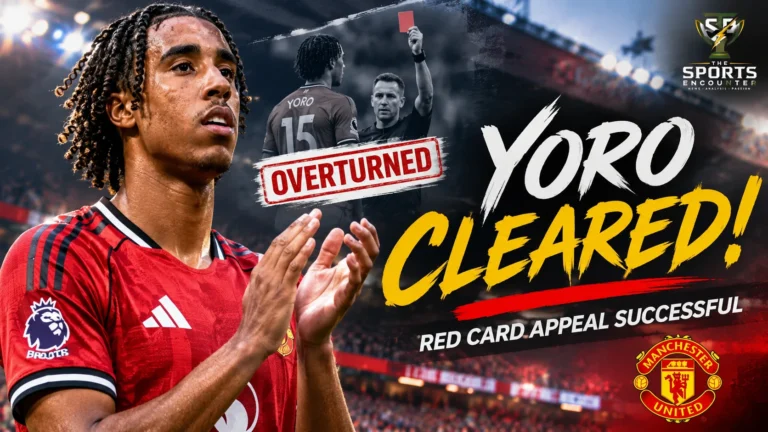
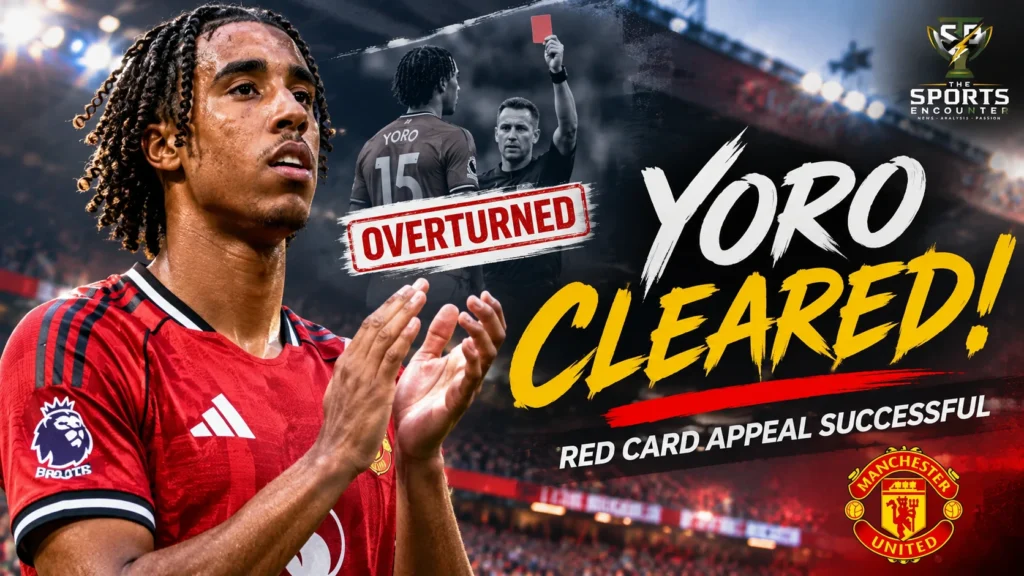
MANCHESTER, England, November 24, 2026: Manchester United have successfully appealed Leny Yoro’s controversial red card against Liverpool, clearing the French defender to face Brentford after the Football Association overturned his dismissal during Sunday’s 4-0 Premier League defeat at Anfield.
The independent Regulatory Commission accepted United’s claim of wrongful dismissal, removing the one-match suspension that followed Yoro’s eighth-minute sending-off for allegedly denying Alexander Isak an obvious goalscoring opportunity.
Key Takeaways
- The independent Regulatory Commission accepted United’s claim of wrongful dismissal, removing the one-match suspension that followed Yoro’s eighth-minute sending-off for allegedly denying Alexander Isak an obvious goalscoring opportunity.
- Yoro was dismissed by referee Sam Barrott after bringing down Liverpool striker Alexander Isak just outside the Manchester United penalty area.
- Yoro’s availability provides Pochettino with an immediate selection benefit ahead of Saturday’s Premier League meeting with Brentford at Old Trafford.
- United host Brentford at Old Trafford on November 28, giving Pochettino his first opportunity to manage the team at home.
The ruling gives new manager Mauricio Pochettino an important defensive option for his first home league match. It also exposes a difficult question for English football: how can a decision considered sufficiently clear to survive an in-match VAR check subsequently be overturned through the disciplinary process?
Story at a glance
Why Manchester United Won Leny Yoro’s Red Card Appeal
Yoro was dismissed by referee Sam Barrott after bringing down Liverpool striker Alexander Isak just outside the Manchester United penalty area.
Was Alexander Isak Denied an Obvious Goalscoring Opportunity?
The central issue was whether Isak had a realistic opportunity to reach the ball and attempt a shot before Lammens intervened.
Why VAR Allowed the Red Card but the FA Overturned It
The apparent contradiction between the two decisions is the most significant issue beyond Yoro’s immediate availability.
How Yoro’s Dismissal Changed Pochettino’s First Manchester United Match
The sending-off immediately disrupted Pochettino’s first competitive assignment as United manager.
Why Overturning the Red Card Cannot Change Liverpool’s Victory
United’s successful appeal has an important but limited effect.
United have obtained the remedy available through the appeal system. The defender’s suspension is gone, but the 4-0 defeat stands. Liverpool retain their three points, and Pochettino must address the defensive failures that left his team 19th in the Premier League.
Why Manchester United Won Leny Yoro’s Red Card Appeal
Yoro was dismissed by referee Sam Barrott after bringing down Liverpool striker Alexander Isak just outside the Manchester United penalty area.
The incident occurred in the eighth minute, with Isak advancing toward goal after a long pass. Barrott judged that Yoro’s challenge had prevented an obvious opportunity to score, an offense that carries a straight red card under the Laws of the Game.
The video assistant referee reviewed the incident without recommending that Barrott reverse his decision.
United challenged the dismissal after the match, arguing that Isak’s heavy touch had taken the ball beyond his immediate control and toward goalkeeper Senne Lammens.
The Football Association subsequently confirmed that the club’s wrongful-dismissal claim had succeeded. Yoro’s one-match suspension was removed, although the independent commission’s detailed written reasons had not been published at the time of the announcement.
That distinction is important. The successful appeal establishes that the dismissal has been overturned. It does not yet establish precisely how the commission evaluated every element of the incident.
The original decision, appeal and outcome were reported by Reuters in its report on the successful challenge.
Was Alexander Isak Denied an Obvious Goalscoring Opportunity?
The central issue was whether Isak had a realistic opportunity to reach the ball and attempt a shot before Lammens intervened.
A foul against the last outfield defender does not automatically justify a red card. Referees must determine whether the offense actually denied an obvious goalscoring opportunity.
Under the International Football Association Board’s Law 12, officials must consider the distance from goal, the general direction of play, the likelihood of the attacker retaining or gaining control of the ball, and the positioning of defenders and attackers.
These criteria explain why the Yoro incident attracted disagreement.
Isak’s Heavy Touch Was Central to the Dispute
Isak was moving toward United’s goal when Yoro made contact with him. However, the Liverpool forward’s touch had sent the ball ahead, bringing the advancing goalkeeper into the calculation.
If Isak was unlikely to regain possession before Lammens collected the ball, the opportunity might not have satisfied the threshold required for a DOGSO dismissal.
That would not necessarily mean Yoro committed no foul. A challenge can be punishable by a free kick without meeting the additional requirements for a red card.
The distinction between the existence of a foul and the seriousness of the disciplinary punishment is essential to understanding the appeal.
United’s case centered on the second question: whether the challenge deprived Liverpool of an opportunity sufficiently obvious to justify removing a player.
Why the Last Defender Argument Is Not Enough
Football discussions frequently describe DOGSO dismissals as last-man red cards. That shorthand can be misleading.
Being the final outfield defender is relevant to the assessment, but it does not settle the decision by itself.
Consider two situations involving an attacker running toward goal.
In the first, the attacker has the ball under close control, is moving directly toward goal and has no realistic defensive obstacle ahead. A foul may clearly deny an obvious scoring opportunity.
In the second, the attacker has pushed the ball too far forward and an advancing goalkeeper is positioned to collect it. Even if the attacker is fouled by the last defender, the scoring opportunity may be less certain.
Yoro’s challenge raised precisely that distinction.
Assessing the goalkeeper’s likely intervention requires judgment about speed, positioning and the trajectory of the ball. It is not enough to establish that Isak was the closest Liverpool attacker to United’s goal.
Why VAR Allowed the Red Card but the FA Overturned It
The apparent contradiction between the two decisions is the most significant issue beyond Yoro’s immediate availability.
VAR and a post-match disciplinary commission perform different functions.
During a match, the video assistant referee assesses whether the on-field decision meets the threshold for intervention under the applicable review protocol. The original referee’s judgment remains important, particularly where an incident involves subjective interpretation.
A disciplinary commission subsequently examines an appeal under the relevant competition rules. Its task is not identical to that of the video assistant referee operating during live play.
Consequently, an appeal can succeed without automatically establishing that the VAR official deliberately ignored evidence or breached the review protocol.
Nevertheless, the outcome raises a legitimate question about consistency.
If the same footage supports an initial dismissal and a later successful appeal, supporters deserve a clear explanation of the reasoning and evidentiary standards involved.
The commission’s written decision will be especially valuable in establishing whether the decisive issue was Isak’s likelihood of reaching the ball, the goalkeeper’s positioning or another aspect of the DOGSO assessment.
Former Referee Dermot Gallagher Supported the Original Decision
The disagreement was evident even before United’s appeal succeeded.
Former Premier League referee Dermot Gallagher defended the on-field dismissal during Sky Sports’ Ref Watch discussion, arguing that the incident appeared to justify a red card from the referee’s perspective.
Former Manchester United captain Roy Keane disagreed with the assessment of Isak’s opportunity, arguing that the Liverpool striker was unlikely to reach the ball.
The competing interpretations are documented in Sky Sports’ examination of the disputed dismissal.
The disagreement demonstrates why DOGSO decisions can be difficult even when video footage is available.
The essential question is not simply whether contact occurred. It is whether that contact removed an opportunity that met the law’s threshold for an obvious chance to score.
How Yoro’s Dismissal Changed Pochettino’s First Manchester United Match
The sending-off immediately disrupted Pochettino’s first competitive assignment as United manager.
United were reduced to ten players before the match had developed into a sustained tactical contest.
Liverpool capitalized almost immediately when Dominik Szoboszlai scored directly from the free kick awarded for Yoro’s challenge.
Florian Wirtz then doubled the advantage, leaving United two goals behind during the opening stages.
Pochettino responded by introducing Harry Maguire for Bryan Mbeumo, sacrificing an attacking player to restore defensive cover.
The substitution was a consequence of the numerical disadvantage. It also changed United’s ability to retain possession, threaten Liverpool’s defense and support their remaining forwards.
That tactical disruption was examined in The Sports Encounter’s analysis of Pochettino’s debut and United’s relegation concerns.
However, the successful appeal should not be treated as proof that United would have avoided defeat with eleven players.
Liverpool scored four goals, and United’s defensive problems had been evident long before the Anfield fixture.
The dismissal altered the conditions of the match. It cannot establish what the result would have been under different circumstances.
Why Overturning the Red Card Cannot Change Liverpool’s Victory
United’s successful appeal has an important but limited effect.
Yoro is no longer required to serve the one-match suspension arising from the dismissal. The decision does not reverse the match result, cancel Liverpool’s goals or award United another opportunity to play the fixture.
This creates a distinction between correcting a disciplinary outcome and repairing the competitive consequences of a decision.
| Issue | After the Appeal |
|---|---|
| Yoro’s red-card suspension | Removed |
| Availability against Brentford | Restored |
| Liverpool’s 4-0 victory | Unchanged |
| Premier League points | Unchanged |
| Commission’s detailed reasoning | Awaiting publication |
| United’s relegation position | Unaffected by the appeal |
The distinction matters because the damage associated with an incorrect dismissal can extend far beyond the player’s suspension.
A team forced to play with ten men may lose tactical flexibility, expend additional energy defending, make substitutions earlier than planned and struggle to create attacking opportunities.
Those consequences cannot be reconstructed reliably after the final whistle.
Football’s disciplinary process can restore a player’s eligibility, but it cannot recreate the match as it might have unfolded without the disputed decision.
That limitation makes accurate in-match decision-making particularly important.
What the Successful Appeal Means for Mauricio Pochettino
Yoro’s availability provides Pochettino with an immediate selection benefit ahead of Saturday’s Premier League meeting with Brentford at Old Trafford.
The French defender remains an important option in a squad whose defensive structure has repeatedly been questioned.
But the manager’s problem extends beyond selecting four defenders.
United have collected only eight points from eleven league matches, leaving them 19th in the standings after the Liverpool defeat.
The club’s difficult start and the scale of Pochettino’s assignment were explored in TSE’s assessment of his relegation challenge.
Yoro’s return offers the possibility of restoring a preferred defensive partnership. It does not automatically solve the weaknesses that have contributed to United’s poor results.
United Need Better Defensive Coordination, Not Just Available Defenders
The sequence leading to Yoro’s dismissal exposed a problem that exists independently of the appeal outcome.
United were vulnerable to a direct pass behind their defensive line, forcing a center-back into a recovery situation against a fast attacker.
Even if the challenge did not warrant a red card, the circumstances leading to it deserve examination.
Pochettino must improve the coordination between United’s defenders and midfielders, particularly when possession changes and opponents attack the space behind the back line.
Continue the Premier League Story

His first weeks in charge will also require decisions about defensive partnerships, the positioning of the fullbacks and how aggressively the team should press.
These concerns were already apparent in The Sports Encounter’s preview of Liverpool against Manchester United, which identified defensive organization as a major challenge for the incoming manager.
The appeal gives Pochettino another available player. His coaching task is to make the defensive unit function more reliably.
Brentford Becomes the First Practical Test of United’s Response
United host Brentford at Old Trafford on November 28, giving Pochettino his first opportunity to manage the team at home.
The fixture carries particular importance because United cannot afford to allow their poor opening to develop into a sustained relegation struggle.
The club’s immediate objectives are straightforward: reduce defensive errors, establish a more reliable midfield structure and convert possession into meaningful attacking opportunities.
Yoro’s availability should give Pochettino greater flexibility in choosing his defensive lineup.
However, the manager must also consider the psychological effect of the Liverpool defeat and the need to establish confidence after another damaging result.
The broader sporting pressure is accompanied by financial concerns. TSE’s analysis of Manchester United’s latest financial results examined why sustained competitive failure creates additional problems for the club’s rebuilding strategy.
A successful appeal provides some relief, but United’s recovery will ultimately be measured through league results rather than disciplinary decisions.
What the FA’s Written Decision Must Clarify
The independent Regulatory Commission’s full reasoning is the most important outstanding development in the case.
Its publication should help establish the basis on which United’s appeal succeeded.
Several questions remain relevant.
Did Isak Have a Realistic Chance of Reaching the Ball?
The commission’s assessment of the ball’s trajectory, Isak’s movement and Lammens’ position could clarify why the dismissal was considered wrongful.
Was the Challenge Still a Foul?
Overturning a DOGSO dismissal does not necessarily establish that no foul occurred. The written reasoning may help distinguish between those two issues.
What Does the Decision Reveal About VAR?
The case raises questions about how subjective judgments are reviewed and whether the existing intervention threshold produces consistent outcomes.
However, the successful appeal alone does not prove that the VAR protocol was breached.
Could the Case Influence Future DOGSO Decisions?
The published reasoning may provide useful guidance for interpreting similar incidents, particularly where an attacker has taken a heavy touch and a goalkeeper is advancing.
It should not automatically be treated as a new rule or a binding change to the Laws of the Game.
Manchester United Have Won the Appeal, but Their Bigger Test Remains
Leny Yoro’s successful appeal provides Manchester United with a welcome correction after a painful defeat.
The defender can face Brentford, and Pochettino has one fewer selection problem as he prepares for his first home Premier League match.
Yet the decision also highlights a weakness in football’s system of correcting mistakes. A disciplinary ruling can remove a suspension after the match, but it cannot restore the tactical choices, playing time or competitive opportunities affected by an earlier decision.
The forthcoming written explanation will determine how much can be learned from the case about the interpretation of DOGSO and the relationship between VAR and post-match appeals.
For United, the immediate sporting challenge is more urgent. Their successful appeal does not change their league position, their defensive record or the need for a substantial improvement under Pochettino.
Yoro has regained his eligibility. Manchester United must now regain their competitive stability.
Manchester United
- Manchester United Win Yoro Red Card Appeal, but Liverpool Defeat Exposes a Bigger VAR Problem
- Pochettino Backs United Players, but Liverpool Rout Exposes a Looming Relegation Crisis
- Arsenal’s Lead, City’s Losing Streak and United’s Survival Fight Feature Premier League Weekend Action
- Who’s Afraid of a Manchester United Comeback? A Peeping Drone Spotted at Carrington
- Manchester United’s Financial Warning Makes Pochettino’s Anfield Debut a Bigger Test