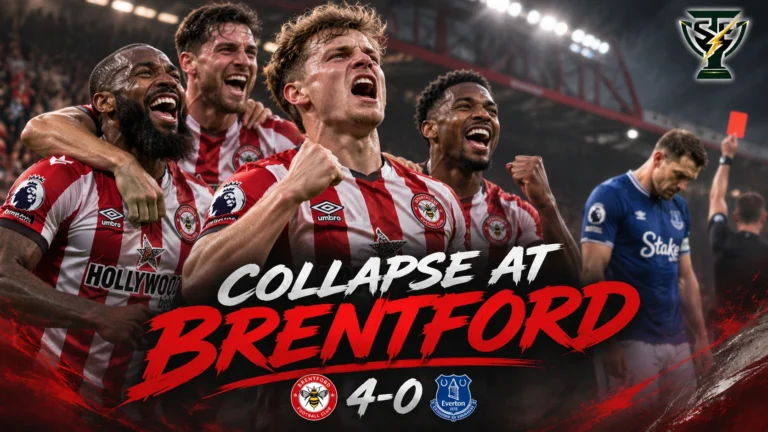
BRENTFORD, England, November 23, 2026: Keane Lewis-Potter scored twice in three minutes as Brentford demolished Everton 4-0 at the Gtech Community Stadium, inflicting a humiliating defeat on David Moyes’ side after captain James Tarkowski was sent off before halftime.
Lewis-Potter struck in the 23rd and 26th minutes to establish a commanding advantage before Tarkowski received a straight red card in the 40th minute following a VAR review. Vitaly Janelt added Brentford’s third goal in the 67th minute, while substitute Fábio Carvalho completed the rout in the closing stages.
Key Takeaways
- Keane Lewis-Potter scored twice in three minutes as Brentford demolished Everton 4-0 at the Gtech Community Stadium, inflicting a humiliating defeat on David Moyes’ side after captain James Tarkowski was sent off before halftime.
- Lewis-Potter struck in the 23rd and 26th minutes to establish a commanding advantage before Tarkowski received a straight red card in the 40th minute following a VAR review.
- The Brentford vs Everton result ended the visitors’ three-match Premier League winning streak and exposed serious defensive problems ahead of their Merseyside derby against Liverpool.
- The result was especially painful for Moyes because the game marked his record-breaking 593rd match in charge of Everton.
The Brentford vs Everton result ended the visitors’ three-match Premier League winning streak and exposed serious defensive problems ahead of their Merseyside derby against Liverpool. For Keith Andrews, it was a particularly satisfying victory because Brentford were without suspended leading scorer Igor Thiago, yet still produced 19 shots, seven on target and 72 percent possession.
Story at a glance
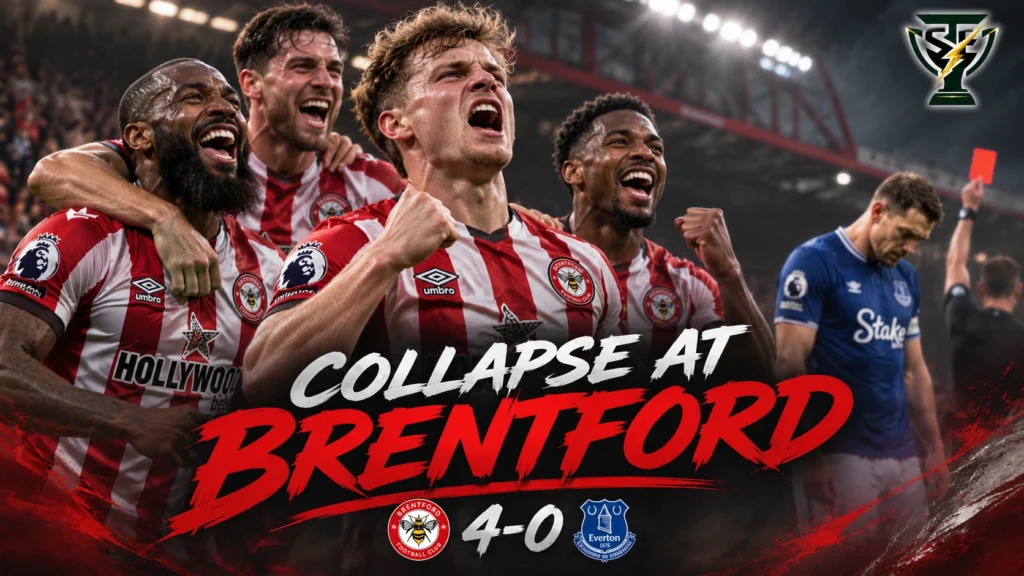
Brentford vs Everton: Two Goals in Three Minutes Destroy Moyes’ Game Plan
The decisive period arrived midway through the first half.
Keane Lewis-Potter Delivers the Performance Brentford Needed Without Igor Thiago
Lewis-Potter’s contribution was particularly important because Brentford entered the game without their leading striker.
James Tarkowski’s Red Card Turned a Defensive Failure Into a Rout
Everton’s evening deteriorated further in the 40th minute.
Vitaly Janelt and Fábio Carvalho Complete Brentford’s Dominant Victory
Brentford’s control continued into the second half.
Everton’s 28 Percent Possession Reveals the Scale of the Collapse
The final statistics underline the imbalance between the teams.
Everton managed just four attempts, two on target and 28 percent possession. Their inability to contain Brentford was apparent well before Tarkowski’s dismissal, making the defensive collapse more concerning than the numerical disadvantage alone might suggest.
The result strengthened Brentford’s position in sixth, while Everton slipped to ninth after an evening that had begun with hopes of continuing their climb toward the European places.
Brentford vs Everton: Two Goals in Three Minutes Destroy Moyes’ Game Plan
The decisive period arrived midway through the first half.
Brentford had already established an encouraging attacking rhythm when Lewis-Potter broke the deadlock in the 23rd minute.
His effort took a deflection that wrong-footed Everton goalkeeper Jordan Pickford, giving the home side a deserved advantage.
Everton barely had time to reorganize before another damaging sequence followed.
Brentford maintained the pressure from a set-piece situation, forcing the visitors into hurried defensive actions. Lewis-Potter reacted to a loose ball and struck again, with the effort deflecting off Thierno Barry on its way into the net.
Two goals within approximately three minutes changed the entire complexion of the match.
The rapid double was especially significant because Everton had arrived with an established defensive structure and confidence from three consecutive victories.
Moyes’ team had previously demonstrated an ability to recover from difficult positions, most notably during their 3-1 victory over Coventry City earlier in the month.
That result featured two goals from Barry and an assist for Kiernan Dewsbury-Hall, as examined in The Sports Encounter’s report on Everton’s comeback against Coventry.
Against Brentford, however, the momentum moved decisively in the opposite direction.
Instead of finding a response after falling behind, Everton conceded again almost immediately.
That failure to stabilize the game became the foundation of their heaviest defeat of the season to date.
Keane Lewis-Potter Delivers the Performance Brentford Needed Without Igor Thiago
Lewis-Potter’s contribution was particularly important because Brentford entered the game without their leading striker.
Thiago was serving the first match of a three-game suspension after receiving a red card during the defeat against Brighton before the international break.
His absence created a significant selection problem for Andrews.
Thiago had been one of Brentford’s most influential attacking players, contributing substantially to their scoring production during the previous campaign and early part of the current season.
Andrews responded by handing Callum Wilson his first Premier League start for the club.
The official Brentford team announcement confirmed Wilson’s selection alongside Dango Ouattara and Jaidon Anthony.
But it was Lewis-Potter who supplied the goals that gave Brentford control.
His success reflected an important aspect of the team’s attacking flexibility.
Rather than relying exclusively on a recognized central striker, Brentford created opportunities through movement across their attacking and midfield positions.
That adaptability has become increasingly important as Andrews attempts to maintain the club’s competitiveness through injuries and suspensions.
The Sports Encounter previously documented Brentford’s attacking potential during their 3-0 victory over Chelsea in the West London derby.
The Everton performance provided another example of how the Bees can punish opponents when their attacking players exploit space aggressively.
James Tarkowski’s Red Card Turned a Defensive Failure Into a Rout
Everton’s evening deteriorated further in the 40th minute.
Tarkowski challenged Brentford midfielder Yehor Yarmoliuk with a high tackle, prompting referee Craig Pawson to issue an initial yellow card.
VAR subsequently recommended an on-field review, after which Pawson upgraded the punishment to a straight red.
Everton were reduced to ten players with more than half the contest remaining.
The dismissal intensified an already difficult situation. Everton were trailing 2-0, struggling to contain Brentford’s attacking movement and now had to reorganize without their captain and experienced central defender.
The challenge for Moyes was immediate.
He needed to preserve enough defensive structure to prevent a wider defeat while retaining some attacking threat that might offer a route back into the contest.
Neither objective was achieved.
Brentford continued controlling possession and territory, eventually adding two further goals.
Why the Red Card Cannot Explain Away Everton’s Entire Performance
The distinction between what happened before and after Tarkowski’s dismissal is crucial.
By the 40th minute, Brentford had already scored twice against Everton’s full-strength lineup.
The visitors’ problems were therefore not created by playing with ten men.
The dismissal made those problems harder to correct.
That sequence matters for Moyes’ post-match assessment. Concentrating entirely on the refereeing decision would overlook the defensive breakdowns that had already placed Everton in serious difficulty.
The team failed to contain Lewis-Potter, struggled to clear dangerous situations and offered too little sustained possession to relieve pressure.
Even before the dismissal, those deficiencies had undermined the defensive organization on which much of Everton’s recent improvement had been built.
Vitaly Janelt and Fábio Carvalho Complete Brentford’s Dominant Victory
Brentford’s control continued into the second half.
With Everton reduced to ten players, Andrews’ team were able to circulate possession more comfortably and force the visitors to defend for prolonged periods.
Janelt scored in the 67th minute, extending the lead to three goals and effectively removing any remaining prospect of a comeback.
The midfielder’s contribution was particularly satisfying because Brentford had already been obtaining important attacking production from several positions.
His goal demonstrated the team’s ability to capitalize on its territorial advantage without needing to force every attack through a conventional striker.
Carvalho then added a fourth in the closing stages after entering as a substitute.
The goal provided another encouraging development for Andrews, with the attacking midfielder returning to the squad following injury problems.
Brentford had confirmed before the match that Carvalho was approaching a return to availability.
His contribution completed an evening in which the home side produced both an emphatic result and evidence of greater attacking depth.
Everton’s 28 Percent Possession Reveals the Scale of the Collapse
The final statistics underline the imbalance between the teams.
| Match Statistic | Brentford | Everton |
|---|---|---|
| Final score | 4 | 0 |
| Shots | 19 | 4 |
| Shots on target | 7 | 2 |
| Possession | 72% | 28% |
| Completed/attempted passes as displayed | 656 passes | 280 passes |
| Pass accuracy | 90% | 71% |
| Corners | 6 | 3 |
| Red cards | 0 | 1 |
Statistics are taken from the final match data accompanying this report. Pass totals represent the source’s displayed passes metric.
Brentford attempted almost five times as many shots as Everton, recording 19 compared with four.
The home side also dominated possession by 44 percentage points.
Its 90 percent passing accuracy reflected the comparatively comfortable conditions in which Brentford were able to move the ball, especially after Tarkowski’s dismissal.
Everton’s 71 percent passing accuracy illustrated their difficulties retaining possession and building meaningful attacks.
Those statistics must be interpreted with the red card in mind, since playing with ten men naturally influences possession and defensive territory.
Nevertheless, the final figures demonstrate why the scoreline was consistent with the overall direction of the game.
Brentford created more opportunities, controlled more possession and applied pressure with far greater regularity.
David Moyes’ Landmark Evening Ends in One of His Most Embarrassing Defeats
The result was especially painful for Moyes because the game marked his record-breaking 593rd match in charge of Everton.
The milestone reflected an extraordinary association with the club across two managerial spells.
Everton had recognized the occasion before kickoff, presenting Moyes with a commemorative tribute.
The club’s official pre-match announcement also highlighted the manager’s milestone and the team’s attempt to extend its winning sequence.
Instead, the celebration ended in a result that raised immediate questions about Everton’s competitive progress.
Moyes has built much of his reputation on defensive organization, physical competitiveness and the ability to make teams difficult to beat.
Everton displayed few of those qualities at Brentford.
The defeat was particularly striking because the team had arrived with confidence following a successful run before the international break.
That recent improvement had encouraged discussion of Everton’s prospects of competing for European qualification.
For Moyes, the task now is to determine whether this was an unusually damaging performance or evidence of weaknesses that opponents can continue exploiting.
Thierno Barry’s Frustrating Night Shows How Quickly Everton’s Momentum Disappeared
Barry’s evening offered another revealing contrast with Everton’s recent form.
The forward had been central to their victory over Coventry, scoring twice during the second half as Moyes’ team overturned a deficit.
He entered the Brentford game as an important attacking threat, supported by a midfield that included Kiernan Dewsbury-Hall and James Garner.
But Everton never established the sustained attacking pressure required to bring those players into the contest consistently.
Barry was also involved in the deflection that contributed to Brentford’s second goal.
His difficulties illustrated a wider problem.
Everton’s recent attacking improvement had depended on effective transitions, controlled possession and the ability to bring their forward players into dangerous areas.
Against Brentford, the midfield struggled to provide that platform.
As the visitors retreated following Tarkowski’s dismissal, their attacking opportunities became even more limited.
Barry was eventually replaced by Brennan Johnson in the second half.
Everton’s defeat therefore represented a collective breakdown rather than the failure of one forward or one defender.
Brentford’s Progress Under Keith Andrews Deserves Greater Recognition
Brentford’s victory also deserves consideration within the wider development of the club.
Andrews entered the campaign seeking to maintain the team’s competitiveness against opponents with considerably larger resources.
The Bees had already delivered several notable results, including their opening-weekend performance against Tottenham.
That victory was part of the early-season developments examined in TSE’s report on the Premier League’s opening weekend.
Brentford subsequently demonstrated their ability to defeat Chelsea and compete against established opponents.
The 4-0 result against Everton strengthens the argument that Andrews has developed an adaptable team capable of winning in different ways.
The victory was achieved without Thiago, and the goals came from Lewis-Potter, Janelt and Carvalho.
That spread of scorers is particularly useful during a season when suspensions and injuries can disrupt established attacking combinations.
Brentford have also demonstrated that they can compete through defensive organization, set-piece effectiveness and aggressive attacking transitions.
The Everton result brought several of those qualities together.
What the Result Means for the Premier League’s European Race
Brentford’s victory lifted them to sixth in the Premier League standings, while Everton dropped to ninth.
That represents an important change in the competitive relationship between two clubs hoping to remain within reach of the European qualification places.
Before the international break, Everton appeared to be developing momentum through three consecutive victories.
Continue the Premier League Story
 Premier LeaguePochettino Backs United Players, but Liverpool Rout Exposes a Looming Relegation Crisis
 Premier LeagueArsenal’s Lead, City’s Losing Streak and United’s Survival Fight Feature Premier League Weekend Action
 Premier LeagueWho’s Afraid of a Manchester United Comeback? A Peeping Drone Spotted at Carrington
Brentford, meanwhile, needed a positive response after losing to Brighton and preparing for a difficult period without Thiago.
Monday’s performance reversed those immediate narratives.
The Bees now have a convincing victory to build upon, while Everton must address the defensive problems exposed by a direct competitor.
However, one match cannot determine which club will finish higher across the season.
Both still face substantial schedules, and the margins in the middle of the table can change quickly.
The Sports Encounter’s preseason Premier League analysis examined the contrasting ambitions facing clubs such as Brentford and Everton as they sought consistency and progress.
The latest result provides a useful measure of how those ambitions are developing.
Everton’s Merseyside Derby Preparation Has Become More Complicated
Everton’s next major challenge is the Merseyside derby against Liverpool.
The fixture carries additional significance because it will test their ability to respond quickly after an emphatic defeat.
Moyes must also contend with Tarkowski’s suspension following his straight red card, subject to any subsequent disciplinary review.
Losing an experienced central defender creates an additional problem against an opponent with considerable attacking quality.
Everton will need to determine how to reorganize their defensive partnerships and improve the protection provided by midfield.
The concern is not simply replacing Tarkowski.
Brentford’s first two goals arrived while he was still on the field, so Moyes must address the wider patterns that left his team vulnerable.
The manager will also need a stronger attacking response from players who struggled to influence the contest in west London.
The Merseyside derby was among the important fixtures identified in TSE’s preview of the latest Premier League action and upcoming challenges.
Following the defeat at Brentford, Everton approach that fixture under considerably greater pressure.
Can Brentford Sustain Their Momentum Without Thiago?
For Andrews, the result creates a different set of questions.
Brentford proved they could score four goals without their leading striker, but Thiago’s suspension continues beyond this match.
That means the coaching staff must maintain attacking effectiveness through other combinations.
Wilson’s involvement, Lewis-Potter’s scoring form and Carvalho’s return provide useful options.
The challenge is to avoid becoming dependent on the extraordinary efficiency of one performance.
Brentford also need to continue developing their defensive stability against opponents who retain a full complement of players.
The dominance over Everton after the red card was impressive, but future matches may require more sustained defending and a different balance of possession.
Andrews will nevertheless be encouraged by the team’s ability to convert a favorable situation into a comprehensive victory.
Brentford did not simply protect their two-goal lead. They continued attacking, added further goals and prevented Everton from establishing a meaningful response.
Brentford’s Victory Exposes a Problem Everton Cannot Blame Entirely on the Referee
The defining feature of Brentford’s 4-0 victory was the sequence in which the damage occurred.
Lewis-Potter scored twice before Tarkowski was dismissed. Everton’s defensive problems were already visible when both teams had eleven players.
The red card increased Brentford’s advantage, while Janelt and Carvalho ensured the final score reflected the home side’s continued control.
For Andrews, the match demonstrated the value of attacking flexibility and the team’s ability to respond to the absence of its most established goalscorer.
For Moyes, it revealed how quickly recent progress can disappear when a team loses defensive discipline and struggles to retain possession.
The Premier League’s official Matchweek 11 analysis had already identified Everton’s creative midfield and Brentford’s home challenge among the important questions surrounding the fixture.
The result provided an emphatic answer.
Brentford have strengthened their case as a team capable of competing near the European places. Everton must rebuild their defensive confidence before one of the most demanding matches of their season.
And the most important lesson from the evening is difficult for Moyes to ignore: Everton were already losing the contest before they lost their captain.
Premier League
- Premier League: Brentford Humiliate Everton 4-0 as Tarkowski Red Card Exposes Moyes’ Defensive Collapse
- Pochettino Backs United Players, but Liverpool Rout Exposes a Looming Relegation Crisis
- Arsenal’s Lead, City’s Losing Streak and United’s Survival Fight Feature Premier League Weekend Action
- Who’s Afraid of a Manchester United Comeback? A Peeping Drone Spotted at Carrington
- Manchester City Financial Case: Three Risks Beyond Points