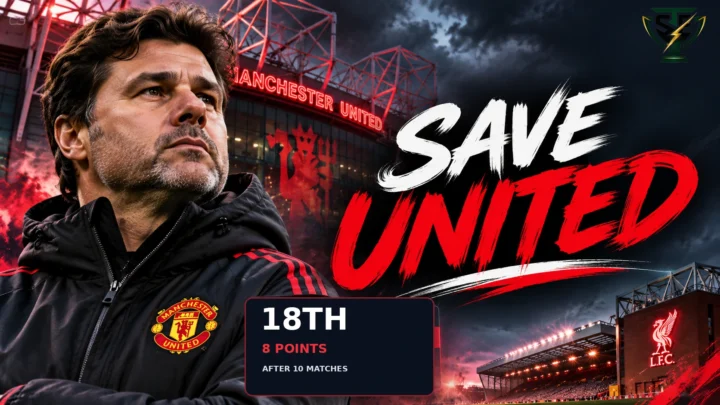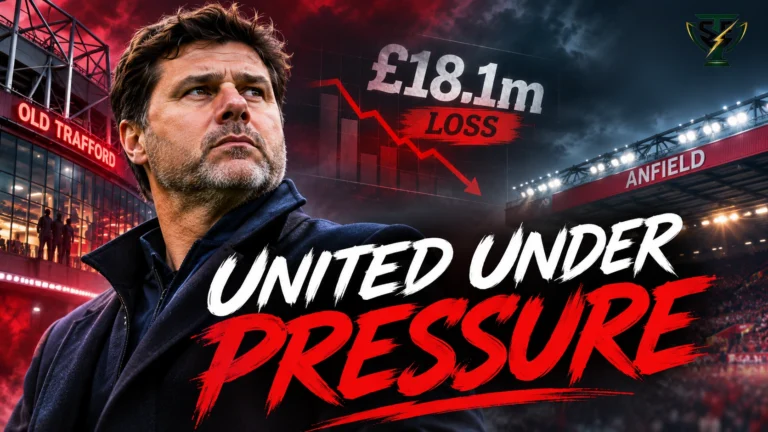
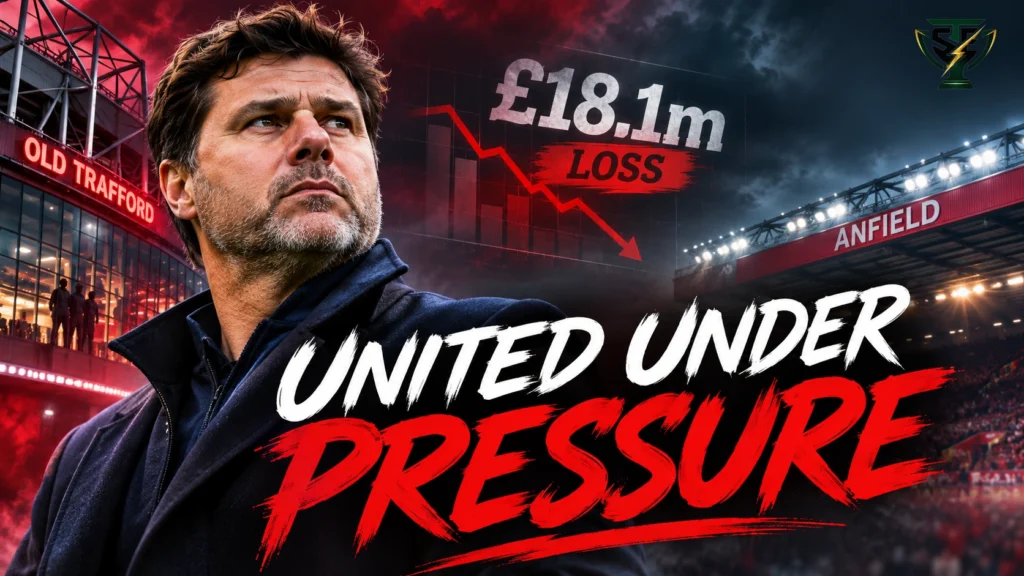
MANCHESTER, England, November 19, 2026: Manchester United earned more money but lost considerably more of it in the latest quarter. Revenue increased to £146.1 million, yet the club reported an £18.1 million net loss, higher borrowing and a reversal in operating profitability. The figures arrived as Mauricio Pochettino began trying to rescue a team sitting 18th in the Premier League, with his first match scheduled against Liverpool at Anfield.
The latest Manchester United finances reveal a problem that another managerial appointment alone cannot resolve. United remain a powerful commercial institution, but the money generated by their global business has not produced a consistently competitive team. Pochettino must begin repairing the football operation immediately, while the club’s leadership faces harder questions about spending efficiency, recruitment decisions and the cost of repeated managerial changes.
Key Takeaways
- United published their first-quarter financial results for fiscal 2027 on Thursday, covering the three months ending September 30, 2026.
- Pochettino officially began work as United’s head coach on November 18 after completing his final responsibilities with the United States men’s national team.
- Pochettino traveled from Cincinnati after completing his final match in charge of the United States, arriving in Manchester with little time to prepare for his first game.
- Liverpool host United on November 22 in a fixture carrying unusually high stakes for the visitors.
Manchester United Finances Reveal the Cost of an Unfinished Rebuild
United published their first-quarter financial results for fiscal 2027 on Thursday, covering the three months ending September 30, 2026.
Story at a glance
Manchester United Finances Reveal the Cost of an Unfinished Rebuild
United published their first-quarter financial results for fiscal 2027 on Thursday, covering the three months ending September 30, 2026.
Why Revenue Growth Has Failed to Protect United From Bigger Losses
The most revealing feature of United’s accounts is the difference between revenue growth and profit performance.
Pochettino Inherits a Sporting Crisis That Predates His Appointment
Pochettino officially began work as United’s head coach on November 18 after completing his final responsibilities with the United States men’s national team.
What Pochettino Can Change Without Another Transfer Window
United’s immediate improvement must come primarily from the players already available.
Why Pochettino’s First Interview Matters More Than His Energy
Pochettino traveled from Cincinnati after completing his final match in charge of the United States, arriving in Manchester with little time to prepare for his first game.
Total revenue increased 4.1% from £140.3 million to £146.1 million. Broadcasting revenue benefited from United’s return to the UEFA Champions League, while matchday income also improved.
However, the additional revenue did not translate into stronger overall profitability.
The club recorded a £3 million operating loss, compared with a £13 million operating profit during the corresponding quarter a year earlier. Its net loss widened from £6.6 million to £18.1 million.
Employee benefit expenses increased by 8.6% to £79.9 million. The club also reported higher non-current borrowings, with refinancing contributing to the year-on-year change.
The figures matter because Pochettino has arrived at a club that already possesses substantial financial resources but needs to use them more effectively.
Manchester United Finances Compared With the Previous Year
| Financial measure | Previous Q1 | Latest Q1 | Change |
|---|---|---|---|
| Total revenue | £140.3m | £146.1m | +4.1% |
| Commercial revenue | £84.2m | £84.1m | -0.1% |
| Broadcasting revenue | £29.9m | £35.2m | +17.7% |
| Matchday revenue | £26.2m | £26.8m | +2.3% |
| Adjusted EBITDA | £26.9m | £27.5m | +2.2% |
| Operating profit/loss | +£13.0m | -£3.0m | £16.0m deterioration |
| Net loss | £6.6m | £18.1m | £11.5m wider loss |
| Employee benefit expenses | £73.6m | £79.9m | +8.6% |
Source: Manchester United plc’s fiscal 2027 first-quarter disclosure. Amounts are rounded to one decimal place. Adjusted EBITDA is a company-reported non-IFRS measure and should not be interpreted as net profit.
The official financial results filed with the US Securities and Exchange Commission provide the detailed figures and accounting explanations.
Why Revenue Growth Has Failed to Protect United From Bigger Losses
The most revealing feature of United’s accounts is the difference between revenue growth and profit performance.
Broadcasting revenue increased by £5.3 million, supported by the club’s return to Champions League participation. Matchday income added another £600,000.
Commercial income, however, remained effectively unchanged at £84.1 million.
Meanwhile, employee expenses increased by approximately £6.3 million, exceeding the club’s £5.8 million growth in total revenue.
That comparison does not establish the complete cause of the net loss. Employee expenses are only one component of the income statement, while player trading, amortization, operating costs, financing and accounting adjustments also influence the final result.
United attributed part of the deterioration in profitability to lower gains from player disposals compared with the corresponding period.
That distinction is important. A reduction in profits from transferring players can worsen reported results even when the club continues generating substantial income from commercial, broadcasting and matchday operations.
The latest quarter therefore contains two different signals.
The underlying business retained its capacity to generate revenue, and adjusted EBITDA increased slightly to £27.5 million. Yet the club’s accounting profitability deteriorated, and its balance sheet continued to carry significant financial obligations.
These are related issues, but they should not be treated as identical measures of financial health.
The £16 Million Operating Swing Is the Most Important Warning
United’s operating position moved from a £13 million profit to a £3 million loss within the same three-month reporting period a year apart.
That represents a £16 million negative swing despite higher revenue.
Measured against the latest quarter’s £146.1 million revenue, the operating loss represents approximately 2.1% of turnover. The previous period generated an operating profit equivalent to roughly 9.3% of revenue.
This produces an operating-margin deterioration of approximately 11.3 percentage points.
The calculation is significant because it demonstrates that revenue growth alone cannot explain the club’s financial trajectory.
A business can earn more and still perform less efficiently if its expenses rise, its player-trading gains decline or other operating factors move against it.
United’s accounts show precisely why examining headline revenue without the underlying profitability measures would provide an incomplete assessment.
Pochettino Inherits a Sporting Crisis That Predates His Appointment
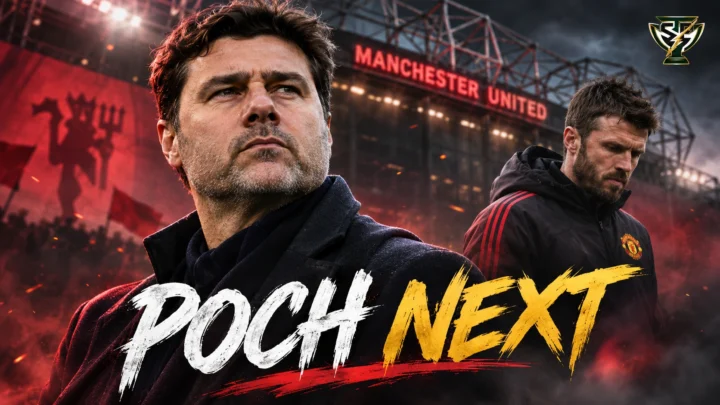
Pochettino officially began work as United’s head coach on November 18 after completing his final responsibilities with the United States men’s national team.
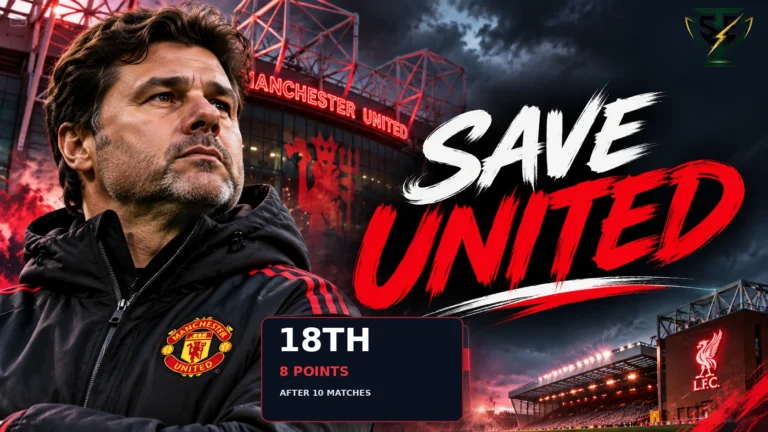
He succeeded Michael Carrick, who was dismissed after overseeing the club’s worst opening ten Premier League matches in four decades.
United have won only once in those ten games and sit third from bottom in the league.
The appointment has therefore been made under immediate competitive pressure.
Pochettino does not have the luxury of spending several months introducing a new system without consequences. United need points while simultaneously correcting the problems responsible for their league position.
The Sports Encounter has already examined the survival implications in its analysis of Pochettino’s 28-game relegation challenge.
That assessment concerns the points United may require to protect their Premier League status. The financial results add a different question: how much more organizational disruption can the club sustain while pursuing recovery?
Pochettino is the eighth permanent United manager or head coach appointed since Sir Alex Ferguson retired in 2013.
Each change has involved different circumstances, but the repeated resets have prevented the club from establishing the managerial continuity that characterized its most successful era.
The historical review of United’s post-Ferguson decline traces how successive approaches have struggled to produce a lasting competitive structure.
The present challenge is particularly severe because the club’s financial resources remain substantial while its league performances have deteriorated sharply.
What Pochettino Can Change Without Another Transfer Window
United’s immediate improvement must come primarily from the players already available.
That places greater importance on tactical organization, fitness, defensive coordination and clear individual responsibilities than on speculation about expensive January signings.
Before Carrick’s dismissal, United had repeatedly struggled to protect space when opponents broke through their initial pressure.
Problems in defensive structure and fixture management were examined in TSE’s tactical analysis of Carrick’s final weeks.
Pochettino’s previous work at Southampton, Tottenham Hotspur and Chelsea provides evidence of his preference for aggressive pressing, energetic movement and coordinated work without the ball.
However, installing those principles successfully requires more than instructing players to run harder.
A pressing system depends on timing, distances between players and the ability to respond when opponents escape pressure.
If the forward line presses while midfielders and defenders remain disconnected, the gaps can make an already vulnerable side easier to attack.
For that reason, United’s new coach faces a sequencing problem: he needs immediate defensive improvement while gradually establishing the collective intensity associated with his best teams.
Three Immediate Priorities for Pochettino
| Priority | Immediate action | Evidence of improvement |
|---|---|---|
| Defensive organization | Reduce the space between midfield and defense | Fewer uncontested entries into dangerous central areas |
| Pressing coordination | Establish clear triggers and supporting positions | More controlled recoveries without exposing the back line |
| Attacking decision-making | Improve support around ball carriers and runners | Better chances created without sacrificing defensive balance |
These are analytical priorities based on United’s reported weaknesses and Pochettino’s established coaching approach, not confirmed instructions from his private training sessions.
The distinction matters because there has been insufficient time to determine which tactical changes he will introduce permanently.
Why Pochettino’s First Interview Matters More Than His Energy
Pochettino traveled from Cincinnati after completing his final match in charge of the United States, arriving in Manchester with little time to prepare for his first game.
He spoke about the responsibility of managing United and emphasized the need to understand the club’s players, staff, culture and identity.
His remarks about having little time to sleep captured the urgency of the appointment, but the more important point was his emphasis on learning about the squad before trying to transform it.
The club’s account of Pochettino’s first interview outlines his initial approach and expectations.
His immediate task is unusual because he has taken charge during an international break and must prepare for one of English football’s most demanding away fixtures.
United cannot realistically expect a completely new playing identity after only a few training sessions.
What they can expect is evidence of preparation, disciplined team selection and a clearer approach to defending against Liverpool.
Pochettino’s first match will therefore reveal more about his short-term decisions than his long-term tactical project.
Anfield Is a Test of Judgment Before It Becomes a Test of Philosophy
Liverpool host United on November 22 in a fixture carrying unusually high stakes for the visitors.
Under normal circumstances, the rivalry itself would dominate the buildup. United’s league position and managerial change have added a more urgent dimension.
Pochettino arrives after United’s failure to establish consistency across their opening ten league matches.
Liverpool will be expected to challenge a side whose defensive organization has repeatedly been questioned, particularly during transitions.
The new manager must decide how aggressively to press, how much possession to contest and how to protect the spaces Liverpool can exploit when they recover the ball.
Attempting to introduce an entirely new, high-risk playing system immediately could create additional vulnerabilities.
Conversely, defending too deeply without an effective route forward would invite sustained pressure and limit United’s ability to create chances.
The balance between those approaches will be one of the most meaningful tactical indicators of Pochettino’s early judgment.
What Would Count as Progress at Anfield?
The result will matter because United urgently need league points, but the performance can also offer useful evidence.
United should aim to maintain compact distances between their defensive and midfield units, avoid repeated turnovers in dangerous positions and create attacks through coordinated movement rather than isolated individual efforts.
Those measures provide a more informative assessment than judging every tactical decision through the final score alone.
A victory would provide an immediate lift. A draw could offer a useful foundation depending on the performance. A defeat would increase pressure, particularly if familiar defensive problems remain unresolved.
The Premier League’s official matchweek analysis identifies Pochettino’s debut as one of the leading storylines following the international break.
The Sports Encounter previously assessed the difficulties surrounding his appointment in its report on Pochettino leaving the United States for Manchester United.
The difference now is that the appointment has been completed, the financial results have been published and the first competitive test is approaching.
United’s Debt Makes Recruitment Efficiency More Important
The club’s financial disclosures also highlighted rising non-current borrowings.
Borrowings denominated in US dollars increased from $650 million to $775 million, with the corresponding sterling value rising from £481.2 million to £577.4 million.
The increase was influenced by refinancing. It should not automatically be interpreted as the club borrowing an additional £96.2 million entirely to fund new player purchases.
Nevertheless, the higher reported borrowing balance remains relevant when evaluating financial flexibility.
United also reported cash and cash equivalents of £55.5 million at September 30.
That cash figure cannot be treated as the club’s entire available transfer budget. Nor can the borrowing figure alone establish how much United may spend under applicable financial regulations.
Transfer capacity depends on several factors, including future cash flows, payment commitments, financing arrangements, squad sales and the relevant competition rules.
The broader implication is that United’s recruitment decisions need to produce more consistent value.
The club cannot simply assume that each disappointing season can be corrected through another expensive cycle of arrivals and departures.
Continue the Premier League Story

Its repeated rebuilding attempts have already raised questions about planning, player suitability and the relationship between recruitment and managerial appointments.
Those issues were explored in TSE’s investigation into why United’s rebuilds have repeatedly failed.
Pochettino’s value may ultimately depend partly on whether he can improve existing players rather than requiring an extensive replacement program.
The Financial Results Cannot Yet Measure the Cost of Pochettino’s Arrival
An important reporting distinction concerns the timing of United’s financial disclosures.
The first-quarter results cover the three months ending September 30.
Carrick’s dismissal and Pochettino’s appointment occurred in November, after that reporting period closed.
Consequently, the newly published first-quarter loss cannot simply be attributed to the managerial change.
Any relevant compensation, contractual or staffing costs recognized after September 30 would need to be assessed in the appropriate subsequent reporting period.
That distinction prevents a misleading interpretation of the financial numbers.
United’s accounts demonstrate that the club was already facing financial pressure before Pochettino took charge. They do not provide a complete accounting of the cost of appointing him or reorganizing his coaching staff.
The club has maintained its full-year revenue guidance of £740 million to £760 million and adjusted EBITDA guidance of £205 million to £225 million.
Those forecasts indicate that management continues to expect substantial business activity and adjusted operating earnings despite the difficult opening quarter.
However, guidance is a forecast rather than a guarantee, and adjusted EBITDA should not be confused with net earnings or unrestricted cash available for transfers.
Can Sporting Recovery and Financial Recovery Reinforce Each Other?
United’s return to Champions League participation helps explain the rise in broadcasting revenue.
That provides one example of how sporting performance can influence the club’s financial results.
European qualification, progression through competitions and competitive league finishes can affect broadcasting distributions, commercial opportunities and the club’s wider financial planning.
Conversely, prolonged underperformance can reduce the sporting opportunities through which clubs generate those revenues.
United’s current league position makes that relationship particularly relevant.
Relegation would have major sporting and financial implications, although its precise effects would depend on contractual terms, revenue arrangements and the eventual circumstances.
The existing TSE relegation analysis examines that immediate risk. The newly disclosed accounts expose why preserving Premier League status is only the beginning of the club’s wider recovery.
Even if Pochettino quickly moves United away from the bottom three, the organization must still address its borrowing obligations, spending decisions and long-term competitive planning.
Equally, improving the club’s accounts without building a more effective team would leave the central sporting problem unresolved.
The Real Test Is Whether Manchester United Can Stop Rebuilding From Scratch
The latest Manchester United finances underline a problem that has survived several managerial appointments: the club continues to generate significant income without consistently turning its resources into competitive stability.
Pochettino arrives with a credible history of developing teams and improving their collective organization, but his previous achievements do not guarantee success at Old Trafford.
His immediate responsibilities are clear. United must defend better, establish a more coherent playing identity and collect enough points to escape the relegation places.
The board’s responsibilities are equally important. Recruitment must support a sustainable football plan, spending must be measured against actual improvement, and managerial decisions must avoid repeating the expensive instability of previous years.
Anfield will provide the first examination of Pochettino’s methods. The next financial statements will reveal more about the club’s underlying trajectory and the costs associated with its latest restructuring.
The two assessments should ultimately be connected.
United cannot build a lasting recovery through managerial enthusiasm alone, and commercial strength cannot indefinitely substitute for results on the pitch.
The challenge facing Manchester United is whether the club can finally make its football decisions as effective as the business that finances them.
Manchester United
- Manchester United’s Financial Warning Makes Pochettino’s Anfield Debut a Bigger Test
- Pochettino Has 28 Games to Save Manchester United From Relegation
- The End of Juan Mata Era: What Made Him So Special
- Pochettino Makes Transatlantic Move to Rescue Sinking Manchester United
- How Carrick’s Tactics, Injuries, and Fixture Congestion Trapped Manchester United