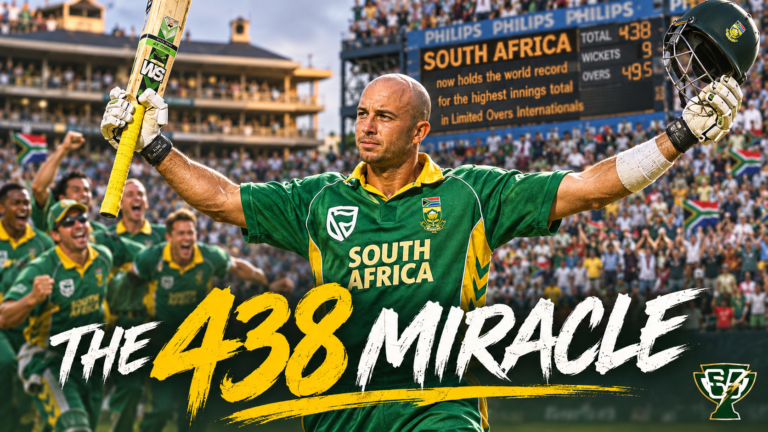
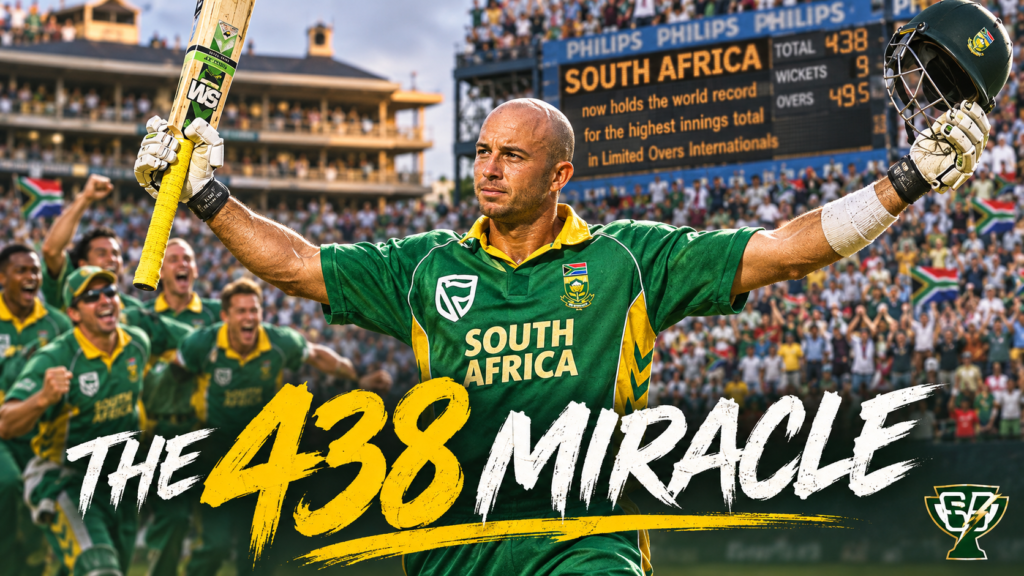
JOHANNESBURG, South Africa, March 12, 2006: Australia had just scored 434/4, the highest total in One-Day International history. Ricky Ponting had destroyed South Africa’s bowling attack with 164 from 105 deliveries, and the reigning world champions appeared certain to win the fifth ODI and clinch the series. What followed at the Wanderers Stadium overturned every expectation. Herschelle Gibbs hammered 175, Graeme Smith contributed 90, and Mark Boucher held his nerve in the final over as South Africa reached 438/9 with one ball remaining, completing an extraordinary one-wicket victory.
The match produced 872 runs, 87 boundaries and 26 sixes across 599 legal deliveries. Australia had four batters score at least 50, yet still lost. South Africa’s innings included a breathtaking 187-run partnership between Smith and Gibbs, followed by a middle-order collapse that nearly handed Australia victory. Nathan Bracken took five wickets, Brett Lee had the chance to defend seven runs in the final over, and Boucher eventually struck the winning boundary. Gibbs and Ponting shared the Player of the Match award, but it was South Africa who claimed the five-match series 3-2.
Key Takeaways
- Australia had just scored 434/4, the highest total in One-Day International history.
- Johan van der Wath’s innings is sometimes overlooked because Gibbs, Smith and Boucher dominate memories of the match.
- The 2006 Johannesburg ODI challenged established expectations about what constituted a defendable score.
- The South Africa-Australia encounter at Johannesburg combined almost every quality that makes ODI cricket memorable.
This encounter opens the bilateral-series section of The Sports Encounter’s A Celebration of 5000 ODIs, our collection of 100 unforgettable men’s One-Day Internationals.
Story at a glance
South Africa vs Australia 2006: Match Summary
The series had been tied 2-2 before the decisive encounter.
Ricky Ponting’s 164 Establishes a World Record Australia Cannot Defend
Ricky Ponting produced one of the finest ODI innings of his career.
Adam Gilchrist, Simon Katich and Michael Hussey Build the 434 Total
Ponting’s innings dominated the headlines, but Australia’s record total depended on several significant contributions.
Graeme Smith’s 90 Makes the Impossible Chase Look Possible
South Africa’s pursuit began badly.
Herschelle Gibbs’ 175 Produces the Innings That Changes ODI History
Herschelle Gibbs delivered one of the most astonishing innings in ODI cricket.
Its inclusion requires little justification from the result alone, but the complete story is even more remarkable. Australia broke the world record for the highest ODI innings, South Africa surpassed it hours later, and the final result was decided with the last pair at the crease.
South Africa vs Australia 2006: Match Summary
| Match detail | Information |
|---|---|
| Tournament | Australia tour of South Africa 2005-06 |
| Match | Fifth ODI, series decider |
| Date | March 12, 2006 |
| Venue | New Wanderers Stadium, Johannesburg |
| Toss | Australia won and elected to bat |
| Australia | 434/4, 50 overs |
| South Africa | 438/9, 49.5 overs |
| Result | South Africa won by 1 wicket |
| Balls remaining | 1 |
| Series result | South Africa won 3-2 |
| Players of the Match | Herschelle Gibbs and Ricky Ponting |
| Player of the Series | Shaun Pollock |
| Australia’s highest scorer | Ricky Ponting, 164 |
| South Africa’s highest scorer | Herschelle Gibbs, 175 |
| Best bowling, Australia | Nathan Bracken, 5/67 |
| Winning batter | Mark Boucher, 50* |
| Total match aggregate | 872 runs |
The series had been tied 2-2 before the decisive encounter.
Australia had won the fourth ODI at Durban by one wicket, setting up a winner-takes-all finish in Johannesburg.
Both teams possessed formidable batting lineups, but few spectators could have anticipated the scale of what was about to unfold.
Ricky Ponting’s 164 Establishes a World Record Australia Cannot Defend
Ricky Ponting produced one of the finest ODI innings of his career.
The Australian captain scored 164 from just 105 deliveries, striking 13 fours and nine sixes.
His strike rate of 156.19 was extraordinary, particularly in an era when totals above 350 were still considered exceptional.
Ponting came to the crease after Adam Gilchrist and Simon Katich had established a 97-run opening partnership.
Gilchrist scored 55 from 44 balls, striking nine boundaries.
Katich then provided stability with 79 from 90 deliveries.
Their performances allowed Ponting to attack without the pressure of rebuilding an innings.
Australia reached 216/2 when Katich departed in the 31st over.
Ponting was already well established.
He then accelerated alongside Michael Hussey, who contributed 81 from 51 balls.
The third-wicket partnership added 158 runs.
Australia advanced to 374/3 in the 47th over.
Ponting continued attacking, eventually falling for 164 with the score at 407/4.
By then, Australia had moved beyond anything previously achieved in ODI cricket.
Andrew Symonds finished unbeaten on 27 from 13 deliveries, while Brett Lee contributed nine not out.
Australia closed at 434/4.
The previous highest ODI total had been Sri Lanka’s 398/5 against Kenya in the 1996 World Cup.
Australia had surpassed that record by 36 runs.
For a few hours, Ponting’s innings appeared certain to define the match.
Ricky Ponting’s Record-Breaking Innings
| Statistic | Performance |
|---|---|
| Runs | 164 |
| Balls faced | 105 |
| Fours | 13 |
| Sixes | 9 |
| Strike rate | 156.19 |
| Partnership with Hussey | 158 |
| Australia’s final total | 434/4 |
| Share of team runs | 37.79% |
| Player of the Match | Joint winner |
Ponting alone struck nine sixes, as many as South Africa’s entire team would hit during the chase.
His innings deserved the official recognition it received, even though Australia eventually lost.
Adam Gilchrist, Simon Katich and Michael Hussey Build the 434 Total
Ponting’s innings dominated the headlines, but Australia’s record total depended on several significant contributions.
Gilchrist attacked immediately, scoring 55 from 44 deliveries.
His opening partnership with Katich forced South Africa’s bowlers onto the defensive.
Katich played the more measured innings, scoring 79 from 90 balls.
His partnership with Ponting ensured Australia continued accumulating runs after Gilchrist departed.
Hussey then provided the late acceleration.
His 81 from 51 deliveries included nine fours and three sixes.
Together, Ponting and Hussey added 158 runs, pushing Australia toward the 400-run mark.
Australia’s top four batters collectively scored 379 runs.
The innings contained sustained aggression rather than a single isolated burst.
South Africa’s bowlers conceded 434 runs, with Roger Telemachus taking two wickets for 87.
Makhaya Ntini and Andrew Hall claimed one wicket each.
Jacques Kallis conceded 70 runs from six overs, while Johan van der Wath went for 76 from ten.
Australia had dominated the first innings.
Their challenge was to defend a target of 435, considerably higher than any successful ODI chase at the time.
Graeme Smith’s 90 Makes the Impossible Chase Look Possible
South Africa’s pursuit began badly.
Boeta Dippenaar was bowled by Nathan Bracken for one, leaving the hosts at 3/1.
A chase of 435 looked even more daunting.
Captain Graeme Smith responded by attacking Australia’s bowlers from the beginning.
He scored 90 from just 55 deliveries, striking 13 fours and two sixes.
His strike rate of 163.64 transformed the early stages of the innings.
Smith recognized that South Africa could not afford a prolonged rebuilding phase.
The required scoring rate was already 8.70 runs per over.
Allowing that rate to climb substantially would make the target increasingly difficult.
Smith therefore attacked alongside Herschelle Gibbs.
The pair added 187 runs for the second wicket.
South Africa advanced to 190/2 in the 23rd over.
Smith eventually fell to Michael Clarke for 90.
However, his innings had changed the entire competitive balance.
South Africa had reached nearly 200 before the halfway point.
The chase was no longer merely a theoretical possibility.
Herschelle Gibbs’ 175 Produces the Innings That Changes ODI History
Herschelle Gibbs delivered one of the most astonishing innings in ODI cricket.
He scored 175 from 111 deliveries, striking 21 fours and seven sixes.
His strike rate of 157.66 allowed South Africa to remain ahead of the required scoring rate for long periods.
Gibbs initially supported Smith’s attacking approach.
After the captain departed, he assumed responsibility for controlling the chase.
He combined with AB de Villiers, who made 14, as South Africa added another 94 runs for the third wicket.
The hosts reached 284/3.
Gibbs continued attacking, reaching 150 from just 100 balls.
Australia’s bowlers struggled to find a response.
Stuart Clark conceded 54 from six overs.
Andrew Symonds went for 75 from nine.
Mick Lewis suffered the most difficult spell, conceding 113 from ten overs without taking a wicket.
However, Gibbs eventually fell for 175, caught by Brett Lee off Symonds.
South Africa were 299/4 in the 32nd over.
They still required 136 runs.
The dismissal revived Australia’s hopes because the most destructive batter in the match was gone.
Herschelle Gibbs’ Historic Innings
| Statistic | Performance |
|---|---|
| Runs | 175 |
| Balls faced | 111 |
| Fours | 21 |
| Sixes | 7 |
| Strike rate | 157.66 |
| Partnership with Smith | 187 |
| Partnership with de Villiers | 94 |
| Score when dismissed | 299/4 |
| Runs still needed | 136 |
| Player of the Match | Joint winner |
Gibbs scored 39.95% of South Africa’s final total.
His 175 also represented the difference between a chase that appeared impossible before the innings began and one that Australia could no longer comfortably control.
Why South Africa vs Australia 2006 Changed Expectations About Big Chases
Before this match, no team had successfully chased even 350 in an ODI.
The previous record successful pursuit was New Zealand’s 332/8 against Australia at Christchurch in 2005.
South Africa increased that record by 106 runs.
The significance lies partly in how quickly the chase developed.
South Africa reached 190/2 after 22.1 overs.
Gibbs’ dismissal came at 299/4 with more than 18 overs remaining.
The hosts still needed substantial runs, but they had created enough scoring opportunities to keep the target achievable.
That attacking approach challenged the conventional assumption that a target above 400 would be effectively impossible to chase.
Mark Boucher’s Unbeaten 50 Holds South Africa Together After Gibbs Departs
Mark Boucher entered at a critical stage.
South Africa had lost Gibbs for 175 and needed 136 more runs.
The wicketkeeper-batter scored an unbeaten 50 from 43 deliveries, striking four boundaries.
His contribution was particularly important because South Africa continued losing wickets.
Jacques Kallis made 20 before Symonds dismissed him.
Justin Kemp contributed 13 but fell to Bracken.
South Africa slipped to 355/6.
The hosts still needed 80 runs with only four wickets remaining.
Boucher now had to balance the required scoring rate with preserving the remaining batting resources.
He found valuable support from Johan van der Wath.
The lower-order batter scored 35 from just 18 deliveries, striking three sixes.
Their seventh-wicket partnership added 44 runs.
South Africa advanced to 399/7.
Van der Wath’s dismissal left the hosts needing another 36 runs.
Boucher remained.
Roger Telemachus then made 12 from six deliveries, helping South Africa reach 423/8.
The chase remained alive, but Australia had regained a realistic opportunity to win.
Boucher eventually faced the final over knowing that one mistake could end South Africa’s hopes.
Nathan Bracken’s 5/67 Nearly Rescues Australia After Conceding 434
Nathan Bracken deserves considerable recognition for his performance.
He took five wickets for 67 runs from ten overs.
His figures were outstanding in the context of an innings that produced 438 runs.
Bracken dismissed Dippenaar early.
He later removed AB de Villiers for 14, preventing South Africa from extending the third-wicket partnership.
His most important contributions came during the final stages.
Bracken dismissed Kemp, van der Wath and Telemachus.
Those wickets repeatedly interrupted South Africa’s recovery.
Australia had been unable to stop Gibbs and Smith, but Bracken ensured the chase remained uncertain until the final over.
His five wickets also demonstrate why this was a genuinely competitive contest rather than an uninterrupted batting exhibition.
South Africa lost nine wickets while pursuing 435.
Bracken was responsible for more than half those dismissals.
Johan van der Wath’s 35 Provides the Overlooked Contribution
Johan van der Wath’s innings is sometimes overlooked because Gibbs, Smith and Boucher dominate memories of the match.
However, his 35 from 18 deliveries played a crucial role.
South Africa were 355/6 when Justin Kemp departed.
The hosts still needed 80 runs, with four wickets remaining.
Van der Wath attacked Australia’s bowlers rather than allowing the required scoring rate to increase.
His innings included three sixes and one four.
He added 44 runs with Boucher before Bracken dismissed him.
South Africa were 399/7.
The partnership reduced the target from 80 runs to 36.
That change was crucial.
Boucher still had to finish the chase, but van der Wath’s aggressive contribution prevented Australia from establishing complete control.
South Africa’s Lower-Order Contributions
| Batter | Runs | Balls | Strike rate |
|---|---|---|---|
| Mark Boucher | 50* | 43 | 116.28 |
| Justin Kemp | 13 | 17 | 76.47 |
| Johan van der Wath | 35 | 18 | 194.44 |
| Roger Telemachus | 12 | 6 | 200.00 |
| Andrew Hall | 7 | 4 | 175.00 |
| Makhaya Ntini | 1* | 1 | 100.00 |
Van der Wath and Telemachus combined to score 47 runs from just 24 deliveries.
Those runs helped South Africa remain competitive after losing several established batters.
Brett Lee’s Final Over: How Boucher and Ntini Completed the Chase
South Africa required seven runs from the final six deliveries.
Brett Lee had the ball.
Boucher was at the crease alongside Andrew Hall.
The equation was manageable, but South Africa had only two wickets remaining.
Boucher took a single from the first delivery.
Hall then struck a boundary, reducing the target to two runs.
However, Hall attempted another attacking shot and was caught by Michael Clarke.
South Africa were 433/9.
Australia needed one wicket.
Makhaya Ntini, the No. 11 batter, joined Boucher.
Ntini survived and collected a single to level the scores at 434.
South Africa needed one run to win.
Boucher faced the fifth delivery of the over.
He struck Lee for four.
The ball reached the boundary, completing the chase.
South Africa finished on 438/9 after 49.5 overs.
The stadium erupted as the hosts secured an extraordinary one-wicket victory and the series trophy.
Australia had established a world record earlier in the day.
South Africa had broken it before the match ended.
Five Turning Points in the 438 Game
1. Australia Reach 434/4
Ponting’s 164, supported by Gilchrist, Katich and Hussey, established the highest ODI total ever recorded at that point.
South Africa needed to produce an unprecedented chase.
2. Smith and Gibbs Add 187 Runs
After losing Dippenaar early, South Africa attacked rather than retreating into a cautious rebuilding phase.
Continue A Celebration of 5000 ODIs
 A Celebration of 5000 ODIsA Celebration of 5000 ODIs Match 70: Pakistan vs Sri Lanka 2017, Sarfaraz and Amir Rescue a Lost Champions Trophy Chase
 A Celebration of 5000 ODIsA Celebration of 5000 ODIs Match 69: Praveen Kumar’s Four Wickets, Tendulkar’s 91 Break Australia in Brisbane Thriller
 A Celebration of 5000 ODIsA Celebration of 5000 ODIs Match 68: Aaqib Javed Takes 7/37, Three Indian Stars Fall in Three Balls as Pakistan Rule Sharjah
The partnership took the hosts to 190/2 and transformed the contest.
3. Gibbs Falls for 175 at 299/4
The dismissal removed South Africa’s dominant batter with 136 runs still required.
Australia regained hope.
4. Van der Wath Adds 35 From 18 Balls
With South Africa six wickets down and needing 80, van der Wath’s aggressive innings maintained the required scoring rate.
His partnership with Boucher brought the hosts closer to victory.
5. Ntini Levels the Scores Before Boucher Wins It
Hall’s dismissal at 433/9 left South Africa one wicket away from defeat.
Ntini survived and took the tying run.
Boucher then struck the winning boundary.
Australia vs South Africa 2006: Complete Match Scorecard
Australia Innings: 434/4 in 50 Overs
| Batter | Dismissal | R | B | 4s | 6s | SR |
|---|---|---|---|---|---|---|
| Adam Gilchrist (wk) | c Hall b Telemachus | 55 | 44 | 9 | 0 | 125.00 |
| Simon Katich | c Telemachus b Ntini | 79 | 90 | 9 | 1 | 87.78 |
| Ricky Ponting (c) | c Dippenaar b Telemachus | 164 | 105 | 13 | 9 | 156.19 |
| Michael Hussey | c Ntini b Hall | 81 | 51 | 9 | 3 | 158.82 |
| Andrew Symonds | Not out | 27 | 13 | 3 | 1 | 207.69 |
| Brett Lee | Not out | 9 | 7 | 0 | 0 | 128.57 |
| Damien Martyn | Did not bat | |||||
| Michael Clarke | Did not bat | |||||
| Nathan Bracken | Did not bat | |||||
| Stuart Clark | Did not bat | |||||
| Mick Lewis | Did not bat | |||||
| Extras | 4 leg-byes, 5 wides, 10 no-balls | 19 | ||||
| Total | 4 wickets, 50 overs | 434 |
Fall of wickets: 1-97 (Gilchrist, 15.2), 2-216 (Katich, 30.3), 3-374 (Hussey, 46.1), 4-407 (Ponting, 47.4).
South Africa Bowling
| Bowler | Overs | Maidens | Runs | Wickets | Economy |
|---|---|---|---|---|---|
| Makhaya Ntini | 9 | 0 | 80 | 1 | 8.89 |
| Andrew Hall | 10 | 0 | 80 | 1 | 8.00 |
| Johan van der Wath | 10 | 0 | 76 | 0 | 7.60 |
| Roger Telemachus | 10 | 1 | 87 | 2 | 8.70 |
| Graeme Smith | 4 | 0 | 29 | 0 | 7.25 |
| Jacques Kallis | 6 | 0 | 70 | 0 | 11.67 |
| Justin Kemp | 1 | 0 | 8 | 0 | 8.00 |
South Africa Innings: 438/9 in 49.5 Overs
| Batter | Dismissal | R | B | 4s | 6s | SR |
|---|---|---|---|---|---|---|
| Graeme Smith (c) | c Hussey b Michael Clarke | 90 | 55 | 13 | 2 | 163.64 |
| Boeta Dippenaar | b Bracken | 1 | 7 | 0 | 0 | 14.29 |
| Herschelle Gibbs | c Lee b Symonds | 175 | 111 | 21 | 7 | 157.66 |
| AB de Villiers | c Michael Clarke b Bracken | 14 | 20 | 1 | 0 | 70.00 |
| Jacques Kallis | c & b Symonds | 20 | 21 | 1 | 0 | 95.24 |
| Mark Boucher (wk) | Not out | 50 | 43 | 4 | 0 | 116.28 |
| Justin Kemp | c Martyn b Bracken | 13 | 17 | 0 | 0 | 76.47 |
| Johan van der Wath | c Ponting b Bracken | 35 | 18 | 1 | 3 | 194.44 |
| Roger Telemachus | c Hussey b Bracken | 12 | 6 | 2 | 0 | 200.00 |
| Andrew Hall | c Michael Clarke b Lee | 7 | 4 | 1 | 0 | 175.00 |
| Makhaya Ntini | Not out | 1 | 1 | 0 | 0 | 100.00 |
| Extras | 4 byes, 8 leg-byes, 4 wides, 4 no-balls | 20 | ||||
| Total | 9 wickets, 49.5 overs | 438 |
Fall of wickets: 1-3 (Dippenaar, 1.2), 2-190 (Smith, 22.1), 3-284 (de Villiers, 30.5), 4-299 (Gibbs, 31.5), 5-327 (Kallis, 37.4), 6-355 (Kemp, 42.1), 7-399 (van der Wath, 46.3), 8-423 (Telemachus, 48.2), 9-433 (Hall, 49.3).
Australia Bowling
| Bowler | Overs | Maidens | Runs | Wickets | Economy |
|---|---|---|---|---|---|
| Brett Lee | 7.5 | 0 | 68 | 1 | 8.68 |
| Nathan Bracken | 10 | 0 | 67 | 5 | 6.70 |
| Stuart Clark | 6 | 0 | 54 | 0 | 9.00 |
| Mick Lewis | 10 | 0 | 113 | 0 | 11.30 |
| Andrew Symonds | 9 | 0 | 75 | 2 | 8.33 |
| Michael Clarke | 7 | 0 | 49 | 1 | 7.00 |
Result: South Africa won by one wicket with one delivery remaining.
Series result: South Africa won the five-match ODI series 3-2.
Joint Players of the Match: Herschelle Gibbs, 175 from 111 deliveries, and Ricky Ponting, 164 from 105 deliveries.
Player of the Series: Shaun Pollock.
The Records That Made the Johannesburg ODI Extraordinary
The contest produced records that remain central to the history of one-day cricket.
| Record or milestone | Achievement |
|---|---|
| Australia’s innings | 434/4, then an ODI world record |
| South Africa’s innings | 438/9, new ODI world record |
| Successful chase | 435-run target, highest completed ODI chase |
| Match aggregate | 872 runs |
| Sixes | 26 |
| Fours | 61 |
| Ricky Ponting | 164 from 105 balls |
| Herschelle Gibbs | 175 from 111 balls |
| Nathan Bracken | 5/67 |
| Match margin | One wicket |
| Balls remaining | One |
The 872-run aggregate remained a remarkable benchmark even as modern batting standards developed.
Australia’s 434 became the first 400-plus total in men’s ODI history.
South Africa’s 438 surpassed it in the same match.
The successful pursuit of 435 also established a record that has survived the subsequent evolution of one-day batting.
Why the 438 Game Changed ODI Cricket
The 2006 Johannesburg ODI challenged established expectations about what constituted a defendable score.
Before the match, 300 was generally considered a strong ODI total.
Australia’s 434 appeared to provide an overwhelming advantage.
South Africa’s approach demonstrated that even an unprecedented target could be challenged through sustained attacking partnerships.
Smith and Gibbs recognized the required scoring rate and refused to allow it to become unmanageable.
Gibbs then extended the chase through his remarkable 175.
Boucher and the lower order provided the finishing contributions.
The innings also demonstrated the tactical difficulty of defending extremely large totals.
Australia’s bowlers could not rely solely on the size of the target.
They needed wickets and periods of sustained pressure.
Bracken produced those breakthroughs, but the remaining attack could not restrict South Africa sufficiently.
Mick Lewis’ 0/113 became an unwanted record for runs conceded in an ODI innings.
At the same time, Bracken’s five wickets showed how an effective bowler could remain dangerous even during an unprecedented run chase.
How the Record Chase Compares With Sri Lanka’s 2026 Pursuit of 430
Twenty years later, Sri Lanka produced another extraordinary ODI chase by reaching 430 against England during the Pakistan tri-series in October 2026.
That victory became the second-highest successful men’s ODI chase.
The comparison demonstrates the enduring significance of Johannesburg.
Despite major changes in batting aggression, fielding restrictions and limited-overs tactics, South Africa’s successful pursuit of 435 remains unmatched.
The Sports Encounter examined the more recent performance in Sri Lanka’s historic 430-run chase against England.
Both matches featured exceptional batting performances and targets that would normally have been considered sufficient to guarantee victory.
However, Johannesburg remains the benchmark.
Why Match 71 Belongs in A Celebration of 5000 ODIs
The South Africa-Australia encounter at Johannesburg combined almost every quality that makes ODI cricket memorable.
The result carried series-deciding consequences.
Australia broke the world record for the highest innings total.
South Africa immediately surpassed it.
Ponting and Gibbs produced extraordinary individual performances.
Smith attacked from the opening overs.
Bracken nearly rescued Australia with five wickets.
Boucher completed the chase after the hosts had lost nine wickets.
The final margin was one wicket, with a single delivery remaining.
Few matches have combined so many records, individual achievements and changes in momentum.
The ICC later reported that fans had voted the encounter the greatest ODI in a global poll.
Its influence remains visible whenever a team sets an enormous target and supporters wonder whether the opposition can make a serious attempt to chase it.
Twenty years later, South Africa vs Australia 2006 remains the highest successful chase in men’s ODI cricket and one of the strongest examples of the format’s capacity to produce extraordinary sporting drama.
That is why it deserves its place among the greatest matches in The Sports Encounter’s A Celebration of 5000 ODIs.
A Celebration of 5000 ODIs
- A Celebration of 5000 ODIs Match 71: South Africa vs Australia 2006, The 438 Chase That Changed Cricket
- A Celebration of 5000 ODIs Match 70: Pakistan vs Sri Lanka 2017, Sarfaraz and Amir Rescue a Lost Champions Trophy Chase
- A Celebration of 5000 ODIs Match 69: Praveen Kumar’s Four Wickets, Tendulkar’s 91 Break Australia in Brisbane Thriller
- A Celebration of 5000 ODIs Match 68: Aaqib Javed Takes 7/37, Three Indian Stars Fall in Three Balls as Pakistan Rule Sharjah
- A Celebration of 5000 ODIs Match 66: Imran Khan Takes 6/14, Pakistan Collapse for 87 as India Defend the Impossible