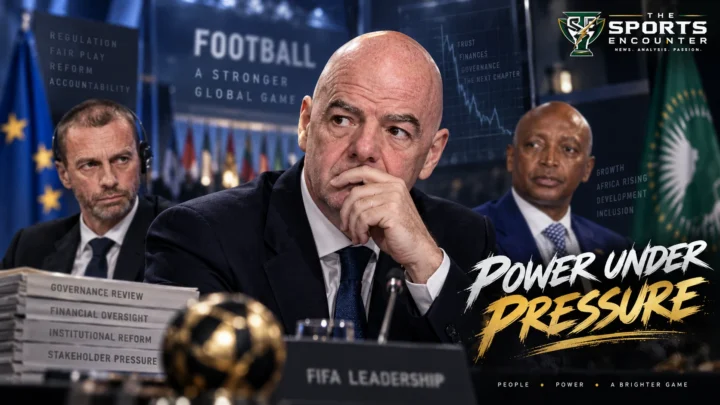
TOKYO, Japan, October 24, 2026: The Asian Football Confederation has endorsed Gianni Infantino for another term as FIFA president, reversing its position just two months after joining European and North American football leaders in accusing him of breaking their trust over a failed $4.2 billion World Cup investment proposal. AFC President Sheikh Salman bin Ebrahim Al Khalifa announced the endorsement at an extraordinary congress in Tokyo on Friday, October 23, significantly strengthening Infantino’s prospects ahead of FIFA’s presidential election in March 2027.
The decision changes the political balance of a leadership contest that appeared far more uncertain during the summer. Asia’s 47-member confederation includes 46 FIFA voting associations, and its public support now complements backing from influential African football leaders. However, national federations retain their individual votes, European associations continue demanding accountability for the abandoned World Cup commercial project, and FIFA’s proposed increase in development funding to $25 million per member association still faces further approval procedures. The endorsement strengthens Infantino’s position without resolving the governance dispute that nearly fractured world football.
Asia Endorses Infantino at Tokyo Congress: What Happened?
The announcement came during the AFC Extraordinary Congress in Tokyo on October 23.
Infantino attended the gathering as Sheikh Salman addressed representatives of Asian football’s national associations.
Story at a glance
Asia Endorses Infantino at Tokyo Congress: What Happened?
The announcement came during the AFC Extraordinary Congress in Tokyo on October 23.
From Accusations of Broken Trust to Public Support in Two Months
The contrast with August is remarkable.
How FIFA Forward Enterprise Triggered the Leadership Crisis
The dispute began with an ambitious plan to raise billions of dollars from private investors.
October 15 Apology Helps Explain the Political Reconciliation
The turning point came at the FIFA Council meeting in Zurich on October 15.
The $25 Million Question: Why Development Funding Matters
Money has become one of the most consequential issues in the FIFA leadership dispute.
In a public declaration of support, the AFC president confirmed that his organization was prepared to back Infantino’s re-election campaign.
“We are ready to move forward, united in support of FIFA President Gianni Infantino,” Sheikh Salman said.
The endorsement carried additional significance because the two officials had been on opposing sides of a serious governance dispute only weeks earlier.
Sheikh Salman acknowledged their previous disagreements but emphasized that the relationship had improved following discussions in Zurich.
Infantino responded by thanking the AFC president and Asian football’s representatives for their support.
He highlighted the role Asian associations have played in expanding international competitions, developing football infrastructure and strengthening FIFA’s development programs.
The official FIFA account of the Tokyo endorsement confirms the exchange between the two leaders.
The immediate consequence is political rather than procedural.
Infantino has gained the public backing of another powerful regional football organization. He has not yet been re-elected, and the AFC president cannot cast every Asian federation’s vote on its behalf.
From Accusations of Broken Trust to Public Support in Two Months
The contrast with August is remarkable.
On August 10, UEFA, the AFC and CONCACAF jointly challenged Infantino’s leadership following the collapse of FIFA Forward Enterprise, a proposed commercial structure involving private investment in rights connected to the World Cup and other FIFA competitions.
The confederations argued that the project had advanced without sufficient consultation, independent scrutiny or transparency.
The dispute moved beyond disagreement over financial policy.
Senior football officials began questioning whether Infantino had respected the governance structures responsible for overseeing FIFA’s most valuable competitions.
The Sports Encounter’s August investigation into the UEFA-AFC-CONCACAF revolt documented the coordinated criticism and the political consequences for Infantino’s presidency.
At that stage, Asia’s participation was particularly damaging to Infantino.
European opposition alone would not necessarily threaten his position because FIFA’s presidential election depends on votes from associations across every continent.
Asia’s alignment with UEFA and CONCACAF suggested that the dispute could weaken support across several regions simultaneously.
Friday’s endorsement disrupts that possibility.
Sheikh Salman has moved from publicly criticizing Infantino’s handling of the investment proposal to publicly supporting his leadership for another electoral term.
That is the central development in the story.
How FIFA Forward Enterprise Triggered the Leadership Crisis
The dispute began with an ambitious plan to raise billions of dollars from private investors.
FIFA Forward Enterprise would have created a new commercial structure involving valuable tournament-related business activities.
The proposal contemplated selling approximately 20% of the commercial entity to outside investors, with the potential transaction valued at approximately $4.2 billion.
Infantino’s argument centered on expanding football development funding, particularly for associations operating with limited commercial resources.
Critics questioned whether private ownership of a commercial vehicle linked to FIFA competitions was appropriate and whether the governing body’s members had received enough information before the plan advanced.
The initiative collapsed after widespread opposition.
TSE’s examination of the World Cup stake plan’s failure explained how the proposal moved from a major commercial initiative to a global governance controversy within days.
FIFA withdrew the plan, but the withdrawal did not immediately restore trust.
The disagreements continued over how the proposal had been developed, who had authorized its progression and whether FIFA’s existing procedures offered sufficient oversight.
Those questions remain relevant despite Friday’s endorsement.
October 15 Apology Helps Explain the Political Reconciliation
The turning point came at the FIFA Council meeting in Zurich on October 15.
Infantino apologized for mistakes in the handling of the abandoned World Cup investment proposal.
However, the apology did not produce unanimous agreement that the governance dispute had been resolved.
European officials continued demanding documentation, independent scrutiny and assurances that similar commercial initiatives could not bypass established consultation procedures.
TSE’s October 15 report on Infantino’s apology examined the continuing dispute and the new funding proposals presented to the FIFA Council.
The October meeting also followed a period of intense preparation in which European representatives had challenged Infantino’s authority and FIFA’s proposed use of financial reserves.
Our October 14 analysis of the approaching FIFA Council confrontation explained why the discussion involved far more than repairing diplomatic relationships.
The timing is important.
Infantino apologized on October 15.
Eight days later, Sheikh Salman endorsed his re-election campaign.
That sequence provides evidence of a political reconciliation, although the public record does not establish that the apology alone caused Asia’s change of position.
The $25 Million Question: Why Development Funding Matters
Money has become one of the most consequential issues in the FIFA leadership dispute.
At the October 15 Council meeting, FIFA presented a proposed development funding package totaling $6.35 billion for the next cycle.
The proposal combines the planned FIFA Forward 4.0 framework with a separate FIFA Surplus Solidarity Programme.
Under the framework, individual FIFA member associations could receive allocations reaching $25 million.
That represents a substantial potential increase in the resources available to national football organizations.
The proposal is particularly relevant to smaller federations that depend heavily on FIFA funding for youth development, women’s football, training facilities and international participation.
However, the distinction between a proposed allocation and a completed payment is essential.
FIFA has stated that eligibility, applications, approvals, disbursement requirements, oversight and auditing arrangements must still be finalized.
The organization expects further consideration in December 2026, with the financial arrangements subject to approval at the 2027 FIFA Congress.
The official FIFA Council statement of October 15 explains the proposed funding increase and its remaining approval requirements.
| Measure | Position | Status |
|---|---|---|
| FIFA Forward 3.0 | Up to $8 million per member association for 2023-2026 | Established program framework |
| New combined association allocation | Up to $25 million per FIFA member association | Proposed framework |
| Overall proposed development funding | $6.35 billion | Presented to FIFA Council |
| Distribution and audit rules | Application, approval, disbursement and control conditions | Further details pending |
| Further FIFA Council consideration | December 2026 | Scheduled decision stage |
| Final congressional approval | March 2027 | Still required under FIFA’s announced process |
The figures should not be confused with the abandoned $4.2 billion private investment project.
FIFA Forward Enterprise involved a proposed commercial transaction with outside investors.
The new funding proposal relies on FIFA’s financial resources and revised development allocations.
Both initiatives share an objective of increasing money available for football development, but they involve different financing mechanisms.
Does the Funding Proposal Explain Asia’s Endorsement?
The timing suggests that development funding has become an important element in Infantino’s efforts to rebuild support.
FIFA has emphasized the financial benefits available to national associations, and Sheikh Salman has welcomed the importance of continued investment in Asian football.
However, no verified evidence establishes that individual AFC members agreed to support Infantino in exchange for funding.
Political incentives, football development priorities and governance concerns can all influence a federation’s position.
Those factors should be analyzed without presenting an unproven financial arrangement as a confirmed exchange.
TSE’s earlier analysis of FIFA’s reserves and African support for Infantino explored the growing importance of football development money in the electoral debate.
FIFA Presidential Election 2027: Why 46 Asian Votes Matter
FIFA has 211 member associations, and each eligible association has one vote in presidential elections.
The AFC has 47 member associations, but only 46 are FIFA members.
That distinction matters when assessing the potential electoral impact of Friday’s announcement.
Sheikh Salman can recommend and publicly endorse Infantino, but he cannot guarantee the votes of all 46 eligible Asian associations.
A similar distinction applies to Africa, where the Confederation of African Football represents 54 FIFA member associations.
CAF leaders have expressed support for Infantino, but the associations retain their individual voting rights.
| Measure | Votes or Associations | Share of FIFA’s 211 Members |
|---|---|---|
| All FIFA member associations | 211 | 100% |
| AFC FIFA voting associations | 46 | 21.8% |
| CAF FIFA voting associations | 54 | 25.6% |
| AFC and CAF combined | 100 | 47.4% |
| UEFA member associations | 55 | 26.1% |
| Illustrative simple majority if 211 valid votes are cast | 106 | 50.2% |
TSE electoral insight: Asia and Africa together represent 100 potential FIFA votes, just six below the 106 needed for a simple majority if all 211 associations cast valid votes and a simple-majority ballot applies.
That calculation is not a prediction of the election result.
It assumes every eligible Asian and African association supports Infantino, an outcome that has not been confirmed.
The actual threshold also depends on valid votes and the applicable presidential election procedures.
Nevertheless, the arithmetic explains why Friday’s endorsement matters so much.
If a substantial majority of Asian and African associations support Infantino, his opponents would need to build a broad coalition extending beyond Europe.
A European campaign alone cannot automatically determine the outcome.
UEFA Remains a Major Source of Opposition
While Sheikh Salman has moved toward reconciliation, European football leaders have continued challenging Infantino’s handling of the abandoned commercial proposal.
UEFA represents 55 FIFA voting associations, making it the largest individual continental grouping.
However, its members cannot determine the presidential result without additional support.
European officials have demanded greater transparency surrounding FIFA Forward Enterprise, the consultation process and the organization’s governance arrangements.
The disagreement also includes broader questions about the independence of oversight procedures and accountability within FIFA.
Those concerns are distinct from whether Infantino enjoys enough votes to win another term.
A successful election campaign would demonstrate electoral support.
It would not automatically answer questions about how the abandoned investment proposal was developed.
That distinction has appeared repeatedly in TSE’s coverage of the leadership crisis.
Our September 15 investigation into European efforts to find an Infantino challenger examined the difficulty of converting public criticism into an election-winning coalition.
Friday’s development makes that challenge more demanding.
Asia’s leadership has now publicly chosen reconciliation rather than continued confrontation with Infantino.
Can European Associations Still Challenge Infantino?
Yes. Friday’s endorsement does not prevent another candidate from entering the race.
The deadline for presidential nominations is November 18, 2026.
The election is scheduled for March 18, 2027, at the 77th FIFA Congress in Rabat, Morocco.
Any serious challenger must secure the necessary nominations and demonstrate that support extends beyond public dissatisfaction with Infantino’s leadership.
The difficulty is especially clear when examining the political positions of individual national associations.
Some European federations have publicly withdrawn support from Infantino, while several associations elsewhere have continued backing him.
TSE’s coverage of Ireland’s withdrawal of support documented the growing opposition during the summer.
But losing an endorsement does not automatically mean losing a vote to an alternative candidate.
An opposing federation still needs a person to support and a campaign capable of winning.
The same principle applies to Asia.
Its president has endorsed Infantino, but individual associations may reach their own decisions before election day.
Why the Tokyo Congress Matters Beyond Infantino’s Re-Election
The Tokyo gathering also addressed the AFC’s own governance arrangements.
Delegates approved statutory amendments intended to align the confederation’s electoral and competition cycles with forthcoming changes to FIFA’s international calendar.
The AFC’s official October 23 congress report confirms those amendments.
The distinction between this formal business and Sheikh Salman’s presidential endorsement is important.
The statutory changes involved the AFC’s institutional arrangements.
The endorsement concerned political support for the head of FIFA.
Neither development establishes that the congress conducted a binding ballot directing all Asian FIFA associations to vote for Infantino.
Conflating those decisions would exaggerate the legal effect of Friday’s announcement.
Continue the FIFA World Cup 2026 Story
 FIFA World Cup 2026Infantino Says Sorry, Critics Demand the Files as FIFA Puts $6.35 Billion on the Table
 FIFA World Cup 2026Infantino Faces FIFA’s Reckoning as Revolt Reaches Zurich, and Now $6 Billion Reserves Enter the Fight
 FIFA World Cup 2026Belgium Turns Balogun Red-Card Row Into Direct Challenge to Infantino’s FIFA Re-Election
How FIFA’s Leadership Crisis Developed
The path to the Tokyo endorsement was shaped by a series of events extending from the failed investment proposal to the October FIFA Council meeting.
| Date | Development | Political Consequence |
|---|---|---|
| July 2026 | World Cup commercial investment proposal faces opposition | Confederations question FIFA’s consultation process |
| July 31 | FIFA announces that Forward Enterprise will not proceed | Commercial plan withdrawn |
| August 10 | UEFA, AFC and CONCACAF issue coordinated criticism | Governance dispute escalates |
| September | More associations publicly question Infantino’s leadership | 2027 election becomes increasingly contested |
| September 21 | Infantino proposes governance scrutiny and consultation reforms | FIFA attempts to respond to accountability concerns |
| October 15 | Infantino apologizes at FIFA Council meeting | Reconciliation efforts continue |
| October 15 | FIFA presents major new development funding proposal | Financial policy becomes central to discussions |
| October 23 | Sheikh Salman endorses Infantino at AFC congress | Asia’s leadership reverses its earlier opposition |
Infantino’s attempt to repair the relationship included proposals for more independent scrutiny of FIFA’s decision-making.
TSE’s September analysis of the proposed FIFA governance review examined why the scope and independence of any investigation would matter.
The October endorsement demonstrates that Infantino has recovered important political support.
It does not establish that every promised governance reform has been adopted or implemented.
What Does Asia’s Decision Mean for the Future of FIFA?
The strongest immediate consequence concerns the 2027 presidential election.
Infantino now has public backing from the leadership of a confederation that previously joined one of the most serious challenges to his presidency.
That makes it harder for opponents to argue that football’s major continental organizations remain united against him.
However, the longer-term implications extend beyond the election.
FIFA must still determine how major commercial initiatives will be reviewed, how member associations will participate in decisions and how development funding will be distributed.
These are institutional questions affecting future presidents as well as Infantino.
The TSE investigation into Infantino’s decision to seek re-election previously examined how the withdrawn World Cup investment plan had transformed the campaign into a debate about presidential authority.
Friday changes the electoral outlook, but the institutional questions remain.
One development should not be used to erase the other.
What to Watch Next in the FIFA Presidential Race
Three upcoming stages could materially change the political picture.
| Date | Event | Why It Matters |
|---|---|---|
| November 2, 2026 | Deadline sought by UEFA for FIFA’s responses to governance questions | May clarify unresolved concerns over the abandoned investment plan |
| November 18, 2026 | Presidential candidate nomination deadline | Establishes the eligible challengers |
| December 2026 | Further FIFA Council review of development funding arrangements | Could clarify eligibility, distribution and oversight |
| March 18, 2027 | FIFA presidential election, Rabat | Member associations decide the next presidential mandate |
The November 2 deadline concerns documentation requested by UEFA and does not guarantee that FIFA will resolve every governance question by that date.
The November 18 deadline will reveal whether an alternative candidate can complete the formal nomination process.
December’s funding deliberations could establish more detail about FIFA’s proposed $25 million allocations.
The March election will ultimately determine whether Infantino remains president.
Until then, the balance between public endorsements and independently controlled federation votes remains one of the central uncertainties.
Gianni Infantino and the AFC Endorsement: Frequently Asked Questions
Has the Asian Football Confederation endorsed Gianni Infantino?
Yes. AFC President Sheikh Salman bin Ebrahim Al Khalifa publicly endorsed Infantino at the extraordinary congress in Tokyo on October 23, 2026.
Why is Asia’s endorsement significant?
The AFC joined UEFA and CONCACAF in criticizing Infantino in August. Its subsequent endorsement strengthens his electoral position and weakens the appearance of a united intercontinental opposition.
Does the AFC endorsement guarantee Infantino 47 votes?
No. The AFC has 47 member associations, but only 46 are FIFA voting members. Each eligible federation controls its own presidential vote.
Why did the AFC previously criticize Infantino?
The confederation objected to the handling of FIFA Forward Enterprise, a proposed commercial investment structure connected to valuable FIFA competition rights, citing concerns about consultation and governance.
Did FIFA sell part of the World Cup to private investors?
No. FIFA abandoned the proposed investment structure before completing the contemplated transaction.
What is FIFA’s proposed $25 million funding allocation?
It is a proposed allocation for member associations under FIFA’s expanded development funding framework. Eligibility, distribution, audit requirements and final approvals remain subject to further decisions.
When is the next FIFA presidential election?
The election is scheduled for March 18, 2027, at the 77th FIFA Congress in Rabat, Morocco. The nomination deadline is November 18, 2026.
Can UEFA prevent Infantino from winning another term?
UEFA cannot decide the election alone. Its 55 associations represent approximately 26% of FIFA’s membership, so a successful challenge would require support from other regions.
Final Analysis: Infantino Has Recovered Asia’s Leadership, but Not Every Vote or Every Answer
The most important change in Tokyo was the restoration of political support from a confederation that had helped challenge Infantino’s authority only two months earlier.
For the FIFA president, the endorsement represents a major recovery ahead of an election that has become closely associated with the organization’s governance crisis.
For Sheikh Salman, the announcement signals a decision to prioritize renewed cooperation with FIFA despite the disputes surrounding the abandoned investment plan.
For European football leaders, the development complicates efforts to build an election-winning alternative.
However, the distinction between political support and institutional accountability remains essential.
Infantino has not yet secured all 46 eligible Asian votes.
FIFA’s proposed development funding arrangements are not fully finalized.
European demands for documents and stronger oversight remain unresolved.
And the formal presidential election will not take place until March 2027.
The AFC’s endorsement changes Infantino’s prospects substantially. Whether it also marks the beginning of a durable reconciliation across world football depends on decisions still to come.
The central conclusion: Asia’s leadership has returned to Infantino’s side. The election is moving in his favor, but the questions that triggered FIFA’s governance crisis have not disappeared.