Key Takeaways
- The competition took place at Dakar’s Aquatics Centre, also identified as the Complexe Tour de l’Oeuf.
- For a swimmer competing in her first Youth Olympic Games, the result represented a major achievement in both performance and composure.
- Elvira Espinosa Demera was born in Guayaquil, Ecuador, on January 20, 2009.
- Los Angeles 2028 represents a potential future objective for Espinosa, but her Dakar result does not automatically qualify her for the senior Olympic Games.
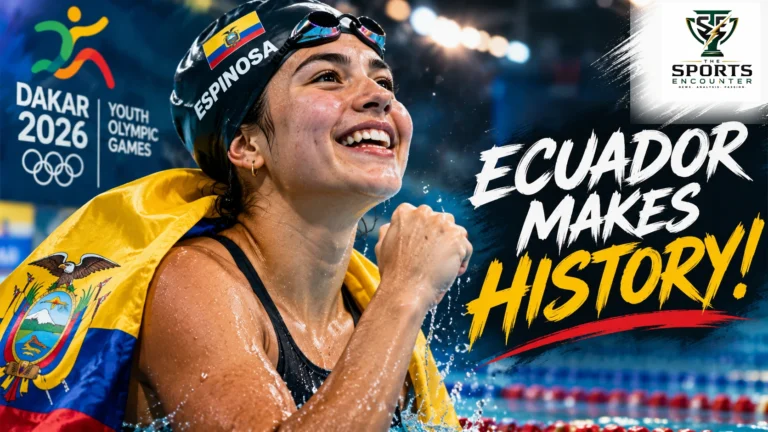
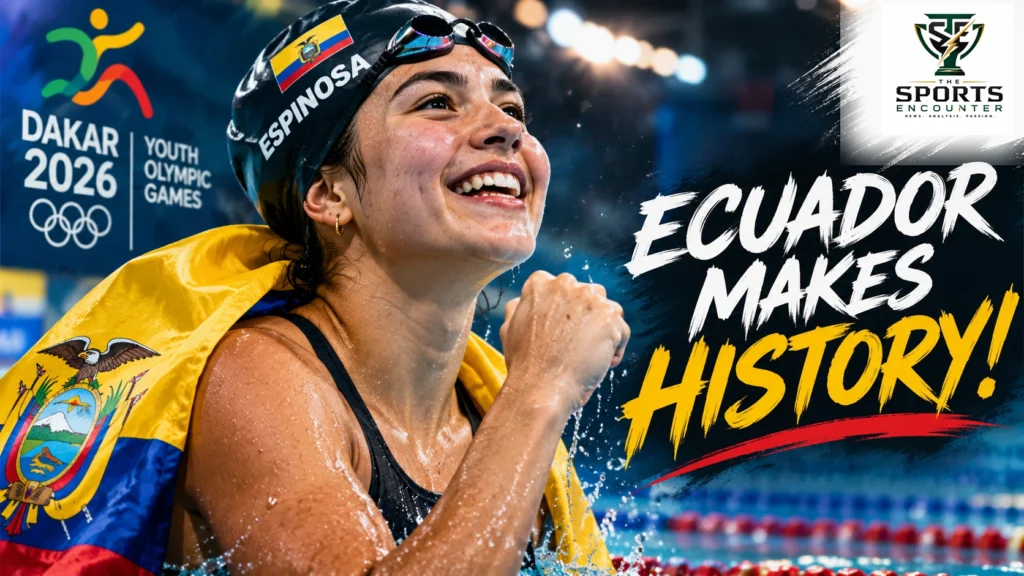
DAKAR, Senegal, November 2, 2026: Ecuador’s Elvira Espinosa made Olympic history on Sunday, November 1, becoming the first swimmer from her country to win a medal at either the senior or Youth Olympic Games. The 17-year-old captured the women’s 400-meter freestyle gold at the Dakar 2026 Youth Olympic Games in 4 minutes, 22.87 seconds, defeating South Africa’s Leah Markgraaff and Belgium’s Célya Paques. Her victory also delivered the first gold medal awarded at the Games and established a new personal best.
Espinosa finished 3.26 seconds ahead of Markgraaff, who took silver in 4:26.13, while Paques secured bronze in 4:28.37. The victory came a day after Espinosa carried Ecuador’s flag during the October 31 opening ceremony, transforming a moment of national representation into a historic result in the pool. Beyond the medal, her performance provides a significant breakthrough for Ecuadorian swimming, which had never previously reached an Olympic podium, even though the country had produced competitive swimmers at the senior Games for decades.
Elvira Espinosa Wins Dakar 2026 Women’s 400m Freestyle Gold
| Medal | Swimmer | Country | Final Time | Behind Winner |
|---|---|---|---|---|
| Gold | Elvira Espinosa | Ecuador | 4:22.87 | Winner |
| Silver | Leah Markgraaff | South Africa | 4:26.13 | +3.26 seconds |
| Bronze | Célya Paques | Belgium | 4:28.37 | +5.50 seconds |
The competition took place at Dakar’s Aquatics Centre, also identified as the Complexe Tour de l’Oeuf.
Story at a glance
Elvira Espinosa Wins Dakar 2026 Women’s 400m Freestyle Gold
The competition took place at Dakar’s Aquatics Centre, also identified as the Complexe Tour de l’Oeuf.
How Elvira Espinosa Became Ecuador’s First Olympic Swimming Medalist
Espinosa arrived at the final carrying the expectations associated with representing her country at the inaugural Youth Olympic Games held on African soil.
Watch the IOC’s Official Elvira Espinosa Dakar 2026 Video
The International Olympic Committee released video footage and athlete reactions following Espinosa’s historic result, alongside coverage of the other swimming medal events on the opening day.
Espinosa’s Personal Best: The Numbers Behind Her Gold Medal
Espinosa’s result becomes even more meaningful when measured against her previous best time.
Who Is Elvira Espinosa? Ecuador’s New Youth Olympic Champion
Elvira Espinosa Demera was born in Guayaquil, Ecuador, on January 20, 2009.
Read next Glasgow 2026 Day 6 Wrap-Up: Australia Passes 100 Medals as Records Fall Across the Games
Espinosa won the 400m freestyle timed final with a performance that was not simply good enough for gold. She lowered her previous personal best while establishing a margin of more than three seconds over the nearest challenger.
For a swimmer competing in her first Youth Olympic Games, the result represented a major achievement in both performance and composure.
How Elvira Espinosa Became Ecuador’s First Olympic Swimming Medalist
Espinosa arrived at the final carrying the expectations associated with representing her country at the inaugural Youth Olympic Games held on African soil.
She had already experienced the emotion of carrying Ecuador’s flag during the opening ceremony alongside equestrian Joaquín Beltrán.
But her biggest moment came in the pool.
The Ecuadorian completed the eight lengths of the 50-meter competition pool in 4:22.87, improving her previous best and establishing a clear lead over the medal contenders.
When she finished, she initially looked around to determine whether she had won.
The reaction of her coach helped confirm what the scoreboard already showed: she had become an Olympic youth champion.
Why Was the 400m Freestyle Victory So Significant?
Ecuador had never previously won a swimming medal at an Olympic event, whether at the senior Games or the Youth Olympic Games.
Espinosa changed that history with a gold medal rather than a silver or bronze.
The International Olympic Committee confirmed the achievement in its official video news release, identifying her as the first Ecuadorian swimmer to reach the Olympic podium at either level.
That historical distinction must be kept precise. A Youth Olympic medal is not the same competition result as a senior Olympic medal. Espinosa’s gold belongs to Dakar 2026, while its historical significance spans both Olympic categories because no Ecuadorian swimmer had previously won a medal in either.
Her achievement also made her the first gold medalist of Dakar 2026, ensuring Ecuador would feature prominently in the opening day’s sporting history.
Watch the IOC’s Official Elvira Espinosa Dakar 2026 Video
The International Olympic Committee released video footage and athlete reactions following Espinosa’s historic result, alongside coverage of the other swimming medal events on the opening day.
🎥VIDEO NEWS RELEASEHistory made on the opening day of swimming at the Youth Olympic Games #Dakar2026 with Elvira Espinosa becoming the first Ecuadorian 🇪🇨 to win a swimming medal in Olympic history.Action & soundbites from today’s swimming medals: https://t.co/Y1yA6h5ZSq https://t.co/HyEhzXy6DH
— IOC MEDIA (@iocmedia) November 1, 2026
Embed note: The post above is the official IOC Media announcement. Its appearance as an interactive post depends on the X embed script being permitted by the publishing website. The direct post link remains available if the embed does not render.
Espinosa’s Personal Best: The Numbers Behind Her Gold Medal
Espinosa’s result becomes even more meaningful when measured against her previous best time.
Before Dakar, her reported personal best in the women’s 400m freestyle was 4:25.34, achieved during the 2026 South American Youth Games.
She improved that mark to 4:22.87 in Senegal.
| Performance | Time | Seconds | Significance |
|---|---|---|---|
| Previous personal best | 4:25.34 | 265.34 | Benchmark entering Dakar |
| Dakar 2026 gold | 4:22.87 | 262.87 | New personal best |
| Improvement | 2.47 seconds | 2.47 | Approximately 0.93% faster |
TSE statistical discovery: Espinosa lowered her previous personal best by 2.47 seconds, approximately 0.93% of her earlier time.
At the elite end of competitive swimming, that improvement is substantial because competitors often measure progress in hundredths of a second.
Her previous best would also have been sufficient to beat the second-place time of 4:26.13 in this particular event, although that comparison cannot establish how the race would have unfolded under different circumstances.
What makes the result especially compelling is that Espinosa improved her own performance while winning the championship.
How Much Faster Was Espinosa Than the Other Medalists?
The final times reveal a clear separation between the three podium positions.
| Comparison | Time Difference | What It Shows |
|---|---|---|
| Espinosa vs Markgraaff | 3.26 seconds | Gold medal winning margin |
| Espinosa vs Paques | 5.50 seconds | Gap between gold and bronze |
| Markgraaff vs Paques | 2.24 seconds | Silver-bronze separation |
| Espinosa vs her previous best | 2.47 seconds | Personal improvement |
Espinosa’s 3.26-second advantage over Markgraaff was greater than the 2.24-second margin separating silver and bronze.
That comparison gives the race result added perspective without claiming knowledge of intermediate splits that have not been independently verified.
Who Is Elvira Espinosa? Ecuador’s New Youth Olympic Champion
Elvira Espinosa Demera was born in Guayaquil, Ecuador, on January 20, 2009.
She began swimming at a young age and has developed through Ecuador’s competitive swimming system, representing the province of Guayas.
Her coach, Rafael Herbas, has helped guide her progression through national and regional competitions.
Before Dakar, she had already competed internationally at youth and senior levels.
In 2025, she won the women’s 400m freestyle at the South American Olympic Promises competition in Paraguay.
She also recorded a 100m freestyle victory at the 2025 PanAm Aquatics Championships in Medellín, establishing herself as a versatile swimmer across multiple freestyle distances.
Her development has not been limited to a single event.
World Aquatics records list performances across the 50m, 100m, 200m, 400m and 800m freestyle, reflecting a training foundation that includes sprinting and middle-distance endurance.
What Does Espinosa’s Development Tell Us About Young Swimming Talent?
Successful youth swimmers often move between different distances before finding their strongest senior events.
Espinosa’s performances across several freestyle disciplines give her coaches opportunities to evaluate speed, endurance and race distribution as she develops.
That versatility is valuable, but a Youth Olympic gold does not automatically guarantee future senior Olympic medals.
Her next stage will involve managing increasing training demands, stronger international opposition and the transition from youth to senior competition.
The broader rise of teenage talent has been especially visible during the 2026 swimming season.
The Sports Encounter’s analysis of 13-year-old Yu Zidi’s rise to second on the all-time women’s 200m individual medley list provides another example of exceptional youth performances against elite competition.
Espinosa’s achievement belongs to a different event and competitive level, but both stories underline how young swimmers are increasingly attracting international attention through measurable results.
Why Ecuador’s Gold Matters Beyond Dakar 2026
Espinosa’s victory could become a significant reference point for Ecuadorian swimming.
Before her result, Ecuador’s Olympic swimming history included competitive performances without a medal.
Jorge Delgado Panchana came particularly close when he finished fourth at the 1972 Munich Olympics.
More than five decades later, Espinosa has delivered an Olympic swimming podium finish.
The two achievements took place in different competition categories, and they should not be treated as directly equivalent.
Nevertheless, the historical connection illustrates why the gold medal has attracted such strong attention in Ecuador.
What Could This Medal Change for Ecuadorian Swimming?
A historic medal can create several opportunities, although none should be treated as automatic.
It can raise public interest in the sport, encourage younger athletes to join swimming programs and strengthen the case for investment in coaching and development facilities.
It may also help existing athletes see that winning medals at international championship level is achievable.
However, sustainable improvement requires more than one champion.
National programs need adequate training access, coaching continuity, financial support and regular opportunities to compete against strong international opposition.
Espinosa has provided an important sporting example. The long-term challenge is whether Ecuador can turn that example into broader participation and competitive depth.
Dakar 2026 Opening Swimming Day: Five Nations Win Gold
Espinosa’s achievement was part of a strong opening day at the Dakar Aquatics Centre.
World Aquatics confirmed victories for athletes representing Ecuador, Argentina, New Zealand, Russia and Egypt.
The range of winning nations illustrated the international character of the Youth Olympic swimming program.
| Gold Medalist | Nation | Opening-Day Significance |
|---|---|---|
| Elvira Espinosa | Ecuador | First gold of Dakar 2026; Ecuador’s first Olympic swimming medal |
| Cecilia Dieleke | Argentina | Opening-day swimming gold |
| Ariel Muchirahondo | New Zealand | Opening-day swimming gold |
| Serafima Fokina | Russia | Women’s 100m butterfly gold in 59.81 |
| Zain Ali | Egypt | Men’s 100m butterfly gold in 52.16 |
Egypt’s Zain Ali produced an emphatic 100m butterfly victory, finishing in 52.16 seconds, 1.87 seconds ahead of Serbia’s Aleksej Kalanj.
Fokina was the only swimmer to break one minute in the women’s 100m butterfly, clocking 59.81 to defeat Romania’s Daria-Mariuca Silisteanu and Brazil’s Ana Julia Aguiar Amaral.
The early results show that Dakar is already producing championship performances across several continents.
Swimming’s Breakthrough Year: Espinosa Joins Other Rising Stars
Espinosa’s achievement arrives during a season containing several important breakthroughs in swimming.
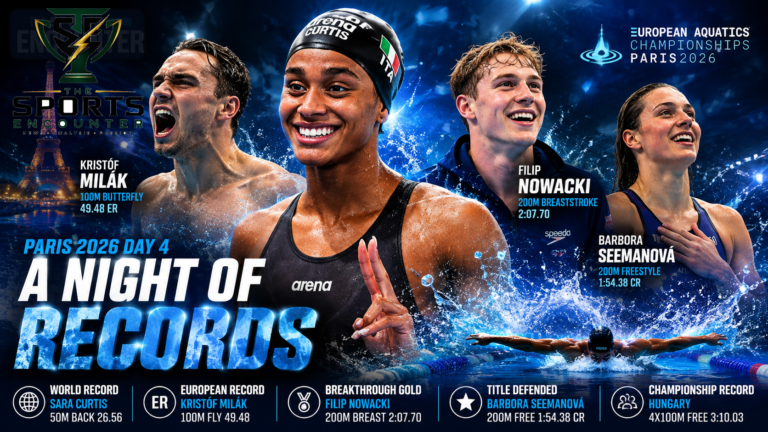
At the 2026 European Aquatics Championships, 19-year-old Italian Sara Curtis broke the women’s 50m backstroke world record twice in roughly 24 hours.
She first lowered the mark to 26.63 in the semifinals, as documented in TSE’s original world-record report.
Curtis then won the final in 26.56, improving her own world record. Our follow-up analysis examined the significance of that remarkable progression.
Great Britain’s Filip Nowacki also produced a breakthrough at the European Championships, winning his first senior international 200m breaststroke title in 2:07.70.
TSE’s Nowacki feature explored how his junior achievements translated into senior success.
Those performances offer useful context for Espinosa, though youth and senior championships involve different standards and conditions.
How Does a Youth Olympic Gold Differ From a Senior World Record?
The Youth Olympic Games bring together eligible younger athletes from around the world, while senior championships generally involve established competitors across a wider age range.
An athlete’s victory at youth level provides evidence of success against the strongest eligible peers.
A senior world record establishes the fastest officially recognized performance in a particular event and course category.
Espinosa has achieved a historic Olympic youth victory, not a senior world record.
Keeping those distinctions clear makes her accomplishment easier to understand without exaggeration.
The 2026 European Championships also produced significant performances from Ellen Walshe, who won 400m individual medley gold, and David Popovici, who captured another European freestyle title.
Those races were examined in TSE’s Ellen Walshe report and our Paris 2026 Day 3 swimming roundup.
Further championship developments, including the performances of Kristóf Milák, Filip Nowacki and Barbora Seemanová, are covered in TSE’s Day 4 European swimming analysis.
For a broader account of the closing stages of the championship, read the European Aquatics Championships finals roundup.
When Will Elvira Espinosa Swim Again at Dakar 2026?
Espinosa’s next reported event is the women’s 200m freestyle on November 6.
The 800m freestyle, in which she had initially been expected to compete, was removed from the Dakar program because of heat-related considerations.
That change affected the available events for swimmers who had prepared for longer-distance competition.
According to the published schedule, the women’s 200m freestyle heats and final are planned for November 6.
| Event | Date | Status | Importance |
|---|---|---|---|
| Women’s 400m freestyle | November 1 | Completed | Espinosa wins gold in 4:22.87 |
| Women’s 800m freestyle | Removed from program | Not contested | Heat-related schedule adjustment |
| Women’s 200m freestyle heats | November 6 | Scheduled | Opportunity to progress to another final |
| Women’s 200m freestyle final | November 6 | Scheduled | Potential second medal opportunity, subject to qualification |
| Swimming competition concludes | November 6 | Scheduled | End of Dakar’s pool program |
These are scheduled events, not confirmed future results. Espinosa must qualify from the heats before she can compete in the 200m final.
Why the 200m Freestyle Presents a Different Challenge
The 200m and 400m freestyle require different tactical approaches.
The shorter race places greater emphasis on early speed and maintaining a high tempo across four lengths of a 50-meter pool.
The 400m demands a different balance of endurance, stroke efficiency and pacing across eight lengths.
Continue the Swimming Story
Espinosa’s experience across several freestyle distances gives her a foundation for adapting between the events, but winning the 400m does not guarantee success over 200m.
Her competitors may have different strengths, and the shorter distance creates opportunities for swimmers who are particularly effective at higher race speeds.
That distinction is evident in the senior swimming program, where athletes can excel over one freestyle distance without automatically dominating another.
Romania’s David Popovici, for example, has established himself across both 100m and 200m freestyle, with his 2026 European performances examined in The Sports Encounter’s Paris finals report.
Espinosa’s challenge will be to adapt her racing strategy while managing the additional expectations that accompany a historic gold medal.
What Could Elvira Espinosa’s Gold Mean for Los Angeles 2028?
Los Angeles 2028 represents a potential future objective for Espinosa, but her Dakar result does not automatically qualify her for the senior Olympic Games.
Senior Olympic qualification is governed by the relevant World Aquatics and IOC eligibility and qualification rules.
Those requirements are separate from Youth Olympic results.
The significance of Dakar lies in demonstrating that Espinosa can perform successfully in a major international setting.
Future senior selection will depend on her performances, eligibility and qualification standards.
The wider transition from championship promise to Olympic performance has been a recurring theme in swimming.
France’s Florent Manaudou, for example, built a career spanning several Olympic Games and multiple medals, as examined in TSE’s analysis of his six-medal Olympic career.
Espinosa is at the beginning of her international journey rather than its conclusion. Her next challenge is building on the Dakar result through consistent development.
Elvira Espinosa and Dakar 2026: Frequently Asked Questions
Who Is Elvira Espinosa?
Elvira Espinosa Demera is a 17-year-old swimmer from Guayaquil, Ecuador, who won the women’s 400m freestyle gold at the Dakar 2026 Youth Olympic Games.
What Event Did Elvira Espinosa Win?
She won the women’s 400m freestyle on November 1, 2026.
What Was Her Winning Time?
Espinosa finished in 4:22.87, establishing a new personal best.
Who Won Silver and Bronze?
South Africa’s Leah Markgraaff took silver in 4:26.13, and Belgium’s Célya Paques won bronze in 4:28.37.
Is Espinosa Ecuador’s First Olympic Swimming Medalist?
Yes. The IOC identifies her as the first Ecuadorian swimmer to win a medal at either the senior or Youth Olympic Games.
Was This the First Gold Medal of Dakar 2026?
Yes. Espinosa won the first gold medal awarded at the Dakar 2026 Youth Olympic Games.
How Much Did Espinosa Improve Her Personal Best?
She improved from 4:25.34 to 4:22.87, a reduction of 2.47 seconds.
How Old Is Elvira Espinosa?
She was 17 when she won gold in Dakar, having been born on January 20, 2009.
When Will Espinosa Compete Again?
Her next reported event is the women’s 200m freestyle on November 6, 2026, subject to the official competition schedule.
Does Her Youth Olympic Gold Qualify Her for LA 2028?
No. Youth Olympic medals do not automatically secure qualification for the senior Olympic Games.
A Gold Medal That Changes Ecuadorian Swimming History
Elvira Espinosa arrived in Dakar as one of Ecuador’s youngest international sporting representatives.
She carried her country’s flag at the opening ceremony and then delivered the first gold medal of the Games.
Her 4:22.87 performance was a personal breakthrough and a national first.
What follows will depend on her development, coaching, health and future international opportunities.
But one fact is already established: for the first time, an Ecuadorian swimmer has stood on an Olympic podium.
That achievement is worth recognizing in its own right, without predicting medals that have not yet been won or treating future success as inevitable.
For Espinosa, Dakar has provided a historic beginning. For Ecuadorian swimming, it has established a new benchmark.
Official sources: The World Aquatics opening-day report confirms the medalists and winning time; the World Aquatics athlete record documents Espinosa’s international results; and the IOC Newsroom’s official Dakar 2026 video release confirms the historic Olympic swimming milestone.