


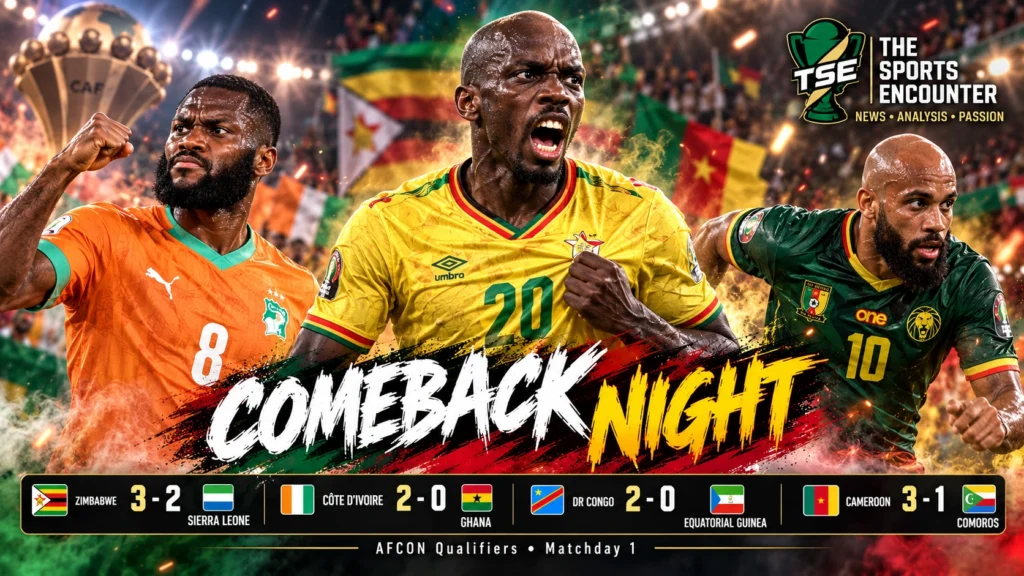
FREETOWN, Sierra Leone, September 24, 2026: Zimbabwe walked into halftime two goals down and apparently heading toward a damaging start to Africa Cup of Nations 2027 qualification. Sixteen second-half minutes changed everything.
Marshall Munetsi scored twice around Tawanda Chirewa’s equalizer as Zimbabwe overturned Sierra Leone’s 2-0 lead to win 3-2, producing the most dramatic result from the first eight matches of the TotalEnergies CAF Africa Cup of Nations PAMOJA 2027 qualifying campaign.
Thursday’s opening slate produced 24 goals across eight matches. Côte d’Ivoire began Hervé Renard’s second spell with a 2-0 victory over Ghana, DR Congo defeated Equatorial Guinea 2-0, Cameroon beat Comoros 3-1 and Namibia edged Congo 1-0.
The night also delivered another two-goal recovery. Botswana appeared to have control against Libya before the hosts fought back to draw 2-2, while Uganda earned a 1-1 result away to Tunisia and Mauritania beat Central African Republic 3-1.
The combination of comebacks, coaching resets, debut goals and immediate pressure across five qualifying groups offered an early reminder of how little margin exists in a six-match qualification campaign.
CAF’s official AFCON 2027 qualifying schedule confirms that Matchday 1 continues across Friday and Saturday, so these eight fixtures represent the opening wave rather than the complete first round.
TL;DR
- Zimbabwe came from 2-0 down at halftime to beat Sierra Leone 3-2.
- Marshall Munetsi scored twice, including the 88th-minute winner.
- Malick Yalcouyé scored on his Côte d’Ivoire debut in a 2-0 win over Ghana.
- Franck Kessié scored Côte d’Ivoire’s second goal from the penalty spot.
- Chancel Mbemba and Yoane Wissa gave DR Congo a 2-0 win over Equatorial Guinea.
- Cameroon beat Comoros 3-1 with goals from David Ningo, Bryan Mbeumo and Danny Namaso.
- Bethuel Muzeu headed Namibia to a 1-0 win over Congo.
- Libya recovered from 2-0 down to draw Botswana 2-2 through a stoppage-time penalty.
- Uganda held Tunisia 1-1 despite the hosts scoring after only 12 minutes.
- The eight matches produced 24 goals, six outright winners and two draws.
AFCON 2027 Qualifying: Thursday’s Results at a Glance
| Group | Match | Result | Goalscorers |
|---|---|---|---|
| Group G | Namibia vs Congo | 1-0 | Bethuel Muzeu 47′ |
| Group E | DR Congo vs Equatorial Guinea | 2-0 | Chancel Mbemba 4′, Yoane Wissa 72′ |
| Group F | Mauritania vs Central African Republic | 3-1 | Aboubakary Koïta pen., Dawda Camara, Mamadou Diallo; Goduine Koyalipou |
| Group H | Libya vs Botswana | 2-2 | Maruwan Alhibeeshi, Ezoo El Mariamy pen.; Tumisang Orebonye 2 |
| Group C | Côte d’Ivoire vs Ghana | 2-0 | Malick Yalcouyé 44′, Franck Kessié 58′ pen. |
| Group E | Sierra Leone vs Zimbabwe | 2-3 | Alie Conteh 7′, Sallieu Tarawallie 27′; Marshall Munetsi 72′, 88′, Tawanda Chirewa 76′ |
| Group G | Cameroon vs Comoros | 3-1 | David Ningo 39′, Bryan Mbeumo, Danny Namaso 81′; Warmed Omari 51′ |
| Group H | Tunisia vs Uganda | 1-1 | Adem Arous 12′; Rogers Mato 68′ |
Zimbabwe Turn 2-0 Into 3-2 in 16 Extraordinary Minutes
No result captured the volatility of opening night better than Zimbabwe’s comeback in Sierra Leone.
Alie Conteh put the hosts ahead after seven minutes. Sallieu Tarawallie doubled the lead in the 27th, leaving Zimbabwe facing a two-goal deficit before halftime.
The match then changed almost completely after the break.
Munetsi pulled one back in the 72nd minute. Four minutes later, Chirewa equalized.
Suddenly, a match Sierra Leone had controlled for more than an hour was level.
Zimbabwe did not settle for the point.
Munetsi scored again in the 88th minute to complete a 3-2 turnaround, turning what had looked like an opening defeat into three points.
The timing makes the comeback particularly damaging for Sierra Leone. They were not gradually worn down across an entire second half. Their two-goal advantage disappeared between the 72nd and 76th minutes before Munetsi delivered the final blow 12 minutes later.
That creates a very different psychological starting point for the two teams in Group E.
Zimbabwe leave the opening fixture knowing they can recover after a match moves badly against them. Sierra Leone have to absorb the opposite lesson: two goals and more than an hour of control did not protect the result.
DR Congo Begin Where Their World Cup Left Off
Zimbabwe’s comeback puts them alongside DR Congo on three points in Group E after Sébastien Desabre’s side delivered the group’s more controlled victory.
Chancel Mbemba needed only four minutes to put DR Congo ahead against Equatorial Guinea, heading in Arthur Masuaku’s corner.
Equatorial Guinea remained competitive and forced goalkeeper Matthieu Epolo into work, but DR Congo kept the lead intact before Yoane Wissa doubled it in the 72nd minute.
Wissa’s involvement continues a productive year for a DR Congo team that gave major opponents significant problems at the World Cup. He scored the equalizer when DR Congo held Portugal 1-1 in their opening group match.
The Congolese also pushed Colombia deep into their World Cup meeting before Daniel Muñoz finally broke Lionel Mpasi’s resistance in the 76th minute.
DR Congo eventually reached the knockout stage and came close to another major result against England, a campaign revisited in TSE’s analysis of the World Cup’s eight third-place qualifiers.
The 2-0 win over Equatorial Guinea therefore feels less like a fresh start from zero and more like an attempt to carry that international momentum into the next continental cycle.
Malick Yalcouyé Gives Hervé Renard the Perfect Return
Côte d’Ivoire’s 2-0 victory over Ghana contained several layers beyond the result.
It was Hervé Renard’s first competitive match of his second spell in charge of the Elephants.
It was also Malick Yalcouyé’s international debut.
The newcomer made the occasion count.
Franck Kessié supplied Yalcouyé in the 44th minute, and the midfielder scored before halftime to put Côte d’Ivoire ahead. Kessié then converted a penalty in the 58th minute to make it 2-0.
Renard had selected eight newcomers as he began reshaping the squad, but the Elephants still retained an experienced spine including Kessié, Ibrahim Sangaré, Ousmane Diomandé, Evan Ndicka and Nicolas Pépé.
That mixture of renewal and continuity may become the defining question of Renard’s second tenure.
Côte d’Ivoire already showed during the World Cup that they can compete through difficult match situations. Amad Diallo scored a 90th-minute winner when the Elephants beat Ecuador in their World Cup opener.
They later made Germany work hard in a 2-1 defeat that exposed how dangerous Côte d’Ivoire could be against elite opposition.
By the end of the group stage, Nicolas Pépé had helped send Côte d’Ivoire into the World Cup knockouts for the first time.
Thursday’s win therefore offered Renard something useful immediately: evidence that a new player can enter an established core and influence a meaningful match.
Ghana’s Missing Core Was Impossible to Ignore
Ghana entered Bouaké with a significantly weakened squad.
Mohammed Kudus, Thomas Partey, Antoine Semenyo and Jordan Ayew were unavailable, removing several of the Black Stars’ most recognizable attacking and midfield reference points.
That matters when assessing the result.
Côte d’Ivoire deserved the victory, but Ghana were attempting one of the most difficult away fixtures in African football without several first-choice players.
The contrast with their World Cup campaign is notable.
Ghana began that tournament when Caleb Yirenkyi’s stoppage-time goal beat Panama 1-0. They then demonstrated considerable defensive discipline when holding England to a 0-0 draw.
Against Côte d’Ivoire, Carlos Queiroz did not have the same personnel available to reproduce that balance.
The Black Stars now need a response when they continue Group C qualification against The Gambia.
Cameroon Answer Comoros Before the Match Can Turn
Cameroon produced one of the cleaner wins of the opening slate, although Comoros briefly threatened to make the contest much more uncomfortable.
David Ningo put Cameroon ahead in the 39th minute before Bryan Mbeumo doubled the advantage shortly after halftime.
Comoros responded quickly.
Warmed Omari scored in the 51st minute, reducing the deficit to 2-1 and creating the possibility of a comeback.
Cameroon refused to let it develop.
Danny Namaso restored the two-goal margin in the 81st minute, securing a 3-1 victory and three points in Group G.
Mbeumo’s goal also reinforces his increasing importance to the national team. Cameroon are trying to restore themselves among Africa’s strongest men’s teams, and reliable attacking production will become essential as the qualification campaign develops.
Namibia Make Group G Immediately More Interesting
Cameroon’s win did not give them sole control of Group G.
Earlier in the day, Namibia beat Congo 1-0 in Gaborone through Bethuel Muzeu’s 47th-minute header.
Namibia enjoyed more of the possession and Riaan Hanamub repeatedly pushed forward from full-back, while Congo struggled to convert their shooting opportunities into meaningful pressure.
The result matters because Namibia are trying to return to the continental finals after appearing at the 2023 AFCON, while Congo have not qualified since 2015.
It also means Cameroon and Namibia begin Group G together on three points.
Their next fixture against each other therefore arrives with immediate importance rather than functioning as an early feel-out game.
Libya Rescue a Point That Could Matter More Than Usual
Libya’s 2-2 draw with Botswana deserves more attention than a typical opening-round stalemate.
Botswana appeared to have won the match after Tumisang Orebonye scored twice.
Libya cut the deficit through Maruwan Alhibeeshi before receiving a penalty in stoppage time. Ezoo El Mariamy converted it to complete the comeback.
Turning 0-2 into 2-2 would already represent an important psychological recovery.
Group H makes the point even more valuable.
Uganda are one of the three AFCON 2027 co-hosts and are already guaranteed a place at the finals alongside Kenya and Tanzania. Under CAF’s qualifying structure, only the highest-ranked non-host nation in Group H will qualify alongside Uganda.
That means Tunisia, Libya and Botswana are effectively competing for one qualification place.
CAF explains that exception in its official AFCON 2027 draw and qualification guide.
Seen through that structure, Libya’s stoppage-time equalizer prevented Botswana from taking a three-point advantage in a race where every point between the non-host teams could become decisive.
Uganda Make Tunisia Work in a Group They Cannot Qualify From Normally
Uganda’s position creates one of the strangest dynamics in AFCON qualification.
They are already qualified as co-hosts, but they still participate in Group H and therefore influence the qualification race around them.
Tunisia learned that immediately.
Adem Arous scored after 12 minutes and appeared to have given new coach Mouine Chaâbani the start he wanted.
Rogers Mato equalized in the 68th minute, allowing Uganda to leave Radès with a 1-1 draw.
Tunisia had already undergone significant change after the World Cup, retaining only 14 players from that squad for the opening qualifying window.
The reset comes after a difficult global campaign in which Japan beat Tunisia 4-0 and the Netherlands later defeated them 3-1.
Chaâbani therefore faces two challenges simultaneously: rebuilding Tunisia after the World Cup and navigating a qualifying group where Uganda’s automatic place changes the mathematics for everybody else.
Mauritania Turn a Level Match Into a Comfortable Opening Win
Mauritania’s 3-1 victory over Central African Republic followed a different pattern.
Aboubakary Koïta opened the scoring from the penalty spot before Goduine Koyalipou equalized for Central African Republic.
The response came through Dawda Camara, who restored Mauritania’s lead, before Mamadou Diallo added the third.
The scoreline gave Mauritania an early advantage in Group F before Burkina Faso and Benin play the group’s other opening fixture.
More importantly, Mauritania did not allow the equalizer to destabilize the match.
Several teams on opening night were forced to respond after momentum changed. Mauritania’s answer was among the most controlled.
Eight Matches, 24 Goals and Two Very Different Comebacks
The raw number from Thursday is 24 goals across eight matches.
The more interesting number is two.
Two teams came back from two goals down.
Zimbabwe turned the deficit into victory.
Libya turned theirs into a draw.
The difference illustrates how quickly qualification points can move.
At halftime in Freetown, Sierra Leone were holding three points and Zimbabwe had none. By the 88th minute, the positions had completely reversed.
When Botswana took a two-goal lead over Libya, they were heading toward three points in a group containing only one available qualification berth for the non-host nations. They finished with one.
Those swings matter in a six-match campaign.
AFCON 2027 Qualification Is Six Matchdays, Not Four
The qualification structure also requires an important clarification.
Each group contains four teams, and CAF’s official format uses home-and-away fixtures across six matchdays.
Matchdays 1 and 2 are being played during the current international window. Matchdays 3 and 4 follow from November 9 to 17, 2026, before Matchdays 5 and 6 conclude the campaign from March 22 to 30, 2027.
The general rule is that the top two teams in each group qualify.
Groups D, H and L operate differently because Kenya, Uganda and Tanzania are already qualified as hosts. In those groups, only the highest-ranked team other than the host advances through qualification.
The finals will be staged in Kenya, Tanzania and Uganda from June 19 to July 17, 2027.
What Thursday’s Opening Matches Actually Told Us
No team has qualified after one match, and no team has been eliminated.
The useful information lies elsewhere.
Zimbabwe demonstrated recovery under extreme pressure.
Côte d’Ivoire showed that Renard can introduce new personnel without removing the experience that carried the Elephants through the World Cup.
DR Congo continued to look like a team whose World Cup progress was structural rather than temporary.
Cameroon handled the one moment when Comoros threatened to reopen their match.
Namibia immediately complicated Group G.
Libya rescued a point that could carry unusual weight because of Group H’s host qualification rules.
Tunisia discovered that their post-World Cup rebuild will not receive an easy opening phase.
The full Matchday 1 picture will only become clear after the remaining qualifiers are completed on Friday and Saturday.
For continuing coverage of African and international football, follow The Sports Encounter’s soccer desk.
Frequently Asked Questions
What were the AFCON 2027 qualifying results on September 24, 2026?
Namibia beat Congo 1-0, DR Congo defeated Equatorial Guinea 2-0, Mauritania beat Central African Republic 3-1, Libya drew Botswana 2-2, Côte d’Ivoire beat Ghana 2-0, Zimbabwe defeated Sierra Leone 3-2, Cameroon beat Comoros 3-1 and Tunisia drew Uganda 1-1.
How many goals were scored in the eight opening matches?
The eight matches produced 24 goals.
What was the biggest comeback?
Zimbabwe produced the night’s most dramatic comeback, recovering from a 2-0 halftime deficit to beat Sierra Leone 3-2.
Who scored Zimbabwe’s winning goal?
Marshall Munetsi scored the winner in the 88th minute. It was his second goal of the match.
Who scored for Côte d’Ivoire against Ghana?
Malick Yalcouyé scored on his international debut in the 44th minute before Franck Kessié converted a penalty in the 58th.
Who scored for DR Congo against Equatorial Guinea?
Chancel Mbemba scored in the fourth minute before Yoane Wissa made it 2-0 in the 72nd minute.
Why is Group H different from most AFCON qualifying groups?
Uganda are automatically qualified as co-hosts. Only the highest-ranked team among Tunisia, Libya and Botswana can therefore qualify from Group H alongside Uganda.
How many AFCON 2027 qualifying matches does each team play?
Each team plays six group-stage qualifiers, facing the other three teams in its group home and away.
When is AFCON 2027?
The TotalEnergies CAF Africa Cup of Nations PAMOJA 2027 is scheduled to take place in Kenya, Tanzania and Uganda from June 19 to July 17, 2027.