


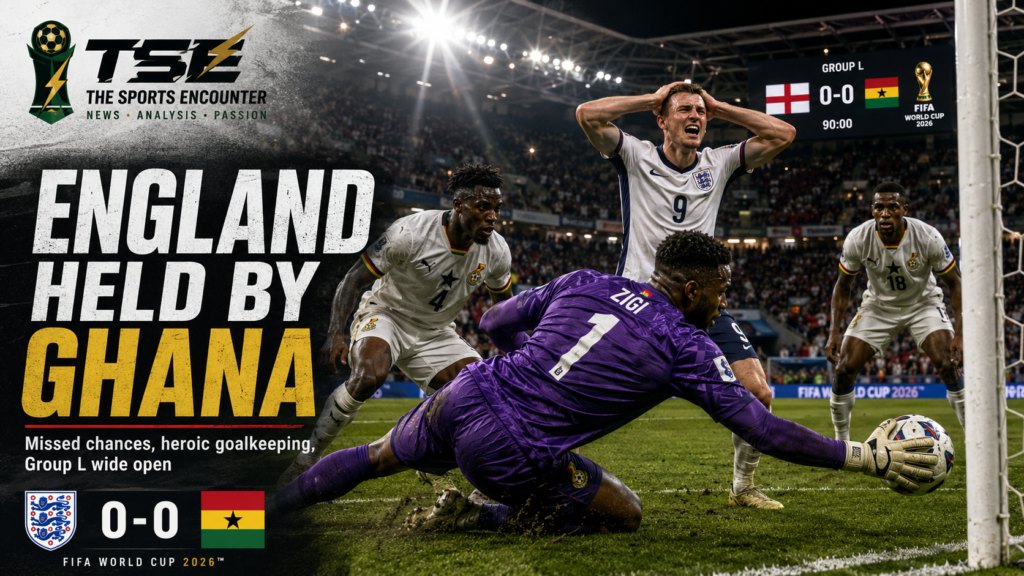
England arrived in Boston with a chance to turn Group L into a controlled march toward the FIFA World Cup 2026 knockout stage.
Ghana arrived with a different plan.
The Black Stars did not come to entertain England. They came to slow them down, deny central space, protect the penalty area, and make one of the tournament favorites prove they could solve a low block under pressure.
England could not.
The result was a tense 0-0 draw that kept both teams unbeaten, moved both onto four points, and left Group L open heading into the final round of fixtures. England had more of the ball, more territory, and the cleaner late chances. Ghana had structure, discipline, and an excellent goalkeeper in Benjamin Asare, who gave Carlos Queiroz’s side the calm they needed when the match began to stretch.
For England, this will feel like a missed opportunity. For Ghana, it will feel like a point earned with intelligence and nerve.
For more tournament coverage, follow The Sports Encounter’s FIFA World Cup 2026 hub.
England Controlled the Ball, but Not the Match
England’s 4-2 win over Croatia in the opening game had raised expectations. That match carried chaos, goals, and attacking authority. This one demanded something different.
Ghana gave England a puzzle.
Thomas Tuchel’s side had to break down a compact defensive setup, find angles between the lines, and move the ball quickly enough to pull Ghana out of shape. Instead, England spent long spells circulating possession without creating enough danger.
Jude Bellingham and Declan Rice tried to dictate rhythm, but Ghana crowded the central areas. Harry Kane often dropped to connect play, yet that also left England short of penalty-box presence when wide deliveries arrived. Anthony Gordon and Noni Madueke showed moments of directness, but Ghana’s defenders rarely allowed them to attack open grass.
England looked more comfortable than Ghana in possession, but comfort is not control.
That was the central problem.
The Three Lions had the ball. Ghana controlled the danger.
England’s first-half performance lacked tempo. They did not register enough clear pressure to make Ghana panic. Passes went sideways too often. Runners arrived late. Crosses came from predictable areas. The Ghana back line defended the box with patience and did not allow England to turn possession into momentum.
After the break, England improved. The substitutions gave Tuchel more width, more movement, and more urgency. Bukayo Saka added sharper decision-making. Nico O’Reilly gave England a fresh penalty-box threat. Eberechi Eze brought more unpredictability.
Still, the breakthrough never came.
England had already shown against Croatia that they can score in bursts. Against Ghana, they showed the other side of tournament football: quality means little if chances are rushed when they finally arrive.
Read more on England’s opening statement in England Beat Croatia 4-2 as Kane and Bellingham Turn Chaos Into a World Cup Statement.
Ghana’s Defensive Plan Deserved Respect
Ghana’s performance was not passive. It was calculated.
Carlos Queiroz built the match around compactness, physical discipline, and controlled risk. Ghana did not press England recklessly. They protected the central lanes, forced England wide, and trusted their defenders to deal with crosses and second balls.
That approach can look negative on television, especially when the opponent has more possession. But World Cup football does not reward moral points for style. It rewards survival, clarity, and execution.
Ghana had all three.
The midfield worked hard to close passing lanes into Bellingham and Kane. The defenders stayed connected, especially when England tried to overload wide areas. Marvin Senaya, Gideon Mensah, Jerome Opoku, and Jonas Adjetey all had to defend under pressure, but Ghana rarely looked emotionally shaken.
That matters in a World Cup group.
Ghana opened their campaign with a late 1-0 win over Panama, covered here in Ghana Leave It Late as Yirenkyi Breaks Panama Hearts in World Cup Opener. That victory gave them room to manage this match differently. A draw against England was not a timid result. It was a strong tournament outcome.
Ghana now have four points from two games, two clean sheets, and a final group match against Croatia that could decide whether they qualify directly or fall into the third-place calculation.
That is a serious position.
Benjamin Asare Gives Ghana the Calm They Needed
Ghana goalkeeper Benjamin Asare did not need to produce a long reel of acrobatic saves to become one of the key figures in the match.
His value came through presence.
Asare handled the pressure cleanly. He held Kane’s low effort in the second half. He managed crosses with composure. He slowed the game when Ghana needed oxygen. He gave his defenders the confidence to stay compact instead of dropping into panic mode.
Goalkeepers in matches like this often get judged by one spectacular save. Asare’s performance was more mature than that. He did not turn the match into a personal circus. He made the routine look routine, and that is exactly what Ghana needed.
His handling mattered because England’s late pressure could have easily become chaotic. Once Saka, Eze, O’Reilly, and Kane began combining around the box, Ghana needed their goalkeeper to keep his decision-making clean.
Asare did that.
The biggest compliment is simple: Ghana’s defense looked calmer because he was behind it.
England’s Missed Chances Could Still Hurt Them
England did enough late in the match to win it.
The best opening came in the final minutes when Nico O’Reilly struck the bar after Reece James delivered into the danger area. The rebound fell toward Kane, but the England captain blasted over from close range under awkward pressure. It was not the cleanest chance, but it was the kind of moment Kane usually turns into punishment.
Then came another late scare for Ghana. Marc Guehi’s looping header was cleared off the line after England attacked from a corner. That was the moment when Ghana’s defensive discipline turned into emergency defending, and they survived.
Those chances changed the emotional reading of the match.
For 70 minutes, England had been frustrated more than unlucky. By full time, they could point to clear late opportunities and say they should have won.
Both things can be true.
England did not create enough across the full match. England also missed the kind of late chances that separate group winners from nervous qualifiers.
Tuchel will know the issue. Against teams that sit deep, England need better spacing, faster switches, and more penalty-box aggression. Kane cannot always be both creator and finisher. Bellingham cannot always force the game open through personality. The wide players must turn possession into cutbacks, not only crosses.
England remain in a strong position, but this was a warning.
The knockout stage will bring stronger opponents. Some will attack England. Others will copy Ghana’s approach and ask the same question: can England break a disciplined block without losing patience?
For a broader look at tournament pressure and surprise results, read When Giants Fall: The World Cup Upsets That Still Make Football Feel Dangerous.
Yellow and Red Cards in England vs Ghana
The match had two yellow cards and no red cards.
Declan Rice was booked in the 41st minute after catching a Ghana player while trying to win the ball back in midfield. For England, that booking matters because fair-play records can still become relevant in group-stage tiebreakers.
Ghana forward Iñaki Williams received a yellow card in the second half for a lunging challenge on Anthony Gordon. It was the clearest disciplinary moment for the Black Stars.
No red card was reported in the available match event logs.
There was also a tense flashpoint involving Jordan Pickford and Ghana substitute Prince Adu after Pickford came out of his area and collided with the forward. VAR reviewed the incident and no foul was awarded against the England goalkeeper.
What the Result Means for England
England now sit on four points from two matches.
That is a strong position, but not yet a perfect one.
The draw means England missed the chance to confirm early control of Group L. Their final match against Panama now carries real importance, especially if goal difference and group ranking shape the Round of 32 path.
England should still be favored to qualify. Four points are usually a solid base in a 48-team tournament where the top two teams and several third-placed sides can progress. Still, Tuchel will not want England relying on calculations.
A win against Panama would almost certainly secure progression and may be enough to win the group, depending on Ghana’s result against Croatia. A draw would likely keep England in a strong position, but it could open the door for Ghana or Croatia to affect the final order.
The bigger issue is performance.
England have shown they can score against a major European opponent. They have also shown they can look blunt when asked to unlock a compact, physical side.
That is not a crisis.
It is a note for the training ground.
For fans trying to understand the expanded format, The Sports Encounter’s guide explains the FIFA World Cup 2026 qualification process and how the Round of 32 changes the group-stage stakes.
What the Result Means for Ghana
Ghana will leave this match with belief.
Four points from two games gives the Black Stars a real route to the knockout stage. Their final match against Croatia will still be demanding, but Ghana have already beaten Panama and held England scoreless. That is not luck. That is a tournament platform.
A draw against Croatia may be enough to qualify directly, depending on the rest of the group picture. A win would put Ghana in a powerful position to challenge for first place if England slip against Panama. Even a narrow defeat may leave Ghana in the best third-place conversation, although Queiroz will want no part of that uncertainty.
Ghana’s biggest positive is defensive trust.
Two matches. Two clean sheets. Four points.
In World Cup football, that travels.
The concern is attacking output. Ghana defended brilliantly against England, but they did not create enough clear chances to threaten a win. If they need to chase the game against Croatia, they will have to show more ambition in possession and more support around Antoine Semenyo, Jordan Ayew, and Iñaki Williams.
Still, Ghana’s tournament is alive and healthy.
They have turned Group L into a real fight.
Final Verdict: England Frustrated, Ghana Strengthened
This was not a classic, but it was a proper World Cup match.
England had the bigger names, stronger squad depth, and better late chances. Ghana had the clearer defensive identity, the calmer goalkeeper, and the discipline to make England uncomfortable for long stretches.
England will see two points dropped.
Ghana will see one point won.
That difference matters because group-stage football is not only about performance. It is about position. After two matches, both teams are unbeaten, both have four points, and both control enough of their own destiny heading into the final round.
England still look likely to reach the knockouts, but they must sharpen their attacking rhythm before the margins get smaller. Ghana look organized enough to qualify, but they will need one more disciplined performance against Croatia to finish the job without depending on third-place math.
Boston did not get goals.
It did get a reminder.
At the World Cup, control without finishing can become frustration. Discipline without panic can become progress.
England learned the first lesson.
Ghana lived the second.
The Sports Encounter’s World Cup 2026 coverage focuses on fixtures, team news, match analysis, fan stories, tournament trends, and the biggest talking points from football’s global stage.