


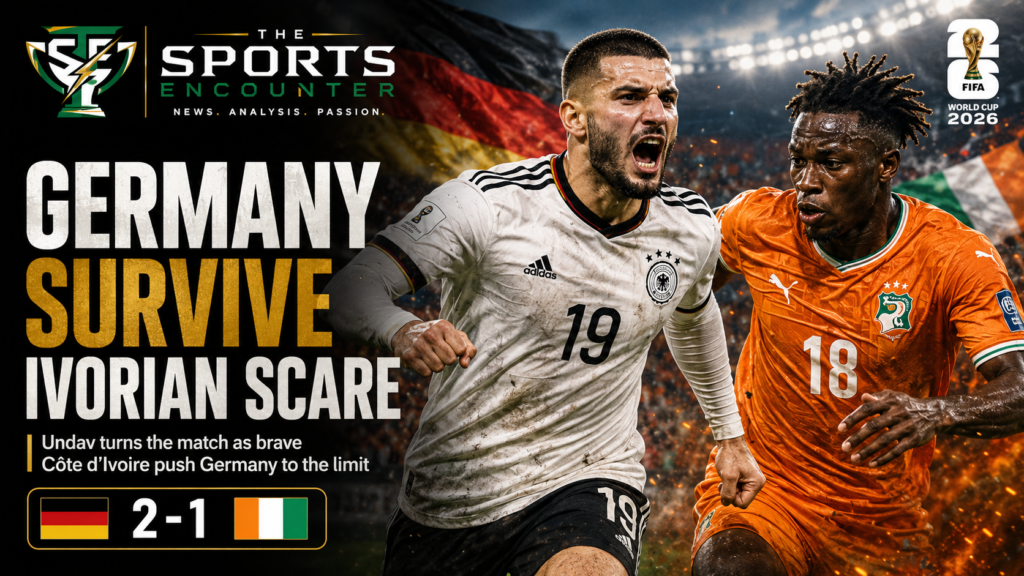
Germany walked into Toronto with the confidence of a team that had already scored seven in its opening match.
Côte d’Ivoire walked in with no interest in playing the role of polite opposition.
For more tournament coverage, follow The Sports Encounter’s FIFA World Cup 2026 hub.
By the end, Germany had the result they wanted. A 2-1 win pushed them closer to control of Group E and confirmed their ability to survive a real test. Yet this match told a more complicated story than the scoreline alone.
Côte d’Ivoire led through Franck Kessié, defended with heart, attacked with purpose, and made Germany look uncomfortable for much of the night. Germany needed second-half changes, more direct movement, and two ruthless finishes from Deniz Undav to escape with all three points.
This was a German win, but it was also an Ivorian warning to the rest of the tournament.
Match Summary: Germany Win Late After Côte d’Ivoire Shake Group E
Côte d’Ivoire started with bravery, not fear.
They pressed Germany’s midfield when the pass was loose, attacked quickly through wide areas, and trusted Franck Kessié to give them balance between aggression and control. Germany had the bigger names, but the Ivorians had the sharper first-half energy.
The breakthrough came in the 30th minute. Kessié reacted inside the box and punished Germany after their defense failed to clear properly. It was not a lucky goal. Côte d’Ivoire had earned the pressure.
Germany reached halftime trailing 1-0, and the frustration was obvious. Their passing looked safe rather than sharp. Their front line lacked timing. Kai Havertz struggled to impose himself, while Jamal Musiala and Leroy Sané found too little space between the lines.
For a team that opened the tournament with a 7-1 win over Curaçao, this was a very different examination.
Germany’s First Half Exposed Old Weaknesses
Germany’s first-half problem was not possession. It was purpose.
They moved the ball often enough, but Côte d’Ivoire blocked central lanes and forced them toward areas where the final ball became predictable. The Germans looked polished until the last third, then rushed when the moment demanded calm.
Côte d’Ivoire also caused problems behind Germany’s fullbacks. Yan Diomande’s pace stretched the pitch and forced Joshua Kimmich and Jonathan Tah into uncomfortable recovery situations. Amad Diallo gave the attack another outlet, while Kessié’s timing from midfield added real danger.
That first half raised a question Germany will need to answer before the knockout rounds: can they handle teams that combine athletic speed with emotional discipline?
This was not the soft resistance of a weaker group opponent. Côte d’Ivoire played like a side that believed it could win.
Second-Half Germany: Better, Braver, and More Direct
Julian Nagelsmann’s second-half management changed the match.
Germany needed freshness and sharper movement. The introductions of Deniz Undav, Nadiem Amiri, and Jamie Leweling gave the team better vertical threat and more urgency. Instead of waiting for perfect passing angles, Germany began attacking the box earlier.
Undav made the biggest difference.
His movement gave Germany a clearer reference point. He attacked space with conviction, occupied defenders, and gave Amiri and Felix Nmecha better targets between Côte d’Ivoire’s center-backs.
The equalizer came in the 68th minute. Amiri delivered from the right, Undav timed his run, and Germany finally had the clean attacking action they had been missing.
That goal changed the emotional weight of the match. Germany no longer looked trapped. Côte d’Ivoire still fought, but they had to defend deeper, chase longer, and survive more pressure.
Undav Delivers the Kind of Finish Germany Needed
The winning goal arrived in stoppage time, and it carried the feel of a knockout moment even though this was still group-stage football.
Felix Nmecha found Undav with a sharp pass into feet. Undav controlled, turned, and finished with the calm of a striker who already knew where the corner was before the ball arrived.
Germany 2. Côte d’Ivoire 1.
That finish did more than win the match. It gave Germany a new selection debate.
Havertz still offers technical value, movement, and link play, but Undav gave Germany the raw penalty-box authority they lacked for an hour. In a tournament where one stale attacking performance can change everything, Nagelsmann may now have to rethink his starting front line.
Germany’s win over Côte d’Ivoire joins a growing list of World Cup matches where second-half corrections have mattered as much as the starting XI. England showed similar attacking authority in their chaotic win over Croatia, covered in England Beat Croatia 4-2 as Kane and Bellingham Turn Chaos Into a World Cup Statement.
Côte d’Ivoire Deserved Respect, Even in Defeat
This was a defeat, but Côte d’Ivoire should walk away with belief.
They did not sit back from the first whistle. They did not treat Germany as untouchable. Their midfield battled, their wide players ran at defenders, and their defensive line survived long spells of pressure through commitment and courage.
Kessié’s goal gave them the lead, but the real story was the collective performance around it. Yahia Fofana made important saves. Wilfried Singo defended with strength before injury forced him off. Diomande gave Germany real problems until tired legs took over.
The Ivorians looked devastated at full time because they knew how close they had come. That reaction said everything.
Côte d’Ivoire still have enough quality to trouble Curacao in their final group match. If they carry this same aggression, they can still fight for qualification.
Yellow and Red Cards: A Rarely Clean World Cup Battle
For all the physical duels, frustration, and late pressure, the match stayed unusually clean on the disciplinary sheet.
There were no yellow cards and no red cards recorded in the available match event logs.
That matters because this was not a slow match. Germany and Côte d’Ivoire fought hard in midfield, challenged aggressively, and played through several tense moments. The referee allowed contact, kept the rhythm alive, and avoided turning a competitive game into a card-heavy contest.
In a tournament already shaped by disciplinary flashpoints, including Paraguay’s dramatic red-card storyline covered in Turkey Crash Out as 10-Man Paraguay Keep World Cup Hopes Alive, Germany vs Côte d’Ivoire stood out for a different reason. It was fierce without becoming reckless.
Match Discipline Summary
| Team | Yellow Cards | Red Cards |
|---|---|---|
| Germany | 0 | 0 |
| Côte d’Ivoire | 0 | 0 |
Tactical Takeaway: Germany Found a Way, But the Warning Is Clear
Germany’s second half showed their depth. That is the positive.
Nagelsmann changed the shape of the game with his bench. Amiri improved the delivery. Leweling added energy. Undav gave Germany a striker’s edge. Nmecha grew into the match and produced the pass that decided it.
Still, this performance also exposed danger signs.
Germany looked vulnerable against speed. Their first-half attack lacked bite. Their defensive structure became stretched when Côte d’Ivoire attacked quickly. Better teams will notice that.
The win matters, but the warning matters too.
Germany have the talent to go deep. They also have enough unresolved issues to make every serious opponent believe there is a route through them.
What This Means for Group E
Germany now control their path toward the knockout stage. Two wins from two matches give them breathing room before their final group match against Ecuador.
Côte d’Ivoire, meanwhile, remain alive. Their opening win over Ecuador still gives them a platform, and their performance against Germany should strengthen belief inside the squad.
This group is still alive because Côte d’Ivoire refused to fold.
For readers tracking how underdogs are changing the tone of this World Cup, Morocco’s tight win over Scotland offers another useful comparison: Morocco Edge Scotland as Saibari’s Early Strike Turns Group C on Its Head.
Final Word: Germany Survive, Côte d’Ivoire Announce Themselves
Germany got the three points. Deniz Undav got the headlines. Nagelsmann got proof that his bench can rescue a match when the starting plan stalls.
Côte d’Ivoire got no points, but they gained something valuable too: tournament credibility.
They pushed Germany into discomfort, led for more than half an hour, and stayed brave until the final whistle. Many teams lose to Germany. Fewer make Germany look this uneasy.
That is why this match should not be remembered only as a German comeback.
It was also Côte d’Ivoire’s statement that Group E still has a fight left in it.
For another World Cup story built around pressure, star power, and team structure, read DR Congo Stun Portugal as Ronaldo’s World Cup Question Grows Louder.