


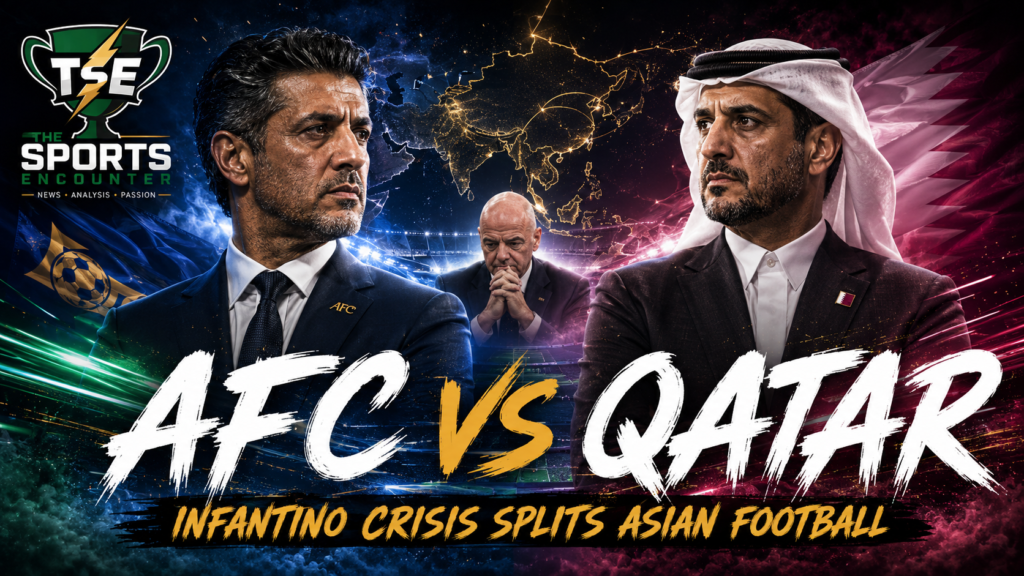
MANAMA, Bahrain, August 18, 2026: The political battle surrounding FIFA President Gianni Infantino has opened a new fault line inside Asian football, with Asian Football Confederation President Sheikh Salman bin Ebrahim Al-Khalifa publicly hitting back at Qatar over its challenge to the AFC’s position in the escalating FIFA leadership crisis.
What began as a dispute over Infantino’s abandoned World Cup commercial investment proposal has now become a struggle over representation, authority and influence inside one of football’s most powerful regional confederations.
Qatar Football Association President Sheikh Hamad bin Khalifa Al-Thani had challenged the AFC after Sheikh Salman joined the presidents of UEFA and CONCACAF in an open letter criticizing Infantino’s leadership. Qatar argued that AFC members had not been consulted before the confederation’s name was attached to the intervention.
Sheikh Salman has now rejected that criticism and defended his authority to act when he believes fundamental football principles are at stake.
The disagreement matters because Qatar is not operating from the margins of Asian football. Sheikh Hamad sits on the AFC Executive Committee and the FIFA Council, while Qatar was also among six Arab football associations that recently declared support for Infantino. The conflict therefore brings the wider FIFA power struggle directly inside the AFC.
AFC-Qatar Dispute: Key Facts
| AFC President | Sheikh Salman bin Ebrahim Al-Khalifa |
| QFA President | Sheikh Hamad bin Khalifa Al-Thani |
| Central dispute | Whether the AFC president had authority to join criticism of Infantino without wider consultation |
| AFC position | Part of the UEFA-AFC-CONCACAF challenge to Infantino |
| Qatar position | Supports Infantino and challenged the procedure used by AFC leadership |
| Why it matters | The FIFA crisis has developed into an internal battle over who represents Asian football |
Sheikh Salman Rejects Qatar’s Procedural Challenge
The argument began after Sheikh Salman joined UEFA President Aleksander Ceferin and CONCACAF President Victor Montagliani in confronting Infantino over the failed attempt to bring private investment into FIFA’s commercial operations.
The three confederations had already escalated the crisis by accusing Infantino of damaging trust and calling for an independent examination of how the controversial proposal was developed.
Qatar then objected to the AFC’s involvement.
Sheikh Hamad argued that neither he nor the Qatar Football Association had been consulted before the statement was issued in the name of the Asian confederation. His complaint effectively questioned whether Sheikh Salman could present a political position as the AFC’s position without first securing wider approval from its members.
Sheikh Salman has responded by defending the responsibilities attached to the AFC presidency and rejecting Qatar’s focus on procedure when, in his view, the underlying issue concerns the interests and values of football.
He also suggested that Qatar’s approach risked damaging unity within Asian football.
The Bigger Story Is Now Inside the AFC
This is where the latest development becomes more important than another exchange of statements.
The Infantino crisis has already divided football between confederations, national associations and senior administrators. The Qatar dispute shows that those divisions no longer fit neatly along continental lines.
The AFC leadership has aligned itself with UEFA and CONCACAF in demanding greater accountability from FIFA. Several influential Arab federations have moved in the opposite direction.
Qatar, Egypt, Lebanon, Morocco, Sudan and Mauritania recently issued a joint declaration backing Infantino and praising his contribution to football development. Four signatories, including Sheikh Hamad, also hold positions on the FIFA Council.
That support followed a widening revolt in Europe and elsewhere. Ireland withdrew its support for Infantino, while New Zealand later joined the growing list of associations distancing themselves from his leadership.
The result is a fragmented political map in which confederation executives can no longer assume that every member association beneath them shares the same position.
Why Qatar’s Challenge Goes Beyond Support for Infantino
Qatar’s objection carries two separate arguments.
One concerns Infantino. Qatar believes the FIFA president deserves continued support despite the controversy surrounding the failed commercial proposal.
The other concerns governance inside the AFC itself.
By challenging the process through which Sheikh Salman joined the open letter, Qatar has raised a legitimate institutional question: when a confederation president takes a position on a major global governance issue, does that automatically represent every national federation inside that confederation?
Sheikh Salman’s response effectively argues that leadership sometimes requires the president to act without first turning every issue into a vote among member associations.
That tension between executive authority and collective representation may survive long after the Infantino controversy ends.
Infantino’s Failed Commercial Plan Still Drives the Crisis
The confrontation traces back to Infantino’s attempt to establish a new commercial structure around FIFA’s most valuable competitions, including the World Cup.
The proposal involved bringing private investment into an entity controlling major FIFA commercial rights. It could have raised about $4.2 billion through the sale of a minority stake.
Opposition developed rapidly because senior football officials said they had not been properly consulted about a proposal capable of reshaping the ownership and governance of FIFA’s commercial assets.
Infantino eventually abandoned the idea, but the reversal failed to stop the political damage.
Senior FIFA figures and national associations subsequently began breaking ranks, turning a rejected business proposal into a wider debate about transparency and presidential authority.
The crisis moved even closer to Infantino this week when FIFA Chief Operating Officer Kevin Lamour left the organization after previously criticizing the way the plan had been handled. Lamour’s departure added another layer of internal pressure around FIFA’s leadership.
Qatar Has Become an Important Part of Infantino’s Support Base
The timing of the dispute is especially important because Infantino is seeking another term as FIFA president in 2027.
European opposition has hardened considerably. The English Football Association has already withdrawn its support for Infantino’s re-election, while other associations have demanded deeper governance reforms.
Infantino still retains meaningful support across other parts of world football, including sections of Africa, South America and the Arab football community.
Qatar’s intervention therefore carries electoral significance as well as institutional significance.
Sheikh Hamad’s position places one of Asia’s most influential football nations openly against the political direction being taken by the AFC president.
Asian Football Now Faces a Representation Problem
The question hanging over the AFC is becoming difficult to avoid.
Who speaks for Asian football?
Sheikh Salman leads the Asian Football Confederation and has taken a clear position alongside UEFA and CONCACAF.
Yet Qatar and other Asian or Arab stakeholders retain their own political interests, FIFA Council representation and relationships with Infantino.
Both realities can exist at the same time. That is precisely why the dispute is potentially damaging.
If individual federations increasingly reject positions taken by their confederation leadership, the crisis could weaken the AFC’s ability to present a unified Asian position on FIFA governance.
Conversely, ignoring dissent from powerful member associations would create its own questions about representation and decision-making.
The FIFA Crisis Has Entered a More Complicated Phase
Infantino’s immediate problem once centered on whether he could contain anger over an abandoned commercial proposal.
The political consequences have since expanded far beyond that original decision.
Confederations are confronting FIFA. National associations are challenging their own confederations. Senior executives have left FIFA. Governments and political figures have entered the debate, including Donald Trump, whose support for Infantino added another dimension to the dispute. The Sports Encounter previously examined how Trump’s intervention changed the political complexion of the FIFA struggle.
The latest AFC-Qatar confrontation shows why the crisis may be increasingly difficult to resolve through one resignation, apology or election.
Football’s governing structures themselves are being tested.
Qatar wants its voice recognized inside the AFC. Sheikh Salman insists the confederation’s president must retain the authority to defend what he considers football’s fundamental interests.
Infantino remains at the center of the storm, but the dispute unfolding around him is now revealing tensions that extend far beyond one man.
Frequently Asked Questions
Why has the AFC president criticized Qatar?
AFC President Sheikh Salman bin Ebrahim Al-Khalifa responded after the Qatar Football Association challenged the AFC’s decision to join UEFA and CONCACAF in criticizing FIFA President Gianni Infantino. Qatar argued that member associations had not been consulted before the AFC took that position.
Does Qatar support Gianni Infantino?
Yes. Qatar was among six Arab football associations that recently expressed support for Infantino amid the growing FIFA leadership crisis.
Why are UEFA, the AFC and CONCACAF criticizing Infantino?
The confederations have raised concerns about governance, consultation and transparency surrounding Infantino’s abandoned proposal to bring private investment into FIFA’s commercial operations.
Is Gianni Infantino still FIFA president?
Yes. Infantino remains FIFA president and is seeking another term in the 2027 presidential election.
What does the AFC-Qatar dispute mean for Asian football?
It exposes disagreement between the AFC’s leadership and influential member associations over both FIFA governance and the authority of the confederation president to represent Asian football on major international issues.