


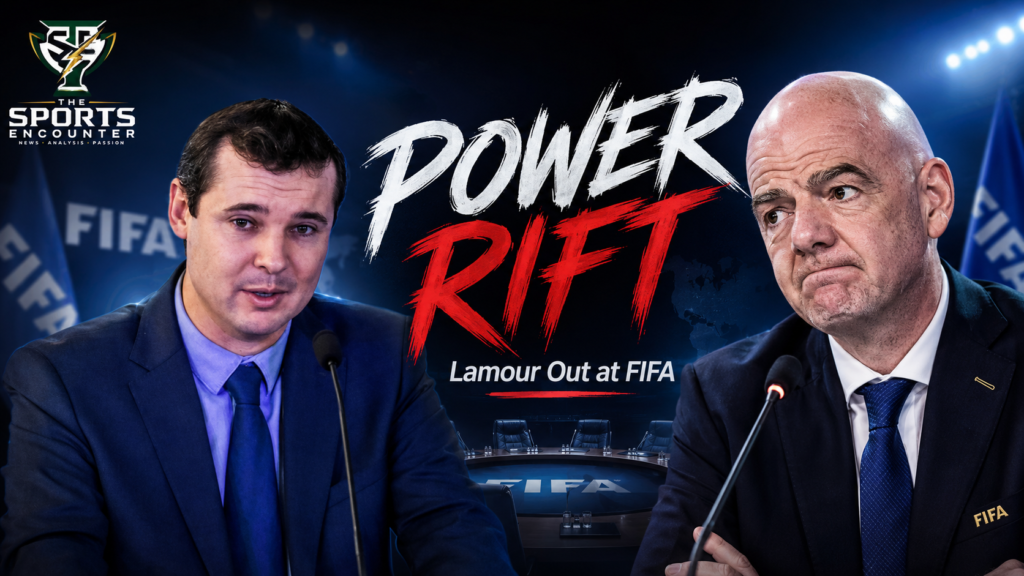
Kevin Lamour warned FIFA that speaking publicly about what he believed had gone wrong inside the organization might cost him his job.
Just over two weeks later, his time at FIFA is over.
FIFA confirmed on August 17, 2026, that its working relationship with Lamour, the organization’s chief operating officer, had ended following one of the most extraordinary internal governance disputes of Gianni Infantino’s presidency.
Officially, FIFA presented the departure in restrained terms. The organization thanked Lamour for his service, while an internal message from Secretary General Mattias Grafström reportedly characterized the separation as mutual and respectful.
The timing tells a much more complicated story.
Lamour had publicly accused FIFA staff of being “deceived” over the controversial FIFA Forward Enterprise proposal, a plan backed by Infantino that could have transferred a minority stake in a new company controlling major FIFA commercial assets to private investors.
He described the proposal as effectively the project of one person.
Then came the line that made clear he understood the personal risk involved:
“If that means I lose my job then so be it. At least I’ll sleep well tonight.”
Now he has lost the job.
Whether FIFA describes that outcome as dismissal, mutual separation or the end of a working relationship, Lamour’s departure has become another major development in a crisis that has already cost Infantino a senior adviser, divided world football’s continental confederations, pushed national associations to withdraw support for his re-election and transformed an abandoned commercial proposal into a much broader argument about how FIFA is governed.
The Sports Encounter has followed the controversy from the moment opposition moved inside FIFA itself. Our earlier report on Carlos Cordeiro’s resignation and Kevin Lamour’s public rebellion identified Lamour’s intervention as especially significant because criticism was no longer coming only from UEFA or outside FIFA.
One of the organization’s most senior executives was saying the process had failed internally.
His departure now raises a harder question.
What happens inside FIFA when a senior executive publicly challenges the president?
Kevin Lamour’s FIFA Departure: What We Know
| Executive | Kevin Lamour |
| FIFA position | Chief Operating Officer |
| Joined FIFA | November 1, 2024 |
| Departure confirmed | August 17, 2026 |
| Immediate background | Public criticism of FIFA Forward Enterprise and Gianni Infantino |
| Lamour’s central allegation | FIFA staff had been deceived over the proposal and process |
| Proposed commercial vehicle | FIFA Forward Enterprise |
| Reported valuation | Approximately $20 billion |
| Proposed investor stake | Up to approximately 20% |
| Potential capital raise | Approximately $4.2 billion |
| Outcome of investment proposal | Abandoned following widespread opposition |
| Other senior departure | Carlos Cordeiro resigned in protest |
Who Is Kevin Lamour?
Lamour was not a peripheral employee suddenly thrust into a political fight.
He occupied one of FIFA’s most senior operational roles.
FIFA announced his appointment as chief operating officer in 2024 after a long career in European football administration. According to FIFA’s official announcement of Lamour’s appointment, he was brought into the organization to oversee several important divisions and subdivisions.
That placed him close to the machinery through which FIFA runs tournaments, administration and organizational projects.
His criticism of FIFA Forward Enterprise therefore carried a different kind of weight from criticism by an opposition federation.
Lamour was speaking as somebody inside the institution.
He was also challenging a proposal connected to the most valuable assets FIFA possesses.
The World Cup is more than a tournament. It is the commercial engine supporting FIFA’s wider development structure, competitions and distributions to 211 member associations.
Any plan to reorganize how that commercial value is held, managed or partly owned was therefore always going to become a governance issue as much as a financial one.
What Was FIFA Forward Enterprise?
FIFA Forward Enterprise, commonly referred to as FFE, was the proposed commercial vehicle at the heart of the crisis.
The plan contemplated placing major commercial rights and operational assets connected to FIFA competitions into a new company reportedly valued at approximately $20 billion.
Private investors could then acquire a minority stake of roughly 20%, potentially bringing FIFA approximately $4.2 billion in immediate capital.
The structure was presented as a way of unlocking more commercial value from FIFA’s enormous portfolio while allowing the governing body to retain majority ownership and sporting control.
That distinction mattered to FIFA.
Critics were unconvinced.
The Sports Encounter examined the structure in detail after the proposal collapsed in our analysis of why FIFA’s $20 billion World Cup stake plan failed within days.
The central objection was larger than valuation.
Opponents questioned whether any private investor should acquire an ownership interest in a business built around football’s most important international competitions.
The criticism became even sharper because many officials said consultation had been inadequate.
That is where Lamour entered the story.
Lamour Said FIFA Staff Had Been Deceived
Public disagreement among FIFA executives is unusual.
Public disagreement this severe is rarer still.
Lamour said staff inside FIFA had been deceived about how the FFE project had developed.
He challenged the level of institutional consultation and described the proposal as the project of one person, language widely understood as placing responsibility directly on Infantino.
That accusation transformed the controversy.
Until then, Infantino could reasonably portray opposition as a political disagreement between FIFA leadership and powerful external confederations.
Lamour made that explanation harder to sustain.
If FIFA’s own COO believed staff had been kept insufficiently informed, the governance question moved inside the headquarters.
The Sports Encounter captured that moment in our original report on the internal FIFA revolt.
Lamour went further than simply opposing the investment structure.
He publicly acknowledged that his intervention could threaten his employment.
That made his August 17 departure impossible to separate politically from the comments that preceded it, even though FIFA’s formal language around the separation has been much more restrained.
FIFA’s Official Language Matters
There is an important journalistic distinction here.
Reports have described Lamour as having been sacked or dismissed.
FIFA’s own language has been less confrontational.
The organization confirmed that its working relationship with Lamour ended on August 17 and thanked him for his contribution.
An internal communication reportedly characterized the departure as mutual and respectful.
Those descriptions should be reported alongside the obvious context rather than replaced by it.
There is currently no public evidence demonstrating the full internal employment process behind Lamour’s exit.
What can be established is the sequence.
Lamour publicly challenged the process surrounding FFE.
He said staff had been deceived.
He acknowledged that speaking out could cost him his position.
Within weeks, his position ended.
Readers can judge the political significance of that sequence without pretending the precise internal employment mechanism has been publicly disclosed.
Carlos Cordeiro Had Already Walked Away
Lamour’s exit is not the first senior personnel consequence of the FFE crisis.
Carlos Cordeiro, a senior adviser to Infantino and former U.S. Soccer president, resigned in protest as opposition to the proposal escalated.
Cordeiro was unequivocal.
He said he had not been involved in developing the proposal and opposed it.
His resignation mattered because Cordeiro was not a longtime Infantino enemy attacking from the outside.
He was an adviser inside the structure.
The combination of Cordeiro leaving and Lamour speaking out created the first unmistakable evidence that resistance had reached senior FIFA management.
Our report on how Cordeiro’s resignation coincided with the wider UEFA-led revolt showed how quickly an investment proposal became a leadership crisis.
Lamour’s departure now completes another stage of that escalation.
The $20 Billion Plan Collapsed, but the Crisis Did Not
FIFA abandoned the proposed transaction at the end of July after resistance spread across major confederations and national associations.
That should theoretically have ended the argument.
Instead, it changed the argument.
The central issue moved from whether FIFA should sell a stake in FFE to how the proposal had been developed in the first place.
Who knew about it?
Who authorized it?
What role did FIFA’s elected bodies play?
How much consultation took place with member associations?
What authority did Infantino have to advance such a structure?
Why did some senior FIFA figures say they had been excluded or deceived?
Those questions survived after the investment plan died.
The Sports Encounter explored that transition in our report on how the abandoned proposal evolved into an institutional crisis inside FIFA.
UEFA, AFC and CONCACAF Turned a Commercial Dispute Into a Governance Revolt
The resistance was not confined to Europe.
UEFA emerged as the most aggressive opponent of the plan, but the Asian Football Confederation and CONCACAF also challenged the process.
That significantly altered the political balance.
A conflict between FIFA and UEFA can be explained through the longstanding institutional rivalry between Zurich and European football.
A conflict involving Europe, Asia and North and Central America is harder to dismiss as one regional power struggle.
Those confederations later demanded deeper scrutiny of the process surrounding the abandoned proposal.
The Sports Encounter examined the shift in our analysis of how UEFA, AFC and CONCACAF turned on Infantino.
The dispute had become about trust.
And trust is much harder to rebuild than a failed deal.
The Political Cost Is Reaching Infantino’s Re-Election Campaign
Infantino’s future at FIFA is now inseparable from the governance crisis.
The presidential election for the next cycle is scheduled for March 2027.
Before the FFE controversy, Infantino appeared to possess an extraordinarily strong position.
FIFA had just completed a commercially successful World Cup.
Revenue was strong.
Member associations had benefited substantially from development programs during his presidency.
No universally recognized challenger had emerged.
The investment dispute changed that atmosphere.
National associations began withdrawing support.
The English FA formally turned against another Infantino term, a development The Sports Encounter covered in our report on the FA withdrawing its backing.
New Zealand has since withdrawn support as well while calling for an independent examination of what happened.
Other associations have raised similar concerns.
None of that automatically means Infantino will lose.
FIFA elections are decided by 211 national associations, each holding one vote.
Infantino retains important support outside the confederations most hostile to him.
The African and South American blocs remain particularly important, while several Arab and smaller football nations continue to value the development funding and political access associated with his presidency.
This is therefore a genuine contest over FIFA’s global coalition.
Lamour’s Exit May Strengthen the Argument for an Independent Review
The most immediate governance consequence of Lamour’s departure could be symbolic.
Opponents of Infantino can now argue that one of the senior officials who challenged the FFE process is no longer inside FIFA.
That will inevitably intensify questions about whether an internal FIFA review alone could satisfy critics.
An independent investigation would potentially examine several issues.
- How FIFA Forward Enterprise was conceived.
- Which FIFA executives and committees were consulted.
- When member associations became aware of the proposal.
- The involvement of investment banks and potential private investors.
- The authority under which negotiations or preparatory work advanced.
- Whether internal governance procedures were followed.
- Whether staff were given accurate information about the project.
These are no longer technical questions about investment structuring.
They relate directly to accountability inside the governing body of world football.
The Thrive Capital Connection Increased Political Sensitivity
The investment proposal also attracted attention because a group associated with Joshua Kushner’s investment interests was expected to play a major role in the private capital side of the transaction.
Reports linked the proposed investor structure to Thrive-related entities, adding another layer of scrutiny to an already politically sensitive project.
The problem for FIFA was not simply who might invest.
The larger question was what investors would be buying.
Broadcast rights.
Sponsorship.
Ticketing.
Hospitality.
Licensing.
Commercial operations associated with competitions whose cultural importance extends far beyond their balance-sheet value.
That is why the proposal was repeatedly described publicly as a plan to “sell” part of the World Cup even though FIFA insisted sporting governance would remain under its control.
Could FIFA Separate Commercial Ownership From Football Control?
This was the conceptual weakness at the heart of FFE.
Technically, commercial ownership and sporting governance can be separated.
An investor can own an economic stake without choosing referees, tournament hosts or national teams.
Football politics rarely stays that clean.
If outside investors put billions into a company dependent on World Cup revenues, they naturally gain an economic interest in how those competitions are structured and monetized.
More matches can mean more inventory.
New competitions can create new commercial products.
Host markets influence sponsorship value.
Broadcast scheduling influences revenue.
Expansion influences both costs and income.
That does not mean investors would automatically dictate football decisions.
It does mean commercial incentives and sporting decisions would become increasingly difficult to treat as completely separate worlds.
That concern helped explain why the proposal generated resistance far beyond questions about price.
Why Lamour’s Position Made His Criticism So Damaging
Every organization can dismiss external criticism as uninformed.
That becomes harder when the criticism comes from the chief operating officer.
Lamour’s role meant he understood FIFA’s internal structures at a level few outsiders could replicate.
When somebody in that position says employees were deceived, the natural response is to ask what he saw that others did not.
FIFA may disagree with his interpretation.
That disagreement itself deserves scrutiny.
A strong governance culture should be capable of documenting how major decisions were made and explaining why senior executives reached radically different conclusions about the same process.
Lamour leaving FIFA does not answer those questions.
It makes them more urgent.
Does Lamour’s Departure Prove FIFA Punished Dissent?
No public evidence currently proves that in a formal employment sense.
That distinction is important.
Correlation in timing is not the same as documentary proof of motive.
FIFA has not publicly released a detailed employment decision showing that Lamour was terminated specifically because of his criticism.
At the same time, pretending his criticism and departure are unrelated developments would ignore obvious context.
The responsible conclusion sits between those extremes.
Lamour publicly challenged Infantino and the FFE process.
He predicted that doing so might cost him his job.
His FIFA employment then ended shortly afterward.
That sequence creates a legitimate governance question even if the complete internal employment record remains private.
Infantino Still Has Significant Political Strength
The scale of the criticism can make it easy to assume Infantino is already politically finished.
That would be premature.
His model of FIFA leadership has always relied heavily on direct relationships with national associations, particularly countries that historically felt ignored by football’s richest regions.
Development funding matters enormously to those federations.
Infrastructure matters.
Training centers matter.
Youth programs matter.
Access to FIFA leadership matters.
Many smaller associations judge Infantino through that lens rather than through European concerns about commercial governance.
The divide around his presidency therefore reflects two competing ideas about FIFA.
One prioritizes institutional checks, consultation and protection of football’s commercial assets.
The other emphasizes redistribution, development money and FIFA’s ability to generate far greater revenue than previous administrations.
Both will matter when associations eventually vote.
The World Cup’s Success May Be Infantino’s Strongest Defense
The irony of the entire crisis is its timing.
It erupted after a World Cup that strengthened FIFA commercially.
Infantino can point to revenue growth, tournament expansion and development spending as evidence that his strategy works.
His supporters can ask why FIFA should retreat from commercial innovation when the organization has become financially stronger.
Opponents respond that commercial success makes governance safeguards more important, not less.
The more valuable FIFA becomes, the more consequential any decision about ownership, privatization or control becomes.
That is the philosophical divide exposed by FIFA Forward Enterprise.
Kevin Lamour Is Gone, but His Central Question Remains
The most striking thing about Lamour’s departure is how little it resolves.
FFE is gone.
Cordeiro is gone.
Lamour is gone.
Infantino remains.
The member associations remain.
The confederations remain divided.
The calls for scrutiny remain.
The 2027 election remains ahead.
Removing the investment proposal removed the immediate commercial battle.
It did not restore the trust that disappeared while the proposal was being developed.
That is the problem FIFA now has to solve.
What Happens Next?
Several developments now deserve close attention.
1. Will FIFA explain Lamour’s departure in greater detail?
The organization may decide its existing statement is sufficient.
If criticism grows, pressure could build for more explanation around how the relationship ended.
2. Will an independent review happen?
This could become the central demand from FIFA’s critics.
The credibility of any investigation will depend heavily on who controls its terms and who appoints those conducting it.
3. Will more national associations withdraw support from Infantino?
The English FA and New Zealand are among those already moving away from him.
Every additional federation changes the arithmetic and, perhaps more importantly, the perception of momentum.
4. Will a credible challenger emerge?
Opposition to an incumbent does not automatically produce an alternative.
Infantino’s critics still need a candidate capable of winning votes across several continents.
5. Will FIFA revisit private investment later?
FFE may be dead, but the financial logic that created it has not disappeared.
The enormous value of World Cup commercial rights will continue attracting investors.
A future proposal could return with stronger consultation, different ownership terms or a completely different corporate structure.
TSE Verdict: This Is Now About FIFA’s Culture, Not a Dead Investment Deal
Kevin Lamour’s departure should not be viewed as the final chapter of the FIFA Forward Enterprise controversy.
It is evidence that the controversy has moved into another stage.
The original question was financial.
Should FIFA sell a minority stake in a commercial company built around the World Cup and its other major assets?
The answer became no.
The new question is institutional.
How was a proposal of that scale able to advance far enough to trigger negotiations, investor interest and global political resistance while senior officials later said consultation had failed?
Lamour made his position unusually clear.
He believed FIFA staff deserved better.
He believed the process had been deceptive.
He believed the project had become too closely associated with one individual.
And he said publicly that he was prepared to lose his job for saying so.
His employment has now ended.
FIFA is entitled to describe the separation in its own terms, and without the complete employment record it would be irresponsible to claim we know every internal reason behind the decision.
But governance is also about perception.
One senior adviser resigned because he opposed the plan.
The chief operating officer publicly challenged it and is now gone.
Major confederations have demanded answers.
National associations are reconsidering their support for the president.
A transaction that was supposed to demonstrate FIFA’s commercial ambition has instead become a test of whether its institutions are strong enough to challenge the person leading them.
That is why Lamour’s departure matters.
This stopped being a story about selling part of FIFA’s business weeks ago.
It is now a story about power.
Who exercises it.
Who questions it.
And what happens when somebody close to the center decides to speak publicly.
For continued reporting on FIFA governance, the World Cup and the political battle over Infantino’s future, follow The Sports Encounter’s FIFA World Cup coverage.
Frequently Asked Questions
Who is Kevin Lamour?
Kevin Lamour served as FIFA’s chief operating officer after joining the organization in November 2024. He previously built a long career in European football administration.
Has FIFA sacked Kevin Lamour?
FIFA confirmed that its working relationship with Lamour ended on August 17, 2026. Media reports have described him as having been dismissed, while FIFA’s own communication characterized the separation in more restrained terms and thanked him for his contribution.
Why did Kevin Lamour criticize Gianni Infantino?
Lamour criticized the process surrounding FIFA Forward Enterprise, saying FIFA staff had been deceived and describing the controversial investment proposal as effectively the project of one person.
What was FIFA Forward Enterprise?
FIFA Forward Enterprise was a proposed commercial subsidiary that would have contained major commercial and operational assets connected to FIFA competitions. FIFA considered selling a minority stake of roughly 20% to private investors.
How much was FIFA Forward Enterprise worth?
Reports placed the proposed valuation at approximately $20 billion, with a potential 20% stake capable of raising around $4.2 billion.
Did FIFA sell part of the World Cup?
No. The proposal was abandoned before the transaction took place. FIFA was considering selling a minority interest in a commercial company connected to competition assets rather than transferring sporting ownership of the World Cup itself.
Why did Carlos Cordeiro resign from FIFA?
Cordeiro resigned as a senior adviser after publicly opposing the proposed FFE structure. He said he had not been involved in developing it and considered the proposal damaging to FIFA’s member associations and football’s long-term interests.
Which football confederations opposed Infantino over the proposal?
UEFA, the Asian Football Confederation and CONCACAF became major critics of the process and later pushed for greater scrutiny of how the proposal had been developed.
Is Gianni Infantino running for FIFA president again?
Infantino’s future is expected to be decided through FIFA’s 2027 presidential process. His position has come under greater scrutiny following the collapse of the investment proposal and the withdrawal of support by several national associations.
Does Kevin Lamour’s departure prove he was fired for speaking out?
The timing raises an obvious question, but the complete internal employment process has not been publicly disclosed. FIFA has confirmed the end of the working relationship without publicly providing evidence establishing that his criticism was the sole formal reason.
Could FIFA revive the private-investment idea?
The specific FIFA Forward Enterprise proposal has been abandoned. However, the enormous commercial value of FIFA competitions means alternative investment or restructuring ideas could emerge in the future, particularly if FIFA develops a model with broader consultation and member approval.
The Sports Encounter’s soccer coverage follows the decisions, governance battles and power struggles shaping world football alongside the matches played on the pitch.