


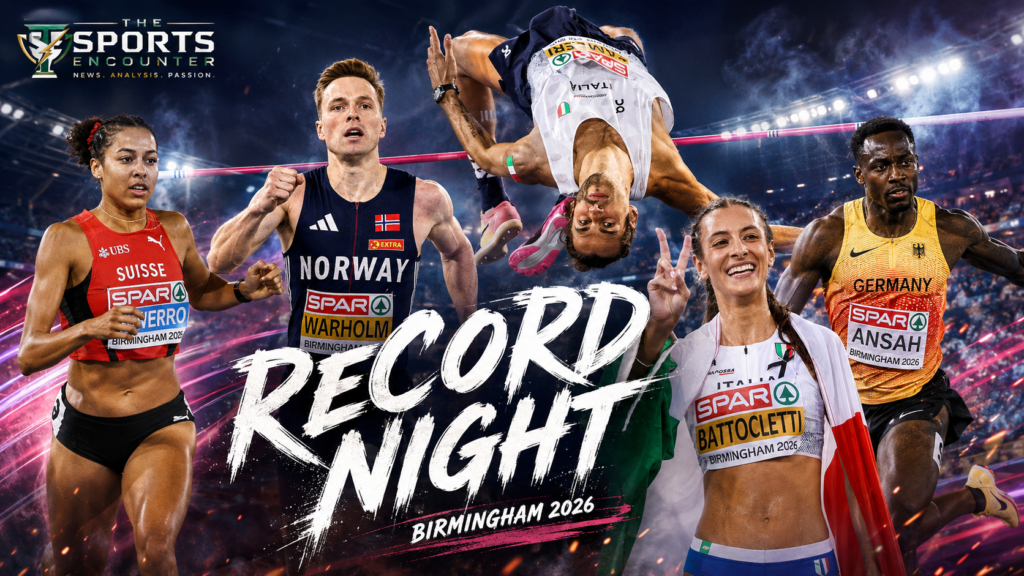
Birmingham 2026 produced the kind of European Athletics Championships session that turns a medal table into a memory. Audrey Werro broke a 44-year championship record to beat Keely Hodgkinson, Karsten Warholm owned the 400m hurdles again, Gianmarco Tamberi turned doubt into high jump gold, Nadia Battocletti completed a historic distance double-double, and Owen Ansah gave Germany a major sprint breakthrough.
This was not a quiet championship day. It was a night of statements.
Werro won the women’s 800m in 1:54.81, holding off Hodgkinson in front of a British crowd that expected a home celebration. Warholm ran 46.63 for his fourth straight European 400m hurdles title. Tamberi cleared a season-best 2.32m to win his fourth European high jump crown. Battocletti took the women’s 10,000m in 31:41.17 after already winning the 5,000m. Ansah captured the men’s 200m in 19.95, with a +2.5 wind reading, to give Germany its clearest sprint headline of the championships.
Some athletes defended territory. Others announced themselves. Together, they gave Birmingham its sharpest finals session yet.
Birmingham 2026 Today’s Biggest Winners at a Glance
| Event | Winner | Winning Mark | Main Story |
|---|---|---|---|
| Women’s 800m | Audrey Werro, Switzerland | 1:54.81 | Championship record, beating Keely Hodgkinson |
| Men’s 400m hurdles | Karsten Warholm, Norway | 46.63 | Fourth straight European title and championship record |
| Men’s high jump | Gianmarco Tamberi, Italy | 2.32m | Fourth European title, third straight, season-best clearance |
| Women’s 10,000m | Nadia Battocletti, Italy | 31:41.17 | Completed 5,000m and 10,000m double-double |
| Men’s 200m | Owen Ansah, Germany | 19.95, +2.5 wind | Germany’s breakthrough sprint gold |
Audrey Werro Turns the 800m Into Her Breakthrough Night
The women’s 800m had the tension of a race built for a major championship. Hodgkinson had the Olympic gold, the home crowd and the pressure. Werro had the fastest momentum of the season and the growing belief that she was ready to change the event’s hierarchy.
She did exactly that.
Werro won in a championship-record 1:54.81, beating Hodgkinson, who took silver in 1:55.01. Femke Broeders-Bol of the Netherlands claimed bronze in 1:55.54, reported as an equal national record.
The significance of Werro’s win went beyond the time. A fast mark in a paced race can prove talent. A championship record against an Olympic champion proves something deeper. It shows that the speed survives pressure, positioning, noise and the emotional weight of a final.
Hodgkinson did not run badly. That is what makes the race so important. She ran a brilliant 1:55.01 and still finished second. Werro did not win because the favorite folded. She won because she found the higher level on the night.
The result now gives the women’s 800m a sharper rivalry. Hodgkinson remains a champion-level force. Werro is no longer waiting outside the conversation. She is standing in the center of it.
Read the full TSE race analysis on Audrey Werro’s record 800m gold over Keely Hodgkinson.
Karsten Warholm Still Runs Like Europe Belongs to Him
Warholm’s dominance has lasted so long that the danger is treating it as routine.
Birmingham showed why that would be a mistake.
The Norwegian world record holder won the men’s 400m hurdles in 46.63, setting a championship record and claiming his fourth straight European title in the event. Germany’s Emil Agyekum took silver in 47.87, while Turkey’s Ismail Nezir earned bronze in 48.26.
Warholm’s race was brutal in its simplicity. He attacked early, forced the field into a chase and never gave the final back. By the home straight, the gold-medal race and the medal race behind him were no longer the same thing.
That is what separates great hurdlers from event-defining hurdlers.
Warholm has now broken 47 seconds 18 times in his career. His 46.63 in Birmingham was not close to his world record, but that is part of the point. One of his seventh-fastest performances ever was still far too much for Europe.
His full dominance is covered in Karsten Warholm’s fourth straight European 400m hurdles gold.
Gianmarco Tamberi Makes the High Jump His Stage Again
Gianmarco Tamberi arrived in Birmingham with a modest season-best of 2.23m and the natural questions that follow a 34-year-old champion in a technical event.
Then the final began, and Tamberi became Tamberi again.
The Italian cleared a season-best 2.32m to win the men’s high jump gold, holding off Ukraine’s Oleh Doroshchuk, who took silver at 2.30m. Matteo Sioli added bronze for Italy with 2.27m, giving the Italians a 1-3 finish on the podium.
This was Tamberi’s fourth European outdoor title and third straight. It was also another reminder that his greatest skill may be timing. Not only technical timing at take-off, but emotional timing inside a major final.
Tamberi understands how to pull a stadium into his attempts. He stretches the drama, feeds off noise and then finds the clearance when the bar begins to feel heavier than the measurement.
The win was not his biggest career achievement. Olympic gold and world gold still sit higher. But Birmingham mattered because it came at a moment when doubt had a reasonable argument. Tamberi answered with 2.32m and another gold medal.
Read the full feature on Gianmarco Tamberi’s fourth European high jump gold.
Nadia Battocletti Turns the Distance Double Into Her Own Property
Nadia Battocletti’s 10,000m gold was the kind of achievement that grows larger once the details settle.
The Italian won in a season-best 31:41.17 after already taking the 5,000m title earlier in the championships. That completed the 5,000m and 10,000m double for the second consecutive European Championships, making her the first woman to achieve that double at back-to-back editions.
Maureen Koster of the Netherlands took silver. Belgium’s Jana van Lent won bronze. Britain’s Megan Keith finished eighth after leading much of the race.
The important part is the repeat.
Winning a distance double once requires range, recovery and championship nerve. Doing it twice, across consecutive editions, means rivals had time to study the pattern and still could not break it.
Battocletti now owns a rare place in European distance running. Rome 2024 gave her a home-stage breakthrough. Birmingham 2026 confirmed that her dominance travels.
Her historic achievement is explored in detail in Nadia Battocletti’s 5,000m and 10,000m double-double.
Owen Ansah Gives Germany Its Sprint Moment
Owen Ansah’s men’s 200m gold gave the evening a breakthrough sprint story.
The German won in 19.95 with a +2.5 wind reading, beating Britain’s Zharnel Hughes, who took silver in 20.16. Italy’s Eseosa Desalu and Switzerland’s Timothé Mumenthaler shared bronze after both were recorded at 20.26.
The wind reading matters. A mark above +2.0 is not legal for record purposes, so Ansah’s 19.95 will not carry the same statistical status as a legal sub-20 performance.
But the title does not need that protection.
Every finalist ran with the same wind. Ansah still beat Hughes by 0.21 seconds and separated himself clearly from a field full of experience and speed. The wind helped the clock. It did not explain the margin.
Ansah had already won 100m bronze earlier in the championships. The 200m gold now gives Germany a sprinter with multi-event championship proof and a profile that can travel beyond one night.
The full story is available in Owen Ansah’s European 200m gold for Germany.
Italy’s Championship Strength Keeps Expanding
Italy came out of the day looking like one of the strongest stories of Birmingham 2026.
Tamberi won high jump gold. Sioli added high jump bronze. Battocletti completed the distance double. Desalu shared 200m bronze. That is a spread across field events, endurance and sprinting.
That spread matters.
National championships stories often become powerful when success stops depending on one athlete or one discipline. Italy now has Tamberi’s showmanship, Battocletti’s distance authority, Sioli’s podium emergence and Desalu’s sprint experience all contributing to the same wider picture.
This is not a one-star campaign.
It is a team identity being reinforced across the stadium.
Britain’s Night Was Strong, Painful and Complicated
Britain did not leave the session empty, but it did leave with several what-ifs.
Hodgkinson ran 1:55.01 and lost to a championship record. Hughes took silver in the 200m behind Ansah. Megan Keith led much of the 10,000m before finishing eighth. The crowd had moments to lift itself, but the biggest gold-medal celebrations belonged elsewhere.
That is the cruel side of a home championship.
Every British move feels amplified. Every near miss feels heavier. Hodgkinson’s silver will sting because she is good enough to win any major 800m final. Hughes’ silver will feel like a missed chance because he had the pedigree. Keith’s race will be remembered for courage more than the final placing.
Still, Britain’s championships have already delivered historic highs, led by Amy Hunt’s rare European 100m and 200m sprint double. This was a night that reminded the home team how fine the difference can be between carrying a crowd and being beaten in front of one.
Birmingham 2026 Is Becoming a Championship of Statements
The session worked because every major result carried a clear meaning.
Werro’s win changed the women’s 800m conversation. Warholm’s record reminded Europe that his event still belongs to him. Tamberi’s gold turned doubt into theatre. Battocletti’s double-double created history. Ansah’s 200m victory gave Germany a new sprint face.
That is why this did not feel like five unrelated finals.
It felt like a championship night with identity.
Some sessions are remembered because records fall. Others are remembered because favorites lose. The best ones do both while also creating new questions for the next season.
Birmingham did that.
The Official Championship Context
The Birmingham 2026 European Athletics Championships are part of the official continental championship structure overseen by European Athletics. Global athlete records, official profiles, rankings and performance lists are maintained by World Athletics.
Host-nation athletics updates are available through British Athletics, while full championship coverage and event information can be followed through European Athletics.
TSE Analysis: This Was the Night Birmingham Found Its Edge
Every championship needs a session where the event stops feeling like a schedule and starts feeling like a story.
This was that session for Birmingham 2026.
It had speed, theatre, endurance, records, home heartbreak and breakthrough energy. Werro gave the night its shock. Warholm gave it authority. Tamberi gave it personality. Battocletti gave it history. Ansah gave it a new sprint headline.
That combination is rare.
The best championship nights do more than hand out medals. They change how athletes are discussed after the stadium lights go down.
Werro is no longer simply the runner with fast 2026 times. She is the European 800m champion who beat Hodgkinson in record time. Warholm is no longer only defending a legacy. He is still actively expanding it. Tamberi is still not ready to become a ceremonial champion. Battocletti has made the European distance double her own. Ansah has moved Germany into the men’s sprint spotlight.
That is a lot for one evening.
And that is exactly why Birmingham 2026 now feels bigger than it did before the session began.
Readers can follow The Sports Encounter’s full athletics coverage through Audrey Werro’s record 800m gold, Karsten Warholm’s hurdles dominance, Gianmarco Tamberi’s high jump gold, Nadia Battocletti’s distance double-double, Owen Ansah’s 200m gold, Amy Hunt’s sprint double, and our wider analysis of sporting greatness.
Frequently Asked Questions
Who were the biggest winners at Birmingham 2026 today?
Audrey Werro, Karsten Warholm, Gianmarco Tamberi, Nadia Battocletti and Owen Ansah produced the day’s biggest victories at the European Athletics Championships.
Who won the women’s 800m gold?
Audrey Werro of Switzerland won the women’s 800m in a championship-record 1:54.81, beating Great Britain’s Keely Hodgkinson.
What did Karsten Warholm win?
Karsten Warholm won his fourth straight European men’s 400m hurdles title in a championship-record 46.63.
Who won the men’s high jump?
Gianmarco Tamberi of Italy won the men’s high jump with a season-best clearance of 2.32m.
What history did Nadia Battocletti make?
Battocletti became the first woman to complete the 5,000m and 10,000m double at consecutive European Championships.
Who won the men’s 200m?
Owen Ansah of Germany won the men’s 200m in a wind-aided 19.95 seconds, beating Zharnel Hughes.
Where can official Birmingham 2026 results be found?
Official championship information is available through European Athletics, while athlete records and global rankings are available through World Athletics.
The Sports Encounter’s athletics coverage follows major championships, records, athlete breakthroughs, sprinting, hurdles, middle-distance running, distance running, field events and the biggest stories shaping global track and field.