


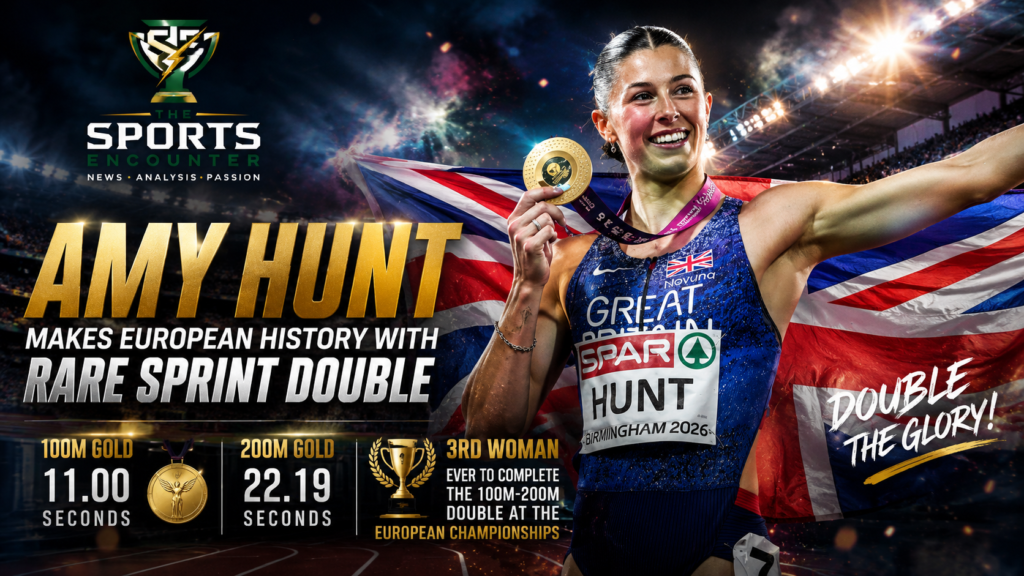
Amy Hunt arrived at the 2026 European Athletics Championships as one of Britain’s most exciting sprinters. She is leaving Birmingham with something much bigger: proof that she can control an entire championship.
The 24-year-old completed a rare 100m-200m sprint double on Thursday night, winning the women’s 200m in a European-leading 22.19 seconds after taking the 100m title earlier in the week in exactly 11.00.
Only two women had previously completed the European sprint double before Hunt, making her just the third in championship history to win both individual short sprints at the same edition. The last was fellow Briton Dina Asher-Smith in 2018.
The achievement becomes even more striking when the quality of the 200m final is considered.
Ireland’s Rhasidat Adeleke produced a national record of 22.28 and still finished second. Asher-Smith, a former world champion, European champion and one of the defining British sprinters of her generation, took bronze. Hunt beat both of them while producing the fastest European performance of the year.
That combination of history, opposition and timing gives Hunt’s double a significance that goes beyond two gold medals.
Birmingham may have marked the moment when British sprinting stopped asking whether she could become its next major star.
She already is.
Amy Hunt’s European Sprint Double at a Glance
| Event | Result | Time | Key Context |
|---|---|---|---|
| Women’s 100m | Gold | 11.00 | First major individual senior title |
| Women’s 200m | Gold | 22.19 | European-leading time |
| 200m Silver | Rhasidat Adeleke | 22.28 | Irish national record |
| 200m Bronze | Dina Asher-Smith | Third | Last woman before Hunt to complete the European sprint double |
| Historical achievement | 100m-200m double | Two golds | Third woman in European Championships history to achieve it |
The 200m Final Was Bigger Than a Straightforward Gold Medal
The final brought together three different stages of European sprinting.
Asher-Smith represented the established benchmark.
Adeleke represented an athlete whose range and physical power have already made her one of Ireland’s most important track stars.
Hunt represented the athlete moving fastest through the hierarchy.
That was what made 22.19 so revealing.
She did not win because the strongest opposition was missing.
She beat it.
Adeleke ran faster than any Irish woman had ever run over 200 meters and still could not get past Hunt. Asher-Smith, whose 2018 European Championships remain one of the great British sprint campaigns, was also behind her.
Hunt controlled the race with enough composure that the final stages felt less like survival and more like confirmation.
The 100m Gold Had Already Changed the Championship
Three days earlier, Hunt had won the 100m in 11.00 seconds.
She did it in a race that again highlighted one of her most interesting characteristics.
Hunt is not always the fastest athlete out of the blocks.
Her strength comes later.
Poland’s Ewa Swoboda and Belgium’s Delphine Nkansa pushed the final hard, but Hunt’s top-end speed carried her through the closing meters and into her first major individual senior title.
The result immediately changed the pressure around the 200m.
Before Monday, Hunt was chasing a breakthrough.
By Thursday, she was chasing history.
The nature of her breakthrough also fits the wider pattern The Sports Encounter has followed across major multi-sport events, including how one great track moment can reshape an entire day’s narrative, as seen in our Glasgow 2026 Day 4 wrap-up and medal table.
The 250m Time Trial That Quietly Changed Her Confidence
One of the most interesting details in Hunt’s preparation happened away from the championship cameras.
In the week before Birmingham, she ran a 250m training time trial and recorded a personal best by roughly one second.
Hunt later described that run as a major confidence boost because it convinced her that she could carry speed deeper into a race.
That matters particularly over 200 meters.
The event requires far more than acceleration.
The athlete has to attack the bend, maintain mechanics while fatigue begins to accumulate and still possess enough speed to resist challengers down the home straight.
A strong 250m effort does not guarantee a championship medal.
For Hunt, it appears to have provided something more useful.
Belief.
Padua Has Become an Important Part of the Amy Hunt Story
Hunt’s development has also been shaped by her move to Italy.
She is based in Padua, where the training environment has given her a different rhythm and a degree of separation from the British athletics system she grew up inside.
Her preparation before Birmingham included an important training week there, and the move increasingly looks like one of the decisions that helped unlock the next level of her career.
Changing countries does not automatically make an athlete faster.
It can, however, change routine, expectations and the way training is processed psychologically.
Hunt has spoken positively about embracing the challenge of living and training abroad, and the results now give that decision a stronger competitive meaning.
She Has Already Come Much Further Than the Birmingham Crowd Could See
The ease of Thursday’s celebration can hide how difficult Hunt’s route back to elite sprinting has been.
In 2022, she attended the Commonwealth Games on crutches after suffering a serious quadriceps injury.
Four years later, she stood inside Alexander Stadium as the fastest woman in Europe over both 100 and 200 meters.
That arc matters because sprinting provides very little protection from physical setbacks.
Explosive athletes depend on tiny margins of power, stiffness, timing and confidence.
A significant leg injury can disrupt all four.
Hunt rebuilt enough to become world silver medallist over 200m in Tokyo in 2025 before taking another major step in Birmingham. Her World Athletics profile now reflects a career that has moved from promise to global and European podium authority.
There Has Also Been a Health Challenge Behind the Results
Hunt’s 2026 season has included another complication.
She has experienced episodes linked to low blood pressure, including near-fainting after demanding 200m races, and has undergone medical monitoring while adjusting hydration and recovery routines.
That makes the Birmingham double even more revealing from a performance-management perspective.
She was not simply racing against seven other athletes.
She was managing the physical demands of repeated championship rounds while knowing how her body had reacted earlier in the season.
Her ability to finish the 200m final strongly suggests the medical and training adjustments are allowing her to compete with greater confidence.
Dina Asher-Smith’s Presence Made the Moment Symbolic
British sprinting rarely receives a cleaner generational image than this.
Asher-Smith was the last woman before Hunt to win both European sprint titles, completing the double in 2018 as part of a historic championship campaign.
Eight years later, she was on the same podium as the woman matching that achievement.
That does not mean Asher-Smith’s era is over.
A bronze medal at a European Championships still reflects elite performance.
But the balance of British women’s sprinting has clearly shifted.
Hunt no longer needs to be introduced as the athlete coming behind Asher-Smith.
She has her own major championship identity now.
Rhasidat Adeleke Ran an Irish Record and Still Lost
Adeleke’s silver deserves substantial context.
Her 22.28 was an Irish national record.
On many nights, that would have been enough to define the entire final.
Instead, it became evidence of how high Hunt had pushed the standard.
Adeleke’s ability to combine 400m strength with 200m speed makes her particularly dangerous in the longer sprint.
Hunt still finished ahead.
That is one reason the 22.19 matters more than a simple championship time.
22.19 Changes Hunt’s Position in the European Sprint Hierarchy
The time became the European lead for 2026.
Hunt already owns a 22.08 personal best from 2025, so Birmingham was not her fastest ever performance.
It may have been more valuable.
Personal bests show speed.
Championship finals show whether that speed survives pressure.
Hunt now has evidence in both categories.
The standard of her performance also belongs beside the best track stories TSE has covered this summer, including the record-breaking athletics and multi-sport performances in our Glasgow 2026 Day 5 records and medal-table report.
Her Career Is Starting to Connect Across Championships
The European double becomes more significant when placed next to what Hunt achieved in 2025.
She was second in the world over 200 meters in Tokyo, clocking 22.14 in the final after running a 22.08 personal best earlier in the championship.
That result showed she could reach a global podium.
Birmingham showed she could enter a championship with expectation and then dominate two separate individual events.
Those are different skills.
One requires producing one exceptional race.
The other requires managing rounds, recovery, media attention and tactical variation across several days.
That is why Hunt’s double belongs in the wider conversation around breakthrough athletes, the same kind of cross-sport rise The Sports Encounter explored in our feature on what separates the greatest athletes from the rest.
The Four-Gold Possibility Makes the Weekend Even Bigger
Hunt is not finished.
Britain still has relay events ahead, and she has openly discussed the possibility of leaving Birmingham with four gold medals.
If she adds both relay titles to the 100m and 200m crowns, she would achieve something unprecedented at the European Championships.
That possibility changes the final days of the championships.
The individual double is already historic.
The relays could turn it into one of the greatest single-championship performances ever produced by a British track athlete.
Britain Can Build Two Relays Around the Fastest Woman in Europe
Hunt’s form gives the British coaching staff an unusual luxury.
They are not inserting an athlete into the relays merely because she is available.
They are inserting the reigning European 100m and 200m champion.
That matters psychologically as well as technically.
Relay teams gain confidence when one member has already proved herself under the exact stadium pressure the group is about to face.
Hunt now brings that authority.
The Television Audience Shows This Story Has Escaped Athletics’ Usual Boundaries
The supplied figures indicate that Hunt’s double attracted more than three million BBC viewers.
That audience claim should be presented carefully because it depends on broadcaster reporting rather than official championship results.
Even so, the wider point is clear.
Hunt is becoming interesting to people who do not follow European athletics week by week.
That is how crossover sports stars begin to emerge.
The Sports Encounter has already seen how major event coverage can grow beyond one sport’s traditional audience, including in our feature on Angharad Evans’ second Glasgow 2026 gold, where a home-nation performance became part of a much wider championship story.
The Sports Personality of the Year Talk Should Be Treated Carefully
The supplied information also places Hunt at 7/2 in early BBC Sports Personality of the Year betting.
Betting markets change quickly and are not an official BBC measure of candidacy, so this should not be treated as a fixed ranking.
The broader point is still useful.
A home championship double creates exactly the kind of highly visible national sporting moment that can push an athlete into a much larger public conversation.
Hunt’s Personality Is Helping the Performance Travel Further
After winning the 200m, Hunt leaned into the moment.
Her celebration referenced Gladiator, a film she has said carries family significance because her father regularly uses lines from it before races.
That kind of personality matters.
Track athletes have only a handful of championship moments each year when mainstream audiences are watching.
Hunt appears increasingly comfortable using them.
She competes seriously without presenting herself as overly rehearsed.
That combination can become commercially and culturally valuable if the results continue.
The Bigger Story Is How Complete Her Sprinting Is Becoming
Winning the 100m and 200m at the same championship requires two related but distinct athletic profiles.
The 100m rewards acceleration, maximum velocity and technical precision under extreme time pressure.
The 200m demands those qualities plus bend running, speed endurance and more sophisticated energy distribution.
Some athletes are naturally better suited to one.
Hunt is demonstrating that she can now win both.
The 11.00 and 22.19 combination makes that clear.
Her Start Still Leaves Room for Improvement
Perhaps the most exciting element is that Hunt does not look technically finished.
Her 100m performance again showed that her start is not necessarily the strongest part of her race.
That creates obvious development potential.
If she improves the first 20 to 30 meters while preserving her exceptional top-end speed, the ceiling moves higher.
This is why European gold may represent a stage of her development rather than its peak.
The Next Question Is Whether Europe Becomes the World
Hunt has already won world silver.
She is now European champion over both short sprints.
The remaining leap is straightforward to define and extremely difficult to make.
Can she become the best sprinter in the world?
The global landscape is deeper than Europe alone.
American and Jamaican sprinting remain powerful, and championship sprinting can change dramatically from season to season.
But Hunt is entering that conversation with increasingly strong evidence.
Her rise also belongs to a wider run of European and Commonwealth athletes turning championship performances into larger career statements, from track finals in Glasgow to pool events like Angharad Evans’ Glasgow gold run and the broader record wave The Sports Encounter tracked across the Games.
TSE Analysis: Birmingham Looks Like a Career Inflection Point
The easiest way to describe Hunt’s week is to count medals.
Two individual finals.
Two victories.
Two European titles.
The deeper value lies in what changed around those medals.
She beat a reigning British benchmark in Asher-Smith.
She resisted a national-record run from Adeleke.
She converted favorite-level expectation into championship results.
She proved her speed across two events.
She did it at home.
She did it after injuries and health complications.
And she may not be finished yet.
Athletes often have championships where they win medals.
Occasionally, they have championships where the way the sport sees them changes.
Birmingham 2026 increasingly looks like that championship for Amy Hunt.
Official championship results, athlete information and event updates are available through European Athletics and World Athletics.
Readers can also follow The Sports Encounter’s wider major-event coverage, including Glasgow 2026 Day 4, Glasgow 2026 Day 5, Angharad Evans’ Glasgow breakthrough, Wimbledon 2026’s new power shift, and Wimbledon 2026 quarter-final drama.
Frequently Asked Questions
What did Amy Hunt win at the 2026 European Athletics Championships?
Hunt won both the women’s 100m and 200m titles in Birmingham, completing a rare European sprint double.
What time did Amy Hunt run in the European 200m final?
She won in 22.19 seconds, the European-leading performance for 2026.
What was Amy Hunt’s 100m winning time?
Hunt won the European 100m title in exactly 11.00 seconds.
Who finished second in the women’s 200m?
Rhasidat Adeleke won silver in an Irish national record of 22.28 seconds.
Who won bronze in the 200m?
Great Britain’s Dina Asher-Smith finished third.
How rare is Amy Hunt’s European sprint double?
She became only the third woman in European Championships history to win both the 100m and 200m at the same edition.
Who was the last woman to win the European sprint double before Hunt?
Dina Asher-Smith achieved the feat in 2018.
What is Amy Hunt’s 200m personal best?
Her personal best is 22.08 seconds, recorded in 2025.
Did Amy Hunt win a World Championships medal?
Yes. She won silver in the women’s 200m at the 2025 World Championships in Tokyo.
Can Amy Hunt win four gold medals in Birmingham?
She already owns the 100m and 200m titles and remains involved in Britain’s relay ambitions, giving her a possible route to four gold medals during the championships.
The Sports Encounter’s athletics coverage follows major championships, records, athlete breakthroughs, sprinting, distance running, field events and the biggest stories shaping global track and field.