


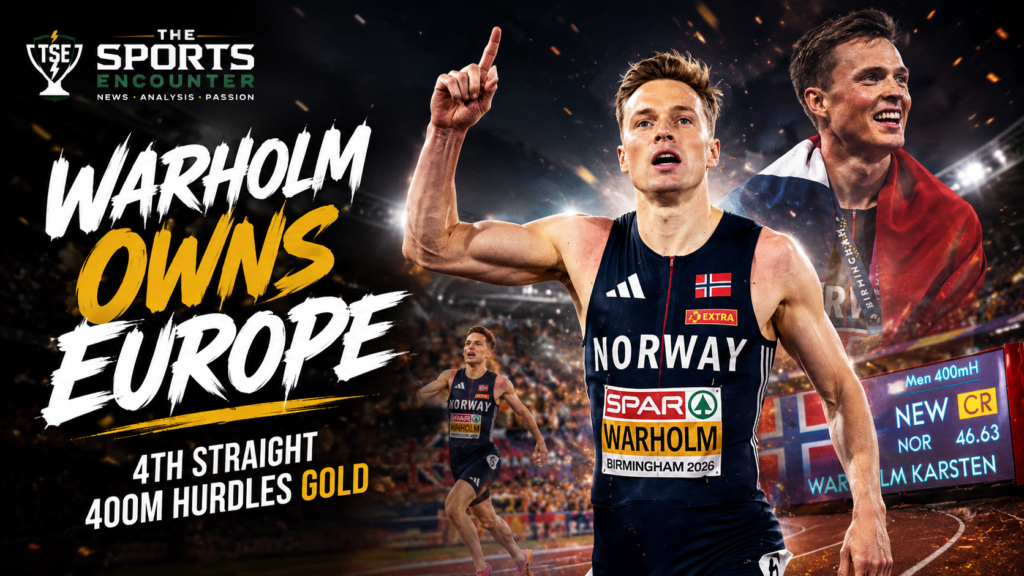
Karsten Warholm did not just win another European 400m hurdles title in Birmingham. He made the event look like personal property.
The Norwegian world record holder claimed his fourth consecutive European men’s 400m hurdles gold at the 2026 European Athletics Championships, storming to victory in 46.63 seconds and finishing more than a second ahead of the field.
Germany’s Emil Agyekum took silver in 47.87, while Turkey’s Ismail Nezir secured bronze in 48.26. Warholm’s winning time was a championship record, his seventh-fastest performance ever, and another reminder that even at 30, he remains Europe’s most complete one-lap hurdler.
The result also continued one of the most remarkable patterns in modern European athletics. Warholm has now won the European 400m hurdles title in 2018, 2022, 2024 and 2026. Even more telling, he has run faster in every European final across that span.
This was not a veteran surviving on reputation.
This was a champion still raising the standard.
Karsten Warholm’s Birmingham 2026 Win at a Glance
| Detail | Information |
|---|---|
| Event | Men’s 400m hurdles final |
| Champion | Karsten Warholm, Norway |
| Winning time | 46.63 seconds |
| Performance note | Championship record |
| Silver | Emil Agyekum, Germany, 47.87 |
| Bronze | Ismail Nezir, Turkey, 48.26 |
| European streak | Fourth straight European 400m hurdles title |
| Sub-47 record | 18th career performance under 47 seconds |
| Additional Birmingham gold | Mixed 4x400m relay |
Warholm Has Turned Europe Into His Own Territory
Some athletes win titles. A smaller group begins to define the event itself.
Warholm belongs firmly in the second category.
His fourth straight European 400m hurdles gold means he has now stretched his continental dominance across eight years, different venues, different challengers and different versions of his own body. That is what makes this Birmingham title so significant.
His first European title in 2018 confirmed that he was more than a global breakthrough story. His later wins made him a standard. Birmingham 2026 now makes the sequence feel historic.
The most impressive detail is not only that he keeps winning.
It is that he keeps winning faster.
Warholm’s European finals have not become nostalgic laps around old greatness. They have become proof that his competitive level remains frighteningly alive.
46.63 Was a Statement, Not Just a Time
A 46.63 in the 400m hurdles is never ordinary.
For Warholm, it sits behind even greater marks on his own career list, but that should not dull its impact. This was his seventh-fastest performance ever and his 18th race under 47 seconds.
Those numbers reveal the problem his rivals face.
Most hurdlers spend careers chasing the kind of time Warholm can produce in a championship final while defending another title. The 46-second range remains an elite neighborhood in the event. Warholm has made it feel like familiar territory.
His official World Athletics athlete profile still carries the greatest number attached to the event: 45.94, the world record he set at the Tokyo Olympic Games. Birmingham did not need to match that night to matter.
It mattered because it showed the distance between Warholm and the European field is still enormous.
The Race Was Over Earlier Than the Clock Said
The final looked decisive almost immediately.
Warholm was clear early, attacking the opening section with the same commitment that has defined his greatest performances. His rhythm through the hurdles forced everyone else into a chase before the race had properly settled.
That is one of his great weapons.
Many 400m hurdlers build gradually. Warholm often makes the race uncomfortable from the first bend. He does not wait for rivals to make tactical choices. He imposes the question early: can you live with this pace and still have anything left?
Karsten Warholm 🇳🇴 sets a Championship Record of 46.63s to win 400mH GOLD at the Euro Championships!🥇
— Track & Field Gazette (@TrackGazette) August 14, 2026
🥈 Emil Agyekum 🇩🇪 47.87
🥉 Ismail Nezir 🇹🇷 48.26 pic.twitter.com/LMfx1Och6b
In Birmingham, the answer was clear.
Agyekum ran 47.87 and still finished more than a second behind. Nezir ran 48.26 and took bronze. Those are medal-winning performances, but Warholm’s superiority turned them into a separate race.
Emil Agyekum Took Silver, But Warholm Remained Out of Reach
Agyekum’s silver should not be overlooked.
The German arrived in Birmingham with strong form and a growing reputation after a major 2026 season. His 47.87 in the final confirmed that he is firmly among Europe’s strongest 400m hurdlers.
But running against Warholm at a European final is a different kind of assignment.
Agyekum did enough to beat everyone else. He did not get close to the man who has made this event his signature stage.
That gap is the story.
Warholm’s dominance does not erase the quality behind him. It simply shows how much better the champion still is when the stakes are highest.
Ismail Nezir’s Bronze Shows Turkey’s Growing Presence
Nezir’s bronze gave Turkey a meaningful place on the podium and added another layer to the event’s changing European depth.
For a discipline that demands speed, endurance, technical precision and emotional control, a 48.26 performance in a major final carries real value. Nezir had to hold himself together through a race where Warholm’s early aggression could easily have disrupted everyone’s rhythm.
Bronze in that kind of final is not merely a result.
It is survival under pressure.
Warholm’s Fourth Straight Title Puts Him in Rare Championship Territory
Winning four straight continental titles is difficult in any event. In the 400m hurdles, it is especially demanding because the event punishes every weakness.
The athlete has to sprint at near-maximum intensity while clearing 10 hurdles, controlling stride pattern, resisting fatigue and keeping technique intact when the body begins to collapse in the final 100 meters.
One mistimed hurdle can change a race.
One rhythm error can turn gold into bronze.
One injury-interrupted season can disrupt the precision required to stay elite.
Warholm has kept coming back.
That is why his Birmingham title sits comfortably beside other repeat-champion stories The Sports Encounter has covered, including Nadia Battocletti’s historic European distance double-double and Amy Hunt’s rare 100m-200m sprint double.
The Mixed 4x400m Relay Gold Added Another Layer
Warholm’s Birmingham week had already delivered gold before the hurdles final.
He was part of Norway’s mixed 4x400m relay success earlier in the championships, giving him a second gold medal at the event and showing that his value now stretches beyond his individual specialty.
That matters because Warholm’s one-lap ability is not limited to hurdles. His flat speed, competitive instincts and relay intensity give Norway a weapon across championship formats.
It also changes how Birmingham 2026 will be remembered for him.
This was not only a successful title defense. It was a multi-gold championship week built around individual dominance and team contribution.
Why Warholm’s Style Still Feels Different
Warholm does not race like a cautious champion protecting a legacy.
He attacks.
That is why his best performances feel so dramatic. He appears to be racing against the limits of the event as much as the athletes beside him. His stride pattern, his first 200 meters, his commitment into the bends and his willingness to accept pain early all create a style that is both risky and difficult to match.
That style has also shaped the way fans understand the event.
The 400m hurdles used to be viewed by many casual viewers as a technical endurance race. Warholm helped turn it into one of track and field’s most explosive spectacles.
His rivalry with Rai Benjamin and Alison dos Santos pushed the event into a golden era. Birmingham showed that, inside Europe, Warholm still stands apart.
He Keeps Defending Without Looking Defensive
There is a difference between defending a title and racing defensively.
Warholm defended the title, but nothing about his race felt protective. He did not sit back. He did not wait to see what others had. He did not turn the final into a tactical scramble.
He ran like the favorite because he was the favorite.
That can be harder than it sounds. When an athlete has won as much as Warholm, every championship becomes an examination of decline. Observers look for a slower first hurdle, a less violent finish, a slight drop in body language or a sign that the next generation is closer.
Birmingham offered no such evidence.
Instead, it gave him another championship record.
The European Final Progression Tells Its Own Story
The fact that Warholm has run faster in each of his European finals since 2018 is one of the strongest details of this entire story.
It turns his title streak into a performance curve.
Champions can accumulate medals while gradually slowing. Warholm has done the opposite at European level. He has added titles while sharpening the winning marks.
That is one reason this 2026 title carries more weight than a simple fourth gold.
It suggests adaptation.
It suggests hunger.
It suggests an athlete who is not satisfied by maintaining a place in history, because he is still actively expanding it.
Norway’s Athletics Identity Keeps Growing Around Warholm
Norway’s modern athletics identity has been shaped by a small group of extraordinary athletes who have made the country visible across global track and field.
Warholm remains central to that story.
He brings a combination of performance, personality and championship reliability that gives Norway a recurring headline whenever the 400m hurdles appear on the schedule. In Birmingham, the mixed relay gold widened that influence by linking him more clearly to Norway’s team success as well.
For a country competing against deeper athletics programs, one athlete of Warholm’s caliber changes perception.
That is the kind of national sporting impact TSE has also explored through wider major-event coverage, including Glasgow 2026 Day 4 and Glasgow 2026 Day 5, where individual breakthroughs and national medal momentum shaped the wider story.
What This Means for the 400m Hurdles Landscape
Warholm’s Birmingham victory does not settle the global picture.
The men’s 400m hurdles remains one of athletics’ deepest and most dangerous events. Benjamin, dos Santos and other challengers ensure that every global final carries a different kind of pressure.
But in Europe, the hierarchy remains obvious.
Agyekum is improving. Nezir has podium strength. Others will come. Yet Warholm’s 46.63 showed that the gap is not only technical or tactical. It is psychological.
Everyone else is racing the event.
Warholm often looks like he is racing the event’s history.
Why 30 Does Not Look Like a Warning Sign Yet
At 30, many hurdlers begin facing questions about durability, recovery and whether explosive rhythm can remain at the highest level.
Warholm has earned those questions simply because of age and the physical violence of the event.
Birmingham answered them for now.
He did not look like a champion hanging on. He looked like a world record holder who still has access to the range of performances that made him great.
The 400m hurdles is unforgiving, but Warholm’s 46.63 showed that his body, rhythm and competitive edge are still working at a level most rivals cannot reach.
His Legacy Is Already Secure, But It Is Still Moving
Warholm’s legacy did not need this title to be valid.
The world record, Olympic gold, world titles and European dominance had already placed him among the defining athletes in 400m hurdles history.
What Birmingham did was different.
It showed that the legacy is still active.
Some champions move from competition into ceremony before they retire. Warholm has resisted that. His performances still create new evidence. His records still move. His European finals still sharpen.
That is why this win belongs in a broader conversation about sustained greatness, the same theme TSE has examined in our feature on what separates the greatest athletes from the rest.
The Official Championship Context
The Birmingham 2026 European Athletics Championships are part of the official continental championship structure overseen by European Athletics. Athlete profiles, performance lists, world records and global results are maintained by World Athletics.
Warholm’s official career record can be followed through his World Athletics profile, while official championship coverage and results are available through European Athletics.
TSE Analysis: Warholm Is Still Racing Like the Event Belongs to Him
The temptation with Warholm is to treat every title as expected.
That is dangerous.
Expectation can flatten greatness when an athlete makes extraordinary performance feel routine. A fourth straight European title in the 400m hurdles is not routine. A 46.63 championship record is not routine. Eighteen career races under 47 seconds are not routine.
Warholm has simply spent so long living near the extreme edge of the event that the exceptional can begin to feel familiar.
Birmingham should push back against that.
This was a complete performance from an athlete who attacked early, controlled the race, destroyed the field and strengthened a title streak that already belonged to European athletics history.
Agyekum and Nezir earned their medals. Warholm owned the final.
That is the difference.
He is no longer building credibility in Europe. He is defending territory. And judging by Birmingham, that territory remains firmly his.
Readers can also follow TSE’s wider athletics and major-event coverage through Amy Hunt’s European sprint double, Nadia Battocletti’s distance double-double, Glasgow 2026 Day 4, Glasgow 2026 Day 5, Angharad Evans’ Glasgow breakthrough, and our analysis of sporting greatness.
Frequently Asked Questions
What did Karsten Warholm win at the 2026 European Athletics Championships?
Karsten Warholm won the men’s 400m hurdles gold medal at the 2026 European Athletics Championships in Birmingham.
What was Karsten Warholm’s winning time?
Warholm won in 46.63 seconds, setting a championship record.
How many consecutive European 400m hurdles titles has Warholm won?
Warholm has won four consecutive European 400m hurdles titles, taking gold in 2018, 2022, 2024 and 2026.
Who won silver and bronze behind Karsten Warholm?
Germany’s Emil Agyekum won silver in 47.87, while Turkey’s Ismail Nezir took bronze in 48.26.
How many times has Warholm broken 47 seconds?
Warholm has now broken 47 seconds 18 times in his career.
Is Karsten Warholm the world record holder?
Yes. Warholm is the world record holder in the men’s 400m hurdles with 45.94.
Did Warholm win another gold medal in Birmingham?
Yes. Warholm also earned gold earlier in the mixed 4x400m relay for Norway.
Why is Warholm’s Birmingham win important?
The win reinforced Warholm’s legacy as Europe’s dominant 400m hurdler, extended his continental title streak and showed that he remains capable of world-class times at 30.
The Sports Encounter’s athletics coverage follows major championships, records, athlete breakthroughs, sprinting, hurdles, distance running, field events and the biggest stories shaping global track and field.