


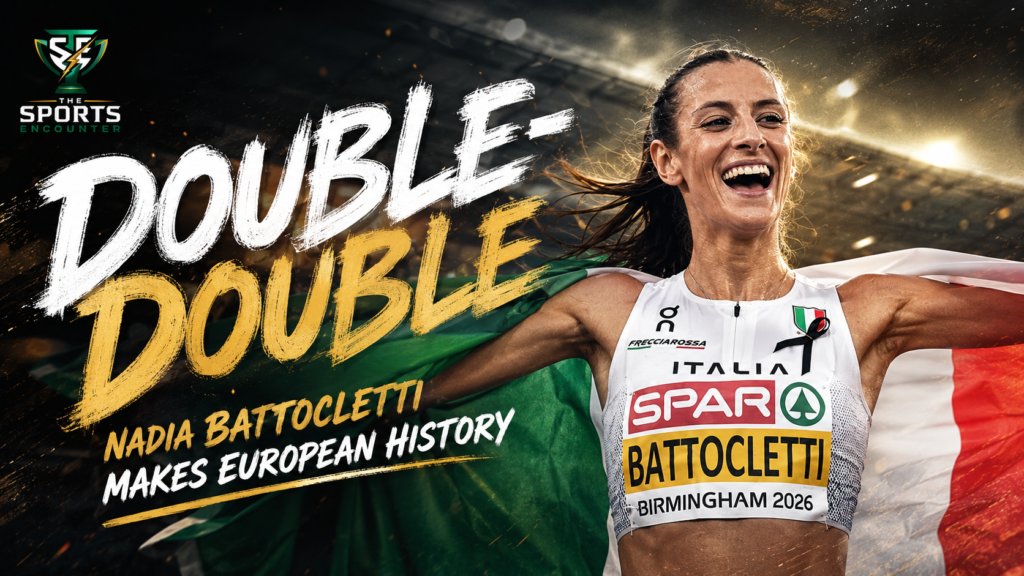
Nadia Battocletti did not simply defend a European title in Birmingham. She turned the 5,000m and 10,000m double into her own piece of continental history.
The Italian distance runner won gold in the women’s 10,000m final at the 2026 European Athletics Championships, producing a season-best 31:41.17 to complete the long-distance double after her earlier 5,000m victory.
That result made Battocletti the first woman to win the 5,000m and 10,000m double at consecutive European Championships, after also sweeping both events at Rome 2024. It also gave her back-to-back European 10,000m titles and confirmed her position as the most reliable championship distance runner in Europe.
Maureen Koster of the Netherlands took silver, while Belgium’s Jana van Lent claimed bronze. British runner Megan Keith finished eighth after spending much of the race at the front, giving the home crowd a reason to believe before Battocletti’s closing strength changed the race.
For Battocletti, this was more than another gold medal.
It was control. It was timing. It was championship authority.
Nadia Battocletti’s Birmingham 2026 10,000m Win at a Glance
| Detail | Information |
|---|---|
| Event | Women’s 10,000m final |
| Champion | Nadia Battocletti |
| Country | Italy |
| Winning time | 31:41.17 |
| Performance note | Season-best time |
| Silver | Maureen Koster, Netherlands |
| Bronze | Jana van Lent, Belgium |
| British result | Megan Keith finished eighth after leading much of the race |
| Historical achievement | First woman to complete the 5,000m/10,000m double at consecutive European Championships |
Battocletti Has Turned the European Double Into a Pattern
Winning the 5,000m and 10,000m at one European Championships is rare enough. Doing it twice, in consecutive editions, changes the entire meaning of the achievement.
At Rome 2024, Battocletti’s double felt like a breakthrough in front of an Italian crowd. At Birmingham 2026, it became proof that the breakthrough had matured into dominance.
That distinction matters.
One golden championship can be explained by form, timing, home advantage or the perfect race week. Repeating it two years later in another country removes most of those explanations. It shows that the athlete has not only reached the level, but learned how to return to it under pressure.
Battocletti came to Birmingham as the defending champion in both events. That brings a different kind of burden. Rivals know your closing speed. They know your patience. They know where you hurt them last time. They spend two years preparing for the version of you that beat them.
She still won both races.
The 10,000m Final Was a Test of Patience Before Power
The women’s 10,000m did not belong to Battocletti from the opening lap.
Megan Keith gave the race its early shape. The British runner led for long stretches, taking responsibility in front of the home crowd and trying to turn the final into something more demanding than a slow tactical wait.
That approach made sense.
Against a runner with Battocletti’s finishing ability, rivals have to ask questions before the closing laps. Letting the Italian sit comfortably and wait for the final move can turn the race into exactly the kind of contest she wants.
Keith’s front-running gave Britain visibility and pushed the field into a race that required decisions.
But championship 10,000m racing often rewards the athlete who knows when not to respond too early.
Battocletti waited. She stayed composed. She trusted the strength that had already carried her through the 5,000m. When the race moved toward its decisive phase, she had enough left to separate herself from the field.
Maureen Koster Made Her Work for It
Koster’s silver medal should not be treated as a supporting detail.
The Dutch runner gave the final a genuine competitive edge and stayed close enough to keep pressure on Battocletti deep into the race. That matters because dominant champions often create the illusion that victory was inevitable.
It rarely is.
Over 25 laps, every small shift matters: when an athlete covers a move, when she chooses to sit back, when she drifts wide, when she protects the inside line, when she begins thinking about the bell. Koster’s presence meant Battocletti could not simply coast toward history.
The silver also underlined the depth of European women’s distance running. Battocletti may be the headline, but she is not racing in a vacuum.
Jana van Lent’s Bronze Gave Belgium a Major Podium Moment
Jana van Lent’s bronze medal gave Belgium one of the biggest distance-running moments of the final.
Bronze in a championship 10,000m often comes down to resilience rather than one spectacular move. The athlete has to survive pace changes, avoid mental drift, stay close enough when the medal race tightens and still respond when the body is already deep into fatigue.
Van Lent did enough of that to reach the podium.
In a race dominated by Battocletti’s historic double-double, Belgium still left with a medal that should carry weight inside its own athletics story.
Megan Keith’s Eighth Place Still Told an Important Story
Keith finished eighth, but her race was more meaningful than the final position alone suggests.
She led much of the race and gave British fans a reason to stay emotionally invested before the medals were decided. That kind of performance takes courage, especially at home, where every lap carries noise, expectation and the temptation to do too much.
Sometimes home athletes choose caution because they fear fading in public.
Keith chose responsibility.
That decision did not deliver a medal, but it shaped the race and showed ambition. For a British distance runner in a European final, that matters.
The Sports Encounter has followed similar major-event moments this summer, including our Glasgow 2026 Day 4 wrap-up and medal table, where home-nation performances helped define the emotional rhythm of the competition.
Why This Double-Double Matters Historically
The phrase “double-double” can sound playful, but in this case it captures a serious athletic achievement.
The 5,000m and 10,000m demand overlapping but distinct strengths. The 5,000m rewards speed, tactical sharpness and the ability to close hard after a controlled pace. The 10,000m asks for deeper aerobic strength, concentration across 25 laps and the discipline to conserve energy without surrendering position.
To win both at one championship, an athlete needs range.
To win both twice in a row, she needs range, recovery, consistency and emotional control.
Battocletti now has all of that attached to her European résumé.
Her achievement also connects Birmingham 2026 with Rome 2024, where she won both the 5,000m and 10,000m as part of a golden Italian athletics surge. The European Athletics archive continues to frame those championship performances as part of one of Italy’s strongest modern track eras.
From Rome Emotion to Birmingham Authority
Rome 2024 had a different emotional texture.
Battocletti was competing at home, in front of Italian fans, during a championship where the national team carried huge momentum. Every gold medal felt amplified by the setting.
Birmingham 2026 asked a different question.
Could she take that dominance away from home?
Could she defend with everyone watching?
Could she become the target and still win?
The answer was clear.
Battocletti’s 10,000m title in Birmingham showed that her European dominance does not depend on atmosphere. It travels.
Her Championship Identity Is Becoming Clear
Some runners look spectacular in paced races and less certain in finals. Others thrive only when the pace is slow and the final lap becomes a sprint.
Battocletti’s recent championship record suggests something more complete.
She can handle tactical pressure. She can absorb expectation. She can run from a controlled position and still produce the final strength needed to decide a race. She also has enough range to move between 5,000m and 10,000m without looking like one event is merely an experiment.
That is why her career now looks less like a collection of good results and more like a defined championship profile.
Her official World Athletics profile already reflects her versatility across 3,000m, 5,000m, 10,000m and road distances, with current world-ranking strength in both the 5,000m and 10,000m disciplines.
Italy’s Golden Distance Runner Has Become a Standard Setter
Italian athletics has enjoyed a powerful period across several disciplines, but Battocletti’s role in that story is distinct.
She gives Italy a distance-running identity on the continental stage.
That matters because European championships are often shaped by national surges. Sprint medals, jumps, throws and relays can create noise, but distance dominance brings a different kind of prestige. It shows depth of preparation, patience and long-term athlete development.
Battocletti has become one of Italy’s strongest symbols of that development.
The Sports Encounter has already explored how one athlete can change the way a nation’s sporting success is understood, including in our feature on what separates the greatest athletes from the rest. Battocletti’s European record now belongs in that broader conversation about consistency, legacy and repeat performance.
The Closing Strength Is Her Signature
Many distance runners can survive. Fewer can finish with authority after surviving.
Battocletti’s best races are built around that difference.
She rarely looks rushed. She does not need to dominate every lap to own the race. Instead, she manages the energy of the final, stays close enough to remain dangerous and then asks opponents to match her when fatigue has already entered their legs.
That kind of finishing strength changes how rivals race against her.
If they go too slowly, they invite her kick.
If they go too early, they risk burning themselves before the last kilometer.
If they wait with her, they still have to beat her in the moment where she has repeatedly proved strongest.
That tactical problem is now Europe’s problem.
Birmingham Adds Another Layer to a Fast-Growing Legacy
Battocletti was already a major figure before this 10,000m final.
She had won the Rome 2024 European double. She had moved through multiple distance events. She had built a reputation as an athlete who could deliver when medals were available rather than merely chase times.
Birmingham adds the repeat factor.
That is what turns achievement into legacy.
Winning can sometimes start a story. Defending gives it structure. Defending across two events gives it weight.
For comparison across major events, TSE has tracked how repeated excellence changes public perception in stories such as Amy Hunt’s rare European sprint double and Angharad Evans’ second gold at Glasgow 2026.
Why the 10,000m Win May Be the Bigger Half of the Double
The 5,000m victory gave Battocletti the first part of the double. The 10,000m made it historic.
That second win carries unique pressure because the athlete knows exactly what is at stake. A title defense is already difficult. A double defense is heavier. A back-to-back 10,000m crown while chasing an unprecedented consecutive European distance double places every lap under a different emotional light.
Battocletti handled that burden with striking calm.
Her 31:41.17 was not just enough to win. It was a season-best performance delivered at the exact moment her historical opportunity required it.
That is the mark of a championship runner.
What This Means for European Distance Running
Battocletti’s double-double raises the standard for everyone else.
Koster, van Lent, Keith and the rest of Europe’s distance runners now know what the target looks like. It is no longer enough to prepare for one event, one pace, or one late move. Battocletti has shown she can handle different race shapes and still find the finish required.
That forces rivals to become more creative.
Future finals may need earlier attacks, stronger team tactics, longer surges or more aggressive pacing. Waiting for the final stages against Battocletti has become a dangerous plan.
What Comes Next for Battocletti?
The immediate answer is celebration. A championship double-double deserves that.
The longer answer is more complicated and more exciting.
Battocletti’s European dominance naturally pushes the conversation toward global championships. Europe now has clear evidence that she can own 5,000m and 10,000m finals. The next challenge is translating that control against the deepest global fields, where African distance power, American strength and wider tactical variety raise the standard again.
That is not a criticism.
It is the next logical stage of a career moving upward.
The official global calendar and athlete records are available through World Athletics, while European championship updates and results are available through European Athletics.
TSE Analysis: Battocletti Is No Longer Chasing History, She Is Organizing It
The most impressive part of Battocletti’s Birmingham 10,000m win was not only the gold medal. It was the sense that she knew exactly how to carry the race into her territory.
That is what elite championship athletes do.
They do not simply react to the final. They organize it around their strengths.
Keith gave the race shape. Koster gave it danger. Van Lent gave it podium depth. Battocletti gave it final authority.
That is why this double-double matters.
It tells Europe that Battocletti’s Rome 2024 was not a perfect home championship that faded into memory. It was the start of a pattern. Birmingham 2026 has now confirmed the pattern.
She is the first woman to win the 5,000m and 10,000m double at consecutive European Championships.
She is a back-to-back 10,000m champion.
She is now one of the defining distance runners in European Athletics Championship history.
And at 26, she still has time to make this story even bigger.
Readers can also follow TSE’s wider major-event coverage through our Glasgow 2026 Day 4 report, Glasgow 2026 Day 5 report, Amy Hunt’s European sprint double, Angharad Evans’ Glasgow breakthrough, and our analysis of sporting greatness.
Frequently Asked Questions
What did Nadia Battocletti win at the 2026 European Athletics Championships?
Nadia Battocletti won the women’s 10,000m title in Birmingham after already winning the 5,000m, completing the distance double.
What was Nadia Battocletti’s winning time in the 10,000m final?
She won the 10,000m final in a season-best 31:41.17.
Why is Battocletti’s Birmingham 2026 achievement historic?
She became the first woman to win the 5,000m and 10,000m double at consecutive European Championships, after doing the same at Rome 2024.
Who won silver and bronze in the women’s 10,000m final?
Maureen Koster of the Netherlands won silver, while Jana van Lent of Belgium took bronze.
How did Megan Keith perform in the 10,000m final?
British runner Megan Keith finished eighth after leading much of the race.
Did Battocletti also win the 10,000m at Rome 2024?
Yes. Battocletti won the 10,000m at Rome 2024 and defended that title at Birmingham 2026.
What events does Nadia Battocletti run?
Battocletti competes across distance events including the 3,000m, 5,000m, 10,000m and road races.
What makes Battocletti such a strong championship runner?
Her combination of patience, tactical discipline, finishing strength and range across both the 5,000m and 10,000m makes her especially dangerous in championship finals.
The Sports Encounter’s athletics coverage follows major championships, distance running, sprinting, records, athlete breakthroughs and the biggest stories shaping global track and field.