


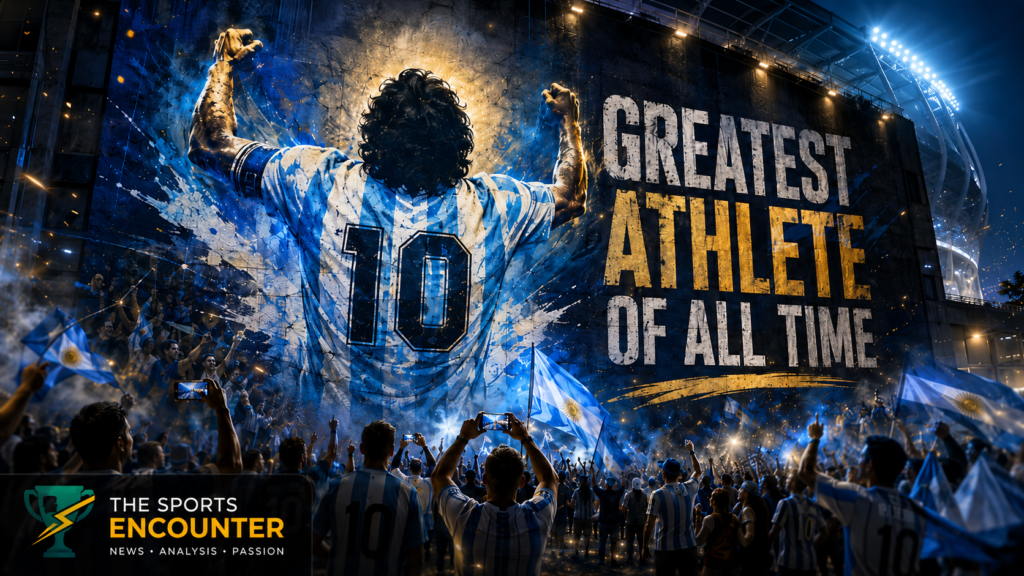
Research current through July 18, 2026
Every era produces an athlete who forces the question: Is this the greatest person ever to play the sport, or even the greatest athlete ever to compete?
For football, that athlete is Lionel Messi. The debate has followed him since his early 20s, and it has only grown louder as his career has stretched beyond two decades, through a World Cup title, a move to Major League Soccer, and a 900th senior career goal.
The problem with the question is not Messi’s résumé. It is the question itself. Football, basketball, tennis, boxing, swimming, gymnastics, and track and field measure greatness in different currencies. A World Cup is not a Grand Slam. A Ballon d’Or cannot be measured directly against an Olympic gold medal. No single statistic can settle an argument involving sports that do not even share a scoreboard.
A full accounting can still reveal how strong Messi’s case has become. His argument rests on career scale, longevity, World Cup history, team trophies, individual awards, scoring records, playmaking, cultural reach, and commercial value.
It also requires comparison with Cristiano Ronaldo, Pelé, Diego Maradona, and the greatest athletes from other sports. The Sports Encounter’s detailed Messi vs. Ronaldo GOAT debate has already shown why football greatness cannot be reduced to goals alone.
The purpose here is broader. The goal is to establish how Messi compares with the strongest sporting résumés ever assembled, while acknowledging the arguments that prevent any cross-sport verdict from becoming absolute.
Career Scale and Longevity
Messi made his senior Barcelona debut in 2004 and remained with the first team for 17 seasons. He left the club with 778 appearances, 672 goals, and 305 assists, along with more victories and trophies than any other player in Barcelona’s history.
Those figures can be explored through FC Barcelona’s official Lionel Messi profile, where the club describes him as its record-setting greatest player.
His 672 goals represent more than a Barcelona record. They stand as the highest official total scored by one player for a single club, surpassing Pelé’s long-standing mark of 643 goals for Santos.
Messi reached 900 senior career goals in March 2026, adding another historic milestone to a career that also includes elite assist production. Most prolific scorers build their legacies primarily around finishing. Messi became one of the most productive scorers ever while also operating as a primary playmaker.
Even at 39, he remained decisive on the biggest stage. Messi scored eight goals during Argentina’s run to the 2026 World Cup final, taking his career World Cup goal total to 21.
His late-career performances placed him among the leading names in The Sports Encounter’s ranking of the top players at the 2026 FIFA World Cup.
Very few athletes in any major global team sport have remained central to championship-level teams across more than two decades. Messi progressed from a teenage Barcelona breakthrough to a tournament-defining force in his late 30s without experiencing a prolonged period of sporting irrelevance.
Lionel Messi’s World Cup Legacy
Messi has appeared at a record six FIFA World Cups, beginning with Germany 2006. During the 2022 final, he passed Lothar Matthäus for the most World Cup appearances in history.
By the end of Qatar 2022, Messi also held the competition record for most minutes played, a total he extended during the 2026 tournament.
Official tournament records, historical features, and competition information are available through the official FIFA website.
Messi’s World Cup story also reflects remarkable age range. He is the only player to score at the tournament as a teenager, in his 20s, and in his 30s.
Five World Cup Events
He is also the only footballer to register an assist at five separate World Cups. Pelé, Maradona, David Beckham, and Grzegorz Lato each recorded assists at three editions.
The 2022 World Cup delivered the signature achievement of Messi’s career. He became the only player to score during the group stage, round of 16, quarterfinal, semifinal, and final of a single tournament.
Messi finished that campaign with seven goals and three assists as Argentina defeated France in one of the most dramatic finals in football history.
The victory answered the most persistent criticism of his international career. Before Qatar, detractors argued that he had never delivered a World Cup in the way Maradona did in 1986. Winning the trophy removed the most significant missing piece from his résumé.
Messi also won the World Cup Golden Ball in 2014 and 2022, becoming the first player to be named the tournament’s best performer at two separate editions.
He and Pelé shared the record for most World Cup knockout-stage assists, with six each, before the complete incorporation of Messi’s 2026 performances into the historical totals.
His continued impact at the 2026 tournament also powered Argentina into another final. The Sports Encounter’s Argentina vs. Spain World Cup final preview examines the possibility of Messi completing another extraordinary chapter against Lamine Yamal and Spain.
Messi’s Achievements With Argentina
Messi is Argentina’s all-time appearance leader. Historical records placed him at 196 international appearances by November 2025, well beyond Javier Mascherano’s former national-team record of 147.
He is also Argentina’s all-time leading scorer and continued adding to that total during the 2026 World Cup.
Official news, national-team information, and competition updates are published by the Argentine Football Association.
Messi’s senior international trophy collection includes:
- 2022 FIFA World Cup
- 2021 Copa América
- 2024 Copa América
- 2022 Finalissima
His wider Argentina honors include the 2005 FIFA Under-20 World Cup and an Olympic gold medal at Beijing 2008.
Winning consecutive Copa América titles in 2021 and 2024 ended another long-running criticism. Messi’s international career could no longer be dismissed as one isolated World Cup triumph. Argentina had built a sustained period of tournament success around him.
The emotional journey gives these achievements additional weight. Messi experienced four major final defeats between 2007 and 2016. He briefly retired from international football following the 2016 Copa América Centenario final, returned, and eventually led Argentina through the most decorated period in its modern history.
That resilience remained visible during Argentina’s 2026 campaign. Messi assisted both goals as his team defeated England 2-1 in the semifinal, a performance covered in The Sports Encounter’s Argentina vs. England semifinal report.
Club Trophies and Team Success
Messi won 35 trophies during his Barcelona career, including:
- 10 La Liga titles
- Seven Copa del Rey trophies
- Four UEFA Champions League titles
- Eight Spanish Super Cups
- Three FIFA Club World Cups
- Three UEFA Super Cups
His Champions League victories came in 2006, 2009, 2011, and 2015. Barcelona recognizes him as its record appearance maker, leading scorer, and most decorated player.
At Paris Saint-Germain, Messi added two Ligue 1 championships and the French Champions Trophy.
His move to Inter Miami brought more trophies:
- 2023 Leagues Cup
- 2024 Supporters’ Shield
- 2025 MLS Cup
Messi turned a young MLS franchise into a trophy-winning club almost immediately. The impact extended beyond his personal statistics because Inter Miami’s competitive expectations changed from the moment he arrived.
Laureus described the 2023 Leagues Cup as the 44th trophy of Messi’s career, making him the most decorated men’s footballer at that point.
Further honors with Inter Miami and Argentina increased the total. Career trophy counts can vary depending on whether youth titles and certain super-cup competitions are included, so any final number must explain its counting method.
Individual Awards and Statistical Dominance
Messi has won a record eight Ballon d’Or awards:
- 2009
- 2010
- 2011
- 2012
- 2015
- 2019
- 2021
- 2023
Cristiano Ronaldo ranks second with five, leaving Messi with a three-award advantage in football’s most recognized individual honor.
Four of Messi’s Ballon d’Or victories came consecutively between 2009 and 2012. That run represents a level of sustained individual supremacy rarely seen in a major team sport.
During the 2012 calendar year, Messi scored 91 goals, breaking Gerd Müller’s 40-year record of 85. It remains one of the most extraordinary single-year statistical achievements in football history.
Messi also holds several major La Liga records:
- Most career goals: 474
- Goals in one season: 50
- League hat tricks: 36
- Most Pichichi trophies: Eight
During the 2011-12 season, he scored a Barcelona-record 73 goals across all competitions.
The distinction between Messi and most elite scorers lies in his creative production. His Barcelona career produced 672 goals and 305 assists, demonstrating elite output in two roles that are usually divided between separate players.
He could finish attacks, create them, carry the ball through defensive structures, dictate tempo, and manipulate space for teammates. That range remains central to the argument that Messi is the most complete attacking footballer in history.
Messi’s Champions League Standing
Messi scored 129 UEFA Champions League goals, the second-highest total in competition history behind Ronaldo.
He holds the record for most goals in the group stage or league phase, scoring 80 times in 86 appearances at a rate of 0.93 goals per game.
His 120 Champions League goals for Barcelona remain the highest total scored by one player for a single club in the competition.
Messi also scored 29 goals in the round of 16, ahead of Ronaldo’s total of 25, and found the net in 18 consecutive Champions League seasons.
Ronaldo retains important advantages in this category. He has:
- More total Champions League goals
- More competition appearances
- Five Champions League titles to Messi’s four
Messi’s argument in European competition rests on more than title count. His supporters point toward scoring efficiency, chance creation, dribbling, assists, tactical control, and his influence on Barcelona’s wider attacking system.
The Messi Versus Ronaldo Question
No comparison has followed Messi more closely than his rivalry with Cristiano Ronaldo.
Ronaldo leads in official senior career goals and Champions League goals. Messi holds the advantage in Ballon d’Or victories, World Cup success, assists, playmaking, and domestic league efficiency.
Ronaldo’s strongest case is based on scoring longevity across England, Spain, Italy, Saudi Arabia, and international football. He has won five Champions League titles and holds the men’s international scoring record.
His career also demonstrates an exceptional ability to adapt. Ronaldo evolved from an explosive winger into a high-volume scorer, aerial specialist, penalty-box forward, and late-career finisher.
Messi offers a different model of greatness. At various points, he has served simultaneously as his team’s:
- Leading scorer
- Primary playmaker
- Best dribbler
- Tactical focal point
- Most dangerous big-game player
The international comparison favors Messi. He owns a World Cup title and two World Cup Golden Balls, while Ronaldo’s best World Cup finish with Portugal was fourth place in 2006.
Ronaldo has won the UEFA European Championship and UEFA Nations League, but Messi’s World Cup and two Copa América titles usually carry greater historical weight in all-time evaluations.
Ronaldo’s 2026 World Cup ended against Spain in the round of 16, an emotional final chapter examined in The Sports Encounter’s report on how Spain ended Ronaldo’s World Cup campaign.
The fairest conclusion recognizes Ronaldo as perhaps the greatest scoring and longevity machine football has produced. Messi’s broader creative influence and international résumé give him the stronger claim as the more complete player.
Messi Compared With Pelé and Maradona
Messi Versus Pelé
Pelé won three World Cups, an achievement Messi does not match. He also became football’s first truly global superstar during an era with very different standards of club mobility, sports science, media coverage, playing conditions, and statistical documentation.
Pelé’s World Cup titles in 1958, 1962, and 1970 remain one of the strongest arguments possessed by any footballer.
Messi’s response rests on:
- More than 20 years of elite-level production
- Eight Ballon d’Or awards
- Dominance in modern European club football
- Extensive verified scoring and assist records
- Success across domestic, continental, and international competition
- Continued relevance into his late 30s
Pelé’s legacy reflects foundational global influence. Messi’s reflects sustained mastery within the most tactically, commercially, and statistically developed era of football.
Messi Versus Maradona
Maradona’s greatest argument remains his transformational performance at the 1986 World Cup and his role in elevating Napoli to unprecedented success in Italian football.
Messi has surpassed Maradona in career goals, assists, club trophies, international trophies, elite longevity, and major individual awards.
Maradona’s supporters argue that he often carried weaker teams and played during a physically brutal defensive era. Tackles that would produce red cards today were frequently tolerated, and attacking players received less protection.
Messi’s supporters point toward the tactical sophistication of the modern game. He faced organized pressing systems, compact defensive blocks, detailed video analysis, and specialized athletic preparation across several footballing generations.
His 2022 World Cup victory supplied the defining international achievement that had previously protected Maradona’s position in Argentina’s national debate.
Messi Compared With the Greatest Athletes in Other Sports
Once the argument leaves football, the comparison becomes genuinely subjective. No shared scoreboard exists between a football field, basketball court, boxing ring, athletics track, tennis court, gymnastics arena, and Olympic swimming pool.
| Athlete | Sport | Signature Greatness Claim |
|---|---|---|
| Michael Jordan | Basketball | Six NBA titles, six Finals MVP awards, and perfection on the championship stage |
| LeBron James | Basketball | NBA career scoring record and elite production across more than two decades |
| Muhammad Ali | Boxing | Heavyweight greatness combined with extraordinary political, cultural, and social influence |
| Usain Bolt | Athletics | Unbeaten Olympic sprint dominance and world records in the 100 and 200 meters |
| Michael Phelps | Swimming | Twenty-three Olympic gold medals, the most won by any Olympian |
| Serena Williams | Tennis | Twenty-three major singles titles and dominance across multiple generations |
| Novak Djokovic | Tennis | Men’s Grand Slam record and the longest reign as world No. 1 |
| Tom Brady | American Football | Seven Super Bowl championships and elite quarterback play into his 40s |
| Wayne Gretzky | Ice Hockey | A statistical separation from his peers rarely matched in a major team sport |
| Tiger Woods | Golf | Fifteen majors and transformational commercial and cultural influence |
| Simone Biles | Gymnastics | Technical innovation, unprecedented difficulty, and sustained championship success |
Messi Versus Michael Jordan
Michael Jordan’s case rests on perfection in the biggest moments. He won six NBA championships, six Finals MVP awards, and five regular-season MVP trophies.
Jordan’s dominance occurred within a shorter and more concentrated competitive window. His cultural influence transformed basketball, footwear, athlete marketing, and the global image of the NBA.
Messi’s counterargument centers on longevity across a much larger global playing population. His success also spans domestic leagues, continental club competition, international tournaments, and different football systems rather than one professional league.
Messi Versus LeBron James
LeBron James provides one of the closest longevity comparisons. He has remained an elite basketball player for more than two decades and owns the NBA’s career scoring record.
Messi holds an advantage in total team trophies and football-specific individual honors. James has carried heavier two-way physical responsibility within a shorter, more physically concentrated professional season.
Both athletes adapted their games as their bodies changed. James shifted between explosive scorer, primary facilitator, power player, and strategic floor controller. Messi progressed from winger to false nine, central creator, record-breaking scorer, and late-career playmaker.
Messi Versus Muhammad Ali
Muhammad Ali transcended boxing through political courage, civil-rights influence, personal sacrifice, and worldwide symbolism.
Messi cannot match Ali’s social and political impact. Few athletes can. His comparative strength lies in a longer and statistically deeper competitive résumé.
The comparison shows why “greatest athlete” and “most important athlete” are not always the same question.
Messi Versus Usain Bolt
Usain Bolt owns one of the cleanest claims to supremacy within a single discipline. His Olympic sprint dominance and world records in the 100 and 200 meters give the argument an objective foundation.
Bolt’s athletic peak is easier to measure because a clock determines the result. Messi’s greatness accumulated through thousands of decisions involving movement, passing, finishing, dribbling, tactical interpretation, and teamwork.
Messi Versus Michael Phelps
Michael Phelps won 23 Olympic gold medals, the highest total in Olympic history.
His medal record is unmatched, although swimming allows competitors to enter several related events during one Olympic Games. Football gives a player one route toward a World Cup medal every four years, making direct numerical comparison misleading.
Messi Versus Serena Williams and Novak Djokovic
Serena Williams combined longevity, tactical evolution, cultural influence, and commercial value across more than 20 years. Her 23 major singles titles place her among the strongest candidates for the greatest athlete ever.
Novak Djokovic owns the men’s Grand Slam singles record and has spent more time ranked world No. 1 than any other male player.
Tennis greatness is more individually measurable because the athlete controls every shot and result without teammates. Messi’s success depends partly on collective systems, but his ability to shape those systems strengthens his team-sport argument.
Messi Versus Tom Brady
Tom Brady won seven Super Bowls and maintained elite quarterback play into his 40s.
His championship record and longevity are historic. Football, however, has a far larger global playing pool than American football and a more expansive international competition structure.
Messi Versus Wayne Gretzky
Wayne Gretzky’s statistical distance from his hockey peers may be stronger than Messi’s separation from other footballers.
Gretzky holds such a large collection of offensive records that his dominance within the NHL remains difficult to match. Messi’s supporters answer by pointing toward football’s worldwide depth, tactical diversity, and enormous talent pool.
Messi Versus Tiger Woods and Simone Biles
Tiger Woods transformed golf commercially and culturally while winning 15 major championships. Injuries interrupted his period of sustained dominance in a way Messi’s career largely avoided.
Simone Biles redefined the technical limits of gymnastics through unprecedented difficulty, innovation, and risk. Her case reflects mastery at the edge of what the human body can perform.
Messi’s greatness relies more heavily on duration, volume, adaptation, and repeated decision-making within an unpredictable team environment.
Laureus Recognition and Cross-Sport Credibility
Messi became the first footballer to win the Laureus World Sportsman of the Year award. He shared the 2020 honor with Lewis Hamilton before winning it outright in 2023.
In 2023, Messi also became the first athlete to win both Laureus World Sportsman of the Year and World Team of the Year during the same year.
The Laureus academy includes Olympic champions, world-record holders, and major sporting legends. That voting body gives the award particular relevance when discussing greatness across different sports.
Roger Federer and Novak Djokovic have won more individual Laureus awards than Messi, however, so this recognition cannot settle the wider debate by itself.
MLS and the Late-Career Argument
Messi’s move to Inter Miami tested whether his performance would remain decisive outside Europe’s biggest leagues.
The results were emphatic. He won the 2025 MLS Golden Boot with 29 regular-season goals, the highest single-season total in the league since 2019.
Messi completed the regular season with:
- 29 goals
- 19 assists
- 48 goal contributions
- 28 appearances
He finished one contribution short of Carlos Vela’s MLS regular-season record of 49 despite playing three fewer matches.
Across the 2025 regular season and playoffs, Messi recorded an MLS-record 61 goal contributions, surpassing Vela’s previous total of 52.
He also established an MLS postseason record with 12 goal contributions, made up of six goals and six assists, during Inter Miami’s 2025 playoff campaign.
In May 2026, Messi became the fastest player in MLS history to reach 100 regular-season goal contributions. He achieved the mark in 64 matches, considerably faster than Sebastian Giovinco’s previous record of 95 games.
At that milestone, Messi had recorded 59 goals and 41 assists in MLS regular-season competition.
MLS also recognizes him as a two-time league MVP for 2024 and 2025, alongside his Golden Boot, Supporters’ Shield, Leagues Cup, and MLS Cup honors.
His Miami chapter matters because he did more than enter a lower-pressure competition at the end of his career. Messi transformed Inter Miami’s results, attendance demand, commercial profile, international following, and championship expectations.
Messi’s Commercial Value and Global Reach
Forbes ranked Messi as the world’s third-highest-paid athlete in 2026, with estimated earnings of $140 million between May 2025 and May 2026.
The figure was divided almost evenly between approximately $70 million in on-field earnings and $70 million from commercial activity.
That balance demonstrated that Messi’s brand power remained comparable to his playing income at age 38.
Forbes has estimated his career earnings at approximately $1.8 billion before taxes and agents’ fees.
His commercial portfolio includes a lifetime relationship with Adidas and major partnerships spanning:
- Sportswear
- Beverages
- Technology
- Tourism
- Luxury products
- Consumer brands
Messi’s celebration following the 2022 World Cup final became the most-liked Instagram image post in history, exceeding 75 million likes.
That record represents more than a social-media curiosity. It demonstrates that one moment from Messi’s career generated engagement beyond the reach of nearly every celebrity, entertainer, and athlete on the platform.
His arrival in Miami increased MLS attendance demand, merchandise sales, subscription interest, media coverage, and international relevance.
The wider cultural response has been examined through The Sports Encounter’s analysis of the most viral players of the 2026 World Cup, where Messi’s cross-generational reach remained a defining factor.
MLS Commissioner Don Garber has repeatedly referred to the commercial transformation surrounding Messi as the “Messi effect.”
His brand differs from that of many superstar athletes. It has largely been built around performance, consistency, family identity, and personal restraint rather than controversy or constant public self-promotion.
The Strongest Case for Lionel Messi
Football is the most widely played and followed sport in the world. Dominating within that environment gives Messi an unusually large competitive and cultural stage.
His résumé combines almost every major dimension commonly used to measure athletic greatness:
- Extraordinary peak performance
- More than two decades of elite longevity
- Historic scoring output
- World-class playmaking
- Domestic league dominance
- Champions League success
- International continental titles
- Olympic gold
- A FIFA World Cup title
- Record individual awards
- Late-career success outside Europe
- Worldwide commercial and cultural influence
No major footballing category is absent from Messi’s career.
His best statistical seasons rival the strongest peaks in sporting history, while the complete career lasted considerably longer than the prime periods of many comparable athletes.
Team sport also creates a particular challenge. Messi could never control every outcome himself. His influence had to operate through teammates, coaches, tactical systems, injuries, and different competition formats.
Sustaining success under those conditions makes individual dominance more difficult to isolate statistically. It may also make the overall achievement more impressive.
Messi evolved tactically throughout his career. He succeeded as:
- An explosive right winger
- A false nine
- A central scorer
- A primary playmaker
- A free-roaming attacker
- A late-career creative controller
That evolution shows that his greatness depended on intelligence, awareness, coordination, and technique alongside acceleration and physical balance.
The Strongest Arguments Against Calling Messi the Greatest Athlete Ever
Cross-sport comparisons remain inherently subjective. No common formula can fairly compare Messi’s goals and assists with Olympic medals, boxing championships, tennis majors, basketball titles, or sprinting world records.
Other candidates possess achievements that Messi cannot directly match:
- Pelé won three World Cups.
- Michael Phelps won 23 Olympic gold medals.
- Michael Jordan earned six Finals MVP awards.
- Tom Brady won seven Super Bowls.
- Usain Bolt created an unbeaten Olympic sprint legacy.
- Wayne Gretzky separated himself statistically from his peers to an extraordinary degree.
- Serena Williams won 23 Grand Slam singles titles.
- Simone Biles redefined the technical limits of her sport.
Messi was also never an athlete in the traditional power-and-speed mold associated with Bolt, Biles, LeBron James, or elite multi-event competitors.
His physical greatness appears through balance, acceleration, coordination, durability, rapid directional changes, and control rather than size or raw strength.
Critics may also point toward his supporting environment at Barcelona. Messi spent most of his prime alongside extraordinary players such as Xavi, Andrés Iniesta, Sergio Busquets, Neymar, and Luis Suárez.
He benefited from one of the most stable and talented club systems in football history.
Supporters of Pelé, Maradona, Jordan, Ali, or other legends may argue that their preferred athlete overcame greater structural or cultural obstacles, carried weaker supporting casts, or dominated their competition more decisively.
Messi’s years at Paris Saint-Germain provide another counterargument. Even a squad containing Messi, Neymar, Kylian Mbappé, and other elite players could not win the Champions League.
That period showed that Messi could not automatically transform every talented team into Europe’s best side. Football greatness always remains partly dependent on collective chemistry, management, balance, and timing.
The Verdict: Is Messi the Greatest Athlete Ever?
The most responsible conclusion is not that Lionel Messi can be objectively proven as the greatest athlete in sports history.
No clean formula can compare a football pitch with an Olympic pool, boxing ring, athletics track, tennis court, basketball arena, or gymnastics floor.
A narrower conclusion carries more factual weight: Messi has built the most complete greatness case ever produced by a footballer.
His résumé survives every serious test commonly applied to sporting greatness:
- Peak: A 91-goal calendar year and seasons of scoring and creative dominance.
- Duration: More than two decades at the elite level.
- Versatility: Scoring, passing, dribbling, playmaking, and tactical control.
- Pressure: A World Cup title following years of international disappointment.
- Team success: Major trophies with Barcelona, PSG, Inter Miami, and Argentina.
- Individual dominance: A record eight Ballon d’Or awards.
- Adaptation: Success across several roles, leagues, tactical systems, and age profiles.
- Cultural impact: One of the largest and most emotionally invested global fan bases in sports.
- Commercial value: Billion-dollar career earnings and sustained worldwide brand power.
Whether those achievements make him the single greatest athlete who ever lived depends on which sport, competitive structure, era, and definition of greatness a person values most.
What can no longer be seriously disputed is that Messi belongs in the smallest group of athletes across any sport who can credibly make that claim.
Frequently Asked Questions
How many Ballon d’Or awards has Lionel Messi won?
Messi has won a record eight Ballon d’Or awards, in 2009, 2010, 2011, 2012, 2015, 2019, 2021, and 2023. Cristiano Ronaldo ranks second with five.
Has Lionel Messi won a World Cup?
Yes. Messi won the 2022 FIFA World Cup with Argentina. He scored seven goals and recorded three assists during the tournament before Argentina defeated France in the final.
How many World Cup Golden Balls has Messi won?
Messi won the World Cup Golden Ball in 2014 and 2022. He became the first player to receive the tournament’s best-player award at two separate World Cups.
How does Messi compare with Cristiano Ronaldo?
Ronaldo leads in official career goals and Champions League goals. Messi holds the advantage in Ballon d’Or awards, World Cup success, assists, playmaking, and overall creative influence. Those distinctions give Messi the stronger claim as the more complete all-around footballer.
How many goals did Messi score for Barcelona?
Messi scored 672 official goals in 778 appearances for Barcelona. That remains the record for most goals scored by one player for a single club.
How has Messi performed since joining Inter Miami?
Messi has won the Leagues Cup, Supporters’ Shield, and MLS Cup with Inter Miami. He also collected two MLS MVP awards and became the fastest player in league history to reach 100 regular-season goal contributions.
Who are Messi’s biggest rivals in the greatest-athlete debate?
The leading cross-sport candidates include Michael Jordan, LeBron James, Muhammad Ali, Serena Williams, Novak Djokovic, Usain Bolt, Michael Phelps, Tom Brady, Wayne Gretzky, Tiger Woods, and Simone Biles. Within football, Messi is most often compared with Cristiano Ronaldo, Pelé, and Diego Maradona.
Is Messi officially considered the greatest athlete of all time?
No official body can objectively award that title across every sport. Messi has, however, assembled one of the strongest cross-sport cases through his longevity, statistics, trophies, individual awards, international achievements, and worldwide cultural influence.
Figures covering trophies, awards, appearances, goals, and commercial earnings reflect research current through July 18, 2026. Career trophy totals may vary according to whether youth competitions and certain super-cup honors are included.
The Sports Encounter’s World Cup 2026 coverage focuses on fixtures, team news, match analysis, fan stories, tournament trends, and the biggest talking points from football’s global stage.