


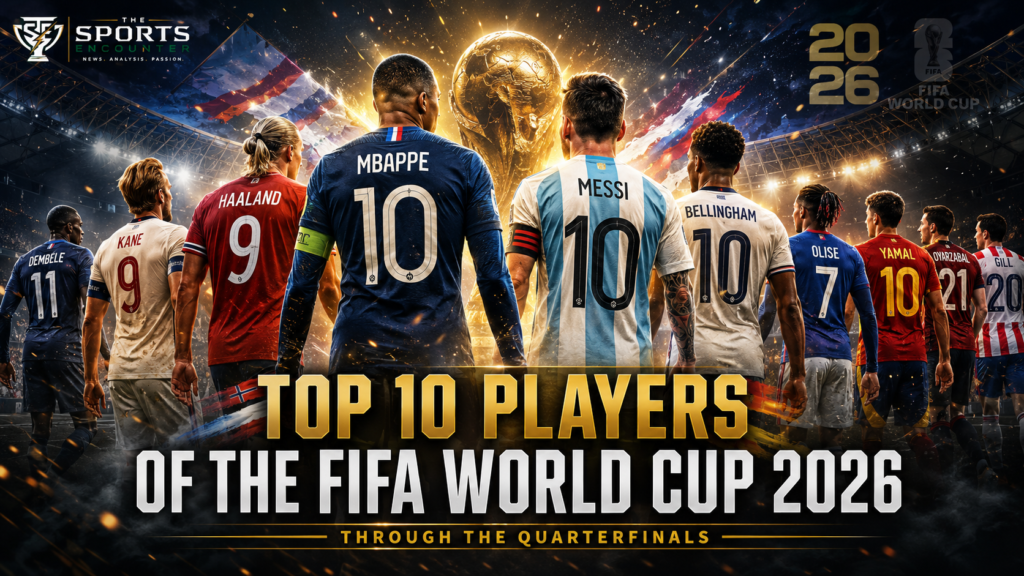
A World Cup player ranking cannot be reduced to a goals table.
Kylian Mbappé and Lionel Messi entered the semifinals tied at the top of the Golden Boot race. Erling Haaland scored seven times in only four appearances. Jude Bellingham repeatedly rescued England when their tournament looked vulnerable.
Other players influenced matches through creation, defensive control, goalkeeping, leadership, and the ability to change the emotional direction of a knockout tie.
The strongest performers combined production with consequence. Their goals, assists, saves, passes, and decisions directly shaped how far their countries traveled.
This ranking assesses the tournament through the quarterfinals. It rewards individual quality, consistency, opposition level, knockout influence, and importance to the team.
TL;DR | The Very Best of the Best!
- Kylian Mbappé ranks first after producing a tournament-leading 11 goal contributions through the quarterfinals.
- Lionel Messi remains close behind after reaching eight goals and 10 total goal contributions while leading Argentina into another semifinal.
- Erling Haaland scored seven goals in four matches and carried Norway to a historic quarterfinal.
- Jude Bellingham scored six times, including braces against Mexico and Norway during the knockouts.
- Ousmane Dembélé and Michael Olise helped make France the tournament’s most dangerous attacking team.
- Harry Kane became England’s leading World Cup scorer and entered the semifinals with six goals.
- Lamine Yamal’s creativity and one-on-one threat remained central to Spain’s title challenge.
- Mikel Oyarzabal supplied goals and intelligent movement throughout Spain’s run.
- Paraguay goalkeeper Orlando Gill earns the final place after helping eliminate Germany and carrying a third-place qualifier into the Round of 16.
World Cup 2026 Top 10 Players at a Glance
| Rank | Player | Country | Primary Impact | Tournament Status at Cutoff |
|---|---|---|---|---|
| 1 | Kylian Mbappé | France | Eight goals, three assists, and decisive knockout production | Semifinalist |
| 2 | Lionel Messi | Argentina | Eight goals, two assists, leadership, and historic records | Semifinalist |
| 3 | Erling Haaland | Norway | Seven goals in four matches and a historic national-team run | Eliminated in quarterfinal |
| 4 | Jude Bellingham | England | Six goals and repeated knockout interventions | Semifinalist |
| 5 | Ousmane Dembélé | France | Five goals, two assists, movement, and attacking balance | Semifinalist |
| 6 | Harry Kane | England | Six goals, one assist, and England World Cup scoring record | Semifinalist |
| 7 | Michael Olise | France | Chance creation, five goal contributions, and tactical versatility | Semifinalist |
| 8 | Lamine Yamal | Spain | Creativity, ball progression, width, and constant one-on-one threat | Semifinalist |
| 9 | Mikel Oyarzabal | Spain | Four goals, one assist, and intelligent final-third movement | Semifinalist |
| 10 | Orlando Gill | Paraguay | Goalkeeping, penalty-shootout composure, and underdog leadership | Eliminated in Round of 16 |
Statistics reflect FIFA’s published tournament data through the quarterfinals. The final ranking should be updated after the World Cup final on July 19, 2026.
10. Orlando Gill, Paraguay
A top-player list dominated by attackers would miss one of the tournament’s strongest underdog performances.
Orlando Gill helped Paraguay become the only Lucky 8 team to progress beyond the Round of 32. Germany controlled possession, created pressure, and appeared to score an extra-time winner through Jonathan Tah.
VAR disallowed the goal after officials decided Waldemar Anton had obstructed the goalkeeper.
Gill remained composed through the rest of extra time and helped Paraguay win the penalty shootout 4-3.
His influence extended beyond individual saves. Paraguay defended deep because they trusted their goalkeeper to manage crosses, second balls, and the pressure created by Germany’s territorial control.
France eventually ended their run with a 1-0 victory in the Round of 16. Gill again gave Paraguay a chance to remain competitive against a much stronger attacking team.
The Sports Encounter examined that unlikely run in our analysis of why Paraguay succeeded where the other Lucky 8 teams failed.
Several elite goalkeepers produced strong tournaments. Gill receives this place because his performance changed the historical ceiling of his team.
9. Mikel Oyarzabal, Spain
Spain’s football often draws attention toward its midfielders and wide creators.
Oyarzabal supplied the movement that helped turn possession into goals.
He reached four goals and one assist through the quarterfinals, placing him among the tournament leaders in total attacking contributions.
His value came from timing rather than physical dominance. Oyarzabal moved between center backs, dropped into spaces that opened passing lanes, and arrived inside the area when defenders became occupied by Lamine Yamal and Spain’s midfield rotations.
The 3-0 victory over Austria showed how effectively Spain could control a knockout match once their forward movement matched the speed of their passing.
Belgium presented a more difficult quarterfinal, but Oyarzabal continued to provide a reference point while Spain worked through pressure and won 2-1.
He has not produced the same viral moments as Mbappé, Messi, or Yamal. His intelligent movement has been essential to Spain’s attack.
8. Lamine Yamal, Spain
Lamine Yamal entered the World Cup carrying expectations that would overwhelm many established players.
He remained willing to demand the ball.
Spain use Yamal to stretch the right side, isolate defenders, and create passing routes into central areas. His first touch can take him away from pressure, while his ability to cut inside forces the opposing fullback to defend several possibilities at once.
Statistics capture only part of that influence.
Defenses shift toward Yamal before he receives possession. That movement creates space for midfield runners, Oyarzabal, and the fullback supporting from behind.
His youth also makes his composure remarkable. World Cup knockout football creates little patience for unnecessary risk, yet Yamal has continued taking on defenders and attempting decisive passes.
The semifinal against France offered another opportunity to strengthen his Golden Ball case. Our France vs Spain semifinal preview explored whether Yamal could overcome Mbappé and France’s deeper attacking resources.
7. Michael Olise, France
Michael Olise may be the most tactically adaptable attacker in France’s squad.
He can start wide, operate between midfield and defense, carry possession centrally, deliver set pieces, and combine around the penalty area.
Olise reached five goal contributions through the quarterfinals. The number tells only part of his tournament.
France’s forward line contains several players who prefer decisive attacking actions. Olise helps connect them. His passing gives Mbappé opportunities to receive while moving toward goal, while his movement supports Dembélé and prevents opponents from directing all their defensive attention toward France’s captain.
He also contributes without the ball. France can adjust their pressing shape because Olise understands when to move centrally and when to protect the wide area.
The Golden Ball conversation usually favors scorers. Olise’s case rests on making an already elite attack function more smoothly.
6. Harry Kane, England
Harry Kane entered the World Cup with questions about whether England could give him enough service.
He responded with six goals and one assist through the quarterfinals.
Kane also moved beyond Gary Lineker to become England’s leading scorer in World Cup history. His record-breaking goal came during the group-stage victory that secured first place in Group L.
His tournament has not been flawless. England struggled for attacking rhythm in several knockout matches, and Kane occasionally became isolated while dropping too far from the penalty area.
He still provided goals, leadership, and a technical reference point.
Kane can receive under pressure, connect midfield with attack, and release runners before moving toward the box himself. That versatility matters when England cannot progress through direct dribbling or fast combinations.
Bellingham has produced England’s most dramatic knockout interventions. Kane remains the forward every opponent must organize around.
5. Ousmane Dembélé, France
France’s attacking depth makes individual evaluation difficult.
Ousmane Dembélé has remained central despite the competition around him.
Five goals and two assists gave him seven total goal contributions through the quarterfinals. He combined direct production with the movement required to prevent France’s attack from becoming dependent on Mbappé.
Dembélé can operate centrally or from either wing. His ability to use both feet makes him difficult to show toward one side, while his acceleration creates chances before defensive blocks can settle.
He also stretches the back line horizontally. When defenders move toward Mbappé, Dembélé can attack the opposite channel or arrive through the center.
Reuters reported that Mbappé, Dembélé, and Olise had combined for 11 goals and nine assists through France’s opening four matches. Their output placed the French attack in conversations about the strongest forward lines in World Cup history.
Dembélé ranks below the tournament’s leading four because France can distribute responsibility across several elite attackers. His performance remains one of the main reasons that luxury has worked.
4. Jude Bellingham, England
England’s tournament repeatedly reached moments when control disappeared and individual authority became necessary.
Bellingham responded.
He scored twice against Mexico in the Round of 16 as England survived a 3-2 battle. Another brace followed against Norway, including the extra-time winner that carried England into the semifinals.
Those goals took him to six for the tournament.
The timing separates Bellingham from other high scorers. Four of his goals arrived during consecutive knockout matches when England faced elimination or extra time.
Against Norway, he equalized in first-half stoppage time and later delivered the decisive goal. The performance ended Haaland’s World Cup and extended England’s run.
The Sports Encounter’s England vs Norway match report explains how Bellingham rescued his team twice.
His midfield influence can still fluctuate. England have not controlled every game, and Bellingham sometimes operates closer to a second striker than a traditional midfielder.
When the match needs a decisive player, he has answered more often than anyone else in Thomas Tuchel’s squad.
3. Erling Haaland, Norway
Erling Haaland played only four matches.
He scored seven goals.
No other leading scorer matched his rate of one goal approximately every 51 minutes. More importantly, those goals changed Norway’s place in World Cup history.
The country had not appeared at the tournament since 1998. Haaland led them into their first quarterfinal and scored twice as Norway eliminated Brazil 2-1 in the Round of 16.
His second goal in that match captured his tournament: power, movement, and the ability to turn a small opening into a decisive moment.
England limited him more effectively in the quarterfinal. Haaland remained dangerous, had a goal ruled out following a foul in the buildup, and forced the defense to remain compact around him.
Norway lost 2-1 after extra time.
His early exit prevents him from ranking above Mbappé or Messi. Four matches also provide a smaller body of work than the semifinalists have produced.
The impact was historic. Our detailed guide to Haaland’s records, career, and first World Cup examines how quickly he transformed Norway’s tournament.
Haaland also became the competition’s most broadly viral figure through goals, memes, music, friendships, and off-field moments. Readers can explore that wider story in our feature asking who became the most viral player at World Cup 2026.
2. Lionel Messi, Argentina
Lionel Messi arrived at his sixth World Cup as the defending champion and the oldest central figure in the Golden Ball race.
He responded by setting records that may survive for generations.
Messi became the World Cup’s all-time leading scorer after moving beyond Miroslav Klose. He also became the first player to score in seven consecutive World Cup matches.
Through the quarterfinals, he had eight goals and 10 total goal contributions.
His influence extended beyond finishing. Argentina continued using Messi to connect midfield with attack, slow the game when control became necessary, and produce the final pass around the penalty area.
The team’s path was not straightforward.
Egypt pushed Argentina into a controversial 3-2 Round of 16 match. Switzerland forced extra time in the quarterfinal before Argentina won 3-1.
Messi remained the player around whom every attacking decision revolved.
His scoring record strengthens the statistical case. The emotional and tactical responsibility strengthens it further.
Argentina’s semifinal against England offered another chapter in a rivalry shaped by the 1966 quarterfinal, Diego Maradona’s 1986 performance, David Beckham’s 1998 red card, and repeated World Cup controversy. Our Argentina vs England semifinal preview examines whether Messi can reach another final.
1. Kylian Mbappé, France
Kylian Mbappé has produced the strongest combination of goals, assists, records, and team progress.
He entered the semifinals with eight goals and three assists, giving him a tournament-leading 11 goal contributions.
Mbappé scored the only goal against Paraguay in the Round of 16. He added another during France’s 2-0 quarterfinal victory over Morocco, moving to 20 career World Cup goals.
That left him one behind Messi’s newly established record of 21.
Mbappé also reached the total across fewer tournament appearances than the Argentine captain. The possibility of overtaking Messi during the same World Cup added another layer to France’s title pursuit.
His quarterfinal contained an imperfection. Mbappé missed a penalty before scoring later in the match and left the field with an injury concern.
France still depend on his acceleration and finishing more than any other attacking weapon. Defenses retreat when he receives possession, creating space for Olise and Dembélé even when Mbappé does not take the final shot.
He ranks first because his numbers lead the tournament and his production has continued into the knockout rounds.
The final matches will decide whether he converts that statistical lead into the Golden Ball.
Players Who Narrowly Missed the Top 10
Martin Ødegaard, Norway
Ødegaard gave Norway creative control and helped connect midfield with Haaland. His leadership was central to their historic run, but Haaland’s scoring had the greater direct impact.
Johan Manzambi, Switzerland
Five goal contributions placed Manzambi among the tournament leaders. Switzerland’s quarterfinal exit and the influence of the leading semifinalists kept him outside the final 10.
Vinícius Júnior, Brazil
Five goal contributions showed his quality. Brazil’s Round of 16 elimination against Norway limited his opportunity to strengthen the case.
Julián Quiñones, Mexico
Quiñones produced five goal contributions and became one of the host nation’s strongest performers. Mexico’s elimination against England reduced the weight of his tournament.
Ismaïla Sarr, Senegal
Sarr’s five goal contributions reflected Senegal’s attacking ceiling. Their inability to protect a two-goal lead against Belgium ended his run too early.
Pedri and Rodri, Spain
Both midfielders deserve recognition for Spain’s control and progression. Their influence is harder to isolate statistically than Yamal’s or Oyarzabal’s final-third contribution.
Who Is Leading the Golden Ball Race?
Mbappé holds the advantage through the quarterfinals.
Messi remains close enough to take first place with another decisive knockout performance. Bellingham can strengthen his case if England reach the final, while Yamal and Olise remain central to their countries’ semifinal hopes.
Haaland’s elimination makes winning the award less likely, even though his scoring rate and historical influence remain elite.
| Golden Ball Position | Player | What Could Change the Race |
|---|---|---|
| Leader | Kylian Mbappé | A final appearance or another decisive scoring display |
| Closest challenger | Lionel Messi | Leading Argentina past England and influencing the final |
| Knockout riser | Jude Bellingham | Another decisive performance against Argentina |
| Creative contender | Michael Olise | Controlling the semifinal and final for France |
| Breakout contender | Lamine Yamal | Producing the defining moment of Spain’s title run |
Fan Poll: Who Has Been the Best Player?
Who gets your vote as the best player at the FIFA World Cup 2026 through the quarterfinals?
- Kylian Mbappé
- Lionel Messi
- Erling Haaland
- Jude Bellingham
- Ousmane Dembélé
- Harry Kane
- Michael Olise
- Lamine Yamal
- Another player
Share your choice in the comments and explain which performance defined the player’s tournament.
Final Verdict
Kylian Mbappé leads this ranking because no player matched his combination of eight goals, three assists, knockout influence, and progress into the semifinals.
Messi remains close enough to change the order. His scoring record, leadership, and influence over Argentina’s attack have kept another Golden Ball within reach.
Haaland produced the tournament’s most explosive short run. Bellingham delivered its strongest sequence of pressure goals. France placed three players in the top seven because its attack combined individual quality with collective balance.
The final ranking cannot be settled before the final whistle on July 19.
World Cups remember the player who finishes the story.
Follow every remaining match, player performance, and tournament record through The Sports Encounter’s FIFA World Cup 2026 hub and complete soccer news and analysis.
The Sports Encounter will update this ranking after the World Cup final to reflect the semifinal and final performances, official awards, and complete tournament statistics.