


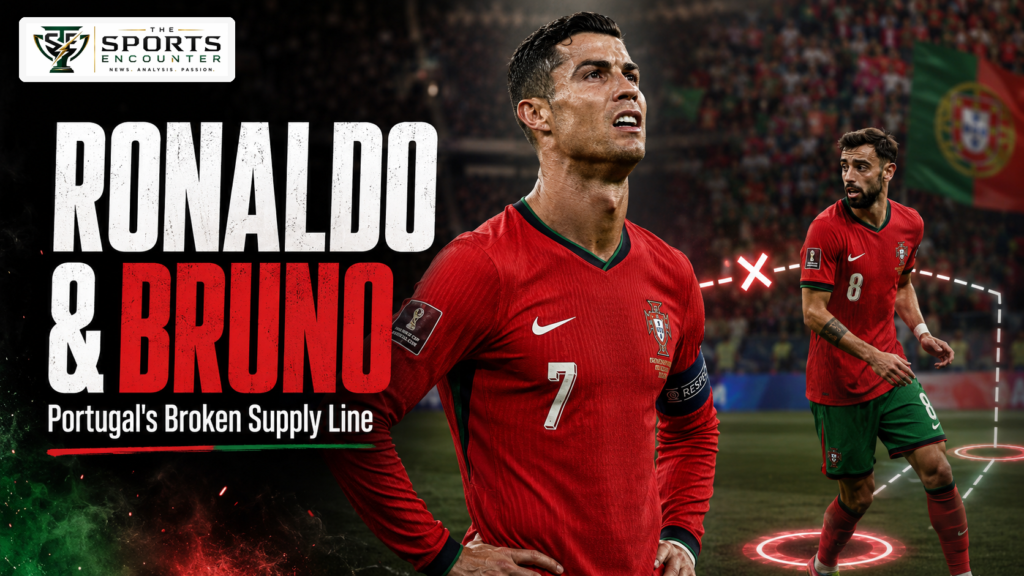
Cristiano Ronaldo looked lonely before he looked old.
That is the part many people missed after Portugal’s frustrating 1-1 draw with DR Congo in Group K of the FIFA World Cup 2026. The easy story was Ronaldo’s age. The louder story was his lack of a goal. The emotional story was the sight of Portugal’s greatest footballer standing between defenders, waiting for service that rarely arrived with the right timing.
For full tournament coverage, follow The Sports Encounter’s FIFA World Cup 2026 hub.
Portugal had the ball. Portugal had territory. Portugal had names, pedigree and a midfield full of expensive talent. What they did not have often enough was the one thing Ronaldo now needs most: clean, early, direct service inside the penalty area.
The most damaging number from Portugal’s opener was not Ronaldo’s zero goals. It was Portugal’s 740 passes producing only one shot on target. That is not a Ronaldo-only problem. That is a supply-line problem.
That is why Bruno Fernandes has become the center of fan frustration.
There is no strong evidence of a personal problem between Bruno and Ronaldo. There is also no statistical basis for saying Bruno has never assisted Ronaldo. Available joint-match data shows he has done that before.
The real issue is sharper than that.
Portugal’s most important attacking midfielder is not turning enough possession into the kind of chances Ronaldo can still punish. Against DR Congo, that weakness became impossible to ignore.
Portugal’s Problem Was Bigger Than Ronaldo
Portugal’s opening draw against DR Congo already felt like one of the early warning signs of this World Cup.
As covered in DR Congo Stun Portugal as Ronaldo’s World Cup Question Grows Louder, João Neves gave Portugal the early lead, but Yoane Wissa’s equalizer turned the match into a very different kind of story. DR Congo did more than win a point. They dragged Portugal into a tactical argument the team could not avoid.
Can Portugal still carry Ronaldo in a system that does not serve him properly?
That question sounds harsh, but it cuts both ways.
If Ronaldo starts, Portugal must feed him in the areas where he remains dangerous. If Portugal want constant pressing, fluid rotations and runners attacking space behind the defense, then Roberto Martínez has to decide whether Ronaldo fits that version of the team for 90 minutes.
The worst option is the middle ground Portugal showed against DR Congo: Ronaldo on the pitch, Portugal controlling possession, but the final ball arriving late, high, crowded or not at all.
That structure helps no one.
The Numbers Behind Portugal’s Broken Supply Line
The frustration around Ronaldo and Bruno becomes clearer when the numbers sit next to the eye test.
Portugal completed 740 passes against DR Congo but produced only one shot on target in a 1-1 draw. That is the core problem. A team can control the ball for long spells and still fail to create real danger if the final pass arrives too slowly or never arrives at all.
Reuters reported that Portugal failed to register another shot on target after João Neves’ early goal. That matters because Ronaldo’s role depends heavily on service inside the box. If Portugal dominate possession but do not keep testing the goalkeeper, the striker becomes isolated no matter how famous his name is.
Ronaldo was also marked tightly and missed two close-range chances. That keeps the analysis balanced. Portugal did not serve him well enough, but he also had moments where a player of his standard would expect to do better.
The Ronaldo-Bruno connection needs context as well. Transfermarkt’s joint-match data lists 120 matches together, with six Ronaldo goals assisted by Bruno Fernandes and three Bruno goals assisted by Ronaldo.
So the “Bruno has never assisted Ronaldo” claim does not hold up.
The stronger point is different: for two players who have shared the pitch for so long, their attacking connection rarely feels automatic for Portugal. Six assists from Bruno to Ronaldo across around 120 shared appearances is not a huge return for a creator-striker partnership involving one of Portugal’s best passers and the greatest goalscorer in international football history.
There is another pressure point. Ronaldo is now a 41-year-old forward playing in his record-equalling sixth World Cup, while still chasing the one major trophy missing from his career. He is no longer the player who can solve every broken attack by running at defenders from deep.
Portugal have to serve the version of Ronaldo they have now, not the one from 10 or 15 years ago.
That is why Bruno’s role matters so much. He does not need to force every ball toward Ronaldo, but Portugal cannot afford a match where their most important creative midfielder helps control possession without turning enough of it into service for the penalty-box striker.
Why Bruno Fernandes Is Taking the Heat
Bruno Fernandes is an easy target because he is supposed to be Portugal’s connector.
He is the player fans expect to turn midfield control into attacking danger. He can shoot from range, play risky passes, switch play, press aggressively and arrive late around the box. At Manchester United, his game has often been built around urgency and volume. He tries things other players avoid.
That bravery is part of his value.
It is also why Portugal fans watch him more closely when Ronaldo looks isolated.
When Bruno receives the ball between the lines, fans expect the pass into Ronaldo. When he drifts wide, they expect the early cross. When he shoots from outside the box, they wonder whether Ronaldo had made a run. When Portugal recycle the ball instead of playing forward, the frustration lands on him because he is the player trusted to break the pattern.
After the DR Congo draw, that frustration spilled into social media. Ronaldo supporters criticized Bruno heavily, arguing that Portugal’s midfield and attack failed to create enough meaningful chances for their captain.
The anger may be emotional, but the underlying complaint is not empty.
Portugal’s possession looked too slow for long spells. The ball moved, but the danger did not always move with it.
The “No Assist” Claim Needs Correction
The claim that Bruno Fernandes has never assisted Cristiano Ronaldo is not accurate based on available public joint-match data. Transfermarkt’s record of their games together lists Ronaldo goals assisted by Bruno and Bruno goals assisted by Ronaldo.
The stronger argument is different.
Bruno has assisted Ronaldo before, but their partnership has rarely felt like a natural, devastating, automatic attacking connection for Portugal. They have shared the pitch for years, yet the chemistry often feels more functional than instinctive.
That is the real football story.
Some partnerships look telepathic. One player moves, the other already knows. One touch opens the lane. One glance decides the pass. Great national teams often need at least one of those combinations in the final third.
Portugal have elite players, but their Ronaldo-Bruno connection does not always look like the heartbeat of the attack.
Ronaldo’s Game Has Changed, So the Service Must Change Too
Ronaldo at 41 cannot be judged through the same lens as Ronaldo at 27.
He will not spend full matches destroying full-backs from wide areas. He will not carry the ball through three defenders every time Portugal run out of ideas. He will not press with the same repeat intensity as younger forwards.
But inside the box, his instincts remain valuable.
That means Portugal need to be honest about what he is now. Ronaldo needs earlier balls. He needs crosses before the defensive block is set. He needs cutbacks across the six-yard area. He needs midfielders to play the pass when the run starts, not two seconds later.
In modern football, two seconds can kill a striker.
A defender steps across. A second center-back drops deeper. The goalkeeper adjusts. The passing lane closes. The run that looked dangerous becomes useless.
That happened too often against DR Congo. Ronaldo made movements, but Portugal’s delivery did not consistently match the timing. By the time the ball reached the danger area, DR Congo had bodies in place and Portugal had already lost the advantage.
Bruno’s Natural Game Can Work Against Ronaldo’s Needs
Bruno is not a simple pass-first midfielder.
He likes high-risk actions. He likes shooting lanes. He likes finding runners in transition. He likes playing with tempo, emotion and freedom. That makes him dangerous, but it can also create a mismatch with Ronaldo’s current needs.
Ronaldo now needs precision more than chaos.
He needs a midfielder who sees the striker’s first movement and plays early. Bruno often wants to scan for the higher-value option, the wider switch, the late runner or the shot. Sometimes that makes sense. Sometimes it slows the one pass Ronaldo actually needs.
This does not mean Bruno is selfish.
It means Portugal’s attacking structure asks different players to solve different problems at the same time. Bruno wants to control, create and finish. Ronaldo wants supply. Bernardo Silva wants rhythm. Wide players want isolation. Full-backs need overlaps. Midfielders want security against counters.
Against a compact team, those needs can collide.
DR Congo exposed that collision.
Portugal Cannot Waste Possession Like This
Possession alone does not scare anyone at a World Cup.
Spain learned that against Cape Verde in another early tournament warning. As covered in Cape Verde Stun Spain With Historic World Cup Draw, a superior team can dominate the ball and still fail to create enough authority in the penalty area.
Portugal fell into a similar trap.
They had control without enough cruelty. They moved DR Congo from side to side, but they did not repeatedly force the kind of defensive panic that leads to tap-ins, rebounds, penalties or desperate clearances.
For Ronaldo, that kind of match is painful.
He becomes visible mostly when the chance does not arrive. Every frustrated gesture becomes a clip. Every missed touch becomes a debate. Every shot he does not take becomes proof for one side or the other.
That is why Portugal must solve the supply issue quickly. Otherwise, every match will become another referendum on Ronaldo instead of a proper assessment of the team.
The Fan Debate Is Emotional, But the Tactical Question Is Real
Ronaldo fans are protective because they have watched him carry Portugal for nearly two decades.
They remember the goals, the pressure, the records, the leadership, the tears, the comebacks and the impossible standards. When he looks isolated, they do not see only one bad match. They see a national team failing to maximize the final World Cup chapter of its greatest player.
That emotion can go too far, especially when it turns into personal attacks on Bruno.
Still, fan emotion often points toward something real before tactical language catches up.
Portugal looked disconnected in the final third. Ronaldo looked underfed. Bruno looked like the obvious player who should fix that. The rest of the team also failed to provide enough support, but Bruno carries the creative responsibility because of his role, reputation and influence.
That is the price of being Portugal’s main attacking organizer.
Roberto Martínez Has a Decision to Make
This is now a coaching problem.
Roberto Martínez has to decide how Portugal want to attack with Ronaldo. The answer cannot be vague.
If Ronaldo starts against Uzbekistan, Portugal need a clearer service plan. The wide players must deliver earlier. Bruno must look for the first forward pass more often. Full-backs must cross with purpose instead of waiting for perfect body shape. Midfielders must attack second balls around Ronaldo so he is not fighting alone against two center-backs.
The next Group K match now carries serious weight. Portugal face Uzbekistan next, while Colombia and DR Congo meet in another match that could shape the group. As explained in Uzbekistan Make History, Colombia Take Control in Group K Thriller, Portugal already sit under pressure after dropping points in their opener.
That pressure changes everything.
A slow win may calm the table. Another flat attacking performance will make the Ronaldo-Bruno debate louder. A defeat or another draw could turn the group into a full crisis.
The Real Issue Is Portugal’s Identity
Portugal have enough talent to win matches in different ways. That sounds like a strength, but it can become a problem if the team never settles on one clear identity.
Are they a possession team? Are they a transition team? Are they built around Ronaldo’s box presence? Are they better with mobile forwards stretching the pitch? Is Bruno the main creator, second striker, pressing trigger or late-arriving finisher?
The answers cannot keep changing inside the same match.
The best World Cup teams usually know their attacking truth. Argentina knew how to protect Lionel Messi’s final run in 2022. France knew how to release Kylian Mbappe in space. Spain at their peak knew how to suffocate teams through midfield control. Germany’s best sides knew how to turn structure into pressure.
Portugal still look like a team with great pieces trying to agree on the picture.
That is dangerous at a World Cup.
As The Sports Encounter noted in When Giants Fall: The World Cup Upsets That Still Make Football Feel Dangerous, reputation does not protect anyone once the match begins. Famous badges still have to defend, run, decide and finish.
Portugal’s badge is famous. Ronaldo’s name is bigger than most teams at this tournament. Bruno is one of Europe’s most productive attacking midfielders.
None of that matters if the ball keeps arriving late.
Ronaldo Still Needs Support, Not Sympathy
There is a lazy version of this debate that treats Ronaldo as either untouchable or finished.
Both views miss the point.
Ronaldo does not need sympathy. He needs service. Portugal do not need to build a museum around him. They need to build attacks that make sense with him on the pitch. If Martínez selects him, the team must play to the strengths he still has.
That means directness.
That means runners close to him.
That means Bruno making faster decisions in central areas.
That means wide players sending balls into dangerous spaces before defenders get comfortable.
That means Portugal accepting that beautiful possession outside the box is useless if it leaves the striker surrounded and still waiting.
What Portugal Must Fix Before Uzbekistan
Portugal’s next match is about more than three points.
It is about clarity.
Uzbekistan will have watched DR Congo frustrate Portugal. They will have seen how a disciplined block can reduce Ronaldo’s influence, crowd central areas and force Portugal into sideways possession. They will know that Portugal can look technically superior without becoming ruthless.
That makes the first 30 minutes important.
Portugal need to attack with cleaner purpose early. Bruno must move the ball before the defense settles. The wide players must deliver crosses when Ronaldo gains half a yard. Midfield runners must stay close enough to collect knockdowns and rebounds.
Portugal also need to avoid the emotional trap.
Forcing passes into Ronaldo just to satisfy the debate will not help. Ignoring his movement will not help either. The answer is better timing, not blind loyalty.
Ronaldo’s presence can still hurt teams if Portugal use him properly. He remains one of football’s great penalty-box readers. He still understands defender body shape, crossing angles and goalkeeper movement at a level most forwards never reach.
But Portugal must make those instincts useful.
Against DR Congo, they did not do it often enough.
Final Verdict: Bruno Is the Symbol, Not the Whole Problem
Bruno Fernandes has become the face of Portugal’s broken supply line because he is the player fans expect to fix it.
That does not make him the only problem. It also does not prove a personal issue with Ronaldo. The evidence points toward something more tactical and more urgent: Portugal have too much talent to look this disconnected around the penalty area.
Ronaldo’s age is part of the discussion, but it cannot be the whole discussion.
If Portugal want to keep starting him, they must serve him with speed and purpose. If they want a different attacking model, they must be brave enough to reshape the front line. What they cannot afford is another match where Ronaldo stands in the box while Portugal pass around the problem.
Bruno does not have to force every ball to Ronaldo.
He does have to make Portugal’s possession hurt more.
Against DR Congo, it did not hurt enough. Against Uzbekistan, there can be no excuse.