


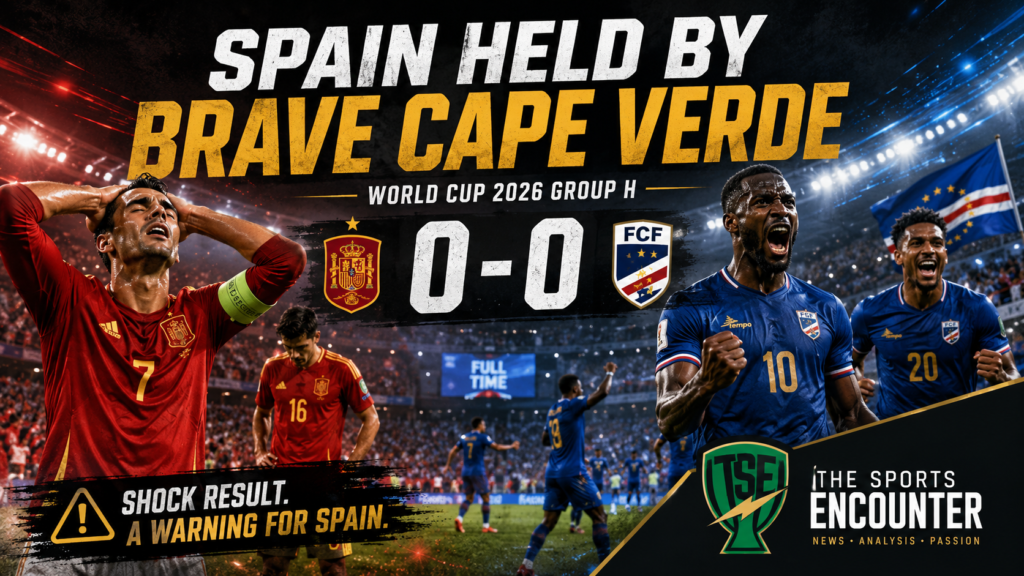
Spain arrived at the FIFA World Cup 2026 expected to make a calm, controlled, and convincing start.
Cape Verde had other ideas.
In one of the strongest early statements of the tournament, the World Cup debutants held Spain to a 0-0 draw in their Group H opener at Atlanta Stadium, frustrating one of the title favorites with discipline, courage, and a defensive performance that will be remembered far beyond the scoreline.
For Spain, this was not a defeat on paper. It felt much heavier than that.
La Roja dominated the ball, controlled long spells of possession, and pushed Cape Verde deep for large parts of the match. Yet their passing rhythm rarely turned into clear authority in the penalty area. Cape Verde defended with patience, stayed compact, trusted goalkeeper Vozinha, and turned Spain’s expected procession into an uncomfortable opening-night examination.
For more tournament coverage, follow our FIFA World Cup 2026 hub.
Match Summary: Spain Control the Ball, Cape Verde Control the Emotion
Spain started with the structure expected from Luis de la Fuente’s side. Rodri, Pedri, and Fabian Ruiz gave them control in midfield, while Gavi, Ferran Torres, and Mikel Oyarzabal looked to stretch Cape Verde’s defensive block.
The problem was not possession.
The problem was what came after it.
Cape Verde accepted Spain’s control in safer areas and focused on denying central spaces near the box. Their defenders stayed tight, their midfield runners tracked Spain’s passing lanes, and Vozinha gave them the calm last line they needed.
Spain had moments. Marc Cucurella pushed forward from left-back and gave the team an outlet. Pedri searched for gaps. Rodri tried to increase the tempo. Ferran Torres and Oyarzabal worked across the front line, but the final action kept failing Spain.
Crosses were cleared. Shots were blocked. Runs arrived a second late. Cape Verde’s box became a crowded, blue wall Spain could not move.
The Key Pattern: Spain Had Control Without Penetration
This was the kind of match that punishes teams that confuse possession with pressure.
Spain had the ball, but Cape Verde often decided where Spain could have it. La Roja moved the play from side to side, but Cape Verde’s shape rarely lost its balance. The underdogs did not chase blindly. They waited, shifted, blocked, and forced Spain into lower-quality decisions.
That made the match feel stranger with every passing minute.
Spain were not being outplayed in the traditional sense. They were being delayed, slowed, and emotionally tested.
Cape Verde’s Defensive Plan Deserved the Result
Cape Verde’s draw was not luck dressed up as romance.
It was structure.
They defended low when needed, stepped out when Spain became predictable, and used counters just enough to remind Spain that overcommitting could carry a cost. Ryan Mendes and Cape Verde’s attacking runners gave their side an outlet, while the midfield worked tirelessly to protect the defense.
Vozinha Gives Cape Verde a World Cup Moment
Goalkeeper Vozinha became the face of Cape Verde’s resistance.
Spain’s best moments still needed saving, catching, punching, or slowing down. Vozinha did all of that with the composure of a player who understood the size of the moment but refused to be swallowed by it.
For a debutant nation, a clean sheet against Spain in a World Cup opener is not just a result. It is a national sporting memory.
Spain’s Biggest Concern: Where Was the Killer Edge?
Spain will not panic after one match, but this draw exposes a real concern.
Tournament favorites need more than rhythm. They need cutting edge. Spain had technical control, but not enough risk. Too many attacks looked neat rather than dangerous. Too many final balls lacked aggression. Too many players waited for the perfect opening instead of forcing one.
That matters because Group H will not get easier.
Spain still have Saudi Arabia and Uruguay ahead. Uruguay, in particular, will not fear a Spain side that looks elegant but blunt.
Lamine Yamal’s Role Will Become a Major Talking Point
Lamine Yamal started on the bench, which immediately became part of the story. When Spain needed more unpredictability, his presence became more valuable.
Spain’s attack lacked sudden acceleration and one-vs-one disruption for long spells. Yamal offers both. His usage in the next match may now become one of Spain’s biggest tactical questions.
For a tournament built on pressure, timing, and courage, Spain may need to trust their most disruptive talent earlier.
Group H Impact: Spain Drop Two Points, Cape Verde Gain Belief
A draw in the opening match changes the emotional shape of a group.
Spain remain strong enough to qualify, but they no longer have margin for comfort. Their next match against Saudi Arabia now carries extra pressure. A slow start can quickly become a group-stage problem if Uruguay also build momentum.
Cape Verde, meanwhile, have given themselves a real platform. One point against Spain changes how every opponent views them. It also changes how Cape Verde view themselves.
They came into the match as debutants.
They left it as competitors.
Read more from the tournament: Sweden Run Riot Against Tunisia in Ruthless 5-1 World Cup Opener.
Tactical Breakdown
Spain’s Possession Became Too Predictable
Spain’s midfield control was clean, but Cape Verde were comfortable defending in front of them. The passing lanes looked good until Spain reached the final third. Once there, the tempo slowed, the movement became easier to track, and Cape Verde’s defenders could reset.
Spain needed more direct runs behind the line and more early deliveries into dangerous zones.
Cape Verde Protected the Central Channel
Cape Verde understood one thing clearly: Spain love to create through the middle.
So they denied the middle.
That forced Spain wide more often than they wanted. Even when Spain crossed, Cape Verde had enough bodies in the box to deal with the danger.
Spain Needed Faster Decisions Around the Box
The difference between a good team and a World Cup-winning team often appears in the final action.
Spain’s final action was too slow too often. Cape Verde used every extra touch against them. Every delay helped the defensive line recover. Every sideways pass lowered the danger.
Player Watch
Spain: Pedri
Pedri tried to dictate rhythm and create angles between the lines. His passing gave Spain control, but Cape Verde’s defensive density limited the spaces he usually exploits.
Spain: Marc Cucurella
Cucurella was one of Spain’s more active attacking outlets from full-back. His forward runs gave Spain width and energy, especially when central routes became congested.
Cape Verde: Vozinha
Vozinha’s calm presence shaped the match. He handled pressure, managed his area well, and gave Cape Verde the belief that Spain could be stopped.
Cape Verde: Ryan Mendes
Mendes gave Cape Verde an outlet and helped prevent Spain from turning the match into one-way traffic. His leadership mattered as much as his attacking work.
What This Means for Spain
Spain are still one of the strongest teams in the tournament.
But this was a warning.
World Cups do not reward reputation. They punish hesitation. Spain must sharpen their attacking decisions, increase their urgency, and turn control into threat before Group H becomes more complicated than expected.
The result also sits alongside our wider Saudi Arabia vs Uruguay Group H opener, which showed how unpredictable the group became from the first round of matches.
For another early tournament shock, read how Australia stunned Turkey in their World Cup 2026 opener.
The Saudi Arabia match now becomes a response test.
Spain do not just need three points. They need proof that this was a bad opening day, not a deeper attacking problem.
What This Means for Cape Verde
Cape Verde have already made history by reaching this World Cup.
Now they have added something bigger: credibility.
Holding Spain to a draw gives them belief, attention, and a route into the group-stage conversation. Their next challenge is different. Teams may now respect them more, prepare for them more seriously, and give them less emotional space.
That is the price of earning respect at a World Cup.
Final Verdict
Spain expected a routine start.
Cape Verde forced them into a fight.
The 0-0 scoreline may not look dramatic at first glance, but this was one of those World Cup matches where the story lives in resistance, pressure, and the refusal of an underdog to accept its assigned role.
Spain leave Atlanta with questions.
Cape Verde leave with a point, a clean sheet, and one of the proudest nights in their football history.
For more football features and match coverage, visit our World Cup 2026 coverage page and follow our latest tournament reports on The Sports Encounter.
FAQs
What was the result of Spain vs Cape Verde in the FIFA World Cup 2026?
Spain drew 0-0 with Cape Verde in their Group H opener at the FIFA World Cup 2026.
Why was Spain’s draw with Cape Verde a shock?
Spain entered the match as one of the tournament favorites, while Cape Verde were World Cup debutants. Cape Verde’s disciplined defensive performance made the result one of the early surprises of the tournament.
Who stood out for Cape Verde against Spain?
Goalkeeper Vozinha was one of Cape Verde’s standout performers. His composure and command helped Cape Verde secure a clean sheet against one of the world’s strongest teams.
What is Spain’s next World Cup 2026 match?
Spain’s next Group H match is against Saudi Arabia.
Can Cape Verde qualify from Group H?
Cape Verde improved their chances by earning a point against Spain. Their qualification hopes will depend on their remaining matches against Uruguay and Saudi Arabia.