


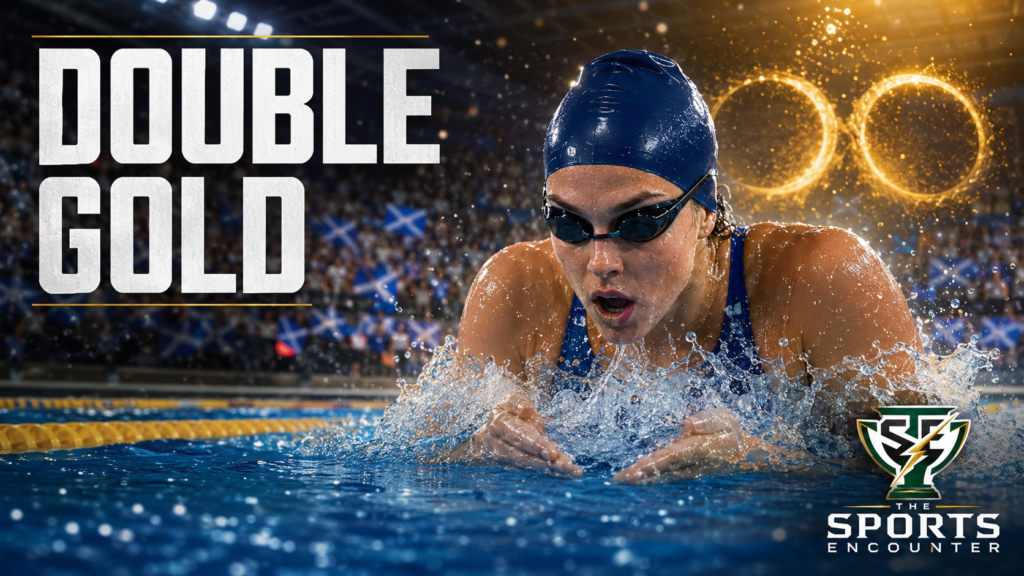
Angharad Evans completed a golden Commonwealth Games double for Scotland by winning the women’s 200m breaststroke final in 2:23.79 at Glasgow 2026, holding off South Africa’s Kaylene Corbett and Northern Ireland’s Ellie McCartney during another emotional night at Tollcross International Swimming Centre.
The 23-year-old entered the final as the fastest qualifier and the woman to beat. She carried the fastest 200m breaststroke time in the world this year, the British record, a home crowd’s expectation, and the emotional weight of having already survived a far more anxious 100m final three days earlier.
Evans handled all of it.
Corbett stayed close enough to make the closing stages uncomfortable, but the Scot protected her advantage and reached the wall in 2:23.79. Corbett secured silver in 2:24.46, while McCartney produced a strong finish to claim bronze for Northern Ireland in 2:24.73.
The winning margin over Corbett was 0.67 seconds. McCartney finished 0.94 behind the champion.
It was Evans’ second individual gold medal of Glasgow 2026, following her dramatic victory in the women’s 100m breaststroke. Strictly speaking, the 200m title took her overall Games collection to three medals because she had also helped Scotland win bronze in the mixed 4x100m medley relay.
Two individual races. Two titles. One relay bronze. In a Scottish team filled with experienced international names, Evans has become one of the defining home athletes of these Games.
Women’s 200m Breaststroke Final Results
| Position | Swimmer | Nation | Time | Margin |
|---|---|---|---|---|
| Gold | Angharad Evans | Scotland | 2:23.79 | Winner |
| Silver | Kaylene Corbett | South Africa | 2:24.46 | +0.67 |
| Bronze | Ellie McCartney | Northern Ireland | 2:24.73 | +0.94 |
Evans did not need to approach her British record of 2:19.70 to win. Championship finals are measured by position, control, and the ability to respond when another swimmer refuses to disappear. Her 2:23.79 was sufficient because she managed the field and retained enough control to resist the pressure behind her.
The result gave Scotland another major home success after a Games in which the host nation had already produced memorable victories across swimming, Para swimming, athletics, gymnastics, and bowls. The broader trajectory of the Scottish campaign can be followed through The Sports Encounter’s Glasgow 2026 Day 4 wrap-up and medal table.
How Angharad Evans Won The 200m Breaststroke Gold
The 200m breaststroke often punishes impatience. A swimmer can win the first 100 meters and lose the race during the third length, when the arms begin to tighten, the kick loses force, and every glide feels longer than it should.
Evans entered the final with enough speed to attack, but her greater responsibility was to control the race. She had already shown at the 2026 Aquatics GB Swimming Championships that she could swim 2:19.70, a British record that placed her among the fastest women in the history of the event.
That made her the favorite. It did not make the final comfortable.
Corbett is an experienced South African breaststroker with major international racing behind her. McCartney arrived with confidence after establishing herself as one of Northern Ireland’s strongest medal prospects. Both had the endurance to remain dangerous over the final 50 meters.
Evans built the position she needed and then held it under pressure. As the three medal contenders approached the wall, the Scot’s advantage had narrowed enough to keep the Tollcross crowd tense. Her touch ended the uncertainty.
The celebration carried joy, but the expression on Evans’ face also showed relief. BBC analyst and former world champion Karen Pickering described it as a beautiful swim with a strong finish, noting the visible combination of relief and happiness after the result was confirmed.
Why The Winning Time Was Slower Than Her British Record
Evans’ 2:23.79 was 4.09 seconds outside the 2:19.70 British record she set in April 2026. That difference does not reduce the quality or importance of the victory.
Record attempts and championship finals create different demands. At a national selection meet, a swimmer may be chasing a time, qualification standard, or record in a race designed around peak performance. At a major final, the only essential objective is touching the wall before every rival.
Evans had already completed several rounds of competition, won the 100m title, and contributed a demanding breaststroke leg to Scotland’s mixed medley relay. The accumulated physical and emotional workload mattered.
The final also developed as a direct contest rather than a record chase. Evans adapted to the field and secured the result Scotland wanted most.
The Final Margin Explained
A 0.67-second winning margin over 200 meters is narrow enough to create tension but clear enough to avoid any doubt over the touch. Corbett needed a substantial gain during the final strokes and could not quite produce it.
McCartney remained only 0.27 seconds behind Corbett, making the battle for silver even tighter than the contest between first and second. All three medalists finished inside one second of each other.
A Breaststroke Double Built On Two Very Different Victories
Evans won the 100m and 200m titles, but the two races tested her in different ways.
The 100m final on July 26 became a contest against fear as much as a race against South Africa’s Aimee Canny. Evans entered as the world’s fastest swimmer of 2026 and had posted the best times in the heats and semifinals. The home crowd expected gold.
Canny led through the opening 50 meters and remained ahead deep into the second length. Evans later admitted that her body had felt tense for two days and that she was concerned it would not deliver the result she wanted.
Her finish changed the race. Evans recovered the deficit during the final meters and won in 1:06.07, edging Canny by 0.12 seconds.
That was her first major individual international title. She described it as overcoming fear after leaving everything in the pool for Scotland.
The 200m final required a different kind of nerve. Evans was no longer trying to prove that she could win a major title. She was trying to return to the blocks, carry the expectation again, and confirm her superiority in her strongest event.
Winning once brought release. Winning again established authority.
Her double also added a Scottish counterpoint to Australia’s commanding control of the swimming medal table. Australia accumulated titles through exceptional depth, as documented in The Sports Encounter’s Glasgow 2026 Day 5 results and medal analysis, but Evans ensured that some of the loudest moments at Tollcross belonged to the host nation.
Evans Had Already Added A Relay Bronze
The 200m gold is widely being described as Evans’ second Glasgow 2026 medal because it was her second individual title. Her complete Games record, however, stands at three medals.
Between her two individual victories, Evans joined Matthew Ward, Keanna MacInnes, and Duncan Scott in Scotland’s mixed 4x100m medley relay final. Dean Fearn and Lucy Grieve also earned medals after contributing during the heats.
Ward opened with a 53.55 backstroke leg. Evans then delivered a superb 1:04.52 breaststroke split, helping Scotland remain second behind Australia at that stage.
MacInnes followed on butterfly before Scott produced a 48.03 freestyle anchor to pull Scotland back through the field and secure bronze in 3:43.70.
Australia won in a Commonwealth Games record of 3:40.46, while South Africa took silver in 3:42.61. Scotland held off Canada, which finished fourth in 3:44.23.
The relay medal broadened the meaning of Evans’ Games. Her individual golds belong to her name, but the bronze demonstrated her value to Scotland’s wider swimming team. It also added to the record medal contribution made by University of Stirling athletes during the competition.
That relay formed one of the major swimming stories emerging around Glasgow 2026’s record-breaking fifth day, when historic performances arrived from large teams and smaller Commonwealth nations alike.
Who Is Angharad Evans And What Has She Achieved?
Who Is Angharad Evans?
Angharad Evans is a 23-year-old British breaststroke specialist who represents Scotland at the Commonwealth Games and Great Britain in Olympic, world, and European competition.
She was born in Cambridge, England, on April 25, 2003. Her American mother and British father gave her an international family background, while her Welsh first name reflects her father’s Welsh-speaking parents.
Evans developed through West Suffolk Swimming Club and spent time studying and competing at the University of Georgia in the United States. Her career accelerated after she moved into the University of Stirling’s high-performance program, where she has worked under coaches Ben Higson and Bradley Hay.
The 2024 season transformed her from a promising domestic swimmer into an international contender. She won the British 100m breaststroke title in 1:06.54 and qualified for the Paris Olympic Games.
Evans then lowered the British record to 1:05.54 at the AP Race International meeting in London. At Paris 2024, her first Olympics, she reached the women’s 100m breaststroke final and finished sixth in 1:05.85 after turning third at halfway.
Later that year, she swam the breaststroke leg for Great Britain’s silver medal-winning women’s 4x100m medley relay at the World Short Course Championships. That result delivered her first senior world medal.
Her progress continued in 2025. Evans retained the British 100m title and lowered her national record to 1:05.37, becoming the first British woman to break 66 seconds in the event.
At the 2025 World Aquatics Championships in Singapore, she finished fourth in the 200m breaststroke, narrowly missing a place on the podium. The result confirmed that her range had expanded beyond the shorter event.
In December 2025, Evans won silver in the 200m breaststroke at the European Short Course Championships. It was her first individual medal at a major senior international championship.
April 2026 provided another leap. She lowered the British long-course records to 1:04.96 in the 100m breaststroke and 2:19.70 in the 200m. Those performances placed her inside elite historical territory in both distances and made her the fastest woman in the world that year entering Glasgow.
She arrived at her first Commonwealth Games with international medals and major expectations, but without a senior individual gold. Six days into Glasgow 2026, she had two.
| Year | Competition | Event | Achievement |
|---|---|---|---|
| 2024 | Aquatics GB Championships | 100m Breaststroke | British champion |
| 2024 | AP Race International | 100m Breaststroke | British record, 1:05.54 |
| 2024 | Paris Olympic Games | 100m Breaststroke | Sixth in the final |
| 2024 | World Short Course Championships | 4x100m Medley Relay | Silver |
| 2025 | Aquatics GB Championships | 100m Breaststroke | British record, 1:05.37 |
| 2025 | World Aquatics Championships | 200m Breaststroke | Fourth |
| 2025 | European Short Course Championships | 200m Breaststroke | Silver |
| 2026 | Aquatics GB Championships | 100m Breaststroke | British record, 1:04.96 |
| 2026 | Aquatics GB Championships | 200m Breaststroke | British record, 2:19.70 |
| 2026 | Commonwealth Games | 100m Breaststroke | Gold, 1:06.07 |
| 2026 | Commonwealth Games | Mixed 4x100m Medley Relay | Bronze |
| 2026 | Commonwealth Games | 200m Breaststroke | Gold, 2:23.79 |
Why Glasgow 2026 Could Change Evans’ Career
Before Glasgow, Evans already possessed the times required to compete with the world’s best breaststrokers. She had reached an Olympic final, finished fourth at a long-course World Championship, won a world relay medal, and broken British records.
The missing piece was an individual senior international title.
Glasgow has now given her two.
The emotional value matters because Evans had previously experienced the other side of major-meet expectation. She entered the 2025 World Championships as a leading contender in the 100m breaststroke but failed to progress to the final. That disappointment remained part of her thinking when she approached the Commonwealth 100m final.
Her response has been convincing. She won a race in which she trailed and felt tense, contributed a high-quality relay split, and returned to win the 200m as the leading favorite.
Those are different competitive problems. Evans solved all three.
Her emergence also strengthens a British women’s swimming group that contains established senior medalists and fast-developing teenagers. England’s Amalie Smith, whose rapid progress was explored in The Sports Encounter’s profile of the 16-year-old Commonwealth medley medalist, represents another part of that promising picture.
Evans is further along. At 23, her attention will increasingly turn toward converting world-leading seasonal times into World Championship and Olympic podium finishes.
What Comes Next For Angharad Evans?
The Los Angeles 2028 Olympic cycle offers the clearest long-term target.
Evans will be 25 during those Games, an age that should place her near the heart of her physical prime. Her sixth-place finish in Paris gave her experience of an Olympic final. Her British records show that she already possesses world-level speed.
The next challenge is repeatability.
Elite breaststroke fields can change quickly. Young swimmers emerge, established champions adjust their programs, and tenths of a second decide whether an athlete finishes first, fourth, or outside a final. Evans must continue producing her fastest performances when the pressure reaches its highest level.
Glasgow does not guarantee future medals. It gives her stronger evidence that she can manage expectation, recover between rounds, and win when an entire arena anticipates her success.
The Games have also increased her national profile. Scottish supporters have now watched her win twice at Tollcross, heard “Flower of Scotland” played in her honor, and seen her contribute to a relay medal alongside Scott and MacInnes.
Her success arrives during a Commonwealth Games shaped by Australian control and breakthrough performances from many smaller delegations. The wider significance of those results is detailed in our complete Glasgow 2026 Day 5 report.
What Evans’ Double Means For Scotland
Host-nation success changes the atmosphere of a multi-sport event. International stars may deliver the fastest performances, but home champions give local crowds a direct emotional connection to the Games.
Evans has provided that connection twice.
Her 100m victory delivered Scotland’s second swimming gold of the competition after Duncan Scott won the men’s 200m individual medley. The 200m title strengthened the host nation’s swimming identity during a meet otherwise dominated by Australia.
Scotland could not match Australia’s depth across every event. It did possess swimmers capable of winning the races that mattered most to the home crowd.
Evans also represents the value of Scotland’s high-performance swimming structure. The University of Stirling has developed and supported numerous Olympic and Commonwealth athletes. Its swimmers reached a record Glasgow medal total before Evans entered the 200m final.
Her success will also matter to younger Scottish swimmers watching from the stands or at home. Major events become more influential when athletes from the host nation are visible at the center of them.
The Sports Encounter’s Day 4 analysis showed how Scottish victories had already helped the hosts maintain a strong position among the leading nations. Evans’ second gold gave that campaign another defining performance.
Final Verdict
Angharad Evans arrived at Glasgow 2026 as a British record holder, Olympic finalist, and one of the fastest breaststrokers in the world. She will leave as a double Commonwealth champion.
The 100m title demanded a late recovery against Aimee Canny and a personal victory over the tension that had followed her into the final. The 200m required control, endurance, and the ability to defend favorite status against Corbett and McCartney.
Evans won the second race in 2:23.79, finishing 0.67 seconds ahead of Corbett and 0.94 clear of McCartney. The time was outside her British record, but the medal was never awarded for a record. It was awarded for reaching the wall first.
Her Glasgow collection now contains gold in the 100m breaststroke, bronze in the mixed medley relay, and gold in the 200m breaststroke.
Three medals. Two individual titles. A home Games transformed into the finest senior competition of her career so far.
Full schedules, official results, athlete information, and Games updates are available through the official Glasgow 2026 Commonwealth Games website.
For another example of a young British swimmer making a major Glasgow breakthrough, read our profile of Amalie Smith’s rise from junior champion to Commonwealth medalist.
Frequently Asked Questions About Angharad Evans
Who Is Angharad Evans?
Angharad Evans is a 23-year-old British breaststroke swimmer who represents Scotland at the Commonwealth Games and Great Britain at the Olympic Games, World Championships, and European Championships. She trains through the University of Stirling’s high-performance swimming program.
What Did Angharad Evans Win At Glasgow 2026?
Evans won gold medals in the women’s 100m and 200m breaststroke events. She also earned bronze as part of Scotland’s mixed 4x100m medley relay team.
How Many Medals Did Angharad Evans Win At Glasgow 2026?
Evans has won three Glasgow 2026 medals: two individual golds and one relay bronze. Her 200m breaststroke victory was her second individual title and third medal overall.
What Was Angharad Evans’ 200m Breaststroke Winning Time?
Evans won the Glasgow 2026 women’s 200m breaststroke final in 2:23.79.
Who Finished Behind Angharad Evans In The 200m Breaststroke Final?
South Africa’s Kaylene Corbett won silver in 2:24.46, while Northern Ireland’s Ellie McCartney claimed bronze in 2:24.73.
What Was Angharad Evans’ Winning Margin?
Evans defeated Corbett by 0.67 seconds in the women’s 200m breaststroke final. McCartney finished 0.94 seconds behind Evans.
Did Angharad Evans Win The 100m Breaststroke At Glasgow 2026?
Yes. Evans won the women’s 100m breaststroke in 1:06.07 after overtaking South Africa’s Aimee Canny during the closing stages. Her winning margin was 0.12 seconds.
What Is Angharad Evans’ British Record In The 200m Breaststroke?
Evans holds the British long-course women’s 200m breaststroke record of 2:19.70, set at the 2026 Aquatics GB Swimming Championships.
What Is Angharad Evans’ British Record In The 100m Breaststroke?
Her British long-course record in the women’s 100m breaststroke is 1:04.96, set at the 2026 Aquatics GB Swimming Championships.
Did Angharad Evans Compete At The Olympics?
Yes. Evans represented Great Britain at the Paris 2024 Olympic Games and finished sixth in the women’s 100m breaststroke final.
Where Was Angharad Evans Born?
Evans was born in Cambridge, England, on April 25, 2003. She represents Scotland at the Commonwealth Games and trains at the University of Stirling.
How Old Is Angharad Evans?
Angharad Evans is 23 years old. She was born on April 25, 2003.
Where Does Angharad Evans Train?
Evans trains through the University of Stirling’s high-performance swimming program. She has credited coaches Ben Higson and Bradley Hay for helping shape her development.
What Are Angharad Evans’ Main Career Achievements?
Her major achievements include two Glasgow 2026 Commonwealth gold medals, a Commonwealth relay bronze, sixth place at the Paris Olympics, World Short Course Championship relay silver, European Short Course Championship 200m silver, fourth place at the 2025 World Championships, multiple British titles, and British records in both the 100m and 200m breaststroke.
Could Angharad Evans Win An Olympic Medal At Los Angeles 2028?
Evans has the speed and international experience to become a Los Angeles 2028 medal contender. She has already reached an Olympic final and recorded world-class times in both breaststroke distances, but qualification and Olympic success will depend on her form during the 2028 season.