


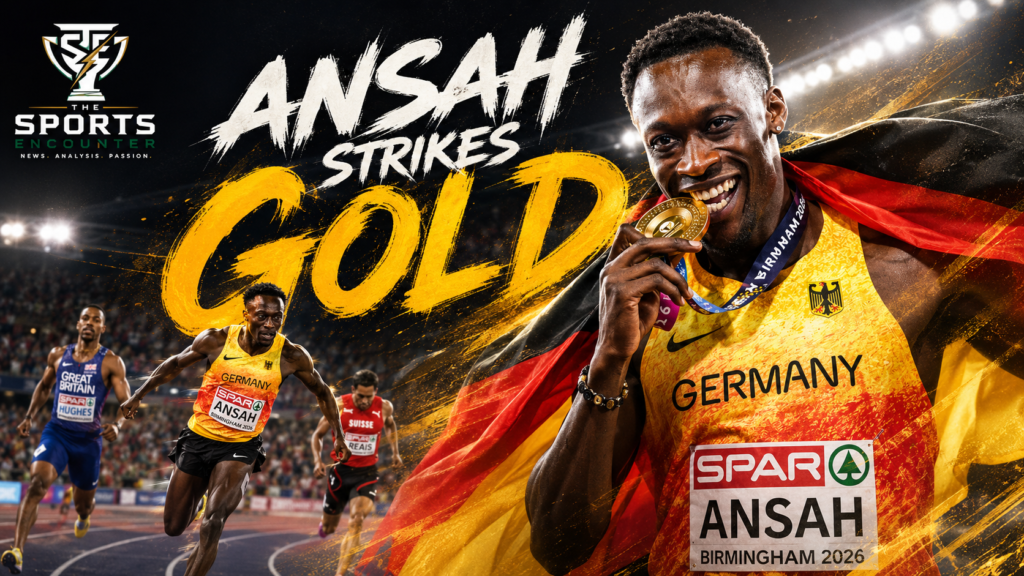
Owen Ansah did not just win the European men’s 200m title in Birmingham. He turned a wind-aided final into a German sprinting statement that Europe could not ignore.
The German sprinter powered to gold in 19.95 seconds at the 2026 European Athletics Championships, beating Britain’s Zharnel Hughes, who took silver in 20.16, while Italy’s Eseosa Desalu and Switzerland’s Timothé Mumenthaler shared bronze after both were recorded at 20.26.
The +2.5 wind means Ansah’s time will not stand as a legal record, but that should not flatten the meaning of the race. The title was real. The margin was real. The way he finished was real.
For a championship already packed with historic performances, Ansah’s 200m gold added something different: a breakthrough sprint victory for Germany in one of track’s most unforgiving events.
Owen Ansah’s European 200m Gold at a Glance
| Detail | Information |
|---|---|
| Event | Men’s 200m final |
| Champion | Owen Ansah, Germany |
| Winning time | 19.95 seconds |
| Wind reading | +2.5 |
| Silver | Zharnel Hughes, Great Britain, 20.16 |
| Bronze | Eseosa Desalu, Italy, 20.26 |
| Bronze | Timothé Mumenthaler, Switzerland, 20.26 |
| Key context | Ansah won after taking 100m bronze earlier in the championships |
Ansah Turned the Final Into His Moment
The men’s 200m final had the ingredients of a tight European showdown.
Hughes brought proven championship pedigree. Desalu had Olympic relay gold and major-stage experience. Mumenthaler entered as a dangerous Swiss contender with the authority of a defending European champion from the previous cycle. Ansah had already shown sharpness in Birmingham by winning 100m bronze.
But the final did not become a slow tactical race.
Ansah made sure of that.
He attacked the bend, held his form into the straight and finished with the kind of authority that left the rest of the field racing for silver and bronze. The 19.95 will carry the wind note, but visually, the win looked emphatic.
That matters in the 200m.
The event is not only about speed. It is about how speed survives the curve, how the body handles transition, and how the sprinter keeps mechanics together when the final 50 meters begin to ask harder questions.
Ansah answered them better than anyone else.
The Wind Reading Should Be Understood Properly
The +2.5 wind reading is important because sprint marks above +2.0 are not legal for record purposes.
That means Ansah’s 19.95 will not carry the same statistical status as a wind-legal sub-20 performance.
But there is a difference between record eligibility and championship value.
The wind helped the clock. It did not choose the winner. Every athlete in the final ran under the same wind conditions, and Ansah still beat Hughes by 0.21 seconds. That gap gives the performance its real meaning.
This was not a photo-finish gold hidden inside a technical footnote.
It was a clear victory.
Zharnel Hughes Had to Settle for Silver
Hughes arrived with the strongest name recognition in the final and the experience to handle championship pressure.
He had already won European 200m gold in 2022 and remains one of Britain’s most important male sprinters. In Birmingham, he ran 20.16 and still could not get close enough to Ansah.
That makes the result interesting rather than merely disappointing.
Hughes was not beaten because he disappeared from the race. He was beaten because Ansah found a sharper level on the night.
For British sprinting, the silver still adds to a championship that has delivered major headlines, including Amy Hunt’s rare 100m-200m sprint double. But in the men’s 200m, the biggest statement belonged to Germany.
A Rare Shared Bronze Added Drama Behind the Winner
Desalu and Mumenthaler both crossed in 20.26, creating a rare shared bronze.
That detail gave the final an unusual shape.
At the front, Ansah’s margin made gold clear. Behind him, the bronze fight came down to a near-perfect tie, with Desalu and Mumenthaler inseparable on the official timing.
For Desalu, the bronze added another major medal to a career built on relay success, speed and experience. For Mumenthaler, it kept him on the podium in an event where defending status can become its own pressure.
The shared bronze also underlined the depth of European 200m sprinting. Ansah had separation, but the fight behind him was brutally tight.
Germany Gets a Sprinting Headline It Can Build Around
Germany has a rich athletics history, but European men’s sprint dominance has not always been the country’s most consistent modern calling card.
Ansah’s 200m gold changes the tone.
A European sprint title gives Germany a visible face in one of the sport’s most marketable events. It also builds on Ansah’s 100m bronze earlier in the championships, creating a week that feels less like a one-race surprise and more like a genuine arrival.
The official German athletics federation, Deutscher Leichtathletik-Verband, now has a sprinter whose Birmingham performance can help carry attention beyond one final.
That matters because sprinting travels. It catches casual audiences quickly. It creates simple storylines and immediate visual impact. A German sprinter winning the European 200m title gives the sport in Germany a sharper public hook.
Owen Ansah 🇩🇪 wins the European men's 200m title in 19.95s (+2.5)!🥇
— Track & Field Gazette (@TrackGazette) August 14, 2026
🥈 Zharnel Hughes 🇬🇧 20.16
🥉 Eseosa Desalu 🇮🇹 20.26 (.251)
🥉 Timothe Mumenthaler 🔥 20.26 (.251) pic.twitter.com/M8OYruzsVl
The 100m Bronze Made the 200m Gold Feel Less Random
Ansah’s gold becomes more convincing when placed beside his earlier 100m bronze.
One medal can sometimes come from a perfect draw, a single great start or a final where rivals misfire. Two sprint medals at the same championship suggest a stronger foundation.
The 100m showed raw speed.
The 200m showed curve management, endurance and race execution.
That range matters because the 200m asks a sprinter to carry speed longer and handle rhythm differently. Ansah proved he could compete in both short sprints across the same championship schedule.
In that sense, his Birmingham week belongs beside other multi-event and repeat-performance stories from these European Championships, including Nadia Battocletti’s historic distance double-double and Karsten Warholm’s fourth straight European hurdles gold.
Why the 200m Is Such a Hard Event to Own
The 200m looks simple to casual viewers because it is over so quickly.
It is not simple.
The event demands acceleration, bend technique, maximum velocity, speed endurance and emotional control. A sprinter must start aggressively without losing shape, run the bend with precision, then enter the straight with enough left to resist the athlete charging from another lane.
The final 60 meters reveal everything.
Some sprinters have the start but not the finish. Some have top speed but lose rhythm on the curve. Some run well when drawn outside but struggle when they cannot see the field clearly.
Ansah’s Birmingham run showed enough balance across those phases to win comfortably.
Hughes Remains Dangerous, But the European Picture Has Shifted
Hughes’ silver should not be treated as decline on its own.
One final does not erase his career. He remains a major European sprint figure, and his experience still matters across future championships and relays.
But the European 200m picture has clearly shifted.
Ansah has moved from contender to champion. Mumenthaler remains a podium-level threat. Desalu still has the experience to find medals. The next major final will not start with one obvious favorite in everyone’s mind.
That is good for the event.
European sprinting feels more competitive when the hierarchy is unstable.
Desalu and Mumenthaler Keep Italy and Switzerland in the Sprint Conversation
Italy’s bronze through Desalu continued a wider championship theme for the Italian team.
Italy has been visible across several disciplines in Birmingham, from Gianmarco Tamberi’s fourth European high jump gold to Battocletti’s distance dominance. Desalu’s medal ensured the sprint program also remained part of that story.
For Switzerland, Mumenthaler’s shared bronze added to a championship already marked by Audrey Werro’s record-breaking 800m gold. Swiss athletics now has visibility in both middle-distance drama and men’s sprinting.
That kind of spread matters for national teams.
It shows medals are not coming from one isolated discipline alone.
Ansah’s Win Adds to Birmingham’s Record of Breakthrough Nights
Birmingham 2026 has not been a championship of routine outcomes only.
Werro beat an Olympic champion in a championship-record 800m. Hunt swept the 100m and 200m. Battocletti completed another distance double. Warholm defended with a championship record. Tamberi rose again when the build-up suggested doubt.
Ansah now adds a men’s sprint breakthrough to that list.
The Sports Encounter has tracked those stories because they all share a common thread: athletes are not merely collecting medals, they are shifting how their events are discussed.
Ansah’s 200m victory does exactly that for Germany.
What Comes Next for Owen Ansah?
The next challenge is turning a European title into a wider global threat.
That is the natural progression for any continental sprint champion. Europe is difficult. The world stage is harsher. The 200m globally includes deeper fields, more sub-20 talent and sprinters who can punish the smallest technical weakness.
Ansah’s Birmingham performance gives him credibility, not a guarantee.
He now has to prove he can reproduce elite 200m racing in legal wind, against global fields, through rounds, under different pressure. That is where reputations become durable.
But the foundation is stronger now than it was before Birmingham.
He is no longer only a promising German sprinter.
He is a European champion.
The Official Championship Context
The Birmingham 2026 European Athletics Championships are part of the official continental championship structure overseen by European Athletics. Athlete records, performance lists and official global profiles are maintained by World Athletics.
Germany’s national athletics updates can be followed through Deutscher Leichtathletik-Verband, while official European championship information is available through European Athletics.
TSE Analysis: Ansah’s Gold Was More Than a Wind-Aided Time
The easy way to discuss this race is to argue about the +2.5 wind.
That would miss the point.
Yes, the time is wind-aided. No, it will not carry legal record status. But championship finals are ultimately about beating the athletes beside you, and Ansah did that clearly.
He beat Hughes by 0.21 seconds. He finished well ahead of a shared bronze dead heat. He converted 100m bronze momentum into 200m gold. He gave Germany one of the biggest sprinting headlines of the championships.
That is the story.
The wind explains the clock.
It does not explain the margin.
Ansah earned the title because he ran the best race when the medals were on the line.
In a Birmingham championship full of historic champions and breakthrough stars, his 200m gold belongs near the center of the sprint conversation.
Readers can also follow The Sports Encounter’s wider athletics coverage through Amy Hunt’s European sprint double, Audrey Werro’s record 800m gold, Nadia Battocletti’s distance double-double, Karsten Warholm’s record hurdles gold, Gianmarco Tamberi’s high jump gold, Glasgow 2026 Day 4, and Glasgow 2026 Day 5.
Frequently Asked Questions
Who won the men’s 200m at the 2026 European Athletics Championships?
Owen Ansah of Germany won the men’s 200m title at the 2026 European Athletics Championships in Birmingham.
What was Owen Ansah’s winning time?
Ansah won in 19.95 seconds with a +2.5 wind reading.
Does Owen Ansah’s 19.95 count as a legal record?
No. The +2.5 wind reading is above the legal limit of +2.0, so the time is not eligible for record purposes.
Who won silver in the men’s 200m?
Great Britain’s Zharnel Hughes won silver in 20.16 seconds.
Who won bronze in the men’s 200m?
Italy’s Eseosa Desalu and Switzerland’s Timothé Mumenthaler shared bronze after both were recorded at 20.26.
Did Owen Ansah win another medal in Birmingham?
Yes. Ansah also won bronze in the men’s 100m earlier in the championships.
Why is Ansah’s 200m gold important for Germany?
It gives Germany a major European sprint title and confirms Ansah as one of the leading names in European men’s sprinting.
Where can official athletics records and results be followed?
Official European championship information is available through European Athletics, while athlete records and global rankings are available through World Athletics.
The Sports Encounter’s athletics coverage follows major championships, records, athlete breakthroughs, sprinting, hurdles, middle-distance running, distance running, field events and the biggest stories shaping global track and field.