


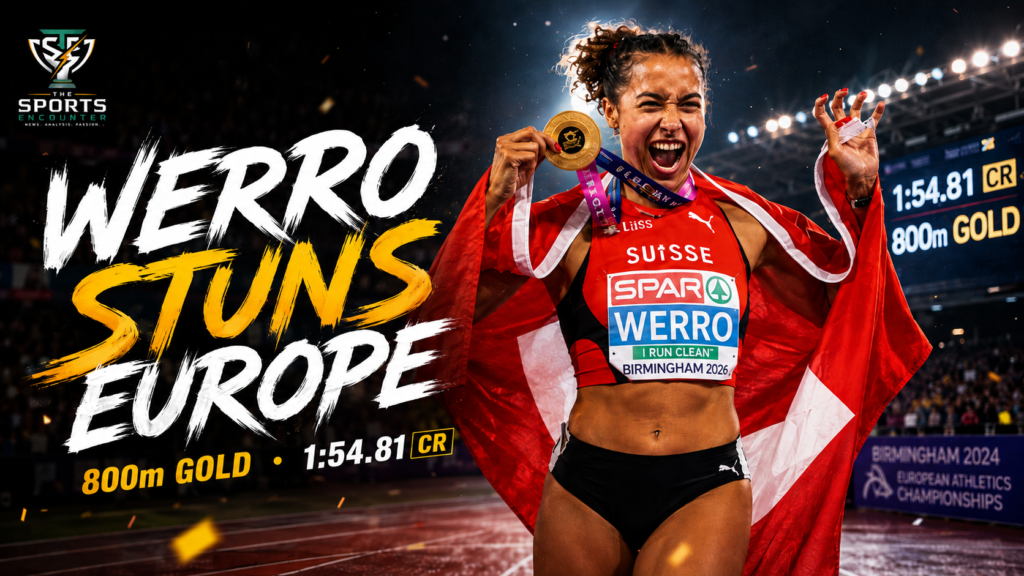
Audrey Werro did not just beat Keely Hodgkinson in Birmingham. She turned the women’s 800m final into one of the defining races of the 2026 European Athletics Championships.
The Swiss middle-distance star won European 800m gold in a championship-record 1:54.81, holding off Britain’s Hodgkinson, who took silver in 1:55.01, and the Netherlands’ Femke Broeders-Bol, who claimed bronze in 1:55.54.
For Werro, this was a first senior European outdoor title and another major statement in a season that has rapidly changed the 800m landscape. For Hodgkinson, the reigning Olympic champion, it was a painful silver in front of a home crowd. For Broeders-Bol, it was further proof that her move from 400m hurdles strength toward 800m ambition has become one of athletics’ most fascinating experiments.
The race had been billed as one of the championship’s must-watch finals.
It delivered.
Audrey Werro’s European 800m Gold at a Glance
| Detail | Information |
|---|---|
| Event | Women’s 800m final |
| Champion | Audrey Werro, Switzerland |
| Winning time | 1:54.81 |
| Performance note | Championship record |
| Silver | Keely Hodgkinson, Great Britain, 1:55.01 |
| Bronze | Femke Broeders-Bol, Netherlands, 1:55.54 |
| Broeders-Bol note | National record-equalling performance |
| Championship impact | Werro’s first senior European outdoor title |
Werro Turned a Showdown Into Her Breakthrough Night
The women’s 800m final carried unusual weight before the athletes even reached the start line.
Hodgkinson had the Olympic gold, the home crowd and the championship résumé. Werro had the fastest momentum of the summer. Broeders-Bol had the intrigue, the power and the ability to change the rhythm of the race in ways few traditional 800m runners could predict.
That combination made the final feel less like a routine medal race and more like a direct argument about where the event is heading.
Werro gave the clearest answer.
She did not win through surprise. Her 2026 form had already warned everyone that she was ready. She had run 1:53.98 in Stockholm in June, then improved to 1:53.80 in Paris, the third-fastest women’s 800m time in history. Her official World Athletics profile now sits behind a season that has moved her from rising threat to championship force.
Birmingham turned that form into gold.
1:54.81 Was Not Just Fast, It Was Championship Fast
Fast times in paced races are one thing. Championship finals are different.
The 800m can become messy, tactical and unforgiving. Athletes fight for position, respond to surges, manage traffic and carry pressure that does not exist in a smooth Diamond League setup. That is why Werro’s 1:54.81 matters so much.
It was not simply another quick time.
It was a championship record, delivered against an Olympic champion and one of the most physically interesting 800m contenders in Europe.
The mark erased a long-standing European Championships standard and confirmed that Werro’s extraordinary summer can survive the biggest continental stage.
Keely Hodgkinson Ran Brilliantly and Still Lost
Hodgkinson’s silver should not be mistaken for failure.
A 1:55.01 in a major championship final is an elite performance. On many European nights, that time wins gold comfortably. In Birmingham, it left her 0.20 seconds short.
That is what makes the result so fascinating.
Hodgkinson was not beaten because she collapsed. She was beaten because Werro found a level that forced even a superb Hodgkinson performance into second place.
For British fans, the result will hurt. The expectation around Hodgkinson at home is different because she has already shown she can win the biggest races. But this final also underlined something important: the women’s 800m has become brutally deep at the top.
The Sports Encounter has tracked similar shifts during these European Championships, including Amy Hunt’s rare European sprint double, where a British favorite-level performance became part of a wider championship breakthrough story.
Femke Broeders-Bol’s Bronze Keeps Her 800m Experiment Alive
Broeders-Bol’s bronze in 1:55.54 added another layer to the race.
Her presence in the 800m has changed the conversation because she brings a different athletic background to the event. A world-class 400m hurdles profile carries speed, strength and unusual rhythm awareness. The question has always been whether that power could fully transfer across two laps.
Bronze in Birmingham suggests the experiment is far beyond curiosity now.
Broeders-Bol’s 1:55.54, reported as an equal national record, puts her firmly inside the European medal picture. It also means the 800m has another elite personality whose tactical shape is not quite like anyone else’s.
For Werro and Hodgkinson, that matters. The event is no longer a two-woman conversation.
The Final Became a Race About Control
The best 800m races often punish athletes who move too early and expose those who wait too long.
That is the balance Werro had to manage.
Against Hodgkinson, she could not afford hesitation. Against Broeders-Bol, she could not allow the race to become purely physical too soon. Against the clock, she had to run fast enough to make history without losing the composure that championship finals demand.
That is why the result feels so complete.
Werro had the speed, but she also had the race judgment. She held herself together in the moment when the final became about more than legs. She had to beat the athlete beside her, the noise around her and the pressure of proving that her summer times were not one-off statements.
She did all three.
Why Werro’s 2026 Rise Has Been So Dramatic
Werro’s Birmingham gold did not arrive from nowhere.
Her 2026 season had already shifted expectations. In Stockholm, she beat Hodgkinson in a sensational 1:53.98, becoming the first woman in decades to break 1:54. In Paris, she went faster again with 1:53.80, moving to third on the world all-time list and becoming the first woman ever to break 1:54 more than once.
Those marks changed her status.
Before them, she was a dangerous young runner. After them, she became a serious threat to the established order of the event.
The European final was the natural test.
Could she repeat that threat when Hodgkinson had championship motivation, British support and every reason to respond?
Yes.
Audrey Werro 🇨🇭 wins 800m GOLD at the European Championships in a Championship Record of 1:54.81!🥇
— Track & Field Gazette (@TrackGazette) August 14, 2026
🥈 Keely Hodgkinson 🇬🇧 1:55.01
🥉 Femke Broeders-Bol 🇳🇱 1:55.54 (=NR) pic.twitter.com/DevW97tRTc
Birmingham May Have Marked a Generational Shift
Hodgkinson remains one of the defining 800m runners of this era. One silver medal does not change that.
But Birmingham did something important. It showed that Werro is no longer chasing entry into the top tier. She is already there.
That changes every future major final.
Hodgkinson can still beat Werro. Broeders-Bol can still grow into the event. Other global rivals remain part of the picture. Yet from this point forward, Werro enters championship 800m finals with a different kind of authority.
She has the time.
She has the record.
Now she has the European gold.
Switzerland Gets a Landmark Middle-Distance Moment
Switzerland has produced strong athletes across different disciplines, but Werro’s 800m victory gives the country a major middle-distance headline.
That matters because 800m success requires more than speed. It demands endurance, tactical courage, repeated training load, race awareness and psychological calm across one of track’s most painful events.
Werro has become a visible symbol of Swiss athletics’ ability to compete at the sharpest end of a global event.
Official federation updates are available through Swiss Athletics, while European championship coverage is available through European Athletics.
Why the 800m Is Becoming One of Athletics’ Most Watchable Events
The women’s 800m has moved into a remarkable phase.
The event now has Hodgkinson’s championship class, Werro’s record-breaking surge, Broeders-Bol’s physical reinvention and a global field that continues to push times into historically rare territory. That creates a perfect blend of tactics, speed and personality.
It also gives fans a race that is easy to understand and impossible to predict.
Two laps.
No hiding place.
One mistimed move can lose a medal. One perfectly timed surge can rewrite a championship record.
That is exactly what Werro produced in Birmingham.
How This Fits Into a Birmingham Championships Full of Historic Performances
Werro’s championship record joined a growing list of standout performances at Birmingham 2026.
The Sports Encounter has already covered Nadia Battocletti’s historic 5,000m-10,000m double-double, Karsten Warholm’s fourth straight European 400m hurdles title, and Gianmarco Tamberi’s fourth European high jump gold.
Those results share a theme.
Established champions are still fighting. New challengers are arriving. Event standards are rising. Birmingham has become less about routine medal collection and more about athletes forcing their disciplines forward.
Werro’s 800m gold belongs strongly in that group.
TSE Analysis: Werro Did More Than Win Gold
The temptation is to frame this race as Werro beating Hodgkinson.
That is accurate, but incomplete.
Werro beat a champion. She beat a home crowd. She beat the pressure created by her own extraordinary summer. She beat the idea that Diamond League speed might not translate to a championship final.
That is why this result carries weight.
It gives her career a new kind of legitimacy.
Before Birmingham, her times demanded attention. After Birmingham, her title demands respect.
Hodgkinson will come again. Broeders-Bol will keep improving. The global picture will remain fierce. But Werro now owns a championship record and a European gold medal from one of the most anticipated races of the season.
That combination is powerful.
It means Audrey Werro is no longer the athlete threatening the top of the 800m.
She is standing there.
Readers can also follow The Sports Encounter’s wider athletics coverage through Amy Hunt’s sprint double, Nadia Battocletti’s distance double-double, Karsten Warholm’s record hurdles gold, Gianmarco Tamberi’s high jump gold, Glasgow 2026 Day 4, Glasgow 2026 Day 5, and our analysis of sporting greatness.
Frequently Asked Questions
Who won the women’s 800m gold at the 2026 European Athletics Championships?
Audrey Werro of Switzerland won the women’s 800m gold medal at the 2026 European Athletics Championships in Birmingham.
What was Audrey Werro’s winning time?
Werro won in 1:54.81, setting a championship record.
Who finished second behind Audrey Werro?
Great Britain’s Keely Hodgkinson finished second in 1:55.01.
Who won bronze in the women’s 800m final?
Femke Broeders-Bol of the Netherlands took bronze in 1:55.54, reported as an equal national record.
Why is Werro’s 800m gold significant?
It was her first senior European outdoor title and confirmed that her record-breaking 2026 season could translate into championship gold.
What is Audrey Werro’s fastest 800m time?
Werro ran 1:53.80 at the Paris Diamond League in 2026, the third-fastest women’s 800m time in history.
Did Werro beat Hodgkinson before Birmingham?
Yes. Werro beat Hodgkinson in Stockholm earlier in 2026, running 1:53.98 in one of the fastest women’s 800m races ever.
Where can official athletics results be followed?
Official championship updates are available through European Athletics, and athlete profiles and rankings are available through World Athletics.
The Sports Encounter’s athletics coverage follows major championships, records, athlete breakthroughs, sprinting, hurdles, middle-distance running, distance running, field events and the biggest stories shaping global track and field.