Connect with us
Ruben Santos | The Sports Encounter

Published

on

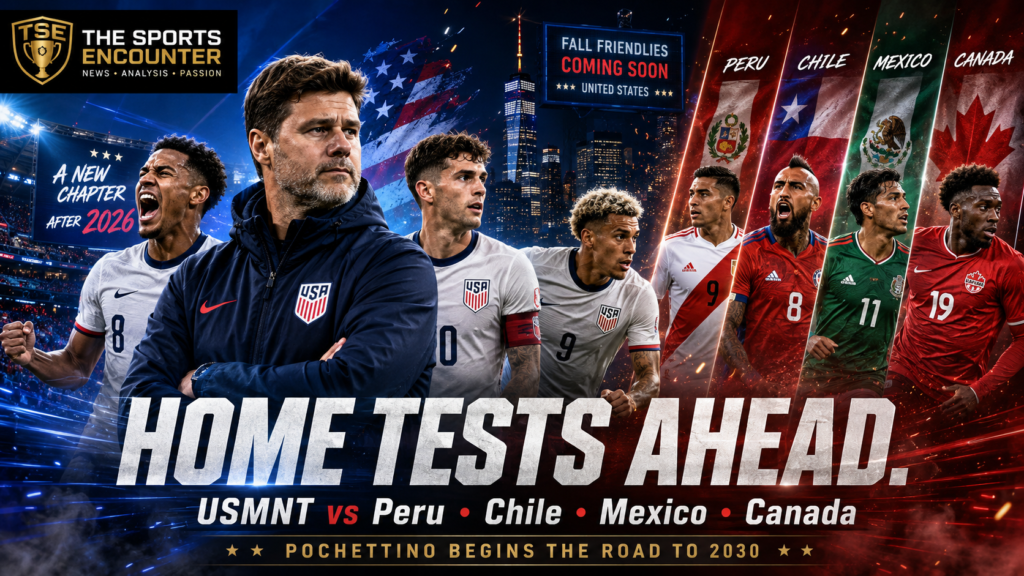
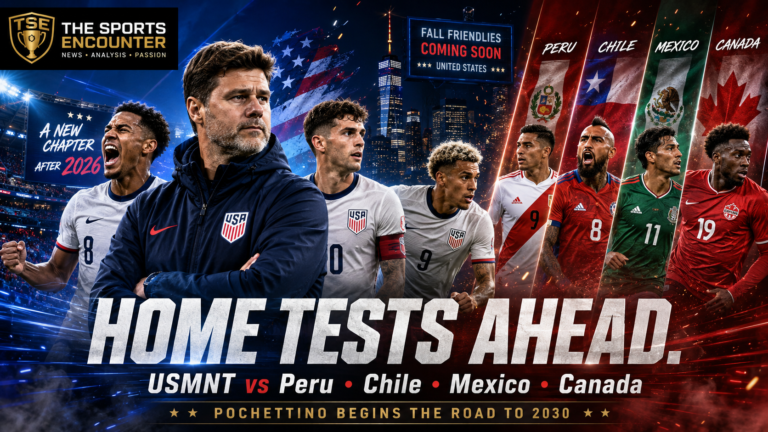
The United States men’s national team will return to action this fall with four home friendlies against Peru, Chile, Mexico, and Canada, giving Mauricio Pochettino an immediate opportunity to reshape the squad after its painful FIFA World Cup 2026 exit.

The Americans will face Peru in Orlando on September 26 before meeting Chile in St. Louis three days later. The schedule then shifts toward two familiar Concacaf rivalries, with Mexico awaiting in Glendale, Arizona, on October 3 and Canada completing the four-match window in St. Paul, Minnesota, on October 6.

These games will be the USMNT’s first since Belgium ended its home World Cup campaign with a decisive 4-1 victory in the Round of 16. They will also open Pochettino’s new contract cycle after U.S. Soccer extended the Argentine coach’s tenure through the 2030 World Cup.

The opponents have been chosen with purpose. Peru and Chile offer contrasting South American challenges. Mexico remains the match that carries the greatest emotional pressure for American players and supporters. Canada has grown into a direct regional competitor capable of questioning the United States’ position in North American soccer.

Four matches across 11 days will leave limited training time, which means Pochettino must arrive with a clear plan. The window offers a chance to reward the players who strengthened their reputations during the World Cup, test younger options and begin addressing the weaknesses Belgium exposed in Seattle.

The next World Cup remains four years away. The evaluation process starts now.

USMNT Fall 2026 Friendly Schedule

Date Match Venue City Kickoff
September 26, 2026 United States vs Peru Inter&Co Stadium Orlando, Florida 4:30 p.m. ET
September 29, 2026 United States vs Chile Energizer Park St. Louis, Missouri 8 p.m. ET
October 3, 2026 United States vs Mexico State Farm Stadium Glendale, Arizona 10 p.m. ET
October 6, 2026 United States vs Canada Allianz Field St. Paul, Minnesota 8 p.m. ET

Supporters can follow ticket information, broadcasting updates, squad announcements and official match coverage through the official U.S. Soccer announcement.

A New Cycle Begins With an Unfinished World Cup Story

The phrase “new cycle” can make international soccer sound cleaner than it really is.

The USMNT is moving toward 2030, but it has not escaped the questions left behind by 2026. Pochettino’s team produced encouraging moments during the tournament, finished first in its group and earned six points, the highest group-stage total in the program’s World Cup history.

The Americans then defeated Bosnia and Herzegovina 2-0 in the Round of 32 despite playing the final portion of the match with 10 men. Folarin Balogun opened the scoring before being sent off, while Malik Tillman’s late free kick secured progression.

That result appeared to show a team learning how to manage knockout pressure. The Sports Encounter’s report on the USA’s victory over Bosnia highlighted the discipline and defensive maturity the Americans showed after losing a player.

Belgium provided a harsher assessment four days later.

The United States conceded early, briefly equalized through Tillman and then lost control as Charles De Ketelaere, Hans Vanaken and Romelu Lukaku punished defensive mistakes. The 4-1 defeat to Belgium exposed a familiar gap between competing confidently and controlling a major knockout match.

Pochettino now has the security of a contract through 2030, but the extension also raises the standard by which his work will be judged. U.S. Soccer has chosen continuity. The next task is proving that continuity can produce evolution.

Why These Four Opponents Make Sense

The sequence gives the United States four different types of examination.

Peru can test the Americans’ patience against a South American opponent likely to protect central spaces and demand careful possession. Chile traditionally brings technical confidence, pressure around the ball and a willingness to compete aggressively in midfield.

Mexico changes the emotional environment. Tactical details remain important, but form can become secondary when the United States and Mexico meet. Every duel, foul, mistake and refereeing decision carries additional meaning.

Canada presents another problem. Its pace, athleticism and transition threat make it capable of attacking the spaces the USMNT sometimes leaves when pushing numbers forward.

Pochettino said the objective was to play the strongest opponents available and give his group a variety of experiences. This schedule follows that principle.

The two South American games can help determine whether the Americans have improved when facing technically secure opponents outside their own confederation. The final two matches will show where the United States currently stands within Concacaf.

Peru Offers the First Test of the Rebuild

The Peru match will carry less emotional noise than the games against Mexico and Canada, which may make it the most useful starting point for Pochettino.

He can evaluate the structure of his team without every selection decision becoming a referendum on regional supremacy.

The United States should expect to control long stretches of possession in Orlando. That places responsibility on the midfield and fullbacks to create advantages without leaving the defense exposed.

Breaking down an organized opponent has not always come naturally to the USMNT. The team can look dangerous when space opens for Balogun, Christian Pulisic or its other runners. Matches requiring slower construction often become crowded and predictable.

Peru can therefore reveal whether Pochettino has developed better solutions against a compact defensive block.

Central combinations, movement between the lines and the quality of the final pass will matter more than the possession percentage. The Americans must learn to move opponents before trying to play through them.

The game could also give Pochettino room to introduce emerging players without placing them immediately into the emotional intensity of USA-Mexico.

Chile Can Challenge the USMNT’s Midfield Authority

The match against Chile arrives only three days later, making rotation unavoidable.

Pochettino will need to decide whether to treat the opening two games as separate lineups or maintain a core group while changing selected positions. That choice will offer an early clue about his objectives for the window.

Chile can make the United States uncomfortable through midfield pressure and technical exchanges. The Americans must show they can receive the ball under contact, escape pressure and avoid turning every difficult phase into a rushed vertical pass.

The match should offer particular value for Tillman, Weston McKennie, Tyler Adams and the other midfielders competing for long-term roles.

Tillman left the World Cup with a stronger reputation after scoring against Bosnia and Belgium. His ability to operate between midfield and attack gives the United States a different type of creativity.

The next step is consistency. Pochettino needs Tillman and the wider midfield group to influence complete matches rather than isolated moments.

Chile will also test the defensive transition. When the United States loses possession after committing players forward, the first reaction must be coordinated. Belgium showed how quickly a confident opponent can turn loose positioning into clear chances.

USA vs Mexico Remains the Match That Defines the Window

No American friendly against Mexico feels entirely friendly.

The October 3 meeting at State Farm Stadium will carry the biggest crowd, the heaviest attention and the most immediate consequences for how supporters judge the window.

Mexico also enters the post-World Cup period with its own unresolved emotions. El Tri reached the Round of 16 on home soil before its tournament ended, leaving another cycle of pressure around a national team expected to compete at a higher level.

The Sports Encounter followed Mexico’s World Cup progress closely, including its controlled 2-0 knockout victory over Ecuador. That performance showed Mexico’s ability to control tense matches through defensive discipline and timely finishing.

The rivalry will give Pochettino a clear measurement of mentality.

Mexico will press, compete for second balls and try to control the emotional rhythm. The United States cannot allow intensity to become disorder. Its best recent performances against Mexico have combined aggression with tactical patience.

Individual battles will draw attention, particularly in midfield and wide areas. Pulisic will remain central to the American attack, but Pochettino must continue reducing the team’s dependence on him to create every important moment.

Balogun’s movement, Tillman’s intelligence and the support provided by the fullbacks can prevent Mexico from loading its defensive attention toward one side.

The result will not decide the 2030 cycle. It will shape how the first week of that cycle feels.

Canada Is No Longer a Secondary Rival

The final game against Canada should not be treated as an exhibition after the Mexico match.

Canadian soccer has changed. The national team carries greater speed, confidence and international experience than it did a decade ago. Its leading players operate in major European leagues, while the wider program has grown more comfortable challenging the United States and Mexico directly.

Canada’s World Cup ended with a 3-0 Round of 16 defeat to Morocco, a result covered in The Sports Encounter’s report on how the Atlas Lions eliminated the Canadians.

The scoreline was painful, but Canada’s tournament also included a historic 6-0 group-stage victory powered by Jonathan David’s hat trick. That performance showed the damage the Canadians can cause when their transition game gains space, as detailed in our coverage of Canada’s record-breaking win.

Against the United States, Canada is likely to attack quickly rather than compete for sterile possession.

Pochettino’s side must manage the space behind its fullbacks and prevent turnovers from becoming open-field races. That challenge becomes harder in the fourth match of an 11-day window, when fatigue can affect defensive recovery and decision-making.

The final game may therefore reveal the squad’s depth more clearly than the first three.

Pochettino Has Earned More Time, but Expectations Are Rising

U.S. Soccer’s decision to extend Pochettino through 2030 reflects belief in the wider direction of the program.

He took charge in 2024 and gradually moved the team toward a more aggressive, high-pressing approach. The World Cup group stage provided evidence that the work was producing results.

Finishing ahead of Australia, Paraguay and Türkiye was meaningful. Six points established a new USMNT group-stage high, while the Bosnia victory delivered the program’s first knockout success of the tournament.

The Belgium defeat placed those gains in perspective.

Pochettino is no longer preparing a young host nation for a home World Cup. He is now responsible for taking a tested group toward the next level.

The 2030 project should include more than waiting for the existing core to mature. Squad competition must increase. Tactical flexibility must improve. New leaders must emerge before injuries or declining form force change.

Extending the coach early gives him authority to make difficult decisions without treating every friendly as a short-term survival test.

That freedom should lead to experimentation with purpose rather than experimentation for its own sake.

Which Players Should Form the Core?

The World Cup established several players as central to the next phase.

Christian Pulisic

Pulisic remains the most influential American attacker and the player opponents plan around first. His movement, directness and experience make him difficult to replace.

Pochettino must still find ways to protect him from carrying too much creative responsibility. The United States becomes easier to defend when every meaningful attack needs Pulisic to beat the first opponent.

Malik Tillman

Tillman’s World Cup performances changed his standing within the squad. Goals against Bosnia and Belgium showed his composure in major moments.

He can become the connector between midfield and attack, particularly when opponents compress the center. His development may be one of the most important stories of the new cycle.

Folarin Balogun

Balogun gives the attack depth and penalty-area presence. His goal against Bosnia showed the instinct Pochettino needs from a central striker.

The red card in that same match also underlined the need for greater control. He must become an emotional and tactical reference point rather than merely the most direct runner.

Tyler Adams and Weston McKennie

Both midfielders bring experience, competitiveness and familiarity with high-pressure Concacaf games.

The question is how the midfield evolves around them. The United States needs technical security as well as energy, especially against opponents capable of controlling possession.

Matt Freese and the Defensive Unit

The goalkeeper and back line left the World Cup with mixed evaluations. They contributed to important wins, but Belgium exposed positioning and decision-making problems.

Pochettino must use the fall window to test whether those errors were tournament-specific or evidence of a wider structural weakness.

New Faces Must Enter Before the Squad Becomes Comfortable

The danger after a respectable World Cup is that a national team mistakes familiarity for progress.

Pochettino should retain a strong core, but every position needs genuine competition.

Sebastian Berhalter is one player whose trajectory deserves attention. The midfielder appeared in all five U.S. World Cup matches before completing a move to Middlesbrough.

The Sports Encounter’s report on Berhalter’s four-year Middlesbrough contract examined how his World Cup role and MLS form earned him a European opportunity.

Players developing overseas should not receive automatic selection, but regular competition in demanding environments can strengthen the national team.

The fall games may also give Pochettino a chance to assess young MLS players and members of the youth national-team structure. The 2030 squad will not be built only from the names that appeared in 2026.

Four years provide time, but international windows disappear quickly. A coach may receive only a handful of meaningful gatherings each season.

Every camp must move the selection process forward.

Four Cities Get Their Post-World Cup Moment

Orlando, St. Louis, Glendale and St. Paul did not host matches during the 2026 World Cup.

U.S. Soccer’s schedule gives supporters in those markets a chance to reconnect with a national team that spent the summer performing in front of enormous home crowds.

The decision also spreads the post-tournament momentum beyond the World Cup host cities.

The tournament was staged across 16 cities in the United States, Canada and Mexico. Its scale, transportation demands and regional differences were central to The Sports Encounter’s guide to the 11 U.S. World Cup host cities.

The fall friendlies now offer a different kind of opportunity. They can bring national-team soccer into strong regional markets without the pricing, travel pressure and global demand associated with the World Cup.

Orlando’s match against Peru has been designated as a Fan Appreciation Match. St. Louis will host Chile in an Impact Match, while Glendale receives the marquee Mexico fixture.

Allianz Field in St. Paul should offer a strong setting for the Canada game, particularly if both teams use competitive lineups.

What the USMNT Must Improve Before 2030

The four friendlies should begin a broader process focused on several clear weaknesses.

Control After Scoring

The United States responded well in several World Cup matches, but Belgium showed how quickly momentum can disappear. After Tillman equalized, the Americans conceded again almost immediately.

Strong tournament teams understand when to accelerate and when to calm the match.

Defending Transitions

Pochettino wants an aggressive team, which naturally creates space. The issue is whether the midfield and back line are positioned to manage that risk when possession is lost.

Chance Creation Against Compact Teams

Peru may provide the first test. The United States must develop more varied methods of creating chances when opponents refuse to leave space behind the defense.

Depth Beyond the Starting XI

Four games in 11 days will expose the quality of the wider squad. Pochettino needs substitutes who can change matches rather than simply preserve the original plan.

Emotional Control in Rivalry Games

Mexico and Canada will challenge the Americans physically and psychologically. Discipline must remain part of the team’s identity.

The Bigger North American Picture

The 2026 World Cup was expected to change soccer’s standing across the United States, Canada and Mexico.

The tournament’s commercial impact became visible even before it ended. When all three host nations were eliminated, ticket demand and resale prices around later matches changed sharply.

The Sports Encounter explored that effect in its analysis of why World Cup ticket prices fell after the host nations exited.

Now the three countries begin the quieter work of turning tournament attention into long-term national-team growth.

For the United States, that means maintaining fan interest after the spectacle has moved on. Mexico must rebuild confidence after another World Cup that ended earlier than supporters expected. Canada must prove that its progress can survive beyond one home tournament.

The October matches will bring those three programs back into direct comparison.

What Would Make This Window Successful?

Four wins would look impressive, but results alone should not define the window.

A successful series would provide evidence that Pochettino has identified the right core while opening space for new players. The Americans should show improved control in possession, cleaner defensive transitions and enough attacking variety to avoid becoming dependent on Pulisic.

The Mexico game will naturally attract the most attention. The Canada match may be equally important from a development perspective because it arrives at the end of a demanding schedule.

Pochettino should also leave the window with clearer answers about goalkeeper, center-back depth, midfield balance and the hierarchy among his forwards.

The team does not need to look ready for 2030 in October 2026.

It should look like it has started moving toward it.

The Sports Encounter View

The USMNT’s fall schedule offers the right balance for the first step after a complicated home World Cup.

Peru and Chile will test different parts of the Americans’ possession game. Mexico will bring the rivalry pressure that no training session can recreate. Canada will challenge the squad’s depth, transition defense and regional authority.

Pochettino has been given four more years because U.S. Soccer believes the progress shown in 2026 can become something larger.

That belief is reasonable. The United States won its group, earned a record six points and survived a tense knockout match against Bosnia.

The Belgium loss remains the more useful reference.

A team hoping to become a global contender cannot accept that its World Cup ceiling ends whenever it meets an opponent with greater tactical calm and knockout experience.

The next phase should build on the energy of the home tournament without becoming trapped by it. Some World Cup players will become long-term leaders. Others will be replaced as Pochettino searches for a stronger squad.

Peru, Chile, Mexico and Canada will not decide the success of the 2030 project.

They will reveal how seriously that project has begun.

Follow The Sports Encounter’s soccer coverage for USMNT updates, international match reports, tactical analysis and the major stories shaping the next World Cup cycle.

USMNT Fall Friendlies FAQs

Who will the USMNT play in September and October 2026?

The United States will face Peru, Chile, Mexico and Canada in four home friendlies.

When is USA vs Peru?

The match will be played on September 26, 2026, at Inter&Co Stadium in Orlando, with kickoff scheduled for 4:30 p.m. ET.

When is USA vs Chile?

The United States will host Chile on September 29 at Energizer Park in St. Louis. Kickoff is scheduled for 8 p.m. ET.

When is the next USA vs Mexico match?

The Concacaf rivals will meet on October 3 at State Farm Stadium in Glendale, Arizona. Kickoff is scheduled for 10 p.m. ET.

When will the USMNT play Canada?

The United States will host Canada on October 6 at Allianz Field in St. Paul, Minnesota, at 8 p.m. ET.

Will Mauricio Pochettino remain USMNT coach?

Yes. Pochettino has agreed to a new contract that will keep him in charge through the 2030 World Cup.

How did the United States perform at the 2026 World Cup?

The Americans finished first in their group with a national-record six points, defeated Bosnia and Herzegovina in the Round of 32 and lost 4-1 to Belgium in the Round of 16.

Where can fans watch the USMNT friendlies?

U.S. Soccer has confirmed television and streaming coverage across TNT, truTV, HBO Max, Telemundo, Universo and Peacock, although the exact combination varies by match.

Sports Writer, North America. Ruben Santos covers North American sports for The Sports Encounter, including the NBA, NHL, MLS, MLB, and major international events across the United States, Canada, and Mexico. His work focuses on game stories, league developments, fan experience, tournament logistics, American sports culture, and the major storylines shaping the region. Coverage areas: NBA, NHL, MLS, MLB, North American sports, FIFA World Cup 2026, league analysis.

Breaking News

Harper and Asalanka Punish Colombo’s Chaos as Galle Reach LPL Final

Sam Harper’s commanding 77 and Charith Asalanka’s composed 59 carried Galle Gallants past Colombo Kaps and into the LPL 2026 final against Jaffna Kings.

Published

on

Galle Gallants, Colombo Kaps, Lanka Premier League 2026, Sam Harper, Charith Asalanka

Colombo Kaps scored quickly enough to threaten Galle Gallants, but they never batted long enough to control the match.

That difference decided Qualifier 2.

Colombo lost five wickets inside seven overs, recovered through Rubin Hermann and Ravindu Fernando, and then surrendered its remaining batting resources before completing 20 overs. Galle responded with a far calmer chase, riding Sam Harper’s masterful 77 and Charith Asalanka’s 59 to reach 177 for four in 18.4 overs.

The six-wicket victory at the R. Premadasa Stadium sends Galle into Saturday’s Lanka Premier League 2026 final against Jaffna Kings. Colombo’s promising playoff run ends one victory short of the title match.

TL;DR

  • Galle Gallants chased 177 in 18.4 overs to win Qualifier 2 by six wickets.
  • Sam Harper led the chase with 77 from 51 balls, including four fours and four sixes.
  • Charith Asalanka scored 59 from 42 and shared a match-defining 126-run partnership with Harper.
  • Colombo recovered from 52 for five to reach 176, but was bowled out in 18.5 overs.
  • Dasun Shanaka’s constant bowling changes prevented Colombo from controlling the innings.
  • Galle will face Jaffna Kings in the LPL 2026 final on August 8.

Galle Gallants vs Colombo Kaps Scorecard

DetailInformation
CompetitionLanka Premier League 2026, Qualifier 2
VenueR. Premadasa Stadium, Colombo
DateAugust 7, 2026
TossColombo Kaps elected to bat
Colombo Kaps176 all out in 18.5 overs
Galle Gallants177/4 in 18.4 overs
ResultGalle Gallants won by six wickets
Top Galle batterSam Harper, 77 from 51 balls
Galle supportCharith Asalanka, 59 from 42 balls
Top Colombo battersRavindu Fernando 48; Rubin Hermann 45
Best Galle bowlingSachindu Colombage 2/34; Charith Asalanka 2/34
Turning pointHarper and Asalanka added 126 after Galle slipped to 21/1
What comes nextGalle face Jaffna Kings in the August 8 final

Colombo’s Run Rate Hid a Deeper Batting Failure

A total of 176 from 18.5 overs suggests aggression. The scorecard tells a harsher story.

Colombo fell to 20 for three before the third over had ended. Sadeera Samarawickrama made five, Thanuka Dabare scored 11, and captain Kamindu Mendis managed one. Janith Liyanage briefly counterattacked with 23 from nine balls, but his dismissal left the Kaps at 47 for four.

James Neesham then fell for one, reducing Colombo to 52 for five in 6.1 overs.

The Kaps kept swinging when the situation called for one decisive partnership. That approach produced boundaries, but it repeatedly exposed new batters before they had understood the surface or match situation.

Hermann supplied some resistance with 45 from 33 balls. Ravindu Fernando changed the innings’ pace with five sixes in a 27-ball 48, while Malsha Tharupathi contributed a valuable 28 from 17. Their hitting dragged Colombo toward a defendable total, yet the team lost its seventh wicket at 158 in the 17th over and was dismissed with seven balls unused.

Those missing deliveries mattered. Even at a modest late-innings rate, Colombo could have added another 10 to 15 runs. Against a Galle batting lineup that eventually needed eight runs from the final eight balls, that extra cushion could have changed the pressure entirely.

Colombo had shown much better knockout control while eliminating Kandy, as detailed in The Sports Encounter’s report on McDermott, Neesham and Wanuja Sahan ending the Royals’ campaign. Qualifier 2 exposed the opposite version of their batting.

Shanaka Kept Searching Until Galle Found Control

Dasun Shanaka’s captaincy deserves as much credit as the wickets.

Colombo’s batters attacked nearly every bowling matchup, which could easily have forced a captain into defensive thinking. Shanaka continued rotating his options instead. Six bowlers entered the attack, preventing any Colombo batter from settling against one repeated pace or angle.

Charith Asalanka conceded 34 from three overs but removed Dabare and Kamindu. Mohammad Nawaz delivered the evening’s most economical spell, taking one for 12 from two overs. Akif Javed and Tharindu Ratnayake collected one wicket each, while Sachindu Colombage returned two for 34.

The changes did not stop every boundary. They kept producing questions, and Colombo’s reckless shot selection eventually supplied the answers.

Galle had already beaten the Kaps twice during the league stage, including a 13-run victory that secured a top-two finish. Shanaka again showed why his team has handled changing match situations better across the tournament.

Harper and Asalanka Remove the Panic From the Chase

Galle lost Thomas Rogers for 13 at 21 for one, giving Colombo the early opening it needed. Harper and Asalanka closed it with patience, strike rotation and controlled aggression.

Their 126-run partnership lasted 84 balls. Harper struck four fours and four sixes during his 77 from 51, while Asalanka contributed three fours and four sixes in a 42-ball 59.

Both batters understood that the required rate demanded intent without desperation. They targeted weaker deliveries, kept the scoreboard moving between boundaries and denied Colombo the clusters of wickets that had damaged the first innings.

Harper has repeatedly shaped Galle’s successful chases. His earlier 65 against the same opponent helped produce another victory, covered in The Sports Encounter’s report on Galle’s five-wicket win over Colombo.

Asalanka again provided the calm middle-overs influence that defined his 65 in Galle’s opening victory over Jaffna.

Colombo dismissed Asalanka, Harper and Chamika Karunaratne late, but the damage had already been done. Shanaka completed the chase with a six, finishing unbeaten on eight from three balls.

The Final Brings Galle Back to Jaffna

Galle’s reward is an immediate rematch with Jaffna Kings, who defeated them by 14 runs in Qualifier 1 after Kamil Mishara’s unbeaten century.

Jaffna will enter the final rested and confident after posting 242 for two in that meeting. Galle arrives with momentum, a proven chasing structure and fresh evidence that Harper and Asalanka can manage knockout pressure.

The official Lanka Premier League schedule confirms that the final will take place at the R. Premadasa Stadium on August 8. Readers can follow the buildup through The Sports Encounter’s Lanka Premier League coverage hub and wider cricket reporting and analysis.

Colombo leaves with clear evidence of its attacking ability, but also with the question that ended its season: why keep swinging when the match was asking someone to stay?

Galle found the balance Colombo could not. One more victory will make them champions.

Continue Reading

Breaking News

Ilhan Fandi Delivers the Point That Sends Singapore Through

Ilhan Fandi rescued Singapore with a decisive second-half equalizer against Indonesia, earning the Lions the point they needed to reach the ASEAN Championship semifinals.

Published

on

Ilhan Fandi Delivers the Point That Sends Singapore Through

Singapore spent 19 tense second-half minutes watching its place in the ASEAN Championship semifinals slip toward Indonesia. Then Ilhan Fandi reacted first to one moment of defensive confusion and changed the direction of two campaigns.

His 66th-minute equalizer earned Singapore a 1-1 draw at Jalan Besar Stadium on Friday, August 7, giving the Lions the point they needed to finish second in Group A. Indonesia, which had to win, finished one point behind Singapore and exited the tournament despite leading through Ragnar Oratmangoen.

For Singapore, the final whistle brought relief, celebration and another place in the last four. For Indonesia, it confirmed a painful elimination after a group campaign that began with two convincing victories.

TL;DR

  • Singapore drew 1-1 with Indonesia and qualified for the semifinals.
  • Ragnar Oratmangoen put Indonesia ahead in the 47th minute.
  • Ilhan Fandi equalized in the 66th minute after confusion inside Indonesia’s penalty area.
  • Jacob Mahler earned the official Hyundai Player of the Match award.
  • Song Ui-young briefly received a second yellow card, but the referee overturned it after an on-field review.
  • Vietnam won Group A with 10 points, followed by Singapore with eight and Indonesia with seven.

Singapore vs Indonesia Match Information

DetailInformation
MatchSingapore vs Indonesia
CompetitionASEAN Hyundai Cup 2026, Group A
Final scoreSingapore 1-1 Indonesia
GoalscorersRagnar Oratmangoen 47’; Ilhan Fandi 66’
VenueJalan Besar Stadium, Singapore
DateFriday, August 7, 2026
Top performerJacob Mahler, Hyundai Player of the Match
Turning pointIlhan punished confusion between Rizky Ridho and Cahya Supriadi
CardsSeven confirmed yellow cards; Song Ui-young’s second yellow was overturned
Group impactSingapore qualified in second place; Indonesia was eliminated
Next matchSingapore hosts the Group B winner on August 15

Indonesia Struck First but Could Not Find Control

Indonesia approached the match with no room for calculation. John Herdman’s side needed all three points, while Singapore could advance with a draw.

That urgency nearly produced a goal after only two minutes. Mitch Baker found space with goalkeeper Izwan Mahbud exposed, but Shah Shahiran recovered with a perfectly timed sliding block. The intervention set the tone for a Singapore performance built on defensive concentration and collective recovery.

Indonesia carried the greater attacking obligation, yet Singapore gradually slowed the contest in midfield. Jacob Mahler helped protect the central areas, while Shah and Hariss Syahin limited the clean passing lanes Indonesia needed to dictate the tempo.

The hosts also created chances. Song Ui-young forced Cahya Supriadi into a save after meeting Lionel Tan’s low cross, while Ilhan tested the goalkeeper with an improvised effort. At the opposite end, Izwan stretched to keep out Baker’s header.

The score remained level until two minutes after halftime. Thom Haye delayed his pass just long enough to release Dony Pamungkas on the left. Dony cut the ball back, and Oratmangoen scored at the second attempt.

Indonesia had earned the lead it needed. The challenge was keeping it.

A Reversed Decision Kept Singapore Alive

The match appeared to turn decisively against Singapore in the 58th minute when Song received what initially looked like his second yellow card for a challenge on Ivar Jenner.

Referee Mohammed Khalfan Salim Al Mani reviewed the incident at the pitch-side monitor and rescinded the booking. The decision meant Singapore remained at full strength rather than facing the closing half-hour with 10 men.

Eight minutes later, the Lions equalized.

A lofted delivery created hesitation between defender Rizky Ridho and goalkeeper Cahya. Neither completed the clearance, allowing Ilhan to reach the loose ball and guide a first-time finish into an empty net.

It was a poacher’s goal shaped by anticipation rather than elaborate buildup. Ilhan understood the danger before Indonesia’s defenders resolved it. His third important goal of the tournament completed a group stage in which he repeatedly supplied Singapore’s decisive attacking moments.

Readers who followed his earlier contributions will recognize the pattern. Ilhan also delivered the dramatic winner in the tournament opener before scoring against Timor-Leste, a performance covered in The Sports Encounter’s report on Singapore’s controlled victory over Timor-Leste.

Mahler Gave Singapore Its Defensive Foundation

Ilhan scored the qualification goal, but Mahler earned the official Player of the Match award for holding Singapore together under pressure.

His positioning helped close central spaces, and his willingness to contest second balls prevented Indonesia from building sustained attacks after taking the lead. Indonesia pushed forward late, with Rizky Pratama hitting the side netting, but Singapore protected the penalty area and avoided the decisive mistake.

The defensive resilience echoed the disciplined performance that earned the Lions a goalless draw against Vietnam in Hanoi. Across those two defining matches, Singapore conceded only once and collected the two points that separated it from Indonesia.

More regional tournament reporting is available through The Sports Encounter’s soccer coverage and its ASEAN Championship 2026 coverage.

Indonesia’s Strong Start Ended in Frustration

Indonesia leaves the tournament with seven points and a positive goal difference, but its inability to recover from the 3-0 defeat against Vietnam proved costly.

Herdman’s team had looked dangerous earlier in the campaign. Baker scored a hat trick in the 5-1 victory over Cambodia, and Indonesia later defeated Timor-Leste 3-0. Those results created momentum but could not guarantee qualification.

Against Singapore, Indonesia produced several threatening moments and deserved its lead. The team’s problems arrived after Oratmangoen scored. Rather than controlling possession and forcing Singapore to chase recklessly, Indonesia allowed the hosts to remain within one incident of qualification.

That incident came in the 66th minute.

Yellow and Red Cards

MinutePlayerTeamCard
43’Song Ui-youngSingaporeYellow
58’Ivar JennerIndonesiaYellow
76’Mitch BakerIndonesiaYellow
77’Lionel TanSingaporeYellow
82’Marc KlokIndonesiaYellow
86’Timo GeypensIndonesiaYellow
90+7’Jacob MahlerSingaporeYellow

No player finished the match with a red card. Song’s second caution was canceled following the referee’s monitor review.

Final Group A Points Table

Pos.TeamPWDLGFGAGDPts
1Vietnam4310131+1210
2Singapore422052+38
3Indonesia421195+47
4Cambodia4103610-43
5Timor-Leste4004015-150

Vietnam’s 3-1 win over Cambodia secured first place. Singapore qualified as the runner-up, while Indonesia, Cambodia and Timor-Leste were eliminated.

What Comes Next for Singapore?

Singapore will host the Group B winner in the first leg of its semifinal on August 15. The Lions remain two stages away from a fifth regional title, but their group campaign has shown why they can trouble stronger opponents.

They can defend compactly, absorb pressure and find decisive contributions from Ilhan. Mahler’s influence gives the midfield stability, while Izwan’s experience provides security behind the defensive line.

Singapore did not require a victory on Friday. It needed composure when the match turned against it. The Lions found enough, and Ilhan found the goal that carried them into the semifinals.

Continue Reading

Breaking News

Nguyễn Đình Bắc Answers Cambodia’s Challenge as Vietnam Win Group A

Nguyễn Đình Bắc scored twice as Vietnam survived Cambodia’s second-half fightback, won 3-1 in Hanoi and secured first place in ASEAN Championship Group A.

Published

on

Nguyễn Đình Bắc Answers Cambodia’s Challenge as Vietnam Win Group A

Cambodia’s equalizer forced Mỹ Đình National Stadium to confront an uncomfortable possibility. Vietnam had controlled the ball, created the better chances and led for most of the evening, yet one sharp Cambodian attack had suddenly placed top spot in Group A back in jeopardy.

The defending champions responded with the composure expected from a team planning another deep tournament run.

Vakhim Im’s 84th-minute own goal restored Vietnam’s advantage before Nguyễn Đình Bắc completed his two-goal performance five minutes later, sealing a 3-1 victory in Hanoi on Friday, August 7.

Vietnam finished the group stage unbeaten with 10 points and advanced to the ASEAN Hyundai Cup 2026 semifinals as Group A winners. Cambodia ended its campaign in fourth place with three points, but Iago Bento Fernandes’ equalizer and the resistance surrounding it made Vietnam work far harder than the final score suggests.

Fans can follow The Sports Encounter’s continuing regional coverage through our soccer news and analysis hub.

TL;DR

  • Vietnam defeated Cambodia 3-1 at Mỹ Đình National Stadium.
  • Nguyễn Đình Bắc scored in the 18th and 89th minutes.
  • Substitute Iago Bento Fernandes equalized for Cambodia in the 71st minute.
  • Vakhim Im’s 84th-minute own goal became the decisive turning point.
  • Vietnam won Group A with 10 points and qualified for the semifinals.
  • Cambodia received one yellow card. Vietnam received none, and no red cards were shown.

Vietnam vs Cambodia Match Information

DetailInformation
MatchVietnam vs Cambodia
CompetitionASEAN Hyundai Cup 2026, Group A
ResultVietnam 3-1 Cambodia
VenueMỹ Đình National Stadium, Hanoi
DateFriday, August 7, 2026
Vietnam goalsNguyễn Đình Bắc 18’, 89’; Vakhim Im own goal 84’
Cambodia goalIago Bento Fernandes 71’
Top performerNguyễn Đình Bắc, two goals and four shots on target
Turning pointVakhim Im’s own goal restored Vietnam’s lead in the 84th minute
Yellow cardsVietnam 0; Cambodia 1
Red cardsNone
Group impactVietnam won Group A; Cambodia were eliminated

Dình Bắc Gives Vietnam Early Control

Vietnam entered the match knowing a draw would secure qualification, but coach Kim Sang-sik had made his intention clear beforehand. He wanted victory and first place after the frustration of the team’s earlier goalless draw with Singapore.

Dình Bắc delivered the opening goal after 18 minutes. The forward received possession inside the penalty area and produced a forceful finish past Koy Salim, giving Vietnam the reward their territorial control deserved.

The hosts held 75.2 percent possession and attempted 16 shots compared with Cambodia’s six. Their passing repeatedly moved Cambodia’s compact 4-4-2 shape from side to side, while Nguyễn Quang Hải and Nguyễn Hoàng Đức helped control the central spaces.

Dình Bắc remained the most direct threat. All four of his attempts tested the goalkeeper, extending a tournament that began with his hat trick in Vietnam’s 7-0 opening victory over Timor-Leste.

Yet Vietnam failed to turn its control into a second goal before halftime. Salim made timely saves, while Cambodia protected the central route toward goal better than it had during the 5-1 defeat against Indonesia.

Cambodia’s Halftime Change Creates a Real Contest

Cambodia coach Koji Gyotoku introduced Iago Bento Fernandes for Hav Soknet at halftime, sacrificing the scorer of two goals in the 3-0 win over Timor-Leste for a quicker, more mobile attacking option.

The change paid off in the 71st minute.

Iago found the space Cambodia had spent most of the match trying to create and beat Patrik Lê Giang to make it 1-1. Vietnam had conceded for the first time in the tournament, and Cambodia suddenly had a result capable of disrupting the top of Group A.

The equalizer exposed the only serious concern in Vietnam’s performance. Heavy possession can create comfort, and comfort can reduce defensive alertness. Cambodia completed far fewer passes and produced only three shots on target, but one well-timed attack was enough to change the emotional temperature inside Mỹ Đình.

For 13 minutes, Cambodia had belief.

Two Late Goals Separate the Group Winner From the Eliminated Side

Vietnam’s winning goal arrived cruelly for the visitors. With six minutes remaining, pressure around Cambodia’s penalty area ended with Vakhim Im turning the ball into his own net.

The own goal reflected the strain Vietnam had built across the match. Cambodia spent long periods defending close to its goal, making 12 fouls and repeatedly clearing attacks before the hosts could find a clean final shot.

Dình Bắc then removed any remaining uncertainty in the 89th minute. His second goal completed Vietnam’s recovery and moved him further into the tournament’s individual scoring conversation.

The forward’s development has given Kim another reliable match-winner alongside Nguyễn Xuân Son, Đỗ Hoàng Hên and Quang Hải. Vietnam’s depth had already driven its 3-0 victory over Indonesia. Against Cambodia, Dình Bắc supplied both the early finish and the late assurance.

Updated ASEAN Championship Group A Table

Singapore’s draw with Indonesia completed the final Group A standings.

Pos.TeamPWDLGFGAGDPts
1Vietnam4310131+1210
2Singapore422052+38
3Indonesia421195+47
4Cambodia4103610-43
5Timor-Leste4004015-150

Vietnam and Singapore advance to the two-legged semifinals. Indonesia miss out despite collecting seven points, while Cambodia and Timor-Leste leave the competition.

The final standings confirm the possibilities outlined in The Sports Encounter’s final group-stage qualification preview. Vietnam will face the Group B runner-up, whose identity will be decided after the remaining matches.

Official tournament schedules and semifinal updates are available through the ASEAN United FC competition portal.

What Vietnam and Cambodia Take From the Group Stage

Vietnam reached the semifinals through three different types of performance. It overwhelmed Timor-Leste, endured Singapore’s defensive resistance and clinically punished Indonesia before surviving Cambodia’s late challenge.

That range matters in knockout football. Kim’s team has scored 13 goals, conceded only once and shown it can win through sustained possession, pressing and rapid transitions.

Cambodia leave with fewer rewards, but their campaign contained useful signs. Soknet’s two goals against Timor-Leste, Iago’s impact in Hanoi and the team’s willingness to keep attacking stronger opponents offer a base for future development.

Vietnam move forward as Group A’s strongest team. Cambodia head home after proving, for a tense second-half spell in Hanoi, that they could still make the defending champions feel the pressure.https://chatgpt.com/backend-api/sentinel/frame.html?sv=20260423af3c

Continue Reading

FIFA World Cup 2026 Hub

Cinematic FIFA governance graphic showing a somber football executive at a FIFA Congress podium, a glowing FA letter stamped “Support Withdrawn,” the headline “FA Turns Against Infantino,” international flags, a connected globe, and The Sports Encounter logo. Cinematic FIFA governance graphic showing a somber football executive at a FIFA Congress podium, a glowing FA letter stamped “Support Withdrawn,” the headline “FA Turns Against Infantino,” international flags, a connected globe, and The Sports Encounter logo.
Breaking News1 day ago

English FA Turns Its Back on Gianni Infantino, Withdraws Support for Re-Election

The English FA has formally withdrawn its support for Gianni Infantino’s bid for another term as FIFA president, adding major...

A suited FIFA official bows at a crisis meeting beneath a fractured world football graphic, surrounded by delegates, torn $4.2 billion deal papers and the headline “World Cup Not for Sale.” A suited FIFA official bows at a crisis meeting beneath a fractured world football graphic, surrounded by delegates, torn $4.2 billion deal papers and the headline “World Cup Not for Sale.”
Editor's Choice2 days ago

FIFA President Apologizes to Member Nations After FIFA World Cup Selloff Plan Fails to Inspire

FIFA has apologized to its member associations after abandoning a controversial plan to sell a 20% stake in a new...

Gianni Infantino stands under pressure as FIFA officials hold crisis talks in Morocco following the rejected World Cup commercial stake sale proposal. Gianni Infantino stands under pressure as FIFA officials hold crisis talks in Morocco following the rejected World Cup commercial stake sale proposal.
Breaking News2 days ago

Infantino in Survival Mode After World Cup Stake Sale Idea Results in Global Revolt

Gianni Infantino’s abandoned World Cup commercial rights proposal has triggered an internal FIFA revolt, lost European support, and drawn a...

Gianni Infantino stands isolated at a FIFA podium as Arsène Wenger, Mattias Grafstrom, Prince Ali and divided football officials surround him, with fractured blue-and-red VFX imagery, The Sports Encounter logo, and the headline “Allies Break Ranks.” Gianni Infantino stands isolated at a FIFA podium as Arsène Wenger, Mattias Grafstrom, Prince Ali and divided football officials surround him, with fractured blue-and-red VFX imagery, The Sports Encounter logo, and the headline “Allies Break Ranks.”
Editor's Choice3 days ago

Crisis Plagues FIFA as Wenger, Grafstrom and Federations Break Ranks

Gianni Infantino’s grip on FIFA is under growing pressure after senior officials, European federations and former allies distanced themselves from...

Gianni Infantino stands between representatives of smaller football nations and the rejected UEFA and CONCACAF blocs, with a glowing world map, voting imagery, and the headline “Small Nations, Big Power” beneath The Sports Encounter logo. Gianni Infantino stands between representatives of smaller football nations and the rejected UEFA and CONCACAF blocs, with a glowing world map, voting imagery, and the headline “Small Nations, Big Power” beneath The Sports Encounter logo.
Editor's Choice4 days ago

Infantino Looks to Smaller Nations After UEFA, CONCACAF Snub

Gianni Infantino’s FIFA future may depend on smaller and emerging nations after UEFA and CONCACAF lost confidence in his leadership....

Gianni Infantino appears under a fractured World Cup trophy as UEFA, AFC, and other football stakeholders reject FIFA’s failed private investment stake plan. Gianni Infantino appears under a fractured World Cup trophy as UEFA, AFC, and other football stakeholders reject FIFA’s failed private investment stake plan.
Editor's Choice5 days ago

FIFA’s World Cup Stake Plan Failed in Three Days. The Damage to Gianni Infantino May Last Much Longer

FIFA’s attempt to sell a 20% stake in a new World Cup commercial entity collapsed within days after a global...

Cinematic tribute to Cristiano Ronaldo’s World Cup career, showing his rise, record-breaking goals and six-tournament journey on one side, and his emotional final farewell with Portugal on the other, under the headline “Goals. Records. Farewell.” with The Sports Encounter logo. Cinematic tribute to Cristiano Ronaldo’s World Cup career, showing his rise, record-breaking goals and six-tournament journey on one side, and his emotional final farewell with Portugal on the other, under the headline “Goals. Records. Farewell.” with The Sports Encounter logo.
Editor's Choice5 days ago

Cristiano Ronaldo’s World Cup Career: Goals, Records and Final Farewell

Cristiano Ronaldo became the first man to score in six FIFA World Cups, but football’s greatest tournament never gave him...

Cinematic VFX featured image showing fictionalized World Cup legend silhouettes walking toward a glowing stadium tunnel, with farewell confetti, The Sports Encounter logo, and the headline “The Last Dance: World Cup Legends Say Goodbye.” Cinematic VFX featured image showing fictionalized World Cup legend silhouettes walking toward a glowing stadium tunnel, with farewell confetti, The Sports Encounter logo, and the headline “The Last Dance: World Cup Legends Say Goodbye.”
Editor's Choice6 days ago

The Golden Generation Saying Goodbye After the FIFA World Cup 2026

The 2026 World Cup did more than crown a champion. It marked the emotional farewell of a generation that shaped...

Cinematic tribute to Neymar Jr.’s World Cup journey, showing his Brazilian flair and rainbow-flick skill on one side and his pain, injuries and emotional heartbreak on the other, with the headline “Skill. Pain. Legacy.” and The Sports Encounter logo. Cinematic tribute to Neymar Jr.’s World Cup journey, showing his Brazilian flair and rainbow-flick skill on one side and his pain, injuries and emotional heartbreak on the other, with the headline “Skill. Pain. Legacy.” and The Sports Encounter logo.
Editor's Choice7 days ago

Neymar’s World Cup Career: Skill, Pain, and the Rainbow Flick Legacy

Neymar carried Brazil’s World Cup hopes across four tournaments, producing unforgettable goals while enduring injuries, criticism and elimination heartbreak. His...

Cinematic FIFA World Cup 2030 graphic showing the golden trophy at the center of a global football revolt, with protesting delegates, distressed executives, collapsing financial charts, torn investment documents, and the headline “World Cup 2030: Not for Sale?” alongside The Sports Encounter logo. Cinematic FIFA World Cup 2030 graphic showing the golden trophy at the center of a global football revolt, with protesting delegates, distressed executives, collapsing financial charts, torn investment documents, and the headline “World Cup 2030: Not for Sale?” alongside The Sports Encounter logo.
Editor's Choice7 days ago

Is the FIFA World Cup 2030 Not for Sale Anymore?

FIFA’s proposal to sell a minority stake in a $20 billion World Cup commercial company appears to have collapsed after...

A cinematic World Cup 2030 graphic compares a 48-team format with a proposed 64-team expansion, surrounded by national teams, global flags, the trophy, and contrasting calls to grow or protect the tournament. A cinematic World Cup 2030 graphic compares a 48-team format with a proposed 64-team expansion, surrounded by national teams, global flags, the trophy, and contrasting calls to grow or protect the tournament.
Editor's Choice1 week ago

FIFA Explores 64-Nation World Cup for 2030: Is Another Expansion Worth It?

FIFA is examining whether the 2030 World Cup should expand from 48 to 64 teams. The proposal could increase global...

Gianni Infantino faces mounting internal opposition at FIFA as Carlos Cordeiro resigns and Kevin Lamour publicly challenges the proposed World Cup stake sale. Gianni Infantino faces mounting internal opposition at FIFA as Carlos Cordeiro resigns and Kevin Lamour publicly challenges the proposed World Cup stake sale.
Editor's Choice1 week ago

FIFA Revolt Moves Inside Infantino’s Office as Cordeiro Quits and Kevin Lamour Condemns World Cup Selloff

FIFA’s World Cup stake crisis has moved inside the organization. Carlos Cordeiro has resigned in protest, while chief operating officer...

Gianni Infantino faces mounting opposition to FIFA’s proposed World Cup stake sale as UEFA officials threaten a boycott and private investors circle the tournament’s commercial future. Gianni Infantino faces mounting opposition to FIFA’s proposed World Cup stake sale as UEFA officials threaten a boycott and private investors circle the tournament’s commercial future.
Editor's Choice1 week ago

Infantino’s World Cup Selloff Crisis Deepens as Adviser Quits and UEFA Backs FIFA Boycott

Gianni Infantino’s plan to bring private investors into a $20 billion FIFA commercial company has triggered a global soccer revolt....

Cinematic VFX-style featured image showing a cracked FIFA World Cup trophy chained at the center beneath a fractured globe as CONCACAF rejects FIFA’s World Cup stake sale proposal. A CONCACAF flag with a red “Rejected” stamp faces a FIFA flag in a storm-lit stadium, with the headline “CONCACAF Rejects FIFA Stake Plan” and the official The Sports Encounter logo in the top-left. Cinematic VFX-style featured image showing a cracked FIFA World Cup trophy chained at the center beneath a fractured globe as CONCACAF rejects FIFA’s World Cup stake sale proposal. A CONCACAF flag with a red “Rejected” stamp faces a FIFA flag in a storm-lit stadium, with the headline “CONCACAF Rejects FIFA Stake Plan” and the official The Sports Encounter logo in the top-left.
Editor's Choice1 week ago

CONCACAF Rejects FIFA’s World Cup Stake Plan as Infantino Faces a Global Governance Revolt

CONCACAF has unanimously rejected FIFA’s proposal to bring private investors into a new company controlling the commercial business of the...

Cinematic graphic showing a cracked World Cup trophy between UEFA and FIFA, symbolizing Europe’s boycott threat and the possibility of a rival international tournament. Cinematic graphic showing a cracked World Cup trophy between UEFA and FIFA, symbolizing Europe’s boycott threat and the possibility of a rival international tournament.
Breaking News1 week ago

Could UEFA Create Its Own World Cup? Kaveh Solhekol’s Warning Shows How Far the FIFA Crisis Could Go

UEFA’s threat to boycott FIFA competitions has opened a much bigger question for world soccer: if Europe walks away from...

European football representatives confront FIFA’s World Cup investment proposal across a fractured stadium pitch, with the headline “Europe Draws the Line.” European football representatives confront FIFA’s World Cup investment proposal across a fractured stadium pitch, with the headline “Europe Draws the Line.”
Breaking News1 week ago

UEFA Votes 55-0 for FIFA Boycott as Infantino’s World Cup Plan Sparks Open Revolt

UEFA’s 55 member associations have unanimously threatened to withdraw their national teams from FIFA competitions unless Gianni Infantino abandons plans...

Cinematic illustration of a global football trophy caught between passionate fans and private investors, symbolizing FIFA’s proposed $20 billion World Cup commercial stake sale. Cinematic illustration of a global football trophy caught between passionate fans and private investors, symbolizing FIFA’s proposed $20 billion World Cup commercial stake sale.
Editor's Choice1 week ago

Why FIFA Selling Stakes in the World Cup Isn’t a Good Idea

FIFA plans to raise up to $4.2 billion by selling minority stakes in a new commercial company valued at $20...

Cinematic FIFA vs UEFA confrontation with rival soccer executives facing off across a fractured pitch as global federation delegates gather around the World Cup trophy. Cinematic FIFA vs UEFA confrontation with rival soccer executives facing off across a fractured pitch as global federation delegates gather around the World Cup trophy.
Breaking News1 week ago

FIFA and UEFA at Loggerheads: Could the $20 Billion World Cup Plan Trigger a Global Soccer Revolt?

UEFA has opened a direct confrontation with FIFA over its proposed $20 billion World Cup company. The decisive battle will...

VFX cinematic featured image showing Cape Verde’s Sidny Lopes Cabral-inspired footballer celebrating a dramatic long-range goal against Argentina, with The Sports Encounter logo and the headline “Goal of a Nation.” VFX cinematic featured image showing Cape Verde’s Sidny Lopes Cabral-inspired footballer celebrating a dramatic long-range goal against Argentina, with The Sports Encounter logo and the headline “Goal of a Nation.”
Breaking News2 weeks ago

Sidny Lopes Cabral’s World Cup Wonder Goal Gave Cape Verde a Moment No One Can Take Away

Sidny Lopes Cabral’s stunning 25-yard strike against Argentina gave Cape Verde its defining World Cup 2026 moment. The 23-year-old left-back...

Gianni Infantino angrily addresses reporters at a tense press conference as cameras flash, alongside The Sports Encounter logo and the headline “FIFA Fires Back.” Gianni Infantino angrily addresses reporters at a tense press conference as cameras flash, alongside The Sports Encounter logo and the headline “FIFA Fires Back.”
Editor's Choice2 weeks ago

Gianni Infantino Defends FIFA World Cup 2026 Decisions in an Open Letter

Gianni Infantino says critics allowed hate to obscure the joy of FIFA World Cup 2026. Fans, players, officials, and national...

ASEAN Championship 2026

English Premier League 2026

NHL 2026

The Hundred 2026

Wimbledon 2026

French Open 2026

Lanka Premier League 2026

Global Super League 2026

The World of LeBron James

NFL 2026-27

Boxing Gloves On

US Open 2026

Breaking News