


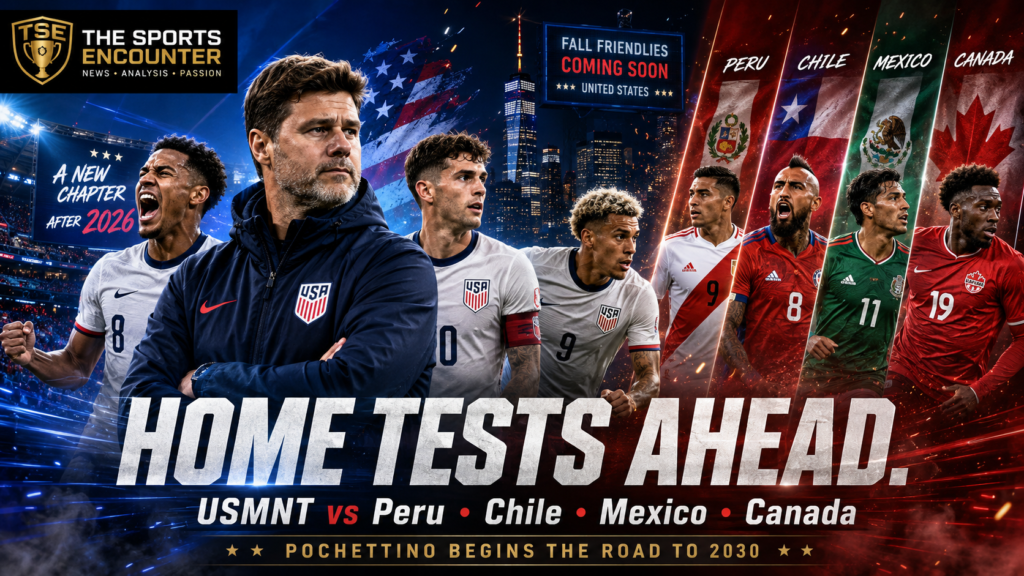
The United States men’s national team will return to action this fall with four home friendlies against Peru, Chile, Mexico, and Canada, giving Mauricio Pochettino an immediate opportunity to reshape the squad after its painful FIFA World Cup 2026 exit.
The Americans will face Peru in Orlando on September 26 before meeting Chile in St. Louis three days later. The schedule then shifts toward two familiar Concacaf rivalries, with Mexico awaiting in Glendale, Arizona, on October 3 and Canada completing the four-match window in St. Paul, Minnesota, on October 6.
These games will be the USMNT’s first since Belgium ended its home World Cup campaign with a decisive 4-1 victory in the Round of 16. They will also open Pochettino’s new contract cycle after U.S. Soccer extended the Argentine coach’s tenure through the 2030 World Cup.
The opponents have been chosen with purpose. Peru and Chile offer contrasting South American challenges. Mexico remains the match that carries the greatest emotional pressure for American players and supporters. Canada has grown into a direct regional competitor capable of questioning the United States’ position in North American soccer.
Four matches across 11 days will leave limited training time, which means Pochettino must arrive with a clear plan. The window offers a chance to reward the players who strengthened their reputations during the World Cup, test younger options and begin addressing the weaknesses Belgium exposed in Seattle.
The next World Cup remains four years away. The evaluation process starts now.
USMNT Fall 2026 Friendly Schedule
| Date | Match | Venue | City | Kickoff |
|---|---|---|---|---|
| September 26, 2026 | United States vs Peru | Inter&Co Stadium | Orlando, Florida | 4:30 p.m. ET |
| September 29, 2026 | United States vs Chile | Energizer Park | St. Louis, Missouri | 8 p.m. ET |
| October 3, 2026 | United States vs Mexico | State Farm Stadium | Glendale, Arizona | 10 p.m. ET |
| October 6, 2026 | United States vs Canada | Allianz Field | St. Paul, Minnesota | 8 p.m. ET |
Supporters can follow ticket information, broadcasting updates, squad announcements and official match coverage through the official U.S. Soccer announcement.
A New Cycle Begins With an Unfinished World Cup Story
The phrase “new cycle” can make international soccer sound cleaner than it really is.
The USMNT is moving toward 2030, but it has not escaped the questions left behind by 2026. Pochettino’s team produced encouraging moments during the tournament, finished first in its group and earned six points, the highest group-stage total in the program’s World Cup history.
The Americans then defeated Bosnia and Herzegovina 2-0 in the Round of 32 despite playing the final portion of the match with 10 men. Folarin Balogun opened the scoring before being sent off, while Malik Tillman’s late free kick secured progression.
That result appeared to show a team learning how to manage knockout pressure. The Sports Encounter’s report on the USA’s victory over Bosnia highlighted the discipline and defensive maturity the Americans showed after losing a player.
Belgium provided a harsher assessment four days later.
The United States conceded early, briefly equalized through Tillman and then lost control as Charles De Ketelaere, Hans Vanaken and Romelu Lukaku punished defensive mistakes. The 4-1 defeat to Belgium exposed a familiar gap between competing confidently and controlling a major knockout match.
Pochettino now has the security of a contract through 2030, but the extension also raises the standard by which his work will be judged. U.S. Soccer has chosen continuity. The next task is proving that continuity can produce evolution.
Why These Four Opponents Make Sense
The sequence gives the United States four different types of examination.
Peru can test the Americans’ patience against a South American opponent likely to protect central spaces and demand careful possession. Chile traditionally brings technical confidence, pressure around the ball and a willingness to compete aggressively in midfield.
Mexico changes the emotional environment. Tactical details remain important, but form can become secondary when the United States and Mexico meet. Every duel, foul, mistake and refereeing decision carries additional meaning.
Canada presents another problem. Its pace, athleticism and transition threat make it capable of attacking the spaces the USMNT sometimes leaves when pushing numbers forward.
Pochettino said the objective was to play the strongest opponents available and give his group a variety of experiences. This schedule follows that principle.
The two South American games can help determine whether the Americans have improved when facing technically secure opponents outside their own confederation. The final two matches will show where the United States currently stands within Concacaf.
Peru Offers the First Test of the Rebuild
The Peru match will carry less emotional noise than the games against Mexico and Canada, which may make it the most useful starting point for Pochettino.
He can evaluate the structure of his team without every selection decision becoming a referendum on regional supremacy.
The United States should expect to control long stretches of possession in Orlando. That places responsibility on the midfield and fullbacks to create advantages without leaving the defense exposed.
Breaking down an organized opponent has not always come naturally to the USMNT. The team can look dangerous when space opens for Balogun, Christian Pulisic or its other runners. Matches requiring slower construction often become crowded and predictable.
Peru can therefore reveal whether Pochettino has developed better solutions against a compact defensive block.
Central combinations, movement between the lines and the quality of the final pass will matter more than the possession percentage. The Americans must learn to move opponents before trying to play through them.
The game could also give Pochettino room to introduce emerging players without placing them immediately into the emotional intensity of USA-Mexico.
Chile Can Challenge the USMNT’s Midfield Authority
The match against Chile arrives only three days later, making rotation unavoidable.
Pochettino will need to decide whether to treat the opening two games as separate lineups or maintain a core group while changing selected positions. That choice will offer an early clue about his objectives for the window.
Chile can make the United States uncomfortable through midfield pressure and technical exchanges. The Americans must show they can receive the ball under contact, escape pressure and avoid turning every difficult phase into a rushed vertical pass.
The match should offer particular value for Tillman, Weston McKennie, Tyler Adams and the other midfielders competing for long-term roles.
Tillman left the World Cup with a stronger reputation after scoring against Bosnia and Belgium. His ability to operate between midfield and attack gives the United States a different type of creativity.
The next step is consistency. Pochettino needs Tillman and the wider midfield group to influence complete matches rather than isolated moments.
Chile will also test the defensive transition. When the United States loses possession after committing players forward, the first reaction must be coordinated. Belgium showed how quickly a confident opponent can turn loose positioning into clear chances.
USA vs Mexico Remains the Match That Defines the Window
No American friendly against Mexico feels entirely friendly.
The October 3 meeting at State Farm Stadium will carry the biggest crowd, the heaviest attention and the most immediate consequences for how supporters judge the window.
Mexico also enters the post-World Cup period with its own unresolved emotions. El Tri reached the Round of 16 on home soil before its tournament ended, leaving another cycle of pressure around a national team expected to compete at a higher level.
The Sports Encounter followed Mexico’s World Cup progress closely, including its controlled 2-0 knockout victory over Ecuador. That performance showed Mexico’s ability to control tense matches through defensive discipline and timely finishing.
The rivalry will give Pochettino a clear measurement of mentality.
Mexico will press, compete for second balls and try to control the emotional rhythm. The United States cannot allow intensity to become disorder. Its best recent performances against Mexico have combined aggression with tactical patience.
Individual battles will draw attention, particularly in midfield and wide areas. Pulisic will remain central to the American attack, but Pochettino must continue reducing the team’s dependence on him to create every important moment.
Balogun’s movement, Tillman’s intelligence and the support provided by the fullbacks can prevent Mexico from loading its defensive attention toward one side.
The result will not decide the 2030 cycle. It will shape how the first week of that cycle feels.
Canada Is No Longer a Secondary Rival
The final game against Canada should not be treated as an exhibition after the Mexico match.
Canadian soccer has changed. The national team carries greater speed, confidence and international experience than it did a decade ago. Its leading players operate in major European leagues, while the wider program has grown more comfortable challenging the United States and Mexico directly.
Canada’s World Cup ended with a 3-0 Round of 16 defeat to Morocco, a result covered in The Sports Encounter’s report on how the Atlas Lions eliminated the Canadians.
The scoreline was painful, but Canada’s tournament also included a historic 6-0 group-stage victory powered by Jonathan David’s hat trick. That performance showed the damage the Canadians can cause when their transition game gains space, as detailed in our coverage of Canada’s record-breaking win.
Against the United States, Canada is likely to attack quickly rather than compete for sterile possession.
Pochettino’s side must manage the space behind its fullbacks and prevent turnovers from becoming open-field races. That challenge becomes harder in the fourth match of an 11-day window, when fatigue can affect defensive recovery and decision-making.
The final game may therefore reveal the squad’s depth more clearly than the first three.
Pochettino Has Earned More Time, but Expectations Are Rising
U.S. Soccer’s decision to extend Pochettino through 2030 reflects belief in the wider direction of the program.
He took charge in 2024 and gradually moved the team toward a more aggressive, high-pressing approach. The World Cup group stage provided evidence that the work was producing results.
Finishing ahead of Australia, Paraguay and Türkiye was meaningful. Six points established a new USMNT group-stage high, while the Bosnia victory delivered the program’s first knockout success of the tournament.
The Belgium defeat placed those gains in perspective.
Pochettino is no longer preparing a young host nation for a home World Cup. He is now responsible for taking a tested group toward the next level.
The 2030 project should include more than waiting for the existing core to mature. Squad competition must increase. Tactical flexibility must improve. New leaders must emerge before injuries or declining form force change.
Extending the coach early gives him authority to make difficult decisions without treating every friendly as a short-term survival test.
That freedom should lead to experimentation with purpose rather than experimentation for its own sake.
Which Players Should Form the Core?
The World Cup established several players as central to the next phase.
Christian Pulisic
Pulisic remains the most influential American attacker and the player opponents plan around first. His movement, directness and experience make him difficult to replace.
Pochettino must still find ways to protect him from carrying too much creative responsibility. The United States becomes easier to defend when every meaningful attack needs Pulisic to beat the first opponent.
Malik Tillman
Tillman’s World Cup performances changed his standing within the squad. Goals against Bosnia and Belgium showed his composure in major moments.
He can become the connector between midfield and attack, particularly when opponents compress the center. His development may be one of the most important stories of the new cycle.
Folarin Balogun
Balogun gives the attack depth and penalty-area presence. His goal against Bosnia showed the instinct Pochettino needs from a central striker.
The red card in that same match also underlined the need for greater control. He must become an emotional and tactical reference point rather than merely the most direct runner.
Tyler Adams and Weston McKennie
Both midfielders bring experience, competitiveness and familiarity with high-pressure Concacaf games.
The question is how the midfield evolves around them. The United States needs technical security as well as energy, especially against opponents capable of controlling possession.
Matt Freese and the Defensive Unit
The goalkeeper and back line left the World Cup with mixed evaluations. They contributed to important wins, but Belgium exposed positioning and decision-making problems.
Pochettino must use the fall window to test whether those errors were tournament-specific or evidence of a wider structural weakness.
New Faces Must Enter Before the Squad Becomes Comfortable
The danger after a respectable World Cup is that a national team mistakes familiarity for progress.
Pochettino should retain a strong core, but every position needs genuine competition.
Sebastian Berhalter is one player whose trajectory deserves attention. The midfielder appeared in all five U.S. World Cup matches before completing a move to Middlesbrough.
The Sports Encounter’s report on Berhalter’s four-year Middlesbrough contract examined how his World Cup role and MLS form earned him a European opportunity.
Players developing overseas should not receive automatic selection, but regular competition in demanding environments can strengthen the national team.
The fall games may also give Pochettino a chance to assess young MLS players and members of the youth national-team structure. The 2030 squad will not be built only from the names that appeared in 2026.
Four years provide time, but international windows disappear quickly. A coach may receive only a handful of meaningful gatherings each season.
Every camp must move the selection process forward.
Four Cities Get Their Post-World Cup Moment
Orlando, St. Louis, Glendale and St. Paul did not host matches during the 2026 World Cup.
U.S. Soccer’s schedule gives supporters in those markets a chance to reconnect with a national team that spent the summer performing in front of enormous home crowds.
The decision also spreads the post-tournament momentum beyond the World Cup host cities.
The tournament was staged across 16 cities in the United States, Canada and Mexico. Its scale, transportation demands and regional differences were central to The Sports Encounter’s guide to the 11 U.S. World Cup host cities.
The fall friendlies now offer a different kind of opportunity. They can bring national-team soccer into strong regional markets without the pricing, travel pressure and global demand associated with the World Cup.
Orlando’s match against Peru has been designated as a Fan Appreciation Match. St. Louis will host Chile in an Impact Match, while Glendale receives the marquee Mexico fixture.
Allianz Field in St. Paul should offer a strong setting for the Canada game, particularly if both teams use competitive lineups.
What the USMNT Must Improve Before 2030
The four friendlies should begin a broader process focused on several clear weaknesses.
Control After Scoring
The United States responded well in several World Cup matches, but Belgium showed how quickly momentum can disappear. After Tillman equalized, the Americans conceded again almost immediately.
Strong tournament teams understand when to accelerate and when to calm the match.
Defending Transitions
Pochettino wants an aggressive team, which naturally creates space. The issue is whether the midfield and back line are positioned to manage that risk when possession is lost.
Chance Creation Against Compact Teams
Peru may provide the first test. The United States must develop more varied methods of creating chances when opponents refuse to leave space behind the defense.
Depth Beyond the Starting XI
Four games in 11 days will expose the quality of the wider squad. Pochettino needs substitutes who can change matches rather than simply preserve the original plan.
Emotional Control in Rivalry Games
Mexico and Canada will challenge the Americans physically and psychologically. Discipline must remain part of the team’s identity.
The Bigger North American Picture
The 2026 World Cup was expected to change soccer’s standing across the United States, Canada and Mexico.
The tournament’s commercial impact became visible even before it ended. When all three host nations were eliminated, ticket demand and resale prices around later matches changed sharply.
The Sports Encounter explored that effect in its analysis of why World Cup ticket prices fell after the host nations exited.
Now the three countries begin the quieter work of turning tournament attention into long-term national-team growth.
For the United States, that means maintaining fan interest after the spectacle has moved on. Mexico must rebuild confidence after another World Cup that ended earlier than supporters expected. Canada must prove that its progress can survive beyond one home tournament.
The October matches will bring those three programs back into direct comparison.
What Would Make This Window Successful?
Four wins would look impressive, but results alone should not define the window.
A successful series would provide evidence that Pochettino has identified the right core while opening space for new players. The Americans should show improved control in possession, cleaner defensive transitions and enough attacking variety to avoid becoming dependent on Pulisic.
The Mexico game will naturally attract the most attention. The Canada match may be equally important from a development perspective because it arrives at the end of a demanding schedule.
Pochettino should also leave the window with clearer answers about goalkeeper, center-back depth, midfield balance and the hierarchy among his forwards.
The team does not need to look ready for 2030 in October 2026.
It should look like it has started moving toward it.
The Sports Encounter View
The USMNT’s fall schedule offers the right balance for the first step after a complicated home World Cup.
Peru and Chile will test different parts of the Americans’ possession game. Mexico will bring the rivalry pressure that no training session can recreate. Canada will challenge the squad’s depth, transition defense and regional authority.
Pochettino has been given four more years because U.S. Soccer believes the progress shown in 2026 can become something larger.
That belief is reasonable. The United States won its group, earned a record six points and survived a tense knockout match against Bosnia.
The Belgium loss remains the more useful reference.
A team hoping to become a global contender cannot accept that its World Cup ceiling ends whenever it meets an opponent with greater tactical calm and knockout experience.
The next phase should build on the energy of the home tournament without becoming trapped by it. Some World Cup players will become long-term leaders. Others will be replaced as Pochettino searches for a stronger squad.
Peru, Chile, Mexico and Canada will not decide the success of the 2030 project.
They will reveal how seriously that project has begun.
Follow The Sports Encounter’s soccer coverage for USMNT updates, international match reports, tactical analysis and the major stories shaping the next World Cup cycle.
USMNT Fall Friendlies FAQs
Who will the USMNT play in September and October 2026?
The United States will face Peru, Chile, Mexico and Canada in four home friendlies.
When is USA vs Peru?
The match will be played on September 26, 2026, at Inter&Co Stadium in Orlando, with kickoff scheduled for 4:30 p.m. ET.
When is USA vs Chile?
The United States will host Chile on September 29 at Energizer Park in St. Louis. Kickoff is scheduled for 8 p.m. ET.
When is the next USA vs Mexico match?
The Concacaf rivals will meet on October 3 at State Farm Stadium in Glendale, Arizona. Kickoff is scheduled for 10 p.m. ET.
When will the USMNT play Canada?
The United States will host Canada on October 6 at Allianz Field in St. Paul, Minnesota, at 8 p.m. ET.
Will Mauricio Pochettino remain USMNT coach?
Yes. Pochettino has agreed to a new contract that will keep him in charge through the 2030 World Cup.
How did the United States perform at the 2026 World Cup?
The Americans finished first in their group with a national-record six points, defeated Bosnia and Herzegovina in the Round of 32 and lost 4-1 to Belgium in the Round of 16.
Where can fans watch the USMNT friendlies?
U.S. Soccer has confirmed television and streaming coverage across TNT, truTV, HBO Max, Telemundo, Universo and Peacock, although the exact combination varies by match.