


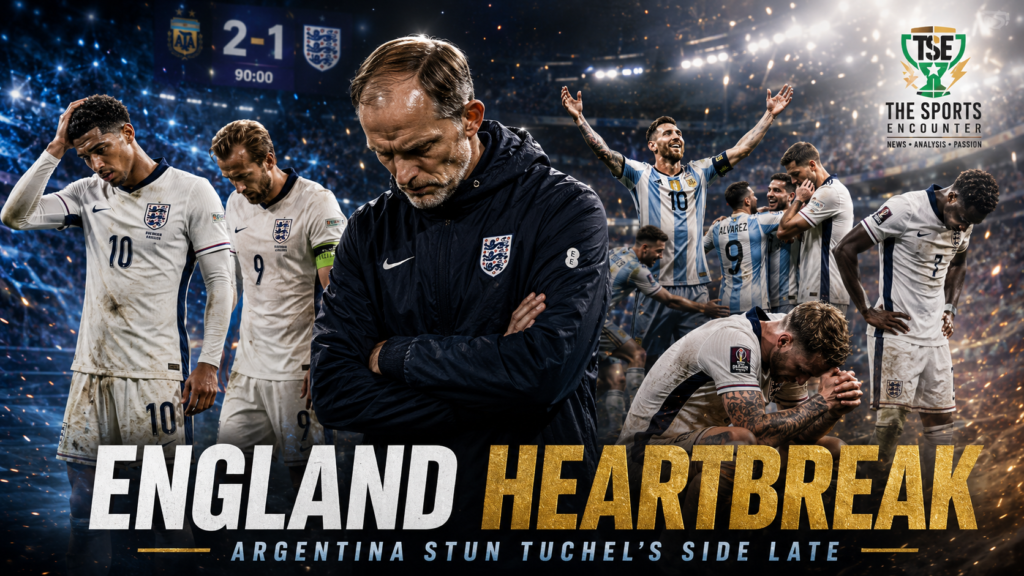
For 55 minutes in Atlanta, England dared to dream. Then, in the space of seven second-half minutes, six decades of hurt found a new chapter, and Thomas Tuchel’s Three Lions became the latest England side to watch a World Cup final slip through their fingers.
This is the full story of how England lost 2-1 to Argentina in the 2026 World Cup semi-final, what went wrong tactically, what Tuchel and his players said afterward, how the football world reacted, and why a controversial banner turned a football story into a diplomatic one.
Readers can revisit the buildup, rivalry and tactical questions in our Argentina vs. England World Cup semi-final preview.
England vs. Argentina: Match at a Glance
| Detail | Information |
|---|---|
| Competition | FIFA World Cup 2026, Semi-final, Match 102 |
| Date | July 15, 2026 |
| Venue | Atlanta Stadium, Atlanta, Georgia, USA |
| Final Score | England 1-2 Argentina |
| England Scorer | Anthony Gordon, 55th minute |
| Argentina Scorers | Enzo Fernández, 85th minute; Lautaro Martínez, 90+2 |
| Messi’s Involvement | Assisted both Argentina goals |
| Result | Argentina advanced to the final against Spain on July 19 |
| England’s Next Match | Third-place playoff against France |
The Result: England 1-2 Argentina
England and Argentina met at Atlanta Stadium on July 15, 2026, in the second World Cup semi-final, with a place in Sunday’s final against Spain on the line.
After a goalless, cagey first half, Anthony Gordon broke the deadlock in the 55th minute, tapping home a pinpoint cross from Morgan Rogers to send England into dreamland. For a while, it looked like the Three Lions were 35 minutes away from their first World Cup final appearance since winning the tournament on home soil in 1966.
It did not last.
Argentina, driven by Lionel Messi, laid siege to England’s penalty area for the rest of the match. Alexis Mac Allister crashed a header off the inside of the post before Enzo Fernández leveled the score in the 85th minute with a strike from outside the penalty area.
In the second minute of stoppage time, Lautaro Martínez rose to head home Messi’s cross and complete a devastating comeback. Argentina won 2-1 and moved on to defend their title against Spain.
The complete result, goals and official match information are available in the FIFA England vs. Argentina semi-final report.
Spain had secured the other place in the final by beating France 2-0. Our report on how Spain controlled France in the first World Cup semi-final explains why Argentina will face a very different tactical challenge in the title match.
The match statistics tell their own brutal story. Argentina finished with 56 percent possession and attempted 15 shots, while England produced only five. Argentina registered five attempts on target compared with England’s two.
Perhaps the most damaging number emerged from the post-match data. Between the 72nd and 92nd minutes, England completed just two passes in the opposition half, compared with Argentina’s 111.
England stopped controlling the ball, stopped moving the game away from their penalty area and allowed Argentina to dictate every phase. The defending champions eventually made that pressure count.
Full Match Statistics: England vs. Argentina
| Statistic | England | Argentina |
|---|---|---|
| Possession | 35% | 56% |
| Total Shots | 5 | 15 |
| Shots on Target | 2 | 5 |
| Shots off Target | 1 | 8 |
| Attempts Inside Penalty Area | 2 | 7 |
| Attempts Outside Penalty Area | 3 | 8 |
| Goals Scored | 1 | 2 |
| Assists | 1 | 2 |
| Passes in Opposition Half, 72nd-92nd minute | 2 | 111 |
Source: FIFA official match statistics and post-match reporting.
England vs. Argentina Goal Timeline
| Minute | Player | Team | What Happened |
|---|---|---|---|
| 0-54 | None | Both | A physical and cautious first half ended goalless. |
| 55 | Anthony Gordon | England | Gordon converted Morgan Rogers’ right-wing cross. |
| 55-84 | None | Argentina pressure | England retreated, while Argentina dominated possession and territory. |
| Early 80s | Alexis Mac Allister | Argentina | His header struck the inside of the post. |
| 85 | Enzo Fernández | Argentina | Fernández equalized from outside the area after another sustained attack. |
| 90+2 | Lautaro Martínez | Argentina | Martínez headed in Messi’s cross to complete the comeback. |
The Tactical Collapse: How England Threw Away the Lead
The central storyline out of Atlanta was not simply Argentina’s brilliance. England’s decision-making after Gordon’s goal played an equally important role.
As soon as England went ahead, Thomas Tuchel moved his side toward a back five. The intention was clear: reduce the spaces between defenders, deal with Argentina’s crossing and protect the lead.
The change produced the opposite effect.
Instead of controlling the game through possession, England invited Argentina to camp inside their half. The defensive line dropped, the midfield became disconnected from the attackers and England lost any reliable route out of pressure.
Argentina repeatedly recycled possession around the penalty area. Every clearance came back. Messi found more freedom to move across the pitch, while Mac Allister, Fernández and the fullbacks kept England pinned close to Jordan Pickford’s goal.
ESPN’s analysis of Tuchel’s England substitutions against Argentina examined how the personnel changes reinforced the retreat instead of restoring control.
Zlatan Ibrahimović, working as a television analyst, summarized the problem bluntly.
“England stopped playing when they scored the goal. I don’t know why. Tuchel made some changes, he went too defensive. Scaloni went more offensive. They did not panic. They kept pushing by putting more offensive players in. The best team won.”
Former England and Manchester City defender Micah Richards also questioned the game management. Tuchel had been appointed partly because of his reputation for making decisive tactical interventions during major matches. England instead repeated the same conservative pattern that has damaged previous tournament campaigns.
Journalists were even harsher. The Guardian’s analysis argued that England were in a stronger position than they had been against Croatia in the 2018 semi-final, yet voluntarily surrendered the initiative after scoring.
Other commentators described the change as close to indefensible for a coach hired specifically to help England cross the final barrier at major tournaments.
Thomas Tuchel Accepts England Became Too Passive
Tuchel did not avoid the central criticism after the match.
“We’re disappointed. We were so close, but we got too passive after we scored and conceded a lot of chances. We could not turn the ball possession around and then conceded so many crosses, chances and shots. We were close but couldn’t keep the level up after we scored.”
The England manager defended the reasoning behind moving to a back five.
“We conceded a chance straight away and we decided to go to a back five because the gaps were far too open. They won every header. They kept crossing and crossing, so we went to a back five to close the gaps inside and be strong in the air.”
The explanation made tactical sense in isolation. England were struggling to defend crosses, while Argentina had increased the number of attacking players around the area.
The deeper failure came from what England sacrificed. The additional defender did not stop Argentina from generating chances, and it left England with even fewer players capable of carrying or retaining the ball farther upfield.
Tuchel later accepted responsibility for the passivity, while maintaining that the structure itself was not the only problem. The Guardian’s report on Tuchel’s reaction to the semi-final collapse provides further context on his decisions and England’s inability to manage the lead.
What Pundits and Journalists Said
| Voice | Reaction |
|---|---|
| Zlatan Ibrahimović | “England stopped playing when they scored the goal. The best team won.” |
| Jack Pitt-Brooke | Argued that the collapse was worse than England’s 2018 defeat because Tuchel’s side had better options and a stronger position. |
| Miguel Delaney | Questioned whether the tactical decision was serious enough to place Tuchel’s position under scrutiny. |
| Alan Pardew | Suggested fear and a negative mindset took over once England moved ahead. |
| Thomas Tuchel | Admitted England became too passive and could not regain control of possession. |
| Jacob Steinberg | Argued that Tuchel’s reputation as a tactical problem-solver suffered badly during the second half. |
England’s Deeper Structural Problem
Tuchel pointed to something more fundamental than one formation or substitution pattern.
“In this moment, my feeling was no structure in the world could have helped us.”
He then addressed a broader issue in England’s football identity.
“I think ball possession plays a crucial role. It’s maybe not in our DNA like it is in Spanish DNA or in Argentinian-Brazilian DNA, to take the ball and control the game with the ball.”
That comment reaches the heart of England’s long-running tournament problem.
English football has produced outstanding attacking players, technically gifted midfielders and elite Premier League performers. Yet the national team continues to struggle to dictate high-pressure knockout matches through sustained possession.
When opponents increase the tempo, England often respond by retreating rather than using the ball to slow the match. That tendency appeared against Croatia in 2018, Italy in the Euro 2020 final and Argentina in Atlanta.
England’s route to the semi-final had already exposed similar weaknesses. They survived a difficult knockout match against Mexico and needed Jude Bellingham’s two goals to beat Norway after extra time.
Our report on England’s tense quarter-final victory over Norway showed how Bellingham’s finishing covered periods when the team lacked control.
Much of England’s scoring burden during the tournament rested on Harry Kane and Bellingham. Gordon’s semi-final goal gave England another contributor, but the team could not build on it.
Tuchel’s England Timeline and Tournament Expectations
Tuchel took the England job in January 2025, his first position in international football after a club career that included winning the Champions League with Chelsea.
The Football Association presented him as the coach capable of delivering a second star on England’s shirt, a reference to the country’s only World Cup victory in 1966.
His timeline remains short when compared with coaches who eventually won the World Cup.
| Coach | Country | Time in Role Before Winning |
|---|---|---|
| Aimé Jacquet | France, 1998 | Approximately five years |
| Didier Deschamps | France, 2018 | Approximately six years |
| Thomas Tuchel | England | Approximately 18 months before his first World Cup |
Reaching the semi-final matched Gareth Southgate’s achievement in 2018. That benchmark no longer satisfies a fanbase that has watched England reach the Euro 2020 final, the Euro 2024 final and two World Cup semi-finals without winning a trophy.
England’s Pattern of Tournament Heartbreak
| Tournament | Stage | Result | Context |
|---|---|---|---|
| 1966 World Cup | Final | Beat West Germany 4-2 | England’s only senior men’s World Cup title |
| 2018 World Cup | Semi-final | Lost 2-1 to Croatia | England scored first but lost after extra time |
| Euro 2020 | Final | Lost to Italy on penalties | England scored first |
| Euro 2024 | Final | Lost 2-1 to Spain | Spain scored the late winner |
| 2026 World Cup | Semi-final | Lost 2-1 to Argentina | England led until the 85th minute |
Lionel Messi Was the Uncontrollable Variable
If England’s tactics formed one side of the story, Lionel Messi supplied the other.
Remarkably, the semi-final was the first time Messi had faced England at senior international level. He made the occasion count.
Both Argentina goals came through his creativity. He helped draw England’s defense before the equalizer and then delivered the cross from which Lautaro Martínez scored the winner.
The two assists strengthened Messi’s position in the Golden Boot race. He and Kylian Mbappé were level on eight goals, but Messi moved ahead through the competition’s assist tiebreaker.
Our ranking of the top performers at the FIFA World Cup 2026 tracked how Messi’s goals, assists and leadership drove Argentina through the knockout rounds.
Thierry Henry, Messi’s former Barcelona teammate, offered one of the most vivid descriptions of his mentality.
“Sometimes, don’t wake up the beast. I’ve seen him in training. He switches. He goes and gets the ball and scores three goals in a row. This guy writes history with his feet.”
England’s retreat gave Messi the type of platform he understands better than almost anyone: tired defenders, repeated possession around the area and space to move laterally until the right passing lane appeared.
As he shifted toward the right side, England struggled to decide whether a midfielder, wingback or central defender should follow him. That uncertainty contributed to both decisive attacks.
Golden Boot Race After the Semi-Finals
| Player | Country | Goals | Position After Semi-finals |
|---|---|---|---|
| Lionel Messi | Argentina | 8 | Led through assists |
| Kylian Mbappé | France | 8 | Trailed Messi on the assist tiebreaker |
Argentina’s Habit of Surviving Difficult Moments
It would be inaccurate to describe the result entirely as an England collapse. Lionel Scaloni’s Argentina have repeatedly found solutions during difficult moments.
Cape Verde pushed the defending champions during the group stage. Egypt forced them into a dramatic Round of 16 match. Switzerland took their quarter-final into extra time before Argentina finally broke clear.
Our report on Argentina’s extra-time win over Switzerland examined another match in which Scaloni’s side survived pressure before delivering decisive late goals.
The Argentina manager explained the mentality after beating England.
“I think that this team plays the best when we are facing a difficult situation, with adversity. We had a challenging game and a challenging situation. There was blood in the water, and we went for it.”
Argentina now stand one victory away from becoming the first country to retain the men’s World Cup since Brazil won consecutive titles in 1958 and 1962.
Argentina’s Road to the World Cup Final
| Round | Opponent | Result | Key Story |
|---|---|---|---|
| Round of 16 | Egypt | Argentina advanced | Three late goals were needed to survive |
| Quarter-final | Switzerland | Argentina won after extra time | Switzerland were reduced to 10 players |
| Semi-final | England | Argentina won 2-1 | Two goals arrived in the final seven minutes |
Fan Reaction to England’s Semi-Final Collapse
The online reaction was immediate and severe.
Supporters repeatedly focused on England’s failure to chase a second goal. Many compared the retreat with previous tournament defeats and questioned why a squad containing several elite attacking players spent the closing period defending so close to its own goal.
Journalist Jacob Steinberg wrote that Tuchel’s image as a tactical genius had been damaged by the second half. He also warned that the reaction in England could become toxic quickly.
The frustration built on an already complicated relationship between Tuchel and sections of the support. Earlier in his tenure, he criticized the atmosphere during an England match at Wembley. Traveling fans later responded with chants questioning whether they were loud enough for him.
The Argentina defeat gave those tensions a far more serious context. Supporters are now asking whether Tuchel can restore belief before England’s next major tournament.
The Falklands Banner Turns Football Into a Diplomatic Story
England’s football disappointment was followed by a political controversy.
After the final whistle, Argentina players Lisandro Martínez and Giovani Lo Celso were pictured with a banner reading “Las Malvinas Son Argentinas,” which translates as “The Malvinas Are Argentine.”
The message restated Argentina’s claim over the Falkland Islands, the British Overseas Territory that Argentina calls the Malvinas.
The islands were at the center of the 1982 Falklands War, in which 649 Argentine military personnel, 255 British personnel and three Falkland Islanders were killed.
The UK government subsequently urged FIFA to investigate the Argentina banner.
The incident raised questions under the official FIFA World Cup 2026 Stadium Code of Conduct, which regulates political, offensive and discriminatory signs, banners and other material inside tournament venues.
FIFA had previously fined the Argentine federation over a similar display. Any further disciplinary action would likely depend on the match officials’ reports, the location of the banner, how the players obtained it and the governing body’s interpretation of its political-content rules.
Falklands Banner Controversy: Key Facts
| Issue | Information |
|---|---|
| What Happened | Argentina players displayed a “Las Malvinas Son Argentinas” banner after the match |
| Players Identified | Lisandro Martínez and Giovani Lo Celso |
| Potential Rule Issue | FIFA rules restrict political and ideological messaging at tournament venues |
| UK Response | The government urged FIFA to investigate |
| Historical Context | The Falkland Islands remain a British Overseas Territory claimed by Argentina |
| 1982 War Death Toll | 649 Argentine personnel, 255 British personnel and three Falkland Islanders |
| Possible Outcome | FIFA investigation and a potential financial or disciplinary sanction |
What Comes Next for England and Argentina?
England’s wait for a second World Cup title will now extend to at least 2030.
The Three Lions must first complete their 2026 campaign in the third-place playoff against France. The fixture carries less emotional weight than a final, but it gives Tuchel and his players an opportunity to finish the tournament with a victory.
Argentina turn their full attention to Spain at New York New Jersey Stadium on July 19. Official kickoff details, results and tournament information are available through the FIFA World Cup 2026 fixtures and results page.
Spain will present a different challenge. Their route to the final has been built around possession, positional discipline, defensive control and the creativity of Lamine Yamal.
Argentina bring resilience, experience and Messi’s ability to decide games from areas opponents believe they have already protected.
For Tuchel, the inquest is only beginning. His contract extension gives the Football Association little immediate reason to make a change, but the tactical questions raised in Atlanta will remain.
England reached another semi-final. They also surrendered another lead in a major tournament match by retreating when the pressure increased.
The loss will be remembered for Gordon’s goal, Argentina’s late surge and Messi’s two assists. Above all, it will be remembered as the night England stood close enough to see another World Cup final and then stopped playing the football that had taken them there.
This article will be updated with official FIFA disciplinary decisions, further England reaction and developments before the third-place playoff.