


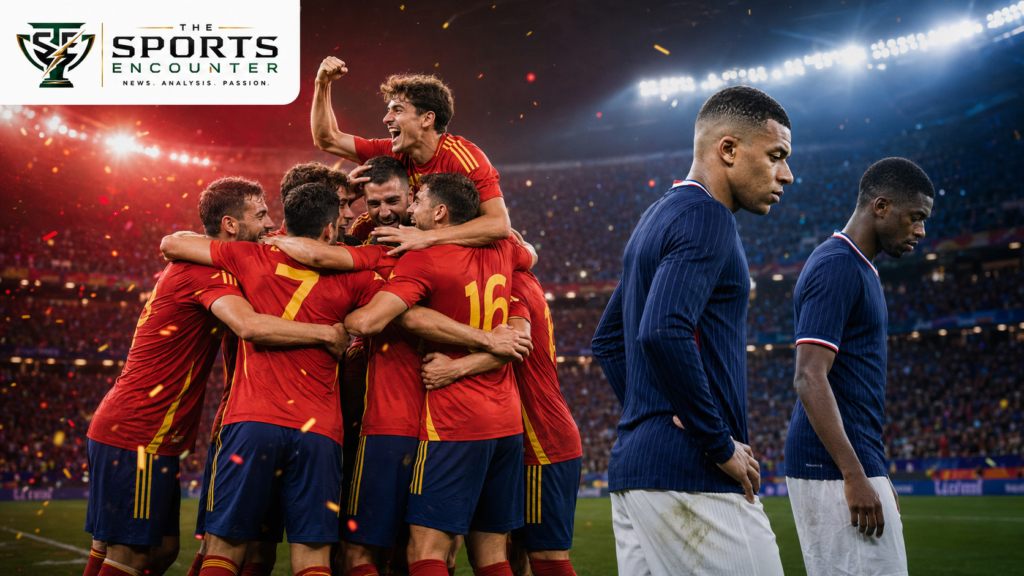
France arrived in Dallas chasing a third consecutive World Cup final with Kylian Mbappé and Ousmane Dembélé leading the tournament’s most feared attack. Ninety minutes later, both had been contained, Spain had completed a commanding 2-0 victory, and Didier Deschamps’ side were heading home without finding a convincing response.
Mikel Oyarzabal converted a disputed first-half penalty before Pedro Porro completed a slick passing move in the 58th minute. Spain then defended their advantage with discipline, awareness, and an exceptional performance from goalkeeper Unai Simón.
The result sends La Roja into their second World Cup final and their first since winning the trophy in 2010. They will face the winner of Argentina’s semifinal against England on July 19.
Spain’s victory also confirmed the defensive strength highlighted in our France vs Spain semifinal preview. France possessed the bigger individual names in attack. Spain controlled where, when, and how those players received the ball.
Follow the tournament through The Sports Encounter’s FIFA World Cup 2026 coverage and our broader soccer news and analysis.
TL;DR
- Spain beat France 2-0 in the first FIFA World Cup 2026 semifinal.
- Mikel Oyarzabal converted a 22nd-minute penalty after Lucas Digne caught Lamine Yamal inside the box.
- Pedro Porro doubled Spain’s lead in the 58th minute after combining with Dani Olmo.
- Yamal had a potential third goal disallowed for offside three minutes later.
- Unai Simón repeatedly left his penalty area to deny Mbappé and controlled Spain’s defense superbly.
- Adrien Rabiot, Mbappe and Marc Cucurella received yellow cards. No red cards were issued.
France vs Spain Semifinal Scorecard
| Detail | Information |
|---|---|
| Match | France vs Spain, FIFA World Cup 2026 semifinal |
| Result | Spain won 2-0 |
| Venue | Dallas Stadium, Arlington, Texas |
| Date | July 14, 2026 |
| Goalscorers | Mikel Oyarzabal 22’ penalty, Pedro Porro 58’ |
| Disallowed Goal | Lamine Yamal, 61’, offside |
| Yellow Cards | France: Adrien Rabiot 9’; Kylian Mbappé 86’; Spain: Marc Cucurella 31’, |
| Red Cards | None |
| Top Performer | Unai Simón, commanding goalkeeping and proactive defensive coverage |
| Turning Point | Oyarzabal’s first-half penalty gave Spain control of the semifinal |
| What It Means | Spain reached their first World Cup final since 2010 |
| Next Match | Spain vs Argentina or England, World Cup final, July 19 |
Spain Take Control Before the First Hydration Break
The opening minutes revealed how Spain intended to manage the semifinal. Rodri remained available beneath the first line of French pressure, while Dani Olmo, Fabián Ruiz, and Álex Baena kept offering passing angles between the lines.
France spent long stretches chasing possession. Whenever Deschamps’ midfield moved forward, Spain found the spare player and moved the ball into another area. Their passes carried purpose, and their positioning made the field feel wider than it was.
The breakthrough came in the 22nd minute. Digne misjudged a defensive header and attempted to hook the ball clear without seeing Yamal moving behind him. His raised boot caught the Spanish winger, and referee Iván Barton immediately pointed to the penalty spot.
France protested, with Mbappé appearing to argue that the ball had touched Yamal’s arm before the contact. Barton did not visit the pitchside monitor. However, the VAR team checked the incident and allowed the original decision to stand.
That distinction matters. The referee did not refuse a VAR check altogether. He chose not to conduct an on-field review because the video officials found no clear and obvious error that required intervention.
Debate will continue over whether Yamal deliberately moved into the path of Digne’s attempted clearance. The defender still caught him high inside the penalty area, giving the officials sufficient grounds to uphold the call.
Oyarzabal showed no concern about the controversy. He drove the penalty beyond Mike Maignan to preserve his perfect record across his last six spot kicks and score his fifth goal of the tournament.
France Spend the First Half Chasing Shadows
France needed a quick tactical response after falling behind. Instead, their attacking structure became increasingly disconnected.
Mbappé struggled to receive the ball facing Spain’s goal. Dembélé found little room between the defensive and midfield lines, while Bradley Barcola fired over after choosing a difficult shot instead of using Digne’s overlapping run.
William Saliba’s injury added to France’s problems. The central defender left the field around the half-hour mark, forcing Maxence Lacroix into a semifinal that was already moving at Spain’s pace.
Rabiot’s early yellow card also weakened France’s midfield aggression. Deschamps removed him at halftime after another late challenge placed him at risk of a second booking.
Spain’s possession and pass completion reflected their control, but their movement mattered even more. Olmo repeatedly appeared in pockets France failed to close. Yamal stretched Digne on the right, while Oyarzabal’s positioning occupied both central defenders.
France reached halftime without creating a sustained period of pressure. Mbappé and Dembélé remained peripheral, and Spain looked far more likely to score the next goal.
Pedro Porro Finishes Spain’s Best Move
Spain carried the same authority into the second half. France needed urgency, yet La Roja continued moving the ball with greater clarity.
The second goal arrived in the 58th minute after an attack that briefly appeared to have broken down. Spain recycled possession rather than forcing a hopeful delivery. Porro played a sharp give-and-go with Olmo, broke into the penalty area, and guided his finish past Maignan into the bottom corner.
That sequence captured the difference between the teams. Spain trusted their positioning and combinations. France waited for an individual player to create something outside the normal flow of the game.
Three minutes later, Yamal appeared to make it 3-0 with a curling finish. The offside flag correctly ruled out the goal, offering France a narrow escape from an even heavier semifinal defeat.
Spain’s knockout journey had already shown their patience. A late winner eliminated Portugal before another composed performance carried them past Belgium, detailed in our report on Spain’s quarterfinal victory over Belgium. Against France, that patience developed into complete tactical control.
Unai Simón Plays the Semifinal as Spain’s Extra Defender
Spain’s defense deserved as much credit as the goalscorers. Cucurella, Aymeric Laporte, Pau Cubarsí, and Porro tracked France’s runners closely, denied central spaces, and rarely allowed Mbappé or Dembélé to receive the ball in comfortable positions.
Simón completed the structure behind them.
The Spanish goalkeeper repeatedly recognized danger before France could turn it into a shot. His best first-half intervention came when Rabiot released Mbappé through the middle. Simón raced beyond his penalty area and cleared the ball with perfect timing.
Similar decisions followed after halftime. He attacked through balls, claimed crosses, and narrowed angles whenever France threatened to move behind Spain’s back line.
Mbappé forced him into action from a tight angle during France’s brief spell of second-half pressure. Simón stayed composed and protected the clean sheet.
His performance combined goalkeeping, anticipation, and defensive leadership. Spain’s high line could operate confidently because their goalkeeper read the space behind it so well. That complete awareness made him the strongest candidate for Player of the Match.
France’s Biggest Weapons Find No Space
Mbappé entered the semifinal level with Lionel Messi on eight goals in the Golden Boot race. Dembélé had scored in France’s 2-0 quarterfinal win over Morocco. Neither player could influence this match consistently.
Spain surrounded Mbappé whenever he moved inside and trusted Porro to follow him when he drifted wide. Dembélé faced similar pressure, with Rodri and Ruiz denying the central combinations France usually use to accelerate attacks.
Deschamps introduced Désiré Doué and Manu Koné, but the substitutions did not change the underlying problem. France lacked coordinated movement around the ball. Their most dangerous players kept receiving possession in crowded or unfavorable areas.
For the first time since their 2-0 group-stage defeat against Mexico in 2010, France lost a World Cup match by a two-goal margin. Their previous knockout exits had been decided by one goal, extra time, or penalties.
Spain Return to the World Cup Final
Spain’s route to the final has grown stronger with every knockout round. They eliminated Portugal through late discipline, survived Belgium’s attacking threat, and then produced their most complete performance against the world’s top-ranked team.
The same control that ended Cristiano Ronaldo and Portugal’s World Cup run now carried Spain past Mbappé and France.
Luis de la Fuente’s side will enter the final with six clean sheets from seven matches, a midfield capable of controlling tempo, and enough variety to score through forwards, midfielders, or advancing defenders.
France leave Dallas with a far less comfortable assessment. Their run to the semifinal confirmed their depth and quality, but Spain exposed how dependent their attack remains on isolated moments from elite individuals.
La Roja played with the stronger structure, sharper awareness, and greater collective confidence. A place in the World Cup final became the natural reward.