Connect with us
Miley Rumer | The Sports Encounter

Published

on

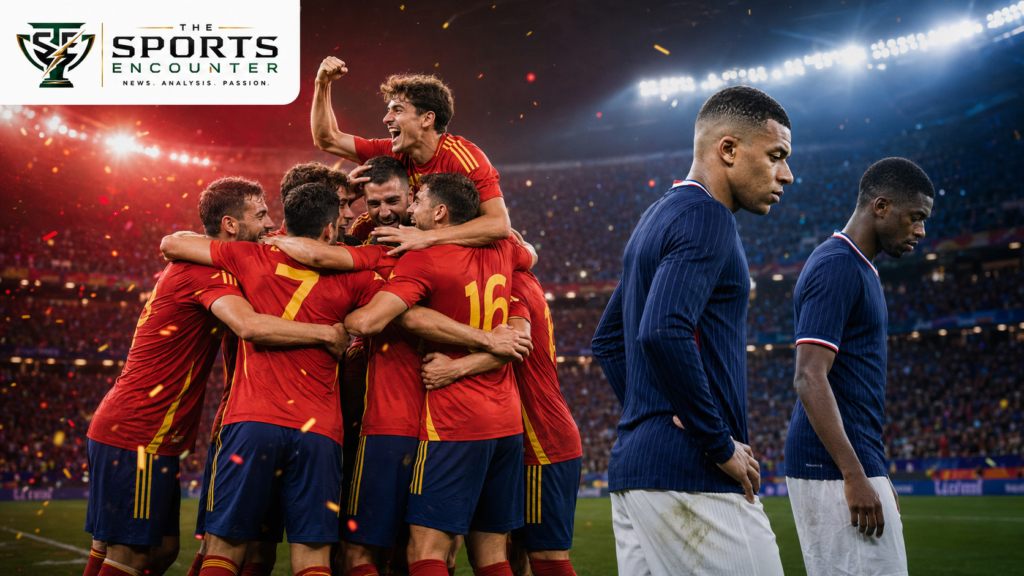
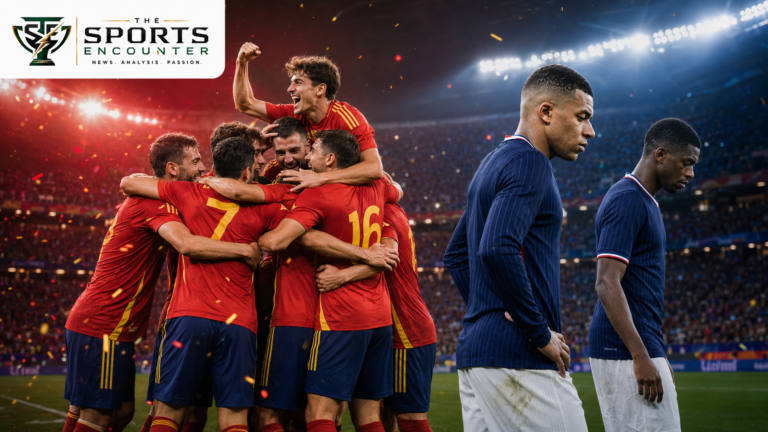
France arrived in Dallas chasing a third consecutive World Cup final with Kylian Mbappé and Ousmane Dembélé leading the tournament’s most feared attack. Ninety minutes later, both had been contained, Spain had completed a commanding 2-0 victory, and Didier Deschamps’ side were heading home without finding a convincing response.

Mikel Oyarzabal converted a disputed first-half penalty before Pedro Porro completed a slick passing move in the 58th minute. Spain then defended their advantage with discipline, awareness, and an exceptional performance from goalkeeper Unai Simón.

The result sends La Roja into their second World Cup final and their first since winning the trophy in 2010. They will face the winner of Argentina’s semifinal against England on July 19.

Spain’s victory also confirmed the defensive strength highlighted in our France vs Spain semifinal preview. France possessed the bigger individual names in attack. Spain controlled where, when, and how those players received the ball.

Follow the tournament through The Sports Encounter’s FIFA World Cup 2026 coverage and our broader soccer news and analysis.

TL;DR

  • Spain beat France 2-0 in the first FIFA World Cup 2026 semifinal.
  • Mikel Oyarzabal converted a 22nd-minute penalty after Lucas Digne caught Lamine Yamal inside the box.
  • Pedro Porro doubled Spain’s lead in the 58th minute after combining with Dani Olmo.
  • Yamal had a potential third goal disallowed for offside three minutes later.
  • Unai Simón repeatedly left his penalty area to deny Mbappé and controlled Spain’s defense superbly.
  • Adrien Rabiot, Mbappe and Marc Cucurella received yellow cards. No red cards were issued.

France vs Spain Semifinal Scorecard

DetailInformation
MatchFrance vs Spain, FIFA World Cup 2026 semifinal
ResultSpain won 2-0
VenueDallas Stadium, Arlington, Texas
DateJuly 14, 2026
GoalscorersMikel Oyarzabal 22’ penalty, Pedro Porro 58’
Disallowed GoalLamine Yamal, 61’, offside
Yellow CardsFrance: Adrien Rabiot 9’; Kylian Mbappé 86’; Spain: Marc Cucurella 31’,
Red CardsNone
Top PerformerUnai Simón, commanding goalkeeping and proactive defensive coverage
Turning PointOyarzabal’s first-half penalty gave Spain control of the semifinal
What It MeansSpain reached their first World Cup final since 2010
Next MatchSpain vs Argentina or England, World Cup final, July 19

Spain Take Control Before the First Hydration Break

The opening minutes revealed how Spain intended to manage the semifinal. Rodri remained available beneath the first line of French pressure, while Dani Olmo, Fabián Ruiz, and Álex Baena kept offering passing angles between the lines.

France spent long stretches chasing possession. Whenever Deschamps’ midfield moved forward, Spain found the spare player and moved the ball into another area. Their passes carried purpose, and their positioning made the field feel wider than it was.

The breakthrough came in the 22nd minute. Digne misjudged a defensive header and attempted to hook the ball clear without seeing Yamal moving behind him. His raised boot caught the Spanish winger, and referee Iván Barton immediately pointed to the penalty spot.

France protested, with Mbappé appearing to argue that the ball had touched Yamal’s arm before the contact. Barton did not visit the pitchside monitor. However, the VAR team checked the incident and allowed the original decision to stand.

That distinction matters. The referee did not refuse a VAR check altogether. He chose not to conduct an on-field review because the video officials found no clear and obvious error that required intervention.

Debate will continue over whether Yamal deliberately moved into the path of Digne’s attempted clearance. The defender still caught him high inside the penalty area, giving the officials sufficient grounds to uphold the call.

Oyarzabal showed no concern about the controversy. He drove the penalty beyond Mike Maignan to preserve his perfect record across his last six spot kicks and score his fifth goal of the tournament.

France Spend the First Half Chasing Shadows

France needed a quick tactical response after falling behind. Instead, their attacking structure became increasingly disconnected.

Mbappé struggled to receive the ball facing Spain’s goal. Dembélé found little room between the defensive and midfield lines, while Bradley Barcola fired over after choosing a difficult shot instead of using Digne’s overlapping run.

William Saliba’s injury added to France’s problems. The central defender left the field around the half-hour mark, forcing Maxence Lacroix into a semifinal that was already moving at Spain’s pace.

Rabiot’s early yellow card also weakened France’s midfield aggression. Deschamps removed him at halftime after another late challenge placed him at risk of a second booking.

Spain’s possession and pass completion reflected their control, but their movement mattered even more. Olmo repeatedly appeared in pockets France failed to close. Yamal stretched Digne on the right, while Oyarzabal’s positioning occupied both central defenders.

France reached halftime without creating a sustained period of pressure. Mbappé and Dembélé remained peripheral, and Spain looked far more likely to score the next goal.

Pedro Porro Finishes Spain’s Best Move

Spain carried the same authority into the second half. France needed urgency, yet La Roja continued moving the ball with greater clarity.

The second goal arrived in the 58th minute after an attack that briefly appeared to have broken down. Spain recycled possession rather than forcing a hopeful delivery. Porro played a sharp give-and-go with Olmo, broke into the penalty area, and guided his finish past Maignan into the bottom corner.

That sequence captured the difference between the teams. Spain trusted their positioning and combinations. France waited for an individual player to create something outside the normal flow of the game.

Three minutes later, Yamal appeared to make it 3-0 with a curling finish. The offside flag correctly ruled out the goal, offering France a narrow escape from an even heavier semifinal defeat.

Spain’s knockout journey had already shown their patience. A late winner eliminated Portugal before another composed performance carried them past Belgium, detailed in our report on Spain’s quarterfinal victory over Belgium. Against France, that patience developed into complete tactical control.

Unai Simón Plays the Semifinal as Spain’s Extra Defender

Spain’s defense deserved as much credit as the goalscorers. Cucurella, Aymeric Laporte, Pau Cubarsí, and Porro tracked France’s runners closely, denied central spaces, and rarely allowed Mbappé or Dembélé to receive the ball in comfortable positions.

Simón completed the structure behind them.

The Spanish goalkeeper repeatedly recognized danger before France could turn it into a shot. His best first-half intervention came when Rabiot released Mbappé through the middle. Simón raced beyond his penalty area and cleared the ball with perfect timing.

Similar decisions followed after halftime. He attacked through balls, claimed crosses, and narrowed angles whenever France threatened to move behind Spain’s back line.

Mbappé forced him into action from a tight angle during France’s brief spell of second-half pressure. Simón stayed composed and protected the clean sheet.

His performance combined goalkeeping, anticipation, and defensive leadership. Spain’s high line could operate confidently because their goalkeeper read the space behind it so well. That complete awareness made him the strongest candidate for Player of the Match.

France’s Biggest Weapons Find No Space

Mbappé entered the semifinal level with Lionel Messi on eight goals in the Golden Boot race. Dembélé had scored in France’s 2-0 quarterfinal win over Morocco. Neither player could influence this match consistently.

Spain surrounded Mbappé whenever he moved inside and trusted Porro to follow him when he drifted wide. Dembélé faced similar pressure, with Rodri and Ruiz denying the central combinations France usually use to accelerate attacks.

Deschamps introduced Désiré Doué and Manu Koné, but the substitutions did not change the underlying problem. France lacked coordinated movement around the ball. Their most dangerous players kept receiving possession in crowded or unfavorable areas.

For the first time since their 2-0 group-stage defeat against Mexico in 2010, France lost a World Cup match by a two-goal margin. Their previous knockout exits had been decided by one goal, extra time, or penalties.

Spain Return to the World Cup Final

Spain’s route to the final has grown stronger with every knockout round. They eliminated Portugal through late discipline, survived Belgium’s attacking threat, and then produced their most complete performance against the world’s top-ranked team.

The same control that ended Cristiano Ronaldo and Portugal’s World Cup run now carried Spain past Mbappé and France.

Luis de la Fuente’s side will enter the final with six clean sheets from seven matches, a midfield capable of controlling tempo, and enough variety to score through forwards, midfielders, or advancing defenders.

France leave Dallas with a far less comfortable assessment. Their run to the semifinal confirmed their depth and quality, but Spain exposed how dependent their attack remains on isolated moments from elite individuals.

La Roja played with the stronger structure, sharper awareness, and greater collective confidence. A place in the World Cup final became the natural reward.
Miley Rumer is a St. Clairsville, Ohio-based sports journalist and The Sports Encounter’s U.S. correspondent, covering the NHL, NBA, NFL, MLB, MLS, and major sporting stories across North America. Her work focuses on player performance, team identity, rivalries, roster decisions, tournament developments, and the human stories that shape how fans experience sport. At The Sports Encounter, Miley contributes breaking news, match coverage, analysis, and feature stories across American and international sport, including major soccer and tennis events. Her reporting combines clear news judgment with performance context, historical perspective, and an understanding of the fan conversations surrounding teams and athletes. Based in the United States, she brings a grounded North American perspective to coverage of the leagues, competitions, and personalities driving global sports interest.

Breaking News

Carlos Alcaraz Returns with a Win as Travis Scott and Nike Turn His US Open Comeback Into a Cultural Event

Carlos Alcaraz returned to singles after four months out and beat Roman Safiullin in straight sets while debuting a Travis Scott x Nike look that brought fashion, celebrity and elite tennis together at the US Open.

Ruben Santos | The Sports Encounter

Published

on

Carlos Alcaraz celebrates during his US Open 2026 first-round win over Roman Safiullin while wearing a Travis Scott x Nike Cactus Jack tennis outfit.

Carlos Alcaraz returned to Grand Slam singles competition on Monday and immediately reminded New York why his presence matters far beyond the scoreline.

The defending US Open champion defeated Roman Safiullin 6-4, 6-4, 6-4 on Arthur Ashe Stadium in his first singles match since April, completing a controlled first-round victory after a four-month absence caused by a right wrist injury.

But the return carried another layer.

Alcaraz walked onto court in a new Travis Scott x Cactus Jack x Nike look that transformed his comeback into part tennis match, part fashion launch and part cultural event.

Travis Scott watched from Alcaraz’s player box.

The Spaniard wore a brown ombré tank top, matching shorts and a special edition of the Nike Vapor 12 featuring Cactus Jack branding and Scott’s signature reverse Swoosh.

The shoes, reported as the Travis Scott x Cactus Jack x Nike Zoom Vapor 12 HC in a pale ivory and cacao colorway, are expected to receive a wider release later this year.

Then Alcaraz did the more important part.

He won.

The official ATP Tour match report confirmed that the 23-year-old defeated Safiullin in two hours and 22 minutes, saving five of six break points and producing a 95 mph forehand winner during a performance that became increasingly convincing as the match progressed.

The US Open’s official tournament coverage also highlighted the unusual challenge facing Alcaraz this fortnight: no man has won the US Open in the hard-court era without playing at least one North American hard-court tournament between Wimbledon and New York.

Alcaraz vs Safiullin: Match at a Glance

Category Carlos Alcaraz Roman Safiullin
Result Won Lost
Score 6-4, 6-4, 6-4 4-6, 4-6, 4-6
Round First Round First Round
Match time 2 hours, 22 minutes
Break points faced 6 Not used as a headline metric
Break points saved 5 Not used as a headline metric
Next opponent Jaime Faria Eliminated

The First Question Was Never the Outfit

Alcaraz’s appearance attracted immediate attention.

The hair was different.

The kit was different.

The shoes were different.

Travis Scott was sitting in the box.

None of that would have mattered much if Alcaraz had looked physically compromised.

His wrist has shaped the entire second half of his 2026 season.

The defending champion had not played a singles match since April.

He missed the clay and grass stretches that normally provide some of the most important competitive weeks of his year.

The Sports Encounter’s US Open 2026 curtain-raiser identified Alcaraz’s wrist as one of the tournament’s central uncertainties long before the first round began.

Our full US Open draw analysis added another layer: Safiullin was not a ceremonial first-round opponent. He had beaten Alcaraz in their first meeting at the Paris Masters in 2023.

That made Monday less about style and more about whether the defending champion still looked like himself.

Alcaraz Looked Cautious Before He Looked Comfortable

The opening stages were measured.

Alcaraz played with white strapping on his right arm.

His serving and forehand appeared controlled rather than fully unleashed early in the match.

That was understandable.

Four months away from singles competition is not something a player erases during the warm-up.

Timing has to return.

Trust in the body has to return.

Players recovering from wrist problems often face an additional mental test because the forehand and serve repeatedly expose the injured area to high-speed load.

Alcaraz gradually began hitting through the court with more freedom.

The clearest sign arrived when he fired a 95 mph forehand winner to break Safiullin in the seventh game.

Arthur Ashe Stadium responded immediately.

The crowd had arrived expecting the defending champion.

That shot looked much closer to him.

Safiullin Had Chances, but Alcaraz Managed the Important Points

Safiullin was never completely overwhelmed.

The Russian created six break-point opportunities.

Alcaraz saved five.

That number matters because return matches often become difficult when pressure accumulates around the recovering player’s serve.

A poor service game can quickly create hesitation.

Alcaraz repeatedly avoided that sequence.

He did not need his most spectacular tennis.

He needed enough precision at the important moments.

Three identical 6-4 sets eventually produced a scoreline that looked routine.

The path was useful precisely because it was not completely effortless.

Four Months Away, Then Straight Back Into Arthur Ashe Stadium

There was no gentle re-entry into singles competition.

Alcaraz did not return at a smaller event.

He did not use Montreal or Cincinnati to build match rhythm.

His first singles match since April came inside the largest tennis stadium in the world while defending a Grand Slam title.

The Sports Encounter’s men’s US Open title-race analysis described Alcaraz as the major uncertainty in a draw already reshaped by Jannik Sinner’s withdrawal and Novak Djokovic’s pursuit of a 25th Grand Slam title.

Monday provided the first actual evidence.

The evidence was encouraging.

The Travis Scott Collaboration Made the Return Feel Bigger Than Tennis

Alcaraz has always been unusually comfortable as both athlete and public figure.

That quality has become increasingly valuable in a sport searching for personalities capable of reaching younger audiences beyond traditional tennis followers.

The Travis Scott partnership pushed that crossover into another space.

Shortly before Alcaraz’s match, Nike released a promotional video featuring Scott and Alcaraz.

The collaboration then moved directly from advertising into live competition.

Alcaraz appeared in the Cactus Jack-designed kit on Arthur Ashe.

Scott watched courtside.

The footwear became instantly visible to television audiences and photographers covering the match.

That timing made the product launch difficult to separate from the sporting comeback.

The Shoes Were Built Around Nike’s Vapor 12 Platform

The special footwear is based on Nike’s Vapor 12 performance tennis line.

Nike describes the Vapor 12 hard-court shoe as a model designed around lighter construction, Air Zoom cushioning, lateral stability and traction for aggressive movement.

The Travis Scott version adds the visual language associated with Cactus Jack.

The reverse Swoosh is the most recognizable element.

The pale ivory and cacao styling also moved far away from the more traditional white tennis-shoe aesthetic that has dominated Grand Slam fashion for generations.

This was performance footwear presented as culture.

The US Open Has Become the Perfect Stage for This Kind of Collaboration

New York has always allowed tennis to behave differently.

Wimbledon protects tradition.

Roland Garros has its own visual identity.

The US Open has long been the major where crowd energy, celebrity attendance, music, fashion and sport overlap most naturally.

That environment made Alcaraz’s Cactus Jack debut feel less like a distraction and more like part of the tournament’s identity.

The Sports Encounter’s feature on Roger Federer’s New York return explored the same idea from another direction: Arthur Ashe Stadium has become a place where tennis history and entertainment culture regularly occupy the same night.

Alcaraz represents the younger version of that crossover.

He Had Already Tested the Fashion Direction in Mixed Doubles

The Cactus Jack look was not Alcaraz’s first unusual outfit of the tournament.

During the US Open’s redesigned mixed doubles event, he wore a purple-and-orange Nike jersey while partnering Serena Williams.

That pairing was already one of the tournament’s biggest celebrity attractions.

Our US Open mixed-doubles coverage documented how the new format brought together major singles stars and established doubles players, including Alcaraz and Williams, Novak Djokovic and Aryna Sabalenka, and several other high-profile partnerships.

The tournament has deliberately embraced crossover appeal.

Alcaraz is becoming one of its most natural vehicles.

The Clothing Changed, but the Tennis Identity Did Not

The most useful observation from Monday was how little the broader spectacle seemed to affect Alcaraz once the match settled.

There were cameras focused on the shoes.

There were cameras focused on Scott.

There was conversation about the kit.

There was still a dangerous opponent on the other side of the net.

Alcaraz gradually reduced all of it to tennis.

That is a skill in itself.

Modern elite athletes increasingly carry responsibilities far beyond competition.

They launch products.

They appear in campaigns.

They become global lifestyle brands.

The successful ones still have to separate commercial noise from competitive focus when play begins.

Alcaraz Is Trying to Break a 48-Year US Open Pattern

The physical challenge remains significant.

The US Open’s own research identified something remarkable before Monday’s match.

Every men’s champion since the tournament switched to hard courts in 1978 had played at least one North American hard-court event between Wimbledon and the US Open.

That streak covers 48 consecutive champions.

Alcaraz skipped the entire summer hard-court swing while recovering from injury.

If he successfully defends his title, he will become the first man of the hard-court era to win New York without that preparation.

That gives his comeback a historical dimension unrelated to clothing, sneakers or celebrity.

The Absence From Cincinnati Looks Even More Important Now

Most US Open contenders arrived in New York after accumulating meaningful hard-court matches.

The Sports Encounter’s Cincinnati men’s wrap showed Arthur Fils arriving at the US Open with a Masters 1000 title and substantial competitive momentum.

Others had used Montreal or Cincinnati to test form, fitness and tactics.

Alcaraz had none of that.

He entered New York with training rather than tournament evidence.

Monday was therefore not only a first round.

It was his first real hard-court examination of the summer.

The Match Also Strengthened an Already Remarkable Major Record in 2026

Alcaraz improved to 8-0 in Grand Slam matches this season.

He began the year by completing the Career Grand Slam at the Australian Open.

The wrist injury then interrupted the momentum that should have carried him through Roland Garros and Wimbledon.

His season therefore contains a strange contrast.

When available at a major, he has not lost.

The problem has been availability itself.

New York now becomes a test of whether his body can remain reliable for seven rounds.

Winning One Match Does Not Answer the Wrist Question

The straight-sets victory is encouraging.

It is not a medical clearance for the next two weeks.

Grand Slam stress accumulates.

Best-of-five tennis exposes the body differently from one controlled opening-round match.

Longer rallies, late-night scheduling, consecutive matches and increasingly dangerous opponents create new physical demands.

Alcaraz showed no obvious signs of serious physical trouble against Safiullin.

The tournament still needs more evidence.

Jaime Faria Comes Next

Alcaraz will face Jaime Faria in the second round.

Faria advanced after defeating American Jenson Brooksby.

On paper, Alcaraz will be expected to move forward.

The more important question may be whether he can continue increasing his physical intensity without producing a reaction in the wrist.

The ideal early rounds for a returning champion are not necessarily spectacular.

They are efficient.

Every unnecessary hour avoided now may matter later.

The Men’s Draw Has Already Changed Around Him

Alcaraz returned to a US Open that had already lost one of its biggest names.

Novak Djokovic was stunned by Mariano Navone in five sets in one of the tournament’s biggest opening-round shocks.

The Sports Encounter has been tracking that rapidly changing field through its August 27 US Open wrap and August 28 qualifying wrap.

Jannik Sinner’s withdrawal had already altered the hierarchy.

Djokovic’s exit changed it again.

Every round Alcaraz survives now carries greater significance.

Sabalenka Also Began Her Title Defense With a Win

Day Two was not only about Alcaraz.

Aryna Sabalenka opened her attempt to win a third consecutive US Open title by defeating Camila Osorio 6-2, 6-4.

Her result continued a tournament in which defending champions on both sides began successfully despite arriving with different pressures.

Sabalenka entered New York after an uneven North American summer.

The Sports Encounter’s Cincinnati round-of-16 analysis covered her defeat to Sara Bejlek shortly before the US Open.

Alcaraz arrived with almost no recent singles match play.

Both passed their opening tests.

Alcaraz Is Becoming One of Tennis’ Most Valuable Cultural Bridges

This is where the Travis Scott collaboration becomes more meaningful than a sneaker story.

Tennis has spent years trying to broaden its cultural reach.

It wants younger audiences.

It wants relevance beyond Grand Slam finals.

It wants athletes who can exist inside fashion, music and entertainment without weakening the sport itself.

Alcaraz has increasingly become that athlete.

His tennis remains the foundation.

Seven Grand Slam titles provide the credibility.

His personality, movement, style and willingness to experiment make the commercial layer easier to build around him.

Travis Scott Brings a Different Audience to Tennis

Scott’s involvement matters because Cactus Jack operates in a cultural space that reaches far beyond traditional tennis consumers.

The reverse-Swoosh Nike collaborations have become recognizable streetwear products.

Moving that design language into a performance tennis shoe creates an unusual bridge.

People who may never follow ATP rankings can still recognize the collaboration.

Tennis fans who would never track sneaker launches suddenly encounter Cactus Jack during a Grand Slam match.

That overlap is valuable to Nike.

It can also be valuable to tennis.

The Bigger Test Is Whether Performance Keeps Supporting the Brand

Fashion partnerships work best when the athlete remains competitive enough to make the product feel connected to elite performance.

Alcaraz understands that equation better than most.

If he loses early, the kit becomes a memorable first-round fashion moment.

If he reaches the second week, every match extends the visibility.

If he wins the tournament, the shoes become associated with a historic title defense after a four-month injury absence.

The commercial stakes therefore rise alongside the sporting ones.

Arthur Ashe Has Become Alcaraz’s Most Natural Stage

Alcaraz has a deep relationship with New York.

He won his first Grand Slam title here.

He became the youngest men’s world No. 1 after that breakthrough.

He returned as defending champion in 2026 carrying another layer of expectation.

The arena suits him.

The noise suits him.

The late-night atmosphere suits him.

Even the fashion experimentation makes more sense here than it would at most other tournaments.

TSE Analysis: The Return Was Bigger Than the Outfit, but the Outfit Was Part of the Return

It would be easy to dismiss the Travis Scott collaboration as decoration around a tennis match.

That misses what elite sport increasingly looks like.

Modern stars do not arrive at major events carrying only rackets and rankings.

They arrive carrying brands, campaigns, commercial partnerships and cultural identities.

The question is whether any of that interferes with performance.

For one round, Alcaraz handled both worlds comfortably.

He arrived wearing one of the most discussed tennis looks of the tournament.

He had one of the world’s biggest musicians sitting in his box.

He was returning from four months away.

He was defending a Grand Slam title.

He faced an opponent who had beaten him before.

He won 6-4, 6-4, 6-4.

That is why the day worked.

The collaboration created attention.

The tennis justified it.

Final Verdict

Carlos Alcaraz returned to US Open singles competition with a straight-sets victory over Roman Safiullin and moved into the second round without showing any obvious physical breakdown from the wrist injury that had kept him away since April.

The performance was controlled rather than spectacular.

That may have been exactly what he needed.

He saved five of six break points.

He gradually increased his forehand intensity.

He avoided a long opening-round battle.

He improved to 8-0 in Grand Slam matches this season.

And he did it while debuting a Cactus Jack x Nike look designed with Travis Scott, turning the defending champion’s return into one of the first major crossover moments of the 2026 US Open.

The shoes generated attention.

The straight-sets win generated something more valuable.

Evidence.

Alcaraz is back on court.

Now New York gets to discover how far back he really is.

Frequently Asked Questions

Did Carlos Alcaraz win his first match at the 2026 US Open?

Yes. Alcaraz defeated Roman Safiullin 6-4, 6-4, 6-4 in the first round.

How long was Carlos Alcaraz out before the US Open?

Alcaraz had not played a singles match since April because of a right wrist injury.

What shoes did Carlos Alcaraz wear at the 2026 US Open?

He debuted a Travis Scott x Cactus Jack x Nike Zoom Vapor 12 HC design in a pale ivory and cacao colorway featuring the reverse Swoosh associated with Scott’s Nike collaborations.

Was Travis Scott at Carlos Alcaraz’s match?

Yes. Travis Scott watched Alcaraz’s first-round victory from the Spaniard’s player box at Arthur Ashe Stadium.

Who does Carlos Alcaraz play next?

Alcaraz will face Jaime Faria in the second round.

How many Grand Slam matches has Alcaraz won in 2026?

His victory over Safiullin improved his Grand Slam record for the season to 8-0.

Continue Reading

Breaking News

Barcelona Beat Rayo Vallecano 5-2 as Raphinha and Lamine Yamal Turn a Real Test Into Another Statement

Raphinha and Lamine Yamal scored twice each as Barcelona beat Rayo Vallecano 5-2, surviving two real tests before pulling away late at the Camp Nou.

Jovana Zlatova | The Sports Encounter

Published

on

Raphinha and Lamine Yamal celebrate during Barcelona’s 5-2 La Liga victory over Rayo Vallecano at the Camp Nou.

Barcelona have started the 2026-27 La Liga season by scoring five goals twice in three matches, but Monday night’s 5-2 victory over Rayo Vallecano revealed considerably more about Hansi Flick’s team than another large scoreline might suggest.

Rayo scored first.

They scored twice.

They put every one of their six shots on target.

For a period after halftime, Barcelona’s lead had been reduced to 3-2 and the contest remained alive.

Then Barcelona accelerated again.

Raphinha scored his second goal of the night in the 71st minute before Lamine Yamal added his second in the 90th, completing a 5-2 victory at the Spotify Camp Nou that moved the defending champions to nine points from their opening three league matches.

Barcelona finished with 70% possession, 634 passes at 92% accuracy, 18 shots and six attempts on target. Rayo produced only nine shots but made their opportunities count, putting six on target and twice forcing Barcelona to respond rather than simply control the match.

The official La Liga match center confirmed Barcelona’s scorers as Raphinha in the 19th and 71st minutes, Lamine Yamal in the 21st and 90th, plus Florian Lejeune’s 51st-minute own goal. Sergio Camello scored both Rayo goals in the 12th and 59th minutes.

Barcelona vs Rayo Vallecano: Match at a Glance

Category Barcelona Rayo Vallecano
Final score 5 2
Shots 18 9
Shots on target 6 6
Possession 70% 30%
Passes 634 283
Pass accuracy 92% 79%
Fouls 4 11
Yellow cards 0 1
Offsides 3 4
Corners 9 5

Rayo Scored First and Immediately Changed the Match

Barcelona’s opening two league victories had created an early image of control.

They demolished Elche 5-0 and then beat Athletic Club 2-0 without conceding.

The Sports Encounter’s opening La Liga weekend analysis highlighted how Barcelona had entered the season looking much more settled than several of their rivals, while our Barcelona vs Athletic Club analysis showed a different kind of dominance built around sustained possession and chance creation.

Rayo refused to follow either script.

Sergio Camello scored after only 12 minutes.

Barcelona were suddenly behind for the first time in the league this season.

That created an immediate tactical test.

Rayo could defend with a lead rather than simply survive Barcelona’s early possession. Their wide players could stay compact, their midfield could protect the central lanes and Camello could remain available whenever possession changed.

Barcelona’s response came quickly.

Raphinha Responded in Seven Minutes

Raphinha equalized in the 19th minute.

Seven minutes after falling behind, Barcelona had restored the match to level terms.

The Brazilian’s goal extended a remarkable start to the campaign.

Raphinha scored twice in the 5-0 win over Elche and then opened the scoring against Athletic Club.

Monday’s brace pushed him even further into the center of Barcelona’s early title defense.

His influence has not depended on remaining in one attacking lane.

Raphinha moves inside when Barcelona need another runner around the box, attacks space behind defensive lines and presses aggressively after turnovers.

Against Rayo, he also became Barcelona’s answer whenever the match threatened to become uncomfortable.

Raphinha’s Early La Liga Scoring Run

Match Goals
Elche vs Barcelona 2
Barcelona vs Athletic Club 1
Barcelona vs Rayo Vallecano 2
Total 5

Five goals in three league appearances gives Barcelona an attacker producing at an exceptional early rate without requiring the entire structure to be built around him.

Lamine Yamal Needed Only Two More Minutes

Barcelona had barely finished celebrating the equalizer when Lamine Yamal made it 2-1 in the 21st minute.

The sequence captured something that is becoming increasingly difficult for opponents to manage.

Stopping one Barcelona attacker does not end the danger.

Raphinha can hurt a defense from one side.

Yamal can immediately attack another.

Pedri can move the ball through midfield.

Anthony Gordon gives Flick another direct runner.

Fermín López and Karim Adeyemi can arrive later from the bench.

Yamal’s role carries particular weight after his development through the summer. The Sports Encounter’s deep look at Lamine Yamal’s World Cup 2026 examined how the teenager became comfortable influencing matches even when opponents built entire defensive plans around him.

That experience is now feeding directly into Barcelona’s season.

Barcelona Controlled the Ball, but Rayo Kept Finding Dangerous Moments

The possession numbers strongly favored Barcelona.

Seventy percent of the ball and 634 completed passing attempts tell their own story.

The more revealing number was six.

Rayo registered six shots on target from only nine total attempts.

Barcelona also recorded six shots on target despite attempting twice as many shots.

Rayo therefore did not create volume.

They created efficiency.

That is where Barcelona’s defensive performance deserves scrutiny despite the eventual three-goal margin.

Flick’s aggressive positioning naturally leaves space when possession is lost badly. Fullbacks move forward, midfielders occupy advanced areas and Barcelona often defend with significant territory behind them.

Rayo repeatedly tried to access those spaces quickly instead of attempting to compete through long periods of possession.

Lejeune’s Own Goal Looked Like the Break Barcelona Needed

Barcelona reached halftime 2-1 ahead.

They then received help almost immediately after the restart.

Florian Lejeune turned the ball into his own net in the 51st minute, extending Barcelona’s lead to 3-1.

At that point the match appeared close to settled.

Barcelona had the ball.

They had a two-goal cushion.

Rayo were being asked to chase a team built to punish opponents who open space.

The visitors did something important instead.

They scored again.

Sergio Camello Made It 3-2 and Put Barcelona Under Pressure Again

Camello’s second goal arrived in the 59th minute.

Unai López delivered from the corner and Camello headed beyond Joan García.

Barcelona’s two-goal advantage had lasted only eight minutes.

Suddenly, Flick’s side had to manage a one-goal match again.

This was the most useful section of the night from an analytical perspective.

Barcelona had spent much of their opening league week playing with control and scoreboard comfort.

Rayo created uncertainty.

Another goal would have made it 3-3.

Another defensive transition could have changed the entire atmosphere inside the Camp Nou.

Barcelona did not retreat.

Flick Changed the Midfield Before the Decisive Fourth Goal

Fermín López and Rodri entered in the 64th minute for Dani Olmo and Marc Bernal.

The substitutions gave Barcelona fresh movement and greater control around the middle of the pitch.

Rodri’s summer arrival has added another dimension to Flick’s options. Our analysis of Rodri’s move from Manchester City to Barcelona focused on exactly this type of situation: moments when Barcelona need to regain structure without abandoning their attacking ambition.

Seven minutes after the double substitution, Barcelona restored their two-goal lead.

Raphinha’s Second Goal Was the Match-Breaker

The decisive fourth goal came from transition rather than long possession.

Anthony Gordon carried Barcelona forward during a fast break and supplied Raphinha on the left.

Raphinha finished across goal in the 71st minute.

Barcelona led 4-2.

Rayo had spent much of the night trying to use transition moments against Barcelona.

This time Barcelona reversed the equation.

Once Rayo had to commit more players forward, Barcelona’s own speed became harder to contain.

Gordon’s contribution also continued an encouraging start following his arrival. Barcelona’s attack now contains several players who can threaten open grass rather than relying entirely on patient positional combinations.

Karim Adeyemi Helped Yamal Finish the Night

Adeyemi replaced Gordon in the 77th minute.

His most important contribution came in the final minute of regulation.

The German forward supplied Yamal, who struck from outside the penalty area to make it 5-2.

It was Yamal’s second goal of the match and another example of Barcelona’s depth changing the nature of games late.

Adeyemi does not need to start every match to influence them.

His acceleration against tired defenders creates a completely different problem after opponents have already spent an hour dealing with Yamal, Raphinha and Gordon.

Barcelona’s Attack Has Scored 12 Goals in Three League Matches

The numbers are beginning to become difficult to ignore.

Match Result
Elche vs Barcelona Barcelona won 5-0
Barcelona vs Athletic Club Barcelona won 2-0
Barcelona vs Rayo Vallecano Barcelona won 5-2
Three-match total 12 goals scored, 2 conceded

Nine points from nine is the obvious reward.

Twelve goals show the scale of the attacking production.

The interesting part is how those goals have arrived.

Barcelona overwhelmed Elche.

They patiently controlled Athletic.

Against Rayo, they twice had to respond to an opponent scoring and then finish the match through their own attacking depth.

This Barcelona Team Has More Ways to Attack Than Last Season

Flick’s squad has changed substantially.

Rodri has joined the midfield.

Anthony Gordon adds another direct wide threat.

Adeyemi offers explosive pace.

João Cancelo has returned permanently, a move we examined in our analysis of Cancelo’s Barcelona deal through 2029.

The important part is how the profiles complement rather than duplicate one another.

Rodri controls.

Pedri manipulates space.

Yamal isolates defenders.

Raphinha attacks depth and presses.

Gordon carries directly.

Adeyemi stretches the field.

Fermín attacks the penalty area.

Flick can now change the type of threat without changing Barcelona’s overall identity.

Yamal Is No Longer Simply Barcelona’s Great Young Prospect

Yamal’s two-goal night reinforces a transformation that has been happening for some time.

He is still only 19.

His responsibilities are no longer those normally assigned to a teenager.

Barcelona expect him to decide matches.

Spain expected the same during their World Cup-winning summer.

His emergence has inevitably invited comparisons with the club’s past, something The Sports Encounter explored in From Messi to Yamal, 19 Years Ago.

The useful comparison now is not stylistic.

It is about responsibility.

Barcelona are comfortable placing major attacking moments in Yamal’s hands.

Rayo Deserve More Credit Than a 5-2 Defeat Usually Receives

Seven goals can make a match look one-sided when viewed only through the result.

This one was not.

Rayo led after 12 minutes.

They reached halftime only one goal behind.

They responded to Lejeune’s own goal by making it 3-2.

They produced six shots on target from nine attempts.

Joan García had work to do.

Rayo’s problem came once the game opened late.

Chasing an equalizer against this Barcelona attack requires accepting risk.

Raphinha punished it.

Yamal punished it again.

The final score grew much larger than the gap had felt during significant portions of the match.

Rayo’s 30% Possession Was Part of the Plan, Not the Entire Problem

Possession alone did not decide the game.

Rayo were never likely to dominate the ball at the Camp Nou.

Their route depended on defending compactly and attacking quickly when Barcelona’s structure opened.

For nearly an hour, the approach gave them a pathway into the contest.

The deeper problem was sustainability.

Barcelona generated 18 shots, nine corners and enough territorial pressure that defending repeated phases eventually became exhausting.

Once Rayo needed a third goal, the spaces increased.

That is when Barcelona’s attacking depth became decisive.

The Defensive Warning Should Not Be Ignored

Barcelona have conceded only two league goals this season.

Both arrived here.

Both came from a Rayo team that produced only 30% possession.

Six shots on target from nine attempts should interest Flick more than the final three-goal margin.

A stronger opponent may create more opportunities from the same spaces.

That becomes particularly relevant with Champions League football approaching.

Barcelona host Feyenoord on September 9 according to the club’s official first-team schedule.

European opponents will study how Rayo escaped pressure and reached Barcelona’s goal with limited possession.

Barcelona Go Top After a Perfect Opening Three Games

Before kickoff, Real Madrid had already reached nine points with three victories.

Barcelona’s 5-2 win matched that perfect record while improving their goal difference.

Flick’s side have scored 12 and conceded two, giving them a goal difference of +10.

Real Madrid entered the night with 10 goals scored, two conceded and a +8 goal difference.

That puts Barcelona first after three matches.

The early title race is already producing contrasting stories.

Barcelona look like a defending champion extending an existing structure.

Real Madrid are building again under José Mourinho, whose evolving side was examined in our analysis of Madrid’s 4-1 victory over Real Sociedad.

Three matches cannot decide a championship.

They can reveal who has started ready.

Barcelona clearly have.

Flick Has Already Used Three Different Types of Victory

The opening week has become a useful study in Barcelona’s range.

Against Elche: Overwhelm

Barcelona scored five and never allowed the promoted side into the match.

Against Athletic Club: Control

Athletic resisted much longer, but Barcelona continued creating chances until their pressure eventually produced a 2-0 victory.

Against Rayo: Respond

Rayo scored first and then threatened again at 3-2.

Barcelona were required to recover momentum twice.

That third type may eventually matter most.

No championship season consists entirely of comfortable wins.

Barcelona’s Next Challenge Comes at Mestalla

Barcelona now travel to Valencia on September 6 before opening their Champions League campaign against Feyenoord three days later.

The schedule begins tightening immediately.

La Liga.

Champions League.

Then another league trip to Levante.

Squad depth will start becoming more important, especially after several Barcelona players went deep into the World Cup during the summer.

The club’s official standings page tracks a title defense that has begun with maximum points.

TSE Analysis: The Scoreline Was Impressive, the Response Was Better

Barcelona’s first five-goal victory of the season against Elche showed what happens when Flick’s attack dominates from beginning to end.

This 5-2 showed something different.

Rayo disrupted the game.

Camello scored before Barcelona had settled.

Barcelona responded through Raphinha and Yamal.

Lejeune’s own goal appeared to create separation.

Camello immediately reduced it again.

Barcelona then had to decide whether to protect 3-2 or continue attacking.

They continued attacking.

That decision ultimately produced the fourth and fifth goals.

There is still defensive work for Flick to examine. Allowing six shots on target from nine Rayo attempts is too efficient from the opponent’s perspective.

But championship teams are not measured only by whether problems appear.

They are measured by how many solutions they possess once those problems appear.

Barcelona had several.

Raphinha supplied two.

Yamal supplied two more.

Gordon created the fourth.

Adeyemi created the fifth.

Fermín and Rodri refreshed midfield.

Three matches into the season, Flick already has evidence that his squad can change the rhythm of a match from the bench without losing its attacking identity.

Final Verdict

Barcelona beat Rayo Vallecano 5-2 and moved to nine points from nine.

Raphinha scored twice.

Lamine Yamal scored twice.

Florian Lejeune’s own goal supplied the other.

Sergio Camello’s brace ensured the night was considerably more competitive than the final score suggests.

Barcelona finished with 70% possession, 18 shots, nine corners and 634 passes completed at 92% accuracy.

Rayo responded with only nine shots but put six on target.

The champions now have 12 league goals from three matches.

The attacking production is spectacular.

The more useful development may be that Barcelona have already been asked to win three different ways.

On Monday night, they discovered how to win after an opponent refused to disappear.

Frequently Asked Questions

What was the Barcelona vs Rayo Vallecano score?

Barcelona defeated Rayo Vallecano 5-2 at the Spotify Camp Nou on August 31, 2026.

Who scored for Barcelona against Rayo Vallecano?

Raphinha scored in the 19th and 71st minutes, Lamine Yamal scored in the 21st and 90th minutes, and Florian Lejeune scored an own goal in the 51st minute.

Who scored Rayo Vallecano’s goals?

Sergio Camello scored both Rayo goals, finding the net in the 12th and 59th minutes.

How many goals has Barcelona scored in La Liga this season?

Barcelona have scored 12 goals through their opening three league matches while conceding two.

How many points does Barcelona have?

Barcelona have nine points after winning all three of their opening La Liga matches.

Who does Barcelona play next?

Barcelona travel to Valencia on September 6 before hosting Feyenoord in the Champions League on September 9.

Continue Reading

Breaking News

Aaron Donald Changes the Rams’ Super Bowl Math as Will Levis Hits Free Agency in NFL Roster Reset

Aaron Donald’s comeback has strengthened the Rams’ Super Bowl case, while Will Levis has cleared waivers and entered free agency after Tennessee moved fully into the Cam Ward era.

Marcos Wetherfield | The Sports Encounter

Published

on

Aaron Donald returns to the Los Angeles Rams as former Tennessee Titans quarterback Will Levis enters NFL free agency after clearing waivers.

The final weekend before the 2026 NFL regular season produced two very different reminders of how quickly careers and championship windows can move.

Aaron Donald is back.

Will Levis is suddenly looking for another team.

Donald, one of the greatest defensive players in NFL history, has ended a two-season retirement and returned to the Los Angeles Rams at age 35. The announcement immediately intensified expectations around a roster already strengthened by the arrival of Myles Garrett and pushed even more betting action toward Los Angeles as the early Super Bowl LXI favorite.

Levis, meanwhile, cleared waivers Monday after the Tennessee Titans released their former second-round quarterback during final roster cuts. All 31 other teams declined the opportunity to claim him and assume the remainder of his contract, leaving the 27-year-old free to negotiate with any club.

The two developments are not directly connected by transaction.

They belong to the same moment in the NFL calendar.

One veteran has returned because he believes he can still perform at the highest level for a team built to win immediately.

Another former starting quarterback has been pushed onto the open market because his original team no longer sees him as part of its future.

With Week 1 approaching, the league is moving from projection to consequence.

NFL August 31: Two Careers Moving in Opposite Directions

Player Development 2026 Impact
Aaron Donald Returned from retirement to Los Angeles Rams Strengthens an already elite defensive front
Will Levis Cleared waivers after Tennessee release Becomes a free agent available to all 32 teams
Donald age 35 Returns after two seasons away
Levis career starts 21 5-16 record
Levis passing yards 3,899 61% career completion rate
Levis passing TDs 21 16 interceptions, 26 total turnovers
Donald career sacks 111 Returns as three-time Defensive Player of the Year
Rams Week 1 vs San Francisco 49ers September 10 in Melbourne

The Los Angeles Rams officially confirmed Donald’s return on August 30, while the Tennessee Titans confirmed Levis among their final roster cuts. The NFL’s official transaction system tracks the league-wide waiver and roster activity surrounding the final 53-man deadline.

Aaron Donald’s Return Has Already Changed the Rams’ Championship Conversation

Donald’s comeback had been building for weeks.

He trained at the Rams’ facility.

Sean McVay repeatedly acknowledged that Donald was following a serious conditioning program.

The team eventually held an official workout that had to be reported through NFL transaction procedures.

Our earlier analysis of Donald’s Rams workout argued that the story had moved beyond casual comeback speculation once he began working under official team conditions.

That possibility is now reality.

Donald officially unretired Sunday and returned to practice with the only NFL franchise he has ever represented.

The reaction has been immediate.

Sportsbooks reported increased money flowing toward Los Angeles after the announcement, with the Rams already positioned among the strongest Super Bowl favorites before Donald officially returned.

The excitement is understandable.

This is not a rebuilding roster hoping one veteran can create credibility.

Los Angeles was already positioned to contend.

Donald has joined a team that recently added Myles Garrett, creating the possibility of one of the most intimidating defensive fronts in football.

Donald and Garrett Could Create a Protection Nightmare

The football consequence is bigger than simply adding another pass rusher.

Offensive lines normally build protection plans around identifying the defender most capable of destroying a passing play before it develops.

Against the Rams, that calculation becomes much more difficult.

Garrett demands extra attention on the edge.

Donald has spent his career destroying protection from the interior.

Sliding protection toward one can create favorable one-on-one situations for the other.

Keeping a running back or tight end in protection reduces the number of receivers available in the passing concept.

Quarterbacks may also have less space to step forward if Donald still produces meaningful interior pressure.

The combination can affect an offense even before either defender records a sack.

Donald Believes He Can Still Be Aaron Donald

The comeback only makes sense if Donald believes he can still play at something close to his old level.

He has said exactly that.

Donald told reporters after returning that he would not be back if he did not believe he could still perform at a high level.

That confidence is important because he does not need football to complete his résumé.

He retired in March 2024 after 10 seasons, already carrying a career that included three Defensive Player of the Year awards, eight first-team All-Pro selections, 10 Pro Bowls and a Super Bowl championship.

There was nothing missing historically.

The motivation now is competitive rather than legacy repair.

The Numbers Donald Left Behind Were Already Hall of Fame Numbers

Donald returns with 154 regular-season appearances and 150 starts.

His career numbers include:

Category Aaron Donald
Regular-season games 154
Starts 150
Sacks 111.0
Total tackles 543
Tackles for loss 176
Quarterback hits 256
Forced fumbles 24
First-team All-Pro selections 8
Defensive Player of the Year awards 3

The Rams’ own updated player biography also credits Donald with 790 pressures across his regular-season career.

Those numbers explain why his comeback has altered expectations before he has taken a regular-season snap.

The Rams Were Already a Serious Super Bowl Team

Donald is not returning to the situation he left in 2024.

The Rams have continued changing around him.

Matthew Stafford remains central to the offense.

The front office has continued investing aggressively.

Myles Garrett’s arrival created one of the biggest defensive personnel moves of the offseason.

The franchise also remains one of the NFL’s most valuable organizations, ranking second behind Dallas in the latest valuation landscape covered in our analysis of the NFL’s $9.34 billion average franchise value.

Donald’s return therefore adds football power to an organization already operating from a position of financial and competitive strength.

Betting Markets Reacted Before Donald Played a Snap

The market response provides another measure of how seriously his return is being taken.

Los Angeles remained around +500 to win Super Bowl LXI at BetMGM following the announcement.

The more revealing movement came from betting distribution.

After Donald’s return became official, the Rams attracted approximately 22 percent of Super Bowl bets and 30 percent of money wagered during that period.

They were also positioned as favorites to win the NFC.

Betting markets do not predict football perfectly.

They do reveal where expectations and money are moving.

Donald’s return caused both to move toward Los Angeles.

There Is Still a Major Unknown: What Does a 35-Year-Old Donald Look Like After Two Years Away?

The excitement should not erase the obvious question.

Donald last played an NFL game after the 2023 season.

Two seasons away from professional football cannot be treated like an ordinary offseason.

Interior defensive line is also one of the most physically demanding positions on the field.

Donald will face double teams, 300-pound offensive linemen and repeated high-impact collisions.

His conditioning program may have kept him in extraordinary shape.

Game conditioning is different.

McVay and the Rams therefore face an important workload decision.

The smartest version of this comeback may not involve asking Donald to play every defensive snap.

It may involve preserving him for high-leverage passing downs, third downs and late-game situations where one interior rush can change a result.

Week 1 in Australia Becomes Even Bigger

The NFL regular season begins with a major international spotlight for Los Angeles.

The Rams face the San Francisco 49ers on September 10 at the Melbourne Cricket Ground.

Donald’s return transforms that game immediately.

A matchup that already carried divisional importance will now become the first live test of whether one of the league’s greatest defenders can reproduce meaningful NFL disruption after two seasons away.

The league’s international expansion and changing competitive landscape have become recurring themes in our NFL coverage, including the broader structural shift examined when the NFL ended the traditional Pro Bowl game while preserving Pro Bowl recognition.

While Donald Returns, Will Levis Has Lost His Place in Tennessee

Levis’ situation sits at the opposite end of the NFL cycle.

Tennessee selected him 33rd overall in the 2023 draft.

He threw four touchdown passes in his first NFL start and briefly looked capable of becoming the Titans’ long-term answer at quarterback.

The following seasons never produced enough stability.

Levis started 21 games for Tennessee.

He completed 61 percent of his passes for 3,899 yards and 21 touchdowns.

The turnovers became a major problem.

He committed 26 across those starts, including 16 interceptions.

The Titans went 5-16 with Levis starting.

Eventually, Tennessee stopped waiting.

Cam Ward Changed Levis’ Career in Tennessee

The Titans used the No. 1 overall pick to draft Cam Ward.

From that moment, Levis’ long-term position became increasingly difficult to defend.

Ward was no developmental quarterback being asked to sit behind a veteran.

He was drafted to become the franchise.

Our NFL preseason Week 1 analysis followed Ward’s difficult early outing against San Francisco, where he completed only five of 12 passes for 57 yards despite Tennessee winning the game.

The Titans nevertheless continued building around him.

Levis spent the previous season recovering from shoulder surgery after Ward had already replaced him as the starter.

Final roster cuts completed the transition.

Going Unclaimed Is the Most Revealing Part of the Levis Story

Being waived does not automatically mean a young quarterback has no market.

Another team can claim him.

Because Levis has fewer than four NFL seasons, all 31 other teams had the opportunity to add him through the waiver process and take over the remaining terms of his contract.

Nobody did.

The waiver period expired Monday.

Levis then became a free agent.

That does not mean his NFL career is over.

It does mean his market is different from what it would have been if another team had considered him valuable enough to claim immediately.

Why Teams May Prefer Levis as a Free Agent

The lack of a waiver claim should not necessarily be interpreted as 31 clubs deciding they have no interest.

Clearing waivers changes the negotiating structure.

Teams can now discuss a new contract instead of automatically inheriting the remaining terms of his Tennessee deal.

They can also define his role clearly before signing him.

That could appeal to clubs looking for a developmental backup rather than a quarterback expected to compete for an immediate starting job.

Levis still has traits NFL coaches value.

He has arm strength.

He has starting experience.

He has played under real pressure.

He remains young enough for another coaching staff to believe some of the decision-making issues can be improved.

The Next Team Has to Fix the Turnovers First

The central problem is straightforward.

Twenty-six total turnovers in 21 starts is too many.

Arm talent can create opportunities.

It cannot compensate indefinitely for possessions given away.

Levis frequently showed the confidence to attack windows downfield.

The same aggression sometimes produced decisions that placed Tennessee’s defense back on the field.

His next coaching staff must decide whether those mistakes came primarily from processing, mechanics, protection problems or an offensive environment that never settled around him.

The answer will determine whether his second NFL chapter becomes rehabilitation or another short stop.

Tennessee Has Fully Moved Into the Cam Ward Era

Waiving Levis eliminates any lingering debate around the quarterback hierarchy.

This is Ward’s team.

Tennessee has invested heavily in supporting that decision.

The offensive line includes Peter Skoronski, whose major contract extension became part of our preseason discussion around how the Titans are trying to build a safer environment for Ward.

The roster has also gone through repeated injury and depth adjustments, including the developments covered in our NFL injury roundup involving Titans receiver Elic Ayomanor.

The franchise has made its choice.

Ward now has to justify it.

Levis Was Not the Only Quarterback Pushed Onto the Market

The final roster deadline produced heavy quarterback movement across the NFL.

Nineteen quarterbacks were waived Sunday.

Tennessee also moved on from former Detroit Lions and University of Tennessee quarterback Hendon Hooker.

Miami waived Mark Gronowski and Cam Miller, both of whom also cleared waivers.

The Dolphins claimed former Missouri quarterback Brady Cook after previously trading Quinn Ewers to Jacksonville.

That volume shows how aggressively teams are evaluating backup quarterback spots before Week 1.

August depth-chart competitions stop being theoretical once rosters fall to 53.

The Waiver Wire Is Where Preseason Evaluation Becomes Real

The league spends July and August carrying expanded rosters.

Coaches can evaluate developmental players while protecting established starters.

The final cut changes everything.

Every roster place has an opportunity cost.

Adding one player often requires removing another.

The movement continued Monday as clubs claimed players discarded elsewhere.

Miami led the league with seven waiver claims.

Las Vegas held the first position in the waiver order because the order follows the 2026 draft sequence at this stage of the year.

Our late-preseason NFL roster roundup had already shown teams becoming increasingly aggressive with veteran signings and depth adjustments as Week 1 approached.

The final waiver cycle is the sharpest version of that process.

Donald Represents the Veteran Luxury Every Contender Wants

The Rams’ situation is almost the opposite.

Most teams reach the end of August wondering where they can find another useful defensive lineman.

Los Angeles added Aaron Donald.

He already knows McVay.

He knows the organization.

He knows the expectations.

There is no adaptation period involving a new city, locker room or defensive culture.

The only serious unknown is physical.

If Donald can still produce pressure, the Rams have added a rare championship-level player without sacrificing draft capital in a trade.

The Rams Have to Resist the Temptation to Treat Donald Like He Is 30

Donald’s reputation creates its own danger.

McVay knows what the old version could handle.

The Rams cannot automatically assume the returning version should carry the same workload.

Thirty-five is old for an NFL defensive tackle.

Two seasons away increase the uncertainty.

The long-term goal is not winning a September snap-count argument.

It is having Donald healthy when playoff football begins.

A carefully managed workload could make him more valuable in January than forcing him through excessive early-season usage.

Los Angeles Has Become the Team Everyone Wants to Measure Immediately

Before Donald returned, the Rams already belonged in the championship conversation.

After his return, expectations have accelerated.

That creates a different challenge.

Every opponent knows the defensive front is the headline.

Every offensive coordinator will spend the week designing ways to neutralize Donald and Garrett.

Every poor offensive performance by Los Angeles will create questions about whether the defense is being asked to carry too much.

Super Bowl favorites do not receive much patience.

The betting market has merely made that pressure visible earlier.

Levis Has to Accept a Different Type of Opportunity

For Levis, the next decision may require a change in expectations.

He entered Tennessee as a high second-round pick with a realistic path toward becoming a franchise quarterback.

His next job may be QB2.

That is not necessarily a dead end.

Backup roles give quarterbacks time to rebuild mechanics, study different offensive systems and regain confidence without being judged every week through the starting position.

Several NFL quarterbacks have recovered careers after their first franchise moved on.

That path requires choosing the environment rather than chasing the quickest opportunity to start.

The Patriots and Other Quarterback-Needy Teams Will Naturally Be Discussed

Levis will attract speculation immediately.

New England is an obvious connection because Mike Vrabel coached him during his rookie season in Tennessee.

Other teams looking for experienced backup options will also be mentioned.

Those possibilities should remain possibilities until a team actually signs him.

The confirmed development is simpler.

Levis is available.

No team claimed him.

His representation can now negotiate directly across the league.

Roster Depth Is Already Becoming One of the Season’s Major Themes

The final week before kickoff has been filled with injuries, releases, veteran signings and emergency adjustments.

Our training-camp analysis of roster depth argued that the strongest teams are often not simply those with the best starting lineups.

They are the teams capable of absorbing bad news without changing their entire season.

The Rams have taken the idea even further.

They have added a future Hall of Famer to an already competitive defense.

Tennessee has done something different.

It has removed an old quarterback possibility to create complete clarity around the new one.

The NFL’s Final Cuts Produce Winners, Losers and Second Careers

Final roster weekend is often discussed through numbers.

Ninety players become 53.

Practice squads open.

Waiver claims arrive.

Trades continue around the margins.

For players, the process is far more personal.

A former high draft pick can become unemployed.

A veteran who thought his career was over can return to a championship contender.

Those opposite outcomes appeared almost simultaneously this weekend.

Donald’s Comeback Also Changes the Defensive Player Landscape

The NFL has continued producing elite young pass rushers during Donald’s absence.

Garrett remains one of the league’s defining defenders.

Micah Parsons and other younger stars have taken larger roles in conversations about the league’s best defensive player.

Donald’s return creates a fascinating comparison.

He no longer has to prove that his career belongs above theirs historically.

He does have to prove that the 2026 version still belongs on the same field competitively.

That will be one of the most compelling individual storylines of September.

Levis’ Story Is Now About Survival Rather Than Draft Position

The 33rd pick in the 2023 draft no longer matters much.

Draft status provides opportunity.

It does not guarantee permanence.

Levis received 21 starts.

Tennessee eventually decided the combination of results, turnovers, injuries and Ward’s arrival justified moving on.

His second team will judge him differently.

The question will no longer be whether he justified a second-round selection.

It will be whether he can provide enough value to occupy one of the NFL’s limited quarterback roster spots.

Week 1 Will Begin With the Rams Under a Brighter Spotlight

Donald’s comeback has turned Los Angeles’ international opener into one of the NFL’s immediate must-watch games.

San Francisco already knows how disruptive Donald can be from years of NFC West meetings.

The difference now is the unknown.

How many snaps will he play?

Where will the Rams align him?

How aggressively will San Francisco slide protection toward Garrett?

Can Donald still collapse the interior of the pocket consistently?

Those questions become real on September 10.

Tennessee Begins With a Different Type of Pressure

The Titans open their season against the New York Jets.

Ward no longer has Levis behind him as a former starter whose presence can encourage a quarterback debate after one poor game.

That can help a young quarterback.

It can also remove the easiest alternative if things go badly.

Tennessee has committed.

The roster decision says as much as any preseason press conference could.

Why These Two Stories Belong Together

Donald and Levis occupy completely different parts of the NFL hierarchy.

One is a first-ballot Hall of Fame-level player returning because a championship window has reopened.

The other is a former high draft pick trying to prevent his first failed starting opportunity from defining the rest of his career.

The connection is the ruthless timing of professional football.

Teams do not build rosters around what players once represented.

They build them around what they believe those players can provide now.

The Rams believe Donald can still move them closer to a Super Bowl.

The Titans decided Levis no longer moved them closer to anything they were building.

Final Analysis: August 31 Showed Both Sides of the NFL’s Opportunity Cycle

Aaron Donald retired with nothing left to prove.

Two years later, he looked at the Rams, looked at himself and decided there was enough competitive reason to return.

Los Angeles now gets to add one of the greatest defensive players in league history to a roster already featuring Myles Garrett.

The betting market responded immediately.

The football world will respond in Week 1.

Will Levis faces a much less comfortable version of opportunity.

Tennessee once drafted him to become its future.

Twenty-one starts, 26 turnovers, shoulder surgery and the arrival of Cam Ward changed the plan.

Thirty-one teams had the opportunity to claim his contract.

None did.

Now Levis must find the right team rather than simply another team.

That may eventually become the best thing for his career if it places him inside a stable offense with time to rebuild.

Nothing is guaranteed.

That is exactly what the final roster deadline reminds the entire league every year.

One player can walk back through the door after two seasons away and immediately alter the Super Bowl conversation.

Another can walk out of the building three years after being drafted as a potential franchise quarterback.

The 2026 NFL season has not officially begun.

The consequences already have.

Continue Reading

FIFA World Cup 2026 Hub

Leandro Paredes and Argentina players during the fallout from the 2026 FIFA World Cup final as FIFA announces suspensions and disciplinary sanctions. Leandro Paredes and Argentina players during the fallout from the 2026 FIFA World Cup final as FIFA announces suspensions and disciplinary sanctions.
Breaking News2 weeks ago

FIFA Hits Argentina with Heavy World Cup Sanctions as Paredes Gets 10-Game Ban

FIFA has handed Argentina major disciplinary sanctions after the 2026 World Cup final brawl, including a 10-game suspension for Leandro...

Gianni Infantino at the center of a cinematic FIFA power struggle as UEFA, AFC and CONCACAF weigh a possible no-confidence move against the FIFA president. Gianni Infantino at the center of a cinematic FIFA power struggle as UEFA, AFC and CONCACAF weigh a possible no-confidence move against the FIFA president.
Breaking News2 weeks ago

Can FIFA Oust Gianni Infantino? Regional Powerhouses Now Weigh Historic No-Confidence Vote

Gianni Infantino is facing the most serious political challenge of his FIFA presidency as UEFA, the AFC and CONCACAF discuss...

AFC President Sheikh Salman and Qatar football officials depicted in a dramatic split-screen graphic as the Gianni Infantino crisis deepens divisions inside Asian football. AFC President Sheikh Salman and Qatar football officials depicted in a dramatic split-screen graphic as the Gianni Infantino crisis deepens divisions inside Asian football.
Editor's Choice2 weeks ago

AFC-Qatar Rift Deepens as Infantino Crisis Divides Asian Football

AFC President Sheikh Salman bin Ebrahim Al-Khalifa has hit back at Qatar after its football federation challenged the confederation’s stance...

Kevin Lamour and Gianni Infantino feature in a FIFA governance graphic highlighting Lamour’s departure after criticism of the abandoned World Cup investment plan. Kevin Lamour and Gianni Infantino feature in a FIFA governance graphic highlighting Lamour’s departure after criticism of the abandoned World Cup investment plan.
Breaking News2 weeks ago

Why FIFA COO Kevin Lamour Was Shown the Exit Way

FIFA COO Kevin Lamour has left the organization weeks after accusing staff of being deceived over the abandoned FIFA Forward...

Gianni Infantino pictured against an Ireland football backdrop as the FAI withdraws support for his FIFA re-election campaign. Gianni Infantino pictured against an Ireland football backdrop as the FAI withdraws support for his FIFA re-election campaign.
Breaking News3 weeks ago

Ireland Turns on Infantino as FIFA Election Revolt Spreads Beyond Europe’s Heavyweights

Ireland has withdrawn its support for Gianni Infantino’s re-election as FIFA president, adding another national association to a widening governance...

Donald Trump backs Gianni Infantino as UEFA, AFC and CONCACAF intensify pressure on the FIFA president ahead of the 2027 election. Donald Trump backs Gianni Infantino as UEFA, AFC and CONCACAF intensify pressure on the FIFA president ahead of the 2027 election.
Breaking News3 weeks ago

Donald Trump Comes to Gianni Infantino’s Rescue as FIFA Crisis Turns Political

Donald Trump has thrown his support behind Gianni Infantino as UEFA, AFC and CONCACAF deepen their challenge to the FIFA...

Gianni Infantino appears under intense scrutiny as UEFA, AFC and CONCACAF challenge his FIFA leadership over the abandoned World Cup commercial rights stake-sale plan. Gianni Infantino appears under intense scrutiny as UEFA, AFC and CONCACAF challenge his FIFA leadership over the abandoned World Cup commercial rights stake-sale plan.
Editor's Choice3 weeks ago

UEFA, AFC and CONCACAF Turn on Infantino as FIFA Crisis Becomes a Fight for His Presidency

UEFA, the AFC and CONCACAF have jointly accused FIFA President Gianni Infantino of breaking trust over the abandoned World Cup...

Gianni Infantino stands under intense scrutiny in a cinematic FIFA leadership crisis scene, surrounded by press cameras, officials, global football imagery, and the headline “Infantino Under Pressure.” Gianni Infantino stands under intense scrutiny in a cinematic FIFA leadership crisis scene, surrounded by press cameras, officials, global football imagery, and the headline “Infantino Under Pressure.”
Editor's Choice3 weeks ago

FIFA Says Infantino Is Being Undermined as Leadership Crisis Turns Into a Battle Over Legitimacy

FIFA has escalated its defense of Gianni Infantino, warning of a concerted effort to undermine its president as the fallout...

Lionel Messi raises both index fingers toward the sky in Argentina’s No. 10 jersey during a match, illustrating the uncertainty around when the 39-year-old legend will retire from international football. Lionel Messi raises both index fingers toward the sky in Argentina’s No. 10 jersey during a match, illustrating the uncertainty around when the 39-year-old legend will retire from international football.
Editor's Choice3 weeks ago

When Will Lionel Messi Retire? Argentina President Says Only Messi Has the Answer

Lionel Messi’s retirement remains an open question after his eight-goal 2026 World Cup. Argentina president Claudio Tapia says only Messi...

Cinematic FIFA governance graphic showing a somber football executive at a FIFA Congress podium, a glowing FA letter stamped “Support Withdrawn,” the headline “FA Turns Against Infantino,” international flags, a connected globe, and The Sports Encounter logo. Cinematic FIFA governance graphic showing a somber football executive at a FIFA Congress podium, a glowing FA letter stamped “Support Withdrawn,” the headline “FA Turns Against Infantino,” international flags, a connected globe, and The Sports Encounter logo.
Breaking News4 weeks ago

English FA Turns Its Back on Gianni Infantino, Withdraws Support for Re-Election

The English FA has formally withdrawn its support for Gianni Infantino’s bid for another term as FIFA president, adding major...

A suited FIFA official bows at a crisis meeting beneath a fractured world football graphic, surrounded by delegates, torn $4.2 billion deal papers and the headline “World Cup Not for Sale.” A suited FIFA official bows at a crisis meeting beneath a fractured world football graphic, surrounded by delegates, torn $4.2 billion deal papers and the headline “World Cup Not for Sale.”
Editor's Choice4 weeks ago

FIFA President Apologizes to Member Nations After FIFA World Cup Selloff Plan Fails to Inspire

FIFA has apologized to its member associations after abandoning a controversial plan to sell a 20% stake in a new...

Gianni Infantino stands under pressure as FIFA officials hold crisis talks in Morocco following the rejected World Cup commercial stake sale proposal. Gianni Infantino stands under pressure as FIFA officials hold crisis talks in Morocco following the rejected World Cup commercial stake sale proposal.
Breaking News4 weeks ago

Infantino in Survival Mode After World Cup Stake Sale Idea Results in Global Revolt

Gianni Infantino’s abandoned World Cup commercial rights proposal has triggered an internal FIFA revolt, lost European support, and drawn a...

Gianni Infantino stands isolated at a FIFA podium as Arsène Wenger, Mattias Grafstrom, Prince Ali and divided football officials surround him, with fractured blue-and-red VFX imagery, The Sports Encounter logo, and the headline “Allies Break Ranks.” Gianni Infantino stands isolated at a FIFA podium as Arsène Wenger, Mattias Grafstrom, Prince Ali and divided football officials surround him, with fractured blue-and-red VFX imagery, The Sports Encounter logo, and the headline “Allies Break Ranks.”
Editor's Choice4 weeks ago

Crisis Plagues FIFA as Wenger, Grafstrom and Federations Break Ranks

Gianni Infantino’s grip on FIFA is under growing pressure after senior officials, European federations and former allies distanced themselves from...

Gianni Infantino stands between representatives of smaller football nations and the rejected UEFA and CONCACAF blocs, with a glowing world map, voting imagery, and the headline “Small Nations, Big Power” beneath The Sports Encounter logo. Gianni Infantino stands between representatives of smaller football nations and the rejected UEFA and CONCACAF blocs, with a glowing world map, voting imagery, and the headline “Small Nations, Big Power” beneath The Sports Encounter logo.
Editor's Choice4 weeks ago

Infantino Looks to Smaller Nations After UEFA, CONCACAF Snub

Gianni Infantino’s FIFA future may depend on smaller and emerging nations after UEFA and CONCACAF lost confidence in his leadership....

Gianni Infantino appears under a fractured World Cup trophy as UEFA, AFC, and other football stakeholders reject FIFA’s failed private investment stake plan. Gianni Infantino appears under a fractured World Cup trophy as UEFA, AFC, and other football stakeholders reject FIFA’s failed private investment stake plan.
Editor's Choice4 weeks ago

FIFA’s World Cup Stake Plan Failed in Three Days. The Damage to Gianni Infantino May Last Much Longer

FIFA’s attempt to sell a 20% stake in a new World Cup commercial entity collapsed within days after a global...

Cinematic tribute to Cristiano Ronaldo’s World Cup career, showing his rise, record-breaking goals and six-tournament journey on one side, and his emotional final farewell with Portugal on the other, under the headline “Goals. Records. Farewell.” with The Sports Encounter logo. Cinematic tribute to Cristiano Ronaldo’s World Cup career, showing his rise, record-breaking goals and six-tournament journey on one side, and his emotional final farewell with Portugal on the other, under the headline “Goals. Records. Farewell.” with The Sports Encounter logo.
Editor's Choice1 month ago

Cristiano Ronaldo’s World Cup Career: Goals, Records and Final Farewell

Cristiano Ronaldo became the first man to score in six FIFA World Cups, but football’s greatest tournament never gave him...

Cinematic VFX featured image showing fictionalized World Cup legend silhouettes walking toward a glowing stadium tunnel, with farewell confetti, The Sports Encounter logo, and the headline “The Last Dance: World Cup Legends Say Goodbye.” Cinematic VFX featured image showing fictionalized World Cup legend silhouettes walking toward a glowing stadium tunnel, with farewell confetti, The Sports Encounter logo, and the headline “The Last Dance: World Cup Legends Say Goodbye.”
Editor's Choice1 month ago

The Golden Generation Saying Goodbye After the FIFA World Cup 2026

The 2026 World Cup did more than crown a champion. It marked the emotional farewell of a generation that shaped...

Cinematic tribute to Neymar Jr.’s World Cup journey, showing his Brazilian flair and rainbow-flick skill on one side and his pain, injuries and emotional heartbreak on the other, with the headline “Skill. Pain. Legacy.” and The Sports Encounter logo. Cinematic tribute to Neymar Jr.’s World Cup journey, showing his Brazilian flair and rainbow-flick skill on one side and his pain, injuries and emotional heartbreak on the other, with the headline “Skill. Pain. Legacy.” and The Sports Encounter logo.
Editor's Choice1 month ago

Neymar’s World Cup Career: Skill, Pain, and the Rainbow Flick Legacy

Neymar carried Brazil’s World Cup hopes across four tournaments, producing unforgettable goals while enduring injuries, criticism and elimination heartbreak. His...

Cinematic FIFA World Cup 2030 graphic showing the golden trophy at the center of a global football revolt, with protesting delegates, distressed executives, collapsing financial charts, torn investment documents, and the headline “World Cup 2030: Not for Sale?” alongside The Sports Encounter logo. Cinematic FIFA World Cup 2030 graphic showing the golden trophy at the center of a global football revolt, with protesting delegates, distressed executives, collapsing financial charts, torn investment documents, and the headline “World Cup 2030: Not for Sale?” alongside The Sports Encounter logo.
Editor's Choice1 month ago

Is the FIFA World Cup 2030 Not for Sale Anymore?

FIFA’s proposal to sell a minority stake in a $20 billion World Cup commercial company appears to have collapsed after...

A cinematic World Cup 2030 graphic compares a 48-team format with a proposed 64-team expansion, surrounded by national teams, global flags, the trophy, and contrasting calls to grow or protect the tournament. A cinematic World Cup 2030 graphic compares a 48-team format with a proposed 64-team expansion, surrounded by national teams, global flags, the trophy, and contrasting calls to grow or protect the tournament.
Editor's Choice1 month ago

FIFA Explores 64-Nation World Cup for 2030: Is Another Expansion Worth It?

FIFA is examining whether the 2030 World Cup should expand from 48 to 64 teams. The proposal could increase global...

ASEAN Championship 2026

English Premier League 2026

NHL 2026

The Hundred 2026

Wimbledon 2026

French Open 2026

Lanka Premier League 2026

Global Super League 2026

The World of LeBron James

NFL 2026-27

Boxing Gloves On

US Open 2026

Breaking News