


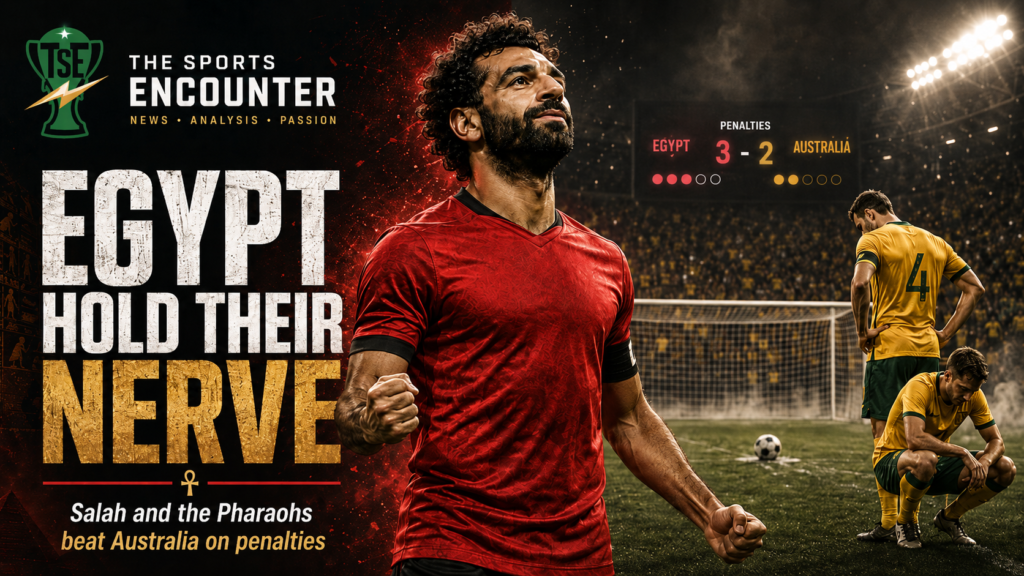
Egypt Survive the Shootout Test Australia Forced Upon Them
Egypt walked into the penalty shootout with a nation holding its breath and walked out with one of the biggest results in its World Cup history.
After 120 tense minutes against Australia at Dallas Stadium, the Pharaohs held their nerve to win 3-2 on penalties after a 1-1 draw in the FIFA World Cup 2026 Round of 32. It was not clean. It was not comfortable. It tested Egypt’s legs, belief, decision-making, and emotional control.
That is exactly why it mattered.
Mohamed Salah, still working his way back from a hamstring concern, started for Egypt and carried the weight of the occasion with familiar calm. He did not dominate every phase. He missed a good chance in extra time. Still, when Egypt needed authority in the shootout, Salah gave them the moment their supporters will remember.
His final penalty sent Egypt into the Round of 16 and ended Australia’s brave tournament run.
For more background on Egypt’s road to this stage, read The Sports Encounter’s earlier coverage of how Egypt advanced after Iran’s late offside heartbreak and how Salah helped Egypt secure their historic first World Cup win against New Zealand.
Match Scorecard
| Detail | Information |
|---|---|
| Match | Australia vs Egypt |
| Competition | FIFA World Cup 2026 |
| Round | Round of 32 |
| Venue | Dallas Stadium, Arlington |
| Result | Australia 1-1 Egypt after extra time |
| Penalty Shootout | Egypt won 3-2 |
| Egypt Goal | Emam Ashour, 13’ |
| Australia Goal | Mohamed Hany own goal, 55’ |
| Red Cards | None |
| Yellow Cards | Three yeloow cards to Egypt |
| Next Match | Egypt face the winner of Argentina vs Cape Verde |
Ashour Gives Egypt the Start They Needed
Egypt’s opening goal came early enough to change the emotional shape of the match.
In the 13th minute, Salah helped create pressure from a set-piece phase. Karim Hafez then delivered from the right side, and Emam Ashour attacked the far-post space with conviction. His header gave Egypt a 1-0 lead and rewarded their sharper start.
That goal showed Egypt at their best: compact, alert, and dangerous when Salah and the supporting runners found pockets around Australia’s back line.
Australia, however, did not panic. The Socceroos absorbed the blow, stayed in the contest, and slowly pushed Egypt into longer defensive phases. Their response said a lot about why they reached the knockout stage in the first place. This was a team built on structure, patience, and refusal to drift out of games.
The same traits carried Australia into the knockouts after their disciplined group-stage finish, which The Sports Encounter covered in Australia Survive Paraguay Test to Reach World Cup Knockouts.
Australia Earn Their Equalizer Through Pressure
Australia’s equalizer arrived in the 55th minute, and although it went down as a Mohamed Hany own goal, the moment came from sustained pressure.
The Socceroos forced Egypt into uncomfortable defensive positions. Their delivery into the box created uncertainty, and Hany’s attempted clearance turned into a painful own goal. For Egypt, it was the kind of mistake that can drain energy from a knockout team. For Australia, it opened the match again.
From there, the game became less about rhythm and more about nerve.
Australia had spells where they looked more settled in possession. Egypt had flashes through Salah, Omar Marmoush, Ashour, and late runners from midfield. Neither side fully broke the other. The longer the match went, the more each attack carried fear as much as ambition.
That balance made the final half hour of regulation tense rather than open. Egypt did not want to lose a historic chance. Australia sensed that the longer they stayed level, the more pressure would shift toward the Pharaohs.
Salah’s Courage Was Not About Perfection
Salah’s performance deserves a fair reading.
He was not at his sharpest across the full match. His recent fitness concern mattered. Extra time exposed that he lacked some explosiveness in key moments, including one chance where he could have settled the tie before penalties.
Yet great tournament leadership does not always look like total control.
Salah kept showing for the ball. He kept pointing Egypt into better positions. He kept Australia’s defenders honest. Most importantly, he stayed mentally present after missing a chance that could have haunted him.
That is where his value showed up most clearly.
Penalty shootouts punish hesitation. Salah stepped forward when Egypt needed him and delivered with composure. For a player whose international legacy has carried years of pressure, this was a moment of release as much as victory.
Australia Exit With Respect
Australia will feel the pain of the penalty shootout, especially after forcing Egypt into the deepest part of the match.
Harry Souttar had been central to Australia’s defensive resistance, but his missed penalty became one of the shootout’s defining moments. That cruelty often follows defenders in knockout football. Souttar helped keep Australia alive across the match, then found himself attached to the moment that shifted the shootout toward Egypt.
Still, Australia’s performance deserves respect.
The Socceroos took the match beyond 90 minutes because they stayed organized and refused to chase recklessly after going behind. Their midfield worked hard to disrupt Egypt’s transitions. Their back line survived multiple pressure waves. Their late goalkeeper change before penalties showed tactical preparation and belief.
Australia did not leave because they collapsed. They left because Egypt handled the final psychological test better.
For wider tournament context, read The Sports Encounter’s World Cup 2026 knockout picture.
Cards and Discipline
Egypt finished the match with three yellow cards, while no red cards were shown.
The bookings reflected how physically demanding the tie became as Australia pushed Egypt deep into extra time. Egypt’s late defensive pressure produced two important free-kick moments for Australia, including one after Yasser Ibrahim slid in late on Mohamed Toure near the end of extra time. The Guardian live feed also recorded an Egypt substitute, Hassan, going into the book in extra time after pulling back Aziz Behich.
Who Will Egypt Play in the Round of 16?
Egypt will face the winner of Argentina vs Cape Verde in the Round of 16.
That creates two very different possibilities. Argentina would bring the full weight of defending champion status, Lionel Messi’s final World Cup chase, and one of the tournament’s strongest attacking groups. Cape Verde would bring one of the most emotional underdog stories of the 2026 World Cup, a team that has already earned global respect by reaching the knockouts in its first World Cup appearance.
Either way, Egypt now belong in that conversation.
They are no longer chasing their first World Cup win. They are no longer just happy to reach the knockout rounds. They have won a knockout match under pressure, survived extra time, and stood firm in penalties.
For Salah and his men, that changes the tone of Egypt’s tournament.
Final Word
Egypt’s win over Australia was not a flowing attacking statement. It was a test of courage, patience, and emotional control.
Ashour gave Egypt the start. Australia forced the fight. Hany’s own goal shook the Pharaohs. Extra time drained both teams. Then the shootout asked the question that knockout football always asks: who can still think clearly when the body and crowd both scream?
Egypt answered.
The Pharaohs are into the Round of 16, and Salah still has another World Cup night to chase.
The Sports Encounter’s World Cup 2026 coverage focuses on fixtures, team news, match analysis, fan stories, tournament trends, and the biggest talking points from football’s global stage.