


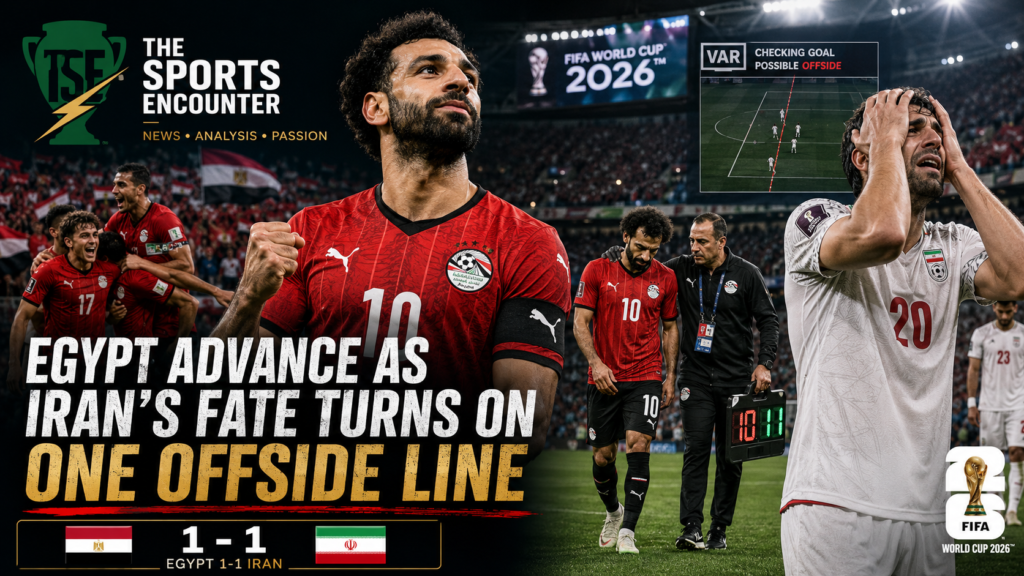
Egypt are going to the FIFA World Cup 2026 Round of 32, but they walked there through one of the most painful finishes Iran have ever experienced on a World Cup stage.
A 1-1 draw at Seattle Stadium was enough for Egypt to finish second in Group G and set up a knockout meeting with Australia. For Iran, the same result left everything hanging. One late strike seemed to have sent Team Melli into the next round. One VAR check pulled the moment away.
Shoja Khalilzadeh thought he had written Iranian football history in stoppage time. His finish sparked wild celebrations, sent the bench racing forward, and briefly pushed Iran toward a first World Cup knockout appearance. Then the offside review arrived. The goal disappeared. So did Iran’s control over their own tournament.
Egypt survived. Iran waited.
For full tournament coverage, fixtures, match reports, and knockout updates, follow The Sports Encounter’s FIFA World Cup 2026 hub.
Match Facts: Egypt vs Iran
| Detail | Information |
|---|---|
| Match | Egypt vs Iran |
| Competition | FIFA World Cup 2026 |
| Stage | Group G |
| Venue | Seattle Stadium, Seattle |
| Final Score | Egypt 1-1 Iran |
| Egypt Goal | Mahmoud Saber, 5th minute |
| Iran Goal | Ramin Rezaeian, 14th minute |
| Key Moment | Shoja Khalilzadeh’s stoppage-time goal ruled out for offside |
| Penalty Drama | Mehdi Taremi had a first-half penalty saved |
| Egypt Status | Qualified for Round of 32 |
| Egypt Next Opponent | Australia |
| Iran Status | Third in Group G, waiting on other group results |
| Red Cards | None recorded |
| Yellow Cards | Hossein Kanani, Mahmoud Saber, Saeid Ezatolahi, Mohanad Lasheen, Shoja Khalilzadeh |
Egypt Start Fast, Then Lose Control of the Rhythm
Egypt opened the match with the sharpness of a side determined not to treat qualification as a formality.
Inside five minutes, Mohamed Salah helped create the first major opening. His involvement pulled Iran’s defense toward him, and after Alireza Beiranvand failed to deal cleanly with the danger, Mahmoud Saber reacted first. The finish was not glamorous, but it carried huge value. Egypt led 1-0, and Iran suddenly had to chase a match they could not afford to lose.
That early goal should have given Egypt control. Instead, it created a strange rhythm. Egypt had the lead, but Iran had urgency. The Pharaohs tried to manage the ball and slow the tempo, while Iran pushed through the emotional shock and responded almost immediately.
Taremi won a penalty soon after Egypt’s opener, giving Iran a quick route back into the game. Mostafa Shobeir saved it, and for a few seconds it looked like Iran’s night was beginning to turn cruel early. But the ball stayed alive, Iran kept attacking, and Ramin Rezaeian eventually finished from a tight angle in the 14th minute.
Egypt 1. Iran 1.
The first quarter of an hour had already given the match more drama than many full knockout games. It also continued the tense pattern of Group G, where Iran had already shown their resilience in a wild 2-2 draw with New Zealand earlier in the tournament.
Iran Show Nerve After the Penalty Miss
A missed penalty can break a team, especially in a World Cup match with qualification pressure attached to every touch. Iran did not collapse. That was the most impressive part of their performance.
They kept their shape, trusted their defensive structure, and played with more confidence as the game developed. Their 5-3-2 shape gave them bodies behind the ball, but this was not only a survival plan. Iran also carried threat through direct attacks, second balls, and set-piece pressure.
Taremi remained central to their attacking work despite the penalty miss. Rezaeian gave them energy and delivery from wide areas. Saeid Ezatolahi and Mohammad Ghorbani tried to keep Egypt from turning midfield possession into sustained pressure.
Iran’s problem was not spirit. It was the final layer. They often reached dangerous zones but lacked the clean final action until the chaos of stoppage time.
That has been the story of many teams at this World Cup. Margins are no longer small. They are microscopic. The expanded format has given third-place teams hope, but as The Sports Encounter explained in its World Cup 2026 knockout picture, hope can also make the waiting even more painful.
Salah Injury Concern Gives Egypt a New Knockout Worry
Egypt’s qualification came with a clear concern: Mohamed Salah did not finish the match.
Salah was substituted 12 minutes into the second half after asking to come off. Hossam Hassan later said the captain would be assessed, while also indicating that the problem did not appear serious at first glance.
That distinction matters.
For Egypt, Salah is not only a scorer. He is the player who changes how opponents defend. Even when he is quiet, teams tilt toward him. They leave space elsewhere because they know one loose pass, one wrong angle, or one isolated defender can turn into a decisive Salah moment.
Egypt can survive without him for stretches. They cannot pretend his condition is a small detail before a knockout match against Australia.
The good news for Egypt is that this does not currently sound like a confirmed major injury. The concern is timing. Knockout football does not wait for full comfort. Recovery windows are short, selection decisions become sharper, and every training session suddenly carries medical significance.
Egypt also had other fitness concerns, including Ahmed Fatouh, while Hamdi Fathi is expected to be monitored ahead of the Australia game.
Salah’s importance to Egypt was already clear when he helped deliver the country’s historic first World Cup win against New Zealand, a performance covered by The Sports Encounter in Salah Leads Egypt to Historic First World Cup Win as New Zealand Collapse After Bright Start.
The Stoppage-Time Goal That Almost Changed Everything
The match seemed to be drifting toward a draw until injury time ripped it open.
Iran threw bodies forward. Egypt defended deeper. The ball bounced around the box after a free kick, Shobeir came into traffic, and Khalilzadeh reacted faster than everyone else. His finish sent Iran into a moment of pure release.
Players sprinted. The bench emptied emotionally. Supporters exploded.
For a few seconds, Iran were through. Not maybe. Not almost. Through.
Then came the review.
Khalilzadeh was judged offside because the goalkeeper was no longer the deepest Egyptian player in the sequence. Under the offside law, the line was measured against the second-last opponent, not simply the last outfield defender. It was a rare-looking situation, but the decision was ultimately about positioning after Shobeir had moved out of goal.
That is what made it so painful. This was not a clear attacker standing yards beyond the line. It was a tiny margin in a crowded box, at the worst possible moment, with an entire World Cup journey attached to it.
Iran still had one more chance. They hit the crossbar deep into added time. Egypt blocked, scrambled, and held on.
The final whistle did not bring the same emotion for both teams. Egypt had relief. Iran had shock.
Iran’s Round of 32 Chances: Still Alive, But No Longer in Their Hands
Iran finished third in Group G with three points. That does not automatically eliminate them under the expanded FIFA World Cup 2026 format, where the eight best third-place teams also advance to the Round of 32.
As things stood after the match, Iran remained in the race. The problem is that their fate now depends on results elsewhere.
That is the emotional damage of the disallowed goal. A win would have sent Iran forward with certainty. A draw leaves them watching other matches, calculating goal difference, and hoping enough third-place teams fall short.
Iran can still make the Round of 32. Their chances remain real. But the control has gone.
The players will know that. Coaches can talk about pride, effort, and resilience, but footballers understand moments. Khalilzadeh’s disallowed goal may become the image that defines Iran’s tournament, whether they survive or not.
For readers tracking the format and third-place qualification scenarios, The Sports Encounter’s guide to the FIFA World Cup 2026 qualification process explains how the expanded tournament has changed the pressure around final group matches.
Egypt’s Performance: Good Enough, But Not Complete
Egypt deserve credit for advancing from Group G. They opened with a draw against Belgium, beat New Zealand, and then survived Iran. Five points in this group is a strong return, especially for a team trying to turn promise into knockout credibility.
Still, this performance raised questions.
Egypt started well but did not dominate for long. Their midfield struggled to hold rhythm once Iran settled. After Salah came off, Egypt lost some of their attacking threat and became more cautious. In the final minutes, they defended through panic rather than authority.
That does not make them weak. It makes them human.
World Cup knockout teams often need one survival match before they fully understand the tournament’s temperature. Egypt just had theirs.
Australia will look at this game and see openings. They will see that Egypt can be pressed into hurried clearances. They will notice the spaces Iran found late. They will also prepare for the possibility that Salah may not be fully sharp.
Egypt, meanwhile, will see something else: they are still alive, and knockout football rewards teams that can survive ugly moments.
Australia reached the knockouts after a tense final group match of their own, and The Sports Encounter covered that route in Australia Survive Paraguay Test to Reach World Cup Knockouts.
Cards and Discipline
There were no red cards in Egypt vs Iran.
The match did, however, include several yellow cards. Hossein Kanani and Mahmoud Saber were booked in the first half as the game became more physical after the early goals. Saeid Ezatolahi received a second-half yellow for Iran, while Mohanad Lasheen was booked late for Egypt after stopping an Iranian counterattack.
Khalilzadeh also received a yellow card after the late celebration for the goal that was eventually ruled out. That detail added another strange layer to the drama: Iran lost the goal, but the booking remained part of the match story.
Final Word: Egypt Move On, Iran Live With the Wait
Egypt’s World Cup journey continues. They now move toward a Round of 32 match against Australia with belief, injury concerns, and enough warning signs to keep Hossam Hassan busy.
Iran’s story remains unfinished, but no matter what happens next, this match will sting. They were close to a historic breakthrough. They saw it, touched it, celebrated it, and then lost it to an offside line in stoppage time.
That is the cruelty of World Cup football.
One rebound can change a nation’s mood. One review can freeze a dream. One draw can feel like qualification for one team and heartbreak for another.
Egypt are through. Iran are waiting.
And Seattle just gave World Cup 2026 one of its most dramatic endings yet.
The Sports Encounter’s World Cup 2026 coverage focuses on fixtures, team news, match analysis, fan stories, tournament trends, and the biggest talking points from football’s global stage.
For a wider look at how this result fit into the day’s drama, read our full Day 16 World Cup 2026 highlights feature.