


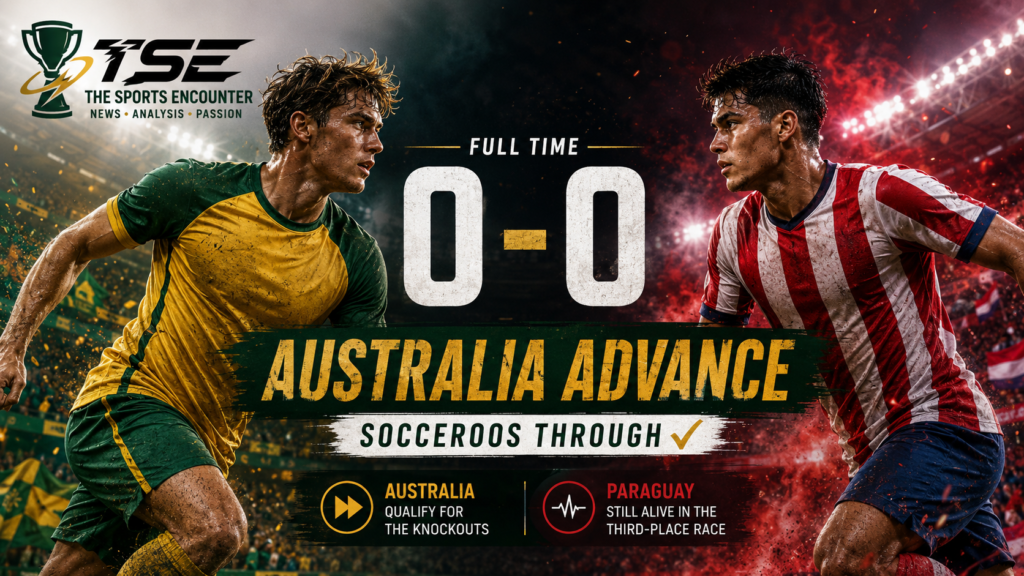
Australia did not need beauty. They needed control, discipline, and one point.
They got all three.
The Socceroos booked their place in the FIFA World Cup 2026 knockout stage after a tense 0-0 draw with Paraguay in their final Group D match at San Francisco Bay Area Stadium. The result confirmed Australia as Group D runner-up, while Paraguay finished third on four points and now sit in a strong position to qualify as one of the best third-placed teams.
For readers following the wider tournament picture, this match also underlined why the expanded format has changed the pressure of final group games. The Sports Encounter has already explained how the FIFA World Cup 2026 qualification process works, including the new Round of 32 and the importance of third-place standings.
For Australia, this was a pressure match handled with maturity. For Paraguay, it was a survival job that may still be enough.
Match Summary: Australia Do What They Needed To Do
The game never turned into a free-flowing attacking contest. That was no surprise.
Australia entered the match knowing a draw would be enough to finish second in Group D. Paraguay also understood that one point would keep them alive in the third-place qualification table.
That created a match full of caution, compact defending, and long spells where neither side wanted to open the door for the other.
Australia looked more settled in their structure, especially after coach Tony Popovic made six changes from the side beaten by the United States. That earlier defeat had exposed Australia’s selection risk and slow start, something The Sports Encounter covered in detail after the USA’s 2-0 win over the Socceroos. Read more in our report on how USA punished Australia as the Socceroos paid for a selection gamble.
This time, Australia looked more disciplined.
They defended with shape, managed transitions well, and avoided the kind of reckless moment that could have turned a safe qualification position into a crisis.
Paraguay had flashes through Julio Enciso, but Australia handled him intelligently. Enciso remained Paraguay’s most dangerous outlet, yet he was often crowded, tracked, and forced to receive the ball too deep to hurt Australia in the final third.
Australia Performance Analysis: Mature, Practical, and Knockout-Ready
Australia’s performance was not glamorous, but it was exactly what the situation required.
The Socceroos stayed compact, protected central spaces, and refused to let Paraguay turn the game into a chaotic physical battle. Alessandro Circati gave Australia authority in the back line, while Jordan Bos offered one of their best attacking outlets when the match opened up.
Australia’s second clean sheet of the tournament says plenty about their defensive improvement. After losing 2-0 to the United States, this was a test of nerve as much as tactics.
Popovic’s side did not panic. They did not chase a goal they did not need. They did not leave themselves exposed.
That matters in tournament football.
Australia’s group campaign has had clear mood swings: a strong opening, a damaging defeat, and then a controlled final-day response. In a World Cup where margins are tight and the Round of 32 adds another layer of risk, that kind of tactical discipline can travel well.
Australia now move into the Round of 32, where they are set to face the runner-up from Group G.
Paraguay Performance Analysis: Organized, Tough, but Too Limited Going Forward
Paraguay did enough to stay alive, but not enough to fully convince anyone that they are ready to trouble stronger knockout opponents.
Their defensive discipline was clear. They stayed compact, kept Australia from creating too many clean chances, and managed the tempo when the match moved into its nervous final phase.
From that angle, Paraguay executed the basic requirement.
The problem was the lack of attacking variety.
Enciso looked like the one player capable of creating something unpredictable. Australia knew it too. Once he was marked tightly, Paraguay had very few alternative routes to goal. Their possession often lacked urgency, and their attacking transitions died before they became real chances.
That pattern has followed Paraguay through the group stage. They showed resilience earlier in the tournament when 10-man Paraguay kept their World Cup hopes alive with a gritty win over Turkey. That result gave them the platform to survive this final group match.
Still, the draw against Australia again exposed their biggest limitation: Paraguay can fight, suffer, and defend, but they need more attacking clarity if they enter the knockouts.
Paraguay’s Chances of Reaching the Knockouts
Paraguay finished third in Group D with four points.
That gives them a strong chance.
In the expanded 48-team World Cup format, eight of the 12 third-placed teams qualify for the Round of 32. Four points is usually a very competitive total in that race, especially when some third-placed teams from other groups finish on fewer points or weaker goal difference.
This is exactly why the new World Cup format has changed match management. Teams no longer play only to finish first or second. They also manage goal difference, discipline, and survival margins across the wider tournament table.
For fans still trying to track that bigger picture, our guide on the FIFA World Cup 2026 qualification process explains why third-place teams now matter so much.
Paraguay are not completely safe until the full third-place table settles, but their chances look very strong.
Key Moment: Australia Survive the Late Nerves
The final 15 minutes carried the real tension.
Both teams knew one mistake could destroy their tournament. Australia dropped deeper late in the match, accepted the draw, and trusted their defensive structure. Paraguay pushed in short spells, but they never committed enough bodies forward to fully risk the point they already had.
Jordan Bos nearly produced a late winner for Australia after cutting inside and curling an effort just wide. At the other end, Paraguay had a late opening, but Australia goalkeeper Patrick Beach dealt with the danger.
In the end, neither team found the breakthrough.
Both walked away with what they came for.
Yellow and Red Cards
There were no red cards in the match.
The main disciplinary moment came in the second half, when Paraguay midfielder Diego Gomez received a yellow card for a professional foul on Jordan Bos.
That booking matters because it leaves Paraguay with a potential suspension issue if they qualify for the Round of 32. In a knockout match, losing a midfield ball-winner can hurt just as much as conceding a late goal.
What This Result Means
Australia finish second in Group D and advance directly to the Round of 32.
This is a major achievement for the Socceroos, especially after the pressure created by their defeat to the United States. They needed a response built on structure, not emotion. They found it.
Paraguay finish third and must wait for confirmation through the best third-placed teams table. Their four-point total gives them a healthy chance, but their attacking limitations remain a concern.
For Australia, the story is progress.
For Paraguay, the story is survival.
And in World Cup football, sometimes survival is enough.
FAQs
Did Australia qualify for the World Cup 2026 knockouts?
Yes. Australia’s 0-0 draw with Paraguay confirmed their place in the Round of 32 as Group D runner-up.
Did Paraguay qualify for the knockouts?
Paraguay finished third in Group D with four points. They are strongly placed to qualify as one of the best third-placed teams, but final confirmation depends on the remaining group results.
Who will Australia play next?
Australia will face the runner-up of Group G in the Round of 32.
Were there any red cards in Paraguay vs Australia?
No. There were no red cards in the match.
Who received a yellow card?
Paraguay midfielder Diego Gomez received a yellow card in the second half for a foul on Jordan Bos.
The Sports Encounter’s World Cup 2026 coverage focuses on fixtures, team news, match analysis, fan stories, tournament trends, and the biggest talking points from football’s global stage.