


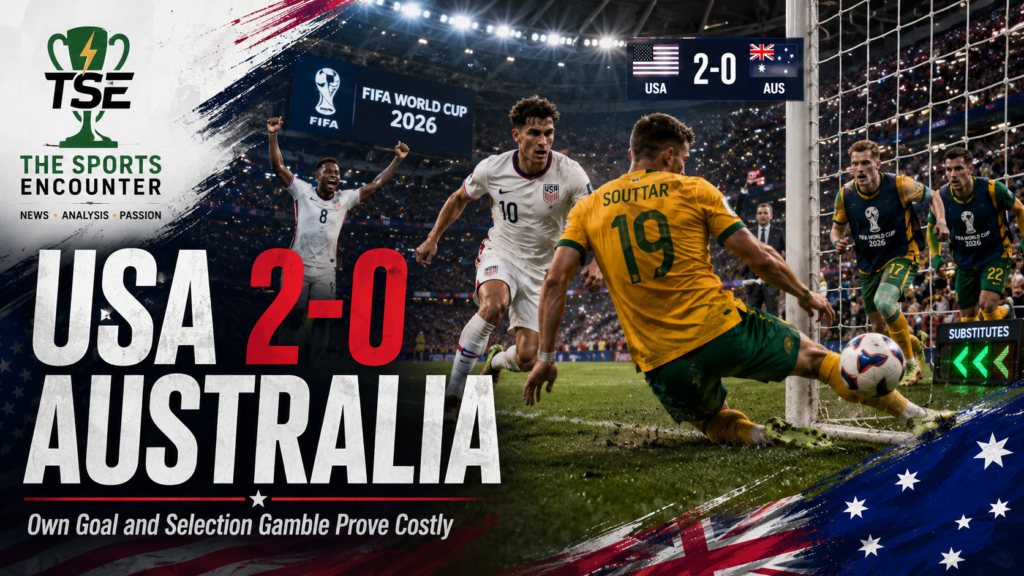
Cameron Burgess’ own goal gave the United States an early lead before Alex Freeman doubled it shortly before halftime after a VAR review. Australia improved after the break, but only after coach Tony Popovic corrected his biggest mistake of the night: leaving Nestory Irankunda and Connor Metcalfe, the two scorers from the win over Türkiye, on the bench.
For more World Cup coverage, follow The Sports Encounter’s FIFA World Cup 2026 hub.
USA Take Control Early as Australia Start Too Cautiously
The United States did not need Christian Pulisic to control this game. That may be the most important message from Seattle.
With Pulisic ruled out through injury, Mauricio Pochettino made one change and trusted Ricardo Pepi to start alongside Folarin Balogun. The move gave the USA enough direct running, pressing energy, and penalty-box presence to trouble Australia from the opening exchanges.
Australia, by contrast, looked like a team trying not to lose before it tried to win.
The Socceroos had beaten Türkiye 2-0 in their opening match, with Nestory Irankunda and Connor Metcalfe both scoring. Yet Tony Popovic left both players out of the starting XI against the United States. On paper, it may have looked like a cautious plan against the host nation. On the field, it sent the wrong message.
Australia sat deep, struggled to progress the ball, and gave the USA too much time to dictate the rhythm. The Americans moved the ball cleaner, won second balls more often, and kept Australia pinned into defensive reactions.
The early numbers told the story. USA had around 70% possession in the first half, with Australia reduced to roughly 30%. That imbalance was not just statistical. It showed in body language, territory, and attacking intent.
Burgess Own Goal Gives USA the Breakthrough
The first goal came in the 11th minute, and it summed up Australia’s uncertain start.
Folarin Balogun drove into a dangerous area and forced the Australian back line to defend while facing its own goal. Cameron Burgess tried to intervene, but his desperate touch redirected the ball into the net.
It was officially an own goal, but it was created by American pressure.
Burgess will take the painful line in the match report, yet the real issue was structural. Australia allowed Balogun to isolate defenders too easily, and the defensive shape did not have enough support around the ball. Once the cross came in, Burgess had little time to adjust his body.
Own goals often look unlucky. This one was unlucky for Burgess, but not random. USA had already pushed Australia into uncomfortable defensive positions.
That early strike changed the tone. The Socceroos had to chase, but their starting setup did not give them enough pace, width, or forward aggression to respond properly.
Freeman’s VAR-Confirmed Goal Leaves Australia With a Mountain to Climb
Alex Freeman made it 2-0 in the 43rd minute, reacting sharply after a deflection from a Sergiño Dest effort. The goal was initially checked, but VAR confirmed it.
That second goal mattered because Australia were already heading toward halftime with problems. At 1-0, Popovic could still argue that his team had stayed in the contest. At 2-0, the selection call became impossible to ignore.
USA did not play flawless football. There were moments when Australia’s pressure caused nervous clearances and rushed decisions in the American back line. Matt Freese had to stay alert, and Chris Richards again looked important in cleaning up dangerous situations.
Still, the hosts carried more threat. Weston McKennie, Tyler Adams, Malik Tillman, Dest, and Antonee Robinson helped USA control central and wide areas. Balogun stretched Australia repeatedly, even without scoring.
The Americans looked balanced. Australia looked incomplete.
That was the difference before halftime.
Popovic’s Worst Decision: Benching Irankunda and Metcalfe
The biggest talking point from Australia’s side was not the own goal. It was the team selection.
Popovic benched Nestory Irankunda and Connor Metcalfe, the two players who had scored in Australia’s 2-0 win over Türkiye. That decision hurt Australia’s attacking identity from the first whistle.
Irankunda gives Australia speed, fearlessness, and direct threat. Metcalfe offers timing, midfield runs, and a better link between buildup and final-third action. Without them, Australia lacked the kind of players who could turn defensive pressure into attacking moments.
Popovic corrected the mistake at halftime, bringing both players on as part of a triple substitution. Australia immediately looked more alive.
The Socceroos pressed higher, carried more danger in transition, and finally began to ask questions of the USA defense. Irankunda’s pace stretched the American back line. Metcalfe forced Matt Freese into action with a second-half effort. Australia also had a few scrappy chances from set pieces and penalty-area rebounds.
That second-half improvement made the original decision look worse.
It was not that Australia suddenly became dominant. They did not. But they finally looked like a team with attacking weapons. The problem was that they had already wasted 45 minutes and conceded twice.
In tournament football, that is a heavy price.
The Sports Encounter recently covered how one decision can reshape a World Cup story in the Zidane injury and France 2002 collapse feature. This was not as dramatic, of course, but the lesson felt similar: selection and timing can decide a campaign before talent gets a fair chance to speak.
USA Performance Analysis: Mature, Controlled, and Ruthless Enough
This was not a wild attacking masterclass from the United States. It was something more useful for a World Cup team: mature control.
USA handled Pulisic’s absence well. That alone matters. Too often, teams lose rhythm when their biggest attacking name is missing. Here, Pochettino’s side stayed organized and trusted the system.
Balogun’s movement caused problems throughout the match. Pepi worked hard, even if he did not dominate the box. McKennie gave USA strength and running power. Adams helped control the tempo. Tillman linked play neatly. Robinson and Dest stretched Australia across both flanks.
Defensively, USA had a few shaky second-half moments, especially after Australia introduced more pace and urgency. Yet they managed the game well enough, slowed the tempo when needed, and closed it out without conceding.
That is tournament maturity.
After opening with a strong win over Paraguay, this result pushed USA closer to the knockout phase and strengthened their case as a serious host-nation contender. For readers tracking early tournament momentum, our report on Jonathan David’s hat-trick for Canada also shows how North American teams are shaping the opening phase of this World Cup.
Australia Performance Analysis: Better Late, But Too Passive Early
Australia’s second half gave supporters something to hold onto. The Socceroos were sharper, braver, and more direct after the substitutions. They attacked set pieces with more conviction and created enough pressure to make the USA work.
But World Cup matches are not won by fixing the obvious after halftime.
The first-half setup was too conservative. Australia gave up too much territory, lacked threat on counters, and let the USA build confidence. The back line had too many emergency moments, and the own goal reflected that pressure.
Burgess’ night became especially painful because he scored the own goal and then came off at halftime. Still, Australia’s problem was not one defender. It was the broader decision to remove momentum from the opening win by benching the players who had delivered it.
Irankunda and Metcalfe showed exactly why they should have started. Once they entered, Australia carried more speed, movement, and edge. That made the first-half approach feel even more cautious in hindsight.
This defeat does not end Australia’s World Cup hopes. But it adds pressure to their final group match against Paraguay. The Socceroos must now rediscover the boldness they showed against Türkiye.
Discipline: Yellow Cards, No Red Cards
The match became increasingly physical in the second half.
Australia’s Alessandro Circati was booked in the first half after a late challenge on Malik Tillman. Antonee Robinson received a yellow card after the break for a late tackle. Late in the game, tempers rose after a clash involving Folarin Balogun and Harry Souttar, with multiple yellow cards shown, including to Souttar, Balogun, and Jacob Italiano. Chris Richards was also booked in stoppage time after fouling Irankunda.
No red cards were reported.
That late edge reflected the pressure of the match. USA were protecting a lead. Australia were frustrated. The referee allowed a physical contest for long stretches, and by the final minutes, the tackles and confrontations had started to pile up.
Tactical Turning Point
The turning point was not only Burgess’ own goal.
The real turning point came before kickoff.
By benching Irankunda and Metcalfe, Popovic reduced Australia’s attacking ceiling from the start. The own goal punished the Socceroos early, but the team selection created the conditions for that pressure.
Once both players came on, Australia looked more balanced and dangerous. That improvement will frustrate fans because it proved the solution had been sitting on the bench.
USA deserve credit for exploiting that caution. Pochettino’s side pressed with purpose, moved the ball with confidence, and used wide overloads well. They did not need to chase chaos. They forced Australia into it.
What This Result Means for Group D
USA now look well placed to move into the knockout stage with serious confidence. Winning without Pulisic gives the squad depth credibility, and another clean sheet-level defensive performance would strengthen belief around Pochettino’s structure.
Australia still have a route forward, but the margin for error has narrowed. Their final group match against Paraguay now carries heavier pressure, and Popovic must decide whether to trust attacking players from the start or risk another slow opening.
The lesson from Seattle is simple enough.
Australia looked like Australia only after the coach changed the team he should probably have started with.
USA, meanwhile, looked like a team growing into the tournament at the right time.