France Crush Norway After Haaland and Ødegaard Start on the Bench
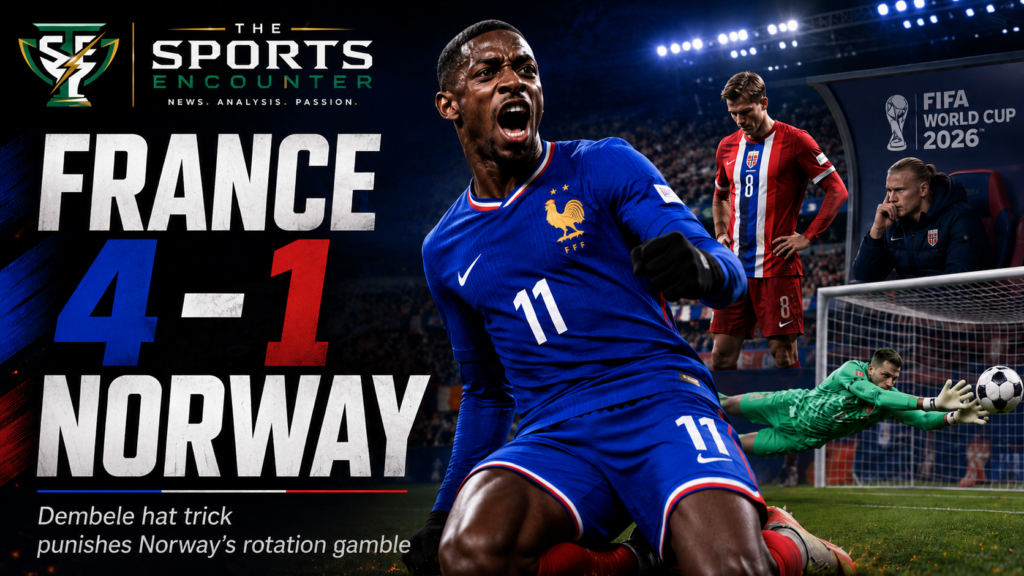
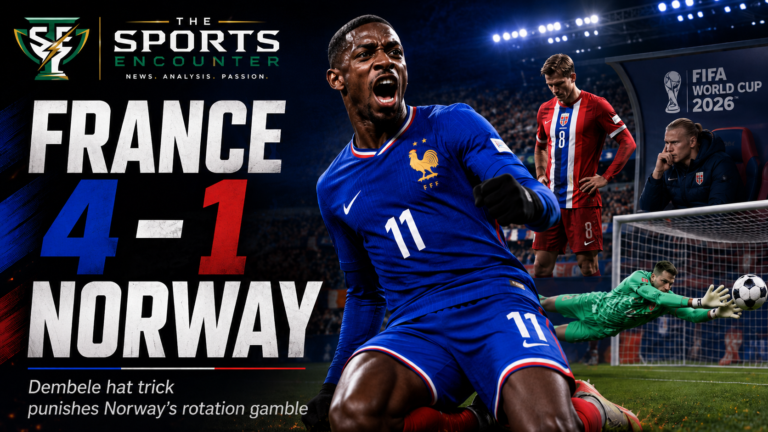
France punished Norway’s bold rotation call with a 4-1 win in Boston, as Ousmane Dembélé scored a ruthless first-half hat trick and Norway paid for leaving Erling Haaland and other key players on the bench.
France arrived in Boston with top spot in Group I still worth taking seriously.
Norway arrived with a different calculation.
That calculation shaped the night before the first whistle. Ståle Solbakken left Erling Haaland, Martin Ødegaard, and several key starters on the bench, choosing freshness for the knockout stage over full-force resistance against one of the tournament favorites. It was a brave call, maybe even a sensible one on paper. By halftime, it looked brutally expensive.
France beat Norway 4-1 at Boston Stadium to finish Group I with nine points from three matches, a perfect record, and another reminder that their attacking depth may be as frightening as their biggest names. Ousmane Dembélé scored a stunning first-half hat trick, Désiré Doué added the fourth in stoppage time, and Norway’s rotated side spent much of the night chasing shadows.
Norway still move into the knockout stage as Group I runners-up. That matters. Solbakken’s decision must be judged with that wider picture in mind. Still, football does not always allow neat strategic explanations when a team loses 4-1 and its most feared striker watches from the bench.
For full tournament movement, fixtures, and knockout updates, follow The Sports Encounter’s FIFA World Cup 2026 coverage hub.
Match Summary: Norway 1-4 France
| Key Detail | Match Information |
|---|---|
| Match | Norway vs France |
| Competition | FIFA World Cup 2026 |
| Stage | Group I |
| Venue | Boston Stadium, Foxborough |
| Final Score | Norway 1-4 France |
| France Scorers | Ousmane Dembélé 7’, 20’, 32’, Désiré Doué 90+4’ |
| Norway Scorer | Thelo Aasgaard 21’ |
| Key Moment | Jørgen Strand Larsen’s second-half penalty saved by Mike Maignan |
| Group Result | France top Group I with 9 points, Norway finish second with 6 |
Dembélé Turns the Night Into a Personal Showcase
This was supposed to be the night of Mbappé versus Haaland.
Instead, Dembélé took the game away from everyone.
France almost scored inside the opening minute when Kylian Mbappé hit the crossbar, a warning shot that told Norway how little time they would get to settle. Six minutes later, Dembélé gave France the lead. He found room, attacked the space, and finished with the calm of a player who could feel the weakness in front of him.
Norway had barely reorganized before the second arrived in the 20th minute. Dembélé again found space on the right side, again punished Norway’s defensive looseness, and again made the finish look cleaner than the situation deserved.
Thelo Aasgaard pulled one back a minute later, giving Norway a brief route back into the game. For a short spell, the rotated side showed the energy and directness that had carried Norway through the group. They pressed higher, moved the ball quicker, and reminded France that the game still had consequences.
Then Dembélé ended the argument.
His third goal in the 32nd minute completed one of the quickest first-half hat tricks in World Cup history and pushed him firmly into the tournament’s Golden Boot conversation. It also exposed the practical cost of Norway’s selection. The backup defensive unit had legs, but it lacked the chemistry and authority needed against elite movement.
France did not need chaos. They needed timing, width, and sharp finishing. Dembélé gave them all three.
France’s perfect group run also followed the pattern they had already shown earlier in the tournament, especially when Mbappé made the difference as France defeated Senegal 3-1.
Norway’s Rotation Call Was Logical, But It Changed the Match
Solbakken’s decision will divide opinion because both sides of the argument make sense.
Norway had already qualified for the knockout stage after wins over Iraq and Senegal. Haaland had carried a heavy load, both physically and emotionally, in Norway’s first two matches. Ødegaard also stayed unused, which showed this was not a one-player decision. It was a full squad-management call.
In tournament football, managers often protect their stars once qualification becomes secure. A fresh Haaland in the Round of 32 may matter more than chasing a group-stage statement against France. Norway did not enter the World Cup as a nation expected to overpower elite opponents every three days. Their best chance of a deep run depends on fitness, structure, and getting their biggest players ready for the elimination rounds.
That wider qualification context matters because the expanded format has changed how managers think about group-stage risk. For readers tracking the route to the knockouts, The Sports Encounter’s guide explains the FIFA World Cup 2026 qualification process and the Round of 32 structure.
That said, rotation comes with a bill.
Against France, the bill arrived early. Norway lost defensive rhythm. The spacing between fullbacks and center backs became too easy for France to attack. Dembélé repeatedly received the ball in dangerous pockets, while Mbappé’s presence kept defenders from overcommitting. France stretched Norway until gaps appeared, then attacked those gaps with speed.
The bigger emotional issue for Norway fans was simple. When the team won a penalty early in the second half, Haaland remained on the bench.
The Missed Penalty That Killed Norway’s Comeback Hope
Norway had a real chance to drag the match back into competitive territory after the break.
Oscar Bobb drove into the box and won a penalty after France opened the second half with less control than they showed in the first. At 3-1, a goal from the spot would have changed the mood inside the stadium. It would have forced France to manage pressure, not just possession.
Jørgen Strand Larsen stepped up.
Mike Maignan saved.
The penalty lacked the conviction Norway needed in that moment. Maignan read it, got down, and kept France two goals clear. It was the kind of save that turns a possible comeback into a closing chapter. Norway continued to create half-chances, including a later opening for Bobb, but the belief had already taken a hit.
That miss will also fuel the Haaland debate. It may not be fair to reduce a team decision to one penalty, but World Cup narratives rarely wait for fairness. When one of the world’s best finishers sits on the bench and another forward fails from the spot, the question writes itself.
Norway’s earlier group-stage progress had been built around Haaland’s ruthless presence, especially when Norway beat Senegal 3-2 to reach the World Cup knockouts. Against France, his absence became part of the story even without him entering the field.
France Look Deeper Than a Superstar Team
France’s biggest statement was not only the scoreline.
It was the way they won without needing Mbappé to dominate the scoring column. Mbappé influenced the game, stretched Norway, and helped create danger, but Dembélé became the finisher. Doué came on and added the fourth. Bradley Barcola also made an impact with the late assist.
That matters for the knockout stage.
World Cup contenders often need different match-winners across a long tournament. France already have the superstar power. What makes them more dangerous is the number of players who can decide a game when the opponent’s plan focuses on Mbappé.
Their midfield also gave them control. Aurélien Tchouaméni helped France dictate large spells, while the back line recovered well after Norway’s best moments. The penalty concession gave Norway a brief door back into the match, but Maignan closed it with authority.
France have now beaten Senegal, Iraq, and Norway. Their goal difference, rhythm, and attacking variety all point toward a side growing into the tournament rather than merely surviving the group.
That attacking momentum was already visible when Mbappé scored twice as France beat Iraq 3-0 to reach the Round of 32. Against Norway, France simply found another way to hurt an opponent.
What This Means for Norway
Norway should not panic.
A 4-1 defeat never looks comfortable, but context matters. They had already done the hard work. Their wins over Iraq and Senegal secured qualification before this match, giving Solbakken the freedom to think beyond one night in Boston. That earlier 3-2 win over Senegal, powered by Haaland’s finishing, remains the result that truly defined their group-stage success.
Still, Norway leave this match with warnings.
Their second unit struggled against elite speed. Their penalty miss showed the pressure of knockout-style moments. Their defensive spacing gave France too many clean looks. Most importantly, the team must quickly shift from protecting players to trusting its strongest lineup again.
Haaland will return to the center of the story now. So will Ødegaard. Norway’s World Cup will no longer be measured by how cleverly they managed the group. It will be judged by how boldly they play when one defeat ends everything.
The knockout race has already produced some sharp tournament swings, and The Sports Encounter’s Day 16 World Cup highlights showed how quickly momentum can change once the giants and underdogs start colliding across groups.
Final Word
France treated the group finale like a chance to sharpen their tournament edge. Norway treated it like a chance to manage risk.
Both approaches had logic.
Only one looked good on the scoreboard.
Dembélé’s hat trick gave France the night’s headline, but the deeper story was about tournament nerve. France showed they can punish weakened opponents without hesitation. Norway showed they are willing to absorb criticism if it gives their best players a cleaner path into the knockouts.
That decision may look smart in a week.
In Boston, it looked like a gamble France were more than happy to expose.
The Sports Encounter’s World Cup 2026 coverage focuses on fixtures, team news, match analysis, fan stories, tournament trends, and the biggest talking points from football’s global stage.
FAQ
What was the final score of Norway vs France?
France beat Norway 4-1 in their FIFA World Cup 2026 Group I match at Boston Stadium.
Who scored for France against Norway?
Ousmane Dembélé scored a first-half hat trick for France. Désiré Doué added the fourth goal in stoppage time.
Who scored Norway’s goal against France?
Thelo Aasgaard scored Norway’s only goal in the first half.
Why did Norway bench Erling Haaland against France?
Norway had already qualified for the knockout stage, so manager Ståle Solbakken rested Haaland and several other key players to protect them before the elimination rounds.
Did Norway miss a penalty against France?
Yes. Jørgen Strand Larsen missed Norway’s second-half penalty, with Mike Maignan making the save.
Did France finish top of Group I?
Yes. France topped Group I with three wins from three matches and nine points.
Are Norway still in the FIFA World Cup 2026?
Yes. Norway finished second in Group I and advanced to the knockout stage.

Breaking News
Harry Kane Wins Second European Golden Shoe as 36-Goal Season Strengthens Ballon d’Or Case
Harry Kane has claimed the European Golden Shoe for the second time after scoring 36 Bundesliga goals. His 61-goal season, domestic double, Champions League form and World Cup impact now strengthen a serious 2026 Ballon d’Or case.
Harry Kane has spent most of his career answering questions with goals.
Could he score outside Tottenham? Could he dominate another league? Could he handle the expectations that come with leading Bayern Munich’s attack? Could he turn individual numbers into major trophies?
By August 2026, most of those questions have disappeared.
Kane received the European Golden Shoe for the second time in his career on Wednesday after scoring 36 Bundesliga goals during Bayern Munich’s extraordinary 2025-26 campaign. The England captain later described himself as “very proud” of the achievement and credited his teammates, coaches and family for helping him win the award.
“Very proud to win the European Golden Shoe for the second time in my career! An award that wouldn’t be possible without the support of my incredible teammates, coaches and family.”
The trophy confirms what the numbers had already made clear. Kane was Europe’s most productive domestic-league goalscorer last season.
Yet the more interesting conversation begins after the trophy presentation.
Kane scored 61 goals for Bayern across competitive matches, helped the German club win the Bundesliga and DFB-Pokal double, struck 14 times in the Champions League, scored a hat-trick in the German Cup final, then added six goals for England during a World Cup campaign that ended with a third-place finish.
At 33, he has assembled the kind of season that usually forces itself into the center of the Ballon d’Or discussion.
The question is how much football’s biggest individual vote will value it.
TL;DR
- Harry Kane has received the 2025-26 European Golden Shoe after scoring 36 Bundesliga goals in 31 appearances.
- He finished with 72 Golden Shoe points, ahead of Erling Haaland on 54 and Kylian Mbappé on 50.
- Kane also won the European Golden Shoe in 2023-24, when he scored the same number of Bundesliga goals: 36.
- He scored 61 competitive goals for Bayern Munich during 2025-26.
- His season included 14 Champions League goals and a hat-trick in Bayern’s 3-0 DFB-Pokal final victory over VfB Stuttgart.
- Bayern completed the Bundesliga and DFB-Pokal double.
- Kane followed his club season with six goals as England finished third at the FIFA World Cup 2026.
- His second Golden Shoe strengthens an already serious Ballon d’Or case, although team achievements and performances in the biggest international matches will also influence the debate.
Harry Kane’s 2025-26 Season at a Glance
| Category | Harry Kane |
|---|---|
| Club | Bayern Munich |
| Bundesliga goals | 36 |
| Bundesliga appearances | 31 |
| European Golden Shoe points | 72 |
| Champions League goals | 14 |
| Competitive Bayern goals in 2025-26 | 61 |
| DFB-Pokal final | Hat-trick vs VfB Stuttgart |
| Major club trophies | Bundesliga, DFB-Pokal |
| World Cup 2026 goals | 6 |
| England World Cup finish | Third |
| European Golden Shoes | 2 |
Kane Wins the European Golden Shoe by a Huge Margin
The European Golden Shoe race never developed into the tight battle many expected.
According to the Bundesliga’s official Golden Shoe report, Kane accumulated 72 points from his 36 league goals.
Manchester City’s Erling Haaland finished on 54 points, while Real Madrid’s Kylian Mbappé collected 50.
| Player | Club | Golden Shoe Points |
|---|---|---|
| Harry Kane | Bayern Munich | 72 |
| Erling Haaland | Manchester City | 54 |
| Kylian Mbappé | Real Madrid | 50 |
An 18-point advantage over Haaland gives the final standings an unusual degree of separation considering the quality of the players involved.
Kane averaged roughly 1.16 Bundesliga goals per appearance. More importantly, his goals formed part of a Bayern attack capable of sustaining pressure across an entire season.
Haaland remains one of the defining scorers of his generation, something The Sports Encounter examined in our detailed look at Erling Haaland’s career, records and evolution. Kane still managed to create considerable distance between himself and the Norwegian in Europe’s domestic scoring race.
Very proud to win the European Golden Shoe for the second time in my career! An award that wouldn’t be possible without the support of my incredible teammates, coaches and family. 🙌 pic.twitter.com/FgMYVI8rIF
— Harry Kane (@HKane) August 19, 2026
The comparison became even more fascinating during the World Cup, when Kane and Haaland found themselves on opposite sides of England’s quarterfinal against Norway.
Europe’s two dominant central strikers had spent the club season chasing goals. By July, they were chasing national history.
36 Goals Again, Three Seasons Apart
There is a strange symmetry to Kane’s two European Golden Shoes.
He scored 36 Bundesliga goals during his first Bayern season in 2023-24.
Two years later, he reached exactly 36 again.
The surrounding circumstances changed dramatically.
His first Golden Shoe in Germany arrived during a season in which Bayern failed to win the Bundesliga. The second came with major silverware attached.
That distinction matters when evaluating Kane’s wider legacy.
Goals have rarely been difficult to find on his résumé. Team trophies were the missing part of the conversation for much of his career.
That gap has narrowed considerably.
61 Bayern Goals Change the Scale of the Discussion
The Bundesliga total gives Kane the Golden Shoe. His wider Bayern numbers explain why his season deserves a deeper examination.
Bayern Munich’s official season review credits Kane with 61 goals across competitive club matches in 2025-26.
That included 36 Bundesliga goals and 14 in 13 Champions League appearances.
Bayern also reported that Kane had reached 146 goals in 147 competitive appearances for the club by August, alongside 33 assists.
Those numbers reveal why describing Kane purely as a penalty-box striker has become increasingly inadequate.
He still finishes attacks at an elite rate. Yet Vincent Kompany has also used his passing range, movement into deeper areas and ability to connect Bayern’s runners around him.
Kane can operate close to the center-backs for one sequence, retreat toward midfield during the next and then arrive inside the penalty area before the defense resets.
That movement gives players around him room to attack.
It also creates an awkward problem for defenders. Following Kane into midfield leaves space behind. Giving him freedom to receive allows one of football’s best passers among center forwards to turn and find runners.
The DFB-Pokal Final May Be the Best Snapshot of Kane’s Season
Statistics across 50 or 60 matches can sometimes blur into one giant number.
The DFB-Pokal final provides something more tangible.
Bayern faced VfB Stuttgart at Berlin’s Olympiastadion with the opportunity to complete the domestic double.
Kane scored three times.
Bayern won 3-0.
His hat-trick pushed his club tally to 61 goals and turned a major final into a personal showcase.
That performance carries particular weight in any Ballon d’Or conversation because individual awards are rarely decided through spreadsheets alone. Voters remember decisive nights, finals, knockout games and performances that become shorthand for an entire season.
Berlin gave Kane one of those nights.
The World Cup Added Another Layer to Kane’s Season
Kane’s season did not end when Bayern’s club campaign finished.
England traveled to North America expecting to challenge for the World Cup, with Kane again carrying the responsibility that comes with captaining a country whose tournament history follows every generation.
He scored six times.
The Sports Encounter’s final breakdown of the leading scorers at the FIFA World Cup 2026 placed Kane sixth in a remarkable scoring race eventually won by Kylian Mbappé.
His goals helped England move through the group stage and early knockout rounds before Argentina stopped Thomas Tuchel’s team in the semifinals.
The buildup to that game had placed enormous attention on Kane, Messi and Bellingham, as explored in our preview of Argentina vs England with a World Cup final at stake.
England fell short.
Our tactical review of why England lost the semifinal to Argentina showed how the team’s attacking burden had become concentrated around Kane and Jude Bellingham during critical stages of the tournament.
Kane then remained on the bench as England beat France 6-4 in the bronze-medal game, with Bukayo Saka producing the defining performance. That remarkable finish is covered in our full report on England’s victory over France in the World Cup third-place playoff.
England returned home with its best men’s World Cup finish since 1966.
Kane returned to Munich with another six tournament goals added to an already extraordinary year.
Best striker in the world. Facts.
— FC Bayern (@FCBayernEN) August 19, 2026
Congrats on your Golden Shoe achievement, @HKane 😮💨🏅 pic.twitter.com/cHolHquYP6
Why the Ballon d’Or Conversation Is Complicated
Sixty-one Bayern goals. A domestic double. Fourteen Champions League goals. Six World Cup goals. A second European Golden Shoe.
Placed together, the résumé looks overwhelming.
The Ballon d’Or has never functioned as a simple goals leaderboard, however.
UEFA’s published explanation of how Ballon d’Or voting is assessed identifies three broad considerations: individual performances and decisive impact, team achievements, and class and fair play.
That framework creates both strengths and complications for Kane.
Individual performance: elite
Very few players can challenge his statistical case.
Thirty-six league goals gave him Europe’s scoring crown. Sixty-one Bayern goals expanded the argument beyond domestic football. His Champions League production showed he could maintain that level against elite continental opposition.
The Sports Encounter ranked Kane among the standout performers during the World Cup knockout stages, giving his individual season another major-tournament dimension.
Team achievement: strong, with one obvious limitation
The Bundesliga and DFB-Pokal double gives Kane the major team success that critics once used against him.
Bayern still missed the Champions League title.
England reached the World Cup semifinals and eventually finished third. Spain won the tournament.
Those details matter because Ballon d’Or races often become especially sensitive to the biggest trophies available in a given year.
Decisive moments: a much stronger case than his old reputation suggests
The DFB-Pokal final hat-trick is difficult to ignore.
So are his league goals, Champions League production and World Cup scoring contribution.
Kane’s performance profile now contains far more trophy-connected moments than it did during the Tottenham years.
Harry Kane’s Ballon d’Or Case: TSE Scorecard
| Category | Assessment | Why It Matters |
|---|---|---|
| Domestic scoring | 10/10 | 36 goals and European Golden Shoe winner |
| Overall club scoring | 10/10 | 61 competitive Bayern goals |
| Champions League production | 9/10 | 14 goals in 13 appearances |
| Domestic trophies | 10/10 | Bundesliga and DFB-Pokal double |
| Major final impact | 10/10 | Hat-trick in the DFB-Pokal final |
| World Cup performance | 8/10 | Six goals as England finished third |
| Champions League team result | 7/10 | Bayern fell short of the title |
| World Cup team result | 8/10 | England reached the semifinals and won bronze |
| Longevity and consistency | 10/10 | Second Golden Shoe and sustained elite production into his 30s |
| Overall Ballon d’Or case | 92/100 | One of the strongest complete-season résumés in world football |
Haaland and Mbappé Keep the Striker Debate Alive
Kane’s numbers become even more impressive when placed beside the forwards defining his era.
Haaland has changed expectations around goalscoring volume. Mbappé used the World Cup to strengthen his own claim to football’s highest individual honors.
Kane sits between them stylistically.
He lacks Haaland’s extraordinary acceleration and physical directness. Mbappé offers a different kind of one-on-one threat from wider areas.
Kane compensates through a combination of finishing, passing, spatial awareness, aerial strength, penalties, long-range shooting and the ability to function as both scorer and attacking reference point.
That versatility explains why comparisons based purely on goals can miss part of his influence.
It also explains why Kane remained in the wider World Cup conversation even when supporters selected other forwards ahead of him in The Sports Encounter’s fan-voted World Cup 2026 Dream Team.
Munich Has Changed Harry Kane’s Career Story
The move from Tottenham to Bayern always carried risk.
Kane left the Premier League while chasing Alan Shearer’s scoring record. He entered a club where winning the Bundesliga was treated almost as a minimum requirement rather than a career-defining achievement.
The first season complicated the narrative when Bayern went trophyless despite Kane scoring 36 league goals.
Three years later, his decision looks very different.
He has won major trophies, broken Bayern records, collected two European Golden Shoes and established himself as the central striker of one of Europe’s biggest clubs.
He has also resisted the idea that an aging elite forward inevitably has to begin looking toward a lower-pressure league.
That subject recently resurfaced when Saudi clubs were linked with major Premier League and European forwards. The Sports Encounter examined Kane’s name in that wider market while reporting on Al-Hilal’s pursuit of Ollie Watkins and the changing striker market.
Kane’s latest comments point toward ambition rather than retreat.
He described 2025-26 as the best season of his career during Wednesday’s Golden Shoe ceremony and spoke enthusiastically about continuing to improve.
Only Messi and Ronaldo Have Won More Golden Shoes
The historical company is becoming difficult to dismiss.
According to Bayern, Kane is now the third player to win the European Golden Shoe twice while representing the club, following Gerd Müller and Robert Lewandowski.
Across the wider history of the award, only Lionel Messi and Cristiano Ronaldo have collected it more often than Kane’s current total.
That does not place Kane alongside them in an overall career debate. Their bodies of work extend far beyond one award.
It does place his peak goalscoring seasons inside a remarkably exclusive historical group.
Football has spent nearly two decades using Messi and Ronaldo as the statistical reference point for attacking greatness. Kane’s second Golden Shoe provides another reason to consider how the next generation of elite scorers should be measured once those two names leave the center of the conversation.
The Most Interesting Part of Kane’s Season May Be His Age
Kane turned 33 in July.
For an earlier generation of strikers, that age often marked the beginning of a visible decline.
Modern conditioning, recovery, tactical intelligence and sports science have changed the curve.
Kane’s game helps, too.
His effectiveness has never depended entirely on explosive pace. Reading defenders, manipulating space, passing accurately and finishing efficiently can age more gracefully than repeated high-speed isolation attacks.
That makes his 2025-26 season significant beyond the trophies.
A striker in his early 30s has just produced the most prolific club campaign of his career.
So, Does Harry Kane Deserve the 2026 Ballon d’Or?
He deserves to be treated as a serious contender.
That conclusion can be reached without pretending the race is settled.
The Ballon d’Or asks voters to combine individual excellence with team achievement, decisive performances and the emotional weight attached to football’s biggest competitions.
Kane checks almost every box.
He won the Bundesliga. Bayern lifted the DFB-Pokal. He scored a hat-trick in the cup final. His 61 club goals established an extraordinary statistical foundation. Fourteen Champions League goals demonstrated elite European production. Another six World Cup goals helped England reach the final four.
His weaker points are relative rather than disastrous.
Bayern did not win the Champions League. England did not reach the World Cup final. Other contenders can therefore build arguments around trophies or tournament moments Kane does not possess.
That is where the vote becomes fascinating.
If the award prioritizes the most consistently devastating individual season, Kane has a compelling argument.
If the electorate gives overwhelming weight to the Champions League or World Cup winner, another candidate may gain the advantage.
Final Verdict: The Golden Shoe Confirms Something Bigger
The trophy Kane lifted in Munich rewards 36 Bundesliga goals.
His season deserves a wider interpretation.
At 33, Harry Kane has produced 61 goals for Bayern Munich, won a domestic double, scored a cup-final hat-trick, finished as Europe’s leading league scorer and followed it with six goals at the World Cup.
He has also won the European Golden Shoe twice in three seasons in Germany.
For years, Kane’s career was discussed through whatever happened to be missing. The absence of a major team trophy usually dominated the conversation, regardless of how many goals he scored.
That old framing has run out of road.
Kane now has trophies. He has records. He has repeat scoring titles. He has major-final goals. He has elite European production and another strong World Cup behind him.
The next judgment belongs to Ballon d’Or voters.
Whatever they decide, the second European Golden Shoe has already settled one important argument.
Harry Kane’s move to Bayern Munich did far more than preserve his goalscoring career. It pushed him into one of the most productive periods any European striker has produced in the modern game.
Frequently Asked Questions
How many European Golden Shoes has Harry Kane won?
Harry Kane has won the European Golden Shoe twice. He first won it after scoring 36 Bundesliga goals for Bayern Munich in 2023-24 and won it again after scoring 36 league goals in 2025-26.
How many Bundesliga goals did Harry Kane score in 2025-26?
Kane scored 36 goals in 31 Bundesliga appearances during the 2025-26 season.
How many goals did Harry Kane score for Bayern Munich in 2025-26?
Bayern Munich credits Kane with 61 goals across competitive club matches during the 2025-26 campaign.
How many Champions League goals did Harry Kane score?
Kane scored 14 goals in 13 Champions League appearances during Bayern Munich’s 2025-26 campaign.
How many goals did Harry Kane score at the 2026 World Cup?
Kane scored six goals for England at the FIFA World Cup 2026. England reached the semifinals before eventually finishing third.
Did Harry Kane win trophies with Bayern in 2025-26?
Yes. Bayern won the Bundesliga and DFB-Pokal, completing a domestic double. Kane scored a hat-trick in the 3-0 German Cup final victory over VfB Stuttgart.
Is Harry Kane a contender for the 2026 Ballon d’Or?
His 61-goal club season, European Golden Shoe, Bundesliga and DFB-Pokal titles, Champions League scoring record and six World Cup goals give him one of the strongest individual cases. The final vote will also reflect the achievements and decisive performances of other leading candidates.
A Celebration of 5000 ODIs
A Celebration of 5000 ODIs Match 8: Australia Break Pakistan’s World Cup Dream in Lahore
Steve Waugh transformed the final over before Craig McDermott dismantled Pakistan’s chase, sending Australia into the 1987 World Cup final by the narrowest of margins.
Eighteen runs separated Pakistan from a home World Cup final. Australia had collected exactly 18 from the last over of its innings.
That symmetry still defines the 1987 semifinal in Lahore. Pakistan recovered from 38 for three through Javed Miandad and Imran Khan, giving a packed Gaddafi Stadium reason to believe. Yet the runs Steve Waugh extracted at the end of Australia’s innings became a burden Pakistan could never shed.
Craig McDermott then took five wickets, including four during the closing stages, as Australia dismissed Pakistan for 249 to win by 18 runs.
That combination of late-innings calculation, a courageous recovery and ruthless fast bowling earns the semifinal its place as Match 8 in A Celebration of 5000 ODIs, The Sports Encounter’s journey through the matches that shaped one-day international cricket.
TL;DR
- Australia defeated Pakistan by 18 runs in the 1987 World Cup semifinal.
- Steve Waugh’s unbeaten 32 helped Australia score 18 from the final over and reach 267 for eight.
- Pakistan fell to 38 for three before Javed Miandad and Imran Khan added 112.
- Craig McDermott claimed five for 44 and won the Player of the Match award.
- Pakistan conceded 34 extras, a costly loss of control in a tight knockout match.
- Australia advanced to the final and secured its first World Cup title by beating England.
Match Information
| Detail | Information |
|---|---|
| Match | Australia vs Pakistan, 1987 World Cup semifinal |
| Date | November 4, 1987 |
| Venue | Gaddafi Stadium, Lahore |
| Toss | Australia won the toss and batted |
| Australia | 267/8 in 50 overs |
| Pakistan | 249 all out in 49 overs |
| Result | Australia won by 18 runs |
| Player of the Match | Craig McDermott, 5/44 |
| Turning Point | Australia scored 18 runs from the final over |
| Tournament Impact | Australia advanced to the World Cup final |
Complete Match Scorecard
Australia Batting
| Batter | Dismissal | Runs | Balls | 4s | 6s |
|---|---|---|---|---|---|
| Geoff Marsh | Run out | 31 | 57 | 2 | 0 |
| David Boon | St Javed Miandad b Saleem Malik | 65 | 91 | 4 | 0 |
| Dean Jones | b Tauseef Ahmed | 38 | 45 | 3 | 0 |
| Allan Border | Run out | 18 | 22 | 2 | 0 |
| Mike Veletta | b Imran Khan | 48 | 50 | 2 | 0 |
| Steve Waugh | Not out | 32 | 28 | 4 | 1 |
| Simon O’Donnell | Run out | 0 | 2 | 0 | 0 |
| Greg Dyer | b Imran Khan | 0 | 1 | 0 | 0 |
| Craig McDermott | b Imran Khan | 1 | 3 | 0 | 0 |
| Tim May | Not out | 0 | 2 | 0 | 0 |
| Bruce Reid | Did not bat | ||||
| Extras | 34 (b 1, lb 19, nb 1, w 13) | ||||
| Total | 267/8 in 50 overs |
Fall of wickets: 73, 155, 155, 215, 236, 236, 241, 249.
Pakistan Bowling
| Bowler | Overs | Maidens | Runs | Wickets |
|---|---|---|---|---|
| Imran Khan | 10 | 1 | 36 | 3 |
| Saleem Jaffar | 6 | 0 | 57 | 0 |
| Wasim Akram | 10 | 0 | 54 | 0 |
| Abdul Qadir | 10 | 0 | 39 | 0 |
| Tauseef Ahmed | 10 | 1 | 39 | 1 |
| Saleem Malik | 4 | 0 | 22 | 1 |
Pakistan Batting
| Batter | Dismissal | Runs | Balls | 4s | 6s |
|---|---|---|---|---|---|
| Ramiz Raja | Run out | 1 | 1 | 0 | 0 |
| Mansoor Akhtar | b McDermott | 9 | 19 | 0 | 0 |
| Saleem Malik | c McDermott b Waugh | 25 | 31 | 3 | 0 |
| Javed Miandad | b Reid | 70 | 103 | 4 | 0 |
| Imran Khan | c Dyer b Border | 58 | 84 | 4 | 0 |
| Wasim Akram | b McDermott | 20 | 13 | 0 | 2 |
| Ijaz Ahmed | c Jones b Reid | 8 | 7 | 1 | 0 |
| Saleem Yousuf | c Dyer b McDermott | 21 | 15 | 2 | 0 |
| Abdul Qadir | Not out | 20 | 16 | 2 | 0 |
| Saleem Jaffar | c Dyer b McDermott | 0 | 2 | 0 | 0 |
| Tauseef Ahmed | c Dyer b McDermott | 1 | 3 | 0 | 0 |
| Extras | 16 (lb 6, w 10) | ||||
| Total | 249 all out in 49 overs |
Fall of wickets: 2, 37, 38, 150, 177, 192, 212, 236, 247, 249.
Australia Bowling
| Bowler | Overs | Maidens | Runs | Wickets |
|---|---|---|---|---|
| Craig McDermott | 10 | 0 | 44 | 5 |
| Bruce Reid | 10 | 2 | 41 | 2 |
| Steve Waugh | 9 | 1 | 51 | 1 |
| Simon O’Donnell | 10 | 1 | 45 | 0 |
| Tim May | 6 | 0 | 36 | 0 |
| Allan Border | 4 | 0 | 26 | 1 |
David Boon Gives Australia Its Platform
David Boon’s 65 provided the control Australia needed after choosing to bat. His partnership with Geoff Marsh settled the innings, while Dean Jones maintained the tempo with 38.
Pakistan fought back when Jones and Boon departed at 155. Mike Veletta responded with 48 from 50 balls, keeping Australia above a run-a-ball trajectory without taking reckless risks.
Imran Khan led Pakistan’s attack superbly, conceding only 36 runs and taking three wickets. However, the support bowling lacked the same discipline. Pakistan conceded 34 extras, including 13 wides and 19 leg byes. In a match decided by 18 runs, those concessions were damaging.
Steve Waugh Turns One Over Into the Winning Margin
Australia slipped from 215 for three to 249 for eight as Imran attacked the lower order. Pakistan appeared to have limited the damage, but Waugh changed the shape of the contest in the final six deliveries.
His unbeaten 32 from 28 balls drove Australia to 267. The last over, delivered by Saleem Jaffar, cost 18 runs. Waugh’s calm, clean striking gave Australia a total that demanded an exceptional chase under semifinal pressure.
It echoed the composure Australia had shown in its one-run victory over India in Chennai. Once again, a handful of late runs proved decisive.
Javed Miandad and Imran Khan Rescue Pakistan
Pakistan’s chase began disastrously. Ramiz Raja was run out before McDermott removed Mansoor Akhtar. Waugh then dismissed Saleem Malik, leaving the hosts 38 for three.
Miandad and Imran refused to let the occasion collapse around them. Their 112-run partnership restored order through controlled rotation, selective aggression and a clear understanding of the required rate.
Imran made 58 before Allan Border dismissed him at 150. Miandad continued to 70, but Bruce Reid bowled him with Pakistan still needing 56 runs. Wasim Akram, Saleem Yousuf and Abdul Qadir attacked bravely, though Australia retained just enough control.
Craig McDermott Owns the Semifinal
McDermott delivered the performance that separated the teams. After removing Mansoor early, he returned to stop Pakistan’s lower-order charge.
Wasim Akram had struck two sixes in a rapid 20 when McDermott bowled him. Saleem Yousuf followed after making 21 from 15 balls. McDermott then dismissed Saleem Jaffar and Tauseef Ahmed to complete figures of five for 44.
The spell earned him the Player of the Match award and carried Australia into the final. Pace mattered, but so did his ability to attack the stumps when Pakistan’s batters had no time to settle.
Why This Semifinal Belongs in the 5,000 ODIs Collection
The match captured the unforgiving mathematics of knockout cricket. Australia’s final-over acceleration, Pakistan’s 34 extras and McDermott’s closing spell all contributed directly to an 18-run result.
Pakistan had enjoyed a powerful home campaign, winning five of its six group matches. The semifinal offered Imran’s team the chance to reach a World Cup final on home soil. Instead, Australia absorbed the atmosphere and survived Pakistan’s strongest partnership.
The victory also prepared the way for Australia’s seven-run win over England in the 1987 final, which secured the country’s first men’s World Cup title.
Readers can explore more landmark matches through The Sports Encounter’s Celebration of 5000 ODIs collection, including India’s 1983 final triumph and Kapil Dev’s rescue against Zimbabwe.
Pakistan found courage after losing three early wickets, but Australia owned the smaller moments. Waugh won the final over, McDermott won the closing passage, and those two interventions ended a nation’s dream within sight of the final.
Breaking News
Vietnam Break Malaysia’s Resistance as Xuân Son Double Sets Up Thailand Final Rematch
Nguyễn Xuân Son came off the bench to score twice as defending champion Vietnam completed a 4-0 aggregate semifinal victory and booked another ASEAN final against Thailand.
Malaysia survived an hour in Hanoi with their comeback hopes technically alive. Within three minutes of Nguyễn Xuân Son entering the contest, those hopes had all but disappeared.
The striker scored twice after coming off the bench as Vietnam defeated Malaysia 2-0 at a packed Mỹ Đình National Stadium on Wednesday, August 19. Combined with their two-goal first-leg victory in Kuala Lumpur, the result carried the defending champions into the ASEAN Hyundai Cup 2026 final with a convincing 4-0 aggregate win.
Vietnam will now face Thailand in a repeat of the 2024 final. Kim Sang-sik’s team enters the decider with greater momentum, while the seven-time champion has an additional recovery day and will host Saturday’s opening leg in Bangkok.
TL;DR
- Vietnam defeated Malaysia 2-0 in the semifinal second leg and advanced 4-0 on aggregate.
- Substitute Nguyễn Xuân Son scored in the 62nd and 89th minutes.
- Xuân Son earned the official Hyundai Player of the Match award.
- Malaysia goalkeeper Azri Ghani made seven saves and delayed Vietnam’s breakthrough.
- No yellow or red cards appeared in the accessible official ASEAN and Google event feeds.
- Vietnam will visit Thailand on August 22 before hosting the return leg on August 26.
Vietnam vs Malaysia Match Information
| Detail | Information |
|---|---|
| Competition | ASEAN Hyundai Cup 2026 |
| Stage | Second semifinal, second leg |
| Result | Vietnam 2-0 Malaysia |
| Aggregate Result | Vietnam won 4-0 |
| Venue | Mỹ Đình National Stadium, Hanoi |
| Date | Wednesday, August 19, 2026 |
| Goalscorer | Nguyễn Xuân Son 62’, 89’ |
| Player of the Match | Nguyễn Xuân Son |
| Turning Point | Xuân Son scored three minutes after entering as a substitute |
| Yellow Cards | None |
| Red Cards | None |
| Final | Thailand vs Vietnam, August 22 and 26 |
The score, goalscorer and official match award were confirmed by the ASEAN Championship’s match report. Additional national-team updates are available through the Vietnam Football Federation and the Football Association of Malaysia.
Vietnam Control the Tie Before Xuân Son Finishes It
Vietnam began with the authority expected from a team protecting a 2-0 advantage. Nguyễn Đình Bắc attacked the right channel inside the opening minute, while Đoàn Văn Hậu forced Azri into an important intervention after 10 minutes.
Pressure continued through Đình Bắc, Nguyễn Quang Hải and Văn Hậu. Malaysia’s goalkeeper repeatedly prevented an early goal, including a flying save when Đình Bắc appeared ready to find the top corner.
Vietnam recorded 26 shots, with 10 reaching the target. Their 11 corners reflected the amount of time spent around Malaysia’s penalty area. The hosts had already shown this attacking depth while winning Group A against Cambodia and during their 3-0 victory over Indonesia.
Malaysia remained level at halftime because Azri performed superbly and Vietnam missed several presentable openings. Holding out was only part of the visitors’ task, however. They still needed two goals to force extra time.
Nguyễn Xuân Son Turns Pressure Into Goals
Kim introduced Xuân Son in the 59th minute after Vietnam’s starting attack had created chances without finding the finish.
The decision produced an almost immediate return. Azri saved Xuân Son’s first close-range header, but the striker remained alert when Trương Tiến Anh’s effort was blocked in the 62nd minute. He collected the loose ball and converted from close range.
Xuân Son added his second in the 89th minute, powering down the left, cutting inside and beating Azri to complete the semifinal.
His six shots and four attempts on target made him the match’s most dangerous player despite spending only half an hour on the field. The double took his tournament total to five goals, level with Đình Bắc at the top of Vietnam’s scoring chart.
Xuân Son’s influence also strengthens Vietnam’s final prospects. Their route to the semifinals had already demonstrated that goals could come from different areas. Now the forward who scored eight times during the 2024 title campaign has found his sharpest form at the ideal moment.
Patrik Lê Giang Preserves Another Clean Sheet
Malaysia enjoyed its best spell shortly after halftime. G. Pavithran forced Patrik Lê Giang into a reaction save before Paulo Josué’s follow-up was deflected over.
Those opportunities offered Malaysia a brief route back into the semifinal. A goal would have reduced the aggregate deficit and placed pressure on a home side growing frustrated by Azri’s saves.
Lê Giang ended the match with four stops and another clean sheet. His calm handling prevented Malaysia from building momentum and allowed Vietnam to continue attacking without panic.
The goalkeeper had also played an important role in Kuala Lumpur. His consistency across both legs helped Vietnam complete a semifinal without conceding.
Malaysia Compete, but Lack the Required Cutting Edge
Malaysia held 52 percent possession and completed 363 accurate passes, yet much of that control occurred away from Vietnam’s most vulnerable areas.
Tan Cheng Hoe’s team needed an early goal but struggled to place runners behind Vietnam’s back three. Paulo Josué lacked sustained service, while Malaysia’s wide attacks rarely created clear opportunities before the interval.
Azri was Malaysia’s outstanding performer. His seven saves kept the game scoreless for 61 minutes and prevented the aggregate margin from becoming heavier.
Reaching the semifinals still represented a respectable campaign. Malaysia secured qualification by defeating the Philippines in their final group game, but losses to Thailand and Vietnam exposed the gap between a competitive semifinalist and the tournament’s two strongest teams.
Vietnam vs Thailand: Who Has the Advantage in the Final?
The ASEAN Championship semifinal history pointed toward another meeting between the region’s dominant programs. Both have arrived, although their semifinal performances created different moods.
Vietnam enters as the slight favorite. The defending champion won both semifinal legs, kept two clean sheets and produced a 4-0 aggregate victory. Kim can also introduce Xuân Son from the bench or restore him to the starting lineup.
Thailand holds the logistical advantage before the opening leg. Anthony Hudson’s players have one additional recovery day and remain in Bangkok, where Saturday’s match will take place. Thailand also won all four group matches and scored 10 unanswered goals before the semifinals.
Concern emerged during their 2-1 home defeat to Singapore. After progressing 4-3 on aggregate, Hudson admitted he was “disappointed with the performance” and said there were “a lot of things we need to fix.”
Vietnam will host the second leg in Hanoi, which gives the defending champion the more valuable structural advantage. If Kim’s team remains level or close after Bangkok, the title will be decided before its own crowd at Mỹ Đình.
Thailand brings seven titles, a record 12th final appearance and the experience of surviving uncomfortable knockout situations. Vietnam carries stronger form, a deeper range of scorers and home advantage in the decisive leg.
The 2024 final ended with Vietnam defeating Thailand 5-3 on aggregate. Two years later, the War Elephants have a chance to settle that account, while Vietnam can confirm that Southeast Asian football’s balance of power has shifted.
Follow continuing tournament analysis through The Sports Encounter’s soccer coverage, its ASEAN Championship qualification archive and the broader FIFA World Cup 2026 hub.https://chatgpt.com/backend-api/sentinel/frame.html?sv=20260810913b
-
Cricket3 weeks agoIs The Hundred Losing Its Oomph Among English Cricket Fans?
-
Editor's Choice2 weeks agoPremier League 2026–27 Curtain Raiser: Fixtures, Teams, Title Contenders, Transfers and Season Predictions
-
Editor's Choice3 weeks agoUS Open 2026 Curtain-Raiser: Players, Schedule, Title Contenders, New York Storylines and Everything Fans Need to Know