



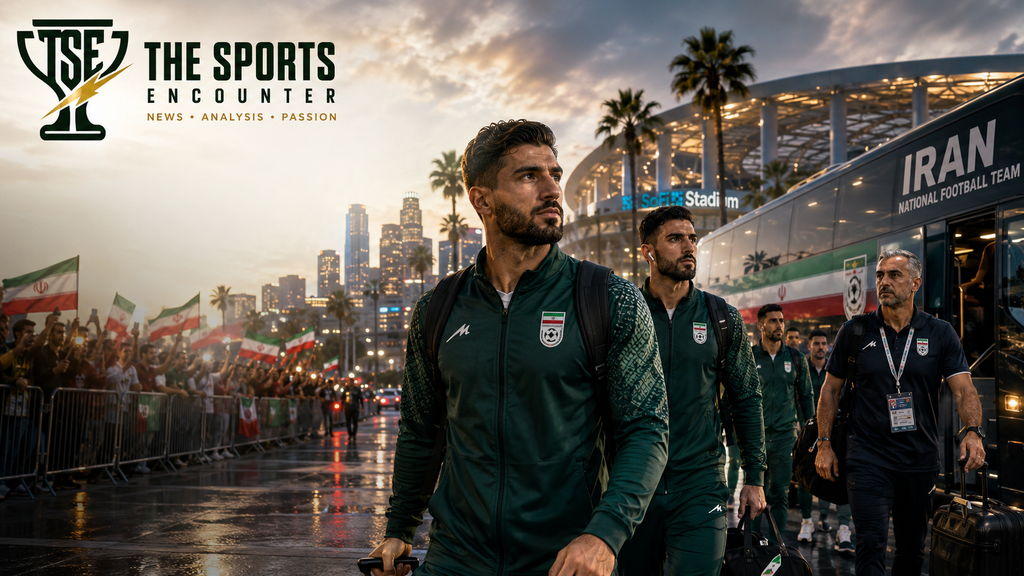
Iran have finally landed on American soil, but their arrival feels nothing like an ordinary World Cup check-in.
Team Melli touched down in Los Angeles on Sunday ahead of their FIFA World Cup 2026 opener against New Zealand, carrying far more than a match plan and a set of training kits. They arrived in the middle of one of the most politically charged backdrops any World Cup side has faced in modern tournament history.
For Iran, though, the mission inside the lines remains simple. They want to win a football match. They want to start strong. They want to give their supporters something uplifting to hold on to at a time when football, politics, identity, and emotion are all colliding at once.
As covered throughout The Sports Encounter’s FIFA World Cup 2026 hub, this tournament was always going to carry a different kind of intensity. Iran’s arrival in the United States has now pushed that feeling into even sharper focus.
Iran Step Into a World Cup Opener Unlike Any Other
Iran’s first group-stage game against New Zealand already mattered because opening matches can shape an entire World Cup campaign. Now it carries a second layer.
The team landed in Los Angeles on the same day news emerged that the United States and Iran were moving toward a peace agreement expected to be formally signed later this week. That development gave the squad’s arrival an unmistakable historical weight, especially with the tournament taking place across North America.
It is one of those rare moments when football does not just exist alongside world events. It walks straight into them.
From Tijuana Emotion to Los Angeles Tension
Iran did not travel to Los Angeles from a calm or neutral setting. The squad left its base in Tijuana, Mexico, after receiving an emotional sendoff from supporters who lined the streets outside the team hotel. Fans waved, chanted “Team Melli,” and tried to give the players one final emotional lift before the next chapter of their World Cup story began.
The scene in Mexico said a lot. Even far from home, Iran’s national team still carries a powerful emotional pull. Supporters were not just watching a squad board a bus. They were sending off a symbol of national identity into a match that feels far bigger than 90 minutes.
A Farewell Built on Hope and Identity
Some fans waved signs of solidarity. Others sang in Spanish. A few simply stood in silence, trying to absorb the strangeness of the moment. That warmth in Tijuana contrasted sharply with the political noise waiting in Los Angeles.
The move itself also highlighted the practical complications surrounding Iran’s tournament campaign. The team shifted its base from Arizona to Mexico in late May, and now must travel into the United States for each of its group-stage matches. That is hardly ideal preparation for a side trying to balance tactical focus, recovery, and emotional stability.
Football First Is Iran’s Public Message
Iran coach Amir Ghalenoei kept his public message clear after the team arrived. He spoke of pride, national representation, and football’s power to bring joy to people. He also made it clear that his squad wants to stay focused on the sport rather than drift into politics.
That is understandable. Coaches and players often say they want the football to speak for them, especially when everything around them threatens to become louder than the game itself.
Still, staying inside that bubble may prove difficult.
Iran Squad Wants to Represent More Than a Scoreline
Iran are not just preparing for New Zealand. They are also carrying the expectations of supporters inside Iran, Iranians living abroad, and a wider global audience watching them through very different lenses.
For some fans, this team represents resilience. For others, it represents a rare source of national joy during deeply painful times. For many in the diaspora, the team’s presence in the United States triggers mixed emotions that are hard to separate from the match itself.
This is where the pressure becomes unusual. Most teams enter a World Cup opener thinking about shape, tempo, transitions, and finishing. Iran must think about all of that while absorbing the emotional spillover of geopolitics, travel disruption, and public scrutiny.
Travel and Visa Problems Have Already Hurt Iran’s Rhythm
Ghalenoei also acknowledged that travel demands and visa problems affecting some federation members have created extra stress. Those details matter more than people often realize.
World Cup preparation lives in routine. Players want the same recovery windows, the same meeting structures, the same training rhythm, and the same mental quiet. Interrupt that routine, and small disadvantages start to stack up.
That point matters even more in a tournament already defined by size and complexity, as we explained in How Affordability Became the Biggest Challenge of FIFA World Cup 2026. This World Cup is not only testing football teams. It is testing logistics, access, movement, and emotional endurance.
Los Angeles Offers Support, Protest, and Contradiction
If Tijuana gave Iran a warm farewell, Los Angeles greeted the team with a far more divided emotional landscape.
Near the stadium, Iranian American protesters gathered to denounce the Iranian government and call attention to human-rights concerns. Their presence served as a reminder that the Iranian story on U.S. soil does not belong to one single narrative. There is pride. There is pain. There is solidarity. There is anger. There is also grief that has not gone away.
That is part of what makes this World Cup moment so complex.
Iran’s Matchday Story Will Not Belong to One Audience
Inside the stadium, fans will watch a football match. Outside it, many will see something else. Some will see a national team trying to give people hope. Others will see a symbol connected to a wider political struggle. Both feelings will exist at the same time.
Los Angeles, home to one of the world’s largest Iranian communities outside Iran, magnifies all of it. The city has deep diaspora roots, long memories, and no shortage of emotion whenever Iran enters a global spotlight.
That Makes Emotional Control a Real Football Factor
This is where the sporting angle returns. Iran cannot afford to let the occasion drag them into an emotionally chaotic performance.
The opener against New Zealand may not carry the glamour of a heavyweight showdown, but it carries serious consequence. Drop points, and the pressure rises immediately. Win, and Iran create breathing room in Group G while also proving they can block out the noise.
That psychological challenge could shape the game almost as much as tactics.
Why New Zealand Cannot Be Treated as a Side Note
It would be easy for outsiders to turn this story into pure geopolitics and forget that Iran still have a football job to do. That would be a mistake.
New Zealand will see opportunity here. They know Iran have arrived under unusual circumstances. They know the emotional weight sits heavily on the other side. That can turn an opener into a dangerous tactical contest.
Iran must guard against two classic tournament traps. The first is starting too cautiously. The second is trying to force the game too early because of the emotional stakes.
Iran Need a Controlled Start, Not a Frenzied One
The first 20 minutes may tell us everything. If Iran settle into their passing rhythm, keep possession clean, and avoid cheap transitions, they have enough quality and experience to control the flow. If they play as though every attack must carry symbolic meaning, the match could become stretched and uncomfortable.
That is why the victory-in-mind theme matters. Victory here should not mean emotional overreach. It should mean discipline, structure, and belief.
This World Cup has already produced strong early statements, including the host nation’s fast start, which you can revisit in Balogun Brace Powers Dream World Cup Start for Co-Hosts. Iran now have the chance to make a very different kind of statement, one built less on spectacle and more on emotional control.
The Match Matters in the Larger Group Picture
Iran’s clash with New Zealand is scheduled for June 15 in Los Angeles, as listed in The Sports Encounter’s FIFA World Cup 2026 schedule. In a compact group stage, that first result can change the feel of everything that follows.
Win, and Iran can approach the rest of the group with momentum. Draw, and uncertainty grows. Lose, and all the emotional noise surrounding this team becomes even louder.
This Is What the 2026 World Cup Looks Like at Full Volume
Iran’s arrival in Los Angeles captures something essential about this tournament.
As we explored in our FIFA World Cup 2026 curtain raiser, this competition was always going to feel bigger, noisier, and more layered than previous editions. More teams. More cities. More travel. More fan cultures. More pressure. More off-field storylines forcing their way onto center stage.
Iran now sit at the heart of one of the most emotionally loaded moments of the entire tournament.
They have crossed into the United States with history pressing on their shoulders. Yet once the whistle blows, none of that will score a goal for them. None of it will clear a defensive line or settle a nervous first touch.
That part still belongs to football.
And that may be exactly what makes this match so compelling.
Iran have landed on U.S. soil with victory in mind. The question now is whether they can turn all that emotional weight into clarity, composure, and three precious points.
The Sports Encounter’s World Cup 2026 coverage focuses on fixtures, team news, match analysis, fan stories, tournament trends, and the biggest talking points from football’s global stage.