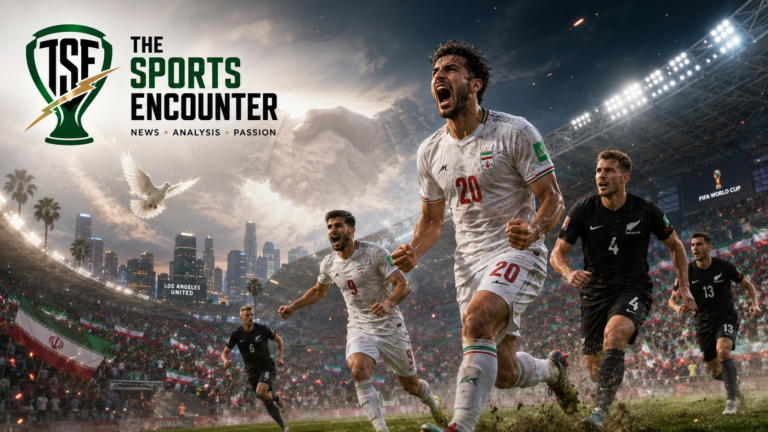
Connect with us
Ruben Santos | The Sports Encounter

Published

on

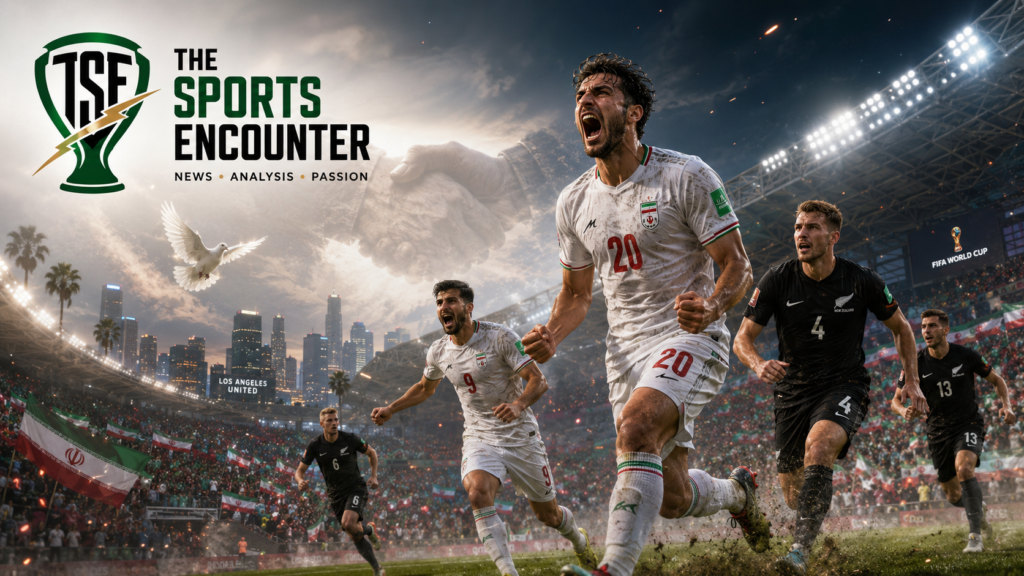
Iran have finally landed on American soil, but their arrival feels nothing like an ordinary World Cup check-in.

Team Melli touched down in Los Angeles on Sunday ahead of their FIFA World Cup 2026 opener against New Zealand, carrying far more than a match plan and a set of training kits. They arrived in the middle of one of the most politically charged backdrops any World Cup side has faced in modern tournament history.

For Iran, though, the mission inside the lines remains simple. They want to win a football match. They want to start strong. They want to give their supporters something uplifting to hold on to at a time when football, politics, identity, and emotion are all colliding at once.

As covered throughout The Sports Encounter’s FIFA World Cup 2026 hub, this tournament was always going to carry a different kind of intensity. Iran’s arrival in the United States has now pushed that feeling into even sharper focus.

Iran Step Into a World Cup Opener Unlike Any Other

Iran’s first group-stage game against New Zealand already mattered because opening matches can shape an entire World Cup campaign. Now it carries a second layer.
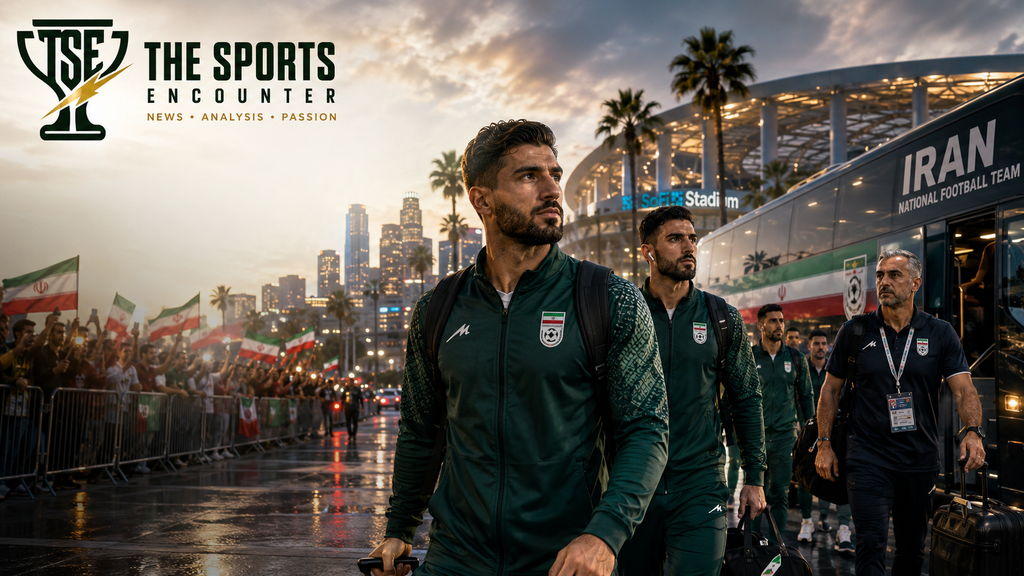
The team landed in Los Angeles on the same day news emerged that the United States and Iran were moving toward a peace agreement expected to be formally signed later this week. That development gave the squad’s arrival an unmistakable historical weight, especially with the tournament taking place across North America.

It is one of those rare moments when football does not just exist alongside world events. It walks straight into them.

From Tijuana Emotion to Los Angeles Tension

Iran did not travel to Los Angeles from a calm or neutral setting. The squad left its base in Tijuana, Mexico, after receiving an emotional sendoff from supporters who lined the streets outside the team hotel. Fans waved, chanted “Team Melli,” and tried to give the players one final emotional lift before the next chapter of their World Cup story began.

The scene in Mexico said a lot. Even far from home, Iran’s national team still carries a powerful emotional pull. Supporters were not just watching a squad board a bus. They were sending off a symbol of national identity into a match that feels far bigger than 90 minutes.

A Farewell Built on Hope and Identity

Some fans waved signs of solidarity. Others sang in Spanish. A few simply stood in silence, trying to absorb the strangeness of the moment. That warmth in Tijuana contrasted sharply with the political noise waiting in Los Angeles.

The move itself also highlighted the practical complications surrounding Iran’s tournament campaign. The team shifted its base from Arizona to Mexico in late May, and now must travel into the United States for each of its group-stage matches. That is hardly ideal preparation for a side trying to balance tactical focus, recovery, and emotional stability.

Football First Is Iran’s Public Message

Iran coach Amir Ghalenoei kept his public message clear after the team arrived. He spoke of pride, national representation, and football’s power to bring joy to people. He also made it clear that his squad wants to stay focused on the sport rather than drift into politics.

That is understandable. Coaches and players often say they want the football to speak for them, especially when everything around them threatens to become louder than the game itself.

Still, staying inside that bubble may prove difficult.

Football First Is Iran’s Public Message

Iran Squad Wants to Represent More Than a Scoreline

Iran are not just preparing for New Zealand. They are also carrying the expectations of supporters inside Iran, Iranians living abroad, and a wider global audience watching them through very different lenses.

For some fans, this team represents resilience. For others, it represents a rare source of national joy during deeply painful times. For many in the diaspora, the team’s presence in the United States triggers mixed emotions that are hard to separate from the match itself.

This is where the pressure becomes unusual. Most teams enter a World Cup opener thinking about shape, tempo, transitions, and finishing. Iran must think about all of that while absorbing the emotional spillover of geopolitics, travel disruption, and public scrutiny.

Travel and Visa Problems Have Already Hurt Iran’s Rhythm

Ghalenoei also acknowledged that travel demands and visa problems affecting some federation members have created extra stress. Those details matter more than people often realize.

World Cup preparation lives in routine. Players want the same recovery windows, the same meeting structures, the same training rhythm, and the same mental quiet. Interrupt that routine, and small disadvantages start to stack up.

That point matters even more in a tournament already defined by size and complexity, as we explained in How Affordability Became the Biggest Challenge of FIFA World Cup 2026. This World Cup is not only testing football teams. It is testing logistics, access, movement, and emotional endurance.

Los Angeles Offers Support, Protest, and Contradiction

If Tijuana gave Iran a warm farewell, Los Angeles greeted the team with a far more divided emotional landscape.

Near the stadium, Iranian American protesters gathered to denounce the Iranian government and call attention to human-rights concerns. Their presence served as a reminder that the Iranian story on U.S. soil does not belong to one single narrative. There is pride. There is pain. There is solidarity. There is anger. There is also grief that has not gone away.

That is part of what makes this World Cup moment so complex.

Iran’s Matchday Story Will Not Belong to One Audience

Inside the stadium, fans will watch a football match. Outside it, many will see something else. Some will see a national team trying to give people hope. Others will see a symbol connected to a wider political struggle. Both feelings will exist at the same time.

Los Angeles, home to one of the world’s largest Iranian communities outside Iran, magnifies all of it. The city has deep diaspora roots, long memories, and no shortage of emotion whenever Iran enters a global spotlight.

That Makes Emotional Control a Real Football Factor

This is where the sporting angle returns. Iran cannot afford to let the occasion drag them into an emotionally chaotic performance.

The opener against New Zealand may not carry the glamour of a heavyweight showdown, but it carries serious consequence. Drop points, and the pressure rises immediately. Win, and Iran create breathing room in Group G while also proving they can block out the noise.

That psychological challenge could shape the game almost as much as tactics.

Why New Zealand Cannot Be Treated as a Side Note

It would be easy for outsiders to turn this story into pure geopolitics and forget that Iran still have a football job to do. That would be a mistake.

New Zealand will see opportunity here. They know Iran have arrived under unusual circumstances. They know the emotional weight sits heavily on the other side. That can turn an opener into a dangerous tactical contest.

Iran must guard against two classic tournament traps. The first is starting too cautiously. The second is trying to force the game too early because of the emotional stakes.

Iran Need a Controlled Start, Not a Frenzied One

The first 20 minutes may tell us everything. If Iran settle into their passing rhythm, keep possession clean, and avoid cheap transitions, they have enough quality and experience to control the flow. If they play as though every attack must carry symbolic meaning, the match could become stretched and uncomfortable.

That is why the victory-in-mind theme matters. Victory here should not mean emotional overreach. It should mean discipline, structure, and belief.

This World Cup has already produced strong early statements, including the host nation’s fast start, which you can revisit in Balogun Brace Powers Dream World Cup Start for Co-Hosts. Iran now have the chance to make a very different kind of statement, one built less on spectacle and more on emotional control.

The Match Matters in the Larger Group Picture

Iran’s clash with New Zealand is scheduled for June 15 in Los Angeles, as listed in The Sports Encounter’s FIFA World Cup 2026 schedule. In a compact group stage, that first result can change the feel of everything that follows.

Win, and Iran can approach the rest of the group with momentum. Draw, and uncertainty grows. Lose, and all the emotional noise surrounding this team becomes even louder.

This Is What the 2026 World Cup Looks Like at Full Volume

Iran’s arrival in Los Angeles captures something essential about this tournament.

As we explored in our FIFA World Cup 2026 curtain raiser, this competition was always going to feel bigger, noisier, and more layered than previous editions. More teams. More cities. More travel. More fan cultures. More pressure. More off-field storylines forcing their way onto center stage.

Iran now sit at the heart of one of the most emotionally loaded moments of the entire tournament.

They have crossed into the United States with history pressing on their shoulders. Yet once the whistle blows, none of that will score a goal for them. None of it will clear a defensive line or settle a nervous first touch.

That part still belongs to football.

And that may be exactly what makes this match so compelling.

Iran have landed on U.S. soil with victory in mind. The question now is whether they can turn all that emotional weight into clarity, composure, and three precious points.


The Sports Encounter’s World Cup 2026 coverage focuses on fixtures, team news, match analysis, fan stories, tournament trends, and the biggest talking points from football’s global stage.

Sports Writer, North America. Ruben Santos covers North American sports for The Sports Encounter, including the NBA, NHL, MLS, MLB, and major international events across the United States, Canada, and Mexico. His work focuses on game stories, league developments, fan experience, tournament logistics, American sports culture, and the major storylines shaping the region. Coverage areas: NBA, NHL, MLS, MLB, North American sports, FIFA World Cup 2026, league analysis.

Cricket

Tim Robinson Explodes as Unicorns Thump Vipers to Enter the Global Super League Final

Tim Robinson struck an unbeaten 68 as San Francisco Unicorns defeated Desert Vipers by eight wickets in the Global Super League Qualifier, setting up a final against Guyana Amazon Warriors.

Marcos Wetherfield | The Sports Encounter

Published

on

San Francisco Unicorns turned one of their most painful defeats of the Global Super League into the performance that saved their tournament.

Four days after Desert Vipers dismantled them by nine wickets at Providence, the Unicorns returned to the same ground, controlled the Qualifier from the opening overs, and completed a commanding eight-wicket victory with 23 balls remaining.

Tim Robinson anchored the chase with an unbeaten 68 from 54 deliveries as San Francisco reached 126 for two in 16.1 overs, comfortably overhauling the Vipers’ modest 122 for seven.

The result sends the Unicorns into the Global Super League final against defending champions Guyana Amazon Warriors, giving the Major League Cricket representatives an immediate opportunity to avenge another earlier defeat.

Robinson was named Player of the Match after combining his composed half-century with two catches in the field. His innings contained eight fours and one six, but its real value came from the calm he brought after San Francisco lost two wickets in three balls.

Oliver Peake finished unbeaten on 33 from 31 deliveries and shared an unbroken 97-run third-wicket partnership with Robinson. Together, they turned what could have become a nervous chase into a controlled procession.

Readers can follow the tournament, franchise cricket, and international match coverage through The Sports Encounter’s Cricket Hub.

Global Super League Qualifier Match Summary

Match detail Information
Competition Global Super League 2026, Qualifier
Match Desert Vipers vs San Francisco Unicorns
Venue Providence Stadium, Guyana
Date July 31, 2026
Desert Vipers 122/7 in 20 overs
San Francisco Unicorns 126/2 in 16.1 overs
Result San Francisco Unicorns won by eight wickets
Balls remaining 23
Player of the Match Tim Robinson, 68 not out from 54 balls and two catches
Best bowling Fabian Allen, 3/20
Key partnership Tim Robinson and Oliver Peake, unbeaten 97
Next match Global Super League final against Guyana Amazon Warriors

Unicorns Respond to Their Earlier Humiliation

This was more than a routine knockout victory.

When the teams met during the league stage, Desert Vipers restricted San Francisco to 151 for seven before chasing the target in only 16.1 overs for the loss of one wicket.

Shadab Khan dominated that match with four wickets for 13 runs, while 19-year-old Zachary Carter struck 55 from 29 deliveries during a nine-wicket victory that revived the Vipers’ tournament.

The Sports Encounter documented how Shadab and Carter rescued the Desert Vipers’ GSL campaign through one of the most complete performances of the league stage.

The Qualifier produced an almost complete reversal.

San Francisco won the toss, chose to field, squeezed the Vipers through the middle overs, and completed their chase in exactly 16.1 overs, the same point at which the Vipers had finished their earlier pursuit.

That symmetry told the story of a team that had learned quickly.

Hassan Khan’s side did not allow the previous defeat to dictate the rematch. The Unicorns changed the pace of the contest, attacked with spin, held their catches, and forced the Vipers into a style of batting that never suited the pressure of a knockout match.

Vipers Lose Momentum Before They Can Build It

Desert Vipers never found a stable tempo after being asked to bat first.

Andries Gous fell for eight in the third over, caught by Peter Siddle off Fabian Allen. Rilee Rossouw briefly threatened to increase the scoring rate with 11 from seven balls, including a four and a six, but Anirudh Immanuel removed him with the total on 29.

The innings then became trapped between survival and acceleration.

Zachary Carter made 15 from 23 deliveries, while captain Shadab Khan required 24 balls for his 14. Their partnership occupied valuable time without creating the platform required for a strong finish.

Carter’s strike rate of 65.21 and Shadab’s 58.33 left the middle and lower order with too much repair work. By the time Kyle Mayers was dismissed for 15 in the 13th over, the Vipers were only 61 for four.

San Francisco understood that wickets were more valuable than chasing dot-ball perfection. The bowlers offered few easy boundary deliveries and kept inviting the batters to force shots against a Providence surface that rewarded patience and changes of pace.

The Vipers reached only 81 for six after Bevon Jacobs fell in the 17th over.

At that point, a total near 110 appeared possible.

Vriitya Aravind prevented a complete collapse with an unbeaten 29 from 20 balls. His five boundaries gave the innings some late life, while Khary Pierre contributed eight from six and Sanjay Pahal struck five from two deliveries.

The Vipers scored 41 runs from their final 23 balls, but the late recovery could not disguise the damage caused earlier.

A total of 122 left almost no room for defensive mistakes.

Fabian Allen Changes the Match

Fabian Allen delivered the most influential bowling performance of the night.

The left-arm spinner finished with three for 20 from four overs, dismissing Gous, Shadab, and Jacobs. Those wickets came at three different stages of the innings and prevented the Vipers from developing any meaningful continuity.

Allen removed Gous before the opener could settle, returned to dismiss Shadab when the captain was attempting to rebuild, and then ended Jacobs’ effort just as the batter threatened to accelerate.

His economy rate of five runs per over was impressive, but the timing of his wickets mattered more.

Hassan Khan also produced an outstanding spell, conceding only 14 runs from four overs and removing Mayers. Immanuel matched those figures with one for 14, while Karima Gore needed only one over to claim Carter’s wicket for four runs.

Together, Allen, Hassan, Immanuel, and Gore bowled 13 overs for 52 runs and took all six wickets credited to bowlers.

That collective return decided the match.

Peter Siddle and Callum Stow conceded 70 runs between them from seven overs without taking a wicket, yet the pressure created by the slower bowlers ensured those expensive overs never became part of a sustained Vipers surge.

San Francisco’s attack demonstrated an important T20 principle: every bowler does not need to dominate when the team’s strongest matchup is used correctly and for long enough.

Early Wickets Give the Vipers Brief Hope

A target of 123 should have been comfortable, but the Vipers briefly created an opening.

Connor Esterhuizen began aggressively, striking 17 from 10 balls with two fours and a six. His intent helped San Francisco move quickly to 29, reducing the pressure on Robinson.

Khary Pierre then changed the atmosphere.

The spinner bowled Esterhuizen for 17 and dismissed captain Hassan Khan for a two-ball duck later in the same over. San Francisco had lost two wickets without adding a run.

At 29 for two after 4.4 overs, the Vipers had their only genuine chance to make the chase uncomfortable.

Another wicket could have exposed a middle order that had experienced collapses earlier in the tournament.

Robinson and Peake refused to offer it.

Robinson Chooses Control Over Drama

Robinson’s innings was built for the situation rather than the highlight reel.

He had already scored 48 against the Vipers in the league-stage defeat, making him San Francisco’s leading batter in both meetings between the teams. This time, he converted his start and remained at the crease until the match was finished.

His half-century came from 48 balls, reflecting the measured nature of the chase. With the required rate barely above six runs per over, there was no reason to manufacture risks against Pierre or attack every delivery from the other spinners.

Robinson waited for errors, rotated the strike, and punished width when it appeared.

Thirty-eight of his 68 runs came in boundaries. The remaining 30 were accumulated through running and strike management, an important detail on a night when the chase required discipline more than explosive power.

Peake played the supporting role intelligently.

The young Australian scored 33 from 31 balls, hitting two fours and two sixes. He did not attempt to match Robinson shot for shot. Instead, he absorbed pressure, targeted selected bowlers, and ensured the Vipers could not create another opening.

Their unbeaten partnership added 97 runs after the double strike at 29.

San Francisco passed 50 in 7.1 overs, reached 78 for two at the halfway stage, and crossed 100 at the end of the 14th over. By then, the outcome had become a matter of timing rather than uncertainty.

Robinson completed the chase in the 17th over, delivering the controlled finish his team had lacked in several earlier passages of the tournament.

Shadab’s Difficult Night Captures the Vipers’ Decline

Shadab Khan had been the central figure in the Vipers’ league-stage victory over San Francisco.

In the Qualifier, his influence disappeared.

He scored 14 from 24 balls, failed to hit a boundary, and conceded 41 runs from four wicketless overs. The Unicorns targeted his bowling more successfully than any other part of the Vipers’ attack.

Shadab’s economy rate of 10.25 was the most expensive among the specialist bowlers who completed four overs.

The contrast with his earlier four-wicket performance was striking.

San Francisco appeared better prepared for his variations, avoided giving him easy dismissals, and forced him to bowl under the pressure of defending a small total. Robinson and Peake were content to wait when the delivery was difficult and attack whenever the length became hittable.

Pierre offered the Vipers some resistance with two for 22, but he could not bowl from both ends.

Vitel Lawes conceded 27 from four overs, Carter gave away 25 from 3.1, and the Unicorns never allowed the required rate to become a factor.

Desert Vipers’ Tournament Ends After a Dramatic Recovery

The Vipers’ elimination will feel particularly painful because they had fought their way back into contention after a difficult start.

They lost their first two matches before Shadab and Carter inspired the nine-wicket victory over San Francisco.

Rilee Rossouw then scored a vital half-century as the Vipers survived Akeal Hosein’s four-wicket spell to defeat Perth Scorchers XI by one wicket. That final-over thriller kept their qualification hopes alive and demonstrated the resilience of a side that had appeared close to elimination.

The full story of that escape can be revisited in The Sports Encounter’s report on how the Vipers survived Akeal Hosein and Perth in a one-wicket GSL thriller.

The Qualifier presented a different challenge.

San Francisco’s slower bowlers denied Rossouw and Shadab the influence they had enjoyed earlier in the tournament. Aravind’s late effort offered hope, but the Vipers had already conceded too much control during the first 16 overs.

San Francisco’s Tournament Has Been Built on Recovery

The Unicorns’ path to the final has rarely been comfortable.

They lost their opening encounter against Guyana Amazon Warriors by three wickets under the DLS method after making 156 for six.

The hosts recovered from 107 for seven to complete the chase, with Rovman Powell remaining unbeaten on 29 and Matthew Forde striking the winning boundary.

That dramatic opening meeting is covered in The Sports Encounter’s report on how Rovman Powell carried Guyana past San Francisco in a rain-shortened chase.

The Unicorns then survived a five-run thriller against Perth Scorchers.

Hammad Azam rescued the innings with an unbeaten 64 after San Francisco slipped to 46 for four, while Ghulam Mudassar took four wickets to defend 152.

Their nine-wicket league-stage defeat to the Vipers exposed major weaknesses, particularly against Shadab and during the middle overs. The Qualifier showed how effectively the team responded.

This has become a campaign defined by repair.

Different players have carried the side at different moments. Hammad rescued them against Perth. Mudassar defended a modest total. Robinson then controlled the most important chase of their GSL campaign.

That variety gives San Francisco a credible chance in the final.

Guyana Amazon Warriors Await in the Final

The Unicorns will now face the tournament’s strongest and most settled team.

Guyana Amazon Warriors entered the competition as defending champions and secured direct qualification for the final by finishing at the top of the league standings.

The competition format awarded the leading team automatic entry into the championship match, while the second- and third-placed sides contested the Qualifier to determine the other finalist.

Schedules, results, tournament information, and official updates are available through the official Global Super League website.

The Warriors have already beaten San Francisco once, but that earlier meeting also showed that the hosts can be placed under severe pressure.

The Unicorns reduced Guyana to 107 for seven before allowing the chase to escape. Their challenge in the final will be to finish the moments they created in the league game.

Providence will bring another layer of difficulty.

Guyana will have the local crowd, greater familiarity with the conditions, and the confidence of defending champions. San Francisco, however, enter the final with fresh evidence that earlier results do not have to define knockout matches.

They have already reversed a nine-wicket defeat against the Vipers.

Now they must attempt the same transformation against the Warriors.

Guyana’s Final League Match Exposed a Possible Weakness

Guyana may have finished at the top of the table, but their passage into the final was not flawless.

Perth Scorchers XI defeated the Warriors by 14 runs after recovering from 78 for eight to score 135. Brody Couch made 43 from 29 balls before Perth’s spinners bowled Guyana out for 121 in 16.1 overs.

The Sports Encounter’s report on how Perth’s spin attack silenced Guyana at Providence provides San Francisco with a useful tactical reference before the final.

Guyana’s top order can be dangerous, particularly when Rahmanullah Gurbaz establishes an early tempo. However, the Perth defeat showed that their batting can unravel when several spin options operate accurately through the middle overs.

San Francisco’s performance against the Vipers suggests they possess the resources to test that vulnerability.

Allen, Hassan, Immanuel, and Gore combined for six wickets and conceded only 52 runs from 13 overs in the Qualifier. Repeating that level of control against Guyana would give the Unicorns a genuine route to the title.

What San Francisco Must Do Differently in the Final

The league-stage meeting with Guyana offered San Francisco both encouragement and warning.

Robinson attacked early, Hammad Azam built an unbeaten 61, and the Unicorns reached 156 for six. Their bowlers then reduced the Warriors to seven wickets down.

The decisive problem was their inability to close the match.

Powell remained calm while wickets fell around him, and San Francisco conceded enough boundaries during the final phase to lose with three deliveries remaining.

The Unicorns must improve in four areas:

  • Protect wickets during the powerplay: Losing two or three early wickets would allow Guyana’s experienced spinners to dictate the middle overs.
  • Attack the middle overs selectively: Robinson and Peake showed against the Vipers that controlled batting can be more valuable than constant aggression.
  • Use spin as the primary pressure weapon: Guyana’s defeat to Perth and the Qualifier both showed how effective slower bowling can be at Providence.
  • Finish the chase or defense: Creating pressure will not be enough if Powell or another experienced Guyana batter remains at the crease.

Providence Continues to Reward Adaptability

The 2026 Global Super League has repeatedly shown that Providence cannot be approached with a single batting formula.

Lahore Qalandars began the tournament by scoring 171 for seven before defeating Perth by 16 runs. The Sports Encounter covered how Farhan Yousaf announced his arrival in the GSL opener with an explosive half-century.

A day later, Michael Bracewell and Usama Mir helped Lahore defeat the Vipers by 38 runs. That performance, detailed in our report on how Bracewell led Lahore from the front at Providence, demonstrated how quickly an innings can collapse once spin gains control.

Later matches produced totals of 112, 122, 135, and 152, reinforcing the importance of reading the pitch rather than relying on a fixed target.

San Francisco handled that challenge correctly in the Qualifier. They recognized that 123 did not require reckless acceleration, absorbed Pierre’s double strike, and allowed Robinson to pace the chase around the required rate.

The final may demand a different approach.

San Francisco Carry Major League Cricket Experience

The Unicorns also bring experience from a highly competitive American franchise system.

Major League Cricket’s recent season produced several close finishes, including a one-run championship match won by Los Angeles Knight Riders.

The Sports Encounter’s report on the Los Angeles Knight Riders’ dramatic MLC final victory highlighted how small tactical decisions can determine a title match.

San Francisco will need the same awareness at Providence.

One loose over, a missed catch, or an unnecessary middle-over dismissal could separate the champion from the runner-up. The Unicorns’ Qualifier performance showed they can execute under pressure, but Guyana will present a deeper batting order and a more experienced bowling attack.

Key Statistics From the Qualifier

  • San Francisco Unicorns won by eight wickets with 23 balls remaining.
  • Tim Robinson scored an unbeaten 68 from 54 balls, including eight fours and one six.
  • Oliver Peake made 33 not out from 31 deliveries.
  • Robinson and Peake shared an unbeaten 97-run third-wicket partnership.
  • Fabian Allen took three wickets for 20 runs from four overs.
  • Hassan Khan and Anirudh Immanuel each conceded only 14 runs from four overs.
  • Vriitya Aravind top-scored for the Vipers with an unbeaten 29 from 20 balls.
  • Shadab Khan scored 14 from 24 balls and conceded 41 runs from four wicketless overs.
  • Khary Pierre claimed both San Francisco wickets and finished with two for 22.
  • The Unicorns reached their target at a run rate of 7.79 per over.

Final Verdict

The scorecard will show an eight-wicket victory completed with 23 balls remaining.

The deeper story is how thoroughly San Francisco corrected the failures of their previous meeting with Desert Vipers.

Their spinners controlled the innings. Allen delivered wickets at crucial stages. Robinson absorbed the pressure created by Pierre’s double strike. Peake stayed with him, and the chase never drifted into panic.

Desert Vipers will regret the 70 deliveries consumed by Carter, Shadab, and Mayers for only 44 runs. Aravind’s late assault gave the total some respectability, but knockout cricket rarely forgives an innings that spends too long searching for momentum.

The Unicorns were sharper, calmer, and more adaptable.

They arrived at Providence carrying the memory of a heavy defeat and left with a place in the Global Super League final.

Guyana Amazon Warriors are next, and San Francisco have already learned the most valuable lesson of their campaign: in a knockout match, the first result does not get a vote.

Frequently Asked Questions

Who won the Global Super League Qualifier between Desert Vipers and San Francisco Unicorns?

San Francisco Unicorns defeated Desert Vipers by eight wickets in the Global Super League Qualifier at Providence Stadium. The Unicorns chased 123 in 16.1 overs with 23 balls remaining.

Who was Player of the Match in the Vipers vs Unicorns Qualifier?

Tim Robinson was named Player of the Match after scoring an unbeaten 68 from 54 balls and taking two catches during the Desert Vipers innings.

How many runs did Tim Robinson score against Desert Vipers?

Tim Robinson scored 68 not out from 54 deliveries, including eight fours and one six. He also shared an unbeaten 97-run partnership with Oliver Peake.

What was the key partnership in San Francisco Unicorns’ chase?

Tim Robinson and Oliver Peake added an unbeaten 97 runs for the third wicket after San Francisco had slipped to 29 for two.

Who was the best bowler for San Francisco Unicorns?

Fabian Allen was the leading bowler for the Unicorns, taking three wickets for 20 runs from four overs. Hassan Khan and Anirudh Immanuel also conceded only 14 runs each from their four-over spells.

Why did Desert Vipers score only 122?

The Vipers struggled to build momentum through the middle overs. Zachary Carter, Shadab Khan, and Kyle Mayers consumed 70 balls for only 44 runs combined, leaving the lower order with too much work to do late in the innings.

Who top-scored for Desert Vipers?

Vriitya Aravind top-scored with an unbeaten 29 from 20 balls. His late boundaries helped the Vipers recover from 81 for six to 122 for seven.

How did Khary Pierre perform in the Qualifier?

Khary Pierre took both San Francisco wickets and finished with figures of two for 22 from four overs. He dismissed Connor Esterhuizen and Hassan Khan in the same over.

Why was Shadab Khan unable to influence the Qualifier?

Shadab struggled with both bat and ball. He scored 14 from 24 deliveries without a boundary and conceded 41 runs from four wicketless overs.

Who will San Francisco Unicorns face in the Global Super League final?

San Francisco Unicorns will face Guyana Amazon Warriors in the Global Super League final.

Why did Guyana Amazon Warriors qualify directly for the final?

Guyana Amazon Warriors finished at the top of the league standings. Under the tournament format, the first-placed team advanced directly to the final, while the second- and third-placed teams contested the Qualifier.

Where will the Global Super League final be played?

The final will be played at Providence Stadium in Guyana, the main venue for the 2026 Global Super League.

When is the Global Super League final?

The final is scheduled for Sunday, with San Francisco Unicorns facing defending champions Guyana Amazon Warriors.

Did Desert Vipers beat San Francisco Unicorns earlier in the tournament?

Yes. Desert Vipers defeated San Francisco Unicorns by nine wickets during the league stage before the Unicorns reversed the result in the Qualifier.

Has San Francisco Unicorns already played Guyana Amazon Warriors in GSL 2026?

Yes. Guyana Amazon Warriors defeated San Francisco by three wickets under the DLS method during the league stage.

What must San Francisco Unicorns improve before the final?

The Unicorns must protect early wickets, use their spin attack effectively, and finish decisive moments more clinically than they did in their earlier defeat to Guyana.

Continue Reading

Editor's Choice

Cincinnati Open Wild Cards Give Jack Draper a Lifeline and Tennis Legends One More Stage

The Cincinnati Open has awarded main-draw wild cards to Jack Draper, Gael Monfils, Grigor Dimitrov and Stan Wawrinka, creating a compelling mix of comeback pressure, tournament history and farewell-season emotion ahead of the US Open.

Published

on

Jack Draper, Gael Monfils, Grigor Dimitrov and Stan Wawrinka featured together after receiving Cincinnati Open main-draw wild cards.

The Cincinnati Open has used its 2026 men’s wild cards to create something far more compelling than a routine entry-list update.

Jack Draper, Gael Monfils, Grigor Dimitrov, and Stan Wawrinka have received direct places in the main draw, bringing together an injured former world No. 4 trying to rebuild his season, a past Cincinnati champion, and two celebrated veterans approaching the end of their professional careers.

Each selection carries a different sporting and emotional meaning.

Draper needs competitive matches and evidence that his body can survive the North American hard-court season. Dimitrov returns to the venue where he achieved one of the defining victories of his career. Monfils and Wawrinka receive another opportunity to perform before an audience that has watched them entertain, endure, and occasionally defy time for nearly two decades.

Cincinnati has also awarded qualifying wild cards to Americans J.J. Wolf, Vignesh Gogineni, Mackenzie McDonald, and Darwin Blanch, along with Japan’s Kei Nishikori.

That second group reflects another side of wild-card policy: local representation, youth development, comeback support, and recognition of distinguished careers.

The result is a field strengthened by reputation, uncertainty, local interest, and emotional weight.

Cincinnati Open 2026 Wild Cards

Entry Player Country Cincinnati significance
Main draw Jack Draper Great Britain Reached the quarterfinals on his 2024 tournament debut
Main draw Gael Monfils France Expected to make his 14th and final Cincinnati appearance
Main draw Grigor Dimitrov Bulgaria Won the Cincinnati title in 2017
Main draw Stan Wawrinka Switzerland Expected to make his 15th and final Cincinnati appearance
Qualifying J.J. Wolf United States Cincinnati native with strong regional support
Qualifying Vignesh Gogineni United States Local player receiving an important development opportunity
Qualifying Mackenzie McDonald United States Experienced American tour professional
Qualifying Darwin Blanch United States Highly regarded young American prospect
Qualifying Kei Nishikori Japan Former world No. 4 and 2014 US Open finalist

The broader Cincinnati Open runs from August 8 to 23 at the Lindner Family Tennis Center. Community activities open the event before qualifying begins, with the main-draw competition following later in the schedule.

The ATP’s official Cincinnati wild-card announcement confirmed the main-draw selections and the players receiving opportunities in qualifying.

Jack Draper’s Wild Card Is About More Than Ranking

Among the four main-draw selections, Draper’s carries the greatest immediate sporting significance.

His talent has already been established. The British left-hander climbed as high as world No. 4, won the 2025 Indian Wells Masters, and reached the Cincinnati quarterfinals during his tournament debut in 2024.

Availability has become the bigger issue.

Draper entered the summer attempting to recover from another difficult sequence of injuries. An arm problem forced him to miss several events, while his 2026 campaign repeatedly stopped just as he appeared ready to build momentum.

He also withdrew from the DC Open shortly before his planned return, renewing concerns over whether his body could withstand consecutive tournaments during the demanding build-up to the US Open.

The late withdrawal turned what should have been a routine comeback into another medical and competitive uncertainty. The Sports Encounter previously examined how Jack Draper’s DC Open withdrawal intensified concerns over his US Open preparations.

That context explains why British supporters reacted so strongly to the Cincinnati announcement.

The wild card removes one significant obstacle. Draper will not have to survive qualifying simply to enter an elite Masters 1000 field. He can prepare specifically for a main-draw opponent, manage his training load, and gain access to one of the most valuable US Open preparation events.

Direct entry, however, cannot solve his central problem.

Draper needs to complete matches.

A player returning from a persistent arm injury may look sharp during practice yet struggle when serving at full intensity across several sets. Match play creates unpredictable demands, including long service games, repeated changes of direction, pressure points, and the temptation to increase pace when an opponent begins attacking.

His recent Montreal wild card gives him another opportunity before Cincinnati. The National Bank Open confirmed Draper’s Montreal main-draw invitation as he continued his return from the arm injury that disrupted his season.

Montreal and Cincinnati therefore form a connected fitness examination.

Strong results would help his confidence and ranking recovery, but the more important measure may be whether Draper can finish multiple matches without another setback. The US Open begins soon after Cincinnati, leaving little recovery time should his arm react badly.

Dimitrov Returns to the Scene of His Greatest Masters Victory

Grigor Dimitrov’s selection is easier to defend on competitive and historical grounds.

The Bulgarian won the Cincinnati Open in 2017, defeating Nick Kyrgios in the final to secure the only ATP Masters 1000 title of his career. Nine years later, he returns as the only former Cincinnati champion among the four main-draw wild-card recipients.

That history matters.

Wild cards often attract criticism when tournaments appear to reward reputation over current merit. Dimitrov’s connection to Cincinnati gives his inclusion a clear local meaning. He has already created one of the tournament’s significant modern memories, and supporters can reasonably view his return as part sporting opportunity and part celebration of the event’s own history.

His tennis also remains suited to Cincinnati’s conditions when his movement and timing are intact.

The hard courts can reward first-strike aggression, an effective serve, and the ability to redirect pace. Dimitrov’s variety, one-handed backhand, defensive athleticism, and willingness to move forward have long made him difficult to read.

The greater uncertainty concerns his physical condition and recent consistency.

Veteran players can remain dangerous over a single match, particularly when they receive a favorable draw. Sustaining that level throughout a Masters tournament is much harder. Cincinnati’s expanded format creates additional physical demands, while the proximity of the US Open makes workload management increasingly important.

Dimitrov’s presence still gives the field something valuable: a former champion capable of turning an early-round contest into a genuine event.

Monfils and Wawrinka Prepare for Their Final Cincinnati Appearances

The emotional center of the announcement belongs to Gael Monfils and Stan Wawrinka.

Both men are competing in what is expected to be their final ATP Tour season. According to the ATP, Wawrinka is preparing for his 15th Cincinnati appearance, while Monfils is set to make his 14th and final appearance at the tournament.

Their selections acknowledge careers that cannot be understood through current rankings alone.

Wawrinka is a three-time Grand Slam singles champion whose best tennis allowed him to break through during an era dominated by Roger Federer, Rafael Nadal, Novak Djokovic, and Andy Murray.

His one-handed backhand became one of the sport’s defining shots, but his greater achievement was his ability to rise in major finals against historically powerful opposition.

Monfils built a different legacy.

The Frenchman became one of tennis’s most imaginative athletes, capable of turning defense into spectacle and routine rallies into improvised performances. His speed, flexibility, court coverage, crowd interaction, and instinct for drama made him a fan favorite across continents.

Neither player will want a ceremonial appearance without competitive purpose. Both have spent their careers trying to win, and both will enter Cincinnati expecting to challenge whoever stands across the net.

Their wild cards nevertheless carry an unavoidable sense of farewell.

A first-round loss could end either man’s relationship with Cincinnati in a matter of hours. A victory could create another night in which a veteran briefly bends the tournament around his presence.

That uncertainty gives their selections real emotional force.

Why Nishikori Faces the Harder Route

Kei Nishikori has received a qualifying wild card rather than direct main-draw entry.

The distinction may generate debate among supporters.

Nishikori reached world No. 4 and became the first Asian man in the Open Era to reach a Grand Slam singles final when he finished runner-up at the 2014 US Open. His speed, return quality, early ball-striking, and ability to take time away from opponents made him one of the finest hard-court players of his generation.

He is also expected to be playing his final ATP Tour season.

Cincinnati’s organizers could have placed him directly alongside Wawrinka and Monfils. Instead, Nishikori must navigate qualifying, where experienced professionals and ambitious younger players compete with little margin for error.

The decision may appear harsh, but it introduces sporting balance into the allocations. A respected career has earned Nishikori access to the event, while his current level must earn him access to the main draw.

Qualifying could also give him useful competitive rhythm if his body holds up. The danger is that an intense opening match may end his Cincinnati campaign before the wider audience has an opportunity to see him.

Why the American Qualifying Wild Cards Matter

The American selections reveal how tournaments use wild cards to serve several responsibilities at once.

J.J. Wolf and Vignesh Gogineni provide a direct Cincinnati connection. Local players can attract regional supporters and strengthen the relationship between a global tournament and its surrounding tennis community.

Jack Draper preparing for the Cincinnati Open as Monfils, Dimitrov, and Wawrinka return for major hard-court appearances.

Mackenzie McDonald represents experience. He has spent years competing at tour level and has recorded victories over elite opponents, yet ranking fluctuations can leave established professionals outside major draws.

Darwin Blanch represents investment in the future.

A qualifying wild card gives a developing player experience against stronger opposition without guaranteeing a place in the main event. That distinction matters because tournaments can support young talent while preserving a genuine competitive test.

The four Americans and Nishikori will need to win their way through qualifying. Their inclusion creates opportunity rather than protection.

Did Cincinnati Choose the Right Balance?

Every wild-card announcement produces arguments because each place given to one player closes a door for someone else.

Critics may question whether aging stars should receive entries ahead of younger players with stronger recent results. Others will ask whether Draper’s fitness justified a main-draw place, particularly after another late withdrawal.

There may also be debate over why Nishikori received only qualifying access while fellow retiring veterans entered the main draw.

Those questions are legitimate.

Wild cards are discretionary assets, and tournaments often use them for commercial appeal as well as competitive development. Famous players sell tickets, generate coverage, and create emotional connections that an unfamiliar ranking-based entrant may not immediately provide.

Cincinnati’s choices still form a coherent group.

Draper brings current relevance and high-level upside. Dimitrov offers tournament history. Monfils and Wawrinka bring farewell-season significance. Nishikori receives a pathway rather than a guaranteed place. Wolf and Gogineni connect the event to Cincinnati, while McDonald and Blanch represent experience and potential.

This is a more thoughtful mixture than simply selecting four famous names.

Cincinnati’s Field Is Already Loaded

The wild cards enter one of the strongest fields of the North American hard-court season.

The tournament announced that Jannik Sinner, Carlos Alcaraz, Alexander Zverev, Novak Djokovic, Ben Shelton, Taylor Fritz, Frances Tiafoe, and Tommy Paul were among the leading men expected to compete.

Organizers said the available top-ranked players from both tours had entered, giving the tournament considerable depth even before the wild cards were added.

The Cincinnati Open’s official singles-field announcement provides further details about the leading ATP and WTA players expected at the Lindner Family Tennis Center.

Cincinnati was also voted the 2025 ATP Masters 1000 Tournament of the Year, adding prestige to a competition that occupies a crucial position between the Canadian Masters events and the US Open.

Readers can follow the wider hard-court season through The Sports Encounter’s Tennis Hub, which brings together tournament reports, player analysis, rankings, rivalries, injury updates, and Grand Slam coverage.

The Sports Encounter has also examined why leading players such as Jannik Sinner and Novak Djokovic manage their schedules carefully before the US Open.

Recent coverage of the changing power structure in men’s tennis and the veteran-versus-breakthrough tension at Wimbledon 2026 also provides useful context for a Cincinnati field combining champions, comeback players, and emerging prospects.

What Comes Next

The wild cards have provided access. The players must now provide the answers.

Can Draper survive Montreal and Cincinnati without aggravating his arm?

Does Dimitrov still possess the movement and durability required to trouble the leading seeds?

Will Monfils or Wawrinka create one final memorable Cincinnati run?

Can Nishikori come through qualifying and join them in the main draw?

Those questions give the announcement its real value.

Cincinnati has opened the gate for four recognizable players, but it has not guaranteed them comfortable journeys. Draper enters with his future momentum at stake. Dimitrov returns carrying the memory of 2017. Monfils and Wawrinka arrive knowing every appearance may be their last.

The tournament has blended sporting risk with nostalgia, local identity, development opportunities, and star power.

Now the court gets the final vote.

Frequently Asked Questions

Which players received Cincinnati Open main-draw wild cards?

Jack Draper, Gael Monfils, Grigor Dimitrov, and Stan Wawrinka received main-draw wild cards for the 2026 Cincinnati Open.

Why did Jack Draper receive a Cincinnati Open wild card?

Draper received a wild card as he continues his return from injury and prepares for the North American hard-court season. The direct entry allows him to avoid qualifying and gives him another opportunity to build match fitness before the US Open.

Which players received Cincinnati Open qualifying wild cards?

Qualifying wild cards went to J.J. Wolf, Vignesh Gogineni, Mackenzie McDonald, Darwin Blanch, and Kei Nishikori.

Why is Grigor Dimitrov’s Cincinnati wild card significant?

Dimitrov won the Cincinnati Open in 2017, the only ATP Masters 1000 title of his career. His return carries strong historical value for the tournament and gives fans another chance to see a former champion compete at the event.

Are Gael Monfils and Stan Wawrinka playing their final Cincinnati Open?

Both players are expected to make their final Cincinnati appearances. Monfils is preparing for his 14th appearance, while Wawrinka is set to compete in Cincinnati for the 15th time.

Why did Kei Nishikori receive only a qualifying wild card?

Cincinnati organizers gave Nishikori access to the tournament through qualifying rather than placing him directly in the main draw. The decision recognizes his career while requiring him to earn his place through competitive matches.

When will the 2026 Cincinnati Open take place?

The 2026 Cincinnati Open is scheduled to run from August 8 to August 23 at the Lindner Family Tennis Center.

Why are Cincinnati Open wild cards important?

Wild cards allow tournaments to support returning players, local competitors, emerging prospects, former champions, and popular veterans who may not qualify through rankings alone. They also help organizers create a stronger balance between sporting merit, fan interest, and player development.

Continue Reading

Editor's Choice

Neymar’s World Cup Career: Skill, Pain, and the Rainbow Flick Legacy

Neymar carried Brazil’s World Cup hopes across four tournaments, producing unforgettable goals while enduring injuries, criticism and elimination heartbreak. His final farewell leaves a legacy shaped by skill, pain and the freedom represented by the rainbow flick.

Ruben Santos | The Sports Encounter

Published

on

Cinematic tribute to Neymar Jr.’s World Cup journey, showing his Brazilian flair and rainbow-flick skill on one side and his pain, injuries and emotional heartbreak on the other, with the headline “Skill. Pain. Legacy.” and The Sports Encounter logo.
Neymar’s World Cup Career: Skill, Pain and the Rainbow Flick Legacy

Neymar Junior’s World Cup career will be remembered through two contrasting images.

One shows a footballer lifting the ball over a defender with a rainbow flick, moving through pressure with the imagination of a child who still believes football should be fun.

The other shows him on the ground.

Sometimes he was holding his ankle. In Brazil in 2014, he left the field on a stretcher with a fractured vertebra. In Qatar in 2022, he sat on the grass after the penalty shootout defeat to Croatia, struggling to process how one of the finest goals of his international career had failed to save Brazil. Four years later, his final World Cup ended with another painful elimination, this time against Norway.

Brazil spent more than a decade asking Neymar to carry the nation toward a sixth World Cup. He gave the shirt goals, assists, creativity, personality, controversy and parts of his body that never fully recovered from the punishment.

He never delivered the trophy Brazil wanted most.

That absence will shape every argument about his place in the Seleção’s history. Yet reducing Neymar’s international career to the World Cup he did not win would erase the burden he carried and the football he produced while carrying it.

His final international numbers remain extraordinary: 130 appearances, 80 goals and 58 assists. He left as Brazil’s leading men’s international scorer and one of its most productive creators. His record was built across 16 years, four World Cups and several different versions of a national team that rarely looked capable of matching his individual imagination.

Carlo Ancelotti has now confirmed that Brazil are moving toward a younger generation. Neymar, Casemiro and Danilo are outside the long-term plan as the five-time world champions begin building toward the 2028 Copa América and, eventually, the 2030 World Cup.

The announcement formally closes a generation that had already ended emotionally.

Neymar retired from international football after Brazil’s 2-1 defeat to Norway in the 2026 World Cup Round of 16. He later made his decision unmistakable. His time had passed. He had given his life and blood to the national team. He no longer wanted to continue.

His farewell carried no World Cup medal.

It carried something more complicated: the legacy of a footballer who represented Brazil’s beauty, absorbed Brazil’s frustration and became the face of a national identity struggling to decide whether it still believed in expressive football.

TL;DR

  • Neymar represented Brazil at the 2014, 2018, 2022 and 2026 World Cups.
  • He scored at four World Cups and finished among Brazil’s leading World Cup goalscorers.
  • His 2014 campaign ended with a fractured vertebra before Brazil’s semifinal defeat to Germany.
  • He returned from major injury before the 2018 World Cup but became a target of criticism over his reactions to fouls.
  • In 2022, he scored a magnificent extra-time goal against Croatia before Brazil lost on penalties.
  • His final World Cup appearance came in Brazil’s 2-1 Round of 16 defeat to Norway in 2026.
  • Neymar retired from international football with 80 goals and 58 assists in 130 appearances.
  • The rainbow flick became a symbol of his creativity, confidence and resistance to football’s hostility toward individual expression.
  • Ancelotti’s decision to move beyond Neymar, Casemiro and Danilo confirms the end of a major Brazilian generation.

Neymar’s Brazil and World Cup Career at a Glance

CategoryRecord
Brazil career2010–2026
International appearances130
International goals80
International assists58
World Cups played2014, 2018, 2022 and 2026
Best World Cup finishFourth place in 2014
Senior international title2013 FIFA Confederations Cup
Final Brazil matchBrazil 1-2 Norway, July 5, 2026
Final Brazil goalStoppage-time penalty against Norway
Defining skillRainbow flick and close-control dribbling

Brazil Gave Neymar the Shirt and the Weight of an Era

Neymar arrived in the senior Brazil team in 2010 when the national side was entering an uncertain period.

The great 2002 champions had disappeared. Ronaldo, Rivaldo, Ronaldinho, Cafu and Roberto Carlos belonged to history. Kaká’s generation had fallen short in 2006 and 2010. Brazil still produced gifted footballers, but the team no longer frightened opponents through the same combination of personality, technique and competitive authority.

Neymar became the answer before he had fully become an adult.

At Santos, he dribbled with a freedom that recalled Brazilian street football. His body feints, acceleration and improvised finishes made defenders look as though they had entered the wrong game. He could attack from the left, move centrally, combine in small spaces or turn ordinary possession into a moment worth replaying.

Brazil saw more than a promising forward. The country saw continuity.

Pelé had made Brazilian football global. Garrincha gave it mischief. Zico gave it elegance. Romário gave it sharpness. Ronaldo gave it explosive power. Ronaldinho made joy feel like a competitive weapon.

Neymar inherited pieces of all those traditions without becoming a copy of any of them.

He was lighter than Ronaldo, more direct than Ronaldinho and more emotionally visible than almost every Brazilian superstar before him. Supporters saw every celebration, complaint, injury, tear and argument. Social media turned those reactions into content. Every touch became evidence for one side of an endless debate.

For Brazil, he remained the player most capable of solving a match independently. That dependence became a strength and a structural weakness.

Opponents could prepare for Brazil by preparing for Neymar. Teammates often waited for him to create the decisive action. Coaches changed, systems shifted and supporting forwards came and went, yet the central instruction rarely changed: give Neymar the ball and hope he invents something.

His emotional return to the national team before the 2026 tournament was explored in Neymar’s Last Dance: Brazil’s Prodigal Son Returns for His Fourth World Cup.

2014: The World Cup That Nearly Broke Brazil With One Knee

The 2014 World Cup was supposed to complete Neymar’s rise.

Brazil hosted the tournament carrying national expectation, political tension and the memory of 1950. Neymar was 22 years old and already the team’s emotional center.

He scored twice against Croatia in the opening match and added another two goals against Cameroon. His tournament was not technically perfect, but he gave Brazil the individual moments a nervous team needed.

The pressure surrounding the host nation was visible. Brazil struggled to control matches cleanly and needed penalties to survive Chile in the Round of 16. Neymar converted his kick in the shootout while carrying an injury and the emotional weight of a stadium that feared another national trauma.

Then came Colombia.

Brazil won the quarterfinal 2-1 through goals from Thiago Silva and David Luiz. The result should have sent the country into celebration.

Instead, the defining image came in the closing minutes.

Colombia defender Juan Camilo Zúñiga challenged Neymar from behind, driving a knee into his lower back. Neymar collapsed and left the field on a stretcher. Medical examinations revealed a fractured vertebra.

His World Cup was over.

The injury landed only centimeters away from causing consequences far beyond football. Neymar later spoke about how close the contact came to threatening his ability to walk. Brazil had lost its best attacker, but the human fear exceeded the tactical damage.

Without Neymar and suspended captain Thiago Silva, Brazil faced Germany in the semifinal. The 7-1 defeat became one of the darkest nights in the history of the national team.

Neymar did not play, yet the result became part of his World Cup story. His absence exposed how deeply Brazil had built its identity around one player. The structure collapsed when the central source of confidence disappeared.

The 2014 tournament established the pattern that would follow him. He had played well. He had scored important goals. Brazil had reached the semifinals. Still, Neymar left the tournament in physical pain while the country remembered the failure more loudly than his contribution.

2018: Talent Returned, but the Conversation Changed

Neymar entered the 2018 World Cup after another race against injury.

A fractured metatarsal suffered with Paris Saint-Germain had kept him out for months. His recovery became a daily national story. Brazil needed him available, even if he lacked full rhythm.

He scored against Costa Rica and Mexico, helping Brazil reach the quarterfinals. He created chances, carried the ball through pressure and remained the player opponents feared most.

Yet the football became secondary to the reaction around him.

Neymar was repeatedly fouled. He also exaggerated some of the contact, rolling across the ground and reacting theatrically. Television replays and social media transformed those moments into global ridicule. The “Neymar Challenge” became a meme in which people imitated his falls.

The criticism was not entirely unfair. Neymar sometimes extended a genuine foul into a performance. His frustration became visible in ways that weakened sympathy for the punishment he was actually receiving.

However, the mockery also distorted reality.

Defenders targeted him because ordinary defensive methods often failed. His ability to change direction at speed forced opponents into desperate contact. Repeated fouls accumulated across matches, and officials did not always protect the player consistently.

Neymar became trapped between two truths. He was genuinely fouled at an exceptional rate. He sometimes reacted in a manner that made people doubt him.

Brazil’s quarterfinal defeat to Belgium ended the campaign. Neymar helped create late opportunities, but Thibaut Courtois denied his final attempt and Belgium advanced 2-1.

The post-tournament discussion focused heavily on his behavior. That damaged the public understanding of his performance. Neymar had returned from a significant injury, scored twice and helped Brazil reach the last eight. Those facts could not compete with the memes.

From that point forward, every Neymar injury carried suspicion among part of the audience. His pain had become entertainment.

The Rainbow Flick Became More Than a Skill

A rainbow flick begins with an act of confidence.

The player traps the ball between the feet, rolls or lifts it upward and sends it over the defender’s head. The move has little margin for error. Failure looks foolish. Success can humiliate an opponent and electrify a stadium.

Neymar did not invent the skill. Brazilian football had long embraced the carretilha or lambreta, while players across generations and countries had used variations of it.

He became its most recognizable modern ambassador.

For Neymar, the rainbow flick expressed a larger idea. Football could remain playful at the highest level. A player did not need to remove imagination from his game simply because the stakes had increased.

Critics called it showboating. Defenders often responded with anger. Some believed the trick lacked respect, particularly when Neymar attempted it late in matches or against beaten opponents. Referees occasionally appeared more offended by the skill than by the retaliatory foul that followed.

Neymar’s position was consistent. Skill belonged inside football. A dribble was not disrespectful merely because it embarrassed someone.

That argument touches the heart of Brazilian football culture.

The Seleção’s global identity was built through competitive success and expressive technique. Pelé’s body feints, Garrincha’s dribbling, Rivelino’s elastico and Ronaldinho’s improvisation all made winning feel creative.

Modern football increasingly prizes structure, pressing, physical coverage and risk management. Players are coached to protect possession and occupy defined zones. Individual expression survives, but it often requires permission from the system.

Neymar played as though permission had already been granted.

The rainbow flick therefore became part of his legacy because it captured the tension surrounding him. Fans who loved Neymar saw courage, joy and Brazilian identity. Critics saw vanity and unnecessary provocation.

Both reactions revealed how football had changed.

2022: Neymar Scored the Goal His World Cup Career Deserved

Qatar offered Neymar what looked like his best final chance.

Brazil entered the 2022 World Cup with depth, balance and attacking options. Vinícius Júnior had developed into an elite forward. Casemiro protected the midfield. Richarlison brought movement and finishing. Thiago Silva continued to provide leadership.

Neymar no longer needed to create every moment alone.

Then he injured his ankle against Serbia in the opening match.

Images of the swelling created immediate fear that his tournament was over. Once again, a World Cup had placed Neymar’s body at the center of Brazil’s hopes.

He missed the remaining group matches but returned against South Korea in the Round of 16. Brazil won 4-1, producing one of the tournament’s most fluid attacking performances. Neymar scored from the penalty spot and helped connect the team’s combinations.

The quarterfinal against Croatia became the most painful defeat of his international career.

Croatia slowed the game, controlled emotional rhythms and prevented Brazil from finding clean attacking spaces. The match entered extra time without a goal.

Then Neymar produced a sequence worthy of any World Cup.

He exchanged quick passes through Croatia’s defense, accelerated into the penalty area, moved around goalkeeper Dominik Livaković and finished from a tight angle.

The goal was beautiful, difficult and decisive in appearance. It also equaled Pelé’s official Brazil scoring record at the time.

Brazil failed to protect the lead.

Bruno Petković equalized following a late counterattack, and Croatia won the penalty shootout. Neymar had been scheduled to take Brazil’s fifth penalty. The shootout ended before he could step forward.

He remained on the field in tears.

This was the cruelest summary of his World Cup career. Neymar had produced the required moment. The team had failed to carry it safely to the finish.

2026: A Final World Cup Reduced to 37 Minutes and One Last Goal

Neymar’s path to the 2026 World Cup required another recovery few players could have completed.

An anterior cruciate ligament injury suffered in 2023 kept him away from Brazil for an extended period. His move to Al-Hilal produced little football, and recurring physical problems raised serious questions about whether he could return to elite international competition.

He went back to Santos, the club where his career had begun.

The return carried emotion and practical purpose. Neymar needed matches, fitness and a familiar environment. Ancelotti needed evidence that the 34-year-old could still contribute to Brazil.

He made the squad, but his role had changed.

Vinícius Júnior had become the primary attacking figure. Younger players offered greater physical intensity. Neymar entered the tournament as a veteran option whose creativity remained valuable but whose body could no longer be trusted for a full campaign.

Brazil opened slowly before finding greater authority. Vinícius scored twice as the Seleção defeated Scotland 3-0 and topped Group C. The full match story is available in Brazil Top Group C After Vinícius Júnior Double Sinks Scotland.

Neymar’s return that night created an emotional lift, but the hierarchy had shifted.

Brazil then survived a serious Round of 32 scare against Japan. Casemiro scored before Gabriel Martinelli produced a late winner, as detailed in Brazil Survive Their First Real World Cup Scare as Japan Fall Late.

The wider emotional relationship between Brazilian football and supporters far from South America was captured in Brazil’s Loudest Second Home Is Hidden in Karachi’s Lyari.

The Round of 16 brought Norway and Erling Haaland.

Before the match, attention centered on whether Vinícius Júnior or Haaland would control the knockout contest. The tactical and emotional stakes were examined in Vini Jr vs Haaland Gives Brazil and Norway a World Cup Clash With Bite.

Brazil had an early penalty, but Bruno Guimarães failed to convert. Norway stayed alive, and goalkeeper Ørjan Nyland produced a career-defining performance.

Haaland scored twice late in the match.

Neymar entered and converted a stoppage-time penalty, giving Brazil brief hope. The finish showed the calm and deception examined in Stutter-Step Penalties Divide World Cup Fans.

Brazil still lost 2-1. The full elimination report, including Haaland’s late double and Neymar’s final goal, can be read in Haaland Turns Brazil’s Missed Penalty Into a World Cup Nightmare.

Neymar had played only 37 minutes during the tournament.

His final touch of consequence for Brazil was a goal. His final image was another elimination.

Ancelotti’s Reset Confirms That Brazil Cannot Keep Waiting

Ancelotti’s decision to move beyond Neymar, Casemiro and Danilo reflects football reality rather than personal rejection.

All three players were over 30 at the 2026 World Cup. Each had provided leadership and experience. Their generation, however, failed to return Brazil to a World Cup final.

The coach’s next immediate target is the 2028 Copa América. He wants younger players to enter the squad early enough to develop under competitive pressure before the 2030 World Cup.

Brazil will retain selected veterans, with Marquinhos cited as a possible figure of continuity. The broader direction is clear.

Vinícius Júnior, Endrick, Estêvão and the next wave must inherit responsibility. Rodrygo’s injury complications have created further uncertainty, while Brazil’s midfield also requires renewal after years of depending on Casemiro’s defensive intelligence.

Vinícius’ growing place at the center of Brazil’s next cycle is also reflected in Vinícius Júnior Set to Stay at Real Madrid, which examines how his World Cup performances strengthened his status for club and country.

For Neymar, Ancelotti’s comments confirm what retirement had already established.

There will be no comeback campaign, no fifth World Cup and no final attempt to repair the story in 2030.

Brazil’s next generation must create a different ending without the player who shaped the previous four tournaments.

Did Neymar Fail Brazil, or Did Brazil Fail to Build Around Him?

The fairest answer sits between those extremes.

Neymar was responsible for parts of his own complicated legacy. His reactions to fouls harmed his credibility. His career choices did not always maximize his competitive potential. Injuries were sometimes followed by public appearances that made supporters question priorities, even when the criticism lacked full context.

He also played in Brazilian teams that depended on him excessively.

Brazil never consistently built the kind of collective attacking structure that allowed Lionel Messi to flourish in Argentina’s later years. Neymar often received the ball far from goal and had to dribble through several lines before creating danger.

During his prime, Brazil lacked a stable elite striker comparable to Ronaldo. Midfield creativity fluctuated. Coaches frequently prioritized defensive security and expected Neymar to supply the imagination.

When he succeeded, Brazil advanced. When opponents isolated or injured him, the attack often became predictable.

His World Cup record contains important production, but tournament legacy is judged through decisive rounds. Pelé won three titles. Romário controlled 1994. Ronaldo scored twice in the 2002 final.

Neymar’s defining knockout goal came against Croatia in 2022, and Brazil still lost.

That difference separates him from the country’s most celebrated World Cup icons. It should not remove him from the conversation about Brazil’s greatest players.

How Should Neymar’s World Cup Career Be Ranked?

Neymar belongs below Brazil’s World Cup-winning legends.

Pelé remains in a separate historical category. Garrincha, Romário, Ronaldo, Rivaldo and other champions delivered performances connected directly to the trophy.

Neymar’s case rests on longevity, production and the difficulty of his circumstances.

He scored across four World Cups. He entered tournaments after major injuries. He became the central creative force for a country that often lacked comparable attacking structure. His influence reached beyond goals through chance creation, set pieces, dribbling and the fear he created in defenders.

His limited role in 2026 prevented him from featuring prominently among the tournament’s leading scorers. For comparison, The Sports Encounter’s ranking of the top 10 goalscorers at FIFA World Cup 2026 shows how the tournament’s attacking hierarchy had moved toward a younger generation.

For complete tournament reporting, analysis and legacy coverage, readers can also visit The Sports Encounter’s FIFA World Cup 2026 coverage hub.

Neymar’s World Cup legacy belongs in the category of brilliant careers without completion.

Johan Cruyff never won the World Cup. Cristiano Ronaldo did not reach a final. George Best never played at the tournament. Football history has room for greatness beyond the trophy.

Brazilian history is less forgiving because the country measures itself through championships.

Neymar knew that standard when he accepted the No. 10 shirt.

The Rainbow Flick Legacy Will Outlive the Arguments

Years from now, younger supporters may discover Neymar through short clips.

They will see the acceleration, elastic touches and the ball moving over defenders. They may wonder why such a gifted player generated so much anger.

The answer lies partly in expectation.

Neymar followed Pelé, Ronaldo and Ronaldinho. He played during the era of Lionel Messi and Cristiano Ronaldo. His transfer fees, celebrity, injuries and public personality created a standard no footballer could satisfy consistently.

The rainbow flick survived all of that noise.

It remains the purest image of his football because it had no guarantee of success. Neymar attempted it because he saw a possibility others did not see or did not dare to try.

That instinct created goals and assists. It also invited fouls, accusations of arrogance and demands that he play more safely.

Neymar rarely played safely. His body eventually paid for that choice.

Final Verdict: Skill, Pain and an Unfinished World Cup Story

Neymar Junior leaves international football as Brazil’s record scorer, one of its leading appearance-makers and the central figure of a 16-year era.

He also leaves without a World Cup title or Copa América medal.

Those facts should remain together.

His international career contained genuine shortcomings, but it cannot be described honestly without acknowledging the injuries, tactical dependence and emotional pressure surrounding him.

In 2014, a fractured vertebra removed him before the semifinal.

In 2018, his football disappeared beneath a global argument about fouls and exaggeration.

In 2022, he scored one of his finest goals before Brazil surrendered the lead and lost on penalties.

In 2026, he played 37 minutes, scored one final goal and watched another World Cup leave Brazil behind.

Ancelotti’s generational reset now gives the Seleção a necessary chance to move forward. The Brazilian Football Confederation and its coaching staff must develop a team whose identity does not depend on waiting for one individual to solve every difficult moment.

Neymar’s story has already moved from active hope into history.

The trophy never arrived. The pain often did.

Yet somewhere inside every compilation of his greatest moments, the ball still rises over a defender’s head.

The rainbow flick remains suspended in the air for a fraction of a second, carrying everything Neymar represented: risk, beauty, rebellion and the belief that football should still contain surprise.

Brazil wanted him to win the World Cup.

Neymar gave Brazil a different legacy. He reminded the world that skill could still challenge structure, even when structure, injury and time eventually won.

The Sports Encounter’s World Cup 2026 coverage focuses on fixtures, team news, match analysis, fan stories, tournament trends, and the biggest talking points from football’s global stage.
Continue Reading

FIFA World Cup 2026 Hub

Cinematic tribute to Neymar Jr.’s World Cup journey, showing his Brazilian flair and rainbow-flick skill on one side and his pain, injuries and emotional heartbreak on the other, with the headline “Skill. Pain. Legacy.” and The Sports Encounter logo. Cinematic tribute to Neymar Jr.’s World Cup journey, showing his Brazilian flair and rainbow-flick skill on one side and his pain, injuries and emotional heartbreak on the other, with the headline “Skill. Pain. Legacy.” and The Sports Encounter logo.
Editor's Choice5 hours ago

Neymar’s World Cup Career: Skill, Pain, and the Rainbow Flick Legacy

Neymar carried Brazil’s World Cup hopes across four tournaments, producing unforgettable goals while enduring injuries, criticism and elimination heartbreak. His...

Cinematic FIFA World Cup 2030 graphic showing the golden trophy at the center of a global football revolt, with protesting delegates, distressed executives, collapsing financial charts, torn investment documents, and the headline “World Cup 2030: Not for Sale?” alongside The Sports Encounter logo. Cinematic FIFA World Cup 2030 graphic showing the golden trophy at the center of a global football revolt, with protesting delegates, distressed executives, collapsing financial charts, torn investment documents, and the headline “World Cup 2030: Not for Sale?” alongside The Sports Encounter logo.
Editor's Choice5 hours ago

Is the FIFA World Cup 2030 Not for Sale Anymore?

FIFA’s proposal to sell a minority stake in a $20 billion World Cup commercial company appears to have collapsed after...

A cinematic World Cup 2030 graphic compares a 48-team format with a proposed 64-team expansion, surrounded by national teams, global flags, the trophy, and contrasting calls to grow or protect the tournament. A cinematic World Cup 2030 graphic compares a 48-team format with a proposed 64-team expansion, surrounded by national teams, global flags, the trophy, and contrasting calls to grow or protect the tournament.
Editor's Choice10 hours ago

FIFA Explores 64-Nation World Cup for 2030: Is Another Expansion Worth It?

FIFA is examining whether the 2030 World Cup should expand from 48 to 64 teams. The proposal could increase global...

Gianni Infantino faces mounting internal opposition at FIFA as Carlos Cordeiro resigns and Kevin Lamour publicly challenges the proposed World Cup stake sale. Gianni Infantino faces mounting internal opposition at FIFA as Carlos Cordeiro resigns and Kevin Lamour publicly challenges the proposed World Cup stake sale.
Editor's Choice11 hours ago

FIFA Revolt Moves Inside Infantino’s Office as Cordeiro Quits and Kevin Lamour Condemns World Cup Selloff

FIFA’s World Cup stake crisis has moved inside the organization. Carlos Cordeiro has resigned in protest, while chief operating officer...

Gianni Infantino faces mounting opposition to FIFA’s proposed World Cup stake sale as UEFA officials threaten a boycott and private investors circle the tournament’s commercial future. Gianni Infantino faces mounting opposition to FIFA’s proposed World Cup stake sale as UEFA officials threaten a boycott and private investors circle the tournament’s commercial future.
Editor's Choice11 hours ago

Infantino’s World Cup Selloff Crisis Deepens as Adviser Quits and UEFA Backs FIFA Boycott

Gianni Infantino’s plan to bring private investors into a $20 billion FIFA commercial company has triggered a global soccer revolt....

Cinematic VFX-style featured image showing a cracked FIFA World Cup trophy chained at the center beneath a fractured globe as CONCACAF rejects FIFA’s World Cup stake sale proposal. A CONCACAF flag with a red “Rejected” stamp faces a FIFA flag in a storm-lit stadium, with the headline “CONCACAF Rejects FIFA Stake Plan” and the official The Sports Encounter logo in the top-left. Cinematic VFX-style featured image showing a cracked FIFA World Cup trophy chained at the center beneath a fractured globe as CONCACAF rejects FIFA’s World Cup stake sale proposal. A CONCACAF flag with a red “Rejected” stamp faces a FIFA flag in a storm-lit stadium, with the headline “CONCACAF Rejects FIFA Stake Plan” and the official The Sports Encounter logo in the top-left.
Editor's Choice1 day ago

CONCACAF Rejects FIFA’s World Cup Stake Plan as Infantino Faces a Global Governance Revolt

CONCACAF has unanimously rejected FIFA’s proposal to bring private investors into a new company controlling the commercial business of the...

Cinematic graphic showing a cracked World Cup trophy between UEFA and FIFA, symbolizing Europe’s boycott threat and the possibility of a rival international tournament. Cinematic graphic showing a cracked World Cup trophy between UEFA and FIFA, symbolizing Europe’s boycott threat and the possibility of a rival international tournament.
Breaking News1 day ago

Could UEFA Create Its Own World Cup? Kaveh Solhekol’s Warning Shows How Far the FIFA Crisis Could Go

UEFA’s threat to boycott FIFA competitions has opened a much bigger question for world soccer: if Europe walks away from...

European football representatives confront FIFA’s World Cup investment proposal across a fractured stadium pitch, with the headline “Europe Draws the Line.” European football representatives confront FIFA’s World Cup investment proposal across a fractured stadium pitch, with the headline “Europe Draws the Line.”
Breaking News1 day ago

UEFA Votes 55-0 for FIFA Boycott as Infantino’s World Cup Plan Sparks Open Revolt

UEFA’s 55 member associations have unanimously threatened to withdraw their national teams from FIFA competitions unless Gianni Infantino abandons plans...

Cinematic illustration of a global football trophy caught between passionate fans and private investors, symbolizing FIFA’s proposed $20 billion World Cup commercial stake sale. Cinematic illustration of a global football trophy caught between passionate fans and private investors, symbolizing FIFA’s proposed $20 billion World Cup commercial stake sale.
Editor's Choice2 days ago

Why FIFA Selling Stakes in the World Cup Isn’t a Good Idea

FIFA plans to raise up to $4.2 billion by selling minority stakes in a new commercial company valued at $20...

Cinematic FIFA vs UEFA confrontation with rival soccer executives facing off across a fractured pitch as global federation delegates gather around the World Cup trophy. Cinematic FIFA vs UEFA confrontation with rival soccer executives facing off across a fractured pitch as global federation delegates gather around the World Cup trophy.
Breaking News3 days ago

FIFA and UEFA at Loggerheads: Could the $20 Billion World Cup Plan Trigger a Global Soccer Revolt?

UEFA has opened a direct confrontation with FIFA over its proposed $20 billion World Cup company. The decisive battle will...

VFX cinematic featured image showing Cape Verde’s Sidny Lopes Cabral-inspired footballer celebrating a dramatic long-range goal against Argentina, with The Sports Encounter logo and the headline “Goal of a Nation.” VFX cinematic featured image showing Cape Verde’s Sidny Lopes Cabral-inspired footballer celebrating a dramatic long-range goal against Argentina, with The Sports Encounter logo and the headline “Goal of a Nation.”
Breaking News4 days ago

Sidny Lopes Cabral’s World Cup Wonder Goal Gave Cape Verde a Moment No One Can Take Away

Sidny Lopes Cabral’s stunning 25-yard strike against Argentina gave Cape Verde its defining World Cup 2026 moment. The 23-year-old left-back...

Gianni Infantino angrily addresses reporters at a tense press conference as cameras flash, alongside The Sports Encounter logo and the headline “FIFA Fires Back.” Gianni Infantino angrily addresses reporters at a tense press conference as cameras flash, alongside The Sports Encounter logo and the headline “FIFA Fires Back.”
Editor's Choice4 days ago

Gianni Infantino Defends FIFA World Cup 2026 Decisions in an Open Letter

Gianni Infantino says critics allowed hate to obscure the joy of FIFA World Cup 2026. Fans, players, officials, and national...

FIFA World Cup 2026 Final Viewership Confirms Soccer’s Rise in the US FIFA World Cup 2026 Final Viewership Confirms Soccer’s Rise in the US
Editor's Choice1 week ago

FIFA World Cup 2026 Final Viewership Confirms Soccer’s Rise in the US

The FIFA World Cup 2026 final drew nearly 63 million U.S. viewers across Fox, Telemundo, and Peacock. The record audience,...

Back view of the 11 players selected in the fan-voted FIFA World Cup 2026 Dream Team walking toward the trophy under stadium lights. Back view of the 11 players selected in the fan-voted FIFA World Cup 2026 Dream Team walking toward the trophy under stadium lights.
Editor's Choice1 week ago

Who Made It to the Fan-Voted Dream Team of the FIFA World Cup 2026?

The fan-voted FIFA World Cup 2026 Dream Team features standout performers from Spain, France, Argentina, England, Norway, and Cape Verde,...

Lamine Yamal kisses the FIFA World Cup trophy as his Spain teammates celebrate behind him under gold confetti and bright stadium lights. Lamine Yamal kisses the FIFA World Cup trophy as his Spain teammates celebrate behind him under gold confetti and bright stadium lights.
Editor's Choice2 weeks ago

How Youngster Lamine Yamal Came of Age in the FIFA World Cup 2026

Lamine Yamal arrived at the FIFA World Cup 2026 as football’s most celebrated teenager. He left as a world champion...

Kylian Mbappé celebrates a FIFA World Cup 2026 goal in his signature crossed-arms pose as France teammates and fans react inside a packed stadium. Kylian Mbappé celebrates a FIFA World Cup 2026 goal in his signature crossed-arms pose as France teammates and fans react inside a packed stadium.
Editor's Choice2 weeks ago

Meet the Top 10 Goal Scorers of the FIFA World Cup 2026

Kylian Mbappé’s speed, movement, and ruthless finishing produced 10 goals and another Golden Boot, but the FIFA World Cup 2026...

Rodri lifts the FIFA World Cup 2026 trophy as Spain’s players celebrate on the winners’ podium beneath gold confetti and stadium lights. Rodri lifts the FIFA World Cup 2026 trophy as Spain’s players celebrate on the winners’ podium beneath gold confetti and stadium lights.
Editor's Choice2 weeks ago

Why FIFA Picked Rodri as the Best Player of the FIFA World Cup 2026

Rodri did not lead the FIFA World Cup 2026 scoring charts, but Spain’s captain controlled the spaces, passing lanes, defensive...

Breaking News2 weeks ago

From Johannesburg to New Jersey: Spain’s Two World Cup Heroes

Separated by sixteen years and two different generations, Andrés Iniesta and Ferran Torres delivered the goals that defined Spain's two...

Ferran Torres Ends Argentina’s Resistance as Spain Rule the World Again Ferran Torres Ends Argentina’s Resistance as Spain Rule the World Again
Breaking News2 weeks ago

Ferran Torres Ends Argentina’s Resistance as Spain Rule the World Again

Ferran Torres struck in extra time as Spain’s relentless control overwhelmed Argentina, ended Lionel Messi’s title defense, and delivered La...

Saka Hat-Trick Outshines Mbappé Record in World Cup Bronze Match Saka Hat-Trick Outshines Mbappé Record in World Cup Bronze Match
Breaking News2 weeks ago

Saka Hat-Trick Outshines Mbappé Record in World Cup Bronze Match

Bukayo Saka scored a hat-trick as England survived a fierce French comeback to win a record-breaking 6-4 World Cup third-place...

ASEAN Championship 2026

English Premier League 2026

NHL 2026

The Hundred 2026

Wimbledon 2026

French Open 2026

Lanka Premier League 2026

Global Super League 2026

The World of LeBron James

NFL 2026-27

Boxing Gloves On

US Open 2026

Breaking News