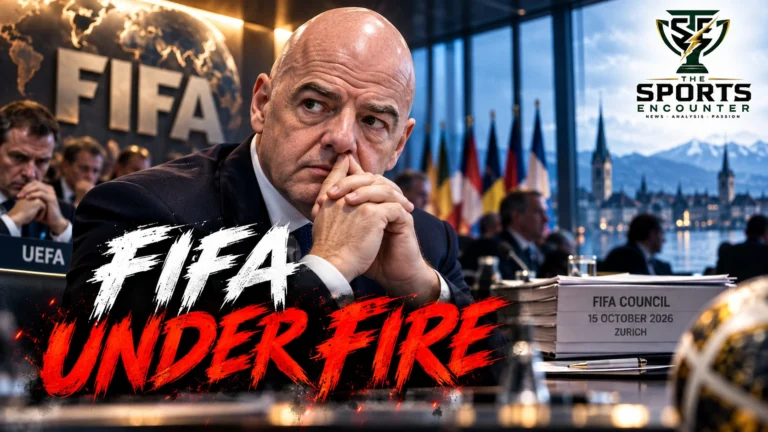
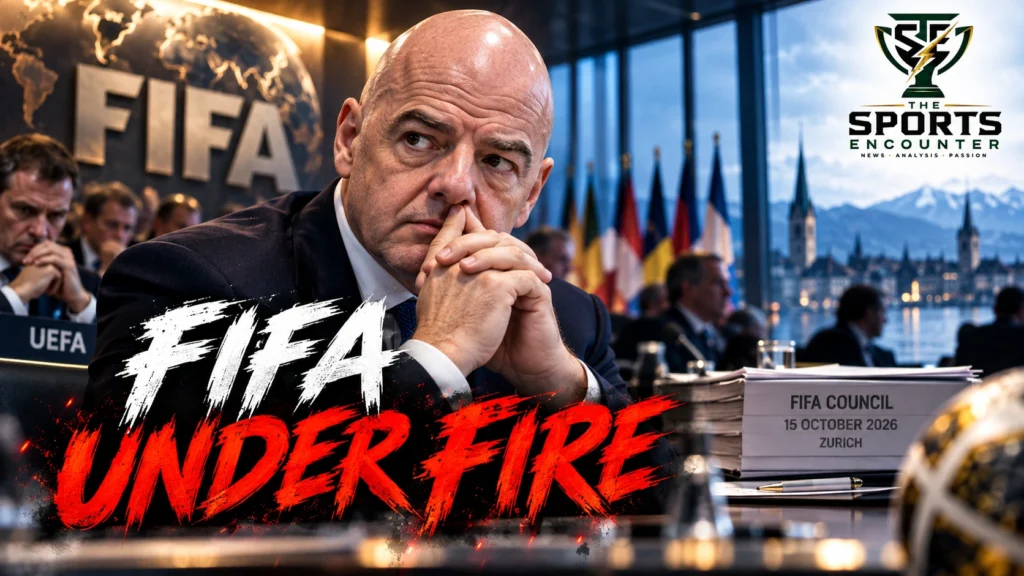
ZURICH, Switzerland, October 15, 2026: Gianni Infantino apologized to FIFA Council members on Thursday for the handling of his abandoned $4.2 billion World Cup commercial investment proposal, but the gesture failed to satisfy European football leaders demanding documents and explanations. After a three-and-a-half-hour meeting at FIFA headquarters, senior officials from England and Germany openly questioned whether Infantino should remain president, intensifying the campaign to replace him in March 2027.
The confrontation produced several consequential decisions without settling the underlying governance dispute. FIFA advanced a proposed $6.35 billion development program for its 211 member associations and other football stakeholders, established a working group to examine governance reforms, and commissioned reviews of disciplinary procedures and the FIFA Peace Prize. However, European delegates said they received no satisfactory answers about the withdrawn investment plan or the controversial suspension of American striker Folarin Balogun’s World Cup ban. The next presidential nomination deadline is November 18, giving Infantino’s opponents little more than a month to assemble a credible challenge.
Infantino Apologizes, but FIFA’s Critics Leave Zurich Unconvinced
The FIFA Council’s 37 members gathered in Zurich for their first meeting since the collapse of FIFA Forward Enterprise, the commercial investment initiative that triggered the most serious institutional challenge of Infantino’s presidency.
The meeting brought the FIFA president face-to-face with representatives who have repeatedly questioned his leadership, governance practices and handling of major commercial decisions.
Story at a glance
Infantino Apologizes, but FIFA’s Critics Leave Zurich Unconvinced
The FIFA Council’s 37 members gathered in Zurich for their first meeting since the collapse of FIFA Forward Enterprise, the commercial investment initiative that triggered the most serious institutional challenge of Infantino’s presidency.
Why Infantino’s $4.2 Billion World Cup Proposal Still Haunts FIFA
FIFA Forward Enterprise, known as FFE, was designed as a commercial structure involving revenue-generating activities associated with FIFA competitions, including the World Cup.
FIFA’s $6.35 Billion Funding Plan Changes the Political Equation
While Infantino’s apology failed to satisfy his critics, FIFA’s proposed financial program could have considerable appeal among national associations.
FIFA Creates a Governance Working Group, but UEFA Wants Stronger Guarantees
One of Thursday’s important institutional decisions was the creation of a working group involving representatives from different confederations to examine FIFA’s governance framework.
Balogun’s World Cup Suspension Returns to FIFA’s Agenda
The Council meeting also reopened a disciplinary controversy from the 2026 World Cup.
Infantino opened the proceedings by apologizing for failures in how the investment project had been developed and communicated.
His acknowledgment addressed one of the central complaints raised during the summer: that senior football officials had been excluded from meaningful discussions about a proposed transaction involving the commercial future of FIFA’s most valuable competitions.
But the apology did not include the documentary evidence European representatives had requested.
England Football Association chair Debbie Hewitt said Infantino asked delegates to submit written questions about the investment proposal rather than providing the requested answers during the meeting.
Hewitt warned that Infantino’s failure to answer those questions would call his suitability for the presidency into question.
German Football Association president Bernd Neuendorf offered an equally critical assessment.
“No satisfactory answers were provided,” Neuendorf said following the meeting.
The reaction is significant because the dispute has progressed beyond objections to a proposed investment transaction. Leading European officials now question whether the president can restore confidence in FIFA’s decision-making processes.
What Actually Changed at the October 15 FIFA Council Meeting?
| Issue | October 15 Outcome | What Remains Unresolved |
|---|---|---|
| FIFA Forward Enterprise | Infantino apologized and confirmed permanent withdrawal. | Requested project documents and detailed explanations remain unavailable to critics. |
| Development funding | FIFA presented its $6.35 billion Surplus Solidarity Programme. | Funding conditions, detailed approvals and final Congress endorsement remain outstanding. |
| FIFA governance | A cross-confederation working group was established. | The scope, independence and practical authority of future reforms remain to be demonstrated. |
| Folarin Balogun suspension | A review of disciplinary procedures was assigned to FIFA’s Legal Committee. | Questions surrounding the original decision remain unanswered. |
| FIFA Peace Prize | The Football Social Responsibility Committee will assess the award. | Whether the prize will continue and under what arrangements remains undecided. |
| 2027 presidency | No presidential election took place. | Potential challengers must satisfy nomination requirements before November 18. |
These outcomes are recorded in FIFA’s official statement following the October 15 Council meeting.
The distinction between establishing a review and completing one is particularly important. FIFA has initiated several processes, but none has yet produced findings that resolve the central allegations about its governance.
Why Infantino’s $4.2 Billion World Cup Proposal Still Haunts FIFA
FIFA Forward Enterprise, known as FFE, was designed as a commercial structure involving revenue-generating activities associated with FIFA competitions, including the World Cup.
The arrangement contemplated selling a minority stake of approximately 20 percent to outside investors, including a group led by Joshua Kushner.
The reported transaction would have raised approximately $4.2 billion.
FIFA maintained that sporting decisions and football governance would remain under its control.
Opponents were concerned about the financial implications, the long-term economic rights granted to private investors and the process through which the project had advanced.
The proposed structure encountered fierce resistance from international football authorities.
UEFA’s national associations organized an extraordinary response, threatening to withdraw from FIFA competitions unless the investment initiative was abandoned.
TSE’s original investigation into UEFA’s unanimous boycott threat documented how opposition to the commercial proposal escalated into an institutional confrontation.
The crisis also spread inside FIFA.
Senior adviser Carlos Cordeiro resigned, while chief operating officer Kevin Lamour publicly challenged the way the proposal had been developed.
TSE’s report on the resignations and internal criticism examined why those developments damaged confidence in the project beyond the objections of regional confederations.
Infantino withdrew the proposal at the end of July.
Thursday’s meeting reaffirmed that the commercial initiative has been permanently abandoned and will not return in another form.
Why Did FIFA Withhold the Documents Requested by UEFA?
FIFA said externally appointed lawyers had briefed the Council on the legal background of the failed commercial project.
However, the organization maintained that details remain confidential because of ongoing legal proceedings in the United States.
President Gianni Infantino has apologised to the Fifa Council for his World Cup sell-off plan. Infantino declined an interview request from the BBC and other media. Instead, he issued this video statement and did not take questions. https://t.co/jwhQouVMhV
— BBC Sport (@BBCSport) October 15, 2026
UEFA has sought access to evidence through American courts for potential legal action in Switzerland concerning the proposed transaction and its financial valuation.
The proceedings involve allegations of possible financial mismanagement. Those allegations have not been established as findings of wrongdoing.
TSE previously examined FIFA’s response to UEFA’s legal efforts, including FIFA’s accusation that the litigation formed part of a campaign against Infantino.
The latest Council meeting did not resolve that disagreement.
FIFA’s position is that the legal proceedings restrict disclosure of some information. Its critics maintain that meaningful accountability requires access to the records necessary to evaluate the proposed transaction.
Those positions create a difficult practical question: how can a governing body review a major financial project when some of the information relevant to that review remains confidential?
FIFA’s $6.35 Billion Funding Plan Changes the Political Equation
While Infantino’s apology failed to satisfy his critics, FIFA’s proposed financial program could have considerable appeal among national associations.
The FIFA Surplus Solidarity Programme would more than double planned development funding for the 2027-2030 cycle.
The total proposed investment amounts to $6.35 billion across FIFA’s member associations, confederations and other eligible stakeholders.
Under the announced framework, individual member associations could receive allocations totaling $25 million during the four-year period.
FIFA says the proposal reflects the exceptional commercial performance of the expanded 2026 World Cup.
The organization is working from an unaudited forecast showing a surplus of approximately $5.2 billion to $5.6 billion for the 2023-2026 financial cycle.
It also proposes retaining $1.7 billion in hard reserves to meet unforeseen financial needs.
What Has FIFA Announced, and What Still Requires Approval?
| Financial Measure | Announced Figure or Status |
|---|---|
| Proposed 2027-2030 development investment | $6.35 billion |
| Proposed allocation per member association | $25 million |
| Number of FIFA member associations | 211 |
| Forecast 2023-2026 cycle surplus | $5.2 billion to $5.6 billion, unaudited |
| Planned reserve protection | $1.7 billion |
| Detailed funding rules | To be finalized through FIFA committees and the December Council meeting |
| Final approval | Subject to the March 2027 FIFA Congress |
The $6.35 billion program should not be confused with an unconditional transfer of money already completed.
FIFA still needs to finalize eligibility, applications, disbursement procedures, monitoring and audit requirements.
The program must then proceed through the appropriate approval process, including the FIFA Congress.
The announcement nevertheless provides a clearer financial commitment than the proposals circulating before the Council meeting.
Why the Funding Package Matters to Infantino’s Re-Election
For national associations with limited commercial income, additional development funding could transform budgets for youth training, facilities, women’s football and national-team operations.
That makes the program financially significant irrespective of the presidential dispute.
However, its timing also carries political consequences.
Infantino is seeking another term as FIFA president in March 2027, and each eligible national association participates in the electoral process.
Increasing development resources may strengthen support among associations that regard FIFA’s financial assistance as essential to football development.
That possibility does not establish that the program was introduced to purchase political support.
It does demonstrate why financial governance and electoral politics have become closely connected.
TSE’s earlier analysis of FIFA’s reserves and African support examined how proposals to distribute more of FIFA’s money had already changed the leadership debate.
Thursday’s announcement moves that discussion from competing proposals toward a defined FIFA funding framework, while leaving final financial approval outstanding.
FIFA Creates a Governance Working Group, but UEFA Wants Stronger Guarantees
One of Thursday’s important institutional decisions was the creation of a working group involving representatives from different confederations to examine FIFA’s governance framework.
The move follows sustained criticism of how the FFE project was developed and presented.
In September, Infantino had already proposed an independent external review of major decision-making processes and stronger consultation with member associations.
TSE’s September report on the proposed independent review identified questions about the review’s scope, authority, access to evidence and timetable.
The new working group represents an institutional response, but it does not automatically answer those questions.
Its credibility will depend on whether members can examine relevant records, propose substantive changes and establish procedures that are enforceable rather than voluntary.
What Does UEFA Want FIFA to Change?
European football’s governing body has proposed a stronger division of responsibilities between FIFA’s president, Council, Bureau, Congress and administration.
UEFA argues that the president should provide strategic leadership without exercising management responsibilities assigned to other offices.
It also wants a more influential Council capable of scrutinizing major proposals before financial or institutional commitments are made.
UEFA’s October 8 reform announcement sets out these proposals and the organization’s demand for new FIFA leadership.
Thursday’s working-group decision addresses the need to examine governance, but its eventual recommendations will determine whether FIFA is prepared to change the distribution of power.
For UEFA’s critics of Infantino, a review without binding structural reforms would leave the underlying problem unresolved.
Balogun’s World Cup Suspension Returns to FIFA’s Agenda
The Council meeting also reopened a disciplinary controversy from the 2026 World Cup.
United States forward Folarin Balogun received a red card against Bosnia and Herzegovina during the tournament’s knockout stage.
Although the dismissal normally carried an automatic suspension for the following match, FIFA’s Disciplinary Committee suspended enforcement of the punishment for a one-year probationary period.
The decision allowed Balogun to play against Belgium.
U.S. President Donald Trump had contacted Infantino seeking a review of the case, prompting questions about whether political involvement had influenced the process.
FIFA maintained that its independent disciplinary authorities made the decision.
The distinction between suspending a punishment and overturning a referee’s red card was examined in TSE’s October 14 investigation into the proposed Balogun disciplinary rule changes.
On Thursday, the FIFA Council agreed that its Legal Committee would review the disciplinary procedures, with findings to be presented at the next Council meeting in December.
Did FIFA Change the Red-Card Rules on October 15?
No final change to the disputed disciplinary procedures was announced.
The Council referred the matter for examination.
That means the existing controversy remains relevant, while any future changes must be assessed against the actual regulations adopted.
European officials also continued seeking explanations about the original Balogun decision and Trump’s involvement.
The October 15 meeting did not publicly establish that FIFA’s disciplinary authorities acted under improper political influence.
Nor did it produce a publicly disclosed account satisfying the concerns raised by the critics.
The next stage will involve examination by FIFA’s Legal Committee rather than an immediately effective rewrite of the disciplinary rules.
FIFA Peace Prize Also Faces Review After Trump Award
The FIFA Peace Prize became another subject of Council scrutiny.
The award was introduced in 2025 and presented to Donald Trump that December.
Questions have since emerged about its selection process, governance and whether the prize should become a continuing annual initiative.
On October 15, the Council assigned FIFA’s Football Social Responsibility Committee responsibility for reviewing the award.
A decision on its future is expected at the December Council meeting.
The referral does not cancel the previous award or establish that the original decision was improper.
It means FIFA has agreed to examine the prize’s future rather than automatically continuing it under the existing arrangements.
Alongside the Balogun case, the decision demonstrates that the October governance dispute now extends beyond commercial investments into FIFA’s wider institutional responsibilities.
Why UEFA’s Opposition Still Leaves Infantino With a Route to Victory
Public criticism from England and Germany represents a significant political challenge, particularly when supported by UEFA’s wider calls for change.
However, FIFA’s presidential election is not determined solely by Europe’s major football associations.
Its 211 member associations form a global electorate in which smaller federations also have votes.
Infantino retains substantial support outside Europe, including backing from prominent African football officials and associations.
That support reflects, in part, the importance of FIFA development programs to countries whose football systems depend on international assistance.
The forthcoming election therefore presents two different challenges.
Infantino’s critics must demonstrate that the organization’s governance requires reform.
They must also identify a qualified candidate capable of attracting sufficient support to defeat him.
TSE’s examination of the growing European campaign against Infantino explained why opposition within UEFA does not automatically translate into an electoral majority.
What Must Happen Before the November 18 Nomination Deadline?
The FIFA presidential election is scheduled for March 18, 2027, in Rabat, Morocco.
Candidates must meet FIFA’s eligibility requirements and secure formal backing from at least five member associations.
Former Switzerland international Ramon Vega has declared an intention to challenge Infantino, but a declaration of interest is not equivalent to a validated presidential candidacy.
UEFA and other critics will need to translate political opposition into formal nominations before the November 18 deadline.
Continue the FIFA World Cup 2026 Story
 FIFA World Cup 2026Infantino Faces FIFA’s Reckoning as Revolt Reaches Zurich, and Now $6 Billion Reserves Enter the Fight
 FIFA World Cup 2026Belgium Turns Balogun Red-Card Row Into Direct Challenge to Infantino’s FIFA Re-Election
 FIFA World Cup 2026FIFA Accuses UEFA of “Smear Campaign” as Infantino Fight Enters US Courts
FIFA’s April 2026 Congress announcement confirms Infantino’s intention to seek another term.
The outcome of Thursday’s meeting leaves the electoral contest unresolved.
European leaders remain openly dissatisfied, while Infantino can point to the proposed development program and the newly established review processes as evidence that FIFA is responding to concerns.
What Comes Next After the October 15 FIFA Council Meeting?
| Date | Expected Development | What to Watch |
|---|---|---|
| Before November 17, 2026 | Further UEFA national-association discussions | Potential agreement on a common approach to FIFA leadership |
| November 18, 2026 | Presidential nomination deadline | Which candidates satisfy FIFA’s formal requirements |
| December 2026 | Next FIFA Council meeting | Funding details, disciplinary review, governance work and Peace Prize decision |
| March 18, 2027 | FIFA presidential election in Rabat | Whether Infantino retains the presidency |
| March 2027 | 77th FIFA Congress | Required decisions on the proposed development funding program |
The December meeting will be especially important because Thursday’s announcements created several processes requiring further decisions.
FIFA must establish the detailed rules for distributing the proposed development funding.
Its Legal Committee is expected to present its work on disciplinary procedures, while the Football Social Responsibility Committee will review the Peace Prize.
The governance working group will face pressure to demonstrate that its examination can produce more than recommendations without practical consequences.
And the election nomination process will determine whether Infantino’s political opponents can convert their opposition into a credible challenge.
The Sports Encounter Analysis: What Does an Apology Change Without Accountability?
The October 15 meeting produced a revealing contrast.
FIFA moved quickly to present a substantial financial program and assign institutional reviews.
Its European critics continued to demand documentary evidence about a commercial transaction that had already been abandoned.
Both issues matter to football’s future.
National associations need reliable resources to support infrastructure, coaching, national teams, women’s football and youth development.
They also need confidence that major financial and governance decisions are subject to transparent procedures.
Thursday’s funding announcement creates a potential benefit for federations across the world.
Yet the ability to distribute more money does not independently establish that FIFA’s previous decision-making process was appropriate.
Equally, criticism of Infantino’s handling of the FFE proposal does not mean a substantial development program should be rejected without examining its benefits and financial safeguards.
The Real Test Is Whether FIFA Can Measure Its Own Reforms
There are several practical standards against which the outcomes of the Zurich meeting can be assessed.
- Transparency: Will relevant documents concerning FFE become available through an appropriate legal and governance process?
- Financial accountability: Will the $6.35 billion program include clear eligibility conditions, independent audits and public reporting?
- Institutional authority: Will the governance working group recommend enforceable limits on decision-making powers?
- Disciplinary consistency: Will the Balogun review clarify how automatic suspensions and discretionary decisions should operate?
- Electoral integrity: Will the 2027 presidential contest proceed under transparent nomination and voting procedures?
Those outcomes provide measurable tests of whether FIFA is addressing the problems raised by the crisis.
The immediate political response from European leaders suggests that an apology alone has not restored their confidence.
The coming months will establish whether FIFA can produce the substantive answers they continue to demand.
FIFA Council October 15, 2026: Frequently Asked Questions
Did Gianni Infantino Apologize at the FIFA Council Meeting?
Yes. Infantino apologized for mistakes in the handling and communication of the withdrawn FIFA Forward Enterprise investment proposal during the October 15 meeting in Zurich.
Why Did European Officials Reject Infantino’s Explanation?
Representatives from England and Germany said they had not received satisfactory answers or the requested documentation concerning the abandoned commercial proposal and other governance issues.
What Happened to FIFA’s $4.2 Billion World Cup Investment Plan?
FIFA Forward Enterprise was withdrawn in July 2026. Infantino reaffirmed on October 15 that the proposal had been permanently abandoned and would not return in another form.
Has FIFA Approved the $6.35 Billion Development Program?
FIFA announced the funding framework on October 15, but detailed eligibility, disbursement and audit requirements remain to be finalized. The program is subject to further Council consideration and Congress approval.
How Much Funding Could Each FIFA Member Association Receive?
Under the proposed 2027-2030 framework, each member association could receive allocations totaling $25 million, subject to the program’s final approval and conditions.
What Did FIFA Decide About Folarin Balogun’s Suspension?
The Council assigned FIFA’s Legal Committee to review disciplinary procedures following the controversy over Balogun’s suspended World Cup ban. No final regulatory change was announced on October 15.
Is FIFA Cancelling the Peace Prize Awarded to Donald Trump?
No cancellation was announced. FIFA’s Football Social Responsibility Committee will examine the future of the Peace Prize, with a decision expected at the December Council meeting.
When Is the Next FIFA Presidential Election?
The election is scheduled for March 18, 2027, in Rabat, Morocco. Candidates must meet the relevant requirements before the November 18, 2026 nomination deadline.
Infantino Has Bought Time, but FIFA’s Questions Remain
Infantino emerged from Zurich still holding the FIFA presidency, with a major development-funding proposal moving through the approval process and a series of institutional reviews underway.
His opponents left with a different conclusion.
They had received an apology, but not the evidence they believe is necessary to restore confidence in the organization’s leadership.
The confrontation therefore remains unresolved, even though the Council has initiated work on several of the issues that produced it.
The next decisions will determine whether the new funding program and governance reviews lead to measurable institutional changes.
They will also unfold as national associations prepare for a presidential election in which Infantino retains influential supporters and his critics must still organize an effective alternative.
For world football, the central question is whether FIFA can demonstrate that its commercial decisions, disciplinary procedures and financial commitments are governed by consistent, transparent rules.
Thursday’s meeting began answering that question through new processes. It did not settle it.