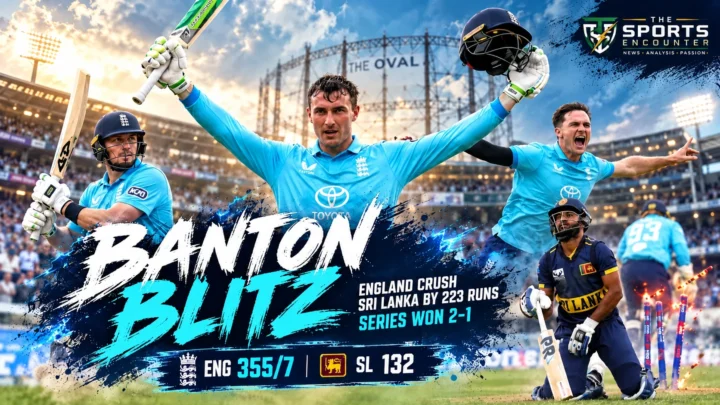
JAKARTA, Indonesia, September 25, 2026: Seven weeks after Singapore ended Indonesia’s ASEAN Championship campaign, the Garuda finally changed the direction of this rivalry.
Ragnar Oratmangoen scored in the first half, Safuwan Baharudin’s second-half red card broke Singapore’s growing resistance, and Ole Romeny converted a penalty as Indonesia opened their FIFA ASEAN Cup 2026 campaign with a 2-0 victory at Gelora Bung Karno.
The score gives Indonesia exactly what they needed from an opening match played under considerable home pressure: three points, a clean sheet and a positive goal difference.
It does not put them top.
Story at a glance
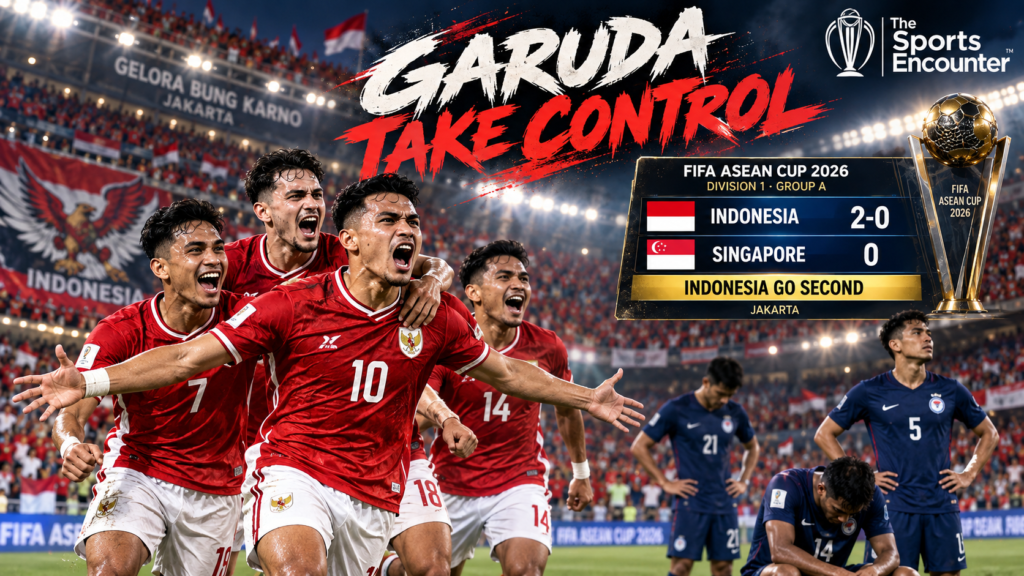
Indonesia vs Singapore: Match at a Glance
The official ASEAN Football Federation report confirms the 2-0 result, Oratmangoen’s 15th-minute opener and Romeny’s 74th-minute second goal. AFF Football
Ragnar Oratmangoen Punishes Singapore’s Slow Start
Indonesia immediately played like the team carrying the attacking responsibility.
Oratmangoen Changes the Story From Their Last Meeting
The goalscorer carried additional significance.
Luke Vickery Gives Indonesia the Width Singapore Could Not Control
Oratmangoen supplied the finish, but Luke Vickery was one of Indonesia’s most influential players.
Singapore Survive the First Half Without Finding an Attack
After conceding, Singapore actually defended reasonably well.
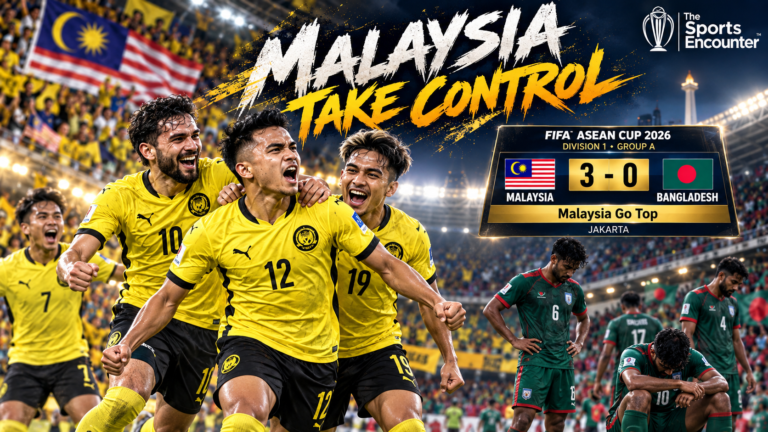
Malaysia’s earlier 3-0 victory over Bangladesh leaves Harimau Malaya first on goal difference, with Indonesia second.
That makes Sunday’s Indonesia-Malaysia meeting considerably bigger than an ordinary Matchday 2 fixture. The winner would take direct control of a group in which only first place reaches the final.
Singapore, meanwhile, leave their opener with no points and a -2 goal difference. Their next match against Bangladesh has already become a test of survival.
The importance of this compressed format was clear before the competition began. The Sports Encounter’s FIFA ASEAN Cup 2026 tournament guide explained why three group matches leave almost no room to repair early mistakes.
Indonesia avoided one.
Singapore now have one to repair.
TL;DR
- Indonesia defeated Singapore 2-0 at Gelora Bung Karno.
- Ragnar Oratmangoen scored in the 15th minute.
- Luke Vickery created the opening with an attacking run and delivery from the right.
- Singapore improved after halftime and finally began testing Indonesia.
- Safuwan Baharudin was sent off following a VAR review for denying Mitchell Baker a clear scoring opportunity.
- Indonesia won a penalty from the resulting attacking sequence.
- Ole Romeny converted in the 74th minute to make it 2-0.
- Indonesia kept a clean sheet.
- Malaysia lead Group A on goal difference after beating Bangladesh 3-0.
- Indonesia sit second, also with three points.
- Singapore are third ahead of Bangladesh on goal difference.
- Indonesia face Malaysia next.
- Singapore meet Bangladesh in a match neither side can afford to lose.
Indonesia vs Singapore: Match at a Glance
| Detail | Information |
|---|---|
| Competition | FIFA ASEAN Cup 2026 |
| Division | Division 1 |
| Group | A |
| Match | Indonesia vs Singapore |
| Date | September 25, 2026 |
| Venue | Gelora Bung Karno Stadium, Jakarta |
| Result | Indonesia 2-0 Singapore |
| Indonesia scorers | Ragnar Oratmangoen 15′, Ole Romeny 74′ pen |
| Halftime | Indonesia 1-0 Singapore |
| Red card | Safuwan Baharudin, Singapore |
| Indonesia next match | Malaysia |
| Singapore next match | Bangladesh |
| Group impact | Indonesia second on goal difference, Singapore third |
The official ASEAN Football Federation report confirms the 2-0 result, Oratmangoen’s 15th-minute opener and Romeny’s 74th-minute second goal. AFF Football
Ragnar Oratmangoen Punishes Singapore’s Slow Start
Indonesia immediately played like the team carrying the attacking responsibility.
The hosts moved the ball quickly, pushed bodies forward and used the width of the pitch to stretch Singapore’s compact defensive structure.
Luke Vickery became particularly important on the right.
Indonesia had already created an early warning from one of his deliveries before Vickery attacked that flank again and supplied the ball that Oratmangoen converted.
The opener came in the 15th minute.
Singapore’s problem was not simply that they conceded.
They conceded before they had established the type of slow, controlled match they needed.
That mattered enormously.
Gavin Lee’s side had frustrated Indonesia only weeks earlier by protecting space, refusing to panic and waiting for their moment.
This time, Indonesia made Singapore chase the game from the opening quarter-hour.
Oratmangoen Changes the Story From Their Last Meeting
The goalscorer carried additional significance.
Oratmangoen had also scored when these teams met in the ASEAN Championship on August 7.
Indonesia led that match 1-0.
They did not win it.
Ilhan Fandi equalized in the 66th minute, Singapore secured the draw they required, and Indonesia were eliminated while the Lions advanced.
TSE covered that painful Indonesian exit in Ilhan Fandi Delivers the Point That Sends Singapore Through.
Friday therefore created an unusual repeat.
Oratmangoen scored first again.
The difference was everything that happened afterward.
Indonesia did not allow Singapore to find another equalizer.
Luke Vickery Gives Indonesia the Width Singapore Could Not Control
Oratmangoen supplied the finish, but Luke Vickery was one of Indonesia’s most influential players.
His willingness to attack from the right forced Singapore’s defensive line to turn toward its own goal rather than simply defend Indonesia in front of them.
That changed the geometry of the match.
Singapore are comfortable defending compact central areas.
They are much less comfortable when opponents reach the outside shoulder of the back line and deliver from advanced positions.
Vickery did exactly that.
His work on the opening goal made him one of the game’s most important performers even without appearing on the scoresheet.
Singapore Survive the First Half Without Finding an Attack
After conceding, Singapore actually defended reasonably well.
Indonesia controlled the ball and territory, but the Lions prevented the match from becoming a first-half rout.
Izwan Mahbud and the defensive unit dealt with repeated pressure while Singapore tried to maintain enough structure to reach halftime within one goal.
They succeeded.
The problem was what happened at the other end.
Ilhan Fandi became isolated.
Singapore struggled to connect midfield possession with their forward line.
The visitors had very little sustained attacking pressure before halftime.
That left Indonesia in an ideal position.
They could continue probing without needing to chase the game recklessly.
Singapore Finally Respond After Halftime
The most encouraging period for Singapore came immediately after the break.
Gavin Lee adjusted his midfield and the Lions became more willing to move possession through central areas.
Song Ui-young began appearing farther forward.
That produced Singapore’s first genuine attempt to test Maarten Paes.
The improvement matters because it showed that the tactical problem was not completely unsolvable.
Singapore could compete once they trusted themselves with the ball.
They simply reached that point too late.
By then, Indonesia already had the lead and could choose when to press rather than constantly forcing the issue.
Singapore were beginning to build their best spell when the match changed completely.
Safuwan Baharudin’s Red Card Is the Decisive Turning Point
Indonesia led 1-0.
Singapore were playing better.
The match was still alive.
Then Safuwan Baharudin challenged Mitchell Baker as the Indonesian forward attacked a dangerous central position.
The referee initially showed a yellow card.
After reviewing the incident at the pitch-side monitor, the decision was upgraded to red for denying a clear goalscoring opportunity.
Singapore were down to 10 men.
The significance went beyond losing a defender.
The Lions had finally begun pushing more players into midfield and spending longer periods outside their own defensive third.
The red card destroyed that progress.
Suddenly they had to reorganize everything again.
The Same Sequence Produces Indonesia’s Second Goal
Singapore barely had time to adjust.
From the attacking sequence following Safuwan’s dismissal, Indonesia earned a penalty after the ball struck a Singapore hand inside the area.
Ole Romeny took responsibility.
The striker sent Izwan Mahbud the wrong way and converted.
Indonesia 2-0 Singapore.
The official regional report records Romeny’s goal in the 74th minute. AFF Football
Within a few minutes, Singapore had gone from chasing a one-goal deficit with improving momentum to chasing two goals with 10 players.
That sequence decided the match.
Ole Romeny Turns Control Into Security
Romeny’s performance deserves more than a mention for the penalty.
Indonesia selected a much stronger senior squad for this FIFA-window competition than the group that struggled to reach the ASEAN Championship semifinals.
Romeny represents that difference.
He offered movement through the middle, linked Indonesia’s attacking lines and constantly occupied Singapore’s central defenders.
He nearly scored before halftime.
When the penalty opportunity arrived later, he finished calmly.
That composure matters because Indonesia’s previous regional campaign repeatedly produced situations in which possession did not become decisive goals.
The 3-0 defeat against Vietnam exposed that weakness brutally.
Against Singapore, Indonesia converted enough of their control to remove uncertainty.
Indonesia’s Attack Looks Different With More Senior Quality
The personnel available to John Herdman substantially changed the level of Indonesia’s starting team.
The hosts could call upon players including Maarten Paes, Kevin Diks, Calvin Verdonk, Ole Romeny and other overseas-based internationals.
FIFA had identified that squad depth as one of Indonesia’s major advantages entering the tournament. FIFA
That matters when comparing this performance with the ASEAN Championship.
Indonesia had produced explosive attacking football there too.
Mitch Baker scored a hat trick on his senior debut as Indonesia crushed Cambodia 5-1, a match TSE covered in Mitch Baker’s Dream Debut Pushes Indonesia Into ASEAN Championship Race.
They later defeated Timor-Leste 3-0, although that match remained scoreless until the 74th minute.
The lesson from that tournament was clear.
Indonesia could overwhelm weaker opponents.
The harder question was whether they could control matches against teams capable of frustrating them.
Singapore had already proved they could.
Friday’s 2-0 result therefore carries more meaning than a routine opening victory.
Maarten Paes Protects the Clean Sheet
Singapore did not produce enough attacking volume to make Paes the central figure of the match.
That does not make his contribution irrelevant.
When Song Ui-young finally found space for Singapore after halftime, Paes handled the shot comfortably.
The moment demonstrated an important advantage for Indonesia.
Their defensive structure does not need to be perfect if the goalkeeper behind it remains calm when an opponent finally breaks through.
A clean sheet gives Indonesia a +2 goal difference after Matchday 1.
That is one goal behind Malaysia.
In this format, even that small distinction matters.
Singapore’s Attack Leaves Ilhan Fandi Too Isolated
Singapore’s greatest problem was separation between midfield and attack.
Ilhan Fandi spent long periods without meaningful support.
When Singapore recovered possession, they often lacked the passing connection required to get the ball to him before Indonesia reorganized.
That prevented one of the region’s most dangerous forwards from influencing the match.
The contrast with Singapore’s recent ASEAN Championship run was noticeable.
Ilhan had repeatedly delivered decisive moments during that tournament and finished among its standout players, as discussed in TSE’s ranking of the performers who shaped the ASEAN Championship.
He could not produce the same impact here because Singapore rarely placed him in situations where his movement could hurt Indonesia.
That is a supply problem as much as a striker problem.
Song Ui-young Shows Singapore’s Route Forward
If Singapore want encouragement, they should look at the start of the second half.
Song Ui-young became more involved.
Singapore moved another body into midfield.
Possession became less rushed.
For a short period, Indonesia had to defend rather than simply dictate.
The Lions need more of that against Bangladesh.
They cannot wait until they are behind to trust their midfield with the ball.
Bangladesh will present a different tactical problem, but Singapore’s objective should remain the same: connect the central areas with Ilhan earlier and more consistently.
Updated FIFA ASEAN Cup 2026 Group A Table
Malaysia’s 3-0 victory over Bangladesh earlier on Friday leaves Group A with two winners and two teams already under pressure.
| Pos. | Team | P | W | D | L | GF | GA | GD | Pts |
|---|---|---|---|---|---|---|---|---|---|
| 1 | Malaysia | 1 | 1 | 0 | 0 | 3 | 0 | +3 | 3 |
| 2 | Indonesia | 1 | 1 | 0 | 0 | 2 | 0 | +2 | 3 |
| 3 | Singapore | 1 | 0 | 0 | 1 | 0 | 2 | -2 | 0 |
| 4 | Bangladesh | 1 | 0 | 0 | 1 | 0 | 3 | -3 | 0 |
Malaysia lead Indonesia by a single goal of differential.
Singapore sit above Bangladesh for the same reason.
The table remains young.
The pressure is already real.
Why Indonesia vs Malaysia Could Decide Group A
The two opening winners meet next.
Indonesia vs Malaysia on September 28 now carries enormous consequences.
Both teams have three points.
Neither has conceded.
Malaysia lead by one goal of difference.
Because only the Group A winner advances to the Division 1 final, the match could become the defining fixture of the section.
A victory would take either side to six points with one match remaining.
For Indonesia, home advantage makes this an especially important opportunity.
Malaysia arrive with confidence after their 3-0 win over Bangladesh.
Indonesia arrive having beaten the team that eliminated them from the previous regional tournament.
Something has to give.
Readers can see the complete remaining schedule and tournament structure in The Sports Encounter’s FIFA ASEAN Cup 2026 guide.
Indonesia’s Qualification Position After Beating Singapore
Indonesia could hardly have asked for much more.
Three points.
Two goals.
No goals conceded.
Their only imperfection is that Malaysia won by one goal more.
The remaining fixtures are:
September 28: Indonesia vs Malaysia
October 1: Indonesia vs Bangladesh
A victory against Malaysia would place Indonesia in control of their own path to the final.
A draw would keep both leading teams alive heading into the last round.
A defeat would leave Indonesia needing help elsewhere.
That is the danger of this competition.
There are only three group matches.
A strong opening does not create comfort.
It creates position.
Singapore’s Qualification Chances Are Damaged, Not Finished
Singapore remain alive.
Their situation is much less forgiving.
The Lions still have:
September 28: Singapore vs Bangladesh
October 1: Malaysia vs Singapore
Six points remain available.
So does first place.
But another defeat would make qualification extraordinarily difficult and could end the meaningful race depending on the Indonesia-Malaysia result.
That makes Bangladesh effectively a must-win assignment.
Before this tournament, Singapore had plenty of evidence that they could survive high-pressure regional matches.
They reached the ASEAN Championship semifinals after the 1-1 draw against Indonesia and later pushed Thailand across two dramatic semifinal legs.
Thailand won the first encounter 3-1, covered by TSE in Thailand Punish Singapore’s Errors as Teerasak Builds a Two-Goal Semifinal Cushion.
Singapore then produced a far better performance in Bangkok and won the second leg 2-1, although Thailand advanced on aggregate.
That resilience will now be tested again.
Singapore vs Bangladesh Is Already an Elimination-Level Match
Both teams have zero points.
Neither scored in its opening match.
Singapore have a -2 goal difference.
Bangladesh have -3.
The loser on Sunday would remain on zero after two games.
In a three-match group where only first place reaches the final, recovering from that position would be almost impossible.
The draw therefore creates a fascinating contrast.
Singapore need to become more assertive.
Bangladesh need to become more secure.
Whoever solves their problem first could return to the qualification race.
The other may be left playing its final match for position rather than a place in the final.
Three Turning Points That Decided Indonesia vs Singapore
1. Vickery Finds Oratmangoen Before Singapore Can Settle
Singapore needed the game to remain scoreless long enough for Indonesian frustration to grow.
The opening goal prevented that.
Vickery stretched the defense and Oratmangoen converted.
Indonesia gained control before pressure could turn into impatience.
2. Singapore Improve After Halftime
This was the point at which the contest could have changed direction.
Song became more influential and Singapore finally moved the ball through midfield with greater confidence.
An equalizer would have brought the memory of August rushing back into the stadium.
Instead, the red card arrived.
3. Safuwan’s Red Card and Romeny’s Penalty End the Resistance
This was the decisive sequence.
Singapore lost a defender.
Indonesia immediately gained the opportunity to double the lead.
Romeny converted.
The competitive balance disappeared.
Star Performer: Ragnar Oratmangoen
Romeny scored the clinching goal.
Vickery created the opening.
But Oratmangoen supplied the moment that established Indonesia’s control.
His movement into the penalty area and finish punished Singapore before they had settled.
The psychological significance also matters.
He was the player who had put Indonesia ahead against Singapore in August before the Lions recovered and knocked the Garuda out.
This time, his goal became the foundation of a victory.
That makes Oratmangoen the central figure in Indonesia’s opening-night story.
Other Standout Performers
Luke Vickery
Vickery’s direct running caused Singapore repeated problems down Indonesia’s right.
His creation of the first goal was the most important example, but his wider contribution helped establish Indonesia’s territorial advantage.
Ole Romeny
Romeny remained a constant threat through the middle and calmly converted the penalty that effectively ended the match.
Maarten Paes
Paes had a relatively quiet evening because Indonesia defended well, but he handled Singapore’s few dangerous moments securely and protected the clean sheet.
Song Ui-young
Singapore’s best attacking phase coincided with Song becoming more involved after halftime.
He showed the Lions how they might approach Bangladesh: play with greater midfield confidence and connect attacks earlier.
What Indonesia Did Better Than in August
The obvious answer is that they scored twice.
The deeper answer is control after scoring.
In August, Indonesia took the lead against Singapore and remained vulnerable to one defensive mistake.
Ilhan punished them.
This time, the Garuda kept pushing without losing their basic structure.
When Singapore improved, Indonesia survived the spell.
When the red card created an advantage, they exploited it.
When the score reached 2-0, they managed the closing phase.
Those details separate possession from control.
Indonesia learned that painfully during the ASEAN Championship.
Friday offered evidence that the lesson may have stuck.
What Singapore Must Fix Before Bangladesh
Three issues stand out.
Start With More Belief
Singapore spent too much of the first half accepting Indonesia’s pressure.
Their second-half improvement showed they could play with greater ambition.
Connect Ilhan Fandi to the Midfield
An isolated striker cannot change a game.
Singapore need earlier and cleaner progression through Song, Hariss Harun and the surrounding midfield structure.
Keep 11 Players on the Field
Safuwan’s red card arrived just as Singapore were beginning to compete more effectively.
Against Bangladesh, discipline will be critical because another self-inflicted numerical disadvantage could destroy their qualification hopes.
Indonesia Win the First Battle, Malaysia Wait in the Next One
Indonesia have repaired one recent wound.
Singapore had denied them an ASEAN Championship semifinal place in August.
Seven weeks later, the Garuda beat the Lions 2-0 in Jakarta.
The emotional value is obvious.
The tournament value matters more.
Malaysia still lead the group.
Only one team reaches the final.
Indonesia’s victory therefore solves the opening problem without solving Group A.
The real test arrives next.
Indonesia versus Malaysia.
Three points against three points.
A +2 goal difference against +3.
Two clean sheets.
One place in the final available.
The FIFA ASEAN Cup has taken only one matchday to produce exactly the pressure its format promised.
Continue the Soccer Story


Frequently Asked Questions
Who won Indonesia vs Singapore in the FIFA ASEAN Cup 2026?
Indonesia defeated Singapore 2-0 at Gelora Bung Karno Stadium in Jakarta.
Who scored for Indonesia?
Ragnar Oratmangoen opened the scoring in the 15th minute before Ole Romeny converted a second-half penalty in the 74th. AFF Football
Who was sent off for Singapore?
Safuwan Baharudin was shown a red card after a VAR review of his challenge on Mitchell Baker.
Who was Indonesia’s best player?
Ragnar Oratmangoen produced the decisive opening goal, while Luke Vickery and Ole Romeny were also among Indonesia’s most influential performers.
Where are Indonesia in FIFA ASEAN Cup Group A?
Indonesia are second with three points and a +2 goal difference.
Who lead Group A?
Malaysia lead with three points and a +3 goal difference following their 3-0 win over Bangladesh.
Where are Singapore in Group A?
Singapore are third with zero points and a -2 goal difference, ahead of Bangladesh on goal difference.
Can Singapore still reach the final?
Yes. Six points remain available from their matches against Bangladesh and Malaysia, but the defeat to Indonesia leaves little margin for another setback.
Who do Indonesia play next?
Indonesia face Malaysia in Jakarta on September 28.
Who do Singapore play next?
Singapore face Bangladesh on September 28.
How many teams advance from Group A?
Only the Group A winner reaches the Division 1 final. The group runner-up enters the bronze final. The format is explained in TSE’s FIFA ASEAN Cup 2026 tournament guide