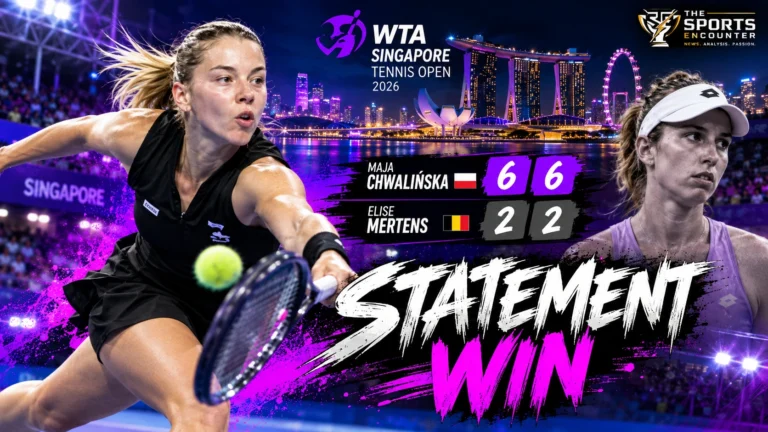
SINGAPORE, Singapore, September 25, 2026: Maja Chwalinska arrived at the Singapore Tennis Open needing to prove that her extraordinary Roland Garros run could travel beyond clay. Three matches later, that question is becoming much harder to ask.
The fifth-seeded Pole dismantled defending champion Elise Mertens 6-2, 6-2 on Friday to reach the Singapore semifinals, collecting the first Top 20 victory of her career and removing one of the tournament’s most experienced hard-court players with startling efficiency.
The score tells only part of the story. Chwalinska gave Mertens almost no stable rhythm, changing height, spin and pace until the Belgian’s aggression began producing errors instead of control. From 2-2 in the opening set, Chwalinska won seven consecutive games and nine of the next 10, turning what had begun as a competitive quarterfinal into her most significant win since reaching the Roland Garros final in June.
According to the WTA’s official match report, Mertens finished with 40 unforced errors while Chwalinska won 70 percent of her first-serve points and 60 percent behind her second serve.
Story at a glance
How Did Chwalinska Take the Match Away From Mertens?
Mertens did not start passively.
Why Chwalinska’s Serving Numbers Mattered More Than Her Ace Count
Chwalinska’s game is usually discussed through touch, disguise and variety.
Chwalinska Has Now Beaten Mertens on Two Very Different Surfaces
Friday’s result looks even stronger when placed beside their first meeting.
Competitive Rhythm May Have Been an Invisible Advantage
There was another difference between the players entering Friday.
Only 11 Games Lost in Three Matches Shows How Complete This Run Has Been
Chwalinska has not reached the semifinals through repeated escapes.
Chwalinska vs Mertens: Singapore Quarterfinal at a Glance
| Category | Maja Chwalinska | Elise Mertens |
|---|---|---|
| Seed | No. 5 | No. 4 |
| Result | Won 6-2, 6-2 | Lost 2-6, 2-6 |
| First-serve points won | 70% | Not published in WTA match reaction |
| Second-serve points won | 60% | Not published in WTA match reaction |
| Unforced errors | Not specified | 40 |
| Singapore status | Semifinalist | Eliminated |
| 2026 head-to-head | 2 wins | 0 wins |
How Did Chwalinska Take the Match Away From Mertens?
Mertens did not start passively.
The Belgian moved forward early, looked to shorten rallies and stayed level through the first four games. At 2-2, the match still resembled the kind of quarterfinal expected between the fourth and fifth seeds.
Then Chwalinska removed the rhythm.
Her game rarely asks the same question twice. A sliced ball can arrive low and slow, the next rally can contain heavier topspin, and the following exchange can suddenly accelerate through a flatter strike. Against a player who likes to establish clean patterns and control position, that constant variation became increasingly disruptive.
Mertens began pressing for solutions.
The error count rose with it.
Chwalinska won seven games in a row from 2-2 in the first set, establishing a 6-2, 3-0 lead before Mertens could interrupt the run. The Pole eventually won nine of 10 games during the decisive passage of the match.
That tactical identity has been visible throughout the week. The Sports Encounter’s analysis of Chwalinska’s 6-4, 6-2 opening victory over Rebecca Sramkova showed how effectively she used spin, trajectory and placement to stop a more conventional hitter from settling into predictable exchanges.
The same principle worked against a much more accomplished opponent on Friday.
Why Chwalinska’s Serving Numbers Mattered More Than Her Ace Count
Chwalinska’s game is usually discussed through touch, disguise and variety.
Her serve deserves more attention after this match.
She won 70 percent of the points behind her first delivery and 60 percent behind her second. More importantly, she did not face a break point until the penultimate game.
That matters because Mertens entered the match as the player with far greater experience at the top end of the WTA Tour. The official WTA match page lists the Belgian as World No. 19 and Chwalinska at No. 25 entering the contest.
Mertens finally broke late in the second set, but the opening came after Chwalinska had already built a 5-1 advantage.
The response was telling.
Instead of allowing the defending champion to build momentum, Chwalinska broke immediately in the next game to finish the match.
Chwalinska Has Now Beaten Mertens on Two Very Different Surfaces
Friday’s result looks even stronger when placed beside their first meeting.
Chwalinska defeated Mertens 6-4, 6-0 in the second round of Roland Garros earlier this year. That victory became one of the early turning points in a run that eventually carried the Polish qualifier all the way to the final.
The Sports Encounter revisited that matchup before this quarterfinal in its analysis of Chwalinska’s route into the Singapore last eight.
Paris offered an obvious explanation for why the matchup might suit Chwalinska. Clay rewards variation, spin, patience and changes of height.
Singapore removes that explanation.
This tournament is played indoors on hard court, where Mertens should theoretically have more opportunity to take the ball early and impose cleaner first-strike patterns.
Chwalinska still controlled the matchup.
Across two meetings in 2026, she has now beaten Mertens 6-4, 6-0 and 6-2, 6-2.
That is becoming a matchup pattern rather than a one-surface anomaly.
Competitive Rhythm May Have Been an Invisible Advantage
There was another difference between the players entering Friday.
Chwalinska had already played two complete matches in Singapore.
She beat Sramkova in 79 minutes, then overwhelmed Oleksandra Oliynykova 6-0, 6-1 in only 59 minutes. The Sports Encounter’s full report on the Oliynykova victory documented how cleanly she entered the quarterfinal.
Mertens’ route was completely different.
As one of the top four seeds, she received a first-round bye. Barbora Krejcikova then withdrew from their scheduled second-round match because of a lower-back injury, meaning Friday became Mertens’ first completed match of the tournament.
That gave the defending champion physical freshness.
It also meant Chwalinska arrived with far more recent knowledge of the speed, bounce and timing of the Singapore courts.
The Sports Encounter had already identified that contrast when Singapore’s draw changed during a dramatic second day that also included Wang Xinyu’s upset of Donna Vekic and Krejcikova’s escape before her withdrawal.
Friday suggested competitive rhythm mattered more than rest.
Only 11 Games Lost in Three Matches Shows How Complete This Run Has Been
Chwalinska has not reached the semifinals through repeated escapes.
| Round | Opponent | Result | Games Lost |
|---|---|---|---|
| First Round | Rebecca Sramkova | 6-4, 6-2 | 6 |
| Second Round | Oleksandra Oliynykova | 6-0, 6-1 | 1 |
| Quarterfinal | Elise Mertens | 6-2, 6-2 | 4 |
| Total | Three matches | 6 sets won, 0 lost | 11 |
That progression is especially striking because the opposition has become stronger while the scorelines have remained one-sided.
Her opening victory was one of the central performances in The Sports Encounter’s Singapore Open Day 1 report.
The Oliynykova match then removed almost all uncertainty before the quarterfinal.
Mertens was supposed to provide the first major resistance.
Instead, Chwalinska dropped only four games.
This Is Chwalinska’s First Career Win Over a Top 20 Player
The ranking milestone gives the result additional weight.
Chwalinska had beaten several high-level opponents during her Roland Garros run, but the highest-ranked names she defeated there sat just outside the Top 20. Mertens entered Friday ranked No. 19.
That makes this Chwalinska’s first victory over a Top 20 opponent, according to the WTA.
The distinction helps explain why Singapore matters to her 2026 season.
Roland Garros changed her career. She entered Paris outside the Top 100, came through qualifying and reached the championship match before Mirra Andreeva ended the run 6-3, 6-2.
The Sports Encounter’s French Open final analysis documented both Andreeva’s breakthrough and the scale of Chwalinska’s improbable journey.
The months afterward were less comfortable.
She suffered an ankle problem at Wimbledon and later lost in the opening round of the US Open to Taylor Townsend, a result included in The Sports Encounter’s US Open upset report.
That made Singapore an important test.
A Grand Slam breakthrough can change a ranking quickly. Sustaining it requires producing the same level under different conditions, against opponents who now know what to expect.
Chwalinska is beginning to do exactly that.
Why Mertens Could Never Find a Stable Pattern
Mertens’ 40 unforced errors will dominate any statistical reading of the loss.
They should not be treated as 40 unrelated mistakes.
Chwalinska kept asking Mertens to create pace from uncomfortable balls, move forward on changing trajectories and defend sudden changes of direction. Drop shots and lobs gradually became more prominent as Mertens tried to close the court.
The most revealing point came in the final game.
Chwalinska used a drop shot, followed with a lob and then finished the exchange with a forehand pass. It was a compact summary of the tactical problem Mertens had been trying to solve all afternoon.
There was rarely one predictable ball to attack.
Who Does Maja Chwalinska Play in the Singapore Semifinal?
Chwalinska will face the winner of top seed Mirra Andreeva and sixth seed Leylah Fernandez.
If Andreeva advances, Singapore will produce a rematch of the Roland Garros final only three months after the Russian defeated Chwalinska for her first Grand Slam title.
That possibility carries obvious narrative weight.
Andreeva has remained one of the defining young players of the season. Her run at the US Open ended in the quarterfinals when Coco Gauff recovered from a set down, a match The Sports Encounter analyzed in Gauff’s three-set victory over Andreeva in New York.
A Fernandez victory would create a first career meeting with Chwalinska.
Either way, Singapore has already changed Chwalinska’s week from an encouraging return to form into something much more meaningful.
What Does Chwalinska’s Singapore Run Mean for Her 2026 Season?
The easy interpretation is that the Roland Garros finalist has rediscovered form.
The evidence now suggests something more useful.
Her tennis is translating.
Clay gave her variation more time to operate. Singapore’s indoor hard courts demand quicker decisions and more reliable serving. Chwalinska has handled both environments well enough to beat the same accomplished opponent convincingly on each.
Three Singapore matches have produced six consecutive sets, only 11 games lost and her first Top 20 victory.
The semifinal will raise the level again.
Whatever happens there, Chwalinska has already supplied the strongest evidence since Paris that her Roland Garros run was not simply one extraordinary fortnight.
Follow The Sports Encounter’s Tennis Hub for continuing Singapore Open coverage, match analysis and major ATP and WTA storylines.
Continue the Tennis Story


Frequently Asked Questions
Who won Maja Chwalinska vs Elise Mertens at the Singapore Open?
Maja Chwalinska defeated Elise Mertens 6-2, 6-2 in the quarterfinals of the 2026 Singapore Tennis Open.
Is Maja Chwalinska into the Singapore Open semifinals?
Yes. Chwalinska reached the semifinals without dropping a set through her first three matches.
Was Elise Mertens the defending Singapore champion?
Yes. Mertens entered the 2026 tournament as the defending champion.
How many games has Chwalinska lost in Singapore?
Chwalinska has lost only 11 games across three matches against Rebecca Sramkova, Oleksandra Oliynykova and Elise Mertens.
Is this Chwalinska’s first Top 20 victory?
Yes. Mertens entered the match ranked No. 19, making the result Chwalinska’s first career victory over a Top 20 opponent.
Has Chwalinska beaten Mertens before?
Yes. Chwalinska also defeated Mertens 6-4, 6-0 in the second round of Roland Garros earlier in 2026.
Who will Chwalinska play next in Singapore?
She will face the winner of top seed Mirra Andreeva and sixth seed Leylah Fernandez.
Could Singapore produce a rematch of the French Open final?
Yes. If Andreeva defeats Fernandez, she will face Chwalinska in a rematch of the 2026 Roland Garros final.
What surface is the Singapore Tennis Open played on?
The tournament is played on indoor hard courts at the OCBC Arena in Singapore.
Is the Singapore Tennis Open a WTA 500 event?
Yes. The 2026 Singapore Tennis Open is a WTA 500 tournament with a 28-player singles draw.
Maja Chwalinska
- Maja Chwalinska Dismantles Defending Champion Mertens, Turns Singapore Run into a Statement
- Maja Chwalinska Dismantles Oliynykova in 59 Minutes to Reach Singapore Open Quarterfinals
- Wang Xinyu Overwhelms Donna Vekic 6-1, 6-2 as Singapore Draw Shifts Again
- Singapore Open 2026: Fernandez Advances as Sasnovich Strikes and Qualifiers Seize Day 1
- Singapore Open: Chwalinska Sweeps Sramkova as Roland Garros Breakthrough Travels to Asia