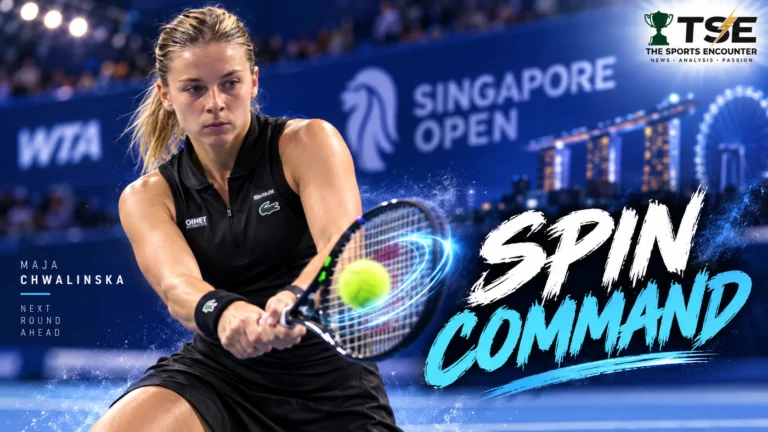
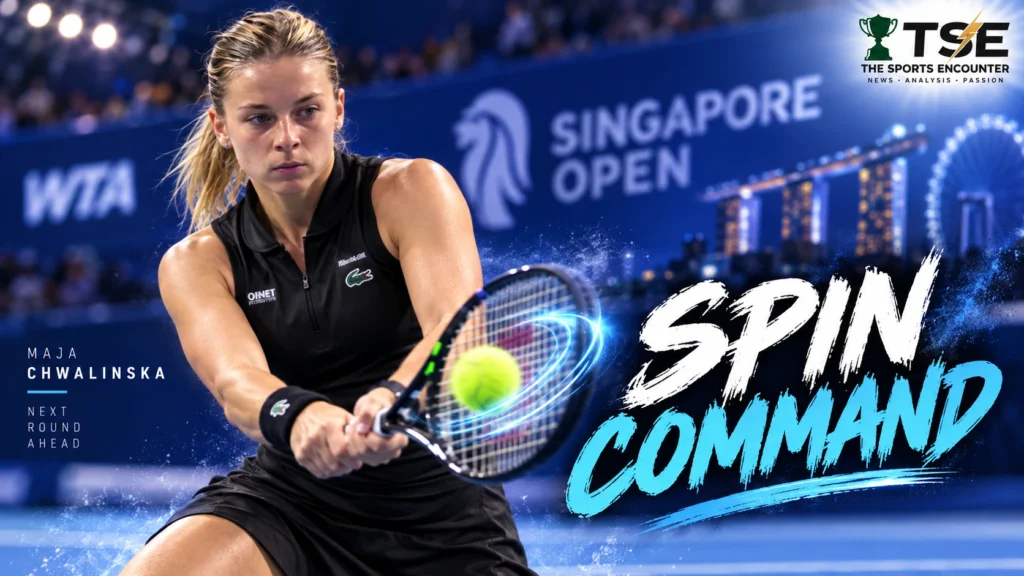
SINGAPORE, Singapore, September 21, 2026: Maja Chwalinska carried the court craft that transformed her season at Roland Garros onto Singapore’s indoor hard courts, defeating Rebecca Sramkova 6-4, 6-2 in 79 minutes to reach the second round of the upgraded WTA 500 Singapore Tennis Open.
The fifth-seeded Pole converted four of six break points, saved four of the five she faced and won 60.4 percent of all points played. Those numbers explain why a potentially awkward first-round match against a player who had beaten her previously became increasingly one-sided as the afternoon developed.
There was also one point that captured Chwalinska’s personality more vividly than any statistic. A return loaded with heavy spin landed on Sramkova’s side, kicked backward and crossed the net again before the Slovak could reach it. The WTA immediately highlighted the shot as one of the opening day’s standout moments.
For Chwalinska, though, the larger story is less about one trick shot and more about what her 2026 season has become. She began Roland Garros outside the Top 100, came through qualifying and reached the final before losing to Mirra Andreeva. Three months later, she arrived in Singapore as the No. 5 seed at a WTA 500 event.
Story at a glance
Maja Chwalinska vs Rebecca Sramkova: Singapore Open Score and Match Stats
The official WTA match statistics show where the contest tilted most decisively. Chwalinska won 71.7 percent of her service points and almost half of Sramkova’s service points.
Why Chwalinska’s Serve Was More Important Than the Highlight-Reel Return
Chwalinska is best known for variety.
What Was the Spinning Return Everyone Was Talking About?
One rally gave the Singapore crowd a much stranger problem to process.
How Far Has Maja Chwalinska Come Since Roland Garros?
The numbers are remarkable.
Why the Singapore Tennis Open Matters More in 2026
The tournament itself has changed.
TSE documented that transformation when Chwalinska’s extraordinary French Open run ended against Andreeva in the final. Singapore now tests whether that breakthrough can become sustained tour-level authority rather than remain the defining fortnight of her season.
Maja Chwalinska vs Rebecca Sramkova: Singapore Open Score and Match Stats
| Category | Rebecca Sramkova | Maja Chwalinska |
|---|---|---|
| Final Score | 4, 2 | 6, 6 |
| Match Time | 1 hour, 19 minutes | |
| First Serve In | 47.2% | 75.5% |
| First-Serve Points Won | 64.0% | 72.5% |
| Second-Serve Points Won | 39.3% | 69.2% |
| Break Points Converted | 1/5 | 4/6 |
| Break Points Saved | 2/6 | 4/5 |
| Total Points Won | 42 | 64 |
The official WTA match statistics show where the contest tilted most decisively. Chwalinska won 71.7 percent of her service points and almost half of Sramkova’s service points.
Why Chwalinska’s Serve Was More Important Than the Highlight-Reel Return
Chwalinska is best known for variety.
She changes height, spin and pace. She can absorb power, use angles and force opponents to generate their own rhythm. That versatility became one of the defining features of her run to the French Open final.
Against Sramkova, the quieter improvement came on serve.
Chwalinska landed 40 of 53 first serves, a 75.5 percent rate. More importantly, her second serve did not become a pressure point. She won nine of 13 second-serve points.
Sramkova managed only 11 of 28.
That gap prevented the Slovak from turning return games into sustained pressure.
Chwalinska faced five break points and lost serve only once. Sramkova faced six and was broken four times.
Break-Point Efficiency Changed the Match
The first set remained competitive because Sramkova could still find enough first-strike tennis to stay close.
Chwalinska’s advantage emerged when the score tightened.
She converted two of her three first-set break opportunities while saving four of the five chances Sramkova created across the match.
That difference became even more pronounced in the second set, when Chwalinska did not face a break point and converted two of three herself.
The Polish player won 69 percent of all points in the second set.
By then, Sramkova was no longer controlling enough neutral rallies to recover.
What Was the Spinning Return Everyone Was Talking About?
One rally gave the Singapore crowd a much stranger problem to process.
Chwalinska met a serve with a heavily cut return that landed inside Sramkova’s court and generated so much backward spin that the ball bounced back over the net.
Sramkova chased it but could not make a legal play before the ball returned to Chwalinska’s side.
The WTA isolated the point in its official opening-day highlights.
The point will travel well on social media because it looks almost accidental.
It also fits Chwalinska’s game.
Her rise has been built less on overwhelming opponents with raw pace and more on disrupting the patterns they prefer. Heavy slice, changing trajectory and soft hands force players to hit different balls from different positions.
Singapore’s indoor conditions reward clean hitting, but they can also amplify the value of a player who prevents a clean hitter from settling.
How Far Has Maja Chwalinska Come Since Roland Garros?
The numbers are remarkable.
Chwalinska entered the French Open ranked No. 114.
She came through qualifying, won six main-draw matches and became one of the lowest-ranked women ever to reach the Roland Garros final.
Only Andreeva stopped her.
That run immediately lifted Chwalinska toward the Top 25 and changed the expectations attached to every tournament that followed.
TSE’s French Open 2026 archive tracks how quickly the women’s hierarchy changed in Paris, while our final analysis detailed why Chwalinska’s qualifier-to-finalist run was so unusual.
The months since Paris have been less linear.
Chwalinska lost early at Wimbledon after suffering a painful fall in a match she had once been in position to win. Hard-court tournaments have also produced reminders that players now prepare specifically for her patterns.
Diana Shnaider beat her in Cincinnati, a result included in TSE’s Cincinnati Open coverage.
Then Alycia Parks recovered from a set down to eliminate Chwalinska at the Monterrey Open, where TSE examined the changing quarterfinal field in our Monterrey Open report.
Singapore therefore matters because Chwalinska is trying to turn the best season of her career into a strong finish rather than relying on the ranking points earned in Paris.
Why the Singapore Tennis Open Matters More in 2026
The tournament itself has changed.
Singapore returned to the WTA calendar in 2025 as a WTA 250 event after a 21-year absence. It has already been upgraded to WTA 500 status.
The 2026 tournament runs from September 21 through 27 at the OCBC Arena at The Kallang, with a 28-player singles draw and a total financial commitment of more than $1.2 million.
The champion receives 500 ranking points and $185,500.
The official event announcement from The Kallang identifies Singapore as Southeast Asia’s only WTA 500 tournament.
That regional position gives the event importance beyond one week of ranking points.
It also opens the WTA’s Asian Swing before Beijing and Wuhan, with the season-ending race still active.
The TSE global sports calendar already points toward the WTA Finals in November, and every 500-point opportunity now carries additional value for players trying to improve their year-end positions.
Who Are the Top Seeds at the Singapore Open?
| Seed | Player |
|---|---|
| 1 | Mirra Andreeva |
| 2 | Amanda Anisimova |
| 3 | Alexandra Eala |
| 4 | Elise Mertens |
| 5 | Maja Chwalinska |
| 6 | Leylah Fernandez |
| 7 | Maria Sakkari |
| 8 | Donna Vekic |
Chwalinska is therefore the fifth seed, not the tournament’s top seed. Andreeva holds the No. 1 position after the field changed through several withdrawals before main-draw play.
The top four seeds received first-round byes.
Chwalinska did not.
Her clean opening victory therefore gives her something Andreeva, Anisimova, Eala and Mertens did not need to earn: an immediate competitive rhythm on the Singapore courts.
Alexandra Eala Arrives With a Different Kind of Pressure
Few players in Singapore will receive the level of regional attention surrounding Eala.
The Filipino is seeded third and received a first-round bye after a season that has already included a Wimbledon upset of Iga Swiatek and her first WTA title in Washington.
TSE covered the breakthrough when Eala defeated Jessica Pegula to win the Mubadala DC Open.
Her popularity has followed her into Singapore. Merchandise carrying her name drew heavy demand before she had even played a point in the tournament.
That creates a different challenge from Chwalinska’s.
Chwalinska arrives trying to reproduce Grand Slam-level tennis across the wider calendar.
Eala arrives as both a contender and one of the tournament’s main commercial attractions.
TSE has already followed how quickly that profile developed, including her Wimbledon victory over Swiatek and the demanding North American run covered in our National Bank Open analysis.
Janice Tjen’s Withdrawal Removes Another Southeast Asian Story
Indonesia’s Janice Tjen had originally been one of the two Southeast Asian direct entrants alongside Eala.
She withdrew before main-draw play because of a right wrist injury.
Her absence matters to the tournament’s regional identity as well as the draw.
Tjen won her first WTA singles title in Chennai in 2025 and had established herself inside the world’s Top 60 before Singapore.
Her withdrawal followed several other changes to the original entry list, including Jessica Pegula, Diana Shnaider, Ekaterina Alexandrova, Clara Tauson and Ann Li.
The field remains strong, but Singapore entered opening day looking different from the version announced in August.
What Else Happened on the Singapore Open’s Opening Day?
Chwalinska was not the only player to advance.
Australian Talia Gibson defeated Fiona Ferro in straight sets and earned a second-round meeting with No. 2 seed Amanda Anisimova.
Qualifier Nao Hibino survived Kristina Mladenovic in three sets.
Aliaksandra Sasnovich also removed Daria Kasatkina, setting up a meeting with top seed Andreeva.
Those results immediately gave two of the tournament’s highest seeds opponents with match rhythm rather than cold starts.
That dynamic is one of the hidden effects of a 28-player draw with first-round byes.
A bye reduces physical load.
It also means the seeded player’s first opponent has already adapted to the court speed and match conditions.
Who Does Maja Chwalinska Play Next in Singapore?
Chwalinska will face the winner of the first-round match between eighth seed Donna Vekic and Wang Xinyu.
Either matchup raises the level immediately.
Vekic offers first-strike power and experience on quick hard courts. Wang can generate pace from both wings and will test whether Chwalinska can continue protecting her second serve as effectively as she did against Sramkova.
The second-round matchup also matters because Chwalinska is defending her status as one of the tournament’s seeded players rather than arriving as the anonymous qualifier who surprised opponents in Paris.
That psychological shift is one of the central tests of her second-half season.
What Does Chwalinska Need to Do to Make a Deep Singapore Run?
The Sramkova match offered a useful blueprint.
Chwalinska does not need to become a power player.
She needs enough first serves in court to protect her variety.
When that happened Monday, Sramkova struggled to attack immediately and rallies moved into the areas where Chwalinska is most comfortable changing spin, height and direction.
The numbers support that reading.
A 75.5 percent first-serve rate gave Sramkova very few second serves to attack. Winning nearly 70 percent behind the second serve meant even those opportunities rarely became advantages.
If Chwalinska maintains those figures against stronger returners, the game that took her to the Roland Garros final becomes much more difficult to rush.
For continuing tournament coverage, rankings context and player analysis, follow The Sports Encounter’s Tennis Hub.
Continue the Tennis Story



Frequently Asked Questions
What was the Maja Chwalinska vs Rebecca Sramkova score?
Maja Chwalinska defeated Rebecca Sramkova 6-4, 6-2 in the first round of the 2026 Singapore Tennis Open.
How long did Chwalinska vs Sramkova last?
The match lasted one hour and 19 minutes.
What seed is Maja Chwalinska at the Singapore Open?
Chwalinska is the No. 5 seed. Mirra Andreeva is the top seed.
Who does Maja Chwalinska play next?
Chwalinska will face the winner of eighth seed Donna Vekic and Wang Xinyu.
Did Maja Chwalinska reach the 2026 French Open final?
Yes. Chwalinska came through qualifying and reached the Roland Garros final before losing to Mirra Andreeva.
What was unusual about Chwalinska’s return against Sramkova?
One heavily spun return landed in Sramkova’s court and bounced backward over the net, producing one of the WTA’s most widely highlighted points from opening day.
Is the Singapore Open a WTA 500 tournament?
Yes. Singapore was upgraded from WTA 250 status in 2025 to WTA 500 status for 2026.
Where is the Singapore Tennis Open played?
The tournament is played on indoor hard courts at the OCBC Arena at The Kallang in Singapore.
Is Alexandra Eala playing in Singapore?
Yes. Eala is the No. 3 seed and received a first-round bye.
Why is Janice Tjen not playing the Singapore Open?
Tjen withdrew before the tournament because of a right wrist injury.