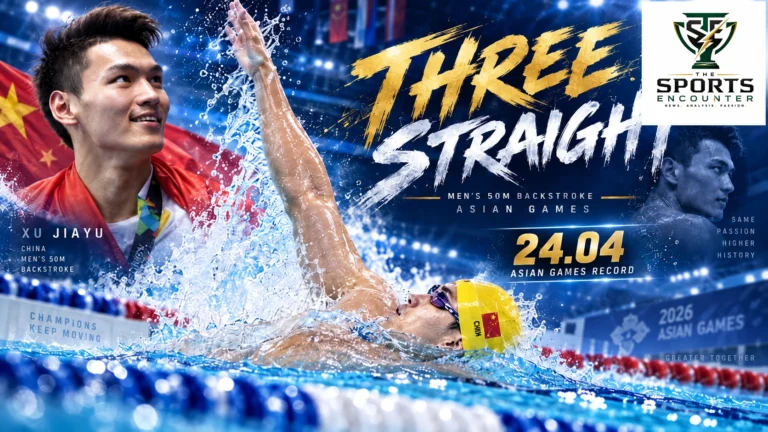
TOKYO, Japan, September 21, 2026: Xu Jiayu has extended one of the most durable individual streaks in Asian Games swimming, winning the men’s 50m backstroke for a third consecutive edition in a Games-record 24.04 at the Tokyo Aquatics Centre.
The 31-year-old Chinese veteran finished 0.45 seconds ahead of teammate Wang Zicheng, who took silver in 24.49, while South Korea’s Yoon Ji-hwan earned bronze in 24.54 during his Asian Games debut.
Xu’s victory completed a sequence stretching across Jakarta 2018, Hangzhou 2023 and Aichi-Nagoya 2026. He won the same one-length backstroke title in 24.75 eight years ago, defended it in 24.38 in Hangzhou and has now lowered the Asian Games record to 24.04.
The title also arrived less than 24 hours after Xu won the men’s 100m backstroke in a Games-record 51.98 during China’s dominant opening swimming session.
Story at a glance
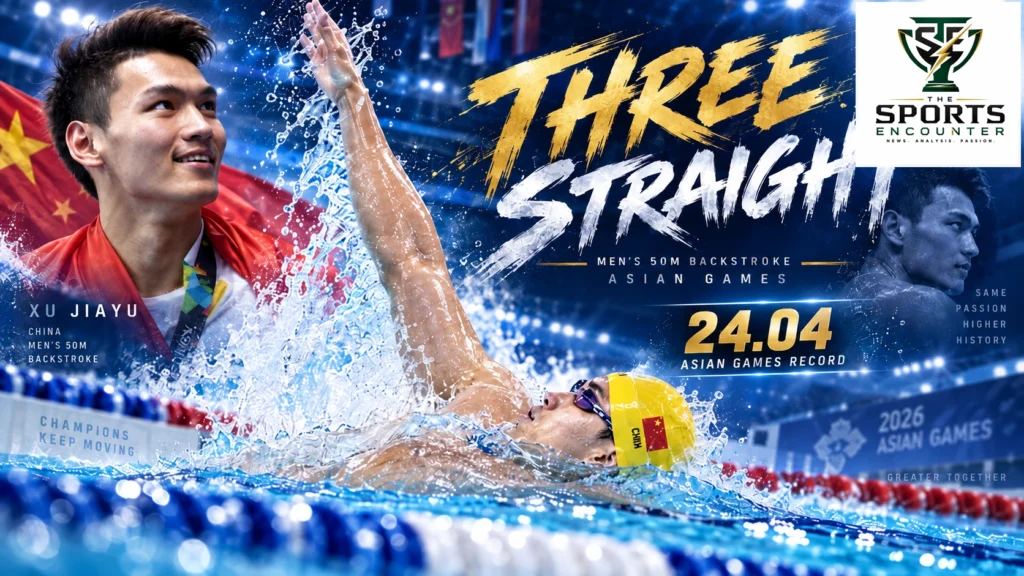
Xu Jiayu’s Three Straight Asian Games 50m Backstroke Titles
The progression is almost as striking as the streak itself.
What Record Did Xu Jiayu Break With 24.04?
Xu broke the Asian Games record in the men’s 50m backstroke.
Why 24.04 at Age 31 Makes the Victory More Significant
Xu is no longer winning because of the profile he built earlier in his career.
Xu Won the 100m Backstroke Less Than 24 Hours Earlier
The workload adds another layer to the result.
China Took Gold and Silver in the 50m Backstroke
Wang Zicheng’s silver strengthened the result beyond Xu’s individual milestone.
His latest gold therefore carries two stories at once: an athlete still swimming close to continental-record pace at 31, and a Chinese backstroke program that continues to draw value from one of its most experienced champions while a much younger generation arrives around him.
Xu Jiayu’s Three Straight Asian Games 50m Backstroke Titles
| Asian Games | Host | Winning Time | Result |
|---|---|---|---|
| 2018 | Jakarta | 24.75 | Gold |
| 2023 | Hangzhou | 24.38 | Gold |
| 2026 | Aichi-Nagoya | 24.04 | Gold, Games record |
The progression is almost as striking as the streak itself.
Xu has gone faster at each Asian Games while moving from his early twenties into his thirties. The official Jakarta 2018 results book records his first title at 24.75, when he beat Japan’s Ryosuke Irie.
Five years later, he won again in Hangzhou in 24.38. The Olympic Council of Asia’s Hangzhou report confirmed that second title.
Tokyo has now produced the fastest of the three.
What Record Did Xu Jiayu Break With 24.04?
Xu broke the Asian Games record in the men’s 50m backstroke.
The previous Games record was 24.28, set by Japan’s Junya Koga at Incheon 2014.
That mark had survived both Jakarta and Hangzhou even though Xu won the title at both editions.
His 24.04 finally removed it by 0.24 seconds.
The time was not an Asian record, because Xu already owns that standard at 23.92. He established the continental mark at China’s national championships in June 2026, becoming the first Asian swimmer to break 24 seconds in the event.
Xu’s official World Aquatics profile lists the 23.92 as his long-course Asian record.
| Record | Time | Holder |
|---|---|---|
| Asian Record | 23.92 | Xu Jiayu |
| Asian Games Record | 24.04 | Xu Jiayu |
| Previous Games Record | 24.28 | Junya Koga |
Why 24.04 at Age 31 Makes the Victory More Significant
Xu is no longer winning because of the profile he built earlier in his career.
He is still producing elite times.
The 23.92 Asian record he set three months before the Games provided the clearest evidence. His 24.04 in Tokyo sits only 0.12 seconds outside that mark.
That proximity is unusual for a swimmer who has been competing internationally for well over a decade.
Backstroke sprinting demands explosive starts, underwater speed, clean breakouts and a precise finish. There is little room to compensate for a weak technical phase across only 50 meters.
TSE has followed similar technical margins in the women’s event this year, including Sara Curtis’ first 50m backstroke world record in Paris and her second record less than 24 hours later.
Xu’s story sits at a very different career stage. Curtis is 19 and accelerating into international prominence. Xu is demonstrating that elite sprint technique can remain competitive deep into a long championship career.
Xu Won the 100m Backstroke Less Than 24 Hours Earlier
The workload adds another layer to the result.
On the opening swimming night, Xu won the 100m backstroke in 51.98, lowering the Asian Games record.
He then returned for the 50m heats on Monday morning, qualified fastest and came back again for the final.
That means his first two individual races at Aichi-Nagoya have produced two gold medals and two Games records.
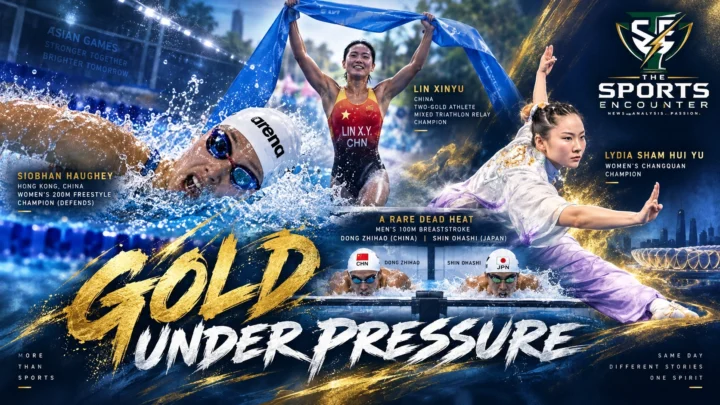
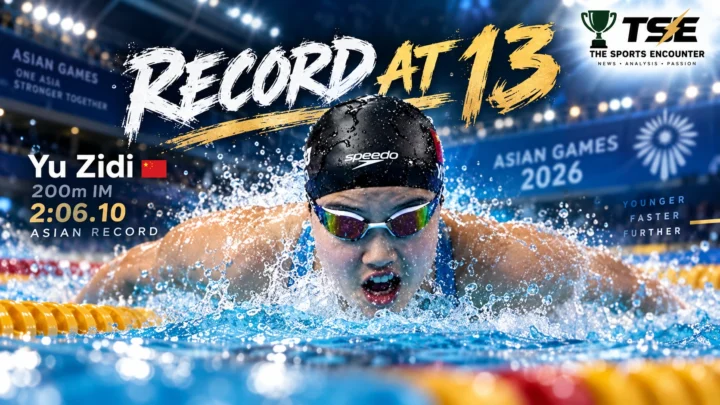
China’s opening pool dominance was already substantial before the 50m final. Yu Zidi had broken the women’s 200m butterfly Games record, Pan Zhanle retained the 100m freestyle title and Tang Qianting set a Games record in the women’s 50m breaststroke.
The wider context is detailed in TSE’s September 20 Asian Games report.
Xu’s second gold makes backstroke another clear source of Chinese control.
China Took Gold and Silver in the 50m Backstroke
Wang Zicheng’s silver strengthened the result beyond Xu’s individual milestone.
Wang finished in 24.49, 0.45 seconds behind his teammate but 0.05 ahead of Korea’s Yoon.
A one-two finish matters in a multi-sport event because it converts one final into a significant medal-table gain.
China entered Aichi-Nagoya after winning 201 gold medals at Hangzhou, with swimming again expected to provide one of the largest blocks of medals. TSE’s complete Asian Games preview identified that depth as one of the central reasons the defending medal-table champion remains so difficult to challenge.
Yoon Ji-hwan Converts His Asian Games Debut Into Bronze
South Korea also left the final with something important.
Yoon Ji-hwan, 20, finished in 24.54 to claim bronze in his first Asian Games appearance.
He had qualified among the fastest swimmers in the morning and remained inside the medal fight against two Chinese finalists with strong home-continent credentials.
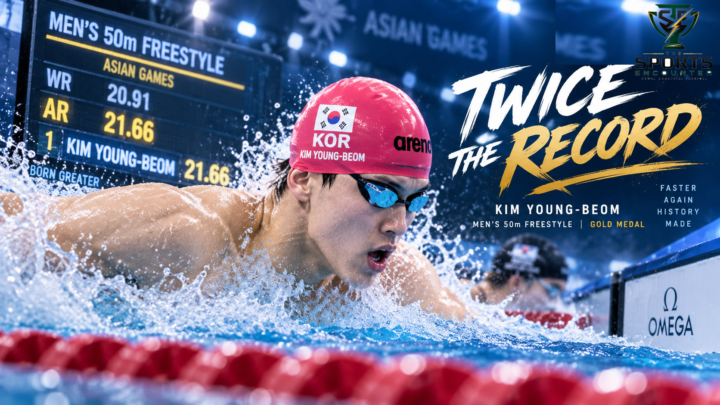
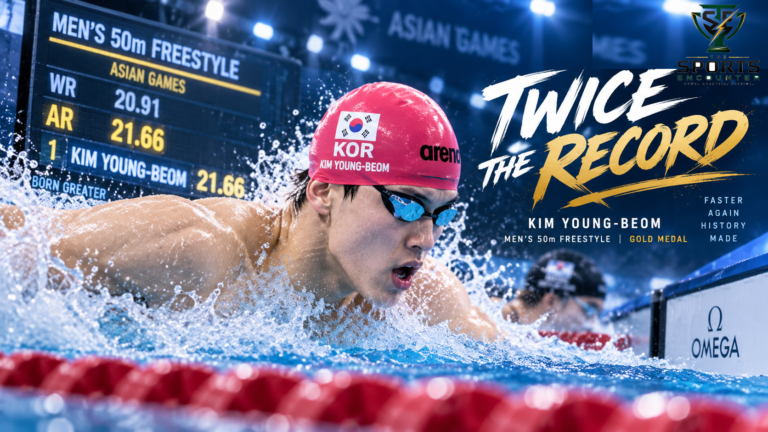
The result continues a productive opening swimming program for Korea after Kim Young-beom’s sprint breakthrough and the country’s relay medals.
Asian sprint swimming has moved rapidly during the last several seasons. TSE’s Paris 2026 swimming analysis showed the same trend at European level, where records repeatedly moved across sprint and middle-distance events during one championship week.
Xu’s Asian Games Career Began With Bronze, Not Gold
The three-title streak becomes more interesting when placed against Xu’s first Asian Games appearance.
At Incheon 2014, Japan’s Junya Koga won the 50m backstroke in the 24.28 Games record Xu finally broke this week.
Xu finished third.
Four years later, he returned in Jakarta and won.
Then came Hangzhou.
Now Tokyo.
Across four Asian Games, the sequence reads bronze, gold, gold, gold.
That trajectory also mirrors his wider career development. Xu became one of the world’s leading 100m and 200m backstrokers before extending his sprint speed deep into his thirties.
Xu Already Had 11 Asian Games Gold Medals Before Aichi-Nagoya
His 50m title belongs to a much larger Asian Games career.
World Aquatics listed Xu with 11 Asian Games gold medals before the 2026 competition began, alongside two silver and one bronze.
Those golds came across individual backstroke events and medley relays in Jakarta and Hangzhou.
The two individual victories already secured in Tokyo lift that career total further.
His longevity resembles a pattern seen among several elite swimmers TSE has followed this year. Katie Ledecky extended a 16-year unbeaten 1,500m freestyle run at the Pan Pacific Championships, while Kylie Masse defended another Commonwealth backstroke title in Glasgow.
Xu’s streak is shorter, but the underlying challenge is familiar. Younger swimmers arrive with faster starts, different training systems and fewer miles in their bodies. Established champions have to keep improving anyway.
Why Backstroke Has Become One of China’s Most Reliable Swimming Events
Xu’s longevity has allowed China to build around a stable elite reference point.
His presence gives younger Chinese backstrokers a direct performance standard in training and national selection rather than an abstract historical mark.
Wang’s silver in Tokyo shows the pipeline is producing another medal-level swimmer while Xu remains competitive.
That type of overlap can be more valuable than a clean generational handover.
It gives a national program established championship experience and emerging speed at the same time.
China are showing the same broader pattern elsewhere. Yu Zidi is 13. Pan Zhanle remains one of the world’s fastest freestyle swimmers. Xu represents the veteran end of the team.
The scale of that mixture helps explain why swimming has accelerated China’s medal-table lead from the opening sessions.
What Xu Jiayu’s Three-Peat Says About Championship Longevity
Winning one 50m backstroke title requires a near-perfect one-length sprint.
Winning the same event across three Asian Games requires the athlete to survive changes in technique, rivals, training cycles and age while remaining the fastest swimmer when the medals are decided.
Xu’s times show that survival has involved progression rather than maintenance.
24.75 in 2018.
24.38 in 2023.
24.04 in 2026.
His fastest Asian Games swim has arrived at his latest Asian Games.
The broader Aichi-Nagoya story began with more than 11,000 athletes entering a 43-sport competition, as detailed in TSE’s Opening Ceremony analysis and our Day 1 competition report.
Xu has already ensured his part of those Games will be remembered through a much simpler sequence.
Three editions. Three titles. His fastest time yet.
Continue the Swimming Story
Frequently Asked Questions
Who won the men’s 50m backstroke at the 2026 Asian Games?
China’s Xu Jiayu won gold in 24.04 seconds.
What record did Xu Jiayu break?
Xu broke the Asian Games record of 24.28 set by Japan’s Junya Koga at Incheon 2014.
Is 24.04 the Asian record?
No. Xu himself holds the Asian record at 23.92, set at the 2026 Chinese National Championships.
How many consecutive Asian Games 50m backstroke titles has Xu Jiayu won?
Xu has won three consecutive titles, at Jakarta 2018, Hangzhou 2023 and Aichi-Nagoya 2026.
What were Xu Jiayu’s winning times in those three Asian Games?
He won in 24.75 in 2018, 24.38 in 2023 and 24.04 in 2026.
Who won silver in the 2026 Asian Games 50m backstroke?
China’s Wang Zicheng took silver in 24.49.
Who won bronze?
South Korea’s Yoon Ji-hwan won bronze in 24.54 in his Asian Games debut.
Did Xu Jiayu also win the 100m backstroke?
Yes. Xu won the 100m backstroke one day earlier in a Games-record 51.98.
How old is Xu Jiayu?
Xu is 31 years old. He was born on August 19, 1995.
What happened in Xu Jiayu’s first Asian Games 50m backstroke?
Xu won bronze at Incheon 2014 behind Junya Koga and Ryosuke Irie before beginning his three-title winning streak in 2018.