Tanzid’s 94 Saves Bangladesh From a Zimbabwe Series Whitewash
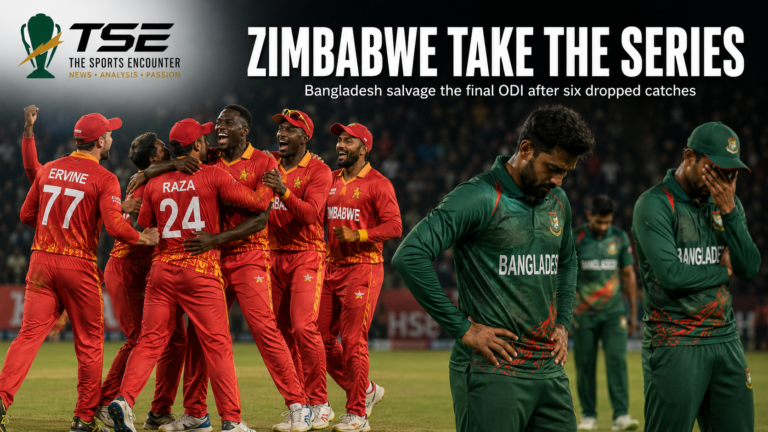
Bangladesh secured a seven-wicket consolation win in Harare as Tanzid Hasan scored 94 and Zimbabwe’s six dropped catches ruined their chance of completing an ODI series sweep.
Zimbabwe had the chance to complete a statement series sweep in Harare, but six dropped catches turned a defendable target into Bangladesh’s easiest batting afternoon of the tour.
The visitors chased 200 with 83 balls remaining, winning the third and final ODI by seven wickets after Tanzid Hasan struck 94 from 101 balls. Soumya Sarkar supported him with 66 as the opening pair punished an experimental Zimbabwe attack that lacked Richard Ngarava, Blessing Muzarabani, and Newman Nyamhuri.
Bangladesh needed this result after losing the one-off Test and the opening two ODIs. The victory could not change the series outcome, but it prevented a clean sweep and gave the batting group some confidence before the three-match T20I series begins on Wednesday, July 15.
TL;DR
- Bangladesh beat Zimbabwe by seven wickets in the third ODI.
- Zimbabwe made 199 in 48.1 overs before Bangladesh reached 200 for 3 in 36.1 overs.
- Tanzid Hasan led the chase with 94 from 101 balls, while Soumya Sarkar scored 66.
- Wessly Madhevere made 75 and Brad Evans contributed 50 for Zimbabwe.
- Zimbabwe dropped six catches and rested three important fast-bowling options.
- The hosts still won the ODI series 2-1, while Bangladesh avoided a tour whitewash.
Zimbabwe vs Bangladesh Third ODI Scorecard
| Detail | Information |
|---|---|
| Match | Zimbabwe vs Bangladesh, 3rd ODI |
| Result | Bangladesh won by seven wickets |
| Venue | Harare Sports Club, Harare |
| Date | July 11, 2026 |
| Zimbabwe | 199 all out in 48.1 overs |
| Bangladesh | 200/3 in 36.1 overs |
| Top Zimbabwe Batters | Wessly Madhevere 75, Brad Evans 50 |
| Top Bangladesh Batters | Tanzid Hasan 94, Soumya Sarkar 66 |
| Best Bowling | Shoriful Islam 4/44 |
| Turning Point | Zimbabwe dropped six catches during Bangladesh’s chase |
| Series Result | Zimbabwe won the three-match ODI series 2-1 |
Bangladesh’s Bowlers Keep Zimbabwe Below 200
Mehidy Hasan Miraz won his third consecutive toss and again asked Zimbabwe to bat. This time, Bangladesh’s bowlers backed the decision with early wickets and sustained control through the middle overs.
Zimbabwe slipped to 27 for 3 after losing Ben Curran, Brian Bennett, and Craig Ervine. The top-order problems placed immediate pressure on a reshaped batting lineup, particularly after the hosts had rested several players to test their bench strength.
Wessly Madhevere stopped the early slide with a patient 75. His innings gave Zimbabwe a route toward a competitive total, although the scoring rate remained modest on a surface that required careful batting.
At 108 for 5 after 33 overs, the hosts still looked in danger of finishing well below 180. Brad Evans then continued his valuable lower-order form by making 50 from 41 balls. His partnerships with the tail added substance to the innings before Zimbabwe were dismissed for 199 in 48.1 overs.
Shoriful Islam finished with 4 for 44, leading a disciplined Bangladesh attack. His wickets ensured Zimbabwe could not repeat the late acceleration that had helped them seal the ODI series in the second match.
Bangladesh’s performance also offered a better response after the batting collapse that wasted Nahid Rana’s six-wicket haul in Zimbabwe’s remarkable first ODI victory.
Zimbabwe Test Their Bench Ahead of the T20Is
Zimbabwe made three changes after securing an unassailable 2-0 lead. Wellington Masakadza, Tanaka Chivanga, and Ernest Masuku replaced Ngarava, Nyamhuri, and Muzarabani.
The changes gave the management an opportunity to assess its reserve options, but they also removed much of the pace threat that had troubled Bangladesh earlier in the series. Ngarava, Zimbabwe’s new Test and ODI captain, received a workload-management break, leaving Sikandar Raza to lead the side.
Bangladesh made two changes of their own. Left-arm spinner Tanvir Islam replaced Rishad Hossain, while Mohammad Saifuddin came in for Nahid Rana.
Resting Rana made sense before the T20I series. The fast bowler had carried a heavy workload and produced career-best figures of 6 for 21 in the opening ODI. Bangladesh needed to manage him carefully with three more international matches beginning four days later.
Readers can follow the upcoming series and other international matches through The Sports Encounter’s Cricket Hub, alongside its broader sports news and match analysis.
Tanzid and Soumya Punish Zimbabwe’s Missed Chances
A target of 200 still required Bangladesh to handle the new ball properly. Their previous two defeats had shown how quickly manageable chases could become uncomfortable.
Zimbabwe’s fielders removed that pressure.
Tanzid and Soumya received repeated lives as six catches went down across the innings. Some chances carried different levels of difficulty, but several were opportunities an international side would expect to hold. Each miss weakened the bowlers’ confidence and allowed Bangladesh’s opening partnership to grow.
Soumya made 66 before Tanaka Chivanga finally broke the stand. By then, Bangladesh had complete control of the asking rate and enough wickets in hand to finish without panic.
Tanzid attacked the weakened bowling lineup with increasing confidence. He struck 94 from 101 deliveries and appeared set for a century before lifting Ernest Masuku to Brad Evans at long-on with only three runs required.
Masuku then dismissed Towhid Hridoy in the same over, briefly turning a routine finish into an untidy one. Najmul Hossain Shanto remained unbeaten on 17, and a wide from Sikandar Raza completed the chase at 200 for 3 after 36.1 overs.
The comfortable finish contrasted sharply with Bangladesh’s collapse in the second ODI, when the visitors lost their final five wickets for 27 runs. This time, the opening partnership removed almost every meaningful element of risk.
The dropped catches also recalled another costly fielding breakdown covered by The Sports Encounter, when Sri Lanka’s missed chances helped West Indies win a decisive T20I. Fielding errors often look like isolated moments, but six of them can reshape an entire chase.
What the Result Means for Both Teams
Zimbabwe deserved their 2-1 series victory. They defended modest totals in the first two ODIs, handled pressure better, and found match-winning contributions from different players. Ben Curran, Brad Evans, Newman Nyamhuri, and the fast-bowling unit all influenced the series.
Yet the final match exposed the risks involved in changing several frontline bowlers at once. Bench testing remains valuable, particularly after a series has been secured, but the replacement attack needed stronger support from the field.
Bangladesh leave the ODI contest with fewer positives. One comfortable chase cannot erase two avoidable defeats or the innings loss in the preceding Test. However, Tanzid’s innings, Soumya’s contribution, and Shoriful’s four wickets gave the visitors a more stable platform before the format changes.
The ICC’s official international cricket coverage will provide the wider schedule and competition context as both teams move into the T20I leg of the tour.
The T20I Series Offers a Fresh Test
The three-match T20I series starts on Wednesday, July 15, with both teams expected to adjust their personnel and tactics for the shorter format.
Zimbabwe will enter it with confidence from the ODI series, although the final match leaves a clear fielding issue to address. Bangladesh finally have a win on the board, but they must show that their improved batting can survive against a full-strength attack without relying on repeated missed chances.
Harare denied Zimbabwe the clean sweep they wanted. The scoreboard will record a seven-wicket Bangladesh victory, while the six dropped catches explain how firmly the final ODI slipped from the hosts’ control.
5.6 TerraExtra High

Breaking News
Messi Faces a Fearless Switzerland With Another World Cup Semifinal at Stake
Lionel Messi and Argentina enter their World Cup quarterfinal as favorites, but Switzerland’s discipline, resilience, and historic run make this a far more dangerous contest than expected.
Lionel Messi has spent much of this World Cup rescuing Argentina from uncomfortable situations. Switzerland now have 90 minutes, perhaps more, to discover whether the defending champions can survive another one.
Argentina enter the fourth and final quarterfinal as clear favorites, carrying the weight of the trophy and a 39-year-old captain who has scored eight goals in the tournament. Yet their path through the knockout rounds has exposed defensive problems that Switzerland are capable of exploiting.
Murat Yakin’s side have reached their first World Cup quarterfinal in 72 years through organization, patience, and an ability to remain composed when matches become tense. Their unexpected presence in the last eight already represents one of the tournament’s finest stories. Beating Argentina would turn it into Swiss football history.
TL;DR
- Argentina face Switzerland in the final World Cup 2026 quarterfinal in Kansas City.
- Messi has scored eight goals and remains central to Argentina’s title defense.
- Argentina recovered from 2-0 down to beat Egypt 3-2 in a controversial Round of 16 match.
- Switzerland eliminated Algeria before beating Colombia 4-3 on penalties after a goalless draw.
- Swiss top scorer Johan Manzambi will miss the quarterfinal with a knee injury.
- The winner will face England or Norway in the semifinals.
Argentina vs Switzerland: Key Match Information
| Detail | Information |
|---|---|
| Match | Argentina vs Switzerland |
| Competition | FIFA World Cup 2026 quarterfinal |
| Date | Saturday, July 11, 2026 |
| Kickoff | 8:00 p.m. CDT / 1:00 a.m. UTC on July 12 |
| Venue | Kansas City Stadium, Kansas City |
| Argentina player to watch | Lionel Messi, eight tournament goals |
| Switzerland player to watch | Gregor Kobel |
| Major absence | Johan Manzambi, Switzerland |
| Referee | João Pinheiro, Portugal |
| Previous World Cup meeting | Argentina won 1-0 after extra time in 2014 |
| Semifinal opponent | Winner of England vs Norway |
Follow the complete tournament bracket, match reports, and analysis through The Sports Encounter’s FIFA World Cup 2026 coverage hub. Official match information is also available through FIFA’s Argentina vs Switzerland match center.
Messi Remains Argentina’s Difference-Maker
Argentina have won all five of their matches, although their knockout performances have carried far more tension than Lionel Scaloni would have wanted.
Messi opened the tournament with a hat trick in a 3-0 victory over Algeria. His influence has continued through every stage, whether scoring, creating chances, taking set pieces, or giving Argentina a calm reference point when control begins to disappear.
The captain scored and assisted during Argentina’s 3-2 extra-time escape against Cabo Verde in the Round of 32. He then endured an extraordinary night against Egypt, missing a penalty before helping drag his team back from two goals down.
Cristian Romero began the comeback in the 79th minute from Messi’s delivery. The captain equalized four minutes later, and Enzo Fernández completed the turnaround in stoppage time.
That performance took Messi to eight goals in this World Cup, level with Kylian Mbappé in the Golden Boot race. Scaloni described him as “a machine” before the quarterfinal and praised the physical preparation that has allowed him to remain decisive at 39.
Argentina’s reliance on Messi remains both a strength and a warning. When the game becomes chaotic, he still finds solutions. However, Switzerland will believe they can trouble a defense that conceded twice against Cabo Verde and twice against Egypt.
The Controversy Argentina Cannot Completely Leave Behind
Argentina’s dramatic victory over Egypt produced serious debate over the officiating.
Egypt had a potential third goal by Mostafa Zico disallowed following a VAR review. Coach Hossam Hassan later suggested that officials wanted Argentina and Messi to remain in the competition. His crossed-arm gesture became another major talking point, as explained in The Sports Encounter’s report on the Egypt coach’s “X” sign.
FIFA referees chief Pierluigi Collina rejected allegations of bias. Argentina defender Lisandro Martínez also defended the tournament’s officials and dismissed the controversy as a media-driven issue.
The debate will follow Argentina into Kansas City, especially after two knockout matches in which the champions looked vulnerable. Their main concern, though, should be the number of chances they have allowed rather than the noise surrounding the decisions.
How Switzerland Reached the Last Eight
Switzerland’s quarterfinal appearance feels surprising because of their long history of falling at the first knockout hurdle. They reached the Round of 16 in 2006, 2014, 2018, and 2022 without advancing.
This team finally broke that barrier.
The Swiss topped Group B after beating Bosnia and Herzegovina 4-1 and host nation Canada 2-1, alongside a 1-1 draw with Qatar. A controlled 2-0 Round of 32 victory over Algeria then carried them into a difficult meeting with Colombia.
Their Round of 16 became a test of concentration. Switzerland and Colombia remained goalless through 120 minutes before Gregor Kobel saved Cucho Hernández’s penalty and Rubén Vargas converted the decisive kick. The shootout victory over Colombia sent the Swiss into their first last-eight appearance since hosting the tournament in 1954.
Yakin must now reorganize his attack without Manzambi. The 20-year-old contributed three goals and two assists before a knee injury ended his tournament. His absence removes Switzerland’s leading scorer and one of their most unpredictable attackers.
Where Switzerland Can Hurt Argentina
Granit Xhaka will carry the tactical responsibility of controlling midfield and preventing Argentina from dictating the tempo around Messi. Denis Zakaria can add physical coverage, while Dan Ndoye, Breel Embolo, and Vargas offer the pace required to attack the spaces behind Argentina’s advancing defenders.
Yakin believes possession will be essential. Switzerland cannot spend the entire match defending near their penalty area because Messi eventually finds openings against compact blocks.
The Swiss should also target transitions. Argentina’s center backs have contributed important goals, but their movement forward can leave space behind the midfield. Egypt and Cabo Verde both showed that direct, confident attacks can unsettle the champions.
Kobel may need another exceptional performance. Switzerland’s structure can restrict Argentina, yet it is unlikely to remove every Messi opportunity.
Who Has the Better Chance of Reaching the Semifinals?
Argentina deserve favoritism because they have more individual quality, greater knockout experience, and the tournament’s most influential player. Their ability to score late also gives them a psychological advantage if the match remains level.
Switzerland’s chance rests on keeping the score close, disrupting Messi’s service, and forcing Argentina into another emotionally demanding contest. A penalty shootout would suit a side arriving with fresh confidence in Kobel.
The Sports Encounter prediction: Argentina have a 68% chance of advancing, with Switzerland at 32%.
A Swiss victory would be historic, but Manzambi’s absence reduces their attacking threat. Argentina should reach the semifinals if they defend with greater discipline and avoid giving Switzerland the transition opportunities that Egypt repeatedly found.
For Messi, the reward would be another World Cup semifinal and two remaining victories between Argentina and consecutive titles. Switzerland stand in the way with a united team, an outstanding goalkeeper, and 72 years of waiting behind them.
The Sports Encounter’s World Cup 2026 coverage focuses on fixtures, team news, match analysis, fan stories, tournament trends, and the biggest talking points from football’s global stage.
Breaking News
Two Rebounds Break Belgium Hearts as Spain Reach World Cup Semifinal
Spain scored twice from rebounds as substitute Mikel Merino punished a late goalkeeping error to seal a 2-1 quarterfinal victory over Belgium.
Two rebounds, two Spanish goals, and one painful World Cup exit for Belgium.
Fabián Ruiz reacted first when Thibaut Courtois parried Dani Olmo’s shot in the 30th minute. Almost an hour later, substitute Mikel Merino punished Senne Lammens after the replacement goalkeeper spilled Pau Cubarsí’s effort.
The circumstances carried a cruel symmetry for Belgium. Spain scored both goals from rebounds, with two different goalkeepers unable to remove the danger at decisive moments.
Merino’s 88th-minute finish gave Spain a dramatic 2-1 victory at Los Angeles Stadium and sent the reigning European champions into a FIFA World Cup 2026 semifinal against France in Dallas.
Charles De Ketelaere had equalized for Belgium in the 41st minute. His header became the first goal Spain had conceded at this World Cup and ended La Roja’s 650-minute international shutout run.
For results, analysis, and the road to the final, follow The Sports Encounter’s FIFA World Cup 2026 coverage.
Spain vs Belgium Match Facts
| Detail | Information |
|---|---|
| Match | Spain vs Belgium |
| Competition | FIFA World Cup 2026 quarterfinal |
| Final score | Spain 2-1 Belgium |
| Venue | Los Angeles Stadium, Inglewood |
| Spain scorers | Fabián Ruiz 30’, Mikel Merino 88’ |
| Belgium scorer | Charles De Ketelaere 41’ |
| Yellow cards | Cubarsí 43’, De Bruyne 85’, Laporte 90+4’, Witsel 90+5’ |
| Red cards | None |
| Referee | Michael Oliver |
| Turning point | Courtois’ injury and Lammens’ late spill |
| Next match | Spain vs France, semifinal |
Nothing Separates the Teams Early
The opening phase offered no clear separation between the two European sides.
Spain controlled more of the ball and tried to stretch Belgium through Lamine Yamal, but the Belgian defense held its shape through the first hydration break. Yamal made some progress on the right, using his close control and quick changes of direction to reach promising areas. None of those early moves produced a clear opening.
Belgium accepted Spain’s territorial control and looked for opportunities to attack the spaces left behind. Kevin De Bruyne tried to give the Red Devils composure in possession, while De Ketelaere and Jérémy Doku offered movement around Spain’s back line.
The match needed someone to break its careful rhythm. Ruiz supplied the answer in the 30th minute.
Fabián Ruiz Scores From the First Rebound
Spain’s opening goal came after another sustained attack forced Belgium toward its own net.
Pedro Porro combined with Yamal before delivering a low ball into the penalty area. Olmo struck it first time, forcing Courtois into a low save. The Belgian goalkeeper stopped the initial effort but could not push the ball away from danger.
Ruiz anticipated the rebound, reached it before Belgium’s defenders, and forced the loose ball over the line.
The midfielder’s alertness finally gave Spain a reward for their pressure. Belgium now faced the difficult task of chasing a team that had not conceded throughout the tournament.
Spain continued attacking after taking the lead. Yamal and his teammates put together another series of threatening moves, creating the sense that a second goal could place the quarterfinal beyond Belgium’s reach.
De Ketelaere changed that conversation four minutes before halftime.
De Ketelaere Scores First Goal Against Spain
Belgium equalized in the 41st minute when De Ketelaere met Timothy Castagne’s excellent cross and directed his header beyond Unai Simón.
De Bruyne started the move by finding Castagne at the right moment, while De Ketelaere moved ahead of Cubarsí to reach the delivery. Replays showed that Marc Cucurella had played the Belgian forward onside.
The goal ended Spain’s perfect defensive record at the 2026 World Cup. It also stopped an international shutout streak that had stretched to 650 minutes across the current tournament and previous fixtures.
Cubarsí received the first yellow card of the match in the 43rd minute. The Spanish defender grabbed De Bruyne’s shorts after going to ground while trying to prevent the Belgian captain from escaping.
Both teams entered halftime level at 1-1.
Belgium’s response showed why Spain coach Luis de la Fuente had called the Red Devils his team’s toughest challenge of the tournament. They absorbed pressure, stayed calm after falling behind, and punished Spain’s defense with a sharp transition.
That resilience had already shaped their campaign. Belgium recovered from two goals down to produce a remarkable extra-time comeback against Senegal before overpowering the hosts in a 4-1 Round of 16 win over the United States.
Yamal Creates Openings but Misses His Chances
Yamal remained Spain’s most persistent attacking threat after halftime.
The teenager repeatedly found his way into the penalty area, but several promising opportunities slipped away through a heavy touch, a blocked effort, or an inaccurate finish. Courtois denied him after Cubarsí played him through early in the second half and later saved another driven attempt.
Belgium struggled to stop Yamal from reaching dangerous positions, yet they prevented him from finding the decisive finish. His movement still affected the shape of the match by forcing the Belgian defense deeper and opening space for Spain’s midfielders.
De Bruyne entered referee Michael Oliver’s book in the 85th minute after wrestling Ferran Torres to the ground. The Belgian captain left the field immediately afterward, with Alexis Saelemaekers replacing him.
Extra time appeared increasingly likely. Spain’s substitutes then decided another knockout match.
Courtois Injury Changes Belgium’s Quarterfinal
Courtois suffered a thigh problem during the second half and left the field in the 71st minute. The visibly emotional goalkeeper took his place on the bench with an ice pack strapped to his left thigh.
Lammens entered under immediate pressure as Spain controlled possession and searched for openings around Belgium’s penalty area.
The goalkeeper initially handled several situations without difficulty. However, the match eventually returned to the same detail that had produced Spain’s opening goal: a rebound inside the penalty area.
Merino Punishes the Second Rebound
Cubarsí sent a bouncing shot toward goal in the 88th minute. Lammens failed to secure it, and Merino reacted before anyone else to place the rebound into the net.
The midfielder had replaced Olmo in the 86th minute and required barely two minutes to make the difference.
The finish carried an unmistakable irony for Belgium. Courtois had saved Olmo’s initial shot before Ruiz converted the first rebound. Lammens then stopped neither Cubarsí’s effort nor the danger that followed, allowing Merino to score from another loose ball.
Spain had spent much of the match trying to pass through Belgium’s defensive structure. In the end, alert reactions to two imperfect saves produced both goals.
Merino’s impact repeated the pattern from Spain’s late Round of 16 victory over Portugal, when he also came from the bench and scored the winner.
Four Yellow Cards but No Red Cards
Belgium pushed hard during seven minutes of added time, and the physical temperature rose as Spain protected their lead.
Laporte received Spain’s second yellow card at 90+4. One minute later, Witsel became the fourth and final player booked after arriving late on Rodri with his studs showing. Oliver decided the challenge warranted a yellow card rather than a red.
The verified disciplinary record showed four yellow cards:
- Pau Cubarsí, Spain, 43rd minute
- Kevin De Bruyne, Belgium, 85th minute
- Aymeric Laporte, Spain, 90+4
- Axel Witsel, Belgium, 90+5
No player received a red card.
Spain Set Up France Semifinal
Hollywood stars Brad Pitt, Javier Bardem, Issa Rae, and Noel Gallagher were among the familiar faces watching from the stands, but Merino owned the closing scene.
Belgium’s campaign ended with the painful knowledge that two rebounds had separated them from a place in extra time. The defeat may also represent the final World Cup appearance for several members of their experienced generation.
Spain advance with growing evidence that their bench can decide close knockout contests. They will now face a French side that defeated Morocco 2-0 in the first World Cup quarterfinal.
France bring Kylian Mbappé and considerable attacking power. Spain carry control, patience, and Merino’s valuable habit of appearing exactly when a difficult match needs someone to settle it.
Official tournament fixtures and disciplinary information are available through FIFA’s World Cup 2026 portal.
Breaking News
Kane, Haaland and a World Cup Semifinal at Stake in Miami
England meet Norway in a World Cup 2026 quarterfinal loaded with pressure, history, Haaland danger, Kane responsibility, and a major defensive blow for the Three Lions.
England survived Mexico. Norway shocked Brazil. Now one of them stands 90 minutes, or maybe more, from a FIFA World Cup semifinal.
That is the pressure waiting in Miami.
England arrive with bigger tournament expectations, deeper squad strength, and a captain who has spent years carrying the emotional weight of a nation. Norway arrive with belief, momentum, Erling Haaland’s goals, Martin Ødegaard’s control, and the kind of fearless energy that can turn a knockout match into a national football moment.
The question is simple enough. Will Harry Kane drag England into another World Cup semifinal, or will Haaland rescue Norway again and give fans another post-match Viking show?
TL;DR
- England face Norway in a FIFA World Cup 2026 quarterfinal at Hard Rock Stadium in Miami Gardens.
- England reached the last eight after a wild 3-2 win over Mexico, with Jude Bellingham scoring twice and Harry Kane converting from the spot.
- Norway stunned Brazil in the Round of 16, with Erling Haaland again becoming the face of their historic run.
- Jarell Quansah is suspended for two matches after his red card against Mexico, creating a major defensive issue for England.
- England have the stronger historical head-to-head record, but Norway’s current tournament form makes this far more dangerous than the past suggests.
- The Kane vs Haaland storyline will dominate, but Declan Rice vs Martin Ødegaard may decide the rhythm of the match.
Key Match Information
| Detail | Information |
|---|---|
| Match | England vs Norway |
| Competition | FIFA World Cup 2026 Quarterfinal |
| Venue | Hard Rock Stadium, Miami Gardens, Florida |
| Date | Saturday, July 11, 2026 |
| Kickoff | 5pm local time, 10pm BST |
| Main Storyline | Harry Kane’s England against Erling Haaland’s history-chasing Norway |
| England Blow | Jarell Quansah suspended for two matches after red card vs Mexico |
| Key Duel | Declan Rice vs Martin Ødegaard |
| What It Means | Winner reaches the FIFA World Cup 2026 semifinal |
England Reached Miami the Hard Way
England’s Round of 16 win over Mexico had everything a knockout match can throw at a team. Noise, pressure, altitude, VAR, a red card, late Mexican pressure, and the familiar English anxiety that follows this team into every major tournament.
As covered in The Sports Encounter’s report on England’s 3-2 win over Mexico, Jude Bellingham delivered one of his most important England performances with two goals, while Harry Kane’s penalty gave the Three Lions the margin they needed. Jordan Pickford also mattered late, because England were forced into survival mode after Quansah’s dismissal.
That victory showed England’s strength and weakness at the same time.
They have match-winners everywhere. Bellingham can bend a knockout game around his presence. Kane still gives England patience and penalty-box authority. Bukayo Saka’s fitness offers another route to control and width. Declan Rice gives the midfield its engine.
Yet England also showed how quickly they can lose command. After Quansah’s red card in the 54th minute, Mexico turned the match into a chase. England got through it, but Norway will have watched the final half-hour carefully.
A team with Haaland does not need many openings.
Quansah Ban Changes England’s Defensive Picture
Jarell Quansah’s two-match suspension is more than a selection headache. It changes the emotional temperature of England’s back line before facing one of the most dangerous strikers in world football.
The Sports Encounter has already broken down the impact of the ban in England Face Defensive Blow Before Norway Quarterfinal Clash. The issue now is how Thomas Tuchel adjusts without allowing the entire plan to become Haaland-focused.
That is the trap.
Norway are not only Haaland. Ødegaard gives them vision between the lines. Their runners give Haaland second-ball support. Their confidence has grown through each round. If England drop too deep to protect the space behind, Norway can start playing the match at their rhythm. If England hold too high, Haaland will wait for one clean pass into the channel.
Tuchel’s biggest call may be psychological as much as tactical. England must respect Norway’s threat without turning the game into a fear exercise.
Norway Are No Longer a Nice Story
Norway’s run has already moved beyond romance. This is no longer a team enjoying a respectable World Cup appearance. This is a side that has reached its first World Cup quarterfinal and removed Brazil from the tournament.
That matters.
Brazil do not lose World Cup knockout matches without changing the emotional weather around a tournament. Norway’s win gave Haaland a global stage that fits his profile. For years, the conversation around him at international level was simple: could one of the game’s most devastating forwards ever carry Norway deep into a major tournament?
This World Cup has started answering that question.
For readers tracking his wider career and World Cup rise, The Sports Encounter’s feature on Erling Haaland’s records, goals, career, and Norway’s World Cup hope explains why this run feels bigger than one knockout bracket. Haaland has become Norway’s belief system. His goals do not only change scorelines. They change how opponents behave.
England know that better than most because many of their defenders have faced him in domestic football. Familiarity helps, but it does not solve the problem. Haaland is rarely quiet for 90 minutes because he does not need constant involvement. He can disappear, wait, drift off one shoulder, and then turn one mistake into a national celebration.
Head-to-Head: England Own the Past, Norway Want the Present
Historically, England have had the advantage in this fixture. Across 12 previous meetings, England have won seven, Norway have won two, and three have ended in draws.
That record will comfort England supporters, but it should not decide how this match is viewed. Most of that history belongs to different teams, different eras, and different football realities. The England team arriving in Miami carries the burden of expectation. Norway carry the freedom of a side that has already gone further than many expected.
There is another layer too. England and Norway have not built their rivalry through repeated tournament heartbreak. This quarterfinal creates its own weight. Kane and Haaland are both Premier League icons. Rice and Ødegaard know each other from Arsenal’s midfield world. Several English players understand the physical and tactical demands Haaland brings.
The head-to-head record says England have history. The current tournament says Norway have danger.
Kane vs Haaland Is the Poster, Rice vs Ødegaard May Be the Match
The obvious headline is Kane vs Haaland. That is natural. One is England’s captain, penalty-box reference point, and emotional leader. The other is Norway’s goal machine, physical nightmare, and the player who has turned this tournament into a personal statement.
Still, the most important battle may sit deeper.
Declan Rice and Martin Ødegaard know each other’s games intimately. Rice will be asked to protect central spaces, disrupt Ødegaard’s rhythm, and prevent Norway from feeding Haaland with clean early balls. Ødegaard will try to pull England’s midfield shape apart, receive between pressure lines, and create the one pass that makes Haaland alive.
If Rice wins that duel, England can keep the match on their terms. If Ødegaard starts finding time, England’s defenders will spend the evening turning, chasing, and making emergency decisions.
That is where Quansah’s absence could become more painful. Defensive changes rarely hurt only in the back line. They affect timing, distances, pressing cues, and trust.
England Need Control, Not Panic
England’s best path is control. They cannot afford another spell like the one that nearly invited Mexico back into the Round of 16 tie.
Kane will be central to that. His role is no longer only about goals. He drops, links, slows matches down, draws fouls, and gives England a reference point when the game becomes emotional. Against Norway, that maturity could matter as much as his finishing.
Bellingham’s timing from midfield will also be decisive. Norway cannot allow him to arrive freely around the box, especially when Kane pulls defenders out of position. Saka can stretch the pitch, while England’s fullbacks must balance attacking support with the threat of Norway’s transitions.
The real challenge is discipline. England must avoid unnecessary fouls, loose passes in midfield, and emotional defending. Norway will feed on broken moments. A cleared corner, a rushed pass, a midfield turnover, or a second ball can become a Haaland chance very quickly.
Will Norway Bring Another Viking Show?
Norway’s post-match Viking celebrations have become one of the images of their tournament run. They fit the mood of this team: proud, physical, connected, and aware that they are carrying a country through rare football territory.
Another Viking show in Miami would mean something historic. It would mean Norway had beaten Brazil and England in back-to-back knockout matches. It would mean Haaland had pushed his country into a World Cup semifinal. It would also turn Norway from tournament story into tournament force.
England will want no part of that scene.
For the Three Lions, this is a match about maturity. They have survived chaos once. Now they must show they can control danger before it becomes crisis. For Norway, this is the chance to prove Brazil was not the peak of their journey.
Kane carries England’s responsibility. Haaland carries Norway’s dream. Miami gets the collision.
Prediction: England’s Depth vs Norway’s Moment
England have the stronger squad on paper. Their midfield variety, knockout experience, and attacking depth should give them enough tools to manage Norway if they keep the game structured.
Norway, however, have the one thing every favorite fears: a striker who can change a match without warning.
This quarterfinal feels less like a mismatch and more like a test of emotional control. England should have enough to edge it if Kane, Bellingham, and Rice impose themselves early. But if the match stays level deep into the second half, Norway’s belief will grow, the Viking energy will rise, and Haaland will feel the moment moving toward him.
For full official competition coverage, fixtures, and tournament updates, visit the FIFA World Cup 2026 official tournament page.