Bangladesh Lose Their Nerve Again as Ben Curran and Zimbabwe Seal the Series in Harare
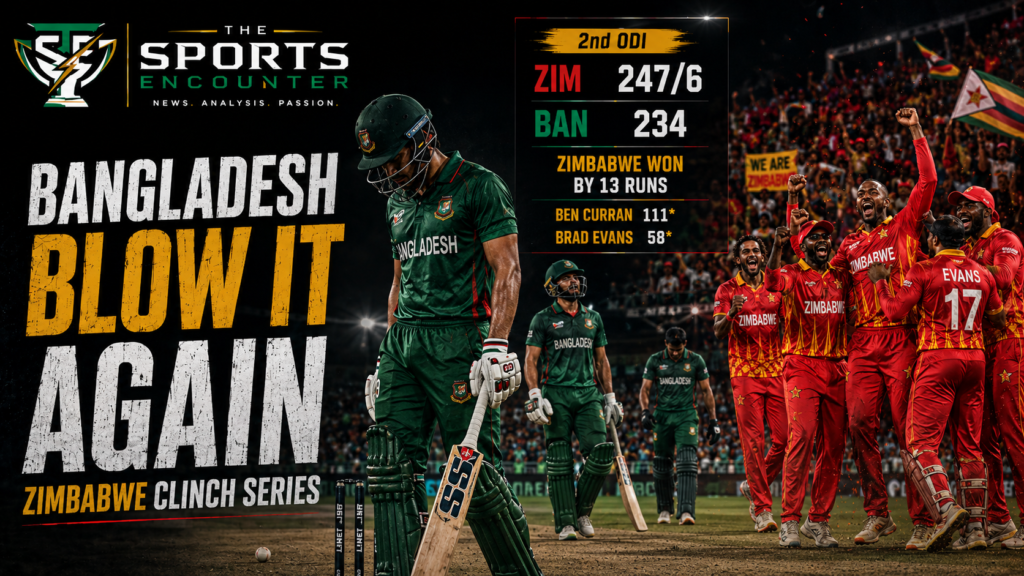
Ben Curran’s unbeaten hundred and Brad Evans’ all-round impact helped Zimbabwe beat Bangladesh by 13 runs after another poor chase in Harare.
Bangladesh did not lose this match because the target was impossible. They lost it because the chase again became too heavy for their temperament.
At one stage in Harare, 248 looked manageable. Tanzid Hasan Tamim had given Bangladesh a base. Towhid Hridoy had settled in. Nurul Hasan had added urgency. The required rate was under control, and Zimbabwe were searching for one more opening.
Then Bangladesh opened the door themselves.
Wickets fell at the wrong time, poor choices returned, and another chase that should have been finished with calm turned into a familiar late-innings mess. Zimbabwe kept fighting, kept believing, and eventually turned a competitive total into a series-clinching 13-run victory.
For Zimbabwe, this was a statement. For Bangladesh, it was another warning sign.
You can follow more cricket coverage in our Cricket News section.
TL;DR
- Zimbabwe beat Bangladesh by 13 runs in the 2nd ODI at Harare Sports Club.
- Ben Curran carried Zimbabwe with an unbeaten 111 from 135 balls.
- Brad Evans changed the innings with 58 not out from 38 balls, then took 2 wickets.
- Bangladesh were well placed during the chase but collapsed from 207 for 5 to 234 all out.
- Zimbabwe won the series 2-0 with one ODI still to play.
- Bangladesh’s repeated failure under chase pressure has become the biggest story of the series.
Scorecard / Key Information Box
| Detail | Information |
|---|---|
| Match | Zimbabwe vs Bangladesh, 2nd ODI |
| Result | Zimbabwe won by 13 runs |
| Venue | Harare Sports Club, Harare |
| Date | July 9, 2026 |
| Zimbabwe | 247/6 in 50 overs |
| Bangladesh | 234 all out in 48.1 overs |
| Top Performer | Ben Curran, 111 not out from 135 balls |
| Key Support | Brad Evans, 58 not out from 38 balls and 2 for 48 |
| Turning Point | Bangladesh losing Nurul Hasan at 207 for 6, then collapsing under late pressure |
| What It Means | Zimbabwe sealed the ODI series 2-0 with one match remaining |
Ben Curran Carries Zimbabwe After Early Trouble
Bangladesh had good reason to feel satisfied after choosing to bowl first.
Taskin Ahmed struck twice inside the first three overs, removing Brian Bennett for a duck and Innocent Kaia for 4. Zimbabwe were 8 for 2, then 32 for 3 when Nahid Rana bowled Craig Ervine. At that stage, Bangladesh had the game moving in the direction they wanted.
The bowlers were disciplined enough to keep Zimbabwe under 250. Taskin finished with 2 for 57, Nahid Rana took 1 for 48, Mehidy Hasan Miraz returned a controlled 2 for 32, and Rishad Hossain picked up one wicket. Zimbabwe were never allowed to explode through the middle overs.
Yet Bangladesh could not remove Ben Curran.
Curran’s unbeaten 111 from 135 balls was not a reckless hundred. It was a patient, intelligent innings built around survival, tempo, and responsibility. Zimbabwe needed someone to bat deep after losing early wickets, and Curran accepted the role without chasing style points.
He added 68 with Sikandar Raza, who made 33 from 53 balls, and then found the perfect late-innings partner in Brad Evans. By the end, Curran had turned Zimbabwe’s innings from fragile to competitive.
For a team defending a series lead, that kind of innings carries more value than the strike rate alone suggests.
Brad Evans Changes the Shape of the Match
Zimbabwe were 148 for 6 in the 37th over when Brad Evans joined Curran.
Bangladesh should have closed the innings down from there. Instead, Evans shifted the pressure back.
His unbeaten 58 from 38 balls gave Zimbabwe the late acceleration they badly needed. He struck two fours and five sixes, taking advantage of anything loose and forcing Bangladesh to defend rather than attack. The unbroken 99-run stand between Curran and Evans turned 200 into 247 and gave Zimbabwe’s bowlers a total they could defend.
That partnership became the difference between a below-par score and a fighting score.
Zimbabwe still finished under 250, which means Bangladesh’s bowlers had done a lot right. But in ODI cricket, the last 10 overs often decide the emotional direction of the chase before it even starts. Bangladesh allowed Evans to give Zimbabwe belief.
That belief carried into the second innings.
For more context on how late lower-order runs can reshape a limited-overs match, read our recent report on Zimbabwe defending 141 after Nahid Rana’s six-wicket spell.
Bangladesh Had the Chase Under Control, Then Lost It
Bangladesh’s chase did not begin perfectly.
Soumya Sarkar fell for 5, and Najmul Hossain Shanto made only 9. At 38 for 2, Zimbabwe had early pressure. But Tanzid Hasan Tamim and Towhid Hridoy rebuilt the innings with an 84-run stand, giving Bangladesh a clear route toward the target.
Tanzid made 57 from 70 balls. Hridoy followed with 60 from 90. Both innings had value because they took Bangladesh close to the point where the chase should have become simple.
That is what makes the defeat harder to accept.
Bangladesh were 122 for 3 when Tanzid fell. They were 169 for 4 when Hridoy was dismissed. Even at 207 for 6 after Nurul Hasan’s wicket, the chase was still within reach. Bangladesh needed 41 from 48 balls with four wickets in hand.
A mature ODI side finishes that match.
Bangladesh did not.
Rishad Hossain fell for 8. Taskin Ahmed was out for 0. Shoriful Islam was bowled by Evans for 6. Mehidy Hasan Miraz, left with the responsibility of finishing the chase, was caught off Richard Ngarava for 27 as Bangladesh were bowled out for 234.
This was less about Zimbabwe finding magic and more about Bangladesh gifting the match away under pressure.
Zimbabwe’s Bowlers Were Disciplined, Patient, and Mature
Zimbabwe’s bowling effort deserves serious credit.
They did not panic when Bangladesh had partnerships. They did not scatter the field too early. They kept asking batters to make decisions, and Bangladesh kept making the wrong ones.
Richard Ngarava led the attack with 3 for 55 and took the final wicket. Blessing Muzarabani’s 2 for 33 from 10 overs was arguably just as important because he controlled the chase from the top. Evans backed up his batting with 2 for 48, while Sikandar Raza, Brian Bennett, and Wessly Madhevere each found key breakthroughs.
Bennett’s wicket of Tanzid was especially important because it broke the stand that had given Bangladesh control. Madhevere’s dismissal of Hridoy was another turning point. Ngarava’s removal of Nurul Hasan pushed the game toward Zimbabwe again.
This was mature defensive bowling. Zimbabwe did not bowl like a team hoping Bangladesh would collapse. They bowled like a team that believed pressure could be built one over at a time.
The result proves they were right.
Bangladesh’s Batting Problem Is Now a Pattern
One poor chase can be dismissed as a bad day. Two in a row begins to look like a pattern.
Bangladesh failed to chase 142 in the first ODI. They then failed to chase 248 in the second. The targets were different, but the problem looked familiar: batters getting starts, losing control, and leaving too much emotional weight for the lower order.
There is enough skill in this batting lineup. Tanzid made a half-century. Hridoy made a fighting 60. Nurul’s 38 from 41 kept the chase alive. Mehidy showed enough calm to keep Bangladesh interested late.
But the collective game sense was not strong enough.
Bangladesh batters continued to give wickets away when the situation called for restraint. Several dismissals came at points where the only real demand was to stay in the match. Zimbabwe were disciplined, but Bangladesh helped them too often.
This is where Bangladesh need a more honest review. The issue is not only shot selection. It is chase structure, match awareness, and responsibility under pressure.
A similar discussion has surrounded other recent batting collapses in international cricket, including India’s poor decision-making in their heavy T20I defeat against England.
Zimbabwe’s Series Win Feels Bigger Than the Margin
Zimbabwe have now won the series with one match to spare.
That matters because both wins came from pressure positions. In the first ODI, they defended 141 after being bowled out cheaply. In the second, they recovered from 148 for 6, posted 247, then defended it after Bangladesh seemed well placed.
This is how teams build belief.
Sikandar Raza summed up the change in Zimbabwe’s mindset after the match, saying the team now believes it can win from any position. That line fits what has happened in this series. Zimbabwe have been tested twice and have refused to go away twice.
For Bangladesh, the third ODI is no longer only about avoiding a clean sweep. It is about restoring some confidence in a batting unit that looks increasingly unsure when chasing.
For Zimbabwe, the final match is a chance to turn a series win into a stronger message about direction, character, and home advantage.
You can also read our cricket features on Kapil Dev’s lasting influence on Indian cricket, Babar Azam’s return as Pakistan Test captain, and how Bazball changed and exposed England.
For official international cricket rankings and fixtures context, visit the ICC’s official ODI rankings page.
Final Word
Zimbabwe won this ODI because they stayed in the contest longer than Bangladesh.
Ben Curran gave them the innings. Brad Evans gave them the surge. Ngarava, Muzarabani, Evans, Raza, Bennett, and Madhevere gave them the wickets. The crowd gave them energy. The result gave them the series.
Bangladesh, meanwhile, will leave Harare with a familiar frustration. Their bowlers kept Zimbabwe under 250. Their batters built enough of a platform. The match was there to be won.
Then pressure arrived, and Bangladesh folded again.
That is the real story of the 2nd ODI. Zimbabwe did not need Bangladesh to be terrible for 100 overs. They only needed them to lose discipline for one decisive stretch.
Bangladesh obliged.

Breaking News
Spain vs Belgium: La Roja’s Control Meets Belgium’s Knockout Fire
Spain bring control, form, and defensive authority into their World Cup quarterfinal against Belgium, but De Ketelaere, Courtois, and Belgian belief make this a dangerous test.
The question around Spain has changed.
Earlier in the FIFA World Cup 2026, it was about whether La Roja had enough edge to survive the knockout pressure. Now, after eliminating Portugal with a stoppage-time winner, the question is sharper: can Spain turn control into a semifinal place against a Belgium side that suddenly looks dangerous again?
This second quarterfinal at Los Angeles Stadium brings two very different forms of momentum. Spain arrive with structure, patience, pressing discipline, and the confidence of a team that has learned how to win tight games. Belgium arrive with release, attacking belief, and the emotional lift of a 4-1 Round of 16 statement against the United States.
For full tournament coverage, follow The Sports Encounter’s FIFA World Cup 2026 hub.
TL;DR
- Spain face Belgium in the FIFA World Cup 2026 quarterfinal at Los Angeles Stadium on July 10.
- Spain reached this stage after beating Portugal 1-0 through a late Mikel Merino goal.
- Belgium stormed past the United States 4-1 in the Round of 16, with Charles De Ketelaere producing a breakout knockout display.
- Spain appear in better overall shape because of their balance, unbeaten rhythm, and defensive control.
- Belgium have momentum too, but their defense must solve the biggest question of the match: how to contain Lamine Yamal.
- The winner moves into the semifinal and stays alive in a tournament where Europe’s heavyweights have begun to separate themselves.
Key Information Box
| Detail | Information |
|---|---|
| Match | Spain vs Belgium |
| Competition | FIFA World Cup 2026 Quarterfinal |
| Venue | Los Angeles Stadium, Inglewood |
| Date | July 10, 2026 |
| Kickoff | 19:00 GMT |
| Referee | Michael Oliver |
| Spain Round of 16 Result | Spain 1-0 Portugal |
| Belgium Round of 16 Result | Belgium 4-1 United States |
| Main Duel | Lamine Yamal vs Belgium defense |
| Head-to-Head | 22 meetings: Spain 12 wins, Belgium 5 wins, 5 draws |
| What It Means | Winner advances to the FIFA World Cup 2026 semifinal |
Spain Arrive With Control, But Also a New Kind of Edge
Spain have carried one of the cleanest tournament profiles into the quarterfinals.
They have not always overwhelmed opponents with chaos or constant goal rushes. Their strength has been more measured: ball control, positional discipline, technical security, and a midfield that can suffocate rhythm before the opposition finds comfort.
The 3-0 win over Austria in the Round of 32 showed Spain’s sharper side. Mikel Oyarzabal scored twice, Pedro Porro added another, and Lamine Yamal stretched Austria’s defensive shape with his movement and timing. That performance, covered in The Sports Encounter’s report on Spain’s commanding Austria win, gave La Roja the attacking authority they needed after earlier questions about whether they could turn possession into punishment.
Then came Portugal.
Spain’s 1-0 Round of 16 win was a different type of proof. They did not need a perfect attacking display. They needed patience, control, nerve, and a late killer moment. Mikel Merino’s stoppage-time winner ended Portugal’s World Cup and likely closed Cristiano Ronaldo’s World Cup story. More importantly for Spain, it confirmed that this team can win a knockout match when the rhythm becomes uncomfortable.
That is why Spain come into this quarterfinal in better overall shape. They have control when the game is open, discipline when the game is tight, and enough bench depth to change the mood late. Their tournament has built layer by layer.
Read more on that emotional knockout night in The Sports Encounter’s report: Spain End Ronaldo’s World Cup Dream With Brutal Late Winner.
Belgium’s Tournament Has Been Messier, But the Belief Is Back
Belgium’s path has been less smooth.
Their group-stage campaign had warning signs. Draws against Egypt and Iran raised questions about tempo, creativity, and whether this version of Belgium still had enough sharpness to go deep. The 5-1 win over New Zealand helped reset the mood, but it did not fully erase the feeling that Belgium were still searching for their best version.
The Round of 16 changed that conversation.
Belgium’s 4-1 win over the United States was their most convincing performance of the tournament. Charles De Ketelaere delivered the kind of display that can change how opponents prepare. His brace gave Belgium a younger attacking reference point beyond the familiar names, while Thibaut Courtois, Kevin De Bruyne, and Romelu Lukaku still give the squad high-level experience around pressure moments.
The win also carried political and emotional noise after the buildup around Folarin Balogun’s availability, which The Sports Encounter covered in its analysis of USA vs Belgium becoming a major World Cup rules debate. Belgium handled that distraction well. Once the match started, they looked sharper, stronger, and far more ruthless than they had earlier in the tournament.
Their 4-1 win also ended the host nation’s run and gave Belgium genuine momentum before facing Spain. The Sports Encounter’s match report on USA’s World Cup dream ending against Belgium remains the key internal reference for that performance.
Which Team Is in Better Shape?
Spain are in better shape overall.
That does not make this match simple. Belgium have the individual quality to hurt any team left in the competition. Courtois can keep them alive. De Bruyne can still find passes that bypass structure. Lukaku can create physical problems late. De Ketelaere now gives Belgium a forward runner with confidence and form.
Still, Spain look more complete.
Their midfield has more control. Their defensive structure has been more reliable. Their wide threat is more consistent. Their unbeaten rhythm under Luis de la Fuente gives them the feel of a team that trusts its own mechanisms rather than waiting for individual rescue acts.
Belgium’s momentum is real, but Spain’s momentum feels more stable.
There is also one selection concern for Belgium. Amadou Onana’s injury removes a major midfield presence, which matters against a Spain side that wants to dominate central zones and force opponents to defend for long spells. Without him, Belgium may need extra defensive discipline from their midfield line and cleaner decision-making when they recover the ball.
Lamine Yamal vs Belgium’s Defense Could Decide the Match
Belgium’s defensive plan begins with Lamine Yamal.
Yamal has already become one of the defining young faces of this World Cup. His threat is not only about dribbling. He changes the geometry of Spain’s attack. When he receives wide, defenders hesitate. When he comes inside, midfielders are forced to decide whether to step out or protect the half-space. That hesitation creates Spain’s rhythm.
Belgium cannot defend him with one player alone.
If the fullback jumps too early, Yamal can slip passes inside or attack the outside shoulder. If Belgium double him too aggressively, Spain can switch play and find space on the far side. If they sit too deep, Spain can keep recycling possession until Rodri and the midfield begin to dictate every angle.
Belgium’s best answer may be controlled aggression. They need to reduce Yamal’s first touch comfort, block his inside passing lanes, and make him defend as much as possible by attacking Spain’s right side when possession turns over.
That is easier to say than to execute.
Yamal’s biggest weapon is calm. He rarely looks rushed. Belgium must avoid the mistake of turning this into a personal duel driven by emotion. The smarter plan is collective: pressure the passer, cover the inside lane, delay the dribble, and avoid cheap fouls near the box.
Spain’s Midfield Control vs Belgium’s Vertical Threat
Spain will likely try to make the match feel slow before making it suddenly fast.
That pattern suits them. Rodri’s presence gives Spain control over second balls and tempo. Pedri, Gavi, Merino, or whichever midfield combination de la Fuente chooses can keep Belgium moving side to side. The aim will be to tire Belgium’s midfield line, pull defenders out of shape, and let Yamal or Nico Williams attack when the space appears.
Belgium will want the opposite.
They need the game to open in moments. Their best chance may come from transitions, quick vertical passes, and early service before Spain’s rest defense settles. De Ketelaere’s confidence after the USA match makes him important here. He can run into gaps, receive between lines, and force Spain’s center backs to make decisions facing their own goal.
De Bruyne’s role could be decisive, even if he is managed carefully. If he gets time to lift his head, Belgium can turn one recovery into a scoring chance. Spain will know that. Cutting off his first forward option may be as important as pressing him directly.
Head-to-Head: Spain Hold the Historical Edge
Spain and Belgium have met 22 times in senior men’s international football.
Spain lead the head-to-head record with 12 wins, while Belgium have won five. Five matches have ended in draws. That history gives Spain the statistical edge, but knockout football rarely follows old records cleanly.
The more relevant pattern is recent competitive identity.
Spain have rebuilt themselves into a cohesive tournament team. Belgium, after years of carrying the “golden generation” label, now look like a side trying to blend old leadership with newer attacking energy. This quarterfinal will test whether Belgium’s reboot has enough substance to survive against one of the most structured teams in the tournament.
Tactical Keys to the Match
| Tactical Area | Spain Need | Belgium Need |
| Wide Play | Isolate Yamal and Williams in advanced zones | Stop first-touch comfort and protect half-spaces |
| Midfield Battle | Control tempo through Rodri and quick passing triangles | Survive without Onana and break pressure cleanly |
| Transitions | Stop De Ketelaere and De Bruyne early | Attack before Spain settle defensively |
| Set Pieces | Avoid needless fouls around the box | Use size and delivery to disrupt Spain’s control |
| Bench Impact | Repeat the late-match influence shown against Portugal | Use Lukaku, De Bruyne, or fresh runners at the right moment |
What Spain Must Avoid
Spain must avoid turning control into comfort.
That has been a familiar danger for possession-heavy teams at World Cups. They can dominate the ball, push the opponent back, and still leave themselves exposed to one transition. Belgium have enough quality to punish that.
La Roja also need patience with purpose. Passing for control is useful only if it moves Belgium’s defensive block. If Spain become too slow, Belgium will settle into a compact shape and wait for counters.
The best version of Spain moves the ball quickly enough to shift the opponent, then accelerates through Yamal, Williams, Oyarzabal, or late midfield runners. That version can make Belgium defend too many zones at once.
What Belgium Must Do to Upset Spain
Belgium need courage, but reckless pressing would be dangerous.
They should pick pressing moments carefully, especially after backward passes or heavy touches. Spain are too comfortable technically to be chased blindly. Belgium must also protect the central spaces in front of their back line because that is where Spain can turn possession into control and control into chances.
Courtois will matter. His experience in Spanish football gives him insight into many of Spain’s players, but this match will still demand concentration for long stretches. Against Spain, goalkeepers can go quiet for 20 minutes and then suddenly face a decisive chance.
Belgium’s attacking players must also be efficient. They may not get many clear openings. When De Ketelaere, Lukaku, or De Bruyne see one, they have to make Spain feel the risk of pushing high.
Prediction: Spain Have the Edge, But Belgium Have the Punch
Spain should enter the FIFA World Cup 2026 quarterfinal as favorites.
They have the stronger tournament body of work, the cleaner tactical identity, and the better balance between control and threat. Their late win over Portugal showed they can carry pressure without panic. Their earlier win over Austria showed they can open up a knockout opponent when the attack clicks.
Belgium, though, are dangerous because they arrive with their best performance behind them. A 4-1 win over the United States gave them belief, goals, and a new attacking headline through De Ketelaere. If they score first, this match could become uncomfortable for Spain very quickly.
Still, the safer read is Spain by a narrow margin.
They look more stable. They have more ways to control the game. And if Lamine Yamal finds enough space against Belgium’s defense, La Roja may have the one player who can tilt a tight quarterfinal before Belgium’s veterans get their chance to rescue it.
For more knockout-stage context, read The Sports Encounter’s Round of 16 preview and the latest Soccer coverage.
Breaking News
India’s T20I Problems Deepen as England Seal Ruthless Nine-Wicket Win
England humiliated India again in the 4th T20I at Bristol, chasing 159 in just 13.5 overs after another fragile Indian batting display. Harry Brook and Phil Salt exposed India’s bowling and selection concerns with a ruthless nine-wicket win.
India needed a response. They gave England a record chase instead.
After the 125-run defeat at Trent Bridge had already exposed India’s confused T20I direction, Bristol made the damage feel deeper. India won the toss, chose to bat, reached only 158-7, and then watched England race to 159-1 in just 13.5 overs.
It was England’s fastest successful T20I chase with a target of 150 or more. It also sealed a 3-0 lead in the five-match series, giving England their first T20I series triumph over India in the format and leaving India with back-to-back T20I series defeats for the first time since 2018-19.
Harry Brook, leading England, demolished the Indian attack with an unbeaten 79 off 35 balls. Phil Salt continued his excellent series with another half-century, finishing 59 not out from 42 deliveries. Together, they added an unbeaten 146-run stand after Jos Buttler fell early.
For England, this was control, clarity, and confidence.
For India, it was another difficult night in a series that is quickly becoming a deeper audit of selection, batting maturity, and the team’s ability to handle overseas T20 conditions.
For more cricket coverage and match analysis, follow The Sports Encounter’s Cricket Hub.
England vs India 4th T20I: Match Summary
| Detail | Information |
|---|---|
| Match | England vs India, 4th T20I |
| Venue | County Ground, Bristol |
| Date | July 9, 2026 |
| Toss | India won the toss and chose to bat |
| India | 158-7 in 20 overs |
| England | 159-1 in 13.5 overs |
| Result | England won by 9 wickets |
| Series Situation | England lead 3-0 in the five-match series |
| Top India Batter | Shreyas Iyer 80* off 49 |
| Top England Batters | Harry Brook 79* off 35, Phil Salt 59* off 42 |
| Best England Bowlers | Jofra Archer 2-20, Josh Tongue 2-36 |
| Major England Record | England’s fastest successful chase with a target of 150 or more |
| India Concern | First back-to-back T20I series defeats since 2018-19 |
| Series Milestone | England’s first T20I series triumph over India |
| Turning Point | India slipped to 48-3 inside seven overs |
India’s Batting Fails Again Under Real Pace and Bounce
India’s total was built almost entirely around Shreyas Iyer.
The Indian captain played a fighting unbeaten 80 from 49 balls, striking four fours and five sixes. He gave India some respectability, especially after another weak start left the innings wobbling early. Without him, India’s scorecard would have looked far worse.
The problem was everything around him.
Vaibhav Sooryavanshi made 15 off 10. Abhishek Sharma scored 16 off 14. Ishan Kishan managed only 4. By 6.4 overs, India were 48-3, and the innings had already lost shape.
This was not simply a bad start. It was another reminder that India’s young top order is struggling to adjust when the ball moves, climbs, and forces better shot selection. In Indian conditions, short boundaries and flatter surfaces can sometimes protect loose batting. In England, the margin is smaller. The ball can swing. The bounce can rush batters. The square boundaries can turn hopeful strokes into catching practice.
That is where India looked underprepared again.
The approach from Vaibhav Sooryavanshi will now attract serious debate. He is young, gifted, and fearless, but fearlessness without control can become a liability at international level. India may believe they are investing in the future, but the question is whether this stage has come too early for him.
There is a difference between backing youth and exposing youth before the player has enough tools for hostile conditions.
Sanju Samson Question Returns After Another Top-Order Failure
The continued absence of Sanju Samson will only add more noise around India’s selection calls.
Samson was once again on the bench while India’s top order failed to give the innings any stability. The debate is bigger than one player now. It is about whether India are selecting for reputation, projection, or actual match requirements.
Samson brings experience, international exposure, wicketkeeping depth, and a more developed understanding of tempo. After another top-order failure, India’s decision to keep him out will be questioned by fans and analysts who believe the team needs maturity more than experimentation.
This is not about blaming one young opener or presenting Samson as a magical fix. It is about balance.
India’s T20I lineup currently looks talented, but fragile. Too many players appear to be batting in the same emotional gear. Too many shots look pre-decided. Too many collapses are being explained as part of a transition when they may actually be signs of poor role clarity.
India had already suffered a brutal collapse in the previous match, when England beat them by 125 runs at Trent Bridge. That result was covered in The Sports Encounter’s report on India’s worst T20I defeat by runs. Bristol did not bring the same numerical embarrassment, but it deepened the same cricketing concern.
Archer and Tongue Keep India Under Pressure
England’s bowling was disciplined without needing to be spectacular for all 20 overs.
Jofra Archer set the tone with 2-20 from four overs. He removed Vaibhav Sooryavanshi and later dismissed Washington Sundar, while also contributing to Axar Patel’s run out at the end of India’s innings.
Josh Tongue continued his strong series, taking 2-36. He dismissed Ishan Kishan and Tilak Varma, keeping India from building momentum around Shreyas Iyer.
Will Jacks also played an important holding role with 1-28 from four overs. Sam Curran went wicketless but gave away only 24 from his four overs, helping England squeeze India through the middle and late phases.
India’s 158 looked below par when the innings ended. It looked much smaller once England started batting.
Brook Breaks the Chase Open
England lost Jos Buttler for 8 at 13-1, but that was the only real moment India had.
Harry Brook came in and immediately changed the mood of the chase. His unbeaten 79 from 35 balls included eight fours and four sixes. It was not a captain’s knock in the old cautious sense. It was a captain taking the game away before India could even imagine pressure.
Brook’s hitting exposed India’s lack of control with the ball. Prince Yadav, Axar Patel, Washington Sundar, Shivam Dube, and Prasidh Krishna all struggled to contain England’s scoring rate. India did not build pressure from either end, and once Brook found rhythm, the chase became a procession.
England reached 62-1 in the power play. By the 10th over, the result was almost settled. Brook and Salt did not need risk management. They had enough time, enough wickets, and enough loose bowling to turn the chase into another statement.
This was England’s T20 cricket at its cleanest: aggressive without panic, ruthless without clutter.
Phil Salt Keeps Punishing India
Phil Salt’s 59 not out continued his excellent run in the series.
After scoring 70 in the previous T20I, Salt produced another controlled half-century. He was slightly quieter than Brook in Bristol, but that almost made the partnership more damaging for India. Brook attacked violently. Salt kept the chase moving, punished width, and ensured England never lost tempo.
Salt’s form has become one of the defining stories of the series. He has given England the kind of top-order certainty India currently lack. Where India are searching for the right balance, England look increasingly comfortable with their roles.
The contrast is uncomfortable for India.
Salt knows his job. Brook knows his job. England’s middle order has clarity behind them. India, at the moment, look like a team trying to force a future without enough present-day stability.
What This Defeat Says About India
This defeat should worry India for more than the result.
They were outplayed in skill, execution, and decision-making. Their batting lacked adaptability. Their bowling lacked discipline. Their selection continues to invite difficult questions.
The biggest concern is the repeated pattern. India’s openers are not giving starts. The middle order is repeatedly walking in under pressure. Shreyas Iyer’s 80* was valuable, but one strong innings cannot hide a top-order system that keeps failing.
Overseas T20 cricket demands more than hitting range. It demands judgment. It demands game awareness. It demands batters who can understand when to attack, when to absorb, and when conditions require a different tempo.
India’s young batters are learning those lessons in public. That can be useful in the long term, but it can also damage confidence if the structure around them is poor.
The same concern appeared during India’s recent T20I struggles in Ireland, where The Sports Encounter covered Ireland’s historic clean sweep over India. This is no longer a one-match problem. It is becoming a pattern.
England Look Settled, India Look Exposed
England have turned this series into a clear message about their white-ball direction.
Brook’s captaincy has looked confident. Salt has been in excellent touch. Archer and Tongue have given them power-play bite. Curran, Jacks, and Rashid have offered control, variation, and tactical flexibility.
India, meanwhile, look caught between rebuilding and reacting.
They are backing young players, but without enough protection. They are keeping experienced options on the bench, but without proving the alternatives are ready. They are trying to play modern T20 cricket, but too often it looks like impatient batting rather than high-quality aggression.
The margin carried more than scoreboard damage.
England went 3-0 up in a five-match series, secured their first T20I series triumph over India, and completed their fastest successful chase with a target of 150 or more. For a side that has often been judged against India’s white-ball depth, this was a serious statement.
India’s problem is now impossible to dress up as one bad night. They have lost back-to-back T20I series for the first time since 2018-19, and the pattern is becoming uncomfortable: weak starts, loose shot selection, unstable selection calls, and a young batting group still searching for answers outside familiar home conditions.
Bristol did not simply give England another win.
It gave India another warning.
Breaking News
England Face Defensive Blow Before Norway Quarterfinal Clash
Jarell Quansah’s two-match FIFA suspension has handed England a major defensive setback before their World Cup 2026 quarterfinal against Norway, forcing Thomas Tuchel to rethink his back line against Erling Haaland and Martin Ødegaard.
England’s formidable defense received a major blow on Thursday ahead of their last-eight clash of the FIFA World Cup 2026 against Norway, as FIFA handed a two-match suspension to Jarell Quansah, The Sports Encounter has learnt.
The decision means Quansah will miss England’s quarterfinal against Norway and would also be unavailable for the semifinal if Thomas Tuchel’s side extend their World Cup run. The defender would only be eligible to return if England reach either the final or the third-place playoff.
It is a costly punishment at a difficult moment for England. They survived a furious Round of 16 battle against Mexico, winning 3-2 despite playing the final stretch with 10 men after Quansah’s red card. That victory sent England into the quarterfinals, but it also left Tuchel with another defensive problem before facing one of the most dangerous attacking teams left in the tournament.
According to the official FIFA World Cup 2026 match schedule, England’s quarterfinal against Norway is part of the last-eight stage, with the winner moving one step closer to the semifinal. That is why Quansah’s suspension now carries far more weight than a normal one-match absence.
Why Was Jarell Quansah Suspended for Two Matches?
Quansah was sent off in the second half against Mexico after a VAR review upgraded his challenge to a red-card offense. The incident immediately changed the shape of the match. England had to protect their lead with one fewer player, adjust their defensive line, and sacrifice attacking balance to survive Mexico’s late pressure.
The challenge divided opinion because Quansah appeared to make contact with the ball, but the follow-through, body momentum, and contact with the opponent’s leg made the incident serious enough for the referee to change the original decision after the video review.
A normal red card usually brings an automatic one-match suspension. FIFA, however, can extend the punishment depending on the nature of the offense. The FIFA Disciplinary Code, available through FIFA’s official legal documents section, allows stronger sanctions for serious foul play.
That is the important detail behind this ruling. FIFA did not treat Quansah’s red card as a routine dismissal. The governing body appears to have classified the challenge as serious foul play, which raises the punishment and removes him from England’s plans for more than one knockout match.
What Matches Will Quansah Miss?
| Match | Quansah Status |
|---|---|
| England vs Norway, Quarterfinal | Suspended |
| Potential Semifinal | Suspended |
| Final or Third-Place Playoff | Eligible to return |
The suspension changes the stakes for England. A one-match ban would have kept Quansah out of only the Norway quarterfinal. A two-match ban means England must now plan for two major knockout games without one of their defensive options.
That matters because knockout football rarely gives teams clean conditions. Injuries, suspensions, yellow-card management, extra time, and tactical matchups all shape selection. England already had a physically demanding battle against Mexico. Now they face Norway with less defensive flexibility and a clear need to protect the spaces where Quansah might have helped.
How This Affects England Against Norway
England’s quarterfinal against Norway was already a difficult tactical assignment. FIFA’s official Norway vs England preview frames the tie as one of the major last-eight battles of the tournament, with Norway chasing a historic semifinal and England trying to return to the final four.
Norway’s attacking threat will force England into one of their toughest defensive tests of the tournament. Erling Haaland’s presence changes how England defend crosses, second balls, transitions, and direct passes behind the line. Martin Ødegaard gives Norway control between midfield and attack, while their wide players can stretch the pitch and create space for early service into dangerous areas.
For readers tracking Haaland’s wider tournament and career profile, The Sports Encounter has already explored his records, scoring impact, and World Cup importance in this detailed feature on Erling Haaland records and World Cup career.
Quansah’s absence does not simply remove one defender from the squad sheet. It reduces England’s ability to rotate, adjust, and respond during the match. Against Mexico, his red card forced Tuchel to make a quick tactical correction and protect the back line under pressure. That reshuffle worked on the night, but Norway will offer a different kind of test.
England will need strong positioning from their center backs, disciplined full-back defending, and midfield protection in front of the back four. If Reece James is not fully ready, the right side of England’s defense becomes even more important. That area was already under pressure after the Mexico game, and Norway will almost certainly test it.
England’s Defensive Depth Now Faces Its Biggest Test
England have been one of the tournament’s most resilient teams, but their route to the quarterfinal has not been smooth. They needed control against DR Congo, nerve against Mexico, and now require tactical maturity against Norway. The defense has often looked strong, but World Cup knockout football can expose even small weaknesses.

Quansah gave England useful coverage because he could help across defensive roles and allow Tuchel to manage different match situations. His suspension removes one layer from that structure. England may still have enough quality, but the margin for error has narrowed.
Tuchel’s biggest decision may now be whether to keep his defensive shape stable or make a specific adjustment for Haaland. England cannot afford to defend too deep for long periods because Norway have the aerial threat to punish passive defending. They also cannot push recklessly high, because one direct pass into space could turn the game.
That balance will define England’s quarterfinal. A clean defensive structure matters, but so does composure. England cannot let the frustration around Quansah’s ban distract them from the practical job: stopping Norway from turning direct attacks and set pieces into decisive moments.
Why the Red Card Debate Matters
The Quansah incident also feeds into a wider discussion around VAR, serious foul play, and how referees judge dangerous challenges in tournament football. Supporters often focus on whether a player touched the ball, but modern foul interpretation also looks at force, control, point of contact, and danger to an opponent.
That makes Quansah’s case relevant beyond England. It sits inside the broader debate around what counts as reckless or dangerous play, especially when VAR intervenes after the referee initially allows play to continue. The Sports Encounter has explained the basics of fouls, dangerous tackles, and referee decisions in this guide on what counts as a foul in soccer.
For England fans, the frustration is understandable. Quansah’s challenge happened in a fast knockout match, and the decision changed both the game and England’s squad situation. For FIFA, the disciplinary process appears to have followed the serious foul play route, which is why the punishment moved beyond a single match.
What England Must Fix Before Norway
England cannot allow the Quansah ruling to become a distraction. Norway will not care about disciplinary debates. They will look at England’s right side, England’s defensive communication, and England’s ability to handle Haaland under pressure.
Tuchel’s staff now have three urgent priorities.
First, England must settle the back line early. Constant reshuffling against a team with Haaland and Ødegaard could invite trouble.
Second, the midfield must protect central spaces. Norway are dangerous when they can play quickly into attacking runners or force defenders into isolated duels.
Third, England need discipline. After Quansah’s red card against Mexico, they cannot risk another careless challenge, especially against a team that can turn set pieces and transitions into decisive moments.
The quarterfinal will test England’s depth, but also their emotional control. Knockout games are often decided by players who stay calm when the match becomes messy.
Key Facts
| Detail | Information |
|---|---|
| Player | Jarell Quansah |
| Team | England |
| Offense | Red card against Mexico |
| Match | England 3-2 Mexico, Round of 16 |
| Suspension | Two matches |
| Immediate match missed | England vs Norway, Quarterfinal |
| Possible second match missed | Semifinal, if England qualify |
| Possible return | Final or third-place playoff |
Final Word
England reached the quarterfinals by surviving Mexico’s pressure, but the cost of that victory is now clear. Quansah’s red card has become a two-match suspension, and Tuchel must solve a defensive puzzle before facing Norway.
The timing could hardly be worse. Norway are confident, Haaland is dangerous, and England’s defense has lost one of its options before the biggest test of their tournament so far.
England still have the talent to cope. What they need now is clarity, discipline, and a defensive plan that can survive Norway’s power without turning the quarterfinal into another emergency.