Connect with us

Cricket

New Zealand Force Series Decider with a Crushing Win Over England in 2nd Test

New Zealand roared back into the Test series with a 253-run win over England at The Oval, powered by Matt Henry’s historic 11-wicket haul, centuries from Glenn Phillips and Henry Nicholls, and a ruthless final-day burst that has forced England to bring Ben Stokes back as captain for the Trent Bridge decider.

Luke Edelman The Sports Encounter

Published

on

New Zealand Force Series Decider with a Crushing Win Over England in 2nd Test

New Zealand did not just level the series at The Oval. They tore it open. After losing the first Test at Lord’s, the Blackcaps responded with a crushing 253-run win over England in the second Test in London, dragging the three-match series back to 1-1 and setting up a high-voltage decider at Trent Bridge.

Matt Henry was the headline act with the ball. Glenn Phillips and Henry Nicholls gave New Zealand the batting weight. Tom Blundell’s work behind the stumps quietly supported the entire plan. England, led by Joe Root in Ben Stokes’ absence, had moments of resistance but never enough control.

Now the final Test has a new edge.

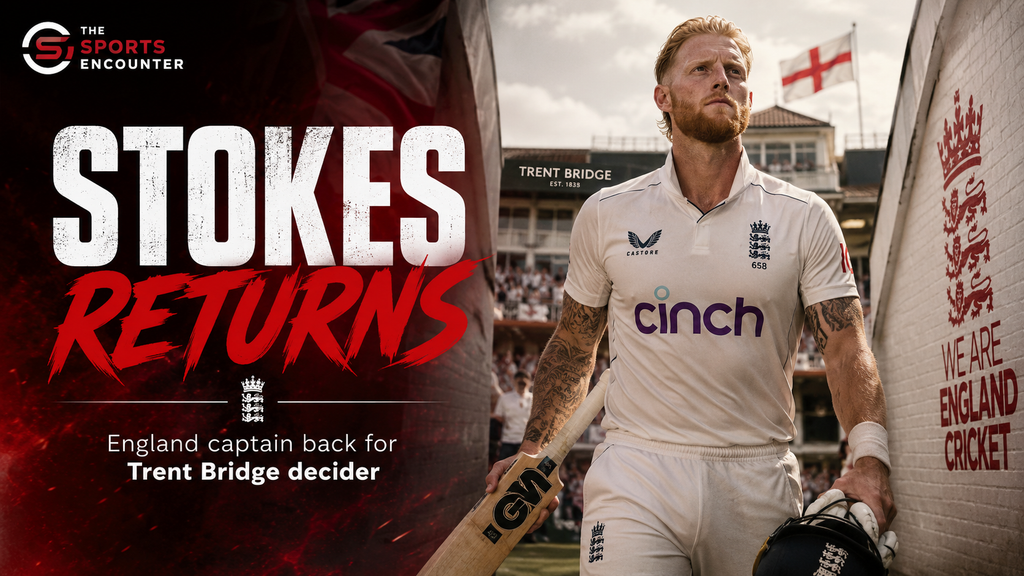
England coach Brendon McCullum has confirmed Stokes will return as captain for the third Test, saying, “Ben will be back and be captain.” He also said England were excited to have him back after speaking to him daily since the incident that led to his omission from The Oval Test.

That means the series now moves to Nottingham with New Zealand carrying momentum and England preparing to welcome back their most influential figure.

For more cricket coverage, match reports, and long-form analysis, follow The Sports Encounter’s Cricket Hub.

New Zealand Turn The Oval Into a Series-Shaping Statement

New Zealand came to The Oval knowing the series could slip away if England backed up their Lord’s win. Instead, the Blackcaps produced one of their finest Test victories on English soil.

England were bowled out for 209 on the final morning while chasing 463. New Zealand needed only 48 minutes on Day 5 to take the last five wickets, turning what had begun as a faint English hope into a fast and brutal finish.

The 253-run margin was New Zealand’s largest Test victory over England by runs in England. It was also only their seventh Test win in England across 95 years, making the scale of the result even more meaningful.

Tom Latham called it “a fantastic week” for his side and framed the victory as a match won through repeated small moments. He pointed to New Zealand’s ability to do things “for a bit longer,” whether that meant batting through difficult passages or bowling relentlessly at the top of off stump.

That was the essence of New Zealand’s win. They did not chase miracle moments. They kept asking England hard questions until England ran out of answers.

Matt Henry Delivers a Historic 11-Wicket Masterclass

Matt Henry’s match figures of 11/109 were the best by a New Zealand bowler against England in Test cricket. They also gave him his first 10-wicket match haul in 35 Tests.

His final-day spell was ruthless.

England resumed at 182/5, with Root still there on 75 and the game not alive exactly, but not fully dead either. Henry removed that last trace of English possibility almost immediately. Root added only two runs before falling lbw for 77, beaten between bat and pad.

Once Root went, the innings folded quickly.

Henry finished with 6/29 in the second innings after taking 5/80 in the first. His final wicket, Jordan Cox, sealed the result and sent New Zealand’s players into celebration. Henry walked off with the ball in his hand, just as he had done after the first innings.

After the match, Henry said he did not expect the final morning to unfold so quickly, joking that the short finish “saved a hot day in the field.” But beneath the modesty was a clear explanation of New Zealand’s method.

Henry spoke about being effective rather than looking like a hero. His plan was simple: create pressure when the surface was not offering much, hit the right areas, and trust the bowling group. He also credited Tom Blundell’s wicketkeeping up to the stumps, saying New Zealand could only use that tactic because they had someone so good behind the stumps.

Latham echoed the same point. He said Henry’s method was to hit the top of off stump repeatedly, build pressure through dot balls, and use the surface’s variable bounce. In Latham’s words, it was “old-school cricket.”

Phillips Takes the Body Blows, Then Takes Control

New Zealand’s win was not built by Henry alone.

Glenn Phillips changed the tone of the match with a first-innings century that required courage before elegance. On the opening evening, Jofra Archer produced a hostile spell and struck Phillips with real venom. England sensed an opening. Root later admitted that if England had taken Phillips’ wicket during that passage, the game might have looked very different.

Phillips survived.

The next morning, he turned survival into command and reached his maiden Test hundred. His 100 was also the first century of the series. It gave New Zealand a base from which their bowlers could attack.

Root gave Phillips credit after the match, saying his innings during Archer’s fiery spell was a lesson for England’s younger batters. The message was clear: recognize the danger, get through it, and then cash in when conditions ease.

That is exactly what Phillips did.

For New Zealand, it was the kind of innings that changes more than a scorecard. It gave the team belief after the Lord’s defeat and showed England that the Blackcaps would not be bullied out of the series.

Henry Nicholls and Rachin Ravindra Bat England Out of the Game

If Phillips gave New Zealand the first major push, Henry Nicholls made sure England could not climb back.

Nicholls scored 121 in the second innings, producing a calm and important hundred while filling a role made heavier by Kane Williamson’s retirement. His innings carried more than runs. It showed New Zealand still had middle-order resilience in a new era.

His 161-run partnership with Rachin Ravindra was one of the decisive passages of the match. England needed early wickets in New Zealand’s second innings to keep the chase within imagination. Nicholls and Ravindra removed that possibility.

By the time New Zealand set England 463, the target was almost beyond the limits of Test history. It was 45 runs more than the highest successful fourth-innings chase ever achieved in Test cricket.

England were not just chasing a match. They were chasing the impossible.

England’s Makeshift XI Was Exposed at the Worst Time

England’s team selection told part of the story before the match even began.

The hosts made five changes from the side that won at Lord’s. Four were enforced by a mix of curfew punishment, injury, and paternity leave. Three players debuted. Two others had only one Test cap each. Root returned as captain for the first time since 2022 and suddenly became the stabilizing figure in a side missing its usual spine.

Stokes and Gus Atkinson were left out after breaking the team’s midnight curfew while celebrating England’s Lord’s win. Jamie Smith was unavailable because of the birth of his second child. Ollie Robinson missed the match with knee soreness. The result was an England XI that looked callow when the pressure peaked.

Root admitted the buildup had been “unsettling,” although he said he enjoyed stepping back into the captaincy space and working with McCullum. He also praised the younger players for giving everything in difficult circumstances.

But he did not hide England’s failings.

Root said England needed to be “more switched on in the field,” adding that missing eight chances was always going to hurt. That line should sting. Against disciplined opponents, dropped chances are not small details. They are match-shaping errors.

Joe Root Resists, Reaches 14,000 Test Runs, But England Fall Short

Root was England’s strongest batting figure across the match, making 46 in the first innings and 77 in the second.

His second-innings resistance carried personal history as well. During the match, Root became only the second man to reach 14,000 Test runs. It was another marker in a remarkable career, but it came in a losing cause.

England needed Root to turn 77 into something monumental. Henry made sure that did not happen.

Root’s dismissal early on the final morning ended England’s final thread of hope. Once he was gone, the rest of the innings moved quickly. The lower order did not have the technique, time, or conditions to survive Henry’s accuracy.

Root’s captaincy record also moved to 27 wins and 27 losses in Tests. That symmetry will matter less than the bigger question England now face: how quickly can they reset before Trent Bridge?

Brendon McCullum Confirms Ben Stokes Will Return as Captain

The story now turns sharply toward Ben Stokes.

After The Oval defeat, Brendon McCullum confirmed Stokes will return for the third Test at Trent Bridge. His message was direct: “Ben will be back and be captain.”

McCullum said his view had not changed and revealed he had spoken to Stokes every day since the curfew incident. He said his initial concern was for Stokes personally and that seeing him return to cricket and enjoy himself again was “really positive.”

That matters because Stokes is more than England’s captain. He is the emotional center of this Test side. His presence changes the dressing room, the selection balance, and the energy of the contest.

Stokes has already warmed up with 95 for his county side, while Atkinson took four wickets and is also expected to return to the selection picture. Jamie Smith’s availability may also become important after debutant wicketkeeper James Rew conceded the most byes by an England keeper in 12 years.

The third Test will not simply be England versus New Zealand. It will also be a test of England’s ability to restore order after a chaotic week.
Brendon McCullum Confirms Ben Stokes Will Return as Captain

Why Stokes’ Return Changes the Decider

Stokes brings cricketing value, but his real influence is structural.

With Stokes back, England get their captain, an all-round option, a senior tactical voice, and a player who thrives in the exact kind of pressure Nottingham will bring. Even if his body is not always easy to manage, his presence gives England a harder edge.

New Zealand will know that too.

The Blackcaps dominated a weakened England side at The Oval, but Trent Bridge will likely bring a stronger, sharper opponent. Atkinson’s likely return strengthens the bowling group. Stokes’ return restores leadership. Jamie Smith, if available, improves the wicketkeeping and batting balance.

Still, New Zealand have earned the right to arrive in Nottingham with belief. Their bowlers have found rhythm. Phillips and Nicholls have hundreds behind them. Henry looks fit, hungry, and decisive.

The decider now has everything: a revived New Zealand, a wounded England, and the return of the juggernaut captain.

England vs New Zealad: 2nd Test Key Match Performers

Matt Henry: 11/109 in the match, including 6/29 in the second innings

Glenn Phillips: 100 in the first innings, his maiden Test century

Henry Nicholls: 121 in the second innings

Rachin Ravindra: Key 161-run partnership with Nicholls

Joe Root: 46 and 77, reached 14,000 Test runs

Jofra Archer: Five wickets in the match and a hostile first-innings spell

Matthew Fisher: Five wickets across both innings for England

Match Snapshot

Match: England vs New Zealand, 2nd Test

Venue: The Oval, London

Result: New Zealand won by 253 runs

Series: England and New Zealand level at 1-1

Player of the Match: Matt Henry

Decider: Third Test at Trent Bridge, Nottingham, starting Thursday, June 25

England vs New Zealand: What Comes Next at Trent Bridge?

The series now moves to Nottingham with both teams carrying very different emotions.

New Zealand will arrive with momentum and confidence. They have rediscovered their method after Lord’s and found a bowling performance that can travel. Their challenge will be backing it up on a short turnaround, especially with fast bowlers coming off a heavy workload.

England will arrive with reinforcements and pressure.

Trent Bridge has often been a happier hunting ground for England. But reputation will not fix missed chances, inconsistent fielding, and the instability caused by selection disruption. Stokes’ return gives England a lift, but it also raises expectations instantly.

The final Test now feels less like a routine decider and more like a stress test for two cricketing identities.

New Zealand have reminded everyone that they can still play tough, patient, old-school Test cricket. England now get their captain back and must prove that chaos has not cracked their method.

For another recent story about a team responding under pressure, read how Australia whitewashed Bangladesh in the T20I series as Mitchell Marsh joined the party.

Final Word: Time for New Zealand to Rejoice Victory

New Zealand’s win at The Oval was complete because it had layers.

Phillips absorbed hostility. Nicholls built authority. Ravindra supported the second-innings push. Blundell gave the bowlers options. Jamieson, O’Rourke and Smith kept pressure in rotation. Henry finished the job with a spell that entered New Zealand cricket history.

England had Root’s resistance, Archer’s bursts, and glimpses from a reshuffled side. But the missed chances, unstable buildup, and final-day collapse were too costly.

The series is level. The decider is set. Stokes is coming back.

That last line changes the temperature of everything.

Luke Edelman is a London-based sports psychologist covering cricket and tennis across Europe for The Sports Encounter. His work focuses on athlete mindset, pressure management, performance routines, confidence, recovery from setbacks, and the mental side of elite competition. Coverage areas: sports psychology, cricket, tennis, athlete performance, mental resilience, European sports, tournament pressure.

Breaking News

England Fall Apart at Trent Bridge as New Zealand Seal Historic Comeback and Stokes Era Ends in Defeat

New Zealand completed a memorable 2-1 Test series comeback against England at Trent Bridge, winning the third Test by 160 runs as Ben Stokes’ international career ended with a painful home defeat.

Hamad Hussain | The Sports Encounter

Published

on

England Fall Apart at Trent Bridge as New Zealand Seal Historic Comeback and Stokes Era Ends in Defeat

England needed one last act of control to send Ben Stokes into retirement with a series win. Instead, Trent Bridge gave English cricket a colder ending: another batting collapse, another failed chase, and a New Zealand side celebrating one of its finest away series victories.

New Zealand beat England by 160 runs in the third Test at Nottingham, closing the match on the final day and taking the three-match series 2-1. For England, the defeat hurt on several levels. It ended Stokes’ international career in loss, raised sharper questions about the team’s direction, and confirmed a second straight Test defeat after the heavy setback at The Oval.

For New Zealand, it became a series to remember. They lost the first Test at Lord’s by 115 runs, then fought back with a 253-run win at The Oval and a commanding finish at Trent Bridge. That kind of response, away from home, against an England side built on aggression and pressure, says plenty about the Blackcaps’ temperament.

For more cricket coverage and long-form match analysis, visit The Sports Encounter’s Cricket Hub.

Match Snapshot

DetailInformation
MatchEngland vs New Zealand, 3rd Test
VenueTrent Bridge, Nottingham
ResultNew Zealand won by 160 runs
Series ResultNew Zealand won 2-1
TargetEngland needed 373
England 2nd Innings212 all out
Player of the MatchDaryl Mitchell
Player of the SeriesNathan Smith

New Zealand Built the Win Before the Final Day

The final scoreline tells only part of the story. New Zealand’s win came from pressure built across five days, not one final burst.

After winning the toss and batting first, New Zealand made 438. Devon Conway’s 157 and Tom Latham’s 151 gave the visitors the kind of first-innings base that makes chasing a Test match feel heavy from the start. England did respond through Ben Duckett’s 113, Jacob Bethell’s 74, and Harry Brook’s 58, but 354 still left them 84 behind.

That deficit mattered.

New Zealand then stretched the game through Daryl Mitchell and Rachin Ravindra. Mitchell’s unbeaten 100 from 241 balls was patient, stubborn, and perfectly suited to the situation. Ravindra’s 94 added fluency and control. When New Zealand declared on 288 for 9, England were left chasing 373.

That target was not impossible in modern cricket. England have built part of their identity around daring fourth-innings chases. Yet this was never only about the number. It was about New Zealand forcing England to bat with judgment after four days of pressure.

England could not do it.

England’s Chase Lost Shape Too Early

England began the final day already damaged at 103 for 4. Stokes had made 30 from 20 balls in his final international innings, but his dismissal on the fourth evening removed the emotional center of the chase. Ben Duckett made 36, Harry Brook 21, and Jacob Bethell fell without scoring.

The fifth morning demanded calm. England gave New Zealand more openings.

Emilio Gay edged Nathan Smith early. Joe Root, England’s best chance of a stabilizing innings, fell for 18 after a brilliant Henry Nicholls run-out. From there, England’s hopes narrowed to resistance rather than victory.

Jamie Smith fought hard for 60 from 90 balls and shared a 75-run stand with Gus Atkinson, who made 19 from 70 balls. That partnership showed England could still survive when they respected the situation. The problem was that too much damage had already been done.

Mitchell Santner helped finish the job, Zak Foulkes took three wickets, and Nathan Smith again showed why he became one of the defining players of the series.

Why England Lost Two Tests in a Row

England’s defeats at The Oval and Trent Bridge came from different match situations, but the pattern looked familiar.

At The Oval, New Zealand punished them with Matt Henry’s 11-wicket masterclass, Glenn Phillips’ century, and a ruthless final-day finish. The Sports Encounter covered that series-turning result in detail here: New Zealand Force Series Decider with a Crushing Win Over England in 2nd Test.

At Trent Bridge, England had Stokes back, Jofra Archer in the wickets, and enough batting depth to compete. Yet they lost key sessions through poor decision-making.

Their top order played too loosely in the chase. Their first innings had promise but never fully erased New Zealand’s advantage. Their second innings lacked the discipline required for a 373 chase. England seemed caught between instinct and responsibility, especially when the target required phases of patience rather than constant momentum.

That is the deeper issue. England’s aggressive style works best when players understand when to attack and when to absorb pressure. In this match, New Zealand handled those moments better.

New Zealand’s Comeback Was Built on Depth

New Zealand’s series comeback deserves serious respect because it came under pressure and without a fully fit attack in the decider.

Matt Henry, the hero of The Oval with 11 wickets, missed the third Test because of a calf injury. Glenn Phillips, who scored a crucial hundred in the second Test, was also unavailable. For many teams, losing two match-winners before a decider in England would become a built-in excuse.

New Zealand turned it into proof of depth.

Nathan Smith, Zak Foulkes, Will O’Rourke, and Santner all gave captain Tom Latham control in different phases. O’Rourke’s injury during the final day made the task even harder, but New Zealand never let the match drift. Their fielding stayed sharp. Their bowling plans stayed disciplined. Their batting partnerships kept England on the back foot.

Smith’s rise across the series was especially important. He took key wickets, carried responsibility, and finished as Player of the Series. In a series that began with New Zealand 1-0 down, his impact helped change the entire tone.

Stokes’ Farewell Leaves England With a Bigger Question

Ben Stokes’ retirement from international cricket gave the match an emotional layer England could not turn into performance.

His final game had moments that reflected his career: a four-wicket haul in the first innings, a brisk 30 in the chase, and the familiar sense that something dramatic might still happen while he was involved. But the ending belonged to New Zealand, not to Stokes.

The Sports Encounter covered the shock of his retirement announcement here: Ben Stokes Shocks World Cricket with Sudden Retirement.

Now England must solve two problems at once. They need a new captain, and they need clarity about their Test identity. Joe Root remains the experienced option, and Harry Brook looks like the natural long-term successor. Root’s continued excellence, including his return to the top of the Test batting rankings, remains central to England’s next phase. Read more here: Joe Root Reclaims No. 1 Test Ranking as England’s Modern Great Keeps Defying Time.

What This Series Means for New Zealand

This was not just a strong away win. It was a statement about New Zealand’s ability to regenerate.

Kane Williamson’s international farewell had already pushed the Blackcaps toward a new era. The Sports Encounter looked at that wider transition here: New Zealand Says Goodbye to Its Quietest Giant: Kane Williamson.

This series showed that New Zealand still have the structure, patience, and competitive nerve to win big matches away from home. Conway and Latham gave them old-school batting value. Mitchell and Ravindra controlled key middle phases. Smith and Foulkes showed the bowling group has fresh life beyond the established names.

They lost the first Test. They lost Henry before the decider. They lost Phillips too. Then they won the series.

That is why this comeback will sit high in New Zealand’s modern Test memories.

Final Verdict

England ended the series with too many questions and too little control. Their style still has power, but the last two Tests exposed the danger of turning aggression into habit. Stokes leaves behind a huge legacy, but he also leaves England at a difficult crossroads.

New Zealand leave England with something cleaner: a 2-1 series win, a historic comeback, and proof that their Test cricket still has steel.

At Trent Bridge, England wanted a farewell story.

New Zealand wrote a comeback story instead.

The Sports Encounter’s cricket coverage focuses on match reports, player performances, tactical analysis, selection debates, rankings, tournament trends, and the biggest stories shaping the modern game.

Continue Reading

Breaking News

West Indies Crush Sri Lanka by an Innings as Jangoo, Chase and Roach Turn North Sound Into a Statement

West Indies crushed Sri Lanka by an innings and 217 runs at North Sound after Amir Jangoo’s 233, Roston Chase’s 194 and Kemar Roach’s 300th Test wicket.

Jawad Hussain | The Sports Encounter

Published

on

West Indies cricketers celebrate a dominant innings victory over Sri Lanka at North Sound, with key match details highlighting Amir Jangoo’s 233, Roston Chase’s 194, and Kemar Roach’s 300th Test wicket.

West Indies produced one of their most complete Test wins in recent memory at North Sound, crushing Sri Lanka by an innings and 217 runs in the first Test after a match built on record-breaking batting, relentless fast bowling, and a milestone moment for Kemar Roach.

Sri Lanka made 308 after being sent in. West Indies replied with 626/9 declared, powered by Amir Jangoo’s 233, Roston Chase’s 194, and a 401-run sixth-wicket stand that rewrote both West Indies and Test cricket records. The hosts then dismissed Sri Lanka for 101 in the second innings to seal victory before tea on day four at the Sir Vivian Richards Stadium.

This was more than a big win.

It was a Test that gave West Indies a new batting story, a captain’s statement, a fast-bowling milestone, and a reminder of what their red-ball cricket can still look like when every part of the side clicks.

For more cricket coverage, follow The Sports Encounter’s Cricket section.

Key Facts: West Indies vs Sri Lanka, 1st Test

DetailInformation
MatchWest Indies vs Sri Lanka, 1st Test
VenueSir Vivian Richards Stadium, North Sound, Antigua
DatesJune 25-28, 2026
SeriesSri Lanka tour of West Indies
WTC cycleICC World Test Championship
TossWest Indies won and chose to field
Sri Lanka 1st innings308 all out
West Indies 1st innings626/9 declared
Sri Lanka 2nd innings101 all out
ResultWest Indies won by an innings and 217 runs
Major batting recordAmir Jangoo and Roston Chase added 401 for the sixth wicket
Major bowling milestoneKemar Roach reached 300 Test wickets

Read Next

West Indies Turn the Toss Into Control

West Indies won the toss and chose to bowl first, backing their seam attack to make early use of the North Sound surface.

Sri Lanka were not blown away immediately. Captain Dhananjaya de Silva produced a strong first-innings 120 from 168 balls, hitting 17 fours and giving the visitors a serious base. Dinesh Chandimal added 54, while Sonal Dinusha contributed 43.

A total of 308 gave Sri Lanka something to defend.

West Indies shared the wickets well. Justin Greaves took 3/39, Kemar Roach, Alzarri Joseph and Shamar Joseph picked up two wickets each, and Jayden Seales added one. At that stage, the Test was still alive.

Then West Indies slipped to 168/5.

Sri Lanka had an opening. West Indies had pressure. The match needed someone to take ownership.

Amir Jangoo and Roston Chase did far more than that.

Jangoo’s 233 Announces a New West Indies Match-Winner

Amir Jangoo walked into this Test with something to prove and left it with one of the great modern West Indies batting performances.

His 233 from 373 balls was not a loose, carefree innings. It was a long act of control. He batted for 579 minutes, struck 19 fours and three sixes, and turned a vulnerable West Indies position into total command.

Jangoo became only the third West Indies batter to score a Test double century against Sri Lanka, joining Brian Lara and Chris Gayle.

That company alone tells the story.

The innings mattered because of where it started. West Indies were 168/5 when Justin Greaves fell. Sri Lanka were still in the match. One more wicket could have changed the tone completely.

Instead, Jangoo settled in, absorbed pressure, trusted his scoring areas, and gradually broke Sri Lanka’s resistance.

By the time he was dismissed for 233, West Indies were already beyond Sri Lanka’s reach.

Chase Misses 200, But Captains the Test With 194

Roston Chase fell six runs short of a double century, but his 194 was every bit as valuable as Jangoo’s double hundred.

The West Indies captain faced 324 balls, batted for 512 minutes, and hit 13 fours and two sixes. It was his highest Test score and one of the defining innings of his career.

Chase did not simply ride Jangoo’s momentum. He helped create it.

He arrived when West Indies were rebuilding. He left when the match was effectively gone for Sri Lanka.

That is captaincy with the bat.

West Indies eventually declared on 626/9 after 160.5 overs, taking a 318-run first-innings lead.

Sri Lanka were no longer chasing victory. They were fighting for survival.

The 401-Run Stand That Rewrote West Indies and Test History

Jangoo and Chase added 401 runs for the sixth wicket.

That partnership broke two major records.

First, it became West Indies’ highest sixth-wicket partnership in Test cricket, breaking the previous national record of 282 between Brian Lara and Ridley Jacobs.

Second, it broke the overall Test record for the highest sixth-wicket partnership or lower, passing the 399-run stand between Ben Stokes and Jonny Bairstow against South Africa in Cape Town in 2016.

It also became the first 400-plus stand for the sixth wicket or lower in Test cricket history.

That number is the spine of this match.

West Indies were five down and vulnerable. Sri Lanka had found a route into the innings. Then Jangoo and Chase batted them out of the contest, out of the day, and ultimately out of the Test.

Match-Defining Partnerships

PartnershipRunsWicketRecord/Impact
Amir Jangoo and Roston Chase401Sixth wicketWest Indies’ highest sixth-wicket Test stand and the highest sixth-wicket stand or lower in Test history
Brian Lara and Ridley Jacobs282Sixth wicketPrevious West Indies sixth-wicket Test partnership record
Dhananjaya de Silva and Sonal Dinusha99Sixth wicketHelped Sri Lanka recover in the first innings
Brandon King and John Campbell58First wicketGave West Indies a stable start before early wickets fell

Roach’s 300th Test Wicket Gives the Win Its Historic Soul

Kemar Roach’s second-innings spell gave this Test its emotional centerpiece.

Roach finished with 4/51 in the second innings and six wickets in the match. His fourth wicket of the innings was also his 300th in Test cricket.

The milestone came when he bowled Asitha Fernando.

Roach came wide of the crease, angled a full ball into middle stump from round the wicket, and rattled the stumps as Asitha swung and missed. Roach looked skyward and absorbed the moment. Bowling coach Ravi Rampaul rose to his feet. Jayden Seales, Shamar Joseph and Alzarri Joseph rushed toward him. Roston Chase embraced him.

Everyone wanted a piece of Roach.

It was more than one wicket.

Roach became only the fifth West Indies bowler to reach 300 Test wickets, joining Courtney Walsh, Curtly Ambrose, Malcolm Marshall and Lance Gibbs.

For a team trying to rebuild its Test identity around a new generation of quicks, the scene carried real meaning. The younger fast bowlers mobbing Roach showed what the milestone represented. The old guard had delivered again, and he had shown the next generation what endurance looks like.

Top 5 West Indies Test Wicket-Takers

RankBowlerTest WicketsWest Indies Legacy
1Courtney Walsh519West Indies’ all-time Test wicket leader
2Curtly Ambrose405One of the greatest fast bowlers in Test history
3Malcolm Marshall376Widely regarded among cricket’s finest quicks
4Lance Gibbs309West Indies’ greatest Test spinner
5Kemar Roach300Fifth West Indies bowler to reach 300 Test wickets

Kemar Roach in All-Time Test Wicket Context

CategoryBowlerCountryTest WicketsWhy It Matters
All-time leaderMuttiah MuralitharanSri Lanka800Highest wicket-taker in Test history
Second all-timeShane WarneAustralia708One of cricket’s defining match-winning spinners
Most by a fast bowlerJames AndersonEngland704Highest Test wicket tally by a seamer
West Indies leaderCourtney WalshWest Indies519First fast bowler to reach 500 Test wickets
West Indies modern greatKemar RoachWest Indies300Enters the elite 300-wicket Test club

Sri Lanka Collapse Under Seam Pressure

Sri Lanka began their second innings 318 runs behind. They needed long partnerships, soft hands, and hours of concentration.

They found none of them.

Jayden Seales struck early, removing Pathum Nissanka for 3. Roach trapped Nishan Madushka lbw for 2. Seales then removed nightwatcher Kasun Rajitha for 4.

Sri Lanka were 19/3 after 5.1 overs.

That left Dinesh Chandimal trying to delay the inevitable. He made 43 from 60 balls, but Sri Lanka kept losing wickets around him. Shamar Joseph bowled Kamindu Mendis for 9 and trapped Dhananjaya de Silva lbw for a duck. That second wicket mattered because Dhananjaya had been Sri Lanka’s first-innings pillar.

Alzarri Joseph then bowled Kusal Mendis for 8.

Roach removed Chandimal, Milan Rathnayaka and Asitha Fernando during the second-innings collapse. Sri Lanka slipped from 71/6 to 84/9, and the Test was nearly done.

Seales completed the job.

He knocked over Lahiru Kumara with a sharp full ball from around the stumps. Kumara backed away again, looking for room, but could not connect. Seales connected with the stumps instead, sealing West Indies’ innings-and-217-run victory and triggering celebrations across the home camp.

Sri Lanka were all out for 101 in 31.2 overs.

West Indies Bowling Card: Sri Lanka Second Innings

BowlerOversRunsWicketsEconomy
Kemar Roach115144.63
Jayden Seales10.21431.35
Shamar Joseph51923.80
Alzarri Joseph51112.20

The numbers show the balance of the attack.

Roach supplied the landmark and the cutting edge. Seales gave control and the final blow. Shamar Joseph and Alzarri Joseph added pace, hostility, and pressure.

That mix is exactly what West Indies want from their Test bowling future.

Sri Lanka’s Worrying Lessons

Sri Lanka had one major first-innings performance from Dhananjaya de Silva, one useful contribution from Chandimal, and too little else.

Their first innings total of 308 looked competitive only until West Indies batted. Once Jangoo and Chase took control, Sri Lanka needed a disciplined second innings to make West Indies bat again.

Instead, they collapsed.

The second innings tells the story:

ScoreSituation
8/1Nissanka gone early
19/3Top order broken
48/5Dhananjaya dismissed for 0
71/6Kusal Mendis gone
84/9Roach tears through the tail
101 all outSeales seals the win

Sri Lanka were not only beaten by runs. They were beaten by pressure, scoreboard weight, and a West Indies pace attack that kept asking questions.

Their bowlers also paid the price for the Jangoo-Chase stand. Milan Rathnayaka worked hard for 5/124. Sonal Dinusha bowled 56 overs and conceded 234. By the time Sri Lanka came out for their second innings, they had already spent too much time chasing the game.

Why This Massive Victory Matters for West Indies

This was a statement win because every part of the West Indies side contributed.

West Indies players celebrate after bowling Sri Lanka out at North Sound, with broken stumps, a dismissed batter, and The Sports Encounter branding marking Roach’s 300-wicket milestone.

Jangoo gave the batting order a new story. Chase led with authority. Roach reached 300 wickets. Seales looked sharp and controlled. Shamar Joseph and Alzarri Joseph brought energy. Greaves played an important first-innings role with the ball.

The scale of the victory matters too.

An innings-and-217-run win in a World Test Championship match gives West Indies more than points. It gives belief that their Test side can still produce complete performances when batting depth and fast-bowling discipline arrive together.

For supporters who have seen too many fragmented West Indies Test displays, this match offered something different: control from the middle of day two until the final wicket.

Roach Feature Earmarked

Kemar Roach’s 300-wicket milestone deserves its own full feature.

This match report captures the moment, but Roach’s career needs a deeper look. His brilliance has never been built on noise. He carried West Indies fast bowling across different eras, survived injuries, adapted as pace declined, stayed skilful enough to keep taking wickets, and now stands as the bridge between Walsh, Ambrose, Marshall, Gibbs and the new generation of Seales, Shamar Joseph and Alzarri Joseph.

That story deserves a standalone tribute.

Final Verdict

West Indies crushed Sri Lanka because they owned the decisive moments.

Jangoo and Chase turned 168/5 into 626/9 declared with a 401-run record stand. Roach gave the win its historic heartbeat with his 300th Test wicket. Seales delivered the final strike. The fast bowlers finished the job with a second-innings demolition.

Sri Lanka were beaten by an innings and 217 runs because West Indies never let them back into the contest.

At North Sound, West Indies found runs, records, wickets, rhythm, and legacy in the same Test match.

That is why this win feels bigger than the scorecard.

FAQs

What was the result of West Indies vs Sri Lanka 1st Test?
West Indies beat Sri Lanka by an innings and 217 runs at North Sound.

What were the final scores?
Sri Lanka made 308 and 101. West Indies made 626/9 declared.

Who scored the most runs in the match?
Amir Jangoo top-scored with 233 for West Indies.

What record did Amir Jangoo and Roston Chase break?
They added 401 for the sixth wicket, West Indies’ highest sixth-wicket Test partnership and the highest sixth-wicket stand or lower in Test history.

Whose West Indies sixth-wicket record did Jangoo and Chase break?
They broke the previous West Indies sixth-wicket Test record of 282 between Brian Lara and Ridley Jacobs.

Did Kemar Roach reach 300 Test wickets?
Yes. Roach became only the fifth West Indies bowler to reach 300 Test wickets.

Who took the final wicket?
Jayden Seales bowled Lahiru Kumara to complete West Indies’ innings-and-217-run win.

Who are the top five West Indies Test wicket-takers?
Courtney Walsh, Curtly Ambrose, Malcolm Marshall, Lance Gibbs and Kemar Roach.

The Sports Encounter’s cricket coverage focuses on match reports, player performances, tactical analysis, selection debates, rankings, tournament trends, and the biggest stories shaping the modern game.

Continue Reading

Breaking News

Ireland Clean Sweep T20I World Champions India in Belfast

Ireland completed one of their greatest cricket weekends, beating India by one run in Belfast to seal a historic 2-0 T20I series sweep.

Luke Edelman The Sports Encounter

Published

on

Irish cricketers celebrate a historic 2-0 T20I series sweep over India at Stormont, Belfast, with the scoreboard showing Ireland 154/8 and India 153/9 after a one-run win.

Ireland have delivered one of the greatest weekends in their cricket history.

Two days after beating India for the first time in any format, Lorcan Tucker’s side stunned the reigning T20 world champions again in Belfast, defending 154 to win the second T20I by one run and complete a historic 2-0 clean sweep.

India finished on 153/9 chasing 155, leaving Ireland’s players walking around Stormont to acknowledge a crowd that had just witnessed a landmark moment for the sport in the country.

This was a series Ireland entered as outsiders. They leave it with a first-ever series win over India in any format, a 2-0 sweep over the world champions, and a result that brought India’s 16-series undefeated T20I run to a grinding halt.

For more cricket coverage, visit The Sports Encounter’s Cricket section.

Key Facts: Ireland vs India, 2nd T20I

DetailInformation
MatchIreland vs India, 2nd T20I
VenueCivil Service Cricket Club, Stormont, Belfast
DateJune 28, 2026
TossIndia won and chose to field
Ireland score154/8 in 20 overs
India score153/9 in 20 overs
ResultIreland won by 1 run
Series resultIreland won 2-0
Historic recordIreland’s first-ever series win over India in any format
Major India streak ended16 consecutive undefeated T20I series or tournament run
First T20I resultIreland won by 34 runs
Second T20I heroesHarry Tector, Jai Moondra, Matt Hollard, Ben Calitz

Read Next

Ireland Turn One Shock Into a Series Statement

The first win was historic. The second made it unforgettable.

Ireland had already shaken cricket by beating India by 34 runs in the opening T20I at the same ground. That result gave Ireland their first win over India in any format after years of one-way history between the two sides.

The challenge after that was emotional and tactical.

Could Ireland back it up?

Could they handle India’s response?

Could a side missing five first-choice players and working with a weakened attack produce the same discipline again?

By the end of Sunday, the answer had landed loudly.

Ireland defended another total India would have backed themselves to chase. They held their nerve through a chaotic final over. They trusted their bowlers. They kept attacking India’s confidence. They closed out the series with a clean sweep that will sit among the proudest weekends Irish cricket has known.

Harry Tector Gives Ireland a Fighting Total

Ireland’s 154/8 was not a runaway score, but it gave their bowlers something to work with.

Harry Tector held the innings together with 53 off 47 balls, hitting five fours and one six. It was not a flashy T20 innings. It was more important than that. Ireland had lost early wickets, and Tector’s job was to keep the innings alive long enough for someone to change the tempo.

That support came from Ben Calitz, whose 37 off 23 balls gave Ireland the acceleration they badly needed. Calitz struck three fours and two sixes, lifting the total after Ireland had slipped into a dangerous middle phase.

Ross Adair’s 16 off seven balls gave the innings early punch, while George Dockrell’s 19 off 14 added useful late runs.

Ireland’s innings followed a pattern that defined the whole series. They never looked entirely safe, but they kept finding enough.

That mattered because India’s bowlers had created opportunities.

Prince Yadav, on T20I debut, was India’s standout performer with 3/22 in four overs. He removed Lorcan Tucker, Harry Tector and Liam McCarthy, showing control and composure in his first international appearance.

Arshdeep Singh took 2/35, Shivam Dube claimed 2/25, and Harshit Rana kept things tight with 1/17 from three overs.

At the break, India needed 155. Against most sides, that would have looked manageable. Against Ireland in Belfast this weekend, it became a test of nerve.

India’s Chase Cracks in the First Five Overs

India lost the match long before the final ball.

The chase began with chaos. Sanju Samson fell lbw to Jai Moondra from the first ball of the innings. Abhishek Sharma followed for another duck before the first over was complete.

India were 0/1 after one ball, 1/2 after four balls, and 19/3 when captain Shreyas Iyer was bowled by Moondra for 10.

Then Ishan Kishan was run out for 12, leaving India 35/4 after 4.5 overs.

That was the moment Ireland’s belief turned into control.

Moondra had already damaged India in the first T20I. This time, he tore through the top order again. His 3/32 gave Ireland the dream start they needed and placed India’s chase under stress from the opening over.

India still had batting depth, but the early collapse changed the tempo of everything that followed. Every single became heavier. Every dot ball became louder. Every boundary carried the feeling of recovery rather than control.

Tilak Varma Fights, But Ireland Keep Finding Wickets

Tilak Varma gave India hope.

His 55 off 46 balls was the only true anchor in the chase. He absorbed pressure, rebuilt the innings with Axar Patel, and reached his half-century from 45 balls.

But Ireland kept breaking partnerships before India could breathe.

Axar Patel made 14 off 18 before Matt Hollard removed him. Shivam Dube threatened with 20 off 16, but Matthew Humphreys dismissed him at 109/6. Then came the wicket that tilted the match fully toward Ireland.

Tilak, set and dangerous, fell to Hollard for 55 in the 18th over.

India were 117/7.

Suryansh Shedge followed shortly after, also falling to Hollard, and India were 121/8 with their recognized batting almost gone.

Hollard finished with 3/26 from four overs. That mattered because this was not a one-off impact. He had already been central to Ireland’s first win in the series. In the space of one weekend, he became one of the defining figures of Ireland’s greatest T20I series result.

Final Over Chaos, One-Run Glory

India entered the final over needing 20 runs.

Irish cricketers take a lap of honor around Stormont, Belfast, applauding fans after completing a historic 2-0 T20I series sweep over India.

At 135/8 after 19 overs, Ireland were heavy favorites. But India still had Harshit Rana and Arshdeep Singh at the crease, and the final over turned into one last test of composure.

India found boundaries. Ireland conceded extras. The pressure climbed again. Harshit Rana’s late hitting dragged India back into a contest that had looked nearly done.

Then he fell for 21 off 10 balls.

Prince Yadav’s late six brought India painfully close, but Ireland held on by one run. India closed on 153/9.

The margin made the result even more dramatic. Ireland won the first game by 34 runs with authority. They won the second by one run with nerve.

Great weekends need both.

India’s 16-Series Run Ends in Belfast

This result carries major weight because of who Ireland beat and what they stopped.

India arrived in Ireland as reigning T20 world champions. They also carried a 16-series undefeated T20I run, a mark of consistency that had turned them into the benchmark side in the format.

Ireland ended that run in two matches.

The first win proved they could hurt India. The second proved they could handle India’s response.

That is why this clean sweep should be treated as a defining Irish cricket result, not a passing upset. India were expected to level the series after the first defeat. Instead, they lost the toss advantage, the chase, the series, and a major streak.

For India, the questions will be sharp.

Why did the top order collapse twice in Belfast? Why did the chase feel rushed after early wickets? Why did a lineup with enough experience fail to manage two chaseable totals? And why did Ireland look calmer in the pressure moments?

Shreyas Iyer’s side will now carry those questions into a demanding England series.

Lorcan Tucker’s Ireland Deserve Their Bow

This series belongs to Lorcan Tucker and his team.

Ireland were without several regulars. Their attack was weakened. Their squad carried fresh faces. Tucker had only recently taken over the T20I captaincy. Against India, that could have become a reason for survival mode.

Instead, Ireland played with clarity.

They used the conditions. They bowled into the pitch. They forced Indian batters to hit into bigger boundaries. They defended totals that demanded collective discipline rather than one superstar performance.

Across the two games, the pattern was striking.

In the first T20I, Ireland posted 182/9 and bowled India out for 148.

In the second, they posted 154/8 and restricted India to 153/9.

Two games. Two defended totals. Two Indian chases broken by Irish pressure.

The players’ lap around the ground after the match captured the scale of it. This was a thank-you to the crowd, but also a moment of recognition. Irish cricket had just given its supporters a weekend they will talk about for years.

What This Means for Ireland

Ireland now have proof they can beat elite opposition across a series, not only in isolated moments.

That matters for rankings, belief, selection pressure, sponsorship, public attention, and the next generation watching from the stands.

Harry Tector’s batting showed maturity. Tucker’s leadership passed a major early test. Moondra and Hollard gave Ireland new bowling identities. Calitz added punch. Dockrell offered experience. Humphreys and McCarthy gave the attack balance.

This was a team result in the truest sense.

Ireland did not win because India gifted them one bad hour. They won because they kept forcing India into bad decisions over two matches.

Final Verdict

Ireland’s 2-0 clean sweep over India in Belfast is one of the most important results in their cricket history.

They beat the reigning T20 world champions twice. They defended two totals India would have expected to chase. They ended a 16-series undefeated T20I run. They did it while short of key players and with a reshaped attack.

This was Ireland’s weekend.

Lorcan Tucker and his players deserve every step of that lap of honor.

FAQs

What was the result of Ireland vs India 2nd T20I?
Ireland beat India by one run in Belfast. Ireland scored 154/8, and India finished on 153/9.

Did Ireland win the series against India?
Yes. Ireland won the two-match T20I series 2-0.

Is this Ireland’s first series win over India?
Yes. This is Ireland’s first-ever series victory over India in any format.

Who starred for Ireland in the second T20I?
Harry Tector scored 53, Ben Calitz made 37, while Jai Moondra and Matt Hollard took three wickets each.

Who top-scored for India in the chase?
Tilak Varma top-scored for India with 55 off 46 balls.

What major India streak did Ireland end?
Ireland ended India’s 16-series undefeated run in T20I cricket.

The Sports Encounter’s cricket coverage focuses on match reports, player performances, tactical analysis, selection debates, rankings, tournament trends, and the biggest stories shaping the modern game.

Continue Reading

Breaking News