Connect with us
Miley Rumer | The Sports Encounter

Published

on

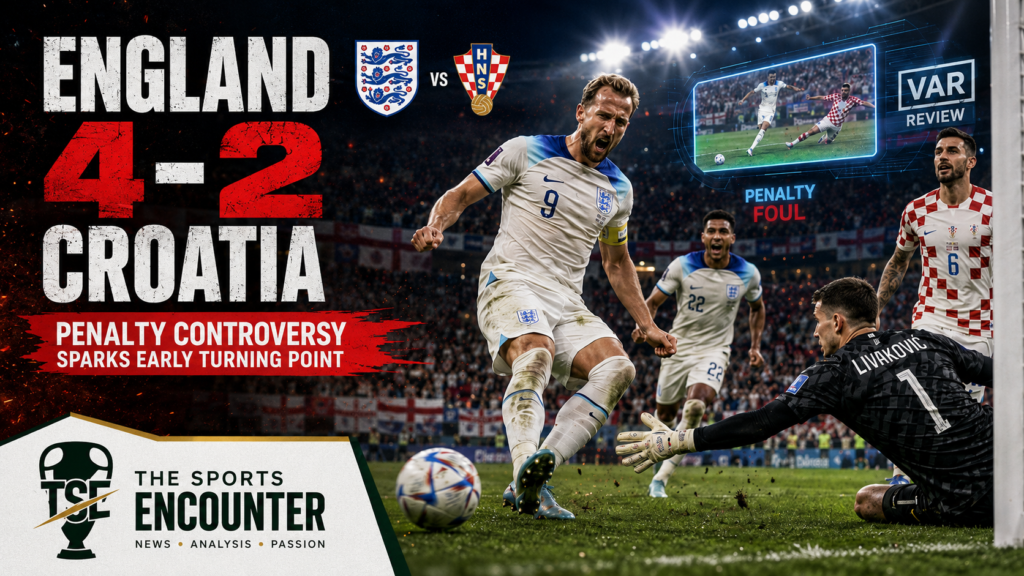
England opened their FIFA World Cup 2026 campaign with a 4-2 win over Croatia in Group L, but this was not the calm, controlled statement Thomas Tuchel would have wanted.

It was louder than that.

It had goals, defensive alarms, Croatian resistance, Harry Kane history, Jude Bellingham authority, and enough first-match chaos to remind England that talent alone will not carry a team through this tournament.

Croatia hurt England twice. They found space, punished loose moments, and refused to let the match become an English procession. But England had too much firepower in the decisive phases. Kane scored twice, Bellingham changed the rhythm after halftime, and Marcus Rashford finished the job late to give England the start they needed.

For more tournament coverage, follow The Sports Encounter’s FIFA World Cup 2026 hub.

Match Summary: England Win, But Croatia Make Them Work

England started the match with the pressure of a favorite and the scars of history.

Croatia have been more than just another opponent for England over the last decade. Their 2018 World Cup semifinal win still sits inside English football memory. That night in Russia turned a dream into pain. This Group L opener in Dallas gave England a chance to set a different tone.

They did.

But they had to survive uncomfortable spells first.

Kane gave England the attacking foundation they needed, scoring twice in a performance that mixed penalty-box instinct with deeper link-up play. His second goal carried extra meaning because it brought him level with Gary Lineker’s England World Cup goalscoring record.

That kind of milestone matters, but the match itself was bigger than one number.

England repeatedly found attacking quality when Croatia looked ready to tilt the contest. Bellingham’s second-half goal gave England the emotional break they needed. Rashford’s late finish then removed Croatia’s last hope of turning pressure into a comeback.

Still, the 4-2 scoreline should not hide the warning signs.

Croatia equalized twice through Martin Baturina and Petar Musa, exposing gaps in England’s defensive spacing and transition control. England won because they had sharper finishers. They did not win because everything worked perfectly.

Kane Shows Why England Still Revolve Around Him

Harry Kane’s value to England is no longer only about goals.

He still scores them, of course. Against Croatia, he scored two more on the World Cup stage and moved into rare England territory. But what made his display important was how often he connected England’s attack when the match became stretched.

Kane dropped into pockets, drew Croatia’s center backs into awkward decisions, and gave England a reference point when the ball needed to stick. That mattered because Croatia tried to drag England into a frantic rhythm.

Some strikers disappear when a match becomes messy. Kane usually becomes more useful.

His penalty-box timing gave England control in the moments that mattered. His movement also opened lanes for runners around him. Bellingham, Rashford, and England’s wide players all benefited from the space Croatia had to protect because Kane remained the constant central threat.

This is why England cannot treat Kane as only a finisher. He is still the player who slows the game when England need calm and sharpens it when they need a final action.

That balance could define England’s tournament.

Was England’s First Goal a Fair Penalty Retake?

England’s opening goal came with controversy attached.

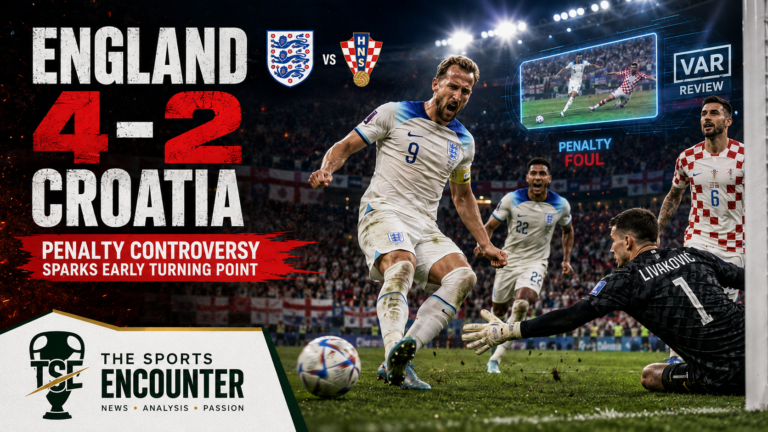
Harry Kane initially saw his penalty saved by Dominik Livakovic, giving Croatia a brief escape from early pressure. But VAR intervened and ruled that the Croatia goalkeeper had stepped off his line before Kane struck the ball. The penalty was retaken, and Kane made no mistake with his second attempt.

For Croatia, it felt like a harsh emotional swing. They had survived the first shot, only to be pulled back into danger by a technical infringement. For England, it was a clear application of the law. Goalkeepers must remain on or above the goal line until the penalty is taken, and VAR judged that Livakovic moved early.

That makes the decision controversial, but not automatically unfair.

The bigger issue for Croatia was psychological. Instead of gaining momentum from a major save, they conceded moments later and had to chase the match from the 12th minute. England benefited from the retake, but Croatia paid for a goalkeeper movement that VAR considered illegal. In a match decided by sharp margins, that early decision gave England the first emotional break of the night.

Bellingham Changed the Temperature After Halftime

Jude Bellingham’s goal was not only a scoring moment.

It was the moment England began to look like a team with control rather than a team trading punches.

The first half carried too much emotional noise for England. Croatia kept finding ways back. England’s defensive line looked uneasy. The midfield did not always protect the back four cleanly. Tuchel’s side had quality, but the match felt too open.

After halftime, Bellingham gave England a different presence.

He carried the ball with purpose, attacked space with authority, and forced Croatia to defend while moving backward. That is where Bellingham is most dangerous. He does not need to touch the ball 100 times to change a match. He needs the right pockets, the right timing, and the courage to drive at a defense when others choose safety.

His goal gave England breathing room.

It also showed why this England team has a different ceiling when Bellingham plays with forward aggression. Kane gives England structure. Bellingham gives them surge.

Together, they made the difference.

Croatia Were Beaten, Not Broken

Croatia lost the match, but this was not a soft defeat.

They showed enough quality to trouble England and enough resilience to suggest Group L is far from settled. Baturina and Musa gave Croatia two important goals, and both finishes reflected a team that still knows how to punish elite opponents when space appears.

Croatia’s problem was not belief.

It was defensive control.

They gave England too many second chances, too much room around the box, and too many chances to reset attacks after pressure should have been cleared. Against Kane and Bellingham, those margins become dangerous quickly.

Luka Modric still offered moments of composure, but Croatia could not fully slow England’s attacking waves after halftime. Their experience kept them alive. Their defending eventually let them down.

That will worry Zlatko Dalic because Croatia now move into their next fixtures against Panama and Ghana with pressure already attached.

For a wider look at how emotional storylines are shaping this tournament, read The Sports Encounter’s feature on the sibling stories giving World Cup 2026 a deeper emotional edge.

England’s Attack Looks Ready, But the Defense Still Needs Work

England scored four goals in an opening World Cup match against Croatia. That is a serious attacking statement.

The problem is that they also conceded twice.

Tournament football does not always punish defensive flaws immediately. Sometimes strong attacking teams survive early errors because their forwards carry them. That happened here. England’s attack gave them enough margin to escape the uncomfortable parts of the match.

But stronger knockout-stage opponents will not be so forgiving.

England’s back line had issues with spacing, recovery runs, and second balls. Croatia found dangerous moments by moving quickly through the middle and using width when England’s shape became uneven. The two goals conceded were not random accidents. They came from patterns that Tuchel will need to address quickly.

That does not make England fragile.

It does make them unfinished.

The best version of England can press, control possession, and score through several routes. The dangerous version of England can also leave gaps when the game becomes emotional. Against Croatia, both versions appeared.

Tuchel will take the result. He will not ignore the warning.

Group L Opens With England in Control

England now have the platform every favorite wants from an opening match: three points, four goals, and attacking rhythm.

Their next Group L match against Ghana now becomes a chance to strengthen their hold on the group. Ghana opened with a 1-0 win over Panama, which means England cannot treat the second match as a soft step. Ghana already have points and will arrive with confidence.

Croatia, meanwhile, face Panama next in a match they cannot afford to waste. A win would pull them back into the qualification picture. Anything less would leave them chasing too much before the final group game against Ghana.

This is why England’s win matters beyond the scoreline.

They have already forced Croatia to play under pressure. They have already put themselves in position to manage the group instead of chase it. In a World Cup with expanded groups and fast-moving qualification pressure, that is valuable.

For another early tournament shock from a European heavyweight’s group-stage test, read our report on DR Congo stunning Portugal as Ronaldo’s World Cup question grows louder.

What England Must Fix Before Ghana

England’s attacking quality is not in doubt.

Their control still needs work.

Before facing Ghana, Tuchel will want sharper defensive distances between midfield and defense. England cannot allow opponents to keep finding central pockets after turnovers. Ghana’s pace and physicality could make those moments even more dangerous.

England also need cleaner game management when they go ahead. Croatia twice found a way back emotionally. That cannot become a habit.

The best teams at the World Cup know when to attack and when to suffocate a match. England attacked well. They did not always suffocate well.

That is the next step.

What Croatia Must Take From the Defeat

Croatia will feel frustrated because they did enough to make England uncomfortable.

But frustration alone will not help them.

They need to fix the defensive mistakes quickly. Their attack showed life. Their midfield still has technical intelligence. Their tournament experience remains useful. But if they defend set pieces, transitions, and box entries this loosely, their World Cup will become difficult fast.

The encouraging part is that Croatia did not disappear after conceding. They fought back twice and showed they can still hurt strong opponents.

The concern is that they needed too much effort to stay close.

That cannot continue.

Final Word: England Win the Opener, But the Real Test Starts Now

England got the result they needed.

A 4-2 win over Croatia gives Tuchel’s team a strong start, gives Kane another historic World Cup night, and gives Bellingham another reminder of how much influence he can carry when England need a match to bend their way.

But this was not a perfect opening performance.

It was thrilling. It was powerful. It was messy. It was also revealing.

England look dangerous enough to hurt anyone in this tournament. They also look open enough to be hurt by teams with courage, speed, and patience.

That makes their World Cup story interesting from the first match.

The talent is real.

The warning signs are real too.

England have started with a win. Now they need to turn a chaotic statement into a controlled campaign.

Miley Rumer is The Sports Encounter’s U.S. correspondent for American sports coverage, focusing on the NHL, NBA, NFL, MLB, MLS, and major sporting stories across North America. Her coverage tracks the moments that shape games, seasons, rivalries, and fan conversations, with a sharp eye on performance, pressure, team identity, and the human stories behind the scoreboard. Based in St. Clairsville, Ohio, Miley brings a grounded American sports voice to The Sports Encounter’s coverage, helping readers follow the biggest developments from arenas, stadiums, locker rooms, and fan communities across the country.

Breaking News

Archer Destroys London Spirit as Southern Brave Survive Nervous Chase

Jofra Archer claimed 4/9 before David Miller steadied a difficult chase as Southern Brave defeated London Spirit by five wickets at Lord’s.

Published

on

Archer Destroys London Spirit as Southern Brave Survive Nervous Chase

London Spirit had reached 103 for five with Jonny Bairstow still at the crease and enough deliveries left to build a competitive total. Twenty balls later, their innings was over.

Jofra Archer triggered a collapse that transformed the match at Lord’s. His pace, control, and late accuracy carried him to remarkable figures of 4 for 9 from 20 balls, leaving Southern Brave with a target of only 106.

The chase became uncomfortable when Brave slipped to 60 for five, but David Miller absorbed the pressure and finished unbeaten on 39. Southern Brave reached 111 for five from 97 balls to secure a five-wicket victory and move back into serious contention for the knockout stage of The Hundred 2026.

TL;DR

  • Southern Brave beat London Spirit by five wickets at Lord’s.
  • London Spirit collapsed from 103 for five to 105 all out in 92 balls.
  • Jofra Archer claimed 4 for 9 and received the Match Hero award.
  • Jonny Bairstow scored 56 from 43 balls, more than half of Spirit’s total.
  • Jamie Smith struck 36 from 22 before David Miller finished the chase with an unbeaten 39.
  • Brave moved to eight points, while Spirit’s qualification prospects suffered another major setback.

London Spirit vs Southern Brave Scorecard

DetailInformation
CompetitionThe Hundred Men’s Competition 2026
MatchMatch 16
DateAugust 1, 2026
VenueLord’s Cricket Ground, London
TossSouthern Brave elected to bowl
London Spirit105 all out from 92 balls
Southern Brave111/5 from 97 balls
ResultSouthern Brave won by five wickets
Top Spirit BatterJonny Bairstow, 56 from 43 balls
Top Brave BattersDavid Miller 39*, Jamie Smith 36
Top BowlerJofra Archer, 4/9 from 20 balls
Match HeroJofra Archer
Turning PointLondon Spirit collapsed from 103/5 to 105 all out
Tournament ImpactBrave moved to eight points; Spirit remained on four

Archer Turns a Recoverable Innings Into a Collapse

London Spirit’s innings depended almost entirely on Bairstow. The opener scored 56 from 43 deliveries, hitting five fours and two sixes while wickets disappeared around him.

Lhuan-dre Pretorius gave Spirit an aggressive start with 11 from eight balls, but Marcus Stoinis removed him with the score on 14. James Rew added 11, while Liam Livingstone managed only five before Adil Rashid dismissed both batters.

Spirit’s middle order then failed to support Bairstow. Dewald Brevis scored one, James Coles made two, and Jamie Overton’s 10 represented the only other double-figure contribution.

At 68 for five, Bairstow and Overton began a necessary recovery. Their partnership carried the total to 103 and gave Spirit a chance of reaching something close to 125, a score that could have tested Brave on a surface offering help to pace and spin.

Archer closed that route immediately.

He removed Bairstow for 56, caught by Chris Jordan, before dismissing David Willey and trapping Andrew Tye leg before on consecutive deliveries. Stoinis then claimed the final two wickets as Spirit lost five wickets for two runs.

Archer finished with four wickets while conceding only nine runs from his full allocation. Stoinis collected 3 for 17 from 17 balls, and Rashid added 2 for 17. The performance strengthened a Brave attack that had already shown its ability to control difficult games when Marcus Stoinis inspired the record defense against Birmingham Phoenix.

Jamie Smith Attacks Before Spirit Fight Back

A target of 106 appeared modest, but Southern Brave quickly discovered that the Lord’s surface still demanded careful batting.

David Willey bowled Ben McKinney for a duck and later removed Nikhil Chaudhary for five. Jamie Smith prevented Spirit from taking complete control by scoring 36 from 22 balls, including four fours and two sixes.

Smith’s aggression gave Brave 38 runs from the 25-ball powerplay. His approach mattered because the rest of the top order struggled to rotate the strike or find boundaries.

James Coles dismissed Smith with the score on 55. Adam Zampa then removed Moeen Ali for nine before a run-out ended Stoinis’ innings on three. Brave had fallen to 60 for five, and Spirit suddenly had a realistic chance of defending one of the lowest totals in the competition.

That pressure exposed a familiar weakness in Brave’s batting. Their earlier last-ball defeat to MI London showed how quickly control could disappear during a tight chase.

Miller refused to allow another collapse.

David Miller Brings Calm to a Nervous Chase

Miller combined calculation with selective aggression. He scored an unbeaten 39 from 28 balls, striking four fours and two sixes while Tristan Stubbs concentrated on survival at the other end.

Stubbs made only 12 from 20 deliveries, but his role carried considerable value. He protected his wicket, helped build an unbroken 51-run partnership, and allowed Miller to target favorable matchups.

The pair required 45 balls to complete their stand, reflecting the difficulty of the pitch and the tension created by Spirit’s bowlers. Miller supplied 38 of those partnership runs from 25 balls.

Willey finished with 2 for 28, while Zampa conceded only 14 from 20 deliveries. Coles also produced a controlled spell of 1 for 13 from 20 balls. Spirit’s bowlers gave the team a chance, but their batters had left them with almost no margin.

Readers can follow further English and franchise coverage through The Sports Encounter’s cricket hub and its wider collection of breaking sports stories.

What the Result Means for Qualification

Southern Brave entered the match with four points from four games after one win and three defeats. Their second consecutive victory lifted them to eight points from five matches, placing them firmly inside the group competing for the three knockout positions.

Brave still have work ahead. Trent Rockets and Welsh Fire occupied the leading positions before this result, while Manchester Super Giants, SunRisers Leeds, and MI London were also clustered around the qualification race. With three league matches remaining, Brave can now influence their own future rather than relying entirely on other results.

Their next match against Welsh Fire on August 3 carries immediate importance. Victory would move Brave to 12 points and strengthen their challenge for the Eliminator. The improved bowling form of Archer, Stoinis, and Rashid gives them a reliable foundation even while the batting remains inconsistent.

London Spirit’s position looks far more dangerous. They remain on four points after one win and three defeats, with five matches still available. Qualification remains mathematically possible, but Spirit will probably need at least four victories and a significant improvement in net run rate.

Their batting must become less dependent on individual rescue efforts. Livingstone had previously produced a major all-round performance, while Bairstow carried this innings almost alone. The repeated lack of middle-order support has become a structural problem rather than an isolated bad night.

The result also arrives during a broader discussion over The Hundred’s connection with English cricket fans. At Lord’s, Archer supplied the kind of high-quality individual performance the competition needs, while the fluctuating chase kept the contest alive until its closing stages.

Final Verdict

Southern Brave won because Archer destroyed London Spirit’s chance of building a defendable total and Miller managed the chase when five wickets created genuine pressure.

Bairstow’s 56 and Spirit’s disciplined bowling deserved more support. A collapse from 103 for five to 105 all out proved too damaging to overcome.

Brave now have consecutive victories and a clear route back into the qualification race. Spirit still have time, but their margin for another batting failure has almost disappeared.

Continue Reading

Breaking News

Thailand Beat Malaysia 2-0 to Take Control of Group B

Thailand beat Malaysia 2-0 in Bangkok to move top of Group B, leaving the semifinal race tighter before the final round of fixtures.

Published

on

Thailand Beat Malaysia 2-0 to Take Control of Group B

TL;DR

  • Thailand defeated Malaysia 2-0 at Rajamangala National Stadium on Saturday, August 1, 2026.
  • Yotsakon Burapha scored from the penalty spot in the 38th minute.
  • Teerasak Poeiphimai doubled the lead in the 56th minute after an earlier miss before halftime.
  • Sarach Yooyen was named Hyundai Player of the Match.
  • Thailand moved to the top of Group B on goal difference.
  • Malaysia remain well placed, but Myanmar and the Philippines are still close enough to keep the group alive.

Match Information

DetailInformation
MatchThailand vs Malaysia
CompetitionASEAN Hyundai Cup 2026, Group B
ResultThailand 2-0 Malaysia
VenueRajamangala National Stadium, Bangkok
DateSaturday, August 1, 2026
Thailand ScorersYotsakon Burapha 38’ pen, Teerasak Poeiphimai 56’
Malaysia ScorersNone
Top PerformerSarach Yooyen, Hyundai Player of the Match
Turning PointYotsakon’s penalty after the pitch-side review
Red CardsNo red cards listed in the accessible official report
Yellow CardsNo named yellow-card list available in the accessible official report at the time of writing
Group ImpactThailand moved top, Malaysia stayed second, and Group B remained open

Updated Group B Table After Thailand 2-0 Malaysia

PositionTeamPlayedWonDrawnLostGoals ForGoals AgainstGoal DifferencePoints
1Thailand220070+76
2Malaysia320163+36
3Myanmar210153+23
4Philippines21015503
5Laos3003113-120

Table calculated after Saturday’s completed Group B matches: Laos 1-4 Philippines and Thailand 2-0 Malaysia.

Thailand Turn Pressure Into Control in Bangkok

Thailand walked into Rajamangala Stadium knowing the night could reshape Group B. Malaysia had already won twice, the Philippines had revived their campaign earlier in the day, and Myanmar were still close enough to matter.

By full time, the War Elephants had answered the pressure with the kind of result contenders need.

Anthony Hudson’s side beat Malaysia 2-0 through goals from Yotsakon Burapha and Teerasak Poeiphimai, moving above Harimau Malaya at the top of Group B on goal difference. Thailand now have six points from two matches, seven goals scored, and none conceded. Malaysia remain on six points, but they have played one match more.

The result gives Thailand the cleanest qualification route in the group. It also prevents Malaysia from building a near-unbreakable lead before the final round of fixtures.

For the wider Southeast Asian football picture, readers can follow The Sports Encounter’s Soccer coverage and the broader FIFA World Cup 2026 hub, where tournament pressure, group-stage math, and knockout pathways remain central themes.

Malaysia Started Organized, But Thailand Found the Better Chances

Malaysia did not collapse. Tan Cheng Hoe’s side arrived in Bangkok with two wins, confidence, and enough structure to make Thailand work for the result.

The first half had the feel of a proper qualification match. Thailand controlled important spells without turning every possession into danger. Malaysia defended compactly, looked to slow the rhythm, and tried to keep the home crowd from feeding Thailand’s tempo.

The first major warning came in the 32nd minute. Teerasak Poeiphimai nearly finished an intricate move near the edge of the box, but Azri Ghani got down well to push the low effort away.

That moment mattered because it showed where Thailand were beginning to find space. They were not simply crossing and hoping. They were combining around the box, using movement from Yotsakon, Teerasak, and supporting midfield runners to pull Malaysia out of shape.

Then came the key decision.

Ubaidullah Shamsul’s challenge on Kakana Khamyok led referee Kim Woo-sung to the pitch-side monitor. After the review, the South Korean official pointed to the spot. Yotsakon stepped up and sent Azri the wrong way in the 38th minute.

Malaysia had stayed in the match for more than half an hour. That penalty changed the emotional direction of the night.

Yotsakon and Teerasak Give Thailand a Real Cutting Edge

Thailand’s attacking threat was built around timing, movement, and patience. Yotsakon gave them the breakthrough from the spot, but his overall contribution went beyond the penalty.

He linked play, occupied defenders, and later played a role in the move that helped create Thailand’s second goal. His second goal of the tournament also confirmed his growing value in a squad that is trying to blend established tournament expectation with younger energy.

Teerasak had a strange night in the best possible way. He should have scored in first-half stoppage time when Chaiyaphon Otton’s powerful cross found him four yards out, only for the striker to volley over. Some players carry that miss into the second half. Teerasak corrected it.

In the 56th minute, Sarach Yooyen fed the ball forward. Yotsakon laid it off to substitute Worachit Kanitsribumphen, who found Teerasak unmarked near the penalty spot. This time, the striker took a touch and bent his shot into the top corner.

That finish gave Thailand control and gave Malaysia a mountain to climb.

Sarach Yooyen Was the Match’s Calm Center

Sarach Yooyen’s Hyundai Player of the Match award made sense because he gave Thailand the balance that allowed the attacking pieces to work.

In matches like this, midfield control often matters more than the final highlight. Sarach helped Thailand manage the tempo, recover loose balls, and feed the forward line at the right moments. His pass in the sequence leading to the second goal was exactly the kind of action that does not always dominate clips but often decides games.

Thailand also looked more composed after going ahead. They did not turn the match into a track meet. They stayed organized, protected the clean sheet, and made Malaysia chase a game that had slowly moved away from them.

That is a strong sign for a team trying to win the group and push toward another deep ASEAN Championship run.

Malaysia Had Chances, But the Finish Was Missing

Malaysia’s best spell came after Thailand’s second goal, when they had no choice but to take more risks.

Wan Kuzain had a clear opportunity with 16 minutes left, but he volleyed Faris Danish’s cross wide. That chance could have changed the final stretch. A goal there would have brought Malaysia back to 2-1 and tested Thailand’s game management.

Soon after, Kampon Phatomakkakul gifted Malaysia possession close to goal but recovered with a sprawling save to deny Paulo Josué. He then made another strong stop moments later, keeping out Daryl Sham.

Those saves protected the result and preserved Thailand’s perfect defensive record in the group.

Malaysia will regret the lack of sharpness in those moments. They were far from poor, but against Thailand in Bangkok, being competitive is not enough. The finishing has to match the effort.

The Sports Encounter previously covered Malaysia’s strong start in Malaysia’s 4-0 win over Laos, but this result shows the next level of the test. Malaysia can control games against weaker opponents. Thailand asked them to solve pressure, quality, and game state all at once.

Discipline Report: What Could Be Verified

The accessible official ASEAN United FC match report confirmed the penalty review, the goals, the venue, the result, and Sarach Yooyen’s Player of the Match award. It did not list any red cards or named yellow-card incidents.

For publication, the safest verified discipline note is:

No red cards were listed in the accessible official match report. No named yellow-card list was available in the accessible official feed at the time of writing.

That wording avoids adding unverified card details while still answering the discipline question responsibly.

What the Result Means for Thailand

Thailand are now in command of their own path.

They have six points from two matches, a +7 goal difference, and two clean sheets. Their remaining fixtures against the Philippines and Myanmar still matter, but the War Elephants have given themselves room to manage the group from the front.

A win in either remaining match may be enough to secure a semifinal place, depending on other results. Even a draw could become valuable because of their goal difference.

Reuters reported before the tournament that the top two teams from each group qualify for the semifinals, with Group B featuring Thailand, Malaysia, the Philippines, Myanmar, and Laos. That format makes Thailand’s clean-sheet start especially powerful because goal difference may become the separating factor in a crowded race.

What the Result Means for Malaysia

Malaysia are still in a strong position, but the group no longer bends fully toward them.

They have six points from three matches, and their final fixture against the Philippines now carries real weight. A win would likely send them through. A draw could be enough depending on Thailand, Myanmar, and the Philippines’ remaining results. A defeat would make the group dangerous.

Malaysia’s goal difference is still positive, but Thailand have moved ahead, and Myanmar remain close with one fewer match played. The Philippines also climbed back into the conversation after their 4-1 win over Laos, covered by The Sports Encounter in Philippines Turn Early Trouble Into 4-1 Win as Laos Collapse After Red Card.

The key for Malaysia now is response. They cannot allow one defeat in Bangkok to undo the work they did against Myanmar and Laos.

Group B Is Now Properly Alive

Thailand are top. Malaysia are second. Myanmar and the Philippines are still close. Laos are almost out, but their matches have already affected goal difference across the group.

That makes the next round compelling. Thailand have the best position, but not yet full safety. Malaysia have points, but not full comfort. Myanmar and the Philippines both need results, and both know one slip from Malaysia could reopen the table.

The Sports Encounter’s report on Myanmar’s 4-1 win over the Philippines remains important to the qualification picture because Myanmar’s goal difference keeps them alive. So does the Philippines’ response against Laos.

Final Takeaway

Thailand’s 2-0 win over Malaysia was measured, clinical, and important. They did not need chaos. They needed control, and they found it.

Yotsakon gave them the first blow. Teerasak gave them breathing space. Sarach gave them structure. Kampon protected the clean sheet when Malaysia threatened late.

Malaysia still have a route to the semifinals, but Thailand now own the clearest path in Group B. The War Elephants have six points, seven goals, no goals conceded, and the confidence of a team that just beat its closest rival.

Group B has not been decided. It has become sharper.

Continue Reading

Breaking News

Philippines Punish 10-Man Laos to Rejoin Group B Race

The Philippines recovered from an early Laos goal to win 4-1 in Vientiane, earning their first Group B victory and reviving their semifinal hopes.

Published

on

Philippines Punish 10-Man Laos to Rejoin Group B Race

TL;DR

  • The Philippines beat Laos 4-1 at Lao National Stadium KM16 in Vientiane.
  • Laos scored first through Damoth Thongkhamsavath in the seventh minute.
  • Phetdavanh Somsanid’s 14th-minute red card changed the match.
  • John Lucero, Jarvey Gayoso, Daisuke Sato, and a Viengxay Sydavong own goal shaped the Philippines’ comeback.
  • Cole Mrowka was named Hyundai Player of the Match.
  • The Philippines moved to three points, while Laos stayed bottom of Group B with three defeats.

Match Information

DetailInformation
MatchLaos vs Philippines
CompetitionASEAN Hyundai Cup 2026, Group B
ResultLaos 1-4 Philippines
VenueLao National Stadium KM16, Vientiane
DateSaturday, August 1, 2026
Laos ScorerDamoth Thongkhamsavath 7’
Philippines ScorersJohn Lucero 47’, Viengxay Sydavong 52’ OG, Jarvey Gayoso 60’ pen, Daisuke Sato 88’
Top PerformerCole Mrowka, Hyundai Player of the Match
Turning PointPhetdavanh Somsanid’s 14th-minute red card
Red CardsPhetdavanh Somsanid, Laos, 14’
Yellow CardsInitial yellow shown to Phetdavanh before the pitch-side review upgraded the decision to red
Group ImpactPhilippines revived their semifinal hopes; Laos moved closer to elimination

Updated Group B Table After Laos 1-4 Philippines

PositionTeamPlayedWonDrawnLostGoals ForGoals AgainstGoal DifferencePoints
1Malaysia220061+56
2Thailand110050+53
3Myanmar210153+23
4Philippines21015503
5Laos3003113-120

Table calculated before Thailand vs Malaysia later on August 1.

Philippines Needed a Reset. Laos Gave Them a Scare First.

The Philippines arrived in Vientiane carrying the weight of a poor opening night. Their 4-1 defeat to Myanmar had left Carles Cuadrat’s side with no margin for another slow start. Seven minutes into this match, that pressure got heavier.

Laos took the lead through Damoth Thongkhamsavath, whose long-range shot slipped through Quincy Kammeraad’s hands and crossed the line. For a few minutes, it looked as if the Philippines were drifting toward another uncomfortable evening.

Then the match turned.

Phetdavanh Somsanid slid into Jarvey Gayoso from behind in the 14th minute. Referee Kim Hee-gon first showed yellow, but after a pitch-side review, the decision became a red card. Laos were down to 10 men before the match had reached its first real rhythm.

From there, the Philippines had to show patience, not panic. They did not score before halftime, but they kept pressing, kept asking questions, and eventually broke Laos open after the interval.

The result brings the Philippines back into the Group B race and gives their campaign some much-needed life after the disappointment covered earlier in The Sports Encounter’s report on Myanmar’s 4-1 win over the Philippines.

Laos Started With Belief, Then Lost Their Shape

Laos deserved credit for the opening goal. They attacked with speed, used transition well, and punished a goalkeeper error. Damoth’s strike may not have looked unstoppable, but his willingness to shoot early gave Laos exactly the kind of start an underdog needs.

The red card changed their night completely.

With 10 men, Laos had to defend deeper and give up more space. That made the game less about their attacking plan and more about survival. For a while, they survived well. The Philippines thought they had equalized through Kenji Nishioka, but the goal was ruled out for an infringement in the build-up. Cole Mrowka also came close with a free kick that bounced just wide of Kop Lokphathip’s left post.

Still, Laos could not keep pushing back forever. The energy required to defend with 10 men caught up with them after halftime. Once the Philippines found the equalizer, Laos lost the one thing that had kept them alive: scoreboard pressure.

Their tournament position now looks bleak. Three matches, zero points, 13 goals conceded, and only one scored leave Laos needing a near-miracle to reach the semifinals.

John Lucero Opens the Door

The Philippines finally got level two minutes into the second half.

Daisuke Sato crossed from the left, Laos failed to clear, and John Lucero reacted sharply. His first-time right-footed finish went across goal and into the bottom corner. It was the kind of finish the Philippines had missed against Myanmar: clean, early, and decisive.

That goal changed the mood. Laos could no longer sit on their early lead. The Philippines could attack with freedom rather than anxiety.

Five minutes later, they were ahead. Mrowka combined with Javier Mariona, received the return pass, and fired toward goal. Viengxay Sydavong stretched to intervene but only redirected the ball past Kop. The own goal made it 2-1 and confirmed that Laos’ defensive resistance had started to crack.

The Sports Encounter’s Soccer coverage has followed how group-stage momentum can shift quickly in short tournaments. This was another clear example. One red card, one equalizer, and suddenly the entire match looked different.

Gayoso and Sato Finish the Job

Jarvey Gayoso had already played a central role in the key disciplinary moment. In the 60th minute, he added his name to the scoreline.

Referee Kim awarded the Philippines a penalty after Gayoso’s strike hit Phoutthavong Saangvitay on the arm. Gayoso took the kick himself and calmly sent the ball down the middle. At 3-1, the match no longer felt fragile for the visitors.

Daisuke Sato then sealed the win two minutes from time. Nishioka delivered from the left, and Sato stayed onside before heading home. It was a strong finish from a senior player who had already contributed to the equalizer.

For the Philippines, those two goals mattered beyond the final score. Goal difference can become decisive in Group B, especially with Malaysia, Thailand, Myanmar, and the Philippines all fighting for position. Turning a tense 2-1 into a 4-1 win gave Cuadrat’s side a cleaner table recovery.

Cole Mrowka Was the Connector

Cole Mrowka earned the official Hyundai Player of the Match award, and his influence was easy to understand.

He threatened with a first-half free kick, helped create the second goal through his combination with Mariona, and gave the Philippines control between midfield and attack. On a night when the team had to break down a reduced opponent without becoming frantic, Mrowka supplied tempo and clarity.

Lucero gave the finish that changed the match. Gayoso gave the penalty and attacking edge. Sato brought leadership and the late goal. Still, Mrowka’s rhythm tied the performance together.

That matters for the Philippines’ next challenge. They now face Thailand, and they will not get the same time or space. If they want to trouble the group favorite, they need Mrowka, Gayoso, Sato, and Lucero to turn this comeback into a platform.

What the Result Means for the Philippines

The Philippines are alive again, but not safe.

They have three points from two matches, with a neutral goal difference after scoring four against Laos and conceding four against Myanmar. That is a much healthier position than they had at halftime in Vientiane, but the schedule remains demanding.

Thailand are next. Malaysia still wait at the end of the group. That means the Philippines probably need at least one major result from those two matches to reach the top two.

The win does give them emotional oxygen. After the heavy Myanmar defeat, a second loss would have left them almost out of the race. Instead, they now move into the next round of fixtures with a real, if difficult, qualification route.

For comparison, Malaysia already strengthened their case with a commanding result discussed in The Sports Encounter’s report on Malaysia’s 4-0 win over Laos, while Myanmar remain part of the same crowded race.

What the Result Means for Laos

Laos are running out of road.

They have lost 5-0 to Thailand, 4-0 to Malaysia, and now 4-1 to the Philippines. The pattern is difficult to ignore. They have competed in spells, but collapses after pressure moments have damaged every match.

Against the Philippines, they had the perfect early setup: a goal, home crowd energy, and an opponent carrying pressure. The red card changed everything, but Laos still had to manage the game better after halftime. They could not.

Their remaining match against Myanmar now looks more like a pride test than a realistic qualification route. Mathematically, hope may remain until the table closes around them. Practically, three defeats and a minus-12 goal difference leave very little room.

The wider ASEAN Hyundai Cup picture can be followed through The Sports Encounter’s World Cup 2026 and international football hub, where qualification formats and tournament pressure are recurring themes.

Final Takeaway

The Philippines got the win they had to get, but Laos made them feel the danger first.

Damoth’s early goal exposed Philippine nerves. Phetdavanh’s red card changed the contest. Lucero’s equalizer opened the door. Mrowka’s control helped the Philippines walk through it. Gayoso and Sato made sure the scoreline carried real value.

The Philippines are back in the Group B race, but the hard part starts now. Thailand and Malaysia will ask much sharper questions than 10-man Laos could manage.

For Laos, the tournament is slipping away fast. For the Philippines, Vientiane may be remembered as the night their campaign finally started.

Continue Reading

FIFA World Cup 2026 Hub

Cinematic VFX featured image showing fictionalized World Cup legend silhouettes walking toward a glowing stadium tunnel, with farewell confetti, The Sports Encounter logo, and the headline “The Last Dance: World Cup Legends Say Goodbye.” Cinematic VFX featured image showing fictionalized World Cup legend silhouettes walking toward a glowing stadium tunnel, with farewell confetti, The Sports Encounter logo, and the headline “The Last Dance: World Cup Legends Say Goodbye.”
Editor's Choice4 hours ago

The Golden Generation Saying Goodbye After the FIFA World Cup 2026

The 2026 World Cup did more than crown a champion. It marked the emotional farewell of a generation that shaped...

Cinematic tribute to Neymar Jr.’s World Cup journey, showing his Brazilian flair and rainbow-flick skill on one side and his pain, injuries and emotional heartbreak on the other, with the headline “Skill. Pain. Legacy.” and The Sports Encounter logo. Cinematic tribute to Neymar Jr.’s World Cup journey, showing his Brazilian flair and rainbow-flick skill on one side and his pain, injuries and emotional heartbreak on the other, with the headline “Skill. Pain. Legacy.” and The Sports Encounter logo.
Editor's Choice2 days ago

Neymar’s World Cup Career: Skill, Pain, and the Rainbow Flick Legacy

Neymar carried Brazil’s World Cup hopes across four tournaments, producing unforgettable goals while enduring injuries, criticism and elimination heartbreak. His...

Cinematic FIFA World Cup 2030 graphic showing the golden trophy at the center of a global football revolt, with protesting delegates, distressed executives, collapsing financial charts, torn investment documents, and the headline “World Cup 2030: Not for Sale?” alongside The Sports Encounter logo. Cinematic FIFA World Cup 2030 graphic showing the golden trophy at the center of a global football revolt, with protesting delegates, distressed executives, collapsing financial charts, torn investment documents, and the headline “World Cup 2030: Not for Sale?” alongside The Sports Encounter logo.
Editor's Choice2 days ago

Is the FIFA World Cup 2030 Not for Sale Anymore?

FIFA’s proposal to sell a minority stake in a $20 billion World Cup commercial company appears to have collapsed after...

A cinematic World Cup 2030 graphic compares a 48-team format with a proposed 64-team expansion, surrounded by national teams, global flags, the trophy, and contrasting calls to grow or protect the tournament. A cinematic World Cup 2030 graphic compares a 48-team format with a proposed 64-team expansion, surrounded by national teams, global flags, the trophy, and contrasting calls to grow or protect the tournament.
Editor's Choice2 days ago

FIFA Explores 64-Nation World Cup for 2030: Is Another Expansion Worth It?

FIFA is examining whether the 2030 World Cup should expand from 48 to 64 teams. The proposal could increase global...

Gianni Infantino faces mounting internal opposition at FIFA as Carlos Cordeiro resigns and Kevin Lamour publicly challenges the proposed World Cup stake sale. Gianni Infantino faces mounting internal opposition at FIFA as Carlos Cordeiro resigns and Kevin Lamour publicly challenges the proposed World Cup stake sale.
Editor's Choice2 days ago

FIFA Revolt Moves Inside Infantino’s Office as Cordeiro Quits and Kevin Lamour Condemns World Cup Selloff

FIFA’s World Cup stake crisis has moved inside the organization. Carlos Cordeiro has resigned in protest, while chief operating officer...

Gianni Infantino faces mounting opposition to FIFA’s proposed World Cup stake sale as UEFA officials threaten a boycott and private investors circle the tournament’s commercial future. Gianni Infantino faces mounting opposition to FIFA’s proposed World Cup stake sale as UEFA officials threaten a boycott and private investors circle the tournament’s commercial future.
Editor's Choice2 days ago

Infantino’s World Cup Selloff Crisis Deepens as Adviser Quits and UEFA Backs FIFA Boycott

Gianni Infantino’s plan to bring private investors into a $20 billion FIFA commercial company has triggered a global soccer revolt....

Cinematic VFX-style featured image showing a cracked FIFA World Cup trophy chained at the center beneath a fractured globe as CONCACAF rejects FIFA’s World Cup stake sale proposal. A CONCACAF flag with a red “Rejected” stamp faces a FIFA flag in a storm-lit stadium, with the headline “CONCACAF Rejects FIFA Stake Plan” and the official The Sports Encounter logo in the top-left. Cinematic VFX-style featured image showing a cracked FIFA World Cup trophy chained at the center beneath a fractured globe as CONCACAF rejects FIFA’s World Cup stake sale proposal. A CONCACAF flag with a red “Rejected” stamp faces a FIFA flag in a storm-lit stadium, with the headline “CONCACAF Rejects FIFA Stake Plan” and the official The Sports Encounter logo in the top-left.
Editor's Choice3 days ago

CONCACAF Rejects FIFA’s World Cup Stake Plan as Infantino Faces a Global Governance Revolt

CONCACAF has unanimously rejected FIFA’s proposal to bring private investors into a new company controlling the commercial business of the...

Cinematic graphic showing a cracked World Cup trophy between UEFA and FIFA, symbolizing Europe’s boycott threat and the possibility of a rival international tournament. Cinematic graphic showing a cracked World Cup trophy between UEFA and FIFA, symbolizing Europe’s boycott threat and the possibility of a rival international tournament.
Breaking News3 days ago

Could UEFA Create Its Own World Cup? Kaveh Solhekol’s Warning Shows How Far the FIFA Crisis Could Go

UEFA’s threat to boycott FIFA competitions has opened a much bigger question for world soccer: if Europe walks away from...

European football representatives confront FIFA’s World Cup investment proposal across a fractured stadium pitch, with the headline “Europe Draws the Line.” European football representatives confront FIFA’s World Cup investment proposal across a fractured stadium pitch, with the headline “Europe Draws the Line.”
Breaking News3 days ago

UEFA Votes 55-0 for FIFA Boycott as Infantino’s World Cup Plan Sparks Open Revolt

UEFA’s 55 member associations have unanimously threatened to withdraw their national teams from FIFA competitions unless Gianni Infantino abandons plans...

Cinematic illustration of a global football trophy caught between passionate fans and private investors, symbolizing FIFA’s proposed $20 billion World Cup commercial stake sale. Cinematic illustration of a global football trophy caught between passionate fans and private investors, symbolizing FIFA’s proposed $20 billion World Cup commercial stake sale.
Editor's Choice4 days ago

Why FIFA Selling Stakes in the World Cup Isn’t a Good Idea

FIFA plans to raise up to $4.2 billion by selling minority stakes in a new commercial company valued at $20...

Cinematic FIFA vs UEFA confrontation with rival soccer executives facing off across a fractured pitch as global federation delegates gather around the World Cup trophy. Cinematic FIFA vs UEFA confrontation with rival soccer executives facing off across a fractured pitch as global federation delegates gather around the World Cup trophy.
Breaking News5 days ago

FIFA and UEFA at Loggerheads: Could the $20 Billion World Cup Plan Trigger a Global Soccer Revolt?

UEFA has opened a direct confrontation with FIFA over its proposed $20 billion World Cup company. The decisive battle will...

VFX cinematic featured image showing Cape Verde’s Sidny Lopes Cabral-inspired footballer celebrating a dramatic long-range goal against Argentina, with The Sports Encounter logo and the headline “Goal of a Nation.” VFX cinematic featured image showing Cape Verde’s Sidny Lopes Cabral-inspired footballer celebrating a dramatic long-range goal against Argentina, with The Sports Encounter logo and the headline “Goal of a Nation.”
Breaking News6 days ago

Sidny Lopes Cabral’s World Cup Wonder Goal Gave Cape Verde a Moment No One Can Take Away

Sidny Lopes Cabral’s stunning 25-yard strike against Argentina gave Cape Verde its defining World Cup 2026 moment. The 23-year-old left-back...

Gianni Infantino angrily addresses reporters at a tense press conference as cameras flash, alongside The Sports Encounter logo and the headline “FIFA Fires Back.” Gianni Infantino angrily addresses reporters at a tense press conference as cameras flash, alongside The Sports Encounter logo and the headline “FIFA Fires Back.”
Editor's Choice6 days ago

Gianni Infantino Defends FIFA World Cup 2026 Decisions in an Open Letter

Gianni Infantino says critics allowed hate to obscure the joy of FIFA World Cup 2026. Fans, players, officials, and national...

FIFA World Cup 2026 Final Viewership Confirms Soccer’s Rise in the US FIFA World Cup 2026 Final Viewership Confirms Soccer’s Rise in the US
Editor's Choice2 weeks ago

FIFA World Cup 2026 Final Viewership Confirms Soccer’s Rise in the US

The FIFA World Cup 2026 final drew nearly 63 million U.S. viewers across Fox, Telemundo, and Peacock. The record audience,...

Back view of the 11 players selected in the fan-voted FIFA World Cup 2026 Dream Team walking toward the trophy under stadium lights. Back view of the 11 players selected in the fan-voted FIFA World Cup 2026 Dream Team walking toward the trophy under stadium lights.
Editor's Choice2 weeks ago

Who Made It to the Fan-Voted Dream Team of the FIFA World Cup 2026?

The fan-voted FIFA World Cup 2026 Dream Team features standout performers from Spain, France, Argentina, England, Norway, and Cape Verde,...

Lamine Yamal kisses the FIFA World Cup trophy as his Spain teammates celebrate behind him under gold confetti and bright stadium lights. Lamine Yamal kisses the FIFA World Cup trophy as his Spain teammates celebrate behind him under gold confetti and bright stadium lights.
Editor's Choice2 weeks ago

How Youngster Lamine Yamal Came of Age in the FIFA World Cup 2026

Lamine Yamal arrived at the FIFA World Cup 2026 as football’s most celebrated teenager. He left as a world champion...

Kylian Mbappé celebrates a FIFA World Cup 2026 goal in his signature crossed-arms pose as France teammates and fans react inside a packed stadium. Kylian Mbappé celebrates a FIFA World Cup 2026 goal in his signature crossed-arms pose as France teammates and fans react inside a packed stadium.
Editor's Choice2 weeks ago

Meet the Top 10 Goal Scorers of the FIFA World Cup 2026

Kylian Mbappé’s speed, movement, and ruthless finishing produced 10 goals and another Golden Boot, but the FIFA World Cup 2026...

Rodri lifts the FIFA World Cup 2026 trophy as Spain’s players celebrate on the winners’ podium beneath gold confetti and stadium lights. Rodri lifts the FIFA World Cup 2026 trophy as Spain’s players celebrate on the winners’ podium beneath gold confetti and stadium lights.
Editor's Choice2 weeks ago

Why FIFA Picked Rodri as the Best Player of the FIFA World Cup 2026

Rodri did not lead the FIFA World Cup 2026 scoring charts, but Spain’s captain controlled the spaces, passing lanes, defensive...

Breaking News2 weeks ago

From Johannesburg to New Jersey: Spain’s Two World Cup Heroes

Separated by sixteen years and two different generations, Andrés Iniesta and Ferran Torres delivered the goals that defined Spain's two...

Ferran Torres Ends Argentina’s Resistance as Spain Rule the World Again Ferran Torres Ends Argentina’s Resistance as Spain Rule the World Again
Breaking News2 weeks ago

Ferran Torres Ends Argentina’s Resistance as Spain Rule the World Again

Ferran Torres struck in extra time as Spain’s relentless control overwhelmed Argentina, ended Lionel Messi’s title defense, and delivered La...

ASEAN Championship 2026

English Premier League 2026

NHL 2026

The Hundred 2026

Wimbledon 2026

French Open 2026

Lanka Premier League 2026

Global Super League 2026

The World of LeBron James

NFL 2026-27

Boxing Gloves On

US Open 2026

Breaking News