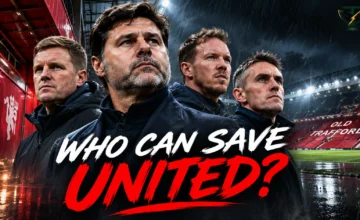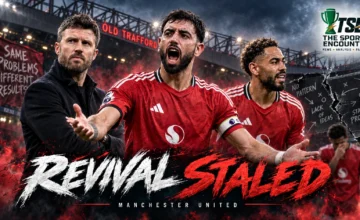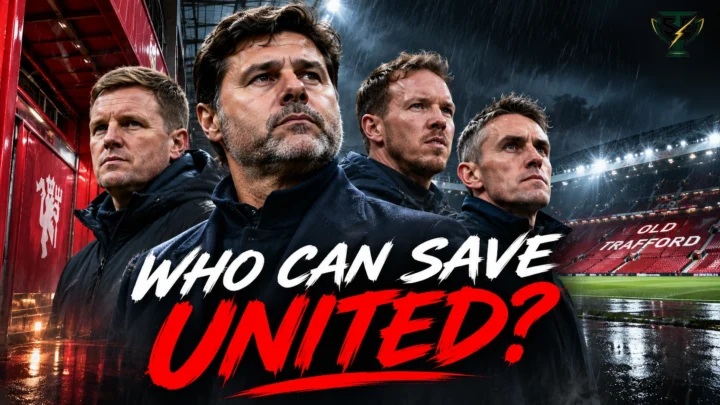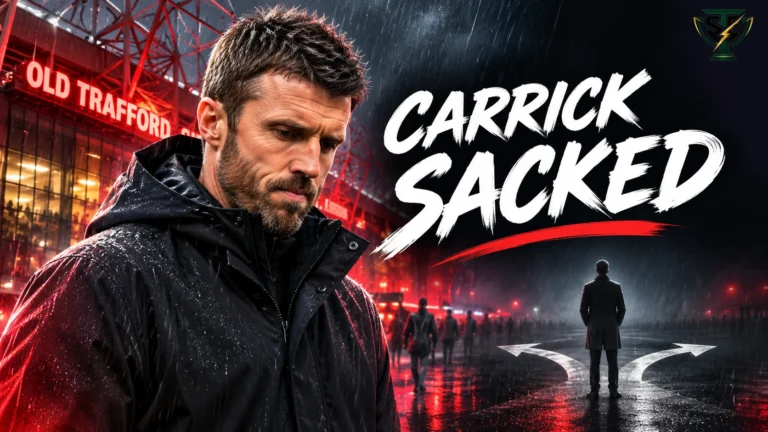
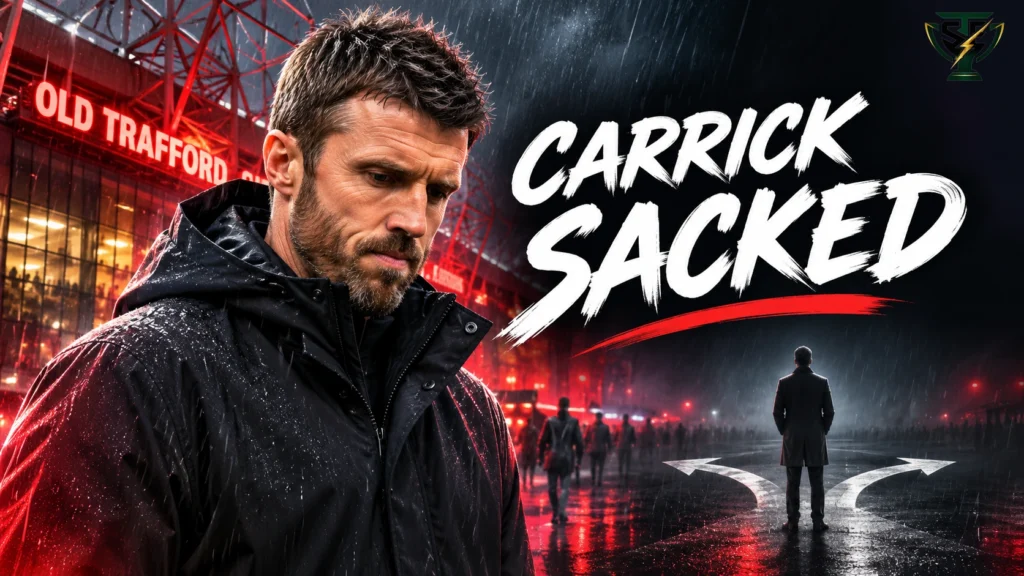
MANCHESTER, England, November 12, 2026: Manchester United have sacked head coach Michael Carrick after a disastrous start to the Premier League season left the 20-time English champions in the relegation zone. Carrick departs with United 18th in the standings, having collected just eight points from 10 league matches. Mauricio Pochettino, currently in charge of the United States men’s national team, has emerged as the leading candidate to replace him, with British media reporting an agreement to take over at Old Trafford.
The dismissal brings an abrupt end to a remarkable reversal in Carrick’s managerial fortunes. Less than six months ago, the former United midfielder had earned a permanent contract through 2028 after guiding the club to third place and Champions League qualification. Now, with one league victory, eight consecutive Premier League matches without a win and a defense repeatedly exposed, United are preparing for another managerial transition before a daunting trip to Liverpool.
Key Takeaways
- Manchester United have sacked head coach Michael Carrick after a disastrous start to the Premier League season left the 20-time English champions in the relegation zone.
- When Carrick returned to United in January following Ruben Amorim’s departure, he inherited a team struggling to translate individual quality into sustained results.
- Attention has immediately shifted to Mauricio Pochettino, the former Tottenham Hotspur and Chelsea manager currently overseeing the United States national team.
- Manchester United’s next Premier League match is scheduled away to Liverpool on November 22, following the international break.
Why Manchester United Sacked Michael Carrick
Manchester United confirmed Carrick’s departure following internal discussions about the club’s deteriorating performances. The decision came after a chaotic 4-4 home draw against Aston Villa, when two stoppage-time goals rescued a point but failed to disguise another alarming defensive display.
Story at a glance
Why Manchester United Sacked Michael Carrick
Manchester United confirmed Carrick’s departure following internal discussions about the club’s deteriorating performances. The decision came after a chaotic 4-4 home draw against Aston Villa, when two stoppage-time goals rescued a point but failed to disguise another alarming defensive display.
Manchester United’s Crisis in Numbers
United’s league position provides the clearest measure of their predicament. They have taken just 26.7% of the available points and are averaging fewer than one point per match.
From Champions League Qualification to a Relegation Battle
When Carrick returned to United in January following Ruben Amorim’s departure, he inherited a team struggling to translate individual quality into sustained results.
The Results That Made Carrick’s Position Untenable
Several recent performances accelerated the pressure on Carrick, but the sequence was particularly damaging because victories repeatedly appeared within reach before United undermined themselves.
Mauricio Pochettino Emerges as Favorite to Replace Carrick
Attention has immediately shifted to Mauricio Pochettino, the former Tottenham Hotspur and Chelsea manager currently overseeing the United States national team.
In a statement reported by Reuters, United described the decision as extremely difficult but necessary to achieve their ambitions. The club also recognized Carrick’s professionalism and his contribution to last season’s recovery.
The numbers explain why sentiment could no longer determine the managerial decision. United have won only three of their 15 competitive matches this season, including just one Premier League victory. Their eight-point return from 10 league fixtures represents their worst position at this stage of a top-flight campaign since 1986-87.
Most concerning is the nature of the decline. United have repeatedly conceded avoidable goals, struggled to control matches after losing possession and failed to convert occasional attacking recoveries into consistent results.
The Sports Encounter had already examined these problems in its investigation into Manchester United’s recurring tactical and recruitment failures. Carrick’s departure confirms the seriousness of that deterioration, although whether his successor can reverse it remains uncertain.
Manchester United’s Crisis in Numbers
United’s league position provides the clearest measure of their predicament. They have taken just 26.7% of the available points and are averaging fewer than one point per match.
| Premier League Measure | Manchester United |
|---|---|
| Position | 18th |
| Matches played | 10 |
| Wins | 1 |
| Draws | 5 |
| Defeats | 4 |
| Points | 8 |
| Goals scored | 14 |
| Goals conceded | 19 |
| Goal difference | -5 |
| Points per match | 0.80 |
| Current league winless run | 8 matches |
Statistical context: The league figures reflect United’s position after 10 matches. The points-per-match average and percentage of available points are calculated from that record.
United’s current rate equates to 30.4 points across a 38-match Premier League season. That is a mathematical illustration of their poor start, not a prediction of their eventual total. With 28 league fixtures remaining, the team still has considerable time to recover.
However, improvement must come quickly. A club that finished third last season is now facing the prospect of spending the coming months looking over its shoulder at the bottom of the table.
That contrast makes Carrick’s dismissal particularly striking. The Sports Encounter’s earlier assessment of 14 reasons Manchester United’s revival had stalled identified the warning signs well before the club entered the relegation zone.
From Champions League Qualification to a Relegation Battle
When Carrick returned to United in January following Ruben Amorim’s departure, he inherited a team struggling to translate individual quality into sustained results.
His initial impact was substantial. United won 11 of their next 16 league matches, climbed from seventh to third and qualified for the Champions League. The improvement prompted the club to reward him with a contract extending until 2028.
The results suggested that Carrick had addressed several fundamental problems. United appeared more organized, their midfield operated with greater clarity and their attacking players benefited from a more coherent approach.
There was also an emotional dimension. Carrick’s long association with Manchester United, including five Premier League titles as a player, made his success particularly meaningful to supporters.
But the transition from an effective interim appointment to a permanent managerial project proved difficult. The new campaign exposed weaknesses that results during the previous season had temporarily obscured.
In August, The Sports Encounter examined Carrick’s rebuilding project and the challenge of sustaining his early success. That question has now received a painful answer.
United’s decline also raises an uncomfortable issue for the club’s leadership. The decision to retain Carrick was based on meaningful competitive improvement, yet the commitment lasted less than six months. It leaves the football department facing fresh scrutiny over how managerial appointments are assessed and supported.
The Results That Made Carrick’s Position Untenable
Several recent performances accelerated the pressure on Carrick, but the sequence was particularly damaging because victories repeatedly appeared within reach before United undermined themselves.
Bournemouth exposed United’s instability
A 3-0 home defeat to Bournemouth intensified criticism of Carrick’s team selection and the players’ collective response. His decision to leave captain Bruno Fernandes on the bench attracted particular attention as United struggled to establish control.
The defeat raised questions about the relationship between the manager and one of his most influential players. Carrick subsequently restored Fernandes to the starting lineup, but the change failed to deliver an immediate improvement.
Chelsea deepened the league crisis
United’s 2-0 defeat at Stamford Bridge demonstrated how difficult they had become to trust against well-organized opponents.
The team continued to experience problems progressing the ball under pressure and protecting its defensive structure when possession was lost. Chelsea capitalized on United’s weaknesses, extending their miserable domestic sequence.
The Sports Encounter previously explored that setback in its report on Manchester United’s worsening crisis and Manchester City’s contrasting struggles.
Roma offered hope but not stability
A dramatic 3-2 Champions League comeback victory against Roma briefly provided relief. United recovered from a two-goal deficit and demonstrated that their attacking quality could still produce outstanding moments.
Yet the performance also highlighted the contradiction running through Carrick’s final weeks. United could produce remarkable recoveries without showing the defensive reliability required to win consistently.
Aston Villa delivered the final warning
The 4-4 draw with Aston Villa proved decisive. United twice recovered from two-goal deficits, eventually securing a point through late goals from Joshua Zirkzee and Patrick Dorgu.
The comeback demonstrated resilience and attacking determination. However, conceding four goals at Old Trafford offered little reassurance that Carrick had found a sustainable solution.
The Premier League’s official analysis noted that United had conceded 30 goals across all competitions and matched their longest winless Premier League sequence.
Four goals scored against Villa could not outweigh the fact that United had surrendered repeated opportunities to control the contest.
Mauricio Pochettino Emerges as Favorite to Replace Carrick
Attention has immediately shifted to Mauricio Pochettino, the former Tottenham Hotspur and Chelsea manager currently overseeing the United States national team.
British media reports indicate that Pochettino has reached an agreement to become Manchester United’s next head coach. However, the club has not formally announced his appointment, and the timing of any transition remains dependent on arrangements involving U.S. Soccer.
Pochettino’s potential arrival presents a significant contractual complication. The Argentine signed an extension with the United States Soccer Federation in August, committing himself to the national team through 2030.
According to U.S. Soccer’s official announcement, that agreement was intended to sustain the program’s development beyond the home World Cup.
Pochettino is also preparing the United States for its CONCACAF Nations League quarterfinal against Haiti, with matches scheduled for November 14 and 17.
Any move to Old Trafford would therefore involve more than a standard managerial appointment. United must resolve the availability of a coach who currently holds an important international position, while U.S. Soccer would face the disruption of losing its head coach early in a new World Cup cycle.
The Sports Encounter recently assessed Pochettino and the other leading Manchester United managerial candidates, examining their tactical approaches and suitability for the club’s current difficulties.
Pochettino offers considerable Premier League experience, a reputation for intensive training and an approach built around pressing, physical preparation and coordinated movement.
Those qualities may appeal to United’s hierarchy, but his appointment would carry no guarantee of immediate success.
Why Another Managerial Change May Not Fix Manchester United
Carrick’s departure creates an opportunity to reset United’s season, but it also risks repeating a familiar pattern.
Successive managers have struggled to establish consistent performances despite changes to personnel, tactical structures and recruitment priorities. The latest decline suggests that responsibility cannot be confined to the coaching staff.
Continue the Premier League Story
 Premier LeagueThe Hunt for the Next Manchester United Manager: Who Can Halt the Shambolic Slide?
 Premier LeagueTen Hag Accuses Ronaldo of Letting Manchester United Down, Then Turns on Club’s Broken Promises
 Premier LeagueManchester United Face a Relegation Fight, Manchester City Lose Invincibility: One City, Two Different Crises
United invested in midfield reinforcements during the summer, but recurring concerns about defensive depth, squad balance and the team’s ability to control transitions remained unresolved.
These problems became more visible as the season progressed. Individual errors contributed to setbacks, but the frequency with which opponents found space around United’s defensive structure points toward wider organizational weaknesses on the field.
The new manager’s immediate responsibility will be to establish a system that players can execute reliably, particularly when the team loses possession or faces sustained pressure.
That requires clarity over defensive responsibilities, the positioning of midfielders and the circumstances in which fullbacks advance. Without those shared principles, changing formations or personnel may deliver only temporary improvement.
The future of important players also requires attention. Bruno Fernandes remains a central creative figure, while the development of United’s attacking options depends on a stable system that provides consistent service.
Marcus Rashford’s return under Carrick was another important part of the previous rebuilding strategy. His position now becomes part of the wider uncertainty surrounding the squad. The Sports Encounter previously examined Rashford’s attempt to revive his Manchester United career under the former midfielder.
Whoever succeeds Carrick must decide whether to preserve elements of the existing project or introduce a substantially different approach. That decision will influence selection, recruitment and potentially the futures of several established players.
Liverpool Away Presents an Immediate Test
Manchester United’s next Premier League match is scheduled away to Liverpool on November 22, following the international break.
The fixture creates a difficult opening assignment for any incoming manager. Liverpool will have the opportunity to test United’s fragile defensive organization, while another defeat could deepen their position near the bottom of the table.
Even if Pochettino is appointed before the game, preparation time would be limited. International commitments mean that many players will return to club training at different stages, reducing the opportunity to implement substantial tactical changes.
The immediate priorities are consequently straightforward: improve defensive concentration, reduce the space opponents can exploit in transition, restore confidence and find a more consistent method of creating scoring opportunities.
United also need points rather than another sequence of encouraging performances that ultimately produce disappointing results.
What Carrick’s Departure Means for Manchester United
Michael Carrick leaves Manchester United with two contrasting achievements defining his latest managerial spell.
His first was rescuing a troubled team, restoring competitive standards and guiding the club back into Europe’s leading competition. His second, less welcome legacy is a collapse that has left United fighting near the bottom of the Premier League only months after finishing third.
The speed of that reversal makes this dismissal different from a routine managerial change. It exposes the instability of United’s rebuilding process and places renewed pressure on the executives responsible for creating a sustainable football strategy.
Pochettino may bring the tactical authority and experience needed to improve results. But his reported arrival would represent only the beginning of a recovery that must address recruitment, defensive organization, player development and accountability throughout the club.
For Manchester United, the immediate challenge is no longer returning to the title race. It is escaping the relegation zone and establishing enough stability to ensure this latest managerial change produces lasting improvement.
Manchester United
- Manchester United Sack Michael Carrick as Relegation Crisis Deepens
- The Hunt for the Next Manchester United Manager: Who Can Halt the Shambolic Slide?
- Champions League: PSG Rewrite the Record Books, Bayern Silence Atlético, and Cunha’s Wild Double Rescues Manchester United
- Frank Ilett’s AI Haircut Prank Fools Manchester United Fans as Chelsea Defeat Extends 755-Day Wait
- Manchester United Face a Relegation Fight, Manchester City Lose Invincibility: One City, Two Different Crises