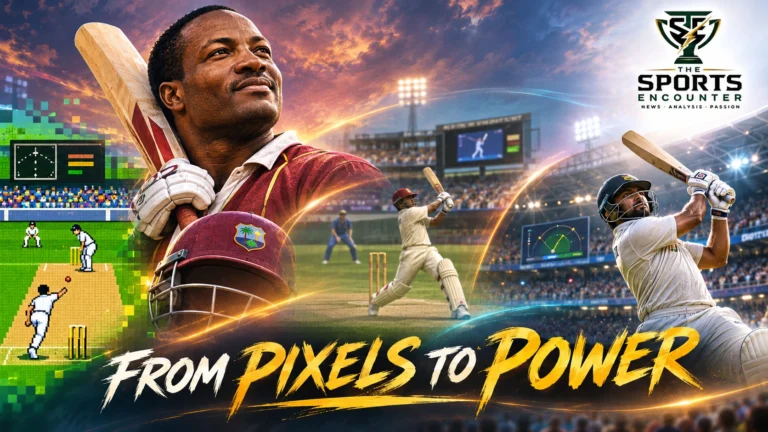
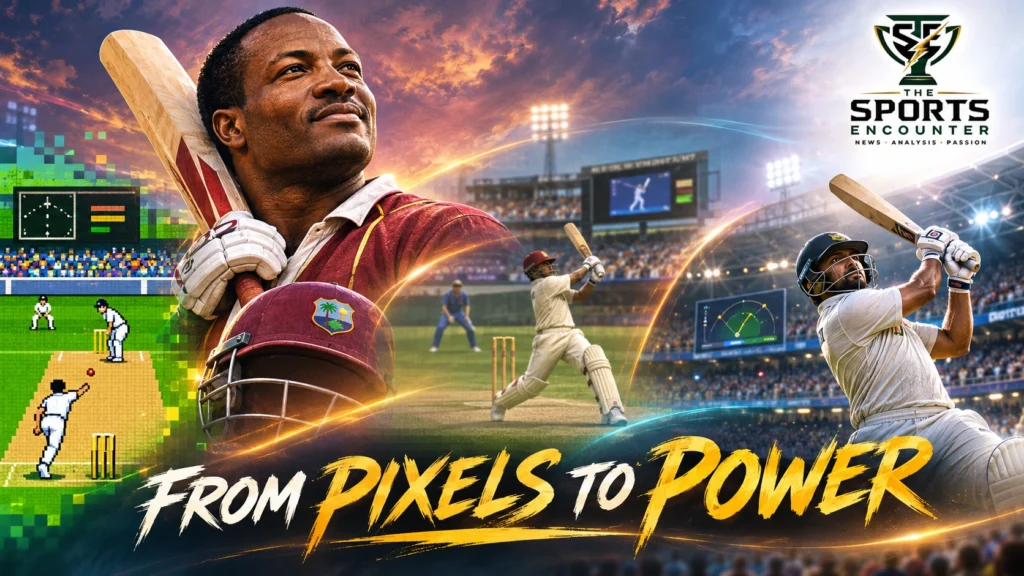
KARACHI, Pakistan, November 12, 2026: In 1996, you did not need photorealistic graphics, motion-captured batting or an expensive gaming console to feel like Brian Lara. A television, a Sega Mega Drive and a handful of colorful pixels were enough. The Caribbean legend’s computerized counterpart walked to the crease, the bowler began his run-up, and suddenly the fate of a virtual Test match rested in your hands. Thirty years later, Cricket 26 offers detailed stadiums, sophisticated batting mechanics, squad management and online competition. The difference is extraordinary, but the question remains: has modern cricket gaming managed to recreate the magic of those simpler days?
From Brian Lara Cricket ’96 and EA Sports Cricket 07 to Don Bradman Cricket, Cricket 24 and Cricket 26, the genre has undergone several transformations. Players have moved from controlling tiny animated figures to managing international careers, building squads and competing against opponents worldwide. Graphics have improved beyond recognition, yet cricket games continue to face the same fundamental challenge: making a sport built around patience, anticipation and split-second decisions feel authentic and entertaining.
TL;DR: Thirty Years of Cricket Gaming
- 1996: Brian Lara Cricket ’96 brought updated international and county teams, historical matches and multiplayer competition to the 16-bit era.
- Late 1990s: Brian Lara Cricket ’99 and EA’s cricket titles pushed the genre toward 3D graphics, television-style presentation and commentary.
- 2005–2007: The competition between EA Sports and Codemasters produced memorable games, including EA Cricket 07 and Brian Lara International Cricket 2007.
- 2014: Don Bradman Cricket 14 helped redefine batting, bowling and career progression.
- 2019–2024: Cricket 19, Cricket 22 and Cricket 24 expanded licensing, women’s cricket, stadium detail, customization and online play.
- 2025–2026: Cricket 26 represents the modern generation, with management careers, enhanced gameplay and deeper team-building features.
Cricket Video Games Timeline: From Brian Lara ’96 to Cricket 26
Cricket gaming existed before Lara ’96, including Graham Gooch’s Test Cricket in the 1980s and the original Brian Lara Cricket in 1994. But Lara ’96 provides a particularly memorable starting point for tracing the evolution of the modern cricket gaming experience.
| Year | Video game | What defined its era |
|---|---|---|
| 1996 | Brian Lara Cricket ’96 | 16-bit presentation, updated teams, classic matches and multiplayer |
| 1996–1997 | EA Sports Cricket 96 and 97 | Growing competition in PC cricket simulation |
| 1998–1999 | Brian Lara Cricket ’99 | 3D-era graphics and broadcast-style commentary |
| 2002–2005 | EA Cricket 2002, 2004 and 2005 | Improving animation, stadiums, match presentation and controls |
| 2005 | Brian Lara International Cricket 2005 | Console-era competition and renewed interest around the Ashes |
| 2006 | EA Sports Cricket 07 | Century Stick batting controls, tournament variety and long-lasting fan appeal |
| 2007 | Brian Lara International Cricket 2007 | Another major step in console-era presentation |
| 2009 | Ashes Cricket 2009 | HD-console-era presentation and Ashes-focused gameplay |
| 2014 | Don Bradman Cricket 14 | New batting and bowling controls, lengthy career mode and community creation tools |
| 2017 | Ashes Cricket | More developed player likenesses, match simulation and career systems |
| 2019 | Cricket 19 | Career progression, expanded customization and modern console gameplay |
| 2021 | Cricket 22 | New-generation visual presentation, licensed competitions and women’s cricket |
| 2023 | Cricket 24 | Expanded licensing, detailed stadiums and cross-platform multiplayer |
| 2025 | Cricket 26 | Management career, enhanced batting and deeper strategic control |
The timeline lists representative milestones rather than every cricket game ever released. Some titles used a year in their name that differed from their actual release year. Cricket 07, for example, arrived in November 2006, while Cricket 26 was released in November 2025.
Story at a glance
Cricket Video Games Timeline: From Brian Lara ’96 to Cricket 26
Cricket gaming existed before Lara ’96, including Graham Gooch’s Test Cricket in the 1980s and the original Brian Lara Cricket in 1994. But Lara ’96 provides a particularly memorable starting point for tracing the evolution of the modern cricket gaming experience.
1996: Brian Lara Cricket Makes a Generation Fall in Love With Gaming
For players who experienced cricket gaming during the 1990s, Brian Lara Cricket ’96 holds a special place.
The Late 1990s: When Cricket Games Began to Look Like Television
The transition from 16-bit consoles to more powerful PCs and the Sony PlayStation changed expectations.
2002–2005: EA Sports Builds the Foundations of Modern Cricket Gaming
EA Cricket 2002, Cricket 2004 and Cricket 2005 formed a significant part of the genre’s transition toward more sophisticated home-computer and console experiences.
2006: Why EA Cricket 07 Became a Cult Favorite
Ask many cricket gamers who grew up playing on PCs during the 2000s which title they remember most fondly, and EA Sports Cricket 07 is likely to enter the conversation.
1996: Brian Lara Cricket Makes a Generation Fall in Love With Gaming
For players who experienced cricket gaming during the 1990s, Brian Lara Cricket ’96 holds a special place.
Developed by Audiogenic and published on the Sega Mega Drive by Codemasters, it built on the original Brian Lara Cricket, which had appeared earlier in the decade.
The 1996 edition included updated teams and player statistics, international matches, English county cricket, a World Cup competition, Test series and classic historical encounters.
It also supported multiplayer competition, allowing friends to share the same screen and settle arguments that might otherwise have lasted an entire afternoon.
The graphics were simple by today’s standards. Batters and fielders appeared as small sprites, the pitch was represented through limited colors and animations, and movement followed recognizable but repetitive patterns.
Yet the game understood something important about cricket.
It gave players decisions to make.
You could select your shots, choose your bowlers, set fields and attempt to build an innings. A mistimed stroke could cost a wicket. A well-placed delivery could produce the satisfaction of dismissing a dangerous batter.
There were limitations, of course. Animation sequences repeated, fielding was constrained by the technology, and the game could not reproduce the subtle mechanics of modern cricket.
But its simplicity also encouraged imagination.
You did not need to see a perfect digital recreation of Lara’s cover drive to believe you had played one.
For context, the real Brian Lara’s career was built around precisely the qualities that games struggled to reproduce: patience, placement and extraordinary concentration. TSE’s retrospective on Lara’s match-winning influence against South Africa offers a reminder of the player behind the gaming franchise.
What Brian Lara ’96 Actually Introduced
It is important not to overstate the game’s originality.
Brian Lara ’96 was an updated version of an existing cricket game, not the invention of computer cricket. The broader franchise had already existed since 1994.
What made the 1996 edition memorable was its combination of accessible gameplay, licensed star appeal and the ability to recreate major cricket competitions on home gaming hardware.
Its importance lies less in any single technical breakthrough than in the experience it offered to a generation of fans.
The Late 1990s: When Cricket Games Began to Look Like Television
The transition from 16-bit consoles to more powerful PCs and the Sony PlayStation changed expectations.
For the first time, developers could begin moving beyond flat-looking stadiums and sprite-based action toward three-dimensional representations of the game.
Brian Lara Cricket ’99 became one of the notable releases of that period.
It introduced 3D-accelerated graphics to the Lara series and featured commentary from Geoffrey Boycott and Jonathan Agnew.
That commentary mattered enormously.
For cricket fans, familiar voices are part of the experience. They connect the action on the field to the atmosphere of television and radio coverage.
Hearing established commentators while playing on a computer helped make the match feel less like an arcade contest and more like an actual cricket broadcast.
Meanwhile, EA Sports was building its own cricket franchise, releasing titles such as Cricket 96, Cricket 97 and ICC Cricket World Cup England 99.
The competition between publishers was important because it encouraged experimentation with match presentation, player animation and controls.
Cricket gaming was gradually moving from a niche digital pastime toward a more recognizable sports simulation genre.
2002–2005: EA Sports Builds the Foundations of Modern Cricket Gaming
EA Cricket 2002, Cricket 2004 and Cricket 2005 formed a significant part of the genre’s transition toward more sophisticated home-computer and console experiences.
Improving hardware allowed developers to create more convincing stadiums, smoother animation, larger player models and more detailed match interfaces.
Batting became increasingly concerned with timing, footwork and shot selection rather than simply choosing a direction.
Bowling controls began offering more opportunities to experiment with line, length, pace and movement.
Cricket 2005 arrived during a memorable year for the sport, when England and Australia contested one of the most celebrated Ashes series.
The atmosphere surrounding that rivalry helped demonstrate the appeal of digitally recreating real sporting drama.
In the real 2005 Ashes, the tension of a two-run victory at Edgbaston offered the kind of finish that gamers dream of experiencing for themselves. TSE revisited that historic contest in its detailed account of England’s 2005 Ashes triumph.
Games could imitate the atmosphere, scoreboards and player identities, but recreating the uncertainty of real cricket was much harder.
That difficulty would become central to the next generation of games.
2006: Why EA Cricket 07 Became a Cult Favorite
Ask many cricket gamers who grew up playing on PCs during the 2000s which title they remember most fondly, and EA Sports Cricket 07 is likely to enter the conversation.
Released in November 2006 for Windows and PlayStation 2, it arrived with an innovative batting control system called Century Stick.
The system was designed to give players greater control over foot movement, shot direction, power and selection.
It also offered licensed squads, Ashes content, county competitions, Australian domestic cricket and faster options for limited-overs play.
Players could spend an evening attempting a five-day Test or switch to an attacking Twenty20 match.
For its time, that flexibility was impressive.
The Game That Refused to Disappear
Cricket 07’s longevity is arguably one of the most interesting stories in cricket gaming history.
EA did not release another major cricket title for home consoles and PCs after it.
Yet the game’s community continued modifying and updating the experience long after its commercial life would ordinarily have ended.
Fan-created patches, roster changes, uniforms and other modifications helped players maintain their connection with the title.
This was not an official continuation by EA. It was evidence of a community unwilling to abandon a familiar game.
The appeal was not entirely about realism.
Cricket 07 was approachable. Its controls could be learned without an extensive tutorial, its matches could be played at different speeds, and its systems were familiar enough to encourage experimentation.
For a generation of cricket fans, that combination mattered more than graphical sophistication.
Players did not necessarily want the most technically accurate simulation. They wanted a game that was enjoyable, recognizable and responsive.
2007–2010: Brian Lara Returns, and Cricket Enters the HD Console Era
Codemasters continued developing the Lara franchise with Brian Lara International Cricket 2005 and Brian Lara International Cricket 2007.
The 2007 game extended the series into a generation of more powerful consoles, bringing improvements in graphical detail and presentation.
Ashes Cricket 2009 followed as another significant release, taking advantage of the PlayStation 3 and Xbox 360 generation.
International Cricket 2010 continued that approach, seeking to make batting, bowling and match presentation feel more authentic.
By this point, gaming audiences expected more than improved player models.
They wanted fielding that responded logically, batting animations that reflected actual strokes and bowling systems that rewarded strategy.
Cricket, however, posed unusual technical challenges.
Unlike many sports games, much of cricket’s action takes place in short, specialized sequences. Each delivery involves the bowler, batter, ball, wicketkeeper, fielders, pitch conditions and potentially several different outcomes.
When any one of those elements behaves unnaturally, the illusion of realism can disappear immediately.
A convincing cricket game therefore requires more than detailed textures or realistic stadium lighting.
It requires believable interactions between the ball, players and match situation.
2014: Don Bradman Cricket Changes the Rules
Don Bradman Cricket 14 marked an important turning point.
Developed by Big Ant Studios, it launched for PlayStation 3 and Xbox 360 in April 2014, with other platform releases following.
The game offered a detailed career mode, a Cricket Academy for user-generated players and teams, and a substantially different approach to batting and bowling.
Its controls emphasized analog-stick input and more deliberate decisions.
Rather than offering success primarily through familiar button combinations, Don Bradman Cricket 14 placed greater responsibility on the player to judge delivery length, choose a stroke and time the shot.
Bowling likewise required control over line and length.
That made the game more demanding for some newcomers, but it also offered players a different sense of accomplishment.
A carefully constructed half-century or a spell of tight bowling felt earned rather than automatic.
The Cricket Academy was equally important.
It allowed the community to create and share players and teams, helping address limitations caused by licensing arrangements.
The focus began shifting away from merely reproducing a televised match toward giving the player meaningful control over an entire cricketing career.
2017–2021: Big Ant Makes Cricket Simulation More Ambitious
Don Bradman Cricket 17, Ashes Cricket and Cricket 19 continued the development of the genre.
With improvements in animation, player creation and career modes, modern cricket games increasingly asked players to think beyond a single match.
It became possible to develop a virtual cricketer, work through a career, improve performance and experience different levels of competition.
For many players, this created a deeper connection with the game.
Instead of selecting an established international superstar for every match, they could build their own.
Cricket 19 expanded that approach, while Ashes Cricket emphasized officially licensed competition and recognizable international rivalries.
The important development was the integration of career progression with increasingly realistic on-field action.
Modern cricket gaming was no longer just about winning a World Cup in one sitting.
It was also about the decisions, setbacks and progress that led to international success.
2021–2024: Better Graphics, Women’s Cricket and Global Competitions
Cricket 22, released in December 2021, helped usher the series into a newer generation of gaming hardware.
Its improvements extended beyond visuals.
Big Ant introduced revised bowling and fielding controls, expanded career features and a broader selection of licensed competitions.
These included the Ashes, Australia’s Big Bash leagues, The Hundred and the Caribbean Premier League.
The representation of women’s cricket was also central to the game’s development.
Both men’s and women’s competitions were incorporated into the experience, reflecting the growing importance of women’s cricket in the international game.
Cricket 24, released on October 5, 2023, continued the expansion.
Its official content included more international teams, professional competitions and over 50 detailed stadiums.
Cross-platform multiplayer enabled players on different supported gaming systems to compete against one another.
Customization tools also allowed communities to create and share additional cricket content.
That development had consequences beyond the game itself.
Cricket fans follow an increasingly diverse calendar of tournaments, from traditional Tests and one-day internationals to franchise T20 competitions and shorter formats. TSE has examined this changing landscape in its analysis of whether tri-nation tournaments can help revive ODI cricket.
Modern developers must accommodate that variety while still making each format feel distinctive.
Mobile Cricket Games: How Smartphones Changed the Audience
The evolution of cricket gaming cannot be understood through PCs and consoles alone.
Smartphones transformed how millions of people could access digital entertainment.
Players no longer needed a dedicated console or high-end computer to enjoy a cricket game.
Mobile titles such as the Real Cricket series brought batting, bowling and tournament modes to handheld devices.
Nautilus Mobile developed the Real Cricket franchise across successive generations, from Real Cricket 14 to later editions including Real Cricket 24.
Mobile gaming introduced a different set of priorities.
Controls had to work on touchscreens. Matches had to fit shorter playing sessions. Interfaces needed to remain readable on small displays.
Developers also had to balance visual ambition against battery life, device performance and storage limitations.
The result was a parallel branch of cricket gaming.
Console and PC titles increasingly pursued detailed simulation, while mobile games emphasized accessibility, portability and quick engagement, even as their mechanics became more sophisticated.
For fans who wanted to play a few overs during a commute or break, mobile cricket offered something traditional console games could not.
Cricket 26: The Next Step Is About Decisions, Not Just Graphics
Cricket 26 arrived in November 2025, with Big Ant Studios and Nacon expanding the systems that define modern cricket simulation.
The game features enhanced batting mechanics, an expanded Ashes mode, Pro Team content and a new Management Career Mode.
Players can manage squads, establish batting orders, develop talent, oversee finances and make tactical decisions beyond the boundary rope.
That changes the relationship between the player and the virtual team.
In Lara ’96, the central fantasy was performing as a famous cricketer or guiding a national side to victory.
In Cricket 26, players can also occupy the role of selector, strategist and team manager.
The game’s Academy tools continue to allow the creation and sharing of stadiums, players and teams.
Its expanded systems are outlined on the official Big Ant Studios Cricket 26 website.
However, more features do not automatically make a game more enjoyable.
The quality of the experience still depends on whether the controls respond consistently, computer-controlled opponents make believable decisions, and the ball behaves convincingly.
Graphics may create the first impression, but gameplay determines whether players return.
Brian Lara ’96 vs Cricket 26: What Has Actually Changed?
| Feature | Brian Lara Cricket ’96 | Cricket 26 |
|---|---|---|
| Visual presentation | 16-bit sprites and simple stadium designs | Detailed 3D players, stadiums, animations and presentation |
| Batting | Relatively simple controls and preset animations | Enhanced shot placement and more detailed input systems |
| Bowling | Basic tactical choices within limited controls | Expanded delivery control and defensive strategies |
| Teams | International and English county teams | Broader licensed and community-created content |
| Career progression | Competition-focused structure | Player career and management career systems |
| Multiplayer | Local multiplayer on supported hardware | Local and online competition |
| Customization | Basic team-editing features | Player, team and stadium creation and sharing |
| Strategic depth | Shot selection, bowling and field placement | On-field tactics plus squad and organizational decisions |
| Biggest appeal | Accessible, memorable cricket action | Broader simulation and management experience |
Thirty years of technological progress have transformed the scale of cricket games.
Yet some of the most important mechanics remain recognizable.
The batter must still judge the delivery. The bowler must still outthink the batter. Captains must still consider the field, match situation and available resources.
Technology has complicated those decisions, but it has not replaced them.
The Graphics Revolution: From Pixels to Photorealism
Perhaps the clearest visual comparison is between a Lara ’96 screenshot and a modern Cricket 26 match.
In the older game, player models consisted of small animated figures, crowd detail was minimal and pitches looked like relatively simple colored surfaces.
Modern graphics engines allow developers to model stadium structures, player equipment, lighting and movement with far greater detail.
Camera angles increasingly resemble television coverage.
Score overlays have become more sophisticated, and replays can present dismissals and boundaries with dramatic close-ups.
But the largest improvement is not merely visual.
It is the integration of graphics with gameplay.
A believable front-foot drive requires the animation, bat movement, ball trajectory and timing system to work together.
If the ball passes through the bat, if an attempted defensive shot becomes an unnatural attacking stroke, or if fielders move without believable momentum, detailed graphics cannot hide the problem.
That is why the evolution of cricket gaming should be judged through more than screenshots.
The genuine breakthrough occurs when visual realism and responsive controls reinforce each other.
Five Things Modern Cricket Games Still Struggle to Recreate
| Real cricket element | Why simulation remains difficult |
|---|---|
| Bat-ball contact | Timing, bat angle, pitch movement and animation must synchronize convincingly |
| Fielding intelligence | Computer-controlled fielders must judge catches, throws, positioning and risk |
| Test match patience | Long periods of defensive cricket must remain strategically interesting |
| Captaincy decisions | Bowling changes and field settings must respond logically to match conditions |
| Unpredictable match drama | Games need natural variation without outcomes feeling random or unfair |
Test cricket presents a particularly difficult design challenge.
In the real sport, a session without a wicket can be gripping because the audience understands the tactical battle taking place.
In a video game, maintaining that tension requires intelligent bowling plans, meaningful defensive controls and realistic scoring patterns.
TSE’s exploration of how Test match duration has changed highlights a wider issue facing cricket: the relationship between playing time, audience expectations and the rhythm of the sport.
A convincing simulation needs to respect that rhythm without making players feel trapped in an unnecessarily repetitive experience.
The Licensing Problem: Why Cricket Games Cannot Always Recreate Real Teams
Another challenge is the difference between real-world cricket and the rights available to game developers.
Modern cricket involves national boards, domestic leagues, franchise competitions, governing bodies, player image rights and commercial agreements.
Licensing arrangements can determine whether a game includes official team names, authentic uniforms, accurate player likenesses and real stadiums.
Some competitions may be fully represented while others require generic alternatives or community-created replacements.
That explains the continuing importance of tools such as Big Ant’s Academy.
For fans, community-created content can help fill gaps when official rights are incomplete.
However, user-generated content is not equivalent to an official license, and its accuracy and availability can vary.
Licensing also means that the number of included teams is not necessarily a reliable measure of a game’s quality.
A smaller game with responsive controls may offer more satisfying cricket than a larger one whose mechanics feel inconsistent.
Which Cricket Game Changed the Genre the Most?
There is no single objectively correct answer, because each generation addressed a different problem.
Brian Lara ’96 helped make cricket gaming accessible and memorable.
Brian Lara Cricket ’99 contributed to the move toward three-dimensional presentation and broadcast commentary.
EA Cricket 07 offered a compelling combination of controls, formats and longevity.
Don Bradman Cricket 14 introduced a different level of control and career simulation.
Cricket 22 and Cricket 24 expanded licensing, representation, visual presentation and online play.
Cricket 26 has pushed further into management and strategic systems.
| Category | Standout title or era | Editorial assessment |
|---|---|---|
| 16-bit nostalgia | Brian Lara Cricket ’96 | A defining experience for fans who discovered cricket gaming in the 1990s |
| Early 3D presentation | Brian Lara Cricket ’99 | An important transition toward a televised cricket experience |
| Accessible PC-era gameplay | EA Cricket 07 | Remarkable longevity and a lasting community following |
| Gameplay reinvention | Don Bradman Cricket 14 | A major change in batting, bowling and career control |
| Modern licensing and presentation | Cricket 24 | Broader official representation and multiplayer possibilities |
| Expanded cricket management | Cricket 26 | More control over squad development and off-field strategy |
These are editorial judgments about each title’s contribution, not sales rankings or a claim that one game is universally superior.
What Cricket Gaming Still Owes Brian Lara
There is a reason Brian Lara remains such a powerful symbol of cricket gaming.
His name represented imagination and ambition at a time when developers had only a fraction of today’s processing power.
His real career provided the perfect inspiration: a batter capable of extraordinary scores, breathtaking stroke play and innings that transformed matches.
Those who remember Lara’s international career will recognize that connection in TSE’s account of the dramatic ODI that denied him a winning international farewell.
The contrast between the digital character and the real cricketer was enormous, yet the ambition was the same.
Players wanted to step into the shoes of their heroes.
That aspiration has survived every console generation.
Today, realistic batting animations and detailed stadiums make the fantasy more convincing. Career modes allow players to create their own stories. Online multiplayer adds competition beyond the living room.
But none of those developments changes the emotional appeal of reaching a century, taking the final wicket or winning a last-ball thriller.
What Comes Next for Cricket Video Games?
The next major advances may be less visible than the graphical revolution of the past three decades.
More responsive fielding intelligence, smarter opposition tactics and improved ball physics could have a greater effect on gameplay than another increase in visual detail.
Artificial intelligence could potentially help opponents adapt to a player’s batting patterns or bowling preferences. However, such features should not be treated as confirmed developments for future titles without official announcements.
Another opportunity lies in making different cricket formats feel genuinely distinct.
A five-day Test should reward patience, consistency and tactical adjustment.
A T20 match should create pressure around scoring rates, field restrictions and risk-taking.
Shorter competitions should have their own rhythm rather than simply feeling like compressed versions of the same match.
Real-world cricket offers a vast archive of memorable moments, including the games collected in TSE’s A Celebration of 5,000 ODIs series. Historical scenarios inspired by such moments could offer compelling challenges if developers recreate the conditions and cricketing decisions accurately.
The ultimate cricket game would combine the responsiveness of an accessible arcade experience with the tactical depth and unpredictability of the real sport.
Continue the Cricket Story
Frequently Asked Questions About Cricket Video Games
Was Brian Lara Cricket ’96 the first cricket video game?
No. Cricket video games existed long before 1996. The original Brian Lara Cricket appeared in 1994, while earlier cricket titles included Graham Gooch’s Test Cricket. Lara ’96 was an updated entry in the Brian Lara series.
What platforms was Brian Lara Cricket ’96 released on?
Brian Lara Cricket ’96 was released for the Sega Mega Drive/Genesis and Amiga. It was known as Shane Warne Cricket in some markets.
When did EA Sports Cricket 07 actually release?
EA Sports Cricket 07 was released in November 2006 for Windows and PlayStation 2, despite the year in its title.
Why is EA Cricket 07 still remembered?
Its accessible gameplay, Century Stick batting controls, variety of competitions and long-lasting modification community helped maintain interest well beyond its original release.
Which game introduced the Don Bradman career experience?
Don Bradman Cricket 14 introduced a detailed career mode in which players could guide a created cricketer from early development toward international competition.
When was Cricket 24 released?
Cricket 24 was released on October 5, 2023, with expanded licensing, detailed stadiums, career systems and cross-platform multiplayer.
Is Cricket 26 available in 2026?
Yes. Cricket 26 was released in November 2025. Its features include Management Career Mode, expanded Ashes content, Pro Team and enhanced on-field controls.
Are mobile cricket games part of the same evolution?
Yes. Games such as the Real Cricket series helped bring cricket simulation to smartphones, making the genre accessible beyond traditional computers and consoles.
Thirty Years Later, Cricket Gaming Still Comes Down to One Ball
Imagine handing a modern Cricket 26 controller to someone whose last cricket gaming experience was Brian Lara ’96.
The stadiums would look almost real. The players would move differently. The controls would require adjustment, and the range of career and management options might seem overwhelming.
But once the bowler reached the crease and released the ball, the essential challenge would be familiar.
Watch the delivery. Judge its length. Choose your shot.
Get it right, and the ball might race to the boundary.
Get it wrong, and your innings could be over.
Thirty years of technological progress have changed almost everything about the way cricket games look, sound and function.
They have not changed the reason we play them.
We still want to hit the winning runs, take the decisive wicket and experience the extraordinary feeling that, for a few unforgettable moments, we are the cricketers we grew up watching.
And perhaps that is why a handful of pixels from 1996 can still compete with the most sophisticated cricket simulation of 2026.