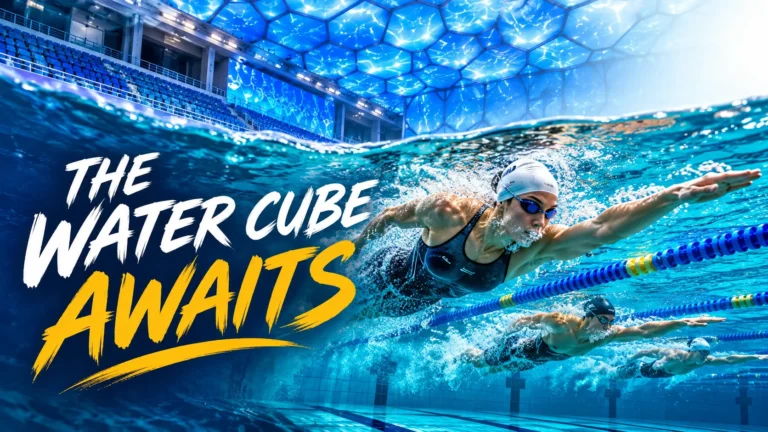
BEIJING, China, November 28, 2026: Eighteen years after Michael Phelps won eight Olympic gold medals at the Water Cube, the Chinese capital is preparing for another extraordinary examination of human speed in the pool. Beijing 2026, the 18th edition of the World Aquatics Swimming Championships (25m), opens on December 1 with several of the world’s fastest swimmers arriving on the back of record-breaking performances.
More than 1,000 athletes from over 200 countries are expected to compete for 45 titles across six days, ending on December 6. The United States returns as the dominant nation from the previous edition in Budapest, but the entry lists suggest that the race for gold in several marquee events could come down to hundredths of a second.
Key Takeaways
- The Water Cube hosted the swimming competition at the 2008 Summer Olympics before being adapted for curling at the 2022 Winter Olympics.
- According to the official World Aquatics schedule announcement, morning heats begin at 10 a.m.
- The 2024 edition produced 30 world records, and the United States won 18 of the 45 titles.
- The World Aquatics prize announcement guarantees a minimum purse of $2,025,000.
Three contests stand out before a single starting signal has sounded. China’s Xu Jiayu and South Africa’s Pieter Coetze are separated by 0.06 seconds in the men’s 50m backstroke entry times. 20-year-old American Maximus Williamson has a marginally faster entry than Olympic champion Léon Marchand in the 200m individual medley, while Kate Douglass and Gretchen Walsh share the women’s 50m freestyle world record.
Story at a glance
Beijing 2026 schedule, venue and competition format
The Water Cube hosted the swimming competition at the 2008 Summer Olympics before being adapted for curling at the 2022 Winter Olympics. Its return to international championship swimming brings a different test from the one that confronted Phelps and his contemporaries: races will take place in a 25-meter pool rather than the Olympic 50-meter format.
Five battles that could define Beijing 2026
The official entry list dated November 27 provides an unusually useful guide to the championship’s competitive balance. Entry times are qualifying or submitted performances from different meets, not predictions or necessarily current personal bests. The following comparisons illustrate how close some of the leading contenders are before racing begins.
Can the championship surpass Budapest’s record harvest?
The 2024 edition produced 30 world records, and the United States won 18 of the 45 titles. Canada finished second on the medal table with four golds, followed by Australia with two. America’s share of gold medals was 40 percent, leaving 27 titles for the rest of the field.
Prize money and Pakistan’s three-swimmer contingent
The World Aquatics prize announcement guarantees a minimum purse of $2,025,000. Individual and relay event winners receive $10,000 per event, and a world-record bonus of $25,000 is available. A swimmer who wins the same race at all three 2026 World Cup stops and then takes the world title can earn a further $15,000 Double Crown bonus.
Beijing 2026 schedule, venue and competition format
The Water Cube hosted the swimming competition at the 2008 Summer Olympics before being adapted for curling at the 2022 Winter Olympics. Its return to international championship swimming brings a different test from the one that confronted Phelps and his contemporaries: races will take place in a 25-meter pool rather than the Olympic 50-meter format.
Beijing 2026 will award medals in 21 men’s events, 21 women’s events and three mixed relays. The program covers freestyle, backstroke, breaststroke, butterfly and individual medley, with individual distances ranging from 50 to 1,500 meters. China previously hosted the short-course championships in Shanghai in 2006 and Hangzhou in 2018.
According to the official World Aquatics schedule announcement, morning heats begin at 10 a.m. Beijing time throughout the meet. Evening sessions start at 7 p.m. for the first five days and at 6 p.m. on the final day. World Aquatics has also published territory-specific viewing information on its website; broadcast availability varies by country.
| Session | Beijing | Pakistan | London | New York |
|---|---|---|---|---|
| Heats, Dec 1-6 | 10 a.m. | 7 a.m. | 2 a.m. | 9 p.m. (previous day) |
| Evening, Dec 1-5 | 7 p.m. | 4 p.m. | 11 a.m. | 6 a.m. |
| Evening, Dec 6 | 6 p.m. | 3 p.m. | 10 a.m. | 5 a.m. |
The opening night includes the women’s 400m freestyle, both 200m individual medleys, the men’s 1500m freestyle and the men’s and women’s 4x100m freestyle relays. The December 2 medal program includes both 100m backstroke and 50m butterfly finals, the women’s 800m freestyle and mixed 4x50m medley relay. Both 100m freestyle titles are scheduled for December 3. On December 4, the 200m breaststroke, 50m backstroke and 100m individual medley titles will be decided, alongside three other finals. December 5 brings both 100m butterfly and 400m individual medley finals, the men’s 800m freestyle and mixed 4x100m medley relay. The final evening features the 50m freestyle, 50m breaststroke, 200m freestyle, 200m backstroke and 4x100m medley relay finals for both sexes. The program remains subject to change.
Five battles that could define Beijing 2026
The official entry list dated November 27 provides an unusually useful guide to the championship’s competitive balance. Entry times are qualifying or submitted performances from different meets, not predictions or necessarily current personal bests. The following comparisons illustrate how close some of the leading contenders are before racing begins.
Douglass and Walsh: America’s sprint rivalry
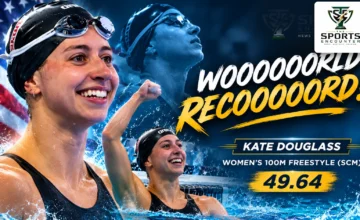
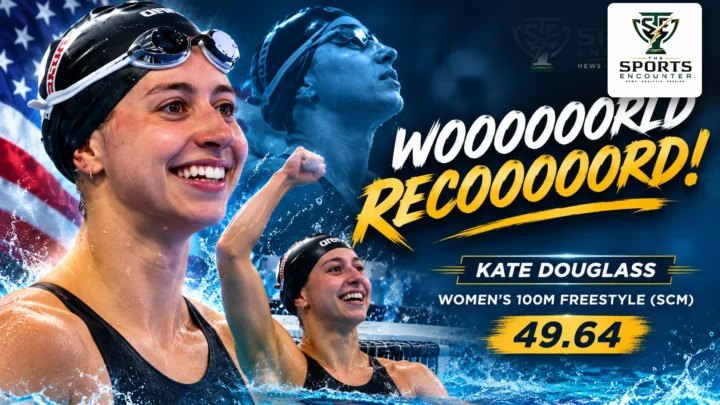
Walsh collected seven gold medals in Budapest in 2024, but her compatriot Douglass arrives at Beijing 2026 with the outright 100m freestyle world record of 49.64 and a share of the 50m mark at 22.75. Both swimmers are entered in both events, making their domestic rivalry an international attraction.
As our analysis of Douglass’ Westmont record showed, her improved opening speed was instrumental in her latest breakthrough. The Dutch swimmer Marrit Steenbergen is another serious challenger, with a 100m entry of 50.32. Walsh also leads the submitted times in the 50m and 100m butterfly and 100m individual medley.
Xu and Coetze: Beijing 2026 could settle a record rivalry
Coetze established a men’s 50m backstroke world record of 22.09 in Tashkent in October. Xu responded with 22.03 in Beijing later that month. The championship offers an opportunity to compare the two in the same pool, under identical race conditions.
Coetze’s progress was already evident during the Astana leg of the Swimming World Cup. In a short-course 50m backstroke race, the start and single turn offer two major opportunities to gain an advantage underwater. A small difference in wall execution could erase the 0.06-second separation between the leading entries.
Marchand faces an emerging American challenger
Marchand owns the men’s 200m individual medley world record of 1:48.88, yet Williamson heads the Beijing entry list at 1:49.70, three hundredths faster than the Frenchman’s submitted 1:49.73. That does not make Williamson the outright favorite, but it gives the opening night’s medley final an added dimension.
Marchand is also entered in the 200m butterfly, 200m breaststroke and 400m individual medley. His versatility will be tested by a concentrated program, particularly when multiple disciplines require different race preparation and recovery strategies.
Jack Alexy and the race beneath 45 seconds
Alexy’s 44.64 world record at the American trials lowered the men’s 100m freestyle standard by two tenths. Egor Kornev arrives with a 44.84 entry, while France’s Maxime Grousset and American Chris Guiliano are both listed at 45.17. Canada’s Josh Liendo follows at 45.30.
China’s Olympic long-course champion Pan Zhanle is entered at 46.20. As our Asian Games swimming coverage demonstrated, Pan’s long-course accomplishments are formidable, but his submitted short-course time places him behind several rivals. Beijing 2026 offers a different measure of his sprinting skills.
Yu Zidi and the next generation of Chinese swimming
Fourteen-year-old Yu Zidi is entered in the 200m butterfly and both the 200m and 400m individual medley. Her older compatriot Yu Yiting leads the 400m medley entries at 4:22.74, ahead of Ireland’s Ellen Walshe at 4:22.97. Yu Zidi’s Asian Games breakthrough came in a 50-meter pool, so Beijing 2026 will provide a useful comparison of her championship form across both pool formats.
Continue the Swimming Story
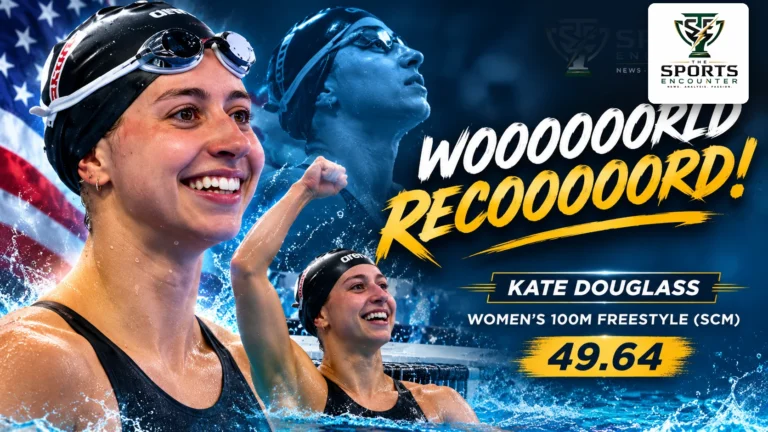 SwimmingKate Douglass Smashes Her Own 100m Freestyle World Record With Historic 49.64 in Westmont
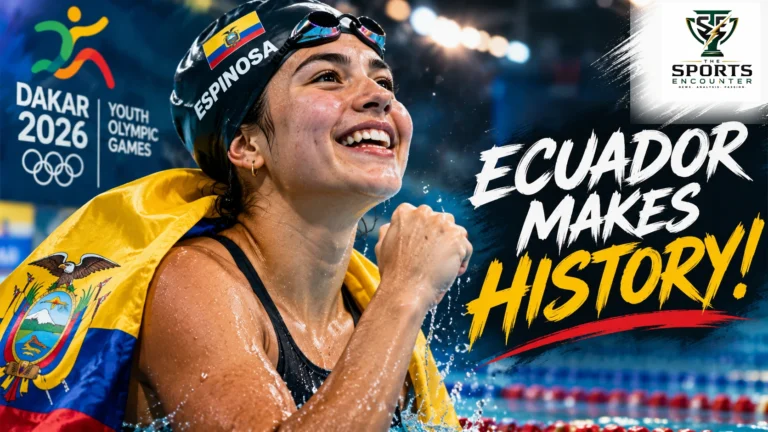 SwimmingElvira Espinosa Wins Dakar 2026’s First Gold as Ecuador Celebrates Historic Olympic Swimming Breakthrough
 Swimming2027 Swimming World Cup: Berlin, Paris and London to Award 36 Direct LA28 Olympic Qualification Places
Yu Zidi’s rapid development has already featured in TSE’s historical analysis of the women’s 200m individual medley. Those long-course performances should not be confused with her short-course entry times. At Beijing 2026, her progress against established international swimmers will be more informative than any expectation that she must win a medal.
Elsewhere at Beijing 2026, Australia’s Lani Pallister leads the women’s 400m freestyle entries with 3:51.87, just 1.62 seconds outside Summer McIntosh’s world record. The men’s 50m freestyle presents another American showdown: Caeleb Dressel and Alexy are separated by only 0.02 seconds on the entry list, at 20.57 and 20.59 respectively.
Can the championship surpass Budapest’s record harvest?
The 2024 edition produced 30 world records, and the United States won 18 of the 45 titles. Canada finished second on the medal table with four golds, followed by Australia with two. America’s share of gold medals was 40 percent, leaving 27 titles for the rest of the field.
Beijing 2026 arrives after another exceptional season, but comparisons must account for the distinction between championship records and absolute world records. Douglass’ 49.64, for example, is 0.67 seconds quicker than Walsh’s Budapest championship record of 50.31. A swimmer could break the championship record without approaching Douglass’ world mark.
Short-course swimming rewards underwater acceleration and efficient turns. A 100m race includes three turns compared with one in a long-course pool. That difference explains why some Olympic stars face particularly strong competition from short-course specialists. It also makes split times worth following alongside the finishing order.
Prize money and Pakistan’s three-swimmer contingent
The World Aquatics prize announcement guarantees a minimum purse of $2,025,000. Individual and relay event winners receive $10,000 per event, and a world-record bonus of $25,000 is available. A swimmer who wins the same race at all three 2026 World Cup stops and then takes the world title can earn a further $15,000 Double Crown bonus.
Pakistan has three swimmers listed for Beijing 2026, each entered in two individual races. For a young contingent, the opportunity to improve entry times and gain experience in a world championship environment is a meaningful benchmark.
| Swimmer | Events and entry times |
|---|---|
| Rayan Awan | 50m breaststroke (30.05); 100m breaststroke (1:07.83) |
| Iman Mir | 50m freestyle (29.03); 50m backstroke (35.35) |
| Azlan Sohail | 100m freestyle (51.84); 200m freestyle (1:53.74) |
The Water Cube’s history will provide the backdrop, but Beijing 2026 will be judged on the races it produces. With established world champions facing increasingly fast challengers, the most revealing moments may come at the walls, where fractions of a second can separate a gold medal from the rest of the podium.